
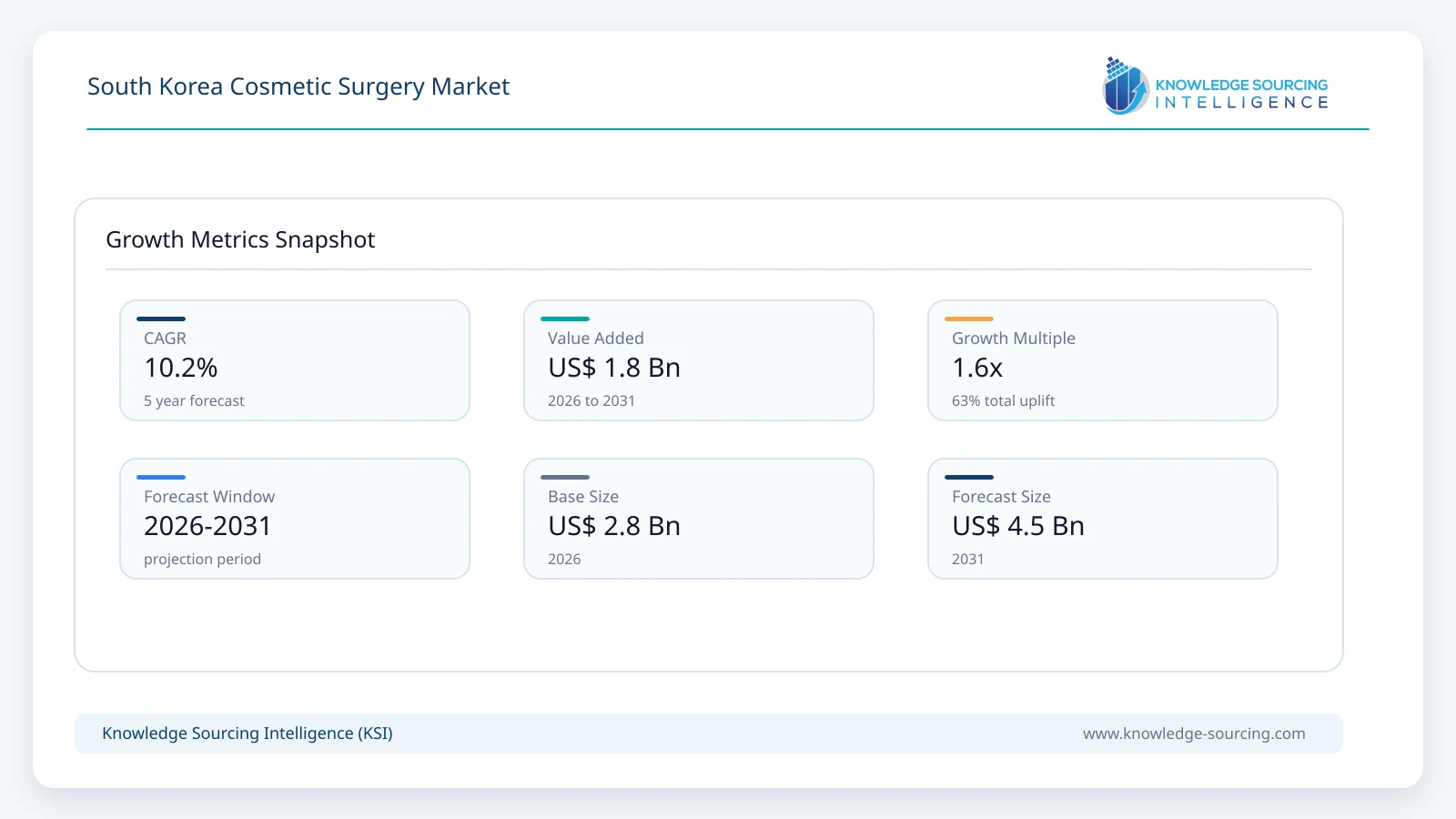
The South Korea Cosmetic Surgery Market is anticipated to grow at an estimated CAGR of 10.2%, from USD 2.80 billion in 2026 to USD 4.55 billion by 2031.
Highlights:
- 1Surgical procedures account for approximately 53% of South Korea cosmetic-surgery revenue in 2026.
- 2Face and head treatments generate approximately 52% of market value in 2026, led by eyelid, rhinoplasty, contouring and facial rejuvenation demand.
- 3International patients contribute approximately 22% of market revenue in 2026 despite representing a much smaller share of total procedure volume.
- 4Seoul accounts for approximately 74% of national cosmetic-surgery revenue in 2026, reflecting the concentration of premium clinics and foreign-patient demand.
- 5Non-surgical physician-delivered procedures are projected to expand at approximately 12.0% annually through 2031.
- 6South Korea had an estimated 2,808 plastic surgeons in the 2024 ISAPS survey, placing it fifth globally by surgeon count.
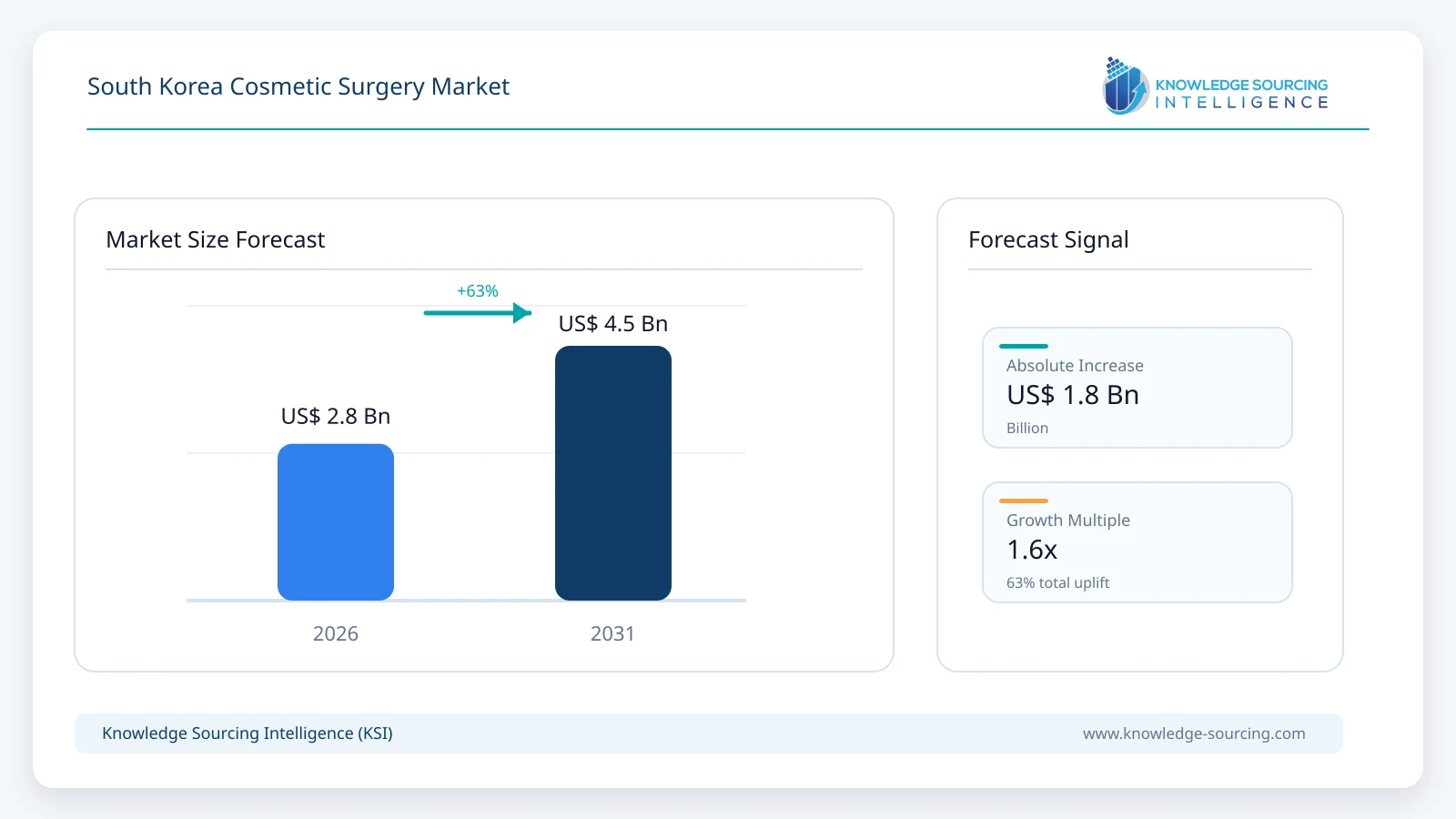
The South Korea cosmetic surgery market covers elective aesthetic services delivered by licensed medical providers, including blepharoplasty, rhinoplasty, facial contouring, facelift and anti-aging surgery, breast procedures, liposuction and body contouring, fat grafting, hair transplantation and selected reconstructive-adjacent procedures performed primarily for cosmetic outcomes. It also includes physician-delivered minimally invasive and non-surgical aesthetics such as botulinum toxin injections, dermal fillers, thread lifting, energy-based tightening, laser or light-based rejuvenation and other clinic-administered procedures that compete directly with surgery for the same aesthetic treatment budget.
South Korea's supply base is unusually deep relative to its population. The 2024 International Society of Aesthetic Plastic Surgery survey estimated 2,808 plastic surgeons in the country, the fifth-largest national surgeon base globally. Large multi-specialty aesthetic hospitals coexist with physician-led clinics, dermatology groups and narrower specialty practices. Seoul, particularly Gangnam and Seocho, is the commercial center, but Busan and selected metropolitan areas have developed secondary clusters. The high provider density increases consumer choice and supports specialized sub-markets in facial bone surgery, rhinoplasty, eyelid surgery, revision procedures, body contouring and minimally invasive facial rejuvenation.
International demand has become a major second growth engine. Korea attracted 2.01 million foreign patients in 2025, up sharply from 1.17 million in 2024, while official 2024 foreign-patient data showed plastic surgery among the leading specialties. KHIDI's analysis of overseas-issued credit-card spending found KRW 359.4 billion of 2024 foreign-patient spending at plastic-surgery providers, behind dermatology but well ahead of most other specialties. Subsequent 2026 card-spending data continued to show plastic surgery as a major component of foreign medical expenditure. International revenue is disproportionately valuable because foreign patients commonly bundle higher-ticket facial surgery, breast surgery, body contouring or multiple procedures with interpretation, consultation and post-operative support.
Market Trends
Medical Tourism Is Shifting From Recovery to Structural Growth
The foreign-patient market is no longer simply recovering from the pandemic. The number of international patients more than tripled between 2023 and 2025, reaching 2.01 million, with China, Japan, Taiwan and the United States accounting for large shares of the total. Plastic surgery benefits from this broader medical-tourism funnel because Korea's aesthetic reputation is reinforced by K-beauty, entertainment and social-media exposure. The demand profile is also becoming more diversified. Japanese and Taiwanese patients often travel for shorter facial procedures and minimally invasive treatments, while patients from China, Southeast Asia, North America and the Middle East are more likely to purchase higher-value surgery packages. The end of the special foreign-tourist VAT refund for cosmetic medical services from January 2026 increases the effective price of treatment, but current spending data suggest that demand remains strong enough to absorb part of that change.
Facial Procedures Remain the Core Differentiator
South Korea's competitive advantage remains strongest in facial aesthetics. Double-eyelid surgery, ptosis correction, rhinoplasty, facial contouring, orthognathic procedures, fat grafting and anti-aging surgery are widely offered by specialist clinics, while injectables and energy-based procedures increasingly serve as entry points for younger patients. This creates a treatment ladder in which consumers can move from relatively low-ticket non-surgical procedures into surgery or revision treatment as needs change. Clinics with 3D imaging, detailed facial analysis and multidisciplinary teams can cross-sell multiple procedures while maintaining a single patient relationship. The result is a market in which facial treatments carry both high volume and high strategic importance even as body and breast surgery remain meaningful revenue pools.
AI, Imaging and Digital Consultation Are Changing Patient Acquisition
Digital consultation has become integral to both domestic and international patient acquisition. Clinics increasingly use high-resolution imaging, simulation tools, translated video consultation, AI-assisted facial analysis and online case review to reduce uncertainty before a patient arrives. For international patients, these tools can improve communication around desired outcomes and help clinics prepare preliminary treatment plans before travel. AI cannot substitute for clinical judgment, particularly for facial bone surgery or revision procedures, but it can improve consultation efficiency and documentation. The commercial effect is a shorter conversion funnel, greater ability to serve multilingual patients and more structured follow-up after surgery.
Market Drivers
A Dense Specialist Ecosystem Supports High Procedure Throughput
South Korea's large plastic-surgeon base is a fundamental market driver because it supports specialization, competition and high procedure availability. ISAPS estimated 2,808 plastic surgeons in 2024, close to India's surgeon count despite South Korea having a far smaller population. In Seoul, major providers can maintain dedicated teams for facial contouring, rhinoplasty, breast surgery, liposuction, anti-aging and revision procedures rather than relying on a generalist model. This depth improves referral pathways for complicated cases and creates a high-velocity market for new techniques, implants and devices. It also enables providers to compete on waiting time and package design, which increases conversion among international patients with limited travel windows.
Foreign-Patient Growth Is Expanding the Addressable Revenue Pool
Foreign-patient inflows are expanding faster than the domestic population can. Korea recorded 2.01 million international patients in 2025, and plastic surgery remained one of the most visible medical-tourism specialties. KHIDI's 2024 card-spending analysis recorded KRW 359.4 billion of foreign-patient spending at plastic-surgery providers, and 2026 tourism-payment data continued to show strong medical-sector spending. Foreign demand allows clinics to grow even in a mature domestic market and supports premium services such as interpretation, concierge coordination, airport transfers and extended post-operative monitoring. Providers with multilingual marketing and government-registered foreign-patient systems therefore have a structural advantage in capturing incremental demand.
High Social Acceptance Sustains Domestic Demand Across Age Groups
Aesthetic treatment in South Korea is broadly normalized, particularly in major cities, and demand extends beyond major surgery. Younger consumers often begin with injectables, eyelid procedures or contouring treatments, while patients in their thirties and forties move toward lifting, fat grafting and facial rejuvenation. Older patients contribute demand for blepharoplasty, face lifting and other age-related procedures, while male participation is expanding in facial contouring, rhinoplasty, hair restoration and body treatments. This broad treatment ladder stabilizes the domestic revenue base even when any single procedure category experiences cyclical changes.
Market Restraints
Safety, Outcome Variability and Information Asymmetry Can Undermine Trust
Cosmetic surgery remains highly dependent on individual surgeon skill, clinical governance and patient selection. High provider density makes comparison difficult for consumers, particularly foreign patients who may rely on social media, brokers or translated advertising. Complications, revision surgery and dissatisfaction can create reputational effects that extend beyond a single clinic. The market is therefore moving toward stronger disclosure of specialist credentials, anesthesiology support, emergency systems and foreign-patient registration. Clinics that compete mainly on discounts face a disadvantage when patients increasingly prioritize documented safety processes and surgeon-specific experience.
Price Competition and the End of the Foreign-Patient VAT Refund Pressure Margins
Competition among Seoul clinics is intense, especially for standardized procedures and minimally invasive treatments. Promotional pricing, broker commissions, digital advertising and multilingual coordinator costs can absorb a meaningful share of revenue. The special VAT refund for foreign tourists receiving eligible cosmetic medical services applied only through 31 December 2025 under the relevant tax provision, which means 2026 international patients face a higher effective treatment cost unless clinics offset the difference through pricing. Large providers can spread marketing and service costs across higher volumes, but smaller clinics must balance acquisition spending against surgeon capacity and case quality.
Segment Analysis
By Procedure Type - Surgical Procedures
Surgical procedures remain the largest revenue category because facial bone surgery, rhinoplasty, breast surgery and body contouring carry far higher ticket values than injectables or single-session device treatments. South Korea's reputation for facial surgery and revision work gives the segment a durable international component. Growth is nevertheless expected to be slower than in non-surgical aesthetics because surgery requires longer recovery, greater clinical screening and higher patient commitment. Non-surgical procedures will gain share as repeated botulinum toxin, filler, tightening and skin-rejuvenation treatments create recurring revenue and attract patients who are not ready for surgery.
By Treatment Area - Face and Head
Face and head treatments are the defining segment of the South Korean market. Eyelid surgery, rhinoplasty, facial contouring, jaw surgery, face lifting, fat grafting, injectables and energy-based rejuvenation are supported by strong domestic demand and global recognition of Korean facial-aesthetic techniques. The segment also benefits from repeat purchasing because surgical and non-surgical procedures can be combined across a patient's treatment journey. Breast and body procedures remain important, particularly among international patients purchasing higher-value packages, but they do not match the breadth of the facial treatment ecosystem.
By Patient Type - International Patients
International patients are the faster-growing patient segment because Korea's overall foreign-patient base continues to expand and aesthetic treatment is one of the country's most visible exportable medical services. International cases tend to generate higher revenue per patient than domestic cases because travel creates an incentive to combine procedures or select higher-ticket surgery. The segment is also more concentrated in large Seoul providers with established multilingual teams and registered foreign-patient operations. Domestic patients remain the majority of market value and provide the recurring base for injectables, facial surgery and revision work.
By Provider Type - Plastic Surgery Clinics and Hospitals
Plastic-surgery clinics and hospitals retain the largest share of revenue because they perform the highest-value invasive procedures and complex revision cases. Large providers such as ID Hospital, Banobagi, JK, View and other Gangnam-based groups combine multiple surgical specialties with dermatology or minimally invasive services, enabling them to capture a larger share of each patient's aesthetic spending. Dermatology and aesthetic medical clinics are growing faster in non-surgical treatments, particularly injectables and energy-based procedures, and are therefore increasing competitive pressure around facial rejuvenation.
By Region - Seoul
Seoul dominates the market because the capital concentrates plastic surgeons, tertiary medical infrastructure, international flights, multilingual coordinators, medical-tourism agencies and the country's most visible aesthetic brands. Gangnam and Seocho form the core high-value cluster, while central Seoul also captures international demand linked to tourism and accommodation. Busan has developed a smaller but credible cosmetic-surgery and medical-tourism ecosystem, and Gyeonggi/Incheon benefit from the wider capital-region patient pool. Even so, the commercial pull of Seoul is expected to remain decisive through 2031.
Technology Outlook
3D Imaging, Simulation and Digital Surgical Planning
Three-dimensional imaging and simulation are increasingly used in rhinoplasty, facial contouring and orthognathic planning. These tools improve communication by showing facial proportions, skeletal structure and possible changes before surgery. For high-value international cases, digital planning can be integrated into remote consultation before travel. The technology is most valuable when it supports surgeon judgment rather than being marketed as a guarantee of the final result, since healing, soft-tissue response and patient anatomy remain variable.
Energy-Based Devices and Combination Treatment Protocols
The boundary between surgery and non-surgical aesthetics is becoming more fluid. High-intensity focused ultrasound, radiofrequency, laser systems, skin boosters, fillers and botulinum toxin are increasingly used before or after surgery to manage skin quality and facial aging. Clinics can therefore extend the patient lifecycle beyond a one-time operation and build recurring treatment revenue. Combination protocols also allow patients to address multiple concerns with less downtime, which is particularly attractive to international travelers and working-age domestic patients.
AI-Assisted Consultation and Multilingual Patient Management
AI-assisted translation, facial analysis and consultation documentation can lower administrative friction in a market with rapidly expanding foreign demand. The greatest near-term value lies in intake, image organization, expectation management and post-treatment communication rather than autonomous clinical decision-making. Providers that combine digital intake with secure photo exchange, clear consent and structured follow-up can improve conversion and reduce misunderstandings across languages. This is likely to become an important service differentiator as foreign-patient volumes continue to rise.
Competitive Environment
The South Korean cosmetic-surgery market is highly fragmented at the clinic level but commercially concentrated around a group of large, internationally visible Seoul providers. ID Hospital, Banobagi Plastic Surgery, JK Plastic Surgery, View Plastic Surgery, DA Plastic Surgery, Nana Plastic Surgery and several other Gangnam groups operate multi-specialty platforms with dedicated international-patient teams. Their scale supports multilingual marketing, extended operating hours, diagnostic imaging, anesthesiology systems and package coordination. Smaller surgeon-led clinics compete through specialization, revision expertise, natural-result positioning or strong digital reputation rather than breadth.
International-patient acquisition has created an ecosystem around clinics that includes government-registered facilitators, medical-tourism agencies and concierge platforms. Docfinderkorea, for example, lists partnerships with JK, Banobagi, ID Hospital, View, Girin, Nana and other providers, while VisitKorea and Medical Korea maintain service-provider directories for foreign patients. This distribution layer improves accessibility but also increases the importance of transparent referral arrangements and price disclosure. Clinics that generate more direct international traffic can reduce intermediary dependence and retain a greater share of procedure economics.
Competitive advantage through 2031 is likely to depend on surgeon-specific reputation, documented safety systems, multilingual service quality, revision capability and digital consultation rather than on clinic size alone. The market's high density means patients can compare many providers quickly. As a result, sustained growth requires strong conversion and repeat-referral performance, not simply high advertising spend.
Recent Developments
September 2026: KHIDI published its 2025 foreign-patient statistical analysis report after South Korea recorded 2.01 million international patients in 2025.
August 2026: Korea Credit Data reported that medical-service spending by foreign-issued cards was the fastest-growing visitor-spending category in the first half of 2026, with plastic-surgery clinics representing a meaningful share of service-sector spending.
June 2026: Korea Tourism Organization payment data showed foreign tourists spent KRW 251.1 billion on medical services in May, with plastic surgery accounting for 18% of the total.
April 2026: The Ministry of Health and Welfare reported that foreign patients exceeded two million for the first time in 2025, with plastic surgery accounting for 11.2% of foreign-patient treatment activity.
January 2026: The special VAT refund for eligible cosmetic medical services supplied to foreign tourists expired after 31 December 2025, raising the effective price of treatment for international patients.
December 2025: KHIDI published its 2024 foreign-patient card-spending analysis, showing KRW 359.4 billion spent at plastic-surgery providers during 2024.
South Korea Cosmetic Surgery Market Scope
| Report Metric | Details |
|---|---|
| Total Market Size in 2026 | USD 2.80 billion |
| Total Market Size in 2031 | USD 4.55 billion |
| Forecast Unit | Billion |
| Growth Rate | 10.2% |
| Study Period | 2021 to 2031 |
| Historical Data | 2021 to 2024 |
| Base Year | 2025 |
| Forecast Period | 2026 – 2031 |
| Segmentation | Procedure Type, Treatment Area, Patient Type, Provider Type, Region |
| Companies |
|
| Customization Scope | 15% Free Customization included with purchase — Request Custom Breakdown → |
| Sample & Data Access | PDF Sample, Excel Databook & Analyst Briefing — Download Free Sample → |
Market Segmentation
By Procedure Type
Surgical Procedures
Eyelid Surgery
Rhinoplasty
Facial Contouring and Orthognathic Procedures
Facelift and Fat Grafting
Breast Surgery
Liposuction and Body Contouring
Hair Transplantation and Others
Non-Surgical Procedures
Botulinum Toxin
Dermal Fillers and Skin Boosters
Energy-Based Skin Tightening and Rejuvenation
Thread Lifting and Other Minimally Invasive Procedures
By Treatment Area
Face and Head
Breast
Body and Extremities
By Patient Type
Domestic Patients
International Patients
By Provider Type
Plastic Surgery Clinics and Hospitals
Dermatology and Aesthetic Medical Clinics
Other Licensed Medical Providers
By Region
Seoul
Gangnam and Seocho
Other Seoul
Gyeonggi and Incheon
Busan
Other South Korea
Table of Contents
1. EXECUTIVE SUMMARY
2. MARKET SNAPSHOT
2.1. Market Overview
2.2. Market Definition
2.3. Scope of the Study
2.4. Market Segmentation
3. BUSINESS LANDSCAPE
3.1. Market Drivers
3.1.1. A Dense Specialist Ecosystem Supports High Procedure Throughput
3.1.2. Foreign-Patient Growth Is Expanding the Addressable Revenue Pool
3.1.3. High Social Acceptance Sustains Domestic Demand Across Age Groups
3.2. Market Restraints
3.2.1. Safety, Outcome Variability and Information Asymmetry Can Undermine Trust
3.2.2. Price Competition and the End of the Foreign-Patient VAT Refund Pressure Margins
3.3. Market Opportunities
3.4. Porter's Five Forces Analysis
3.5. Industry Value Chain Analysis
3.6. Policies and Regulations
3.7. Strategic Recommendations
4. TECHNOLOGICAL OUTLOOK
4.1. 3D Imaging, Simulation and Digital Surgical Planning
4.2. Energy-Based Devices and Combination Treatment Protocols
4.3. AI-Assisted Consultation and Multilingual Patient Management
5. SOUTH KOREA COSMETIC SURGERY MARKET BY PROCEDURE TYPE
5.1. Introduction
5.2. Surgical Procedures
5.2.1. Eyelid Surgery
5.2.2. Rhinoplasty
5.2.3. Facial Contouring and Orthognathic Procedures
5.2.4. Facelift and Fat Grafting
5.2.5. Breast Surgery
5.2.6. Liposuction and Body Contouring
5.2.7. Hair Transplantation and Others
5.3. Non-Surgical Procedures
5.3.1. Botulinum Toxin
5.3.2. Dermal Fillers and Skin Boosters
5.3.3. Energy-Based Skin Tightening and Rejuvenation
5.3.4. Thread Lifting and Other Minimally Invasive Procedures
6. SOUTH KOREA COSMETIC SURGERY MARKET BY TREATMENT AREA
6.1. Introduction
6.2. Face and Head
6.3. Breast
6.4. Body and Extremities
7. SOUTH KOREA COSMETIC SURGERY MARKET BY PATIENT TYPE
7.1. Introduction
7.2. Domestic Patients
7.3. International Patients
8. SOUTH KOREA COSMETIC SURGERY MARKET BY PROVIDER TYPE
8.1. Introduction
8.2. Plastic Surgery Clinics and Hospitals
8.3. Dermatology and Aesthetic Medical Clinics
8.4. Other Licensed Medical Providers
9. SOUTH KOREA COSMETIC SURGERY MARKET BY REGION
9.1. Introduction
9.2. Seoul
9.2.1. Gangnam and Seocho
9.2.2. Other Seoul
9.3. Gyeonggi and Incheon
9.4. Busan
9.5. Other South Korea
10. COMPETITIVE ENVIRONMENT AND ANALYSIS
10.1. Major Players and Strategy Analysis
10.2. Market Share Analysis
10.3. Partnerships, Networks and International-Patient Channels
10.4. Competitive Dashboard
11. COMPANY PROFILES
11.1. ID Hospital
11.2. Banobagi Plastic Surgery
11.3. JK Plastic Surgery
11.4. View Plastic Surgery
11.5. DA Plastic Surgery
11.6. Nana Plastic Surgery
11.7. Girin Plastic Surgery
11.8. Lienjang Plastic Surgery & Aesthetic Clinic
11.9. THE PLUS Plastic Surgery
11.10. JW Plastic Surgery
11.11. AB Plastic Surgery
11.12. Glovi Plastic Surgery
11.13. Deesse Plastic Surgery
11.14. Wonjin Plastic Surgery
11.15. Braun Plastic Surgery
11.16. Cinderella Plastic Surgery
11.17. Dream Medical Group
11.18. 365mc Hospital
12. APPENDIX
12.1. Currency
12.2. Assumptions
12.3. Base and Forecast Years Timeline
12.4. Key Benefits for Stakeholders
12.5. Research Methodology
12.6. Abbreviations





Frequently asked questions
What is the projected growth rate of the South Korea cosmetic surgery market?
The South Korea Cosmetic Surgery Market is forecast to grow at 10.2% CAGR from 2026 to 2031.
What is the estimated market value for South Korea cosmetic surgery by 2031?
The South Korea Cosmetic Surgery Market is projected to reach USD 4.55 billion by 2031.
Which procedure type dominates revenue in the South Korea market?
Surgical procedures account for approximately 53% of revenue in 2026.
Which treatment area generates the most market value in South Korea?
Face and head treatments generate 52% of market value in 2026.
Which city accounts for the largest share of cosmetic surgery revenue?
Seoul accounts for approximately 74% of national cosmetic-surgery revenue in 2026.
What is the growth projection for non-surgical physician-delivered procedures?
Non-surgical procedures are projected to expand at 12.0% annually through 2031.
Cite this report
Knowledge Sourcing Intelligence. (Sep 2026). South Korea Cosmetic Surgery Market - Strategic Insights and Forecasts (2026-2031). https://www.knowledge-sourcing.com/report/south-korea-cosmetic-surgery-market