
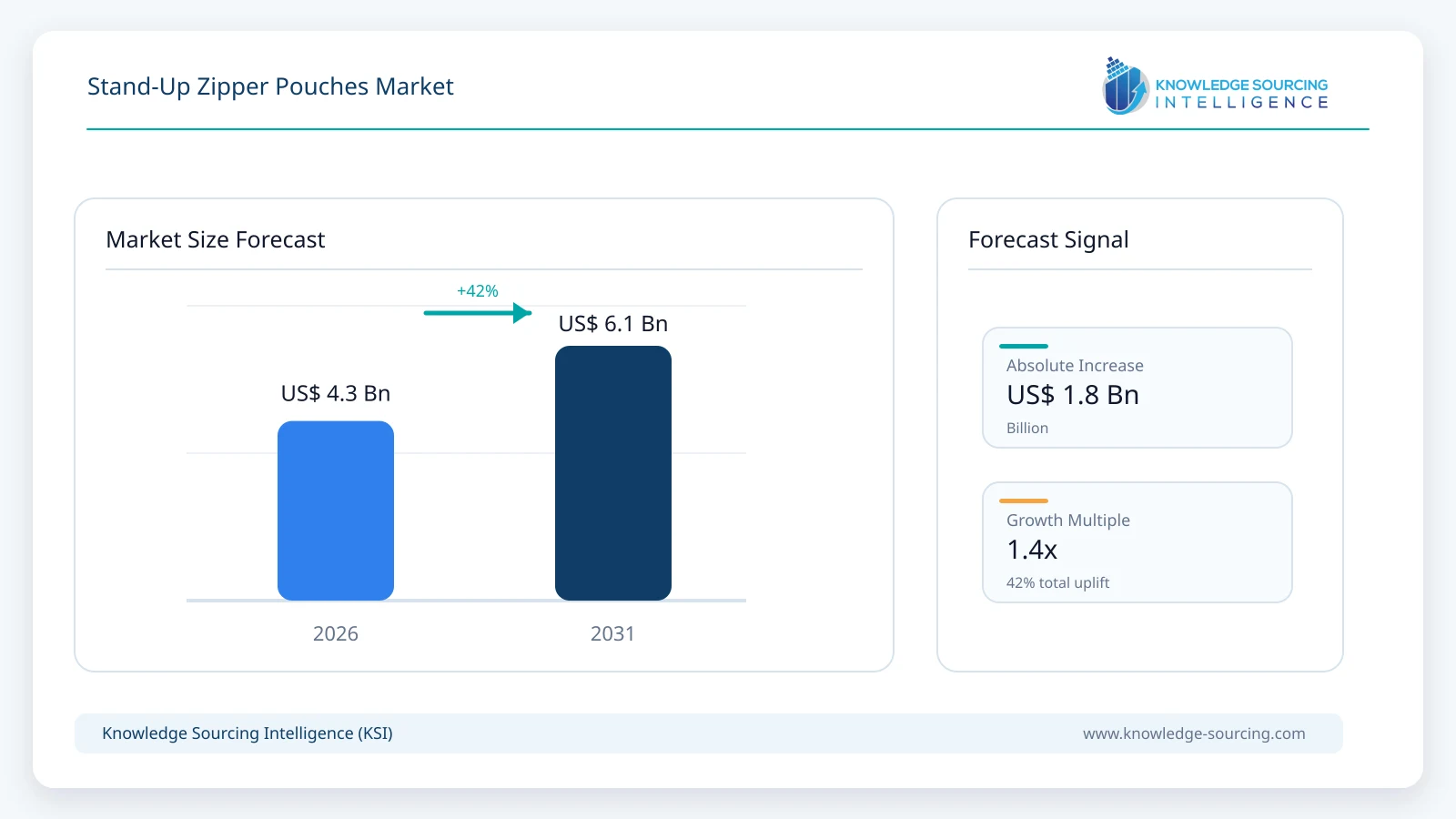
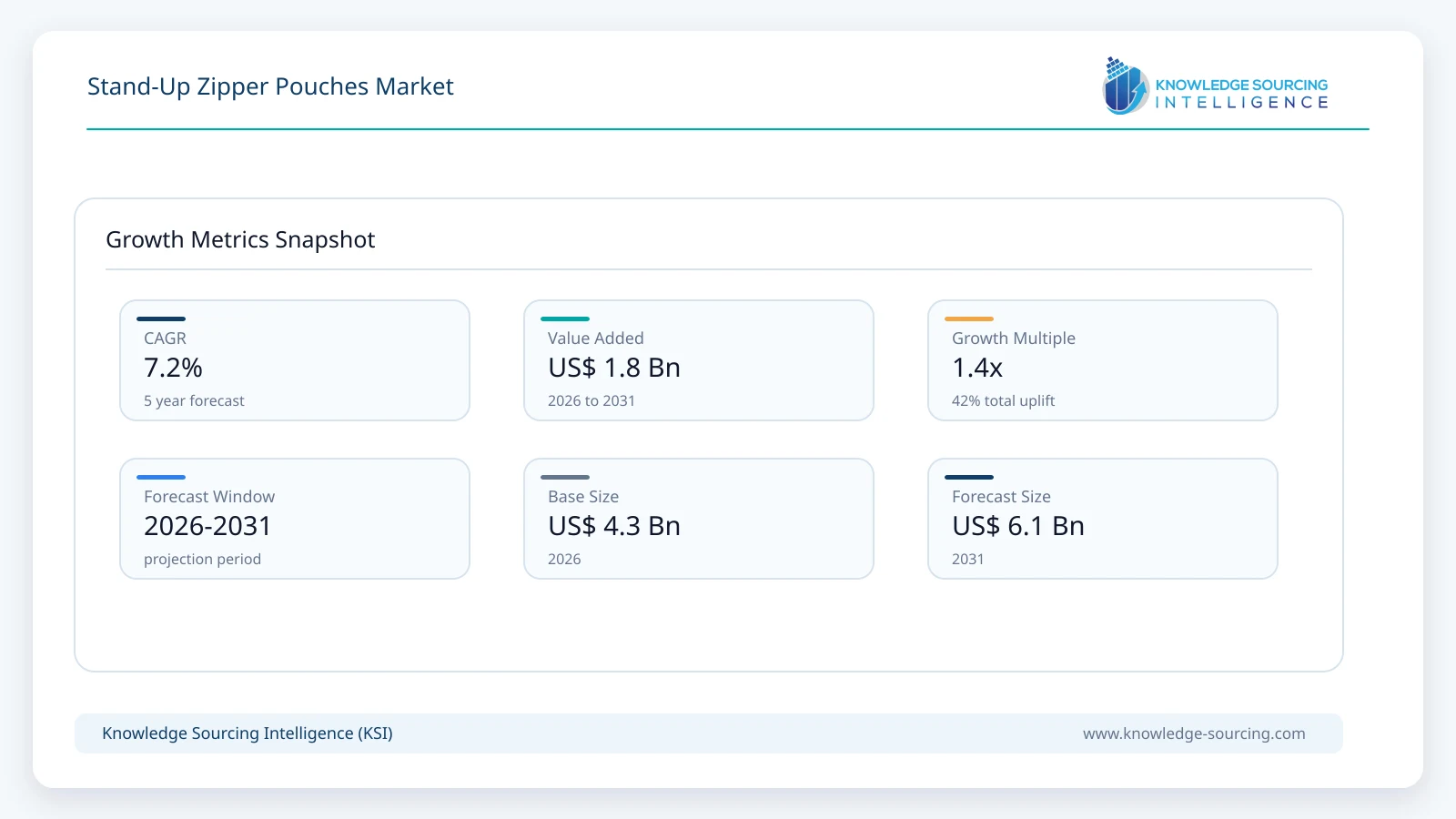
The stand-up zipper pouches market is forecast to grow at a CAGR of 7.2%, reaching USD 6.1 billion in 2031 from USD 4.3 billion in 2026.
Highlights:
- 1Food packaging applications remain the largest source of stand-up zipper pouch demand globally.
- 2Packaging lightweighting initiatives continue to shift volume from rigid formats to flexible pouches.
- 3Reclosability, shelf-life extension, and convenience remain central buyer purchasing criteria.
- 4Regulatory pressure on packaging waste is accelerating investments in recyclable pouch structures.
- 5Asia Pacific manufacturing expansion is strengthening global production capacity and supply networks.
- 6Material selection is increasingly influenced by recyclability requirements and extended producer responsibility regulations.
Key Highlights
Market Overview
Purchasing decisions within the market increasingly extend beyond packaging cost. Brand owners evaluate stand-up zipper pouches based on barrier performance, sealing reliability, shelf-life preservation, regulatory compliance, printing quality, recyclability, and compatibility with automated filling systems. Food manufacturers remain the most influential buyers because packaging performance directly affects product freshness, distribution efficiency, and retail presentation. Healthcare and pharmaceutical users place greater emphasis on contamination control, traceability, and regulatory compliance, while cosmetic and personal care companies prioritize shelf differentiation and premium appearance.
Value creation across the market is distributed among resin suppliers, film manufacturers, converters, printing providers, closure manufacturers, machinery suppliers, and packaging companies. Competitive positioning increasingly depends on the ability to offer customized pouch structures that meet both performance requirements and evolving sustainability expectations. Suppliers capable of providing recyclable or mono-material pouch solutions are receiving greater attention from multinational consumer goods companies seeking to meet packaging commitments and comply with emerging waste regulations.
Regulatory developments are reshaping purchasing behavior in several regions. Extended producer responsibility programs, packaging waste reduction targets, recycled-content mandates, and circular economy policies are influencing material selection and package design. As a result, investment activity is increasingly focused on recyclable flexible packaging technologies, material recovery solutions, and advanced barrier films that maintain product protection while reducing environmental impact.
Key Market Indicators
Indicator | Latest Evidence | Commercial Meaning |
Global plastic production | Over 400 million metric tons annually | Flexible packaging remains dependent on polymer availability and pricing. |
Global food loss and waste | Around one-third of food produced is lost or wasted | Shelf-life extension remains a critical packaging requirement. |
Flexible packaging penetration | Increasing across snacks, pet food, coffee, frozen food, and personal care products | Supports conversion from rigid packaging formats. |
Recyclable packaging commitments | Adopted by numerous multinational consumer goods companies | Drives demand for new pouch structures and material innovation. |
E-commerce packaging demand | Continues to expand across consumer-packaged goods sectors | Favors lightweight and durable packaging formats. |
Key Indicator: Food applications represent the most commercially important demand category for stand-up zipper pouches.
Commercial Meaning: Product freshness, resealability, and transportation efficiency directly influence packaging procurement decisions.
Market Drivers
Expansion of packaged food consumption and distribution networks. Demand for packaged snacks, dried foods, frozen products, confectionery, coffee, pet food, and ready-to-eat products continues to support pouch consumption. Food manufacturers increasingly require packaging formats that preserve freshness while minimizing logistics costs. Stand-up zipper pouches provide a combination of barrier protection, resealability, and shelf visibility that aligns with modern retail and e-commerce distribution requirements. Packaging suppliers are expanding production capabilities to address growing requirements from branded food companies and private-label manufacturers.
Replacement of rigid packaging in selected product categories. Transportation costs, warehouse utilization, and sustainability targets are encouraging the substitution of glass jars, metal containers, and rigid plastic packaging in several consumer product categories. Flexible pouch formats generally require less material and occupy less storage space during transportation and distribution. This cost advantage is particularly relevant for high-volume food and household products where packaging efficiency directly affects margins.
Growing demand for convenience-oriented packaging. Consumer purchasing patterns increasingly favor packaging that can be opened, resealed, stored, and transported easily. Zipper closures support repeated product access without requiring additional storage containers. This functionality is especially valuable in snack foods, pet food, nutritional products, dried fruits, and household products where multiple-use consumption patterns are common.
Sustainability commitments by consumer goods companies. Global brand owners continue to establish packaging targets focused on recyclability, material reduction, and waste management. Packaging suppliers are investing in mono-material polyethylene structures, recyclable barrier films, and downgauging technologies to align with these requirements. These developments are creating opportunities for suppliers capable of balancing environmental performance with product protection requirements.
Growth of e-commerce distribution channels. Direct-to-consumer shipping places greater emphasis on packaging durability and transportation efficiency. Flexible pouches reduce shipping weight and lower freight costs compared with many rigid alternatives. E-commerce growth has therefore increased demand for packaging formats that can withstand distribution while minimizing transportation expenses.
Market Restraints and Challenges
Recycling limitations for multilayer packaging structures. Many stand-up zipper pouches rely on combinations of plastic films, adhesives, barrier layers, and closures that complicate mechanical recycling processes. While these structures deliver excellent product protection, they face increasing scrutiny from regulators and brand owners. Packaging suppliers must invest in alternative material systems that maintain performance while improving recyclability.
Volatility in polymer and raw material prices. Resin costs remain influenced by energy markets, petrochemical feedstock availability, and regional supply disruptions. Sudden increases in polyethylene, polypropylene, or specialty film prices can compress converter margins and complicate long-term customer pricing agreements. Companies often face challenges in passing higher material costs to customers immediately.
Performance trade-offs in sustainable packaging development. Brand owners increasingly request recyclable pouch solutions, yet maintaining oxygen, moisture, aroma, and light barriers can be difficult when transitioning away from complex multilayer structures. Development costs, qualification timelines, and performance validation requirements may extend commercialization cycles for new packaging formats.
Regulatory complexity across regions. Packaging manufacturers must comply with varying food-contact regulations, labeling requirements, recycled-content mandates, and waste management rules across different jurisdictions. Companies operating internationally often require multiple product specifications and certification processes, increasing operational complexity.
Price competition in standardized applications. While customized packaging solutions can support premium pricing, standard pouch categories often face intense competition from regional converters. Price pressure can limit margin expansion, particularly in high-volume applications where buyers maintain significant negotiating leverage.
Major Segment Analysis
Food End-Users
Food applications represent the most commercially important segment within the stand-up zipper pouches market because packaging performance directly influences product quality, shelf life, retail presentation, and transportation economics. Product categories, including snacks, coffee, dried foods, frozen products, confectionery, pet food, and nutritional products, rely heavily on barrier packaging to preserve freshness and prevent contamination. Resealable pouch formats also support portion control and repeated use, features that increasingly influence consumer purchasing behavior.
Buyer requirements within the food segment extend beyond packaging cost. Food manufacturers evaluate oxygen transmission rates, moisture barriers, seal integrity, puncture resistance, filling-line compatibility, printing quality, and regulatory compliance. Large multinational food companies frequently require extensive packaging validation and supplier qualification processes before commercial adoption. These requirements create barriers to entry for smaller converters lacking technical capabilities or quality assurance infrastructure.
Competition within the food segment increasingly centers on sustainable packaging innovation. Brand owners are seeking recyclable structures without compromising barrier performance or shelf life. Suppliers capable of combining product protection, operational efficiency, and regulatory compliance are likely to capture a greater share of future procurement activity. Performance within the food segment remains an important indicator of broader market direction.
Regional Analysis
Region | Main Demand Signal | Principal Constraint |
North America | Packaged food consumption and sustainability commitments | Recycling infrastructure gaps for flexible packaging |
Europe | Circular economy regulations and packaging compliance requirements | Increasing regulatory costs |
Asia Pacific | Manufacturing expansion and rising packaged goods consumption | Fragmented recycling systems |
Middle East and Africa | Growth in modern retail and packaged food distribution | Import dependence for some packaging materials |
South America | Expanding consumer goods production and food processing sectors | Economic volatility and currency fluctuations |
North America
Food processing, pet food production, healthcare packaging demand, and established flexible packaging supply chains support market activity across North America. The United States remains the largest contributor due to its extensive packaged food industry and strong presence of consumer packaged goods companies. Sustainability commitments from multinational brands are accelerating demand for recyclable pouch structures, although flexible packaging recycling infrastructure remains uneven across the region.
Europe
European demand is strongly influenced by packaging waste regulations and circular economy policies. Regulatory initiatives encourage material reduction, recyclability improvements, and higher levels of packaging recovery. Packaging suppliers increasingly focus on mono-material structures and recyclable barrier solutions to align with evolving compliance requirements. Germany, France, Italy, and the United Kingdom remain important markets due to their large food and consumer goods industries.
Asia Pacific
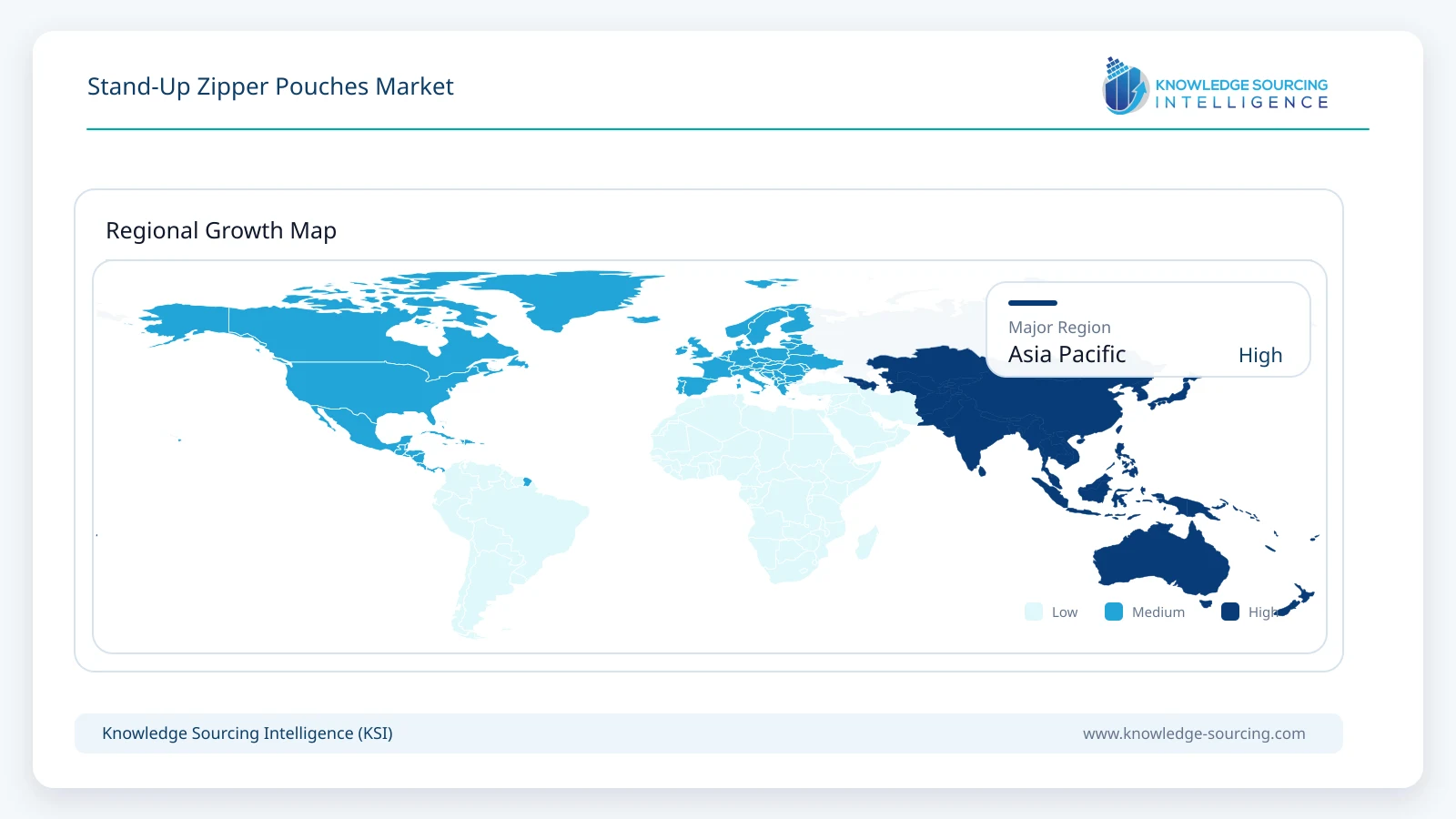
Asia Pacific represents one of the most active manufacturing regions for flexible packaging. China, India, Japan, South Korea, Indonesia, and Thailand support demand through expanding food processing industries, growing consumer markets, and increasing retail modernization. Investments in packaging production capacity continue across the region as both domestic and export-oriented manufacturers seek to serve rising packaged goods demand.
South America
Brazil and Argentina account for a substantial portion of regional demand. Food processing, agricultural exports, and consumer goods manufacturing support packaging consumption. Economic volatility and currency fluctuations can affect purchasing decisions and capital investment activity, but demand for cost-efficient packaging formats continues to support pouch adoption.
Middle East and Africa
Urbanization, modern retail development, and expanding packaged food consumption are contributing to demand growth across selected markets. Saudi Arabia and the United Arab Emirates remain important regional markets due to food imports, retail expansion, and consumer goods manufacturing activity. Local production capacity continues to develop, although import dependence remains relevant for some packaging materials and equipment.
Competitive Landscape
The stand-up zipper pouches market exhibits characteristics of a moderately fragmented packaging industry where global packaging groups compete alongside regional converters and specialized pouch manufacturers. Competitive differentiation is increasingly determined by material science capabilities, converting expertise, regulatory compliance, sustainability performance, and customer support rather than production capacity alone.
Companies such as Mondi, Amcor Plc, ProAmpac, Novolex, WINPAK LTD., and Glenroy have expanded investments in recyclable flexible packaging technologies as brand owners seek alternatives to traditional multilayer structures. Product development efforts increasingly focus on mono-material solutions, improved barrier properties, downgauging opportunities, and compatibility with existing filling systems.
Regional suppliers, including Mangalam Polypack, Nichrome Packaging Solutions, Alpha Pack, and PouchDirect, compete through customization, shorter production runs, local customer support, and application-specific solutions. These capabilities are particularly valuable for small and medium-sized consumer goods manufacturers requiring flexible packaging formats tailored to niche product categories.
Barriers to entry arise from customer qualification requirements, food-contact compliance obligations, quality assurance expectations, and the capital investment required for printing, lamination, conversion, and pouch-making operations. Large customers often maintain lengthy supplier approval processes, creating advantages for established packaging companies with proven performance records.
Recent Developments
May 2026: SunDance installed a new XL-DR pouching machine from Sun Centre USA, expanding production of stand-up zipper pouches, gusseted formats, and specialty closures. The investment increases manufacturing flexibility, capacity, and packaging customization options.
May 2026: SunDance wins top honors at the 2026 Flexible Packaging Association Achievement Awards and expands the availability of the patented POUCH³ format, a cube-shaped stand-up pouch using 30–40% less material than conventional pouches. The design improves shelf efficiency, shipping economics, and product visibility.
September 2025: Borouge, Siegwerk, and TPN Food Packaging introduced a fully recyclable polyethylene stand-up barrier pouch. The de-inkable design delivers strong oxygen protection while supporting circular-economy goals and the replacement of multi-material pouch structures.
July 2025: Amcor and Mediacor introduced a recycle-ready 2-liter spouted stand-up pouch for Nana-branded cleaning products. The lightweight mono-material package reduces plastic consumption while maintaining durability, resealability, and shelf appeal.
Regulatory and Policy Environment
Packaging regulation is becoming a central factor in purchasing decisions across the stand-up zipper pouches market. Requirements related to recyclability, packaging waste reduction, producer responsibility, food-contact safety, labeling, and recycled content are affecting product development priorities. Compliance obligations increasingly influence material selection and packaging design.
European packaging policy remains particularly influential because many multinational consumer goods companies adopt packaging standards that align with European regulatory expectations. Similar policy discussions are emerging across North America, the Asia Pacific, and other regions as governments seek to reduce packaging waste and improve resource efficiency.
Food-contact regulations remain critical throughout the market. Packaging materials must satisfy safety requirements governing migration limits, chemical composition, and manufacturing practices. Suppliers serving healthcare and pharmaceutical applications often face additional validation and documentation requirements.
Outlook and Strategic Implications
Demand during the 2026–2031 period is expected to be shaped less by packaging volume growth alone and more by shifts in packaging specifications. Recyclability, material reduction, product protection, and regulatory compliance will increasingly influence purchasing decisions across food, healthcare, personal care, and consumer goods applications.
Several strategic themes are likely to influence competitive positioning:
Suppliers with commercially viable recyclable pouch technologies are expected to gain greater access to multinational consumer goods accounts.
Material science capabilities will become increasingly important as companies seek to balance sustainability and barrier performance.
Regional manufacturing expansion may reduce supply-chain risk and improve service responsiveness.
Regulatory compliance capabilities will become a stronger source of competitive differentiation.
Investment in advanced printing, pouch conversion, and closure technologies may support higher-value applications.
The market's commercial outlook remains closely tied to packaged food production, consumer convenience requirements, flexible packaging substitution trends, and the industry's ability to develop recyclable solutions without compromising product protection. Companies that can address these requirements simultaneously are likely to be better positioned to capture procurement opportunities throughout the forecast period.
Stand-Up Zipper Pouches Market Scope:
| Report Metric | Details |
|---|---|
| Total Market Size in 2026 | USD 4.3 billion |
| Total Market Size in 2031 | USD 6.1 billion |
| Forecast Unit | Billion |
| Growth Rate | 7.2% |
| Study Period | 2021 to 2031 |
| Historical Data | 2021 to 2024 |
| Base Year | 2025 |
| Forecast Period | 2026 – 2031 |
| Segmentation | Material, Form, Closure Type, End-users, Geography |
| Companies |
|
Market Segmentation
By Material
Plastic
Paper
Aluminum
By Form
Rollstock
Round Bottom
K-style
Flat Bottom
Others
By Closure Type
Top Notch
Zipper
Spout
By End-Users
Food
Healthcare and Pharmaceutical
Cosmetic and Personal Care
Consumer Goods
Others
By Geography
North America
United States
Canada
Mexico
South America
Brazil
Argentina
Others
Europe
United Kingdom
Germany
France
Italy
Spain
Others
The Middle East and Africa
Saudi Arabia
UAE
Others
Asia Pacific
Japan
China
India
South Korea
Taiwan
Thailand
Indonesia
Others
Table of Contents
1. INTRODUCTION
1.1. Market Overview
1.2. Market Definition
1.3. Scope of the Study
1.4. Market Segmentation
1.5. Currency
1.6. Assumptions
1.7. Base and Forecast Years Timeline
2. RESEARCH METHODOLOGY
2.1. Research Data
2.2. Research Process
3. EXECUTIVE SUMMARY
3.1. Key Findings
4. MARKET DYNAMICS
4.1. Market Drivers
4.2. Market Restraints
4.3. Porter’s Five Forces Analysis
4.3.1. Bargaining Power of Suppliers
4.3.2. Bargaining Power of Buyers
4.3.3. Threat of New Entrants
4.3.4. Threat of Substitutes
4.3.5. Competitive Rivalry in the Industry
4.4. Industry Value Chain Analysis
5. STAND-UP ZIPPER POUCHES MARKET, BY MATERIAL
5.1. Introduction
5.2. Plastic
5.3. Paper
5.4. Aluminum
6. STAND-UP ZIPPER POUCHES MARKET, BY FORM
6.1. Introduction
6.2. Rollstock
6.3. Round Bottom
6.4. K-style
6.5. Flat Bottom
6.6. Others
7. STAND-UP ZIPPER POUCHES MARKET, BY CLOSURE TYPE
7.1. Introduction
7.2. Top Notch
7.3. Zipper
7.4. Spout
8. STAND-UP ZIPPER POUCHES MARKET, BY END-USERS
8.1. Introduction
8.2. Food
8.3. Healthcare and Pharmaceutical
8.4. Cosmetic and Personal Care
8.5. Consumer Goods
8.6. Others
9. STAND-UP ZIPPER POUCHES MARKET, BY GEOGRAPHY
9.1. Introduction
9.2. North America
9.2.1. United States
9.2.2. Canada
9.2.3. Mexico
9.3. South America
9.3.1. Brazil
9.3.2. Argentina
9.3.3. Others
9.4. Europe
9.4.1. United Kingdom
9.4.2. Germany
9.4.3. France
9.4.4. Italy
9.4.5. Spain
9.4.6. Others
9.5. The Middle East and Africa
9.5.1. Saudi Arabia
9.5.2. UAE
9.5.3. Others
9.6. Asia Pacific
9.6.1. Japan
9.6.2. China
9.6.3. India
9.6.4. South Korea
9.6.5. Taiwan
9.6.6. Thailand
9.6.7. Indonesia
9.6.8. Others
10. COMPETITIVE ENVIRONMENT AND ANALYSIS
10.1. Major Players and Strategy Analysis
10.2. Market Share Analysis
10.3. Mergers, Acquisitions, Agreements, and Collaborations
10.4. Vendor Competitiveness Matrix
11. COMPANY PROFILES
11.1. PouchDirect
11.2. Alpha Pack
11.3. Mondi
11.4. Nichrome Packaging Solutions
11.5. Mangalam Polypack
11.6. Glenroy, Inc.
11.7. WINPAK LTD.
11.8. ProAmpac
11.9. Novolex
11.10. Amcor Plc
Navigate
Trusted by the world's leading organizations











