
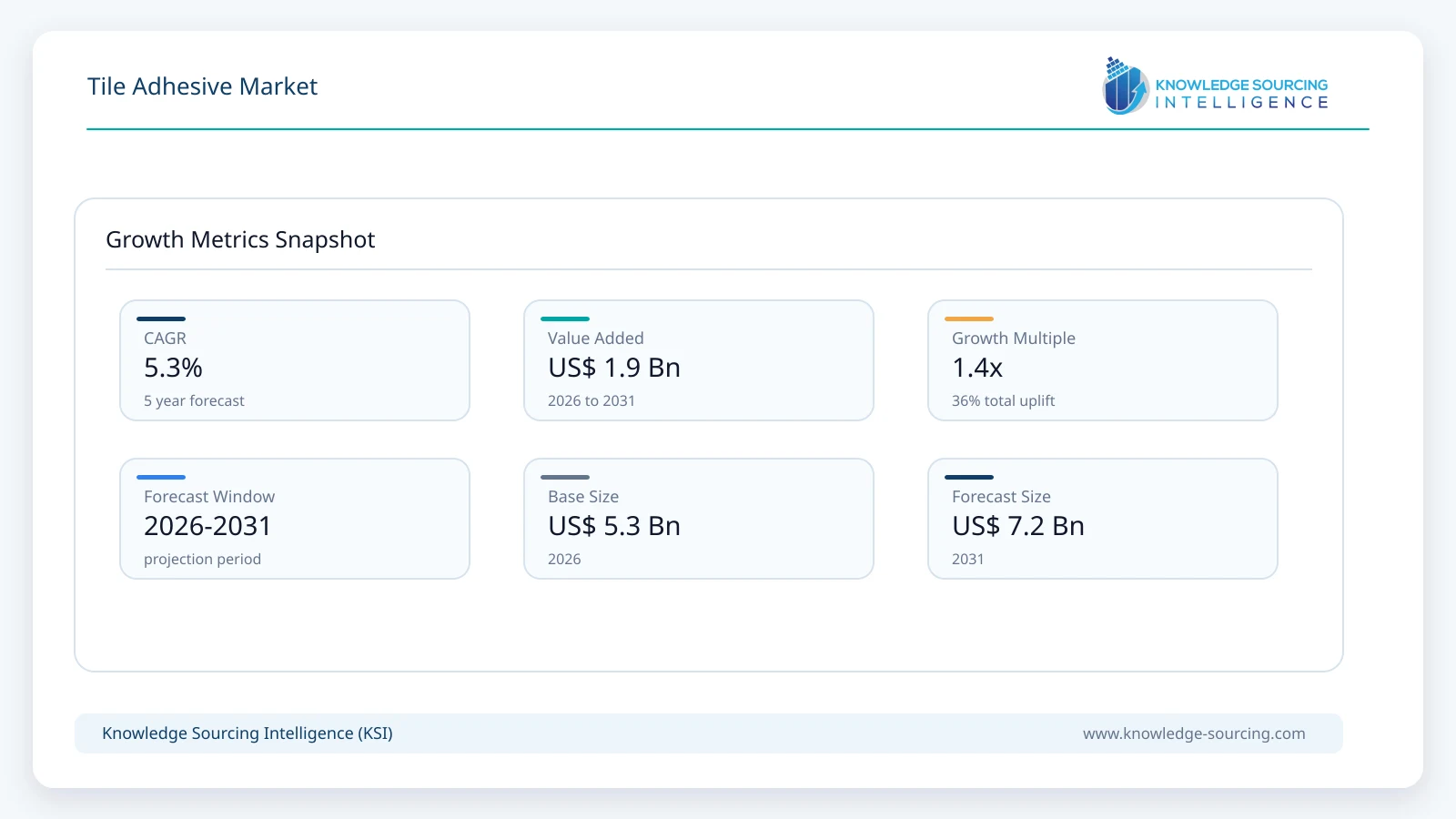
The Tile Adhesive Market is set to reach USD 7.18 billion in 2031, growing at a CAGR of 5.3% between 2026 and 2031, from USD 5.28 billion in 2026.
Highlights:
- 1Increasing preference for polymer-modified flexible adhesives that provide enhanced deformability for large-format tiles and substrates subject to movement or vibration.
- 2Rapid-setting cementitious adhesives allow faster return to service and same-day grouting while retaining extended working times and reliable bond performance.
- 3Sustainable formulations featuring reduced dust, lower emissions, and optimized carbon footprints address environmental regulations and improve on-site working conditions.
- 4Specialized hybrid and premixed adhesives facilitate efficient installation of gauged porcelain panels and vertical applications with superior non-sag and adjustability characteristics.
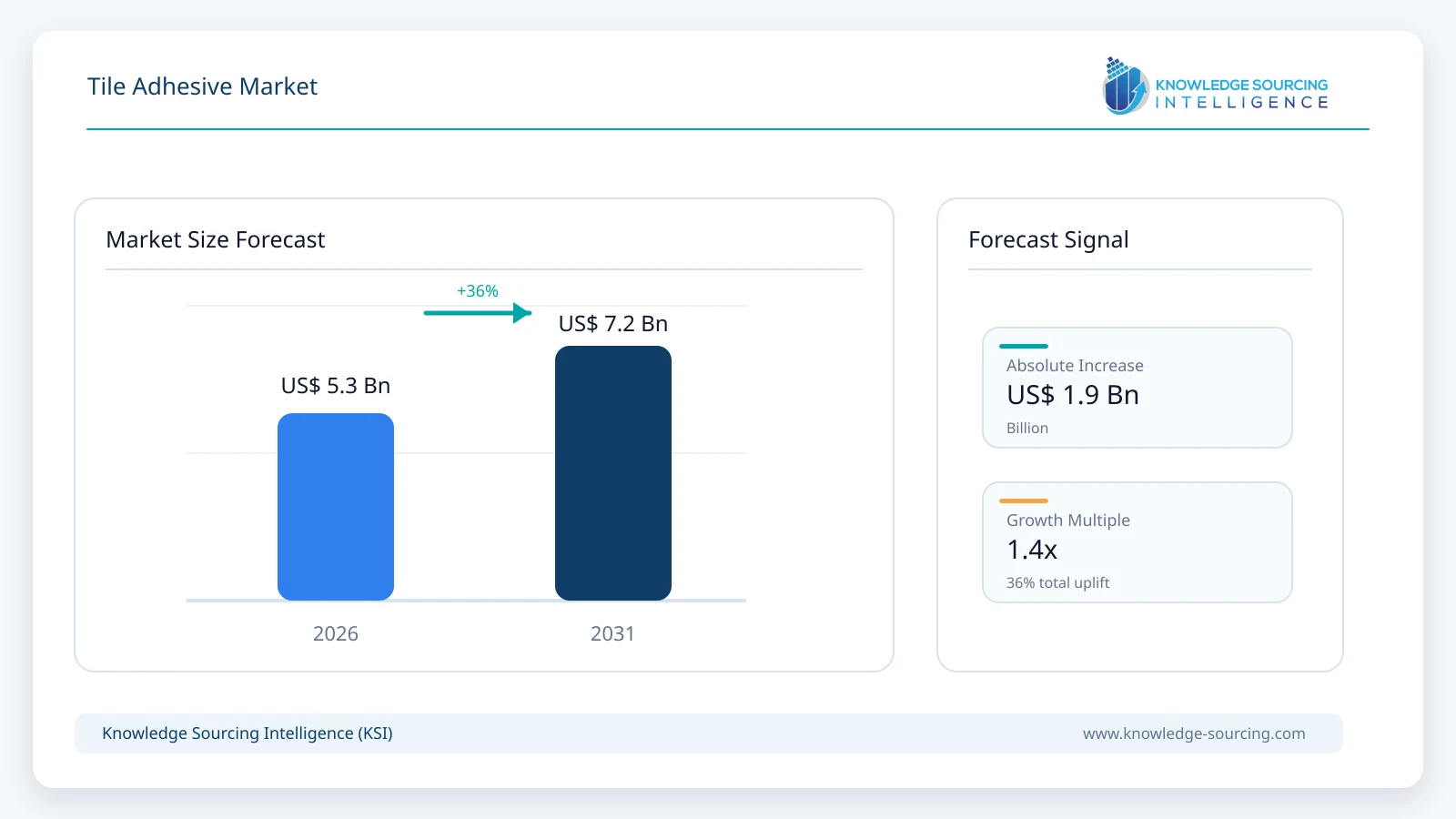
The Tile Adhesive Market is anticipated to grow at a significant CAGR of 5.3% during the forecast period (2026–2031). The global tile adhesive market is expected to grow steadily primarily due to the rising preference for ceramic, porcelain, vitrified, and natural stone tiles from residential, commercial, and infrastructure projects. Tile adhesives offer several advantages over traditional cement-sand mortar. They provide high bond strength, flexibility, and water resistance, making them easier and faster to install. Additionally, there are various types of tile adhesives available that are suitable for different substrates, including large format tiles.
Another factor supporting the adoption of polymer-modified, ready-mix, low-VOC and higher-performing cement-based adhesives is ongoing innovations in their formulations.
Government investments in housing and infrastructure continue to strengthen the demand for tile installation materials, including tile adhesive.
Tile adhesive manufacturers are innovating more rapidly with sustainable and high-performance tile adhesives. For instance, MAPEI continued to broaden its line of installation systems with low-dust, rapid-setting, deformable, and high-bond-strength tile adhesives for large-format porcelain slabs as well as natural stone and other demanding commercial flooring use in 2025.
Sustainability is an increasingly leading differentiator across the market. Top manufacturers such as Sika, Saint-Gobain Weber, MAPEI and Ardex are expanding low-VOC (volatile organic compound) or EMICODE EC1 Plus-certified environmentally friendly tile adhesives, aligning with their green building standards such as LEED and BREEAM.
Large format porcelain tiles and natural stone installations are boosting the adhesive necessities. Manufacturers now offer highly flexible, non-slip, extended open time, and rapid-curing adhesives. These adhesives can support heavier tiles, exterior facades, heated flooring systems and wet-area applications, improving installation efficiency and long-term durability.
Renovation and building refurbishment drive the increased requirement for tile adhesive. Growing investments towards renovation of hotels, hospitals, schools & colleges, malls and other commercial and residential buildings are aiding the replacement of traditional mortar with polymer-modified tile adhesives, providing enhanced adhesion, crack resistance and moisture protection.
Additionally, the high-performance tile adhesives portfolio by manufacturers continues to expand to cater to changing installation needs.
For instance, in February 2026, Walplast Products Pvt. announced the launch of two white cementitious tile adhesives, i.e., HomeSure TileEx EX-333 Stone & Glass Expert and HomeSure TileEx EX-335 Stone & Glass Expert Plus, meant for demanding applications including vitrified, natural stone, glass mosaics, ceramic, basalt tiles, and can be utilized in both dry and wet areas.
The enhanced bond strength, water resistance, flexibility, and compatibility with premium tile installations of these products highlight the high-performance installation solutions trend in the industry for modern construction.
Market Drivers
Rising Residential and Commercial Construction Activities
The rapid urbanization, together with factors such as rising population and investments in residential, commercial, healthcare, hospitality, and institutional buildings, drives demand for a wide variety of tile installations in ceramic, porcelain & stone types that require high shear strength sustained by high-performance adhesives.
As per the United Nations report, approximately 55 percent of the world's population of 8 billion as of November 2022 lived in urban areas, and this is expected to reach 70 percent by 2050, which drives significant demand for new housing and commercial buildings and urban infrastructure.
According to the UNEP Global Status Report for Buildings and Construction 2025–2026, buildings and construction represent 11–13% of global GDP and employ approximately 9% of the workforce across the globe. This demonstrates both a substantial economic footprint and an almost endless pipeline of projects entering construction practices.
The Government of India approved the extension of Pradhan Mantri Awas Yojana–Urban (PMAY-U 2.0) scheme in September 2024, for completion of construction of 1 crore urban housing units in the next five years for eligible families. This offers an opportunity to boost demand for residential flooring and wall tiles.
As part of the same initiative, ? 2.30 lakh crore has been identified as central assistance from the government. This will boost structural work of residential buildings for the long term and associated demand for tile installation materials.
Rise in affordable housing building construction, rise in airport modernization programs and hospital infrastructure, and effective ways for educational institutes to enhance campus quality will further promote the rapid consumption of tiles and eventually strengthen demand for tile adhesives.
Major Segmentation Analysis
Residential
By End-user, the tile adhesives market is segmented into residential, commercial, industrial, and others. The residential segment is expected to show consistent growth owing to the rising global housing demand.
The implementation of infrastructure projects, followed by continuous industrial investments, has shaped the market outlook for tile adhesives. High utilization of ceramic tiles, followed by development in adhesive technologies supporting durability and superior performance, is driving new developments in the market. The residential segment is projected to grow steadily fueled by ongoing housing renovation and housing permit approval globally.
Rapid global population growth has escalated the housing demand, which is anticipated to drive market expansion for tile adhesives especially. According to the United Nations, the global population is expected to reach 8.5 billion by 2030 and will show steady growth from the current volume of 8.3 billion in 2026.
Major global economies have invested billions in residential construction. For instance, according to the U.S Census Bureau, in June 2026, residential construction reached USD 942.77 billion, of which private housing comprised nearly 98% of total spending. Such investment
Housing scheme initiatives by authorities have supported affordable housing development, further expanding the market potential in developed economies such as China, which has taken strategic measures to strengthen housing development under its “15th Five-Year Plan.”
Growing transition towards premium tiles is driving high-performance adhesion requirements, which has supported innovations in adhesive chemistries. Global players like Sika AG offer an extensive portfolio, including the polymer-modified adhesive “SikaCeram-155 Wet Room,” which provides superior adhesion for residential tile installation.
Government policies such as the EU’s “Energy Performance of Buildings Directive” have established a framework to support zero building emissions, which is projected to drive sustainability in tile adhesive development for residential application in such regions.
Regional Analysis
North America: the US
Rapid population growth has simultaneously impacted residential construction in the United States, with private housing construction showing expansion. According to US Census Bureau data, in June 2026, privately owned housing starts reached 1,427,000 units, representing 19% growth over May 2026. The same source indicates positive growth in new privately owned housing sales.
Infrastructure development, followed by billions of investments incurred in commercial and non-residential construction projects, has supported tile adhesives demand for flooring and wall applications in the USA.
Strategic expansion by key companies such as Sika AG through the establishment of production plants in New Jersey has amplified the market outlook for tile adhesives in the Northeastern region of the USA, which includes infrastructure hubs like New York, Washington D.C., and Boston.
International conglomerates, through new product launches and innovations, have invested in the US market to optimize its high market potential. For instance, in February 2026, ARDEX Americas launched type 1 & 2 premixed tile adhesive product “ARDEX D 16” for interior tile installation.
The booming sustainable shift and low-VOC shift supported by EPA rules has encouraged innovations in sealants and adhesive technologies, which has provided a framework for new development supporting future market growth in the United States.
Company Profiles
Sika AG’s strategy in the tile adhesive market centers on combining global technological leadership with targeted market penetration and robust sustainability initiatives. Leveraging its core competencies in chemical building blocks, Sika focuses on delivering high-performance, premium-quality tile-setting materials under its flagship SikaCeram range.
The company emphasizes continuous innovation by developing eco-friendly, low-carbon mortars that reduce environmental impact while meeting modern construction demands such as large-format tiles and rapid-setting requirements. Through a blend of organic growth, localized production, and strategic acquisitions, Sika expands its geographic footprint and distribution channels. This ensures strong customer proximity across both residential and commercial sectors, allowing them to provide comprehensive, system-based solutions from surface preparation to final grouting.
Recent Developments
April 2026: Saint-Gobain Weber rolled out its comfort-enhanced ergonomic tile adhesive formulations globally, delivering a creamy texture requiring 15% less physical effort during interior and exterior tiling applications while maintaining traditional high-bond strength.
February 2026: Sika announced an agreement to acquire Akkim Sealants & Adhesives, a major Turkey-based manufacturer with 2025 net sales near CHF 220 million. The deal expands Sika's production reach into Eastern Europe, the Middle East, and North Africa.
2026: Sika completed its acquisition of Swedish mortar manufacturer Finja, which significantly strengthened Sika’s operational footprint, cross-selling potential, and overall market presence in northern Europe and across the fast-growing Nordic regional construction sector.
2026: Sika has expanded its global manufacturing network with the opening of five new sites located in the United States, Argentina, Colombia, Bangladesh, and Tanzania. These facilities mark an important step in increasing the company’s production capacity and further strengthening its global supply chain in key growth markets.
Tile Adhesive Market Scope:
| Report Metric | Details |
|---|---|
| Total Market Size in 2026 | USD 5.28 billion |
| Total Market Size in 2031 | USD 7.18 billion |
| Forecast Unit | Billion |
| Growth Rate | 5.3% |
| Study Period | 2021 to 2031 |
| Historical Data | 2021 to 2024 |
| Base Year | 2025 |
| Forecast Period | 2026 – 2031 |
| Segmentation | Product Type, Tile Type, Substrate, Application, End User, Geography |
| Companies |
|
Market Segmentation
By Product Type (2021-2031)
By Tile Type (2021-2031)
By Substrate (2021-2031)
By Application (2021-2031)
By End User (2021-2031)
By Geography (2021-2031)
Table of Contents
1. EXECUTIVE SUMMARY
2. MARKET SNAPSHOT
2.1. Market Overview
2.2. Market Definition
2.3. Scope of the Study
2.4. Market Segmentation
3. MARKET DYNAMICS
3.1. Market Drivers
3.2. Market Restraints
3.3. Market Opportunities
3.4. Porter’s Five Forces Analysis
3.5. Industry Value Chain Analysis
4. BUSINESS LANDSCAPE
4.1. Regulatory & Standards Landscape
4.2. Raw Material Analysis (Cement, Polymer Binders, Additives, Others)
4.3. Pricing Analysis
4.4. Import/Export Analysis
4.5. Distribution Channel Analysis
5. TECHNOLOGICAL OUTLOOK
5.1. Lightweight Tile Adhesive Formulations
5.2. Flexible & High-Performance Adhesives
5.3. Low-VOC & Sustainable Formulations
5.4. Smart Manufacturing & Production Automation
6. TILE ADHESIVE MARKET BY PRODUCT TYPE (2021-2031)
6.1. Introduction
6.2. Reaction Resin Adhesive
6.3. Dispersion Adhesive
6.4. Cementitious Adhesive
6.5. Others
7. TILE ADHESIVE MARKET BY TILE TYPE (2021-2031)
7.1. Introduction
7.2. Ceramic Tiles
7.3. Vitrified Tiles
7.4. Natural Stone
7.5. Mosaic
7.6. Others
8. TILE ADHESIVE MARKET BY SUBSTRATE (2021-2031)
8.1. Introduction
8.2. Concrete
8.3. Cement Screed
8.4. Existing Tiles (Tile-on-Tile)
8.5. Glass and Metal
8.6. Wood
8.7. Others
9. TILE ADHESIVE MARKET BY APPLICATION (2021-2031)
9.1. Introduction
9.2. Floor Tiling
9.3. Wall and Ceiling Tiling
9.4. Swimming Pools and Wet Areas
9.5. Balconies and Terraces
9.6. Exterior Facades and Cladding
9.7. Others
10. TILE ADHESIVE MARKET BY END USER (2021-2031)
10.1. Introduction
10.2. Residential
10.3. Commercial
10.4. Industrial
10.5. Others
11. TILE ADHESIVE MARKET BY GEOGRAPHY (2021-2031)
11.1. Introduction
11.2. North America
11.2.1. USA
11.2.2. Canada
11.2.3. Mexico
11.3. South America
11.3.1. Brazil
11.3.2. Argentina
11.3.3. Others
11.4. Europe
11.4.1. United Kingdom
11.4.2. Germany
11.4.3. France
11.4.4. Spain
11.4.5. Others
11.5. Middle East and Africa
11.5.1. Saudi Arabia
11.5.2. UAE
11.5.3. Others
11.6. Asia Pacific
11.6.1. China
11.6.2. India
11.6.3. Japan
11.6.4. South Korea
11.6.5. Australia
11.6.6. Others
12. COMPETITIVE ENVIRONMENT AND ANALYSIS
12.1. Major Players and Strategy Analysis
12.2. Market Share Analysis
12.3. Mergers, Acquisitions, Agreements, and Collaborations
12.4. Competitive Dashboard
13. COMPANY PROFILES
13.1. Sika AG
13.2. Saint-Gobain Weber
13.3. MAPEI S.p.A.
13.4. Arkema Group
13.5. ARDEX Group
13.6. LATICRETE International, Inc.
13.7. Henkel AG & Co. KGaA
13.8. H.B. Fuller Company
13.9. Dow Inc.
13.10. BASF SE
13.11. Pidilite Industries Ltd.
14. RESEARCH METHODOLOGY
15. LIST OF FIGURES
16. LIST OF TABLES
Navigate
Trusted by the world's leading organizations











