
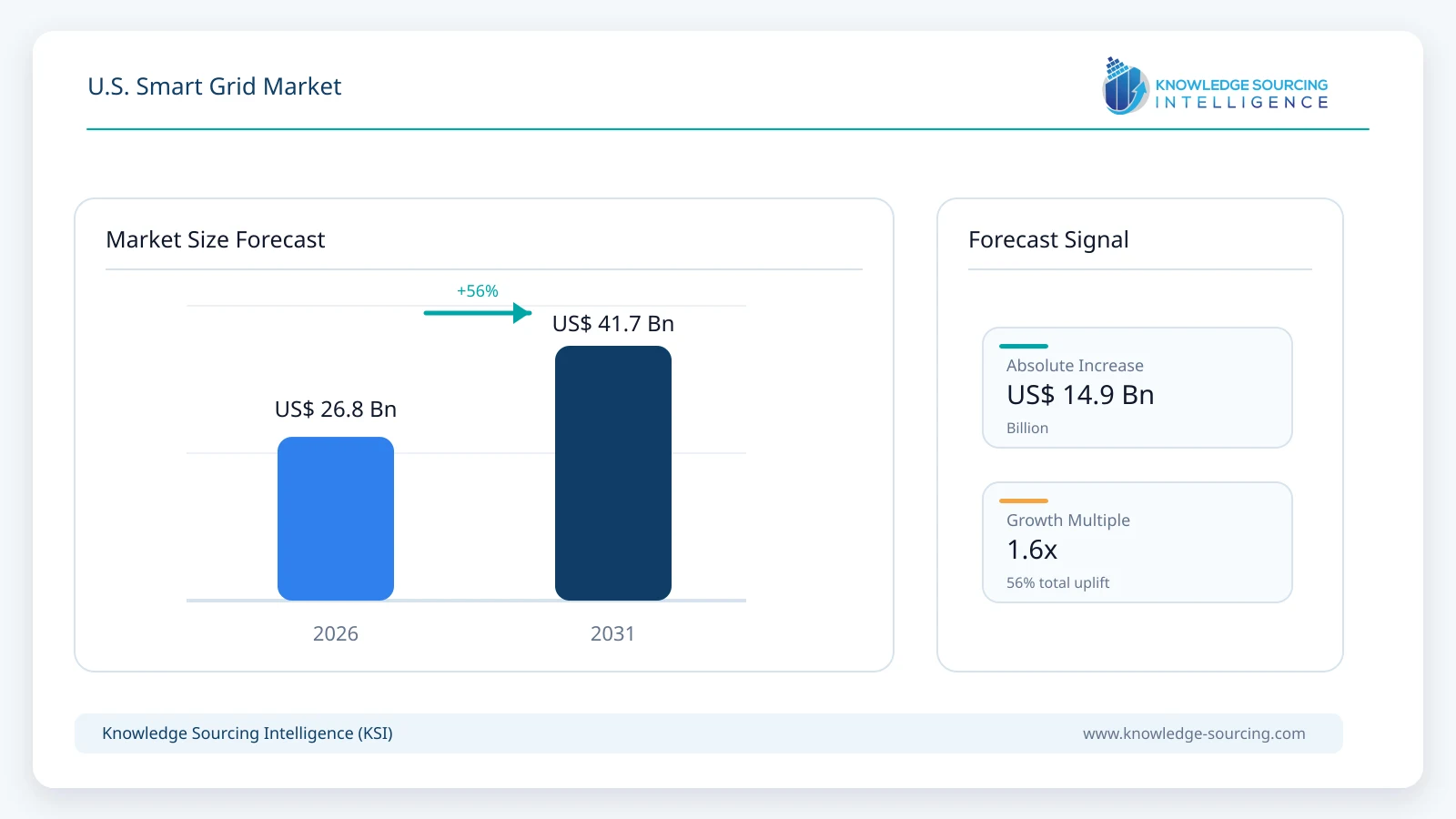
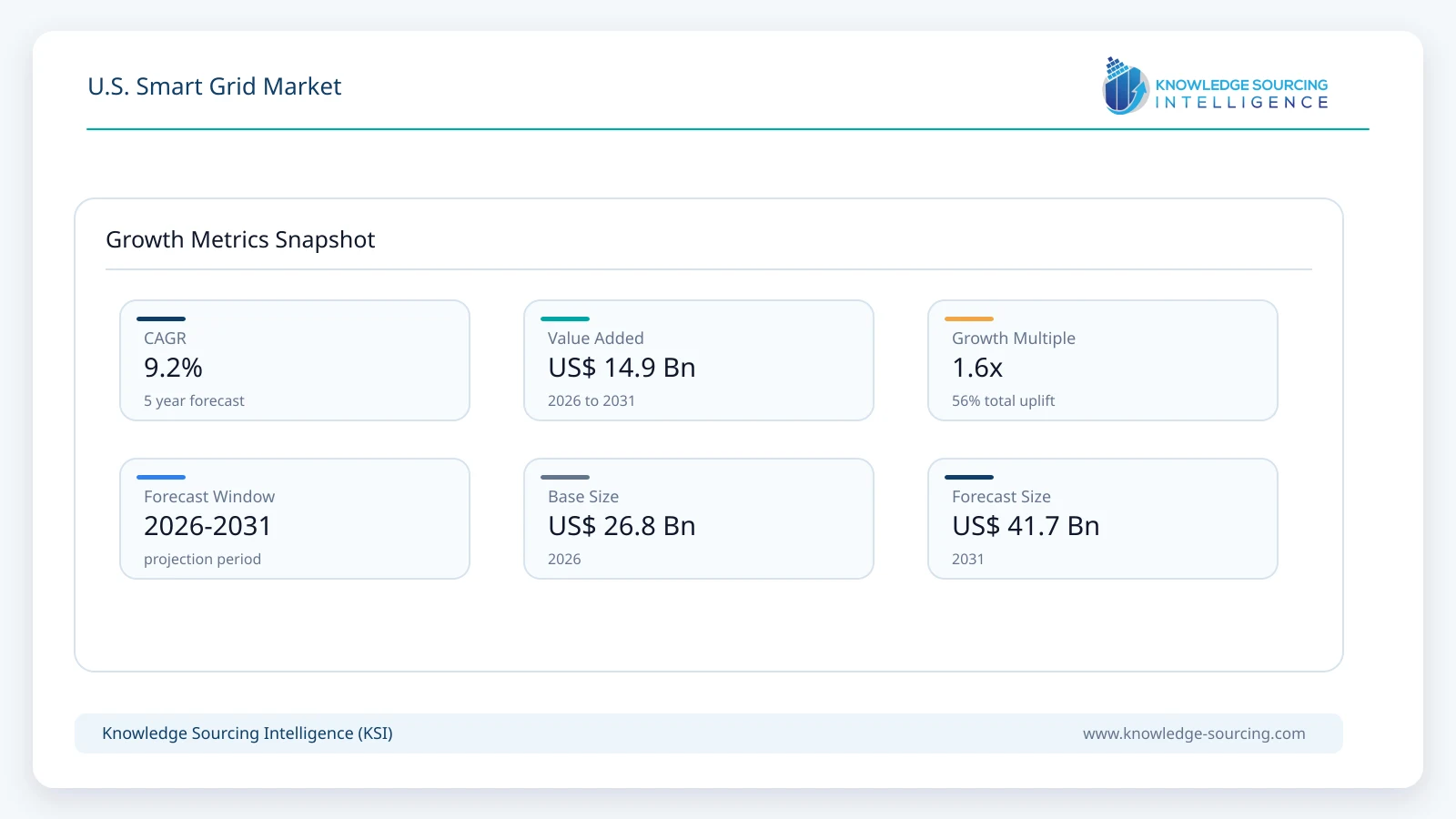
The U.S. smart grid market is forecast to grow at a CAGR of approximately 9.2%, increasing from USD 26.8 billion in 2026 to USD 41.7 billion in 2031.
Highlights:
- 1Distribution accounts for approximately 52% of U.S. smart grid market value in 2026, reflecting accelerated spending on feeder automation, intelligent protection, outage management and distributed-energy-resource integration.
- 2Hardware represents approximately 57% of market value in 2026, supported by smart meters, transformers, circuit breakers, sensors, protection equipment and intelligent grid-edge devices.
- 3Software accounts for approximately 30% of market value in 2026 and is projected to record the fastest offering-level growth at around 11.0% annually through 2031.
- 4Operation and maintenance represents approximately 61% of smart-grid service revenue in 2026 as utilities manage increasingly complex digital, communications and field-device infrastructure.
- 5U.S. electric utilities had 140.5 million AMI meters installed in 2024, up from 127.8 million in 2023, demonstrating continued migration from conventional and one-way metering toward two-way grid intelligence.
The market includes smart-grid-specific hardware, software and associated services deployed across electricity generation, transmission and distribution systems, including advanced metering infrastructure, intelligent transformers, circuit breakers, SCADA devices, protection systems, network sensors, grid communications, advanced distribution management, meter-data management, substation automation and related operating services. Conventional generation assets, basic transmission lines and distribution infrastructure without significant digital, automation or smart-grid functionality are excluded.
Investment conditions are particularly supportive. Edison Electric Institute projects U.S. investor-owned electric utilities to spend USD 220.7 billion in capital expenditure during 2026, compared with USD 178.2 billion in 2024, with distribution and transmission historically accounting for approximately half of functional electric-utility investment. Federal programmes add further support, with the U.S. Department of Energy administering the USD 10.5 billion Grid Resilience and Innovation Partnerships programme, including USD 3 billion specifically allocated to Smart Grid Grants.
The U.S. smart grid is evolving from an infrastructure modernization programme centered largely on smart meters toward a broader digital operating architecture linking meters, substations, distribution feeders, transmission assets, distributed generation and utility control centers. FERC describes smart-grid functionality as the increased use of digital information, automated controls, distributed-resource integration, demand response, advanced metering and communications to improve reliability, efficiency and security. This broader definition increasingly reflects actual utility investment priorities as electricity consumption rises and power flows become less predictable. U.S. utilities had installed 140.5 million AMI meters by 2024, including more than 123 million residential devices, while conventional automated meter-reading installations continued declining. The installed smart-meter base is therefore increasingly serving as a sensing and communications platform for outage detection, voltage management, distributed-resource monitoring and grid-edge analytics rather than functioning only as a billing system.
Rising electricity demand is reinforcing the requirement for real-time grid visibility and control. Lawrence Berkeley National Laboratory’s 2026 update estimates that U.S. data centers could account for 11.8% of national electricity use by 2030 under its central estimate, with a scenario range of 9.5% to 15.3%. This represents a substantial change from 4.4% in 2023 and places additional pressure on transmission capacity, substations and local distribution networks around major data-center clusters. Utilities are therefore investing simultaneously in physical capacity and technologies that increase utilization of existing assets, including dynamic line ratings, advanced distribution management, grid-edge sensing, demand management and automated switching.
Market Trends
Second-Generation AMI Is Turning Smart Meters into Grid Sensors
The U.S. AMI market is increasingly shifting from first-generation billing-oriented meters toward devices with higher-resolution sensing, edge computing and the ability to run applications locally. This transition is important because smart-meter penetration is already high, meaning future revenue depends increasingly on replacement cycles and improved functionality rather than connecting previously unmetered customers. Landis+Gyr positions its next-generation Revelo platform as both a meter and a real-time grid sensor capable of processing waveform data and supporting applications including demand management and load disaggregation. Itron is following a similar architecture through distributed intelligence endpoints that execute applications at the grid edge. In February 2026, PG&E expanded its deployment of Itron Grid Edge Intelligence to support outage management, wildfire-risk reduction and home electrification. The installed base is therefore progressing from AMI 1.0 toward a distributed sensing network capable of supporting utility operations beyond billing.
Grid Software Is Moving Toward Unified Real-Time Orchestration
Utilities historically operated separate systems for outage management, distribution management, meter-data management, SCADA and distributed-resource coordination. Increasingly complex networks are encouraging suppliers to combine these systems into broader operational platforms capable of processing large volumes of real-time data. GE Vernova introduced GridOS for Distribution in February 2026 as a unified platform designed to coordinate distribution-grid operations, followed in June by GridOS for Transmission, which provides near-real-time coordination for transmission systems. The software opportunity is expanding because more connected field equipment increases the quantity of operational data available to utilities, while data centers, DERs, batteries and electrification create greater value from faster decision-making. Utilities are also beginning to incorporate artificial intelligence into grid-edge applications, with Itron and NVIDIA demonstrating AI-based waveform analysis in March 2026 to identify faults and wildfire-related abnormalities directly from distributed endpoints.
Advanced Transmission Technologies Are Moving Into Mainstream Planning
Smart-grid investment is extending beyond distribution automation toward technologies that increase the usable capacity of existing transmission infrastructure. FERC Order No. 1920 requires transmission providers to consider dynamic line ratings, advanced conductors, advanced power-flow control devices and transmission switching when evaluating long-term regional transmission requirements. Dynamic line ratings can increase permitted power flows when actual weather and conductor conditions allow greater thermal capacity than conservative static assumptions. DOE notes that lines can sometimes carry approximately 50% more power than their labelled limits during favorable conditions. Federal funding is reinforcing deployment: DOE announced approximately USD 1.9 billion under the SPARK opportunity in March 2026, with funding directed toward accelerated reconductoring and other advanced transmission technologies that can expand grid capacity using existing rights of way.
Market Drivers
Record Utility Investment and Rapid Electricity-Demand Growth
U.S. electric utilities are entering one of their strongest capital-investment cycles in decades. Edison Electric Institute projects investor-owned utility capital expenditure of USD 220.7 billion in 2026 and USD 248.4 billion by 2029, compared with USD 178.2 billion in 2024. Functional investment data indicate that distribution and transmission together account for approximately half of utility capital spending, providing a large addressable pool for automation, digital protection, intelligent equipment, communications and grid-management software. This investment is being reinforced by rising electricity demand, particularly from data centers and domestic manufacturing. LBNL estimates data centers could consume 11.8% of U.S. electricity by 2030 under its central scenario. The combination increases demand for systems that allow utilities to monitor asset utilization, automate switching, forecast loads and extract additional capacity from existing networks rather than relying exclusively on construction of entirely new infrastructure.
Continued Expansion and Replacement of Advanced Metering Infrastructure
AMI remains a major demand driver even after years of deployment because the installed base is continuing to expand while early smart-meter generations begin entering replacement and upgrade cycles. EIA recorded 140.49 million AMI installations in 2024, increasing by approximately 12.7 million units from 127.76 million in 2023 and by more than 75 million units compared with 2015. Residential customers accounted for more than 123 million installations in 2024, but commercial and industrial AMI deployments also continued increasing. The next phase increasingly involves meters with edge intelligence, high-resolution waveform sensing and integration with outage-management, distributed-energy and demand-response platforms. This means market value can continue growing even as basic smart-meter penetration approaches maturity because the economic role of the meter changes from automated billing toward real-time distribution sensing and control. Utility programmes such as Austin Energy’s USD 44.5 million Landis+Gyr AMI contract demonstrate continued spending on meter-data and grid-optimization functionality.
Federal Funding for Grid Flexibility and Advanced Technologies
Federal programmes are directly supporting deployment of technologies included within the smart-grid market. DOE’s GRIP programme provides up to USD 10.5 billion across grid-resilience, smart-grid and grid-innovation activities, with USD 3 billion specifically allocated to Smart Grid Grants. Eligible investments include metering infrastructure, sensors, software, control systems, communications technologies and equipment for monitoring and integrating distributed generation. DOE had announced more than USD 6 billion through the first two GRIP rounds before introducing the SPARK funding opportunity in March 2026, which provides approximately USD 1.9 billion for reconductoring and other advanced transmission upgrades. The programmes are particularly important because federal funding can reduce deployment risk for technologies that utilities might otherwise introduce more gradually, including advanced transmission monitoring, grid-edge intelligence, digital substations and DER integration. These investments also generate additional utility and private-sector spending because many grants require cost sharing.
Market Restraints
Transformer and Grid-Equipment Supply Constraints
Investment demand is growing faster than manufacturing capacity for several critical grid components, creating a direct constraint on modernization schedules. DOE reported in 2026 that demand for distribution transformers had increased approximately 41% since 2019, while delivery lead times that were typically three to six months in 2019 had increased to one or two years or longer by 2024. Large transformers used in substations and generation systems can now require three to four years. DOE has also identified more than 80,000 different distribution-transformer configurations used across U.S. utilities, with excessive customization limiting manufacturing efficiency. Supply-chain constraints affect more than conventional grid expansion because smart-grid projects frequently require intelligent transformers, advanced substations, circuit breakers and associated sensing equipment to be deployed together. Long equipment lead times can therefore delay software and automation projects even when funding and utility approvals are available.
Cybersecurity and Legacy-System Integration Requirements
The digitalization that enables smart-grid functionality also increases the number of connected devices and communications paths that utilities must secure. DOE describes the next-generation power grid as increasingly functioning as an information network as well as an energy network, with distributed connected assets expanding the attack surface available to adversaries. Distribution networks present a particular challenge because many utilities must integrate modern smart meters, sensors and cloud-connected applications with legacy control systems that were not originally designed for continuous external communication. GAO reported that distribution systems are becoming more vulnerable as industrial-control systems increasingly support remote access and connections to business networks, and as of March 2026 continued to identify gaps in DOE’s comprehensive treatment of distribution-system cybersecurity risks. These requirements increase project cost, extend qualification cycles and can slow adoption of third-party software or grid-edge devices where utilities cannot demonstrate secure interoperability with existing infrastructure.
Segment Analysis
By Function: Distribution
Distribution is the largest smart-grid function because the rapid growth of AMI, distributed energy resources, electric vehicles, battery storage and large commercial loads is increasing the amount of intelligence required below the transmission-substation level. The segment is projected to reach approximately USD 23.0 billion by 2031, representing growth of around 10.6% annually from 2026. Investment increasingly includes automated reclosers, fault-location and service-restoration systems, distribution SCADA, advanced distribution management systems, smart transformers, grid-edge sensors and communications infrastructure. The shift toward bidirectional power flows is particularly important because networks historically designed to move electricity from substations toward consumers must increasingly accommodate rooftop solar, batteries and controllable loads. DOE’s smart-grid funding criteria specifically include monitoring and integrating distributed generation, communications expansion, sensors, software and advanced control equipment, reinforcing investment in this part of the value chain.
By Offering: Hardware
Hardware remains the largest offering category because smart-grid digitalization ultimately depends on field equipment capable of sensing, measuring, switching and protecting physical power networks. The segment is projected to reach approximately USD 22.6 billion by 2031, compared with around USD 15.3 billion in 2026. Major product groups include advanced meters, transformers, intelligent circuit breakers, protection relays, SCADA devices, network sensors, communications equipment and automated switching systems. Growth is slower than software because much of the installed AMI base is already mature, but replacement cycles and increased device intelligence continue raising average functionality. Smart meters increasingly incorporate waveform sensing and edge processing, while digital substations are consolidating protection and automation functions into fewer software-defined devices. GE Vernova’s GridBeats APS launch in February 2026 exemplifies this change by allowing several substation protection and automation functions to operate on a common platform rather than requiring separate dedicated devices.
By Services: Operation and Maintenance
Operation and maintenance remains the largest service category because utilities must continuously manage millions of connected meters, sensors, communications endpoints, protection devices and software systems after installation. O&M smart-grid services are projected to approach USD 3.4 billion by 2031, supported by expanding device counts, cybersecurity requirements and the need to maintain high network availability. The complexity of modern grids increases the importance of software updates, communications-network management, device diagnostics, calibration, cybersecurity monitoring and field-service support rather than traditional mechanical maintenance alone. Suppliers are consequently expanding managed-service and lifecycle offerings alongside equipment sales. Landis+Gyr, for example, supports more than 180 million connected intelligent devices globally and processes more than 1.5 billion utility IoT reads per day through its installed network, demonstrating the scale of ongoing data and operational management associated with modern metering infrastructure.
Competitive Environment and Analysis
The U.S. smart grid market contains several distinct competitive layers rather than one uniform supplier group. GE Vernova, Schneider Electric, Siemens, Hitachi Energy, ABB and Eaton compete across grid automation, protection, substations, power-management equipment and control platforms, while Itron and Landis+Gyr maintain strong positions in AMI, meter-data management and grid-edge intelligence. S&C Electric and Schweitzer Engineering Laboratories are particularly relevant in protection, switching and distribution automation, while Oracle and Cisco contribute utility software and communications capabilities. Increasing integration between hardware and software is reducing the boundary between these groups. GE Vernova is expanding from grid equipment toward unified GridOS software platforms, Itron is adding AI-capable computing to metering endpoints and Eaton is combining intelligent electrical equipment with digital power-management architectures. Supplier differentiation increasingly depends on interoperability, cybersecurity, installed-base compatibility and the ability to combine equipment, software and lifecycle services rather than individual product specifications alone.
Market Share Analysis
The U.S. smart grid market remains fragmented because supplier positions vary considerably across AMI, grid automation, substations, utility software, communications and grid-edge intelligence. No single company dominates the overall market. GE Vernova, Schneider Electric, Siemens, Hitachi Energy, ABB and Eaton command substantial positions in electrical-grid hardware and automation, while Itron and Landis+Gyr are particularly important in advanced metering and distribution-edge intelligence. Landis+Gyr generated approximately USD 1.04 billion of FY2025 revenue from its Americas operations and entered 2026 with a global committed backlog of USD 3.9 billion, demonstrating the scale of specialist metering and grid-intelligence suppliers relative to the broader equipment groups. Market share is increasingly influenced by installed utility platforms because switching meter networks, protection systems or distribution-management software can require lengthy integration and regulatory approval. This creates relatively durable customer relationships while still leaving significant room for specialist software, AI, communications and grid-enhancing-technology suppliers.
Recent Developments
August 2026: Eaton received a USD 7 million U.S. Air Force Research Laboratory contract to develop quantum-computing and machine-learning methods for electric-grid resilience and security.
June 2026: GE Vernova introduced GridOS for Transmission, extending its grid-software portfolio into near-real-time coordinated transmission operations.
March 2026: Itron and NVIDIA demonstrated the integration of AI processing with distributed-intelligence smart-grid endpoints for local detection of faults, abnormalities and wildfire risks.
March 2026: DOE announced approximately USD 1.9 billion under the SPARK programme to support accelerated reconductoring and other advanced transmission technologies.
March 2026: Eaton announced a USD 75 million strategic investment in SPAN to expand smart electrical panels and distributed power controls for residential electrification.
February 2026: GE Vernova launched GridOS for Distribution and the GridBeats APS automation and protection platform to simplify digital distribution-grid and substation operations.
February 2026: PG&E and Itron expanded deployment of Grid Edge Intelligence to support outage management, wildfire-risk reduction, grid planning and customer electrification.
Market Outlook
The U.S. smart grid market is forecast to increase. Distribution remains the largest functional segment because the majority of new complexity is emerging at the grid edge, where utilities must manage advanced meters, rooftop generation, batteries, EV charging, large commercial loads and increasingly automated feeders. Hardware remains the largest offering through 2031, but software grows faster as utilities derive greater operational value from the expanding quantity of data generated by connected equipment. Advanced distribution management, meter-data platforms, grid orchestration and AI-based analytics consequently capture a growing share of total market value.
The investment environment remains strong because U.S. electricity demand is entering a period of sustained growth after years of relatively modest expansion. Data centers are expected to account for a significantly larger share of electricity use by 2030, while investor-owned utilities are already planning annual capital expenditure above USD 220 billion. Federal funding for smart-grid technologies, grid-enhancing transmission systems and resilience projects adds further deployment support. At the same time, equipment supply constraints and cybersecurity requirements prevent modernization from proceeding as quickly as capital availability alone might suggest. Through 2031, the strongest supplier positions are expected among companies capable of integrating intelligent hardware, secure communications, grid software and lifecycle services while remaining compatible with utilities’ large installed base of legacy systems.
U.S. Smart Grid Market Scope
| Report Metric | Details |
|---|---|
| Total Market Size in 2026 | USD 26.8 billion |
| Total Market Size in 2031 | USD 41.7 billion |
| Forecast Unit | Billion |
| Growth Rate | 9.2% |
| Study Period | 2021 to 2031 |
| Historical Data | 2021 to 2024 |
| Base Year | 2025 |
| Forecast Period | 2026 – 2031 |
| Segmentation | Function, Offering, Services |
| Companies |
|
Market Segmentation
By Function
Generation
Transmission
Distribution
By Offering
Hardware
Smart Meters
Transformers
Circuit Breakers
SCADA Devices
Protection and Safety Devices
Programmable Logic Controllers
Network Sensors
Others
Software
Advanced Metering and Meter Data Management
Advanced Distribution Management
Power Delivery and Communication Management
Substation Automation
Asset Management
Smart Billing Management
Others
By Services
Operation and Maintenance
Professional Services
Others
Table of Contents
1. INTRODUCTION
1.1. Market Overview
1.2. Market Definition
1.3. Scope of the Study
1.4. Market Segmentation
1.5. Currency
1.6. Assumptions
1.7. Base and Forecast Years
1.8. Key Benefits to Stakeholders
2. RESEARCH METHODOLOGY
2.1. Research Design
2.2. Secondary Research
2.3. Primary Research
2.4. Market Estimation
2.5. Segment Modelling
2.6. Data Triangulation and Validation
3. EXECUTIVE SUMMARY
3.1. Key Findings
3.2. U.S. Smart Grid Market Size, 2026-2031
3.3. Function Outlook
3.4. Offering Outlook
3.5. Services Outlook
4. MARKET DYNAMICS
4.1. Market Drivers
4.1.1. Record Utility Investment and Rapid Electricity-Demand Growth
4.1.2. Continued Expansion and Replacement of Advanced Metering Infrastructure
4.1.3. Federal Funding for Grid Flexibility and Advanced Technologies
4.2. Market Restraints
4.2.1. Transformer and Grid-Equipment Supply Constraints
4.2.2. Cybersecurity and Legacy-System Integration Requirements
4.3. Porter’s Five Forces Analysis
4.4. Industry Value Chain Analysis
4.5. Regulatory Environment
4.6. Smart Grid Cybersecurity and Interoperability
5. TECHNOLOGICAL OUTLOOK
5.1. Next-Generation Advanced Metering Infrastructure
5.2. Advanced Distribution Management Systems
5.3. Grid Edge Intelligence
5.4. Digital Substations
5.5. Dynamic Line Rating
5.6. Advanced Power Flow Control
5.7. Artificial Intelligence in Grid Operations
6. U.S. SMART GRID MARKET BY FUNCTION
6.1. Introduction
6.2. Generation
6.3. Transmission
6.4. Distribution
7. U.S. SMART GRID MARKET BY OFFERING
7.1. Introduction
7.2. Hardware
7.2.1. Smart Meters
7.2.2. Transformers
7.2.3. Circuit Breakers
7.2.4. SCADA Devices
7.2.5. Protection and Safety Devices
7.2.6. Programmable Logic Controllers
7.2.7. Network Sensors
7.2.8. Others
7.3. Software
7.3.1. Advanced Metering and Meter Data Management
7.3.2. Advanced Distribution Management
7.3.3. Power Delivery and Communication Management
7.3.4. Substation Automation
7.3.5. Asset Management
7.3.6. Smart Billing Management
7.3.7. Others
8. U.S. SMART GRID MARKET BY SERVICES
8.1. Introduction
8.2. Operation and Maintenance
8.3. Professional Services
8.4. Others
9. COMPETITIVE ENVIRONMENT AND ANALYSIS
9.1. Major Players and Strategy Analysis
9.2. Market Share Analysis
9.3. Mergers, Acquisitions, Agreements, and Collaborations
9.4. Competitive Dashboard
10. COMPANY PROFILES
10.1. GE Vernova Inc.
10.2. Schneider Electric SE
10.3. Siemens AG
10.4. Hitachi Energy Ltd.
10.5. ABB Ltd.
10.6. Eaton Corporation plc
10.7. Itron, Inc.
10.8. Landis+Gyr Group AG
10.9. S&C Electric Company
10.10. Hubbell Incorporated
10.11. Schweitzer Engineering Laboratories, Inc.
10.12. Honeywell International Inc.
10.13. Oracle Corporation
10.14. Cisco Systems, Inc.
10.15. Generac Grid Services
Navigate
Trusted by the world's leading organizations











