Enterprise Analytics Software Market Trends & Forecast According to a research study published by Knowledge Sourcing Intelligence (KSI), the enterprise analytics so...

Enterprise Analytics Software Market Trends & Forecast
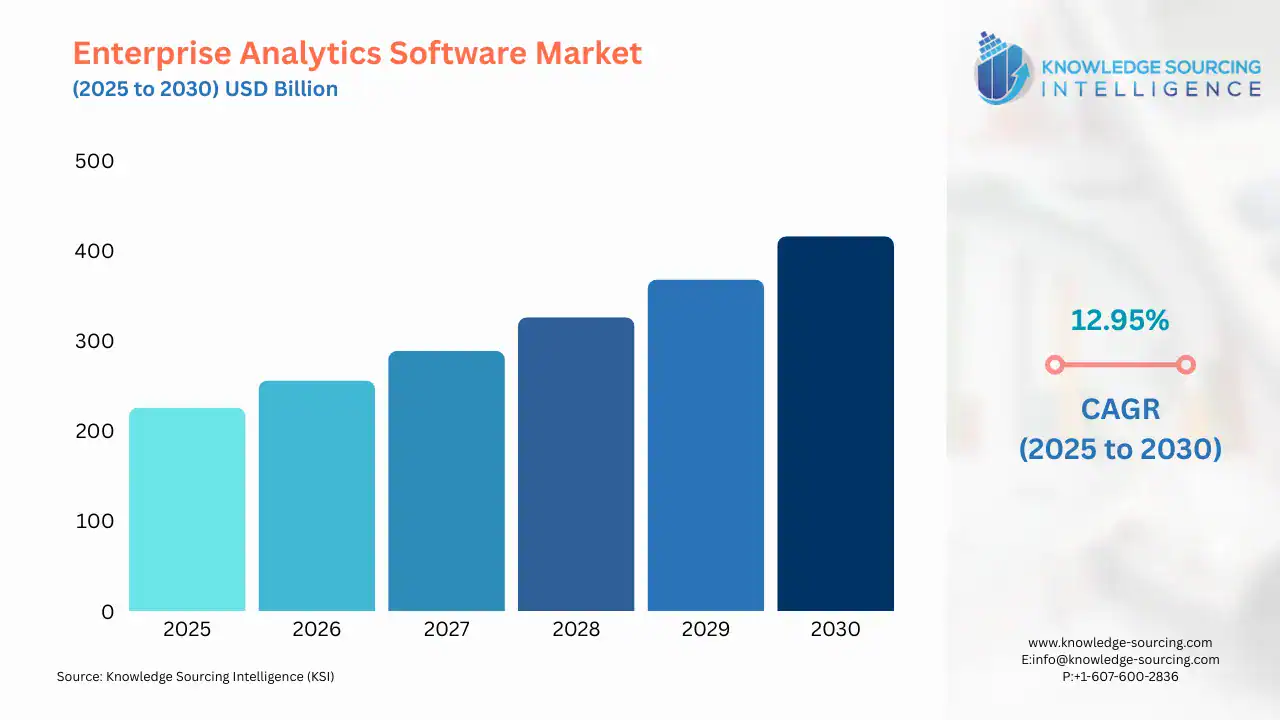
According to a research study published by Knowledge Sourcing Intelligence (KSI), the enterprise analytics software market will expand from USD 226.404 billion in 2025 to USD 416.205 billion in 2030 at a CAGR of 12.95% during the forecast period.Enterprise analytics mainly refers to big data, where organisations can perform analytical processes over the data to extract meaningful insights by using BI and analytical tools and make various decisions based on the insights. The market is projected to show robust growth during the next five years due to the rapid adoption of these tools across various industries, indicating a continuous increase in the quantity of data generated. As the amount of data across organisations is increasing, the need for streamlining business activities is also rising. Hence, the need for various tools to help the organisation's rapid analysis, management, and data optimisation is increasing. As all the functionalities are integrated into a single tool, it enables organisations to analyse the required data in less time, offering numerous economic benefits to companies and instigating its adoption across small and medium enterprises, significantly boosting market growth. Furthermore, the rising implementation of data-driven operations across various industries, such as healthcare, retail, transport, and logistics, among others, is also significantly driving the demand for various BI solutions, contributing to the market in the coming years. Furthermore, the business environment is currently highly volatile and competitive. Thus, there is an increase in the demand for strategic decisions at every step of the business, coupled with the rapid proliferation of data due to the increase in the number of data sources, which widens the opportunities for market expansion. Moreover, decision-making is also considered an integral part of the business process in today’s era, which further requires thorough analytical processing of the data and models. These tools can offer smarter decisions and more actionable insights, increasing their adoption in the coming years.
Get In-Depth Analysis of the Enterprise Analytics Software Market
This article covers the fundamentals. Our full market report provides the granular data, competitive landscape, and strategic insights you need to navigate the global enterprise analytics software industry.- ? Detailed Market Size & Growth Forecasts
- ? Key Player Analysis & Market Share
- ? Industry Vertical Trends & Regional Insights
Enterprise Analytics Software Market Highlights
- The market is segmented by offering into Business Intelligence Platforms, Traditional Business Intelligence Platforms, Data Science Platforms, and Analytics Applications. Business Intelligence Platforms consist of modern software that enables organisations to analyse their data and visualise the resulting insights via dashboards, ad hoc queries, and performance tracking. Modern Business Intelligence Platforms also typically contain self-service, artificial intelligence, and collaboration features that enhance the decision-making process. The market is segmented by enterprise size into Small and Medium enterprises and Large enterprises. Small and Medium enterprises typically do not have the budget for sophisticated analytics, so they tend to utilise low-cost and scalable analytics solutions that are typically cloud-based and produce fast insights without the need for large IT infrastructures. This will allow them to compete appropriately in the domain while keeping their operations simple and efficient.
- The market can be segmented by deployment into Cloud and On-premise. Cloud deployment is associated with delivering analytics services via the Internet without in-house servers. This allows for easy access, flexible scalability, and, as compared to an On-premise deployment, costs significantly less up-front, making it much easier for organisations to adopt analytics with speed.
- The market can also be segmented by industry verticals into BFSI, Healthcare, Retail, IT and Telecom, Manufacturing, Media and Entertainment, and Others. In Retail, for example, analytics solutions are being utilised to monitor consumer behaviour and spending, optimise supply chains, tailor promotions for customers, and monitor and manage inventory in real-time. This has enabled more rapid response rates to trends and greater customer experiences.
- North America is driving enterprise analytics software adoption due to high cloud adoption and technology developments, whereas Asia-Pacific is the fastest-growing region of enterprise analytics software consumption as a result of digital transformation across many segments, government initiatives, and increasing demand from both SMEs and Large enterprises.
Report Coverage:
| Report Metric | Details |
| Enterprise Analytics Software Market Size in 2025 | US$226.404 billion |
| Enterprise Analytics Software Market Size in 2030 | US$416.205 billion |
| Growth Rate | CAGR of 12.95% |
| Drivers |
|
| Restraints |
|
| Segmentation |
|
| List of Major Companies in the Enterprise Analytics Software Market |
|
Enterprise Analytics Software Market Growth Drivers and Restraints
Growth Drivers:- Rising Adoption of Cloud-Based Analytics: Cloud-based analytics systems have been increasingly adopted by organisations due to their inherent scalability, flexibility, and cost benefits. Businesses tend to leverage these platforms for their expedited deployment, UPFRONT architecture costs, and flexibility to work remotely, leading to the adoption of cloud-based analytics across organisations, regardless of size or industry.
- Growing Need for Data-Driven Decision-Making: Organizations are relying more heavily on analytics to understand how operations are running, predict patterns and trends, and gain a competitive advantage. Data-driven decision-making helps leaders make decisions based on facts or situations and in a confident way.
- High Implementation Costs: Enterprise analytics software is software reliant on the investment in technology, skilled human resources and process integration into the existing approaches. This level of investment obviously inhibits small and medium enterprises from taking the leap to increased or more advanced solutions.
- Data Privacy and Security Concerns: Organisations must be conscious of owning and maintaining sensitive data. As such, organisations face formidable government, business requirements, and, of course, cyber-threats. Accordingly, these challenges limit trust in analytics platforms and inhibit wider ranges of adoption in regulated industries, namely BFSI and healthcare.
Enterprise Analytics Software Market Key Development
- Collaboration: Celonis has formed a partnership with IIIT-Allahabad to develop a research centre focused on object-based process mining, AI-based business optimisation, and enterprise-based real-world issues and challenges. In addition, the research centre will provide students and faculty with a hands-on education atmosphere using workshops.
Enterprise Analytics Software Market Segmentation
Knowledge Sourcing Intelligence has segmented the Enterprise Analytics Software Market based on offering, enterprise size, deployment, industry verticals, and region: Enterprise Analytics Software Market, By Offering- Business Intelligence (BI) Platforms
- Traditional BI Platforms
- Data Science Platforms
- Analytics Applications
- Small and Medium
- Large
- Cloud
- On-premise
- BFSI
- Healthcare
- Retail
- IT and Telecom
- Manufacturing
- Media and Entertainment
- Others
- North America
- USA
- Canada
- Mexico
- Europe
- UK
- Germany
- France
- Italy
- Spain
- Others
- Asia Pacific
- China
- India
- Japan
- South Korea
- Taiwan
- Thailand
- Indonesia
- Others
- South America
- Brazil
- Argentina
- Others
- Middle East and Africa (MEA)
- Saudi Arabia
- UAE
- Others
Enterprise Analytics Software Market Key Players
- IBM Corporation
- Microsoft Corporation
- Information Builders
- Oracle
- SAP
- SAS Institute Inc.
- Tableau Software, LLC
- MicroStrategy Incorporated
- Adobe
- RapidMiner, Inc.
Go from Insight to Action with Our Market Research
You've seen the overview. Now, get the detailed data and strategic analysis you need to stay ahead in the enterprise analytics market. Explore our related, in-depth reports. Each report includes comprehensive data, forecasts, and competitive analysis to empower your business decisions.Need specialized data cuts or competitive intelligence?
Our analyst team provides bespoke market sizing, supplier audits, and country-level feasibility reports tailored to your enterprise roadmap.
Speak With an Industry Analyst →Ask an Industry Analyst
Have questions regarding this briefing or market projections? Inquire with our sector lead.
Related Press Releases
View All →
ADC Manufacturing & CDMO Market is expected to reach USD 10.49 billion by 2031
Aug 7, 2026
Lifestyle-Associated Cancer Epidemiology Market is expected to reach USD 13.12 billion by 2031
Aug 5, 2026
Psycho-Oncology Digital Health Market is anticipated to surpass USD 290.01 million in 2031 at a CAGR of 8.5%
Jul 30, 2026
Intratumoral Injection Therapy Market is expected to reach USD 630.39 million by 2031
Jul 24, 2026
Palliative Care in Oncology Market is expected to reach USD 244.1 billion by 2031
Jul 22, 2026More Press Releases
Oncology Drug Resistance Testing Market is projected to reach USD 3.41 billion in 2031 at a CAGR of 6.6 %
The oncology drug resistance testing market is expanding due to rising cancer prevalence, increasing drug resistance, and growing adoption of precision oncology. Advances in NGS-based testing, companion diagnostics, and targeted therapies, alongside FDA approvals and investments in personalized medicine, are accelerating demand for effective resistance monitoring across hospitals and clinical diagnostics worldwide.
TROP-2 Targeted Therapy Market is anticipated to surpass USD 3.29 billion in 2031 at a CAGR of 8.6 %
The TROP-2 Targeted Therapy market is expanding rapidly due to increasing precision oncology adoption, rising cancer prevalence, and growing use of antibody-drug conjugates. North America leads the market, while Asia Pacific shows the fastest growth. Continuous clinical trials, regulatory approvals, and strategic collaborations are accelerating innovation and commercial adoption worldwide.
Second Primary Cancer Prevention Market is expected to reach USD 24.7 billion by 2031
The Second primary cancer prevention refers to strategies aimed at reducing the risk of developing a new, unrelated cancer in individuals with a prior cancer diagnosis. Growing cancer survivorship, advances in treatment, and increasing awareness of long-term health outcomes have heightened the importance of prevention and surveillance programs. Key approaches include routine screening, genetic risk assessment, lifestyle modification, and long-term follow-up care. Government agencies and healthcare organisations increasingly emphasise survivorship care plans and evidence-based screening protocols to detect new malignancies at earlier stages. Continued investments in early detection technologies and personalised risk assessment are expected to support advancements in second primary cancer prevention.