
Artificial Intelligence (AI) has shown a massive increase in growth during the past two years, coupled with the increasing adoption and development of automation and technology worldwide for a wide variety of applications in healthcare, food and beverage, construction, and many other industries. AI...
- Automation and Robotic Process Automation (RPA): Aids in the execution of high-volume, repetitive tasks, augmenting efficiency, and freeing human resources for intricate tasks.
- Machine Learning and Deep Learning: Enables computers to learn from data through Machine Learning (ML) and allows for the implementation of predictive analysis through neural networks through the use of Deep Learning (DL).
- Machine and Computer Vision: Empowers machinery to interpret visual information.
- Natural Learning Processing (NLP): Enables machinery to understand and respond to human language. Examples include GPT-4 by OpenAI.
- Robotics: Allows the integration of ML and computer vision to build robots that are capable of performing complex tasks such as manufacturing, healthcare, and space exploration.
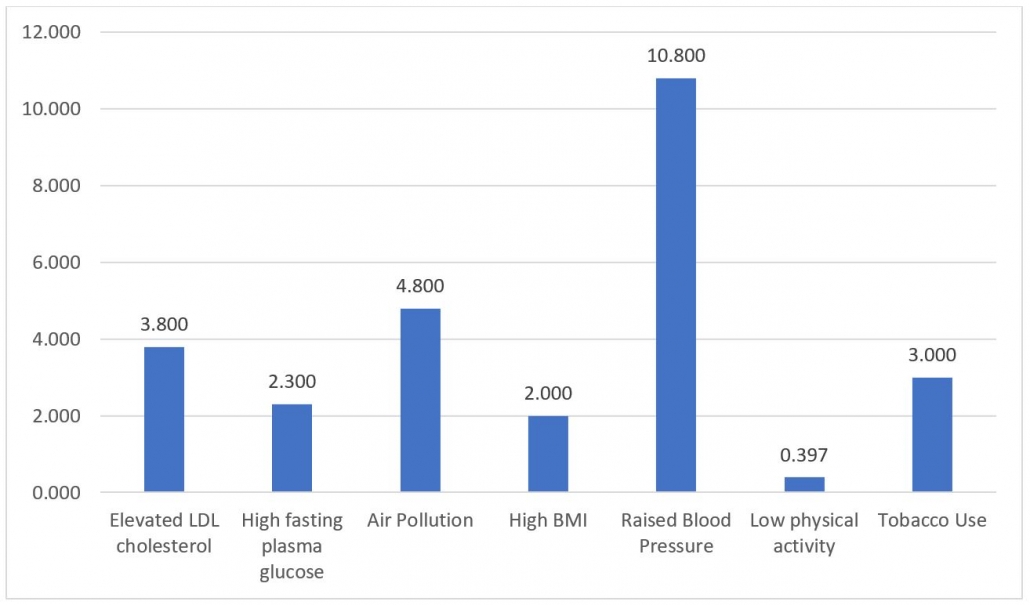 (in millions of people)
Source: World Heart Report, World Heart Federation
Another factor that leads to the increasing prevalence of heart and brain diseases in the market is the increasing aged population worldwide. Aging is one of the major factors that propel the increasing risk factor of heart and brain diseases, which include coronary heart disease, Alzheimer’s disease, Amyotrophic lateral sclerosis (ALS) disease, and many others. The increase in the number of elderly people will increase the need for improved healthcare facilities and technologies, which include MRI devices. AI in MRI devices will help improve the diagnosis through efficiency and improved information collection and production. The World Health Organization states that the number of people aged 60 years and above will account for 1 in 6 people by 2030. It was also stated that the global population of those who are aged 60 years and above will account for an increase from 1 billion in 2020 to 1.4 billion by 2030, which will be expected to double in size to 2.1 billion by 2050. It was also stated that the number of people aged 80 years and above will be expected to triple to reach 426 million by 2050. The increase in the global aged population will lead to an increased prevalence of heart and brain diseases or injuries, further driving the need for MRI devices or scanners in the healthcare sector, coupled with developing technologies such as artificial intelligence integrated into the machinery, helping prevent diseases before occurring or increasing in risk in the human body.
Figure 2: Projected Aged Population Growth, Global, by Billion, 2020-2050
(in millions of people)
Source: World Heart Report, World Heart Federation
Another factor that leads to the increasing prevalence of heart and brain diseases in the market is the increasing aged population worldwide. Aging is one of the major factors that propel the increasing risk factor of heart and brain diseases, which include coronary heart disease, Alzheimer’s disease, Amyotrophic lateral sclerosis (ALS) disease, and many others. The increase in the number of elderly people will increase the need for improved healthcare facilities and technologies, which include MRI devices. AI in MRI devices will help improve the diagnosis through efficiency and improved information collection and production. The World Health Organization states that the number of people aged 60 years and above will account for 1 in 6 people by 2030. It was also stated that the global population of those who are aged 60 years and above will account for an increase from 1 billion in 2020 to 1.4 billion by 2030, which will be expected to double in size to 2.1 billion by 2050. It was also stated that the number of people aged 80 years and above will be expected to triple to reach 426 million by 2050. The increase in the global aged population will lead to an increased prevalence of heart and brain diseases or injuries, further driving the need for MRI devices or scanners in the healthcare sector, coupled with developing technologies such as artificial intelligence integrated into the machinery, helping prevent diseases before occurring or increasing in risk in the human body.
Figure 2: Projected Aged Population Growth, Global, by Billion, 2020-2050
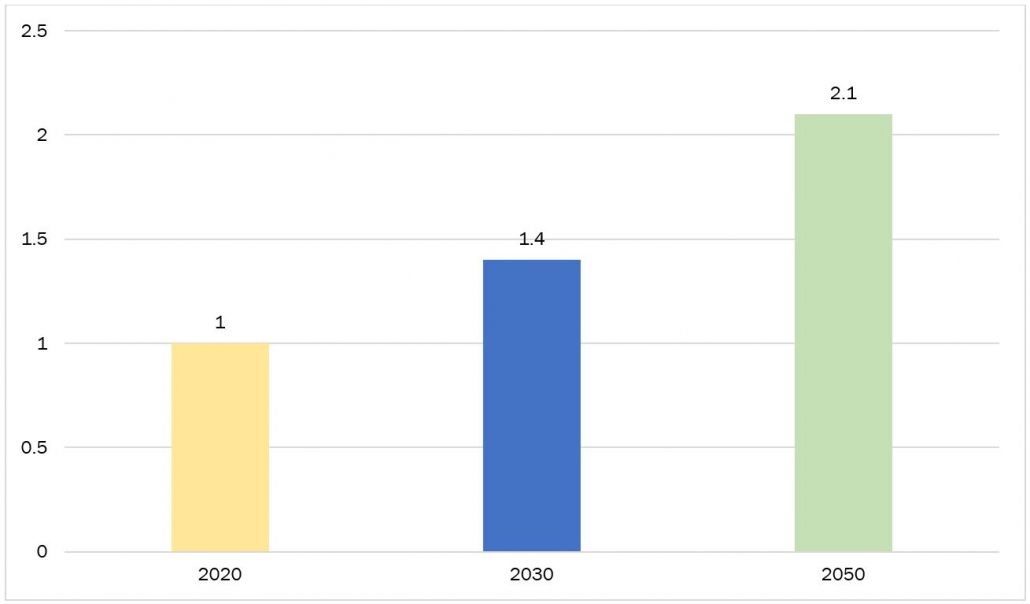 (in billions of people)
Source: World Health Organization
Key Developments:
August 2023: Fujifilm announced the launch of their new MRI system that consists of Deep Learning Reconstruction technology, dubbed ECHELON Synergy. The 1.5 Tesla magnetic resonance imaging (MRI) system employs Synergy DLR, which is Fujifilm’s proprietary Deep Learning Reconstruction (DLR) technology that is powered by AI, that enhances the sharpness of images and produces scans faster, contributing to a higher throughput, image quality, and patient satisfaction.
July 2022: Siemens Healthineers announced the acceleration and improvement of their Magnetic Resonance Imaging (MRI) with artificial intelligence, dubbed Deep Resolve. This deep learning solution for image reconstruction removes the dilemma of the trade-off between scan time, resolution, and image noise of MRI scans. This improved the efficiency and productivity of MRI scanners by allowing clinicians to choose a significantly faster scan time, further reducing noise and maintaining the resolution or even improving the image quality. The solution works with the scanner’s raw data to use AI algorithms, improving the image from the first steps of image reconstruction.
(in billions of people)
Source: World Health Organization
Key Developments:
August 2023: Fujifilm announced the launch of their new MRI system that consists of Deep Learning Reconstruction technology, dubbed ECHELON Synergy. The 1.5 Tesla magnetic resonance imaging (MRI) system employs Synergy DLR, which is Fujifilm’s proprietary Deep Learning Reconstruction (DLR) technology that is powered by AI, that enhances the sharpness of images and produces scans faster, contributing to a higher throughput, image quality, and patient satisfaction.
July 2022: Siemens Healthineers announced the acceleration and improvement of their Magnetic Resonance Imaging (MRI) with artificial intelligence, dubbed Deep Resolve. This deep learning solution for image reconstruction removes the dilemma of the trade-off between scan time, resolution, and image noise of MRI scans. This improved the efficiency and productivity of MRI scanners by allowing clinicians to choose a significantly faster scan time, further reducing noise and maintaining the resolution or even improving the image quality. The solution works with the scanner’s raw data to use AI algorithms, improving the image from the first steps of image reconstruction.Have questions?
More Thought Articles
How EV Charger Manufacturers Can Capitalize on India’s Home Charging Revolution
India’s residential EV charging opportunity is expanding as policy support, EV adoption, and private parking infrastructure develop. Manufacturers can capture value beyond AC chargers through installation, smart charging, load management, solar integration, software, and after-sales services. Housing societies, automakers, and property developers offer scalable routes to residential charging customers.
Second-Life EV Battery Market in India: What Is Driving Demand from Manufacturers?
India’s second-life EV battery market is gaining relevance as electric vehicle adoption expands and batteries retain useful capacity after automotive service. Growing stationary-storage demand, battery data, refurbishment capabilities, EPR obligations, and critical-mineral policies are encouraging manufacturers to extend battery value through reuse before eventual recycling within India’s emerging circular battery ecosystem.
The Rise of Locally Manufactured Battery Separators in India’s EV Ecosystem
India’s battery industry is progressing from pack assembly toward domestic cell and material manufacturing, creating opportunities for lithium-ion battery separators. Policy support, ACC capacity expansion and R&D initiatives are strengthening the ecosystem. However, technical complexity, manufacturing yields, qualification requirements and economics mean localisation will likely advance gradually through coatings, testing and finishing.