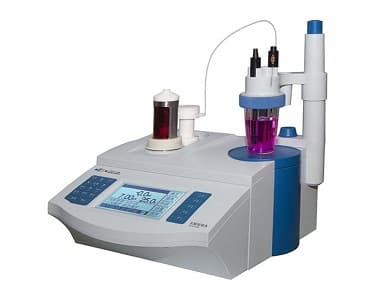
The global potentiometric titration market is projected to grow at a CAGR of 6.21% during the forecast period....
The global potentiometric titration market is projected to grow at a CAGR of 6.21% during the forecast period.
Potentiometric titration is a technique for determining the concentration of a substance. It is frequently employed in the pharmaceutical sector for the analysis of various raw materials and final products. It is used to determine the final concentration of the medication. Potentiometric titration is utilized in several businesses that have high-quality criteria. The potentiometric titration procedure is used in the food and beverage sector to maintain quality control and regulatory standards.
In the petrochemical, pharmaceutical, chemical, and personal care sectors, the technique is employed in the quality control department and R&D laboratories. Due to this reason, the global market for potentiometric titration is anticipated to grow, especially with the pharmaceutical sector rising.
Mettler Toledo, Xylem, Hach, Hanna Instruments, Inc, KEM Co. Ltd., Jinan Hanon Instruments Co Ltd, Spectra Lab Instruments Pvt ltd and, and Scientific technology solutions are a few key major players in the market of potentiometric titration.
Mettler Toledo, based in Switzerland and incorporated in the United States, is an international maker of scales and analytical equipment. It is the world's leading manufacturer of weighing equipment for pharma and biotech, industrial, food retailing, and other uses. The company also offers a variety of equipment classified as analytical, process analytics, and others. The company provides a wide variety of potentiometric titrators. The T5 Excellence titrator, for example, provides complete flexibility for both potentiometric and Karl Fischer applications and may be expanded from 1 to 4 total burettes. For high throughput testing, it also supports "InMotion" automation. This product line includes three different types of titrators: T5, T7, and T9 Excellence titrators.
SI Analytics, a Xylem trademark originally known as SCHOTT instruments, has been recognized for high-quality titrators and other instruments for over 40 years. Their product line includes the TITRONIC 300 piston burette for easy dosing and manual titration, as well as the TitroLine 7800 with sample changer TW 7200 / TW 7450 and TitriSoft software for sophisticated titration operations. The gadgets are employed in all industries, including research, pharmaceutical, chemical, food and beverage, and others. All gadgets and software offer ease through innovative features and simple operation. For instance, the TitroLine 7000 potentiometric titrator includes a high-resolution and accurate pH/ mV measurement interface, allowing it to swiftly determine a wide variety of parameters. Additionally, the TitroLine 5000 Module is a simple automated titrator with a 50 ml dosing unit and pH-electrode for pH titrations.
Hanna Instruments, located in Rhode Island, is a global producer of analytical instruments that was founded in 1978 in Italy. The company has a global network of over 40 companies in over 32 countries. It has production facilities in Romania, Singapore, Hungary, and Mauritius. The company provides, the Automatic Potentiometric Titrator - HI901C that has an exchangeable Clip Lock burette system for easily separating and switching between reagents, as well as a live titration curve for instantly recognizing trends that may emerge during analysis. Furthermore, The HI931 Automatic Titrator is entirely customizable, delivering accurate results and a straightforward user experience, as well as an unrivaled 40,000-step dosing pump for tiny quantities of titrant to assist in achieving a highly precise endpoint for increased consistency.
Scientific Technology Solutions is a leading provider, manufacturer, and exporter of Volumetric Karl Fischer Titrator. It is an ISO-recognised company that was founded in 2005 to create and supply a wide variety of HPCL and electrochemistry products. The company sells its products across the Gulf, Africa, and Asia. The firm provides a volumetric Karl Fischer titrator, which is specially built for the chemical analysis of fluids to identify unknown quantities of substances. It has an ideal resolution and measurement range, as well as the ability to pre-set the titration endpoint and many other features.
Global Potentiometric Titration Market Scope:
| Report Metric | Details |
| Growth Rate | CAGR of 6.21% from 2020 to 2027 |
| Base year | 2020 |
| Forecast period | 2022–2027 |
| Forecast Unit (Value) | USD Billion |
| Segments covered | End-User Type, And Geography |
| Regions covered | North America, South America, Europe, Middle East and Africa, Asia Pacific |
| Companies covered | Mettler Toledo, Xylem, Hach, Hanna Instruments, Inc, KEM Co. Ltd., Jinan Hanon Instruments Co Ltd, Spectra Lab Instruments Pvt ltd, Scientific technology solutions |
| Customization scope | Free report customization with purchase |
Have questions?
More Thought Articles
How EV Charger Manufacturers Can Capitalize on India’s Home Charging Revolution
India’s residential EV charging opportunity is expanding as policy support, EV adoption, and private parking infrastructure develop. Manufacturers can capture value beyond AC chargers through installation, smart charging, load management, solar integration, software, and after-sales services. Housing societies, automakers, and property developers offer scalable routes to residential charging customers.
Second-Life EV Battery Market in India: What Is Driving Demand from Manufacturers?
India’s second-life EV battery market is gaining relevance as electric vehicle adoption expands and batteries retain useful capacity after automotive service. Growing stationary-storage demand, battery data, refurbishment capabilities, EPR obligations, and critical-mineral policies are encouraging manufacturers to extend battery value through reuse before eventual recycling within India’s emerging circular battery ecosystem.
The Rise of Locally Manufactured Battery Separators in India’s EV Ecosystem
India’s battery industry is progressing from pack assembly toward domestic cell and material manufacturing, creating opportunities for lithium-ion battery separators. Policy support, ACC capacity expansion and R&D initiatives are strengthening the ecosystem. However, technical complexity, manufacturing yields, qualification requirements and economics mean localisation will likely advance gradually through coatings, testing and finishing.