
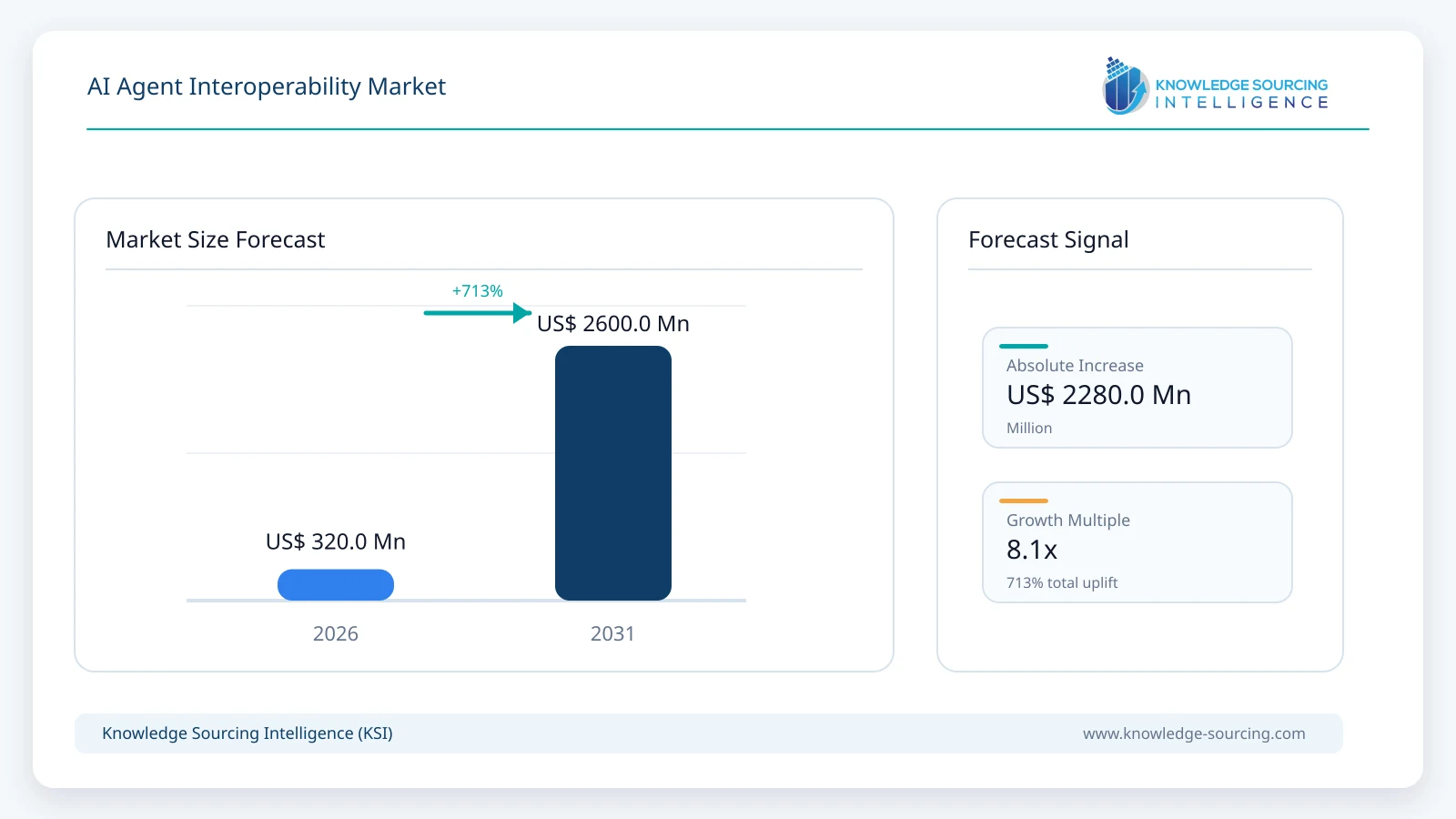
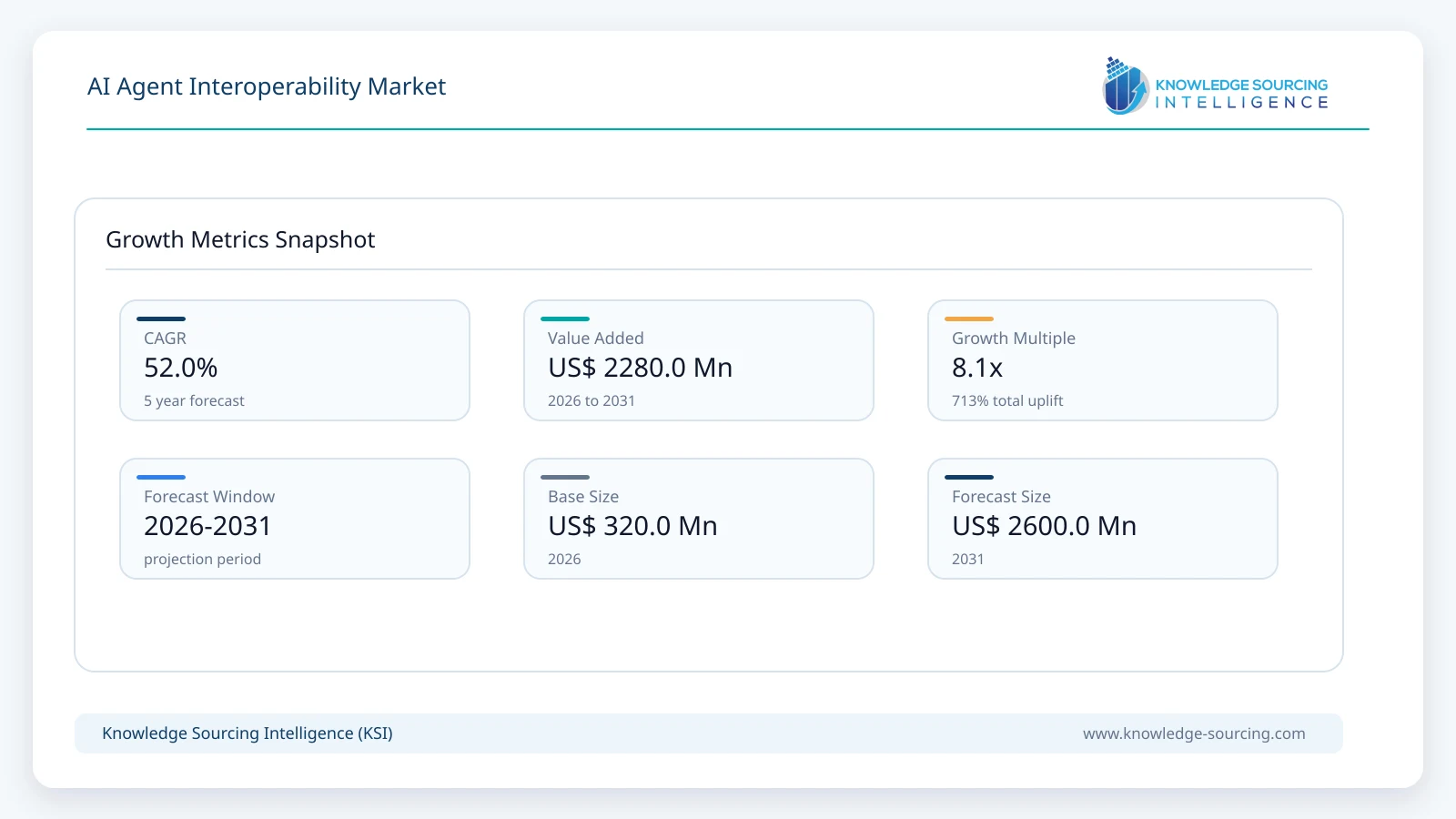
The AI Agent Interoperability Market is forecast to grow at a CAGR of 52.0%, reaching USD 2,600.0 million in 2031 from USD 320.0 million in 2026.
Highlights:
- 1Supported protocol mediation remains the largest commercial offering, with interoperability services extending into catalogs and portable task exchange.
- 2Cross-cloud agent collaboration is becoming practical as enterprise platforms expose external-agent discovery and compatible task interfaces.
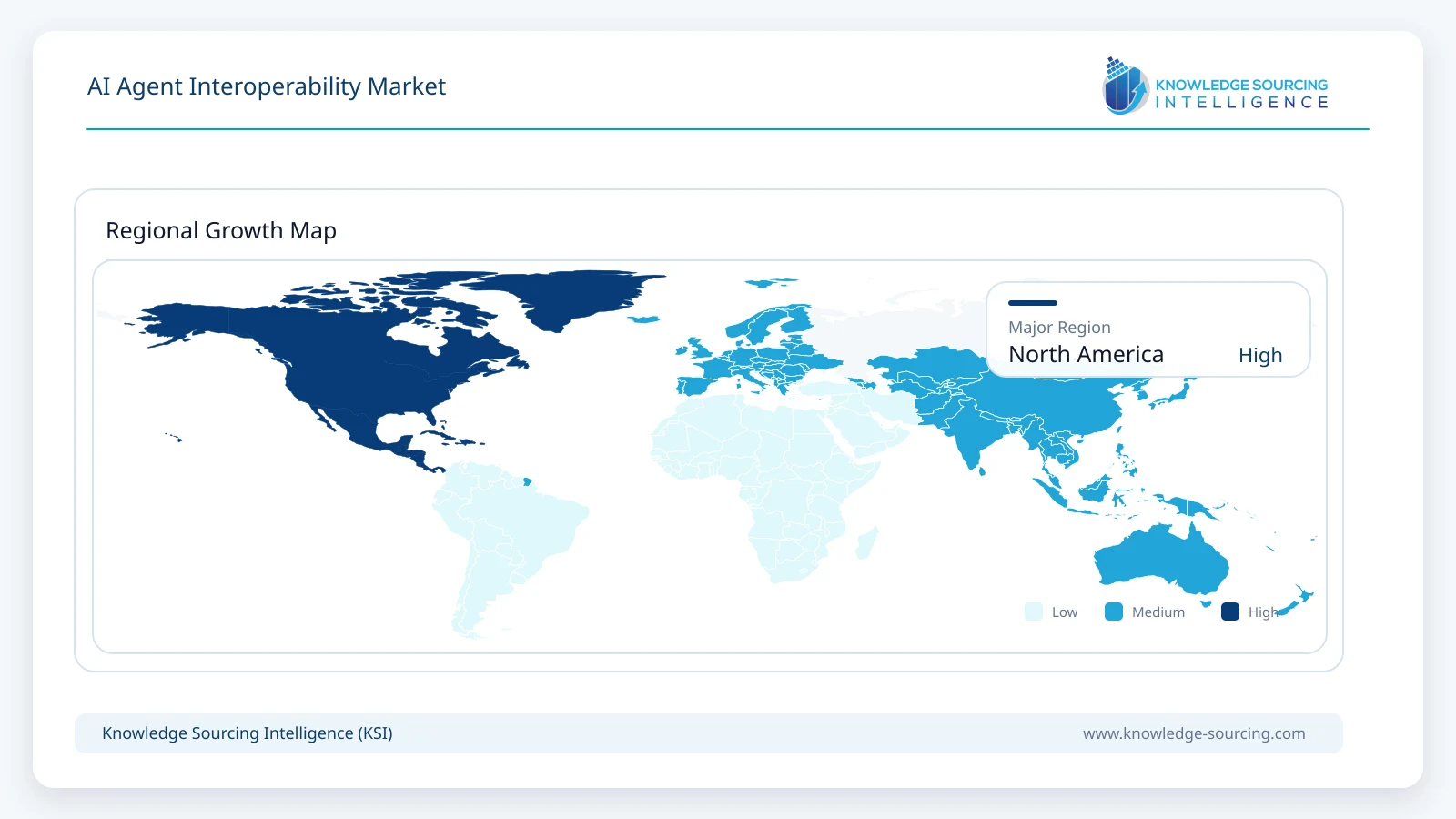
- 3North America leads current spending, while Asia Pacific has the strongest projected regional growth.
- 4Open standards are encouraging adoption, but enterprise customers still require dependable compatibility, support and operational controls.
- 5Persistent registries and standardized skill artifacts are increasingly important as organizations operate larger fleets of specialist agents.
The market encompasses commercial services that allow independent AI agents to discover one another, exchange tasks and operate across differing software frameworks, applications and cloud platforms.
The report examines protocol mediation, managed capability discovery, portable task and context exchange, and cross-vendor compatibility services. Market participants provide these functions through managed cloud products, supported enterprise integrations, private deployments, and related subscriptions. Technology assessment considers how interoperable agents discover approved specialists, transfer structured results, and maintain usable connections as platforms change.
The research analyzes seven segmentation dimensions and demand across North America, South America, Europe, the Middle East and Africa, and Asia Pacific. Competitive assessment covers major cloud providers, enterprise software vendors, and integration specialists serving organizations with mixed agent environments. Adoption trends are evaluated across technology, financial services, retail, industrial operations, and other sectors.
Market Overview
Enterprises are deploying software agents in customer service, software delivery, finance, and operations, but these agents frequently originate from different systems. A customer support agent may need a billing specialist hosted on a separate platform, while a supply-chain workflow can require several agents to exchange structured tasks and results. Without interoperable interfaces, every such relationship becomes a custom software integration that must be maintained when one product changes.
Agent-to-agent communication standards provide a foundation for cross-system exchanges, while agent registries describe what each participant can do. IBM now supports the discovery and management of agents on multiple major clouds. Google has expanded registries for tools and skills, and Salesforce and ServiceNow support collaboration between native and external agents. The commercial challenge is to make those different capabilities work reliably within enterprise procedures.
Interoperability also extends beyond transmitting messages. Agents must agree on task meaning, acceptable outputs, and which system owns a handoff when an operation fails. Buyers therefore evaluate managed compatibility, registry quality, task artifact conversion and supplier support alongside protocol implementation. Enterprises with a limited number of internally built agents may still prefer direct integrations, but larger mixed estates create stronger demand for reusable shared services.
Market Trends
Agent Catalogs Develop into Federated Discovery Services
Enterprise agent inventories are shifting from simple lists of bots toward searchable records of capabilities, ownership and connection contracts. IBM's September and October releases allow users to discover agents created on major external cloud platforms and bring them into a common management view.
Decentralized discovery is developing alongside enterprise catalogs. The Linux Foundation launched DNS-AID in May 2026, proposing use of established DNS infrastructure to locate and verify agents and MCP servers. Centralized registries remain useful for policy-controlled internal estates, while federated directories can support collaboration across suppliers and customers.
Cross-Cloud Agent Handoffs Move Toward Managed Operations
Cross-cloud interoperability is becoming a practical requirement as enterprises adopt different agent ecosystems for distinct departments. IBM watsonx Orchestrate added discovery of Amazon AgentCore agents and then expanded support to Microsoft Foundry and Google Gemini Enterprise Agent Platform in 2026. Microsoft and Google also document cross-platform A2A connections.
The operational challenge extends beyond making the first connection. Long-running tasks need clear ownership, status updates, and predictable handling when a remote agent stops responding. Compatibility services that translate task artifacts, manage revisions, and test fallback behavior can reduce rework.
Compatibility Becomes a Product Rather Than a One-Time Integration
Managed interoperability providers are increasingly packaging protocol updates, connector maintenance, contract checks and multi-agent testing as continuing services. Boomi, Kong, Workato and MuleSoft already manage complex integration environments and can extend those relationships to agent interactions.
Interoperability contracts are therefore moving toward supported registries and recurring enterprise compatibility subscriptions alongside metered protocol exchanges. Open standards help limit lock-in, but commercial differentiation lies in deployment support, workflow portability and observable reliability. Suppliers with existing enterprise integration customers have a distribution advantage, although specialist providers can compete where they simplify fast-moving A2A and MCP implementations.
Portable Skills and Task Artifacts Expand the Ecosystem
Agent portability increasingly depends on reusable task definitions, supported tool interfaces, and standard output artifacts. The Agentic AI Foundation added Agent Skills and Open Responses to its hosted projects in October 2026, broadening shared work beyond message transport.
Portable task descriptions do not automatically transfer business permissions or state, so enterprise deployments still require explicit mappings and testing. Organizations may purchase supported conversions for skills, context fields, and execution artifacts where workflows span customer systems.
Segment Analysis
By Commercial Offering: Protocol Exchange and Supported Mediation
Paid protocol mediation remains the largest revenue stream, representing USD 235 million in 2026 and USD 1.725 billion by 2031. Managed A2A and MCP routing provides a common transport for agent and tool interaction, enabling developers to reuse compatible services across different stacks.
By Interoperability Capability: Protocol Transport and Invocation
Protocol transport and invocation accounts for USD 130 million in 2026 and an estimated USD 835 million by 2031, making it the largest functional capability. Standard requests help agents reach remote tools and collaborating agents without unique point-to-point code.
By Interoperability Topology: Managed Cross-Platform Mediation
Managed cross-platform mediation leads the topology view, increasing from USD 145 million in 2026 to USD 1.13 billion by 2031. In this arrangement, a shared service coordinates agent registration, supported routing and handoff compatibility between otherwise independent environments.
By Connected Agent Ecosystem: Cross-Cloud Platforms
Cross-cloud model and agent platforms account for USD 100 million in 2026 and are forecast to reach USD 880 million in 2031. Large enterprises commonly deploy agents on AWS, Microsoft and Google services while retaining application-native agents from software vendors.
By Deployment Environment: Managed Public Cloud
Managed public cloud accounts for USD 171 million in 2026 and is projected to reach USD 1.40 billion by 2031. Hosted agent registries, protocol gateways and compatibility services reduce the cost of maintaining distributed integration systems.
By Primary Application: Cross-Department Workflow Cooperation
Cross-department workflow cooperation represents USD 110 million in 2026 and is forecast to reach USD 860 million by 2031. Sales, finance, procurement and operations teams increasingly create specialist agents that must contribute to one end-to-end task.
By End-User Industry: Technology and Software
Technology and software companies generate the largest early demand, at USD 99 million in 2026, increasing to USD 735 million by 2031. Cloud operators, software vendors and developers introduce agent networks earlier than many traditional industries and often operate several frameworks concurrently.
Market Drivers
Rising Complexity of Multivendor Agent Estates
Large companies are introducing agents through cloud platforms, software suites and internally developed services at the same time. An operations agent may need a finance agent in another environment to validate a transaction or retrieve a status before an action can proceed.
Enterprise Demand for Reusable Agent Discovery
Unmanaged agent directories create duplicated tools, unknown capabilities and fragile hardcoded endpoints. Capability registries and searchable catalogs give developers a repeatable way to find approved specialist agents and understand which functions they provide. Google has expanded enterprise tool and skill registries, while the Linux Foundation's DNS-AID initiative promotes decentralized discovery.
Expansion of Cross-Platform Business Processes
Agent collaboration is moving beyond a single task or department into connected service, procurement and IT workflows. Salesforce supports multi-agent connections, IBM supports A2A-enabled external agents, and ServiceNow connects third-party systems through AI Agent Fabric.
Standardization of Protocol and Artifact Exchange
The growing adoption of A2A and MCP reduces the need for proprietary connections, but a working enterprise network also needs compatible task metadata, skills, artifacts and lifecycle handling. The Linux Foundation reported more than 150 organizations supporting A2A in April 2026, and the Agentic AI Foundation expanded its shared project base in October.
Cross-Cloud Deployment and Portability Requirements
Multicloud environments force organizations to move context and tasks between agent services with different runtimes, tool definitions and policy systems. IBM's expansion from Amazon AgentCore discovery to Microsoft Foundry and Google Gemini Enterprise Agent Platform demonstrates direct customer demand for federation across providers.
Market Restraints
Open Standards and Bundled Capabilities Limit Pricing
A2A and MCP specifications are available without proprietary protocol licenses, and major software platforms increasingly include basic interoperability functions within existing subscriptions. Salesforce, for example, documents agent connectivity that is built into Agentforce configurations, limiting the scope for a separate fee simply for protocol compliance. Interoperability suppliers therefore need to demonstrate value through managed catalogs, compatibility, reliability and enterprise service commitments. Small deployments can often rely on open-source tools or existing integration software instead of buying a dedicated service.
Inconsistent Semantics Between Different Agent Systems
A successful protocol connection does not guarantee that two agents interpret a task, permission, confidence signal or output artifact in the same way. Teams may still need to translate business terms, normalize schemas and validate the meaning of returned results. An account-opening agent and a compliance agent can exchange messages correctly while disagreeing about what constitutes an approved customer. These semantic differences create testing overhead and can delay procurement of cross-vendor agent networks in regulated industries.
Security and Trust Across Organizational Boundaries
Agent discovery exposes capabilities that may trigger sensitive actions or access confidential records, making trust and authorization central to deployment. External agents must be verified, given limited rights and prevented from forwarding confidential data into unsupported environments. NIST and the Linux Foundation are developing frameworks addressing interoperability and trusted discovery, but enterprises still bear the cost of designing permissions and audit trails. Security reviews are particularly demanding for financial transactions, healthcare records and government systems.
Fragmented Maturity and Version Support
Commercial agent platforms are adopting A2A, MCP and proprietary interfaces at different speeds, and some integrations remain previews rather than broadly available features. SAP's October 2026 architecture notes that bidirectional third-party agent communication has not yet reached general availability, illustrating the gap between reference designs and deployed products. Enterprises must test versions and fallback behavior across each environment. Delayed releases, partial support and uneven error handling can reduce the near-term value of an interoperable agent estate.
Difficult Return-on-Investment Measurement
Managers can measure individual agent call volume, but the financial benefit of cross-platform collaboration is harder to isolate. A successful workflow may involve several agents, data services and human approvals, so the interoperability layer is only one contributor to the outcome. Customers may resist another recurring platform fee unless they can demonstrate fewer custom integrations, faster launches or lower operational failures. Consolidation inside existing API management and enterprise workflow suites also creates pressure on standalone compatibility providers.
Regional Outlook
North America
North America is estimated at USD 139.2 million in 2026 and is forecast to reach USD 1.014 billion by 2031, retaining the largest regional market position. The United States is the principal demand center because major cloud providers, enterprise application companies and agent-development ecosystems are concentrated there. IBM, Google, AWS, Microsoft and Salesforce support interoperability through their agent platforms, while banks and software firms increasingly operate several agent frameworks across different departments.
North American enterprises are placing greater emphasis on shared agent directories, reusable task contracts and predictable governance across vendor boundaries. Financial institutions and large technology companies are particularly exposed to integration complexity because different departments procure specialized systems independently. Supported cross-cloud compatibility and consistent discovery become important when an organization needs to extend a working agent application without rebuilding its surrounding integrations.
Asia Pacific
Asia Pacific is projected to increase from USD 76.8 million in 2026 to USD 806 million in 2031, making it the fastest-growing regional market. China, India, Japan, South Korea, Australia and Singapore have extensive enterprise software activity and increasing investment in automated service and industrial workflows. Large technology companies and regional solution providers are connecting agents with cloud services, e-commerce platforms and local business applications, creating demand for interoperable task exchange.
Regional growth is supported by a mix of domestic cloud ecosystems and multinational enterprise technology deployments. Indian and Southeast Asian software-services organizations can support interoperability across customer-specific platforms, while Japanese and Korean industrial companies require dependable integration with established operational systems. Multilingual interfaces, local hosting requirements and different software stacks make managed compatibility and reusable agent directories commercially relevant throughout the region.
Competitive Landscape
Competition is distributed across cloud platforms, enterprise application providers and specialist integration software companies. Google, Microsoft and AWS offer native pathways for building and connecting agents, while IBM is expanding cross-cloud discovery and operational management. Salesforce and ServiceNow focus on collaboration across enterprise workflows, whereas Boomi, Workato, Kong, Solace and MuleSoft contribute established connectivity and gateway capabilities. Buyers can therefore obtain interoperability through different purchasing routes rather than one standalone product category.
Suppliers differentiate through supported agent ecosystems, availability, version handling, catalog controls and the cost of maintaining live integrations. Open A2A and MCP standards reduce dependence on proprietary interfaces, encouraging vendors to compete through reliable managed services and practical integration with business applications. Enterprises will increasingly compare interoperability tools on whether they prevent duplicate development and maintain consistent task outcomes when agents or platforms are upgraded.
Recent Developments
22 October 2026: The Linux Foundation announced four new Agentic AI Foundation projects, including Agent Skills and Open Responses, extending shared standards for capability portability and model-facing interoperability.
2 October 2026: IBM detailed cross-platform discovery of agents built on Microsoft Foundry and Google Gemini Enterprise Agent Platform through watsonx Orchestrate, following prior Amazon AgentCore integration.
17 August 2026: Salesforce listed general availability of multi-agent orchestration for Agentforce in its August platform updates, expanding native inter-agent workflow options.
27 May 2026: The Linux Foundation launched DNS-AID, an open project for decentralized discovery and verification of agents and MCP servers.
22 April 2026: Google Cloud announced Gemini Enterprise Agent Platform with agent registry, deployment and management functions for enterprise agent collaboration.
9 April 2026: The Linux Foundation reported that A2A had more than 150 supporting organizations and production adoption across several enterprise sectors.
Market Outlook
AI agent interoperability is expected to become a more established part of enterprise technology deployment as organizations operate agents supplied by different vendors and internal development teams. Protocol messaging will remain a major commercial activity, while discovery catalogs and portable task services will become more important for managing larger networks. Enterprises will invest where interoperable services reduce repeated engineering and improve coordination between specialist systems.
Managed public cloud services are likely to lead deployment because they simplify connection maintenance and offer access to existing cloud-based agents. Dedicated and hybrid arrangements will remain relevant where regulated information or local business systems constrain external communication. Product development will focus on cross-framework reliability, better context and artifact translation, and clearer contracts for supported agent capabilities.
Competition will favor providers that connect technical interoperability with the operational needs of business users. Open standards will make basic integration more accessible, but complex enterprises will still require dependable catalog management, compatibility testing and support for changing platform releases. The strongest adoption opportunities will arise where several agents must collaborate repeatedly across organizations or departments without sacrificing task consistency.
AI Agent Interoperability Market Scope:
| Report Metric | Details |
|---|---|
| Total Market Size in 2026 | USD 320.0 million |
| Total Market Size in 2031 | USD 2,600.0 million |
| Forecast Unit | USD Million |
| Growth Rate | 52.0% |
| Study Period | 2021 to 2031 |
| Historical Data | 2021 to 2024 |
| Base Year | 2025 |
| Forecast Period | 2026 – 2031 |
| Segmentation | Commercial Offering, Interoperability Capability, Interoperability Topology, Connected Agent Ecosystem |
| Companies |
|
| Customization Scope | 15% Free Customization included with purchase — Request Custom Breakdown → |
| Sample & Data Access | PDF Sample, Excel Databook & Analyst Briefing — Download Free Sample → |
Market Segmentation
By Commercial Offering
Protocol Exchange and Supported Mediation
Cross-platform Agent Discovery Subscriptions
Portable Context, Skill and Task Handoff Services
Cross-vendor Compatibility and Lifecycle Controls
By Interoperability Capability
Protocol Transport and Invocation
Agent Capability Discovery and Registries
Cross-framework Delegation and Context Exchange
Portable Task, Skill and Artifact Schemas
Compatibility Management and Verification
By Interoperability Topology
Managed Cross-platform Mediation
Federated Enterprise Agent Networks
Registry-led Service Federation
Embedded SDK and Connector Compatibility
By Connected Agent Ecosystem
Cross-cloud Model and Agent Platforms
Enterprise SaaS and Workflow Agents
Open-framework and Custom Agents
Edge and Industry-specific Agent Estates
By Deployment Environment
Managed Public Cloud
Dedicated Cloud and Private VPC
Hybrid and On-premises
Distributed and Edge Environments
By Primary Application
Cross-department Workflow Cooperation
IT Operations and Software Engineering
Customer Service Collaboration
Finance, Risk and Compliance Processes
Supply-chain and Industrial Coordination
By End-user Industry
Technology and Software
Banking and Financial Services
Retail and E-commerce
Manufacturing and Logistics
Healthcare and Life Sciences
Professional and Business Services
Government and Other Industries
By Geography
North America
United States
Canada
Mexico
South America
Brazil
Argentina
Chile
Rest of South America
Europe
United Kingdom
Germany
France
Netherlands
Italy
Spain
Rest of Europe
Middle East and Africa
United Arab Emirates
Saudi Arabia
Israel
South Africa
Rest of Middle East and Africa
Asia Pacific
China
India
Japan
South Korea
Australia
Singapore
Rest of Asia Pacific
Table of Contents
1. EXECUTIVE SUMMARY
2. MARKET SNAPSHOT
2.1. Market Overview
2.2. Market Definition
2.3. Scope of the Study
2.4. Market Segmentation
3. BUSINESS LANDSCAPE
3.1. Market Drivers
3.1.1. Rising Complexity of Multivendor Agent Estates
3.1.2. Enterprise Demand for Reusable Agent Discovery
3.1.3. Expansion of Cross-Platform Business Processes
3.1.4. Standardization of Protocol and Artifact Exchange
3.1.5. Cross-Cloud Deployment and Portability Requirements
3.2. Market Restraints
3.2.1. Open Standards and Bundled Capabilities Limit Pricing
3.2.2. Inconsistent Semantics Between Different Agent Systems
3.2.3. Security and Trust Across Organizational Boundaries
3.2.4. Fragmented Maturity and Version Support
3.2.5. Difficult Return-on-Investment Measurement
3.3. Market Opportunities
3.4. Porter's Five Forces Analysis
3.5. Value Chain Analysis
3.6. Policies and Regulations
3.7. Strategic Recommendations
4. TECHNOLOGICAL OUTLOOK
5. AI AGENT INTEROPERABILITY MARKET BY COMMERCIAL OFFERING
5.1. Introduction
5.2. Protocol exchange and supported mediation
5.3. Cross-platform agent discovery subscriptions
5.4. Portable context, skill and task handoff services
5.5. Cross-vendor compatibility and lifecycle controls
6. AI AGENT INTEROPERABILITY MARKET BY INTEROPERABILITY CAPABILITY
6.1. Introduction
6.2. Protocol transport and invocation
6.3. Agent capability discovery and registries
6.4. Cross-framework delegation and context exchange
6.5. Portable task, skill and artifact schemas
6.6. Compatibility management and verification
7. AI AGENT INTEROPERABILITY MARKET BY INTEROPERABILITY TOPOLOGY
7.1. Introduction
7.2. Managed cross-platform mediation
7.3. Federated enterprise agent networks
7.4. Registry-led service federation
7.5. Embedded SDK and connector compatibility
8. AI AGENT INTEROPERABILITY MARKET BY CONNECTED AGENT ECOSYSTEM
8.1. Introduction
8.2. Cross-cloud model and agent platforms
8.3. Enterprise SaaS and workflow agents
8.4. Open-framework and custom agents
8.5. Edge and industry-specific agent estates
9. AI AGENT INTEROPERABILITY MARKET BY DEPLOYMENT ENVIRONMENT
9.1. Introduction
9.2. Managed public cloud
9.3. Dedicated cloud and private VPC
9.4. Hybrid and on-premises
9.5. Distributed and edge environments
10. AI AGENT INTEROPERABILITY MARKET BY PRIMARY APPLICATION
10.1. Introduction
10.2. Cross-department workflow cooperation
10.3. IT operations and software engineering
10.4. Customer service collaboration
10.5. Finance, risk and compliance processes
10.6. Supply-chain and industrial coordination
11. AI AGENT INTEROPERABILITY MARKET BY END-USER INDUSTRY
11.1. Introduction
11.2. Technology and software
11.3. Banking and financial services
11.4. Retail and e-commerce
11.5. Manufacturing and logistics
11.6. Healthcare and life sciences
11.7. Professional and business services
11.8. Government and other industries
12. AI AGENT INTEROPERABILITY MARKET BY GEOGRAPHY
12.1. North America
12.1.1. United States
12.1.2. Canada
12.1.3. Mexico
12.2. South America
12.2.1. Brazil
12.2.2. Argentina
12.2.3. Chile
12.2.4. Rest of South America
12.3. Europe
12.3.1. United Kingdom
12.3.2. Germany
12.3.3. France
12.3.4. Netherlands
12.3.5. Italy
12.3.6. Spain
12.3.7. Rest of Europe
12.4. Middle East and Africa
12.4.1. United Arab Emirates
12.4.2. Saudi Arabia
12.4.3. Israel
12.4.4. South Africa
12.4.5. Rest of Middle East and Africa
12.5. Asia Pacific
12.5.1. China
12.5.2. India
12.5.3. Japan
12.5.4. South Korea
12.5.5. Australia
12.5.6. Singapore
12.5.7. Rest of Asia Pacific
13. COMPETITIVE ENVIRONMENT AND ANALYSIS
13.1. Major Players and Strategy Analysis
13.2. Market Share Analysis
13.3. Mergers, Acquisitions, Agreements and Collaborations
13.4. Competitive Dashboard
14. COMPANY PROFILES
14.1. Google LLC
14.2. Microsoft Corporation
14.3. Amazon Web Services, Inc.
14.4. IBM Corporation
14.5. Salesforce, Inc.
14.6. ServiceNow, Inc.
14.7. Boomi, LP
14.8. Workato, Inc.
14.9. Kong Inc.
14.10. Cisco Systems, Inc.
14.11. Solace Corporation
14.12. MuleSoft, LLC
15. APPENDIX
15.1. Currency
15.2. Assumptions
15.3. Base and Forecast Years Timeline
15.4. Key Benefits for Stakeholders
15.5. Research Methodology
15.6. Abbreviations





Frequently asked questions
What is the projected AI Agent Interoperability market size by 2031?
The AI Agent Interoperability Market is forecast to reach USD 2,600.0 million by 2031.
What is the projected CAGR for the AI Agent Interoperability market?
The AI Agent Interoperability Market is forecast to grow at a CAGR of 52.0%.
Which regions are significant for AI Agent Interoperability market growth?
North America leads spending, while Asia Pacific shows strongest growth.
What are the core commercial offerings in AI Agent Interoperability?
Protocol mediation, capability discovery, and portable task exchange are key.
Which industries are driving adoption of AI Agent Interoperability?
Technology, financial services, retail, and industrial operations are key sectors.
What are the key emerging trends for AI Agent Interoperability?
Cross-cloud collaboration, persistent registries, and open standards are crucial.
Cite this report
Knowledge Sourcing Intelligence. (Oct 2026). AI Agent Interoperability Market Size, Share & Growth Forecast (2026-2031). https://www.knowledge-sourcing.com/report/ai-agent-interoperability-market