
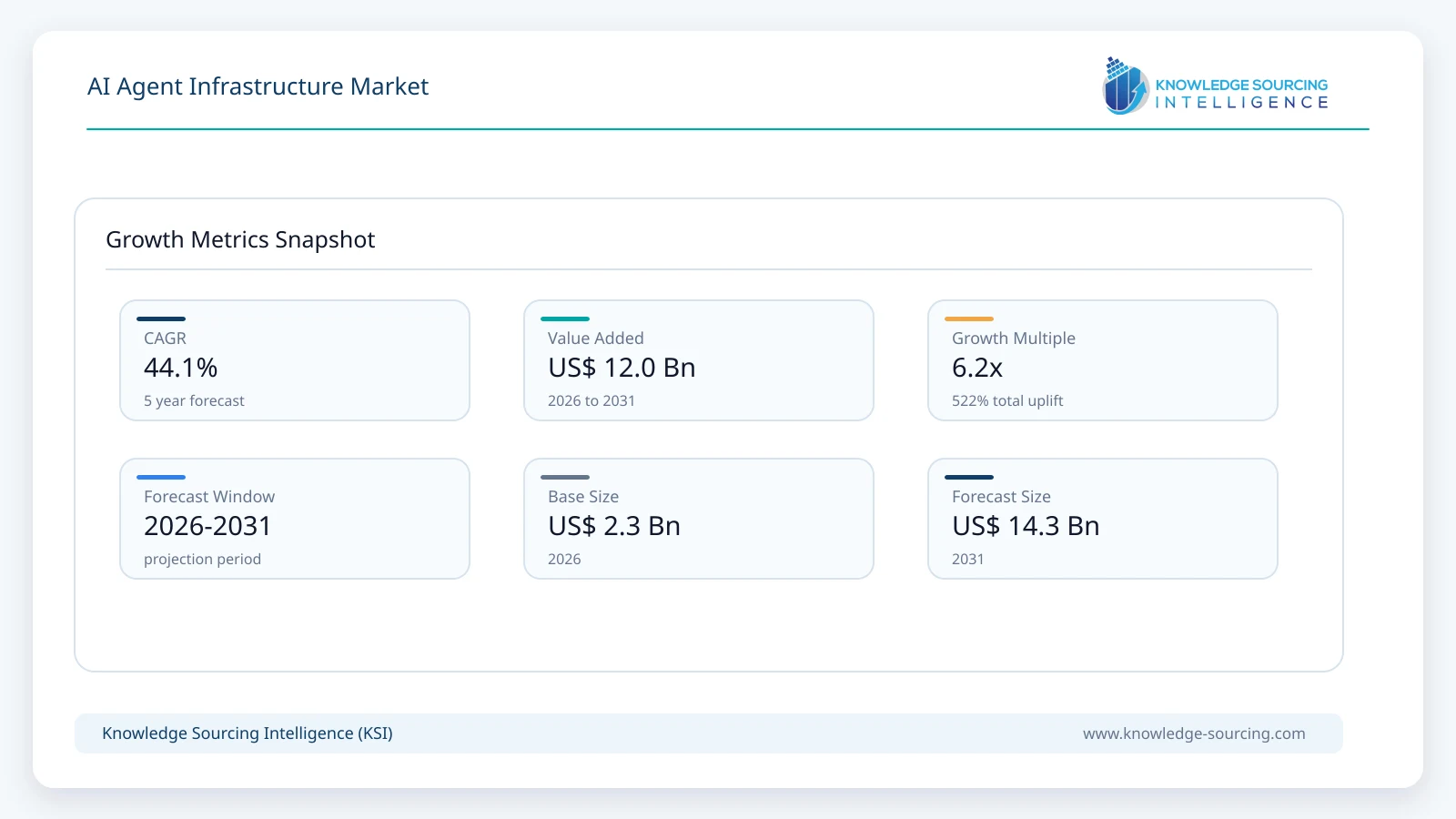
The AI Agent Infrastructure Market is forecast to grow at a CAGR of 44.1%, reaching USD 14.3 billion in 2031 from USD 2.3 billion in 2026.
Highlights:
- 1Agent execution and managed runtime services remain the largest infrastructure category, supported by the growth of background and long-running tasks.
- 2Tool gateways and agent authorization are gaining strategic importance as agents obtain permission to change records and operate business applications.
- 3Integrated cloud platforms compete with modular infrastructure stacks that allow greater control over individual providers.
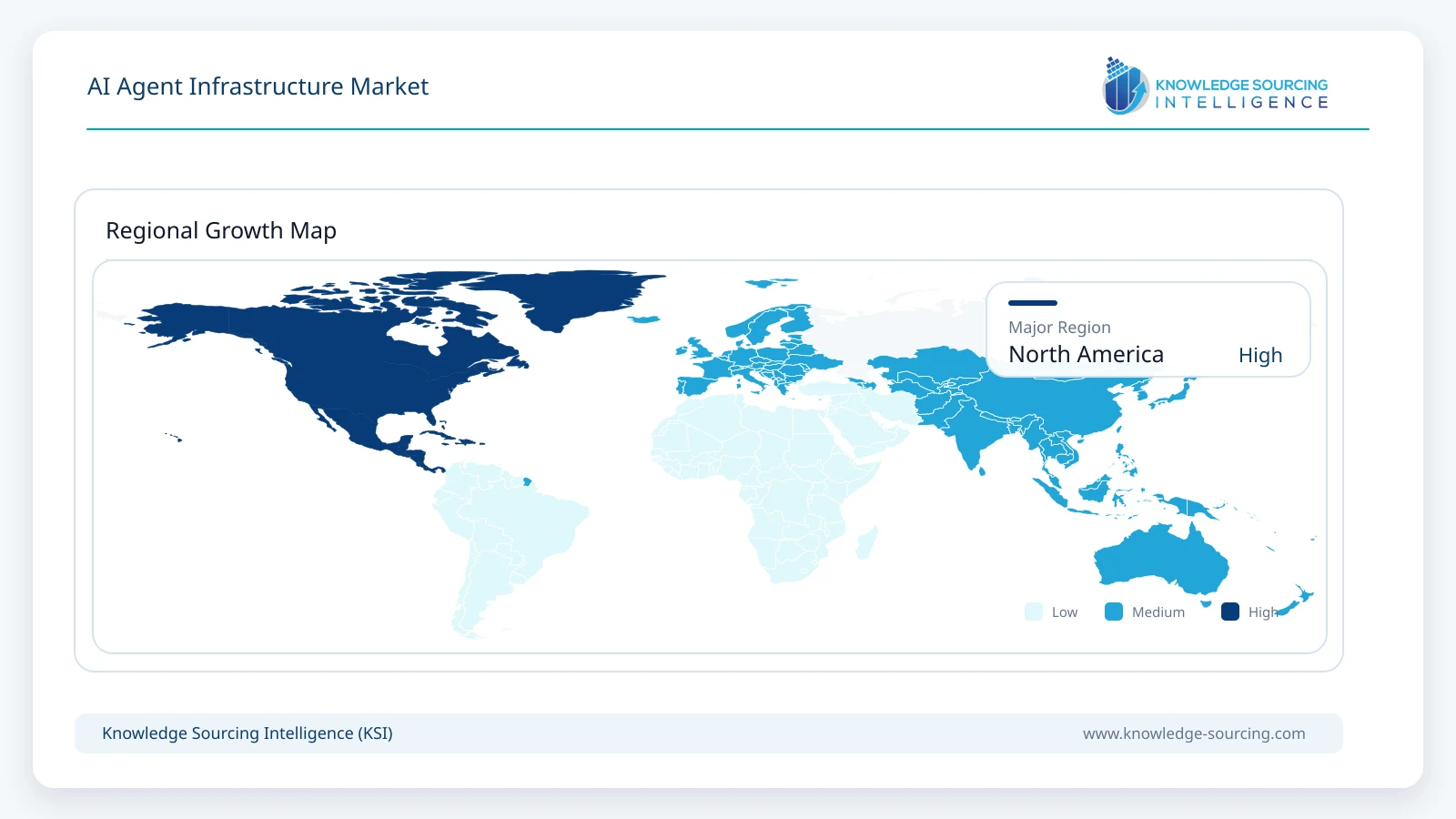
- 4North America is the largest regional market; Asia Pacific is expected to achieve the fastest growth during the forecast period.
- 5Infrastructure economics are shifting toward task-level cost, traceability and dependable outcomes rather than model capability alone.
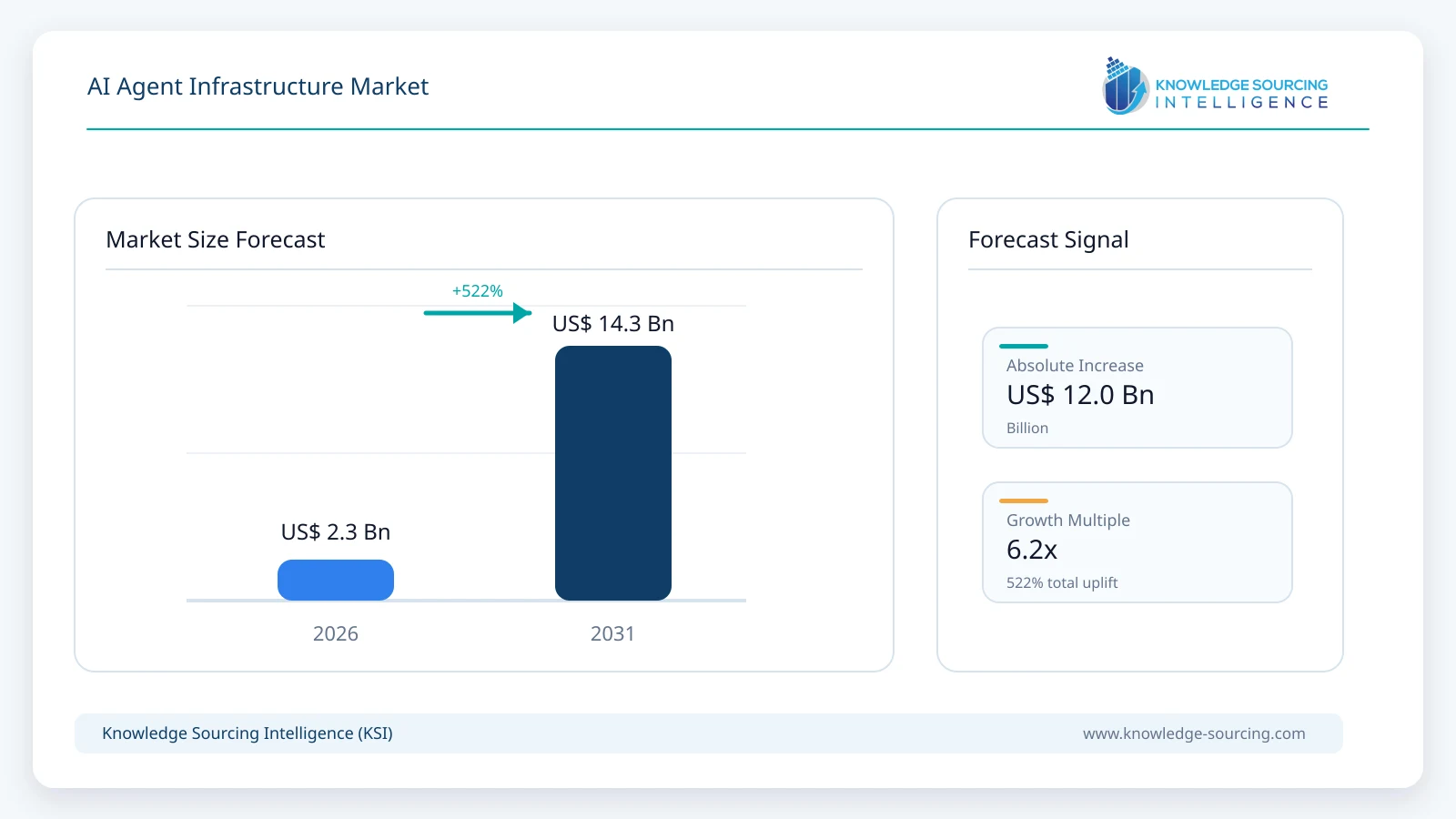
Demand is driven by the common operational capabilities required to execute, connect, observe and protect AI agents in production business environments.
The report assesses managed agent runtimes, persistent task-state services, enterprise tool gateways, monitoring and evaluation systems, identity and policy enforcement, and deployment management. These capabilities support agents that use external applications, retain context across steps, and carry out approved actions. Enterprises can purchase the components through integrated cloud platforms or combine specialist products with private infrastructure.
Market analysis covers commercial service types, deployment environments, platform architectures, agent operating patterns, customer contract models, applications and end-user industries. Competitive positioning increasingly depends on reliable execution, enterprise integration, data governance, and the ability to observe whether automated work is completed correctly.
Market Overview
Production agent systems connect model reasoning with tools, memory, data systems and executable workspaces, creating requirements that conventional chatbot hosting does not fully meet. An agent handling a service request may read an account, check permissions, update a record, send a notification, and wait for approval. Each step creates operational risk if state is lost, credentials are overexposed, or a tool action is repeated unexpectedly. Shared infrastructure can manage these needs across many applications rather than through separate custom integrations.
The supplier market is forming around both integrated and modular offerings. AWS AgentCore exposes compute, gateways, identity, and memory as separately measurable services. Microsoft Foundry and Google Cloud connect agent deployment with enterprise security and operational management, while Cloudflare brings stateful execution closer to edge developer infrastructure. MongoDB Atlas Agent Engine links agent operations with context and governance, and specialist providers serve tool access and monitoring requirements.
Business buyers increasingly assess agent infrastructure through the cost and reliability of a completed task. A low-priced tool call has limited value if an agent cannot resume after interruption, and a fast runtime is insufficient without controlled access to customer information. Demand therefore extends from compute to connectors, event histories, policy checks, and the monitoring needed to identify failed or unsafe steps before they affect business operations.
Market Trends
Integrated Agent Platforms Connect Previously Separate Services
Enterprises developing large agent portfolios are moving away from assembling every control individually. AWS combines managed compute, tool access, identity and memory within AgentCore, while Microsoft Foundry supports agent hosting, toolboxes and observability through a common environment. MongoDB introduced Atlas Agent Engine in September 2026 to bring persistent memory, retrieval and governance closer to operational data. The commercial appeal lies in shorter deployment work and more consistent controls across multiple teams.
Integrated platforms still compete with specialist services because customers may prefer a separate tool gateway, evaluation provider or state store. Architecture decisions increasingly balance procurement simplicity against provider dependence and the need to replace individual components. Framework-neutral interfaces and common telemetry are important for avoiding expensive rework as agent software changes.
Tool Connectivity Becomes a Managed Security Boundary
Agents that access CRM systems, code repositories, and financial applications must act with appropriate user permissions. Arcade provides tool execution with per-action authorization and controlled credential handling, while Composio prices managed tool calls and connected accounts. These services move integration beyond a basic API connector by adding credential rotation, audit records, tool discovery, and operating policies. Buyers can then give agents useful capabilities without distributing unrestricted service-account tokens.
Enterprise demand is growing for centralized gateways that manage access across many applications and agent frameworks. Gateway pricing can depend on completed tool calls, authorization events, or enterprise access contracts, making transaction volumes an important demand indicator. Organizations also need safeguards against repeated actions, revoked permissions, and unexpected changes to third-party APIs.
Observability Expands from Model Traces to Completed Actions
Monitoring agents requires visibility into the sequence of decisions, tool calls, and external effects, not just the latency of one model response. LangSmith offers tracing and production deployment metering, while Arize provides agent trajectory views, evaluations, and monitoring. Enterprise teams use these systems to investigate failures, compare revised workflows and establish which agent behavior should be approved for production use.
Agent evaluation also becomes part of release management as models, prompts, tools and data sources change independently. Regression tests and trace analysis help identify when a workflow still produces fluent answers but performs fewer tasks correctly. Demand for monitoring grows with the number of production agents and the business consequence of their actions.
Durable Runtime and State Support Longer Business Processes
Long-running tasks can involve pauses, delayed approvals, or external systems that fail temporarily. AWS expanded AgentCore runtime options during 2026, including managed instances suited to sustained workloads and a newer microVM runtime with improved memory use. Temporal provides durable workflow execution, while Cloudflare offers stateful agent infrastructure and sandbox options. These capabilities allow an agent to continue work without always holding the same compute process active.
Persistent state has become closely connected to auditability. Teams need to know what was completed before a restart, which approvals remain and which actions are safe to retry. Separate state stores and managed memory services can support this process, especially for agents handling customer records or regulated operations where replaying a transaction would create a business problem.
Segment Analysis
By Commercial Infrastructure Service: Agent Execution and Managed Runtime
Agent execution and managed runtime account for USD 650 million in 2026 and are projected to reach USD 5.75 billion in 2031. The category underpins coding agents, research workflows and autonomous business processes by providing isolated compute and recoverable sessions. AWS AgentCore, Cloudflare and specialist sandbox providers support different runtime profiles, while state, gateways and security services expand the functionality surrounding execution.
By Deployment Environment: Managed Public Cloud
Managed public cloud infrastructure represents USD 1.40 billion in 2026 and is expected to reach USD 8.10 billion by 2031. The ability to purchase execution, monitoring and tool connectivity on demand reduces initial engineering work for developers. Dedicated clouds and private environments remain significant among financial institutions, healthcare organizations and government agencies that need stronger isolation, location controls and contractual access safeguards.
By Platform Architecture: Modular Best-of-Breed Infrastructure
Modular infrastructure accounts for approximately USD 930 million in 2026 as enterprises combine cloud runtimes with specialist gateways, monitoring providers and state services. Integrated full-stack platforms are expected to gain share as deployment scale rises, reaching USD 6.20 billion by 2031. The trade-off concerns procurement convenience, the depth of individual components and the ability to move workloads when pricing or governance requirements change.
By Agent Operating Pattern: Asynchronous Background Agents
Asynchronous background agents are estimated at USD 650 million in 2026 and USD 4.85 billion in 2031, reflecting growing use in software maintenance, business processing and scheduled operations. Unlike short interactive sessions, these agents need dependable queues, checkpoints, and notifications when work finishes or fails. Collaboration across multiple agents also raises requirements for shared state, identity separation and consistent execution histories.
By Customer Contract Model: Usage-Metered Infrastructure
Usage-metered infrastructure contributes USD 1.16 billion in 2026 and is forecast to reach USD 7.80 billion in 2031. Metering suits businesses that are testing agent workloads or dealing with irregular task volumes, and is visible in AWS compute and gateway pricing and specialist tool-call services. Enterprise subscription contracts are more common when customers require fixed service levels, private deployment or ongoing support for business-critical agents.
By Primary Business Application: Software Engineering
Software engineering and development lead with USD 585 million in 2026, expanding to USD 3.93 billion in 2031. Coding agents must inspect repositories, execute tests, read documentation, and maintain safe workspaces across several steps. Enterprise workflow automation is also growing as businesses allow agents to work with procurement, support and IT systems, increasing demand for secure connectors and evidence of completed transactions.
By End-User Industry: Technology and Software
Technology and software customers represent USD 630 million in 2026 and are expected to generate USD 3.91 billion in 2031. These buyers adopt new agent development tools quickly and require high levels of tracing and deployment automation. Banking and financial services, manufacturing, and healthcare bring additional opportunities as they seek controlled task execution, authorization checks, and reliable integration with existing operating systems.
Market Drivers
Enterprise Shift from Agent Pilots to Production
Organizations deploying agents across departments require managed execution, access controls, and repeatable operations rather than demonstration environments. Shared infrastructure reduces duplicated engineering work and supports common service standards for business tasks.
Growing Demand for Secure Enterprise Tool Access
Agents become more useful when they can act on CRM, finance, and development systems. Managed gateways, permission checks and credential controls enable practical automation while reducing the exposure created by broad application keys.
Need for Persistent State and Recoverable Execution
Complex agents often wait for tools, people and external events. Durable workflow services and memory infrastructure allow progress to survive interruptions, minimizing repeat actions and supporting a clear record of what work was completed.
Wider Availability of Metered Infrastructure Services
Consumption-based compute, tool calls, tracing and gateways allow developers to evaluate agent applications without building a full internal stack. Pricing tied to usage also helps buyers compare the operating economics of alternative architectures.
Expansion of Regulated and High-Value Agent Applications
Financial, healthcare, industrial, and government use cases require stronger governance than basic conversational assistants. Identity boundaries, audit trails, and private deployment options support adoption where operational mistakes or information exposure carry material consequences.
Market Restraints
Complexity of Integrating Disparate Infrastructure Components
Runtime, gateway, memory, monitoring, and identity services may come from different suppliers and follow incompatible conventions. Integration work can delay deployment and create maintenance requirements when providers update APIs or frameworks.
Uncertain Cost per Successfully Completed Task
Agents may generate repeated tool calls, long waiting periods and extensive traces while working on one request. Organizations can find it difficult to forecast total infrastructure spending without detailed task-level measurement and usage controls.
Risk of Unauthorized or Repeated External Actions
An agent with excessive permissions can modify information or trigger transactions incorrectly. Failures during retries or approval handoffs can also produce duplicate actions, increasing the security and compliance work needed for production deployment.
Vendor Dependence and Inconsistent Portability
Integrated platforms simplify deployment but may create reliance on proprietary state, policies or operating APIs. Enterprises concerned about provider changes can postpone rollout until migration and cross-platform governance become more predictable.
Uneven Enterprise Readiness and Skills
Businesses need expertise in workflow design, identity management, tool reliability and agent evaluation. Shortages of practical operating experience, together with legacy system constraints, can limit the number of workloads suitable for unattended execution.
Regional Outlook
North America
North America is estimated at USD 1.01 billion in 2026 and is expected to reach USD 5.70 billion by 2031, remaining the largest market. The United States accounts for most regional demand through a large base of cloud, enterprise software and agent development companies. AWS, Microsoft, Google, MongoDB and specialist infrastructure providers serve customers building production agents in software engineering, financial services and business operations.
North American purchasing increasingly focuses on moving agents through testing into controlled production environments. Enterprises are combining tool authorization, tracing, managed compute and data access to reduce operational risk. Regulatory expectations, customer privacy requirements and complex existing systems encourage private deployments alongside public-cloud services, particularly among financial and healthcare buyers.
Asia Pacific
Asia Pacific is forecast to increase from USD 495 million in 2026 to USD 4.28 billion in 2031, the fastest regional growth in the market. China, India, Japan, South Korea and Singapore support an expanding base of developers, digital service businesses and enterprise automation deployments. Regional demand includes multilingual customer operations, software development, industrial workflows and infrastructure for locally operated AI systems.
Businesses across Asia Pacific are evaluating agent infrastructure that can support large task volumes while meeting local data and access requirements. Cloud infrastructure expansion, growing software-service capacity and a wider network of regional integrators support adoption. Demand is expected to shift from basic connector and hosting purchases toward resilient execution, enterprise policy enforcement and monitored automation across larger organizations.
Competitive Landscape
Large cloud companies provide integrated infrastructure bundles, while specialist vendors compete on individual capabilities such as trusted tool actions, workflow durability, memory and tracing. AWS AgentCore, Microsoft Foundry and Google Cloud benefit from established enterprise purchasing relationships. LangSmith, MongoDB, Cloudflare, Temporal, Arcade, Composio and Arize offer alternative routes for customers choosing modular or portable architectures.
Competition centers on dependable task completion, transparent usage charges, access control and ease of integration. Buyers favor platforms that can support different models and frameworks without weakening governance. Open standards and clear commercial separation of compute, memory, tools and monitoring also influence sourcing decisions as agent portfolios expand.
Recent Developments
22 October 2026: Google Cloud announced Agent Compute Engine and expanded agent governance, introducing hardware-isolated agent execution capabilities scheduled for preview in the coming months.
12 October 2026: AWS introduced consumption-based short-term memory pricing for AgentCore, linking memory charges to ingestion, retrieval and storage volume.
29 September 2026: MongoDB introduced Atlas Agent Engine in public preview, combining agent memory, retrieval and governance around its data platform.
18 September 2026: AWS made a revised AgentCore Runtime available with elastic memory reclamation and more consistent startup behavior for isolated sessions.
10 September 2026: OpenAI introduced the Agents API in public beta, offering a managed harness and infrastructure for long-running agent workflows.
4 August 2026: Cloudflare introduced its Agents offering, combining hosted execution with observability and access to durable platform services.
Market Outlook
AI agent infrastructure is expected to become a standard part of enterprise software operations as agents take responsibility for more frequent and consequential tasks. Managed execution will remain the largest spending area, while tool integration, memory, monitoring and authorization gain importance when deployments expand beyond individual developer teams. Integrated platforms can simplify procurement, but specialist infrastructure will remain relevant where customers need deeper control over a critical function.
Industry growth will depend on reducing the cost and risk of completing actual work. Suppliers that offer strong isolation, dependable resumption, permission-aware tool access and clear traces will be better placed to support customer operations over time. Adoption in regulated industries is expected to increase demand for private environments and audit-ready governance, alongside broad public-cloud deployments.
North America is expected to retain the largest share of revenue, while Asia Pacific records the fastest growth as more organizations bring agent workflows into production. The competitive advantage will increasingly belong to providers that connect operational reliability and commercial transparency with the flexibility required by changing models, applications, and business processes.
AI Agent Infrastructure Market Scope:
| Report Metric | Details |
|---|---|
| Total Market Size in 2026 | USD 2.3 billion |
| Total Market Size in 2031 | USD 14.3 billion |
| Forecast Unit | USD Billion |
| Growth Rate | 44.1% |
| Study Period | 2021 to 2031 |
| Historical Data | 2021 to 2024 |
| Base Year | 2025 |
| Forecast Period | 2026 – 2031 |
| Segmentation | Commercial Infrastructure Service, Deployment Environment, Platform Architecture, Agent Operating Pattern |
| Companies |
|
| Customization Scope | 15% Free Customization included with purchase — Request Custom Breakdown → |
| Sample & Data Access | PDF Sample, Excel Databook & Analyst Briefing — Download Free Sample → |
Market Segmentation
By Commercial Infrastructure Service
Agent Execution and Managed Runtime
Agent State and Memory Infrastructure
Agent Tool Gateways and Connectors
Agent Observability and Evaluation
Agent Identity, Security and Policy
Agent Deployment and Operations Control Plane
By Deployment Environment
Managed Public Cloud
Dedicated Cloud and Private VPC
On-premises and Hybrid
By Platform Architecture
Integrated Full-stack Agent Platforms
Modular Best-of-breed Infrastructure
Private and Open-framework Managed Stacks
By Agent Operating Pattern
Interactive Task Agents
Asynchronous Background Agents
Collaborative Multi-agent Workflows
Event-triggered Automation
Extended Human-approved Workflows
By Customer Contract Model
Usage-metered Infrastructure Access
Subscription and Platform Commitments
Dedicated Deployments and Private Licenses
By Primary Business Application
Software Engineering and Development
Enterprise Workflow Automation
Customer Service Operations
IT Operations and Cybersecurity
Research and Data Workflows
Other Applications
By End-user Industry
Technology and Software
Banking and Financial Services
Retail and E-commerce
Healthcare and Life Sciences
Manufacturing and Logistics
Professional and Business Services
Government and Other Industries
By Geography
North America
United States
Canada
Mexico
South America
Brazil
Argentina
Chile
Rest of South America
Europe
United Kingdom
Germany
France
Netherlands
Italy
Spain
Rest of Europe
Middle East and Africa
Saudi Arabia
United Arab Emirates
Israel
South Africa
Rest of Middle East and Africa
Asia Pacific
China
India
Japan
South Korea
Australia
Singapore
Rest of Asia Pacific
Table of Contents
1. EXECUTIVE SUMMARY
2. MARKET SNAPSHOT
2.1. Market Overview
2.2. Market Definition
2.3. Scope of the Study
2.4. Market Segmentation
3. BUSINESS LANDSCAPE
3.1. Market Drivers
3.1.1. Enterprise Shift from Agent Pilots to Production
3.1.2. Growing Demand for Secure Enterprise Tool Access
3.1.3. Need for Persistent State and Recoverable Execution
3.1.4. Wider Availability of Metered Infrastructure Services
3.1.5. Expansion of Regulated and High-Value Agent Applications
3.2. Market Restraints
3.2.1. Complexity of Integrating Disparate Infrastructure Components
3.2.2. Uncertain Cost per Successfully Completed Task
3.2.3. Risk of Unauthorized or Repeated External Actions
3.2.4. Vendor Dependence and Inconsistent Portability
3.2.5. Uneven Enterprise Readiness and Skills
3.3. Market Opportunities
3.4. Porter’s Five Forces Analysis
3.5. Value Chain Analysis
3.6. Policies and Regulations
3.7. Strategic Recommendations
4. TECHNOLOGICAL OUTLOOK
5. AI AGENT INFRASTRUCTURE MARKET BY COMMERCIAL INFRASTRUCTURE SERVICE
5.1. Introduction
5.2. Agent execution and managed runtime
5.3. Agent state and memory infrastructure
5.4. Agent tool gateways and connectors
5.5. Agent observability and evaluation
5.6. Agent identity, security and policy
5.7. Agent deployment and operations control plane
6. AI AGENT INFRASTRUCTURE MARKET BY DEPLOYMENT ENVIRONMENT
6.1. Introduction
6.2. Managed public cloud
6.3. Dedicated cloud and private VPC
6.4. On-premises and hybrid
7. AI AGENT INFRASTRUCTURE MARKET BY PLATFORM ARCHITECTURE
7.1. Introduction
7.2. Integrated full-stack agent platforms
7.3. Modular best-of-breed infrastructure
7.4. Private and open-framework managed stacks
8. AI AGENT INFRASTRUCTURE MARKET BY AGENT OPERATING PATTERN
8.1. Introduction
8.2. Interactive task agents
8.3. Asynchronous background agents
8.4. Collaborative multi-agent workflows
8.5. Event-triggered automation
8.6. Extended human-approved workflows
9. AI AGENT INFRASTRUCTURE MARKET BY CUSTOMER CONTRACT MODEL
9.1. Introduction
9.2. Usage-metered infrastructure access
9.3. Subscription and platform commitments
9.4. Dedicated deployments and private licenses
10. AI AGENT INFRASTRUCTURE MARKET BY PRIMARY BUSINESS APPLICATION
10.1. Introduction
10.2. Software engineering and development
10.3. Enterprise workflow automation
10.4. Customer service operations
10.5. IT operations and cybersecurity
10.6. Research and data workflows
10.7. Other applications
11. AI AGENT INFRASTRUCTURE MARKET BY END-USER INDUSTRY
11.1. Introduction
11.2. Technology and software
11.3. Banking and financial services
11.4. Retail and e-commerce
11.5. Healthcare and life sciences
11.6. Manufacturing and logistics
11.7. Professional and business services
11.8. Government and other industries
12. AI AGENT INFRASTRUCTURE MARKET BY GEOGRAPHY
12.1. North America
12.1.1. United States
12.1.2. Canada
12.1.3. Mexico
12.2. South America
12.2.1. Brazil
12.2.2. Argentina
12.2.3. Chile
12.2.4. Rest of South America
12.3. Europe
12.3.1. United Kingdom
12.3.2. Germany
12.3.3. France
12.3.4. Netherlands
12.3.5. Italy
12.3.6. Spain
12.3.7. Rest of Europe
12.4. Middle East and Africa
12.4.1. Saudi Arabia
12.4.2. United Arab Emirates
12.4.3. Israel
12.4.4. South Africa
12.4.5. Rest of Middle East and Africa
12.5. Asia Pacific
12.5.1. China
12.5.2. India
12.5.3. Japan
12.5.4. South Korea
12.5.5. Australia
12.5.6. Singapore
12.5.7. Rest of Asia Pacific
13. COMPETITIVE ENVIRONMENT AND ANALYSIS
13.1. Major Players and Strategy Analysis
13.2. Market Share Analysis
13.3. Mergers, Acquisitions, Agreements and Collaborations
13.4. Competitive Dashboard
14. COMPANY PROFILES
14.1. Amazon Web Services, Inc.
14.2. Microsoft Corporation
14.3. Google LLC
14.4. Cloudflare, Inc.
14.5. LangChain, Inc.
14.6. MongoDB, Inc.
14.7. Temporal Technologies, Inc.
14.8. Arcade
14.9. Composio
14.10. Arize AI
14.11. OpenAI
14.12. CrewAI
15. APPENDIX
15.1. Currency
15.2. Assumptions
15.3. Base and Forecast Years Timeline
15.4. Key Benefits for Stakeholders
15.5. Research Methodology
15.6. Abbreviations





Frequently asked questions
What is the projected AI Agent Infrastructure market size by 2031?
The AI Agent Infrastructure Market is forecast to reach USD 14.3 billion by 2031.
What is the forecasted CAGR for the AI Agent Infrastructure market?
The AI Agent Infrastructure Market is forecast to grow at a 44.1% CAGR.
Which is the largest regional market for AI Agent Infrastructure?
North America is currently the largest regional market.
Which region is expected to show the fastest growth?
Asia Pacific is expected to achieve the fastest growth.
What are the primary drivers for AI Agent Infrastructure demand?
Demand is driven by operational needs to execute, connect, observe, protect agents.
Which infrastructure category is currently the largest?
Agent execution and managed runtime services remain the largest category.
Cite this report
Knowledge Sourcing Intelligence. (Oct 2026). AI Agent Infrastructure Market Size, Share & Growth Forecast (2026-2031). https://www.knowledge-sourcing.com/report/ai-agent-infrastructure-market