
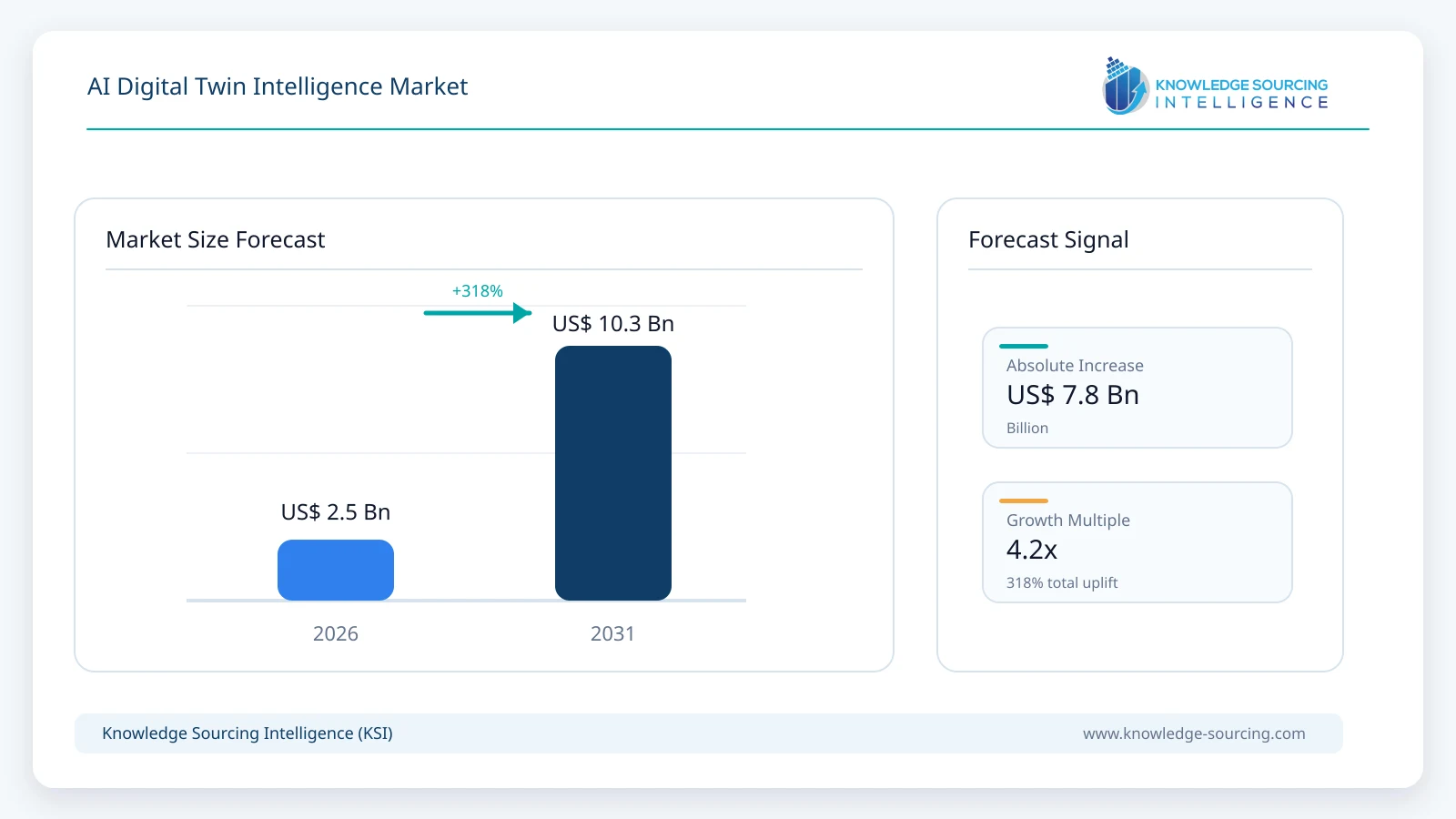
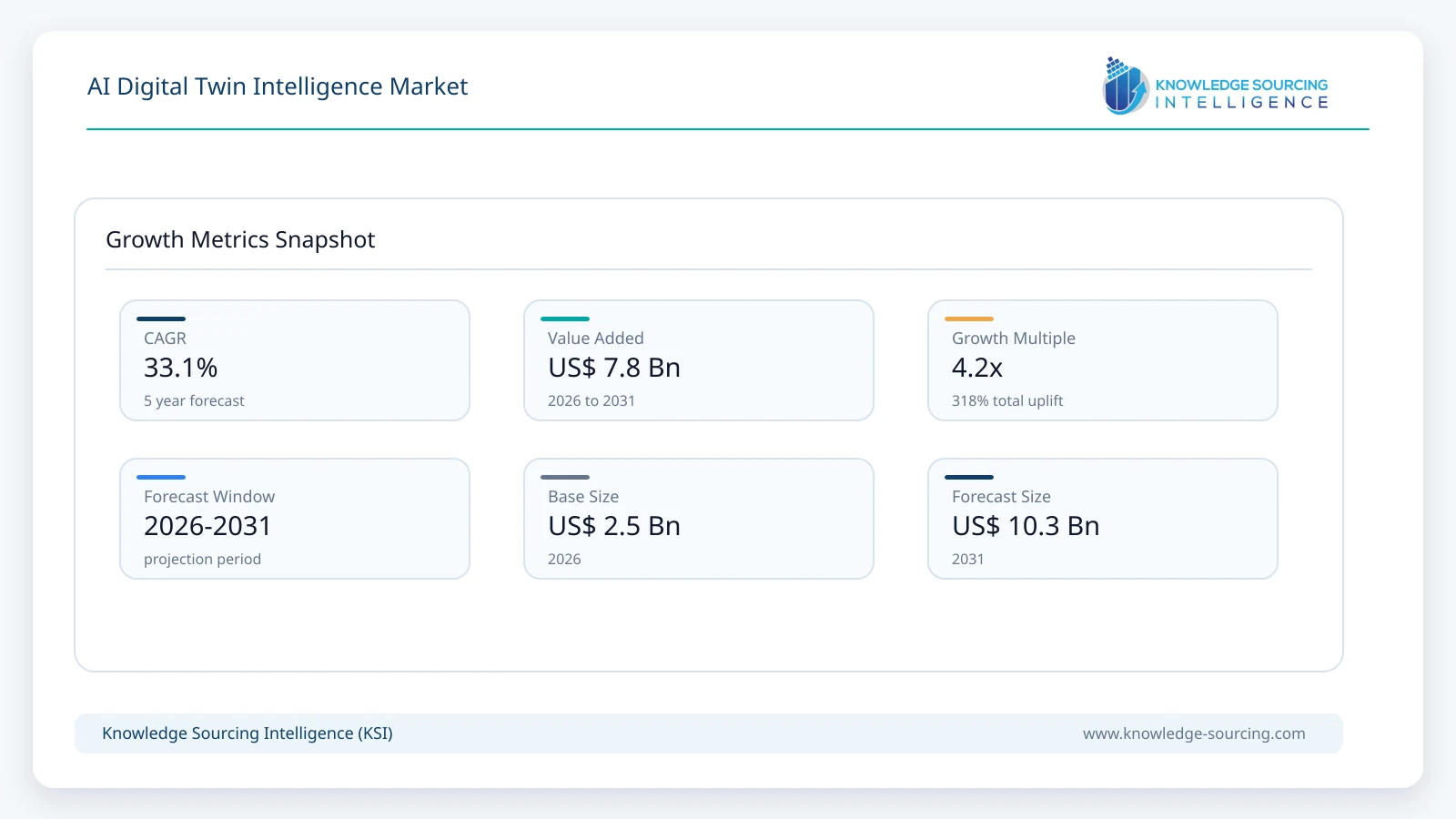
The AI Digital Twin Intelligence Market is projected to increase from USD 2.45 billion in 2026 to USD 10.25 billion in 2031, representing a CAGR of 33.1% during the forecast period.
Highlights:
- 1AI Twin Intelligence Software accounts for an estimated 46.1% of 2026 revenue, reflecting paid predictive, optimization and decision-support functions layered onto operating digital twins.
- 2Asset and equipment twins represent the largest twin-type segment at approximately USD 850 million in 2026, supported by reliability and condition-based operating use cases.
- 3Manufacturing accounts for an estimated 31.0% of 2026 demand and is projected to reach USD 3.01 billion in 2031 as factory and production twins become more actionable.
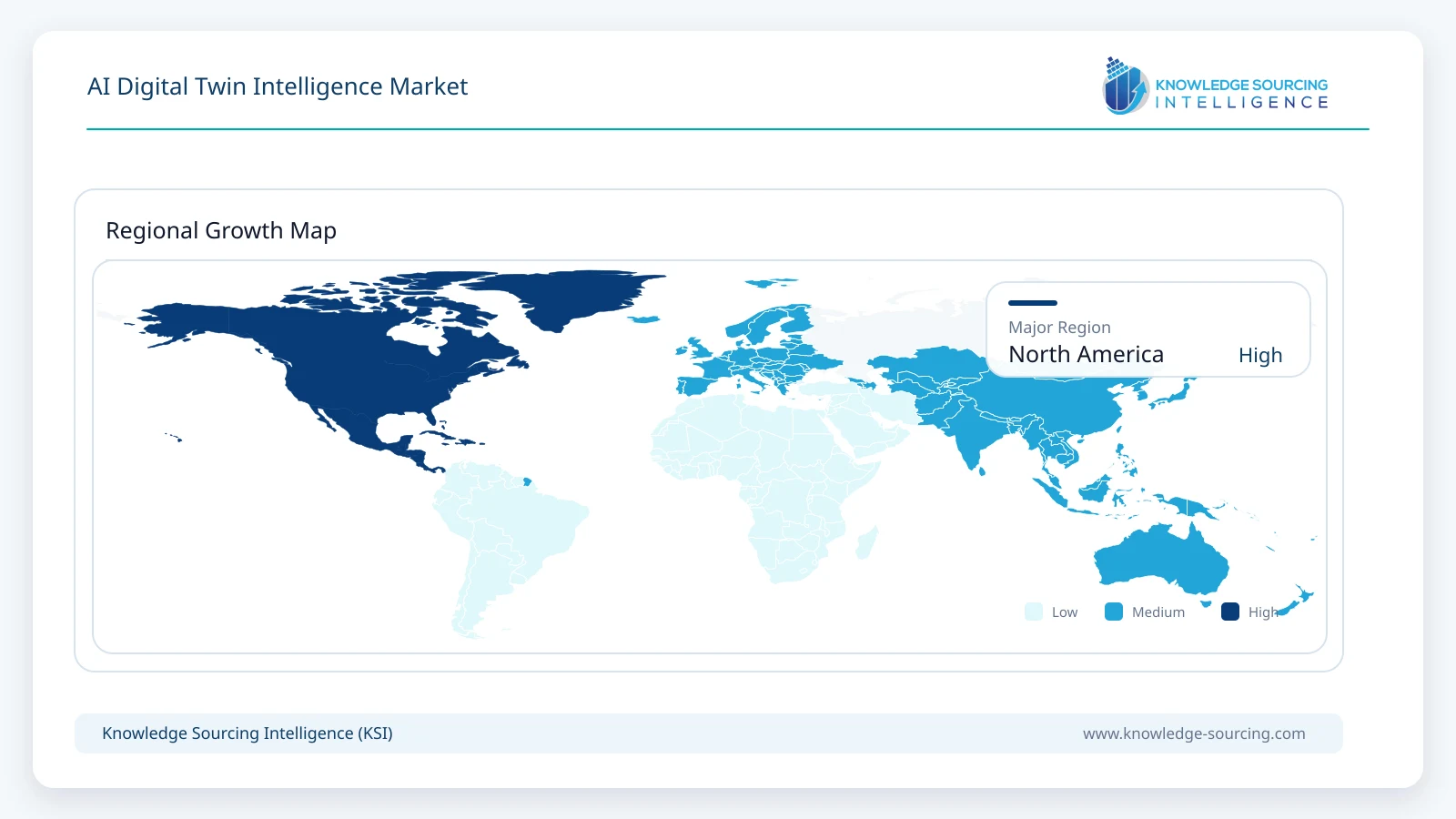
- 4North America represents about 36.7% of 2026 revenue; Asia Pacific is projected to grow faster, supported by manufacturing expansion and industrial automation investment.
- 5Physics-informed AI, validated simulation and operational data integration are central procurement criteria because digital-twin recommendations must be reliable under changing physical conditions.
Demand comprises attributable spending on AI-based prediction, prescriptive analysis, hybrid physics-machine-learning models, agent-assisted simulation and connected operational decision support within digital twins. Customers purchase these capabilities through enterprise software subscriptions, specialized simulation modules, managed analytics and implementation or model calibration services.
An intelligent digital twin is connected to the condition or behavior of an identifiable physical asset, process, facility or infrastructure network. A model that predicts equipment deterioration from sensor inputs, tests a revised production schedule in a validated simulator or recommends corrective settings from a live building twin falls within the scope.
The market is developing through combinations of existing engineering software and newer AI components rather than a single vendor category. Siemens introduced Digital Twin Composer in 2026 to connect high-fidelity simulations with engineering and operational data; Ansys TwinAI includes hybrid analytics and machine-learning methods for asset behavior; AVEVA is developing an agentic twin builder for its industrial intelligence platform.
Market Overview
Manufacturers and infrastructure operators increasingly maintain live models that connect engineering assumptions with sensor feeds, maintenance histories and current operating conditions. AI contributes predictive intelligence by learning patterns from equipment measurements, comparing observed behavior with a physical baseline and identifying changes that merit investigation. The value extends beyond dashboards when a twin can estimate the likely effect of a maintenance action, alter a production sequence or quantify an energy-saving operating range. Procurement therefore often sits with plant engineering, maintenance, reliability or operational technology teams rather than standalone IT innovation budgets.
Physics-informed models are becoming an important route to higher-confidence analysis because a purely statistical model may perform poorly during unusual operating states. Ansys TwinAI combines simulation outputs with machine-learning approaches, while Siemens and NVIDIA connect physics-based industrial scenes with real manufacturing data. Digital twins that use reduced-order models or surrogate simulations can evaluate many more operating options without running a full multiphysics solver for every decision. The commercial opportunity is strongest when engineering teams can verify the AI result against physical limits and can update models as equipment ages or production settings change.
Several supplier groups compete around complementary elements of an intelligent twin. Bentley iTwin IoT links infrastructure sensor streams with AI-powered dashboards and anomaly detection; PTC ThingWorx brings contextualized industrial data into governed agent workflows; AWS combines TwinMaker with cloud-based machine learning and generative interfaces. AVEVA CONNECT provides industrial data context, while Dassault Systèmes is extending virtual twins with agentic engineering functions. Distinctions among product capabilities, paid subscriptions and service integration matter because a customer may obtain several of these components through one project without creating multiple independent market purchases.
Market Trends
Digital Twins Are Becoming Operational Decision Environments
Siemens demonstrated its Digital Twin Composer environment in 2026 using engineering data, live operational signals and NVIDIA Omniverse simulations to analyze potential production changes before they are executed. The company presented a newer version at GTC Berlin in October 2026, emphasizing synchronized factory representations rather than static plant visualization.
Digital-twin intelligence is shifting from creating a convincing digital scene to maintaining a reliable link between physical events and model decisions. Plant personnel need to understand which sensors are current, which simulation assumptions remain valid and whether recommended changes conflict with safety or production constraints.
Hybrid Physics and Machine Learning Are Improving Forecast Reliability
Ansys Digital Twin 2026 R1 expanded its hybrid analytics methods, including Temporal Fusion Transformer and Neural ODE approaches, alongside reduced-order model tools. These techniques combine physical understanding with observed operating behavior, making predictive outputs more useful for equipment whose failure modes are not represented by large labeled datasets.
Industrial customers increasingly compare prediction accuracy, explainability and model-update effort alongside subscription cost. Hybrid models can lower the computational burden of repeated what-if calculations, although the economic case depends on the complexity of the asset and the frequency of operational changes.
Agentic Interfaces Are Connecting Twin Models to Plant Workflows
PTC introduced native agentic AI capabilities in ThingWorx 10.2 in September 2026, including governed access to existing industrial services and operational context. AVEVA announced a CONNECT knowledge-graph and agentic twin-builder roadmap, with its major release planned for the first quarter of 2027.
Agent-driven recommendations will require additional governance where a digital twin influences real equipment. Permission controls, verification of data sources and human approval remain important for safety-critical changes. Near-term commercial value is therefore likely to favor assisted diagnosis and simulated intervention planning before broad adoption of fully autonomous closed-loop operations.
Spatial Simulation Is Expanding Into Infrastructure and AI Facilities
NVIDIA released an Omniverse DSX digital-twin blueprint in March 2026 to support AI-factory design and operational simulation, including power, cooling and networking relationships. Bentley applies digital-twin analytics to bridges, dams, rail and other infrastructure where synchronized sensor data can identify abnormal conditions.
Facilities and network assets have different commercial requirements from individual machines. Asset owners often need to combine GIS or 3D geometry with operating data, forecast impacts across interconnected systems and preserve engineering traceability over decades.
Segment Analysis
By Intelligence Function: Prescriptive Optimization
Prescriptive optimization is projected to reach USD 2.81 billion by 2031, compared with USD 635 million in 2026. The segment uses connected models to compare operating alternatives, estimate performance outcomes and recommend settings, inspection priorities or resource allocations. In plants and utility networks, these capabilities can translate anomaly detection into operational changes that have measurable economic effects.
The value of optimization depends on dependable real-time inputs and constraints that represent actual equipment capability. Siemens factory-twin workflows and industry-specific simulation tools illustrate a movement toward virtual validation before changes are applied. Customers are likely to prioritize use cases where avoided downtime, reduced scrap, improved throughput or lower energy costs can be quantified rather than purchasing broad optimization claims without deployment evidence.
By Twin Type: Asset and Equipment Twins
Asset and equipment twins are expected to generate USD 3.39 billion of 2031 spending, rising from USD 850 million in 2026. The segment covers predictive operating models of turbines, pumps, production machinery, transport equipment and other physical assets, with demand supported by recurring monitoring, maintenance and performance optimization rather than one-off 3D model creation.
Bentley iTwin IoT links physical infrastructure measurements with anomalies and predictive insights, while Ansys TwinAI focuses on hybrid physical and learned asset behavior. Industrial equipment suppliers may bundle digital-twin intelligence into service agreements, so revenue recognition must be tied to the paid intelligence component of these offerings. Asset-type segmentation measures the primary operating object being modeled and does not create another sale when the same twin also participates in a plant-level workflow.
By Industry: Manufacturing
Manufacturing is forecast to reach USD 3.01 billion in 2031 from USD 760 million in 2026. Digital-twin intelligence supports line commissioning, production balancing, machine health, quality investigation and the validation of automation changes. Large factories are early adopters because they already have engineering models, operational data infrastructure and economic incentives to prevent interruptions in high-value production.
Commercial deployments increasingly span individual machines and entire production systems. Siemens has described the use of its Digital Twin Composer by PepsiCo to examine manufacturing and warehouse changes, while ABB is integrating NVIDIA Omniverse libraries with RobotStudio for physically accurate simulation. Buyers will continue to weigh integration complexity and deployment times against cost savings, especially where factories operate equipment from multiple suppliers and maintain fragmented data histories.
Market Drivers
Greater Cost of Unplanned Asset Downtime
High-value production assets and infrastructure networks create a strong financial incentive for earlier fault identification. An AI model connected to a digital twin can combine actual sensor behavior with engineering operating limits to flag deterioration before a stoppage occurs.
Expanding Availability of Industrial Sensor Data
Industrial IoT deployments generate temperature, vibration, pressure, throughput and electrical signals that can update models continuously. PTC ThingWorx, AWS IoT and AVEVA CONNECT provide routes for organizing these data into asset context, improving the information available to AI models.
Advances in Physics-Based AI and Simulation
Hybrid methods, reduced-order simulation and GPU-accelerated physical models make repeated scenario testing more practical for complex assets. Ansys TwinAI provides examples of hybrid modeling, while NVIDIA Omniverse-based industrial workflows extend physics-based simulation into operational environments. Faster model evaluation enables engineers to compare more operating settings and failure hypotheses without waiting for lengthy full-system simulation runs.
Industrial Productivity and Energy-Efficiency Priorities
Manufacturing plants and building or utility operators face ongoing pressure to improve throughput while reducing energy use and material losses. Digital twins can compare the expected effects of changing operating conditions before those changes affect live systems.
Adoption of AI-Assisted Industrial Workflows
Industrial vendors are embedding AI assistants into platforms already used by plant engineering and operations teams. PTC ThingWorx 10.2 and Dassault Systèmes virtual companions demonstrate ways to make complex modeling functions accessible through governed natural-language interactions.
Market Restraints
Fragmented Operational and Engineering Data
Industrial twins depend on combining design specifications, maintenance histories, control-system telemetry and enterprise information. These datasets frequently use different identifiers, update frequencies and ownership arrangements, increasing integration costs. When sensor measurements cannot be matched reliably to the correct equipment state, AI predictions may look precise but support poor decisions, limiting customer willingness to expand deployments.
Model Drift and Difficult Validation
Real assets wear, are modified and operate outside historic conditions. Machine-learning models trained on a limited set of failures or normal operating periods can produce unreliable predictions when processes change. A digital twin requires ongoing calibration, physical plausibility checks and monitoring for drift, increasing specialist service needs and reducing the suitability of generic models for safety-critical industrial systems.
Uncertain Attribution of Software Value
Digital-twin intelligence is often purchased as a module inside larger industrial software, simulation or asset-management agreements. Customers may not have a separate budget line for AI predictions, while vendors may not publish component-level revenue.
Security, Safety and Control-System Governance
Connected industrial twins use sensitive equipment information and can influence processes where incorrect instructions create safety or continuity risks. Enterprise security requirements, operational technology segmentation and control over agent permissions constrain automated action.
Implementation Effort and Shortage of Domain Expertise
High-fidelity asset twins require engineering assumptions, integration with real-time systems and expert review of physical outputs. Mid-market businesses may lack simulation specialists or the data engineering capacity to maintain these models. Even when software pricing is affordable, commissioning costs, complex supplier ecosystems and long industrial equipment lifecycles can delay revenue recognition and adoption.
Regional Outlook
North America
North America is projected to remain the largest regional market, increasing from USD 900 million in 2026 to USD 3.63 billion in 2031. The United States has a broad base of advanced manufacturing, industrial cloud services, engineering software providers, energy assets and infrastructure operators, making it an early market for AI-based condition monitoring and simulation.
North American demand is supported by the cost of unplanned outages in large asset fleets and by investment in factory automation, data center infrastructure and equipment lifecycle management. Canada contributes through energy, mining and infrastructure assets, while Mexico has opportunities in automotive and electronics manufacturing. Buying decisions increasingly focus on integration into control systems, cybersecurity, audited model performance and measurable operational improvement rather than the breadth of a vendor’s digital-twin visualization portfolio.
Asia Pacific
Asia Pacific is projected to grow from USD 620 million in 2026 to USD 2.95 billion in 2031, making it the fastest-growing major region in the base model. China, Japan and South Korea contribute large manufacturing and automation ecosystems, while India, Singapore and Australia offer opportunities across production facilities, ports, energy systems, buildings and asset-intensive infrastructure.
Manufacturers in Asia Pacific are increasingly using connected simulations for production planning, robot commissioning and equipment maintenance, creating opportunities for AI-powered twin analytics. Local system integrators and equipment OEMs often shape purchasing decisions alongside multinational software providers. The region’s market mix is expected to move toward recurring intelligence subscriptions as operational data maturity improves, although implementation costs and heterogeneous equipment standards will continue to affect deployments in smaller factories.
Competitive Landscape
Competition spans engineering simulation specialists, industrial software vendors, infrastructure digital-twin providers, industrial cloud platforms and physical AI technology developers. Siemens combines plant engineering data and Digital Twin Composer workflows; Dassault Systèmes provides virtual twins and industry-specific AI experiences; Ansys, operating under Synopsys, offers TwinAI hybrid analytics; PTC ThingWorx provides connected industrial applications and agentic services.
NVIDIA supplies simulation and physical AI libraries that software companies can embed in their digital-twin products; AWS provides industrial twin infrastructure and AI services used by customer and partner applications. ABB participates through robot and factory simulation, while IBM and GE Vernova provide operational asset intelligence offerings. Competition increasingly depends on domain-specific model fidelity, verified integration and ability to support continuous industrial operations. Supplier breadth should not be equated with market share, and partnerships or shared technology stacks do not justify counting the same customer contract several times.
Recent Developments
October 2026: Siemens presented Digital Twin Composer 2612 at NVIDIA GTC Berlin, bringing operational data, AI and simulation into a synchronized factory environment to evaluate production changes before implementation.
September 2026: PTC introduced ThingWorx 10.2, including a native AI Assistant, governed agent services and Model Context Protocol support for industrial data and workflows.
June 2026: AVEVA announced enhancements to CONNECT, including a planned industrial knowledge graph and agentic twin builder targeted for the first quarter of 2027.
March 2026: NVIDIA released the Omniverse DSX digital-twin blueprint for AI factories, enabling simulation of site power, cooling, networking and operational behavior.
March 2026: ABB Robotics announced its RobotStudio HyperReality development with NVIDIA Omniverse libraries to improve physically accurate robotics simulation and deployment planning.
February 2026: Dassault Systèmes and NVIDIA announced an industrial AI partnership designed to connect virtual twins, science-grounded world models and AI-powered engineering workflows.
Market Outlook
AI digital-twin intelligence is expected to expand as industrial customers move from monitoring and virtual visualization toward verified prediction, optimization and assisted operational decisions. The strongest near-term opportunities lie in high-value equipment, manufacturing systems, energy assets and infrastructure networks with usable sensor histories and clearly measurable losses from downtime or inefficient operation.
Supplier competition will increasingly favor recurring software functions that integrate with established industrial engineering and operational technology. Agentic interfaces may broaden accessibility to intelligent twins, but safety-critical actions are likely to require controlled approval and validation.
AI Digital Twin Intelligence Market Scope
| Report Metric | Details |
|---|---|
| Total Market Size in 2026 | USD 2.45 billion |
| Total Market Size in 2031 | USD 10.25 billion |
| Forecast Unit | Billion |
| Growth Rate | 33.1% |
| Study Period | 2021 to 2031 |
| Historical Data | 2021 to 2024 |
| Base Year | 2025 |
| Forecast Period | 2026 – 2031 |
| Segmentation | Offering, Intelligence Function, Twin Type, Deployment Mode, Industry Vertical, Buyer Type, AI Architecture, Geography |
| Companies |
|
| Customization Scope | 15% Free Customization included with purchase — Request Custom Breakdown → |
| Sample & Data Access | PDF Sample, Excel Databook & Analyst Briefing — Download Free Sample → |
Market Segmentation
By Offering
AI Twin Intelligence Software
AI-Assisted Simulation Modules
Managed Twin Intelligence Services
Implementation and Model Calibration
By Intelligence Function
Predictive Condition and Anomaly Intelligence
Prescriptive Optimization
Physics-Informed Simulation and Surrogates
Generative and Agentic Twin Intelligence
Autonomous Closed-Loop Decision Intelligence
By Twin Type
Asset and Equipment Twins
Process and Production Twins
Facility and Building Twins
Network and Infrastructure Twins
Product and Lifecycle Twins
By Deployment Mode
Cloud
Hybrid and Edge
On-Premises
By Industry Vertical
Manufacturing
Energy and Utilities
Infrastructure and Construction
Transportation and Logistics
Commercial Buildings
Healthcare and Life Sciences
By Buyer Type
Large Industrial Enterprises
Industrial Equipment OEMs
Utility and Network Operators
Infrastructure and Property Owners
Mid-Market Organizations
By AI Architecture
Physics-Informed Hybrid Models
Time-Series and Sensor-Learning Models
Computer Vision and Spatial AI
Generative and Agentic Models
Optimization and Reinforcement Learning
By Geography
North America
United States
Canada
Mexico
South America
Brazil
Chile
Argentina
Rest of South America
Europe
Germany
United Kingdom
France
Italy
Netherlands
Spain
Nordic Countries
Rest of Europe
Middle East and Africa
United Arab Emirates
Saudi Arabia
South Africa
Israel
Rest of Middle East and Africa
Asia Pacific
China
Japan
India
South Korea
Singapore
Australia
Taiwan
Rest of Asia Pacific
Table of Contents
1. EXECUTIVE SUMMARY
1.1. Market Opportunity and Key Findings
1.2. Global Market Size and Forecast, 2026-2031
1.3. Market Outlook
2. MARKET SNAPSHOT
2.1. Industry Definition and Scope
2.2. Market Dynamics at a Glance
2.3. Technology and Adoption Outlook
3. BUSINESS LANDSCAPE
3.1. Market Drivers
3.1.1. Cost of Unplanned Downtime
3.1.2. Availability of Industrial Sensor Data
3.1.3. Physics-Based AI and Simulation
3.1.4. Productivity and Energy Efficiency
3.1.5. AI-Assisted Industrial Workflows
3.2. Market Restraints
3.2.1. Fragmented Operational and Engineering Data
3.2.2. Model Drift and Validation
3.2.3. Software Value Attribution
3.2.4. Security and Safety Governance
3.2.5. Implementation Expertise
3.3. Market Opportunities
3.4. Porter’s Five Forces Analysis
3.5. Industry Value Chain Analysis
3.6. Policies and Regulations
3.7. Strategic Recommendations
4. TECHNOLOGICAL OUTLOOK
4.1. Physics-Informed and Hybrid Models
4.2. Industrial IoT and Live Asset Synchronization
4.3. AI-Assisted Simulation and Optimization
4.4. Agentic Twin Intelligence
4.5. Interoperability and Model Validation
5. AI DIGITAL TWIN INTELLIGENCE MARKET BY OFFERING
5.1. AI Twin Intelligence Software
5.2. AI-Assisted Simulation Modules
5.3. Managed Twin Intelligence Services
5.4. Implementation and Model Calibration
6. AI DIGITAL TWIN INTELLIGENCE MARKET BY INTELLIGENCE FUNCTION
6.1. Predictive Condition and Anomaly Intelligence
6.2. Prescriptive Optimization
6.3. Physics-Informed Simulation and Surrogates
6.4. Generative and Agentic Twin Intelligence
6.5. Autonomous Closed-Loop Decision Intelligence
7. AI DIGITAL TWIN INTELLIGENCE MARKET BY TWIN TYPE
7.1. Asset and Equipment Twins
7.2. Process and Production Twins
7.3. Facility and Building Twins
7.4. Network and Infrastructure Twins
7.5. Product and Lifecycle Twins
8. AI DIGITAL TWIN INTELLIGENCE MARKET BY DEPLOYMENT MODE
8.1. Cloud
8.2. Hybrid and Edge
8.3. On-Premises
9. AI DIGITAL TWIN INTELLIGENCE MARKET BY INDUSTRY VERTICAL
9.1. Manufacturing
9.2. Energy and Utilities
9.3. Infrastructure and Construction
9.4. Transportation and Logistics
9.5. Commercial Buildings
9.6. Healthcare and Life Sciences
10. AI DIGITAL TWIN INTELLIGENCE MARKET BY BUYER TYPE
10.1. Large Industrial Enterprises
10.2. Industrial Equipment OEMs
10.3. Utility and Network Operators
10.4. Infrastructure and Property Owners
10.5. Mid-Market Organizations
11. AI DIGITAL TWIN INTELLIGENCE MARKET BY AI ARCHITECTURE
11.1. Physics-Informed Hybrid Models
11.2. Time-Series and Sensor-Learning Models
11.3. Computer Vision and Spatial AI
11.4. Generative and Agentic Models
11.5. Optimization and Reinforcement Learning
12. AI DIGITAL TWIN INTELLIGENCE MARKET BY GEOGRAPHY
12.1. North America
12.1.1. United States
12.1.2. Canada
12.1.3. Mexico
12.2. South America
12.2.1. Brazil
12.2.2. Chile
12.2.3. Argentina
12.2.4. Rest of South America
12.3. Europe
12.3.1. Germany
12.3.2. United Kingdom
12.3.3. France
12.3.4. Italy
12.3.5. Netherlands
12.3.6. Spain
12.3.7. Nordic Countries
12.3.8. Rest of Europe
12.4. Middle East and Africa
12.4.1. United Arab Emirates
12.4.2. Saudi Arabia
12.4.3. South Africa
12.4.4. Israel
12.4.5. Rest of Middle East and Africa
12.5. Asia Pacific
12.5.1. China
12.5.2. Japan
12.5.3. India
12.5.4. South Korea
12.5.5. Singapore
12.5.6. Australia
12.5.7. Taiwan
12.5.8. Rest of Asia Pacific
13. COMPETITIVE ENVIRONMENT AND ANALYSIS
13.1. Major Players and Strategy Analysis
13.2. Market Share Analysis
13.3. Mergers, Acquisitions, Agreements and Collaborations
13.4. Competitive Dashboard
14. COMPANY PROFILES
14.1. Siemens AG
14.2. Dassault Systèmes SE
14.3. Ansys (Synopsys, Inc.)
14.4. PTC Inc.
14.5. Bentley Systems, Incorporated
14.6. AVEVA Group Limited (Schneider Electric)
14.7. NVIDIA Corporation
14.8. Amazon Web Services (Amazon.com, Inc.)
14.9. ABB Ltd
14.10. IBM Corporation
14.11. GE Vernova Inc.
14.12. Autodesk, Inc.
15. APPENDIX
15.1. Currency
15.2. Assumptions
15.3. Base and Forecast Years
15.4. Research Methodology
15.5. Abbreviations





Frequently asked questions
What is the AI Digital Twin Intelligence market size and growth forecast?
Growing from $2.45 billion in 2026 to $10.25 billion by 2031, 33.1% CAGR.
Which component segment holds the largest market share in 2026?
AI Twin Intelligence Software accounts for 46.1% of 2026 revenue.
Which digital twin type represents the largest segment in 2026?
Asset and equipment twins are the largest, at USD 850 million in 2026.
Which industry accounts for the highest demand in this market?
Manufacturing leads with 31.0% of 2026 demand, reaching $3.01 billion by 2031.
Which region leads the AI Digital Twin Intelligence market?
North America leads with 36.7% of 2026 revenue; Asia Pacific grows faster.
What are key procurement criteria for intelligent digital twins?
Physics-informed AI, validated simulation, and operational data integration are central.
Cite this report
Knowledge Sourcing Intelligence. (Oct 2026). AI Digital Twin Intelligence Market Size, Share & Growth Forecast (2026-2031). https://www.knowledge-sourcing.com/report/ai-digital-twin-intelligence-market