
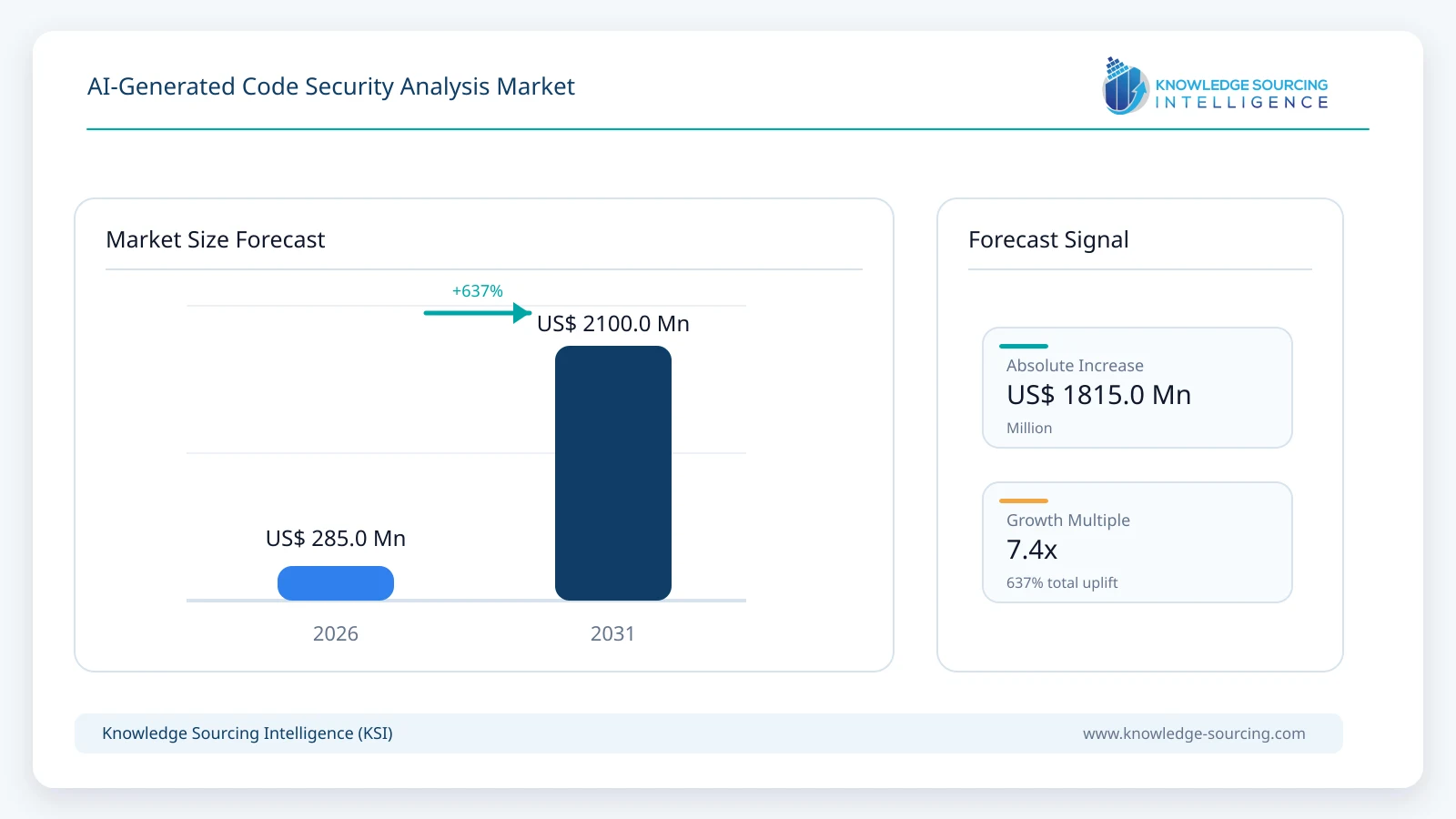
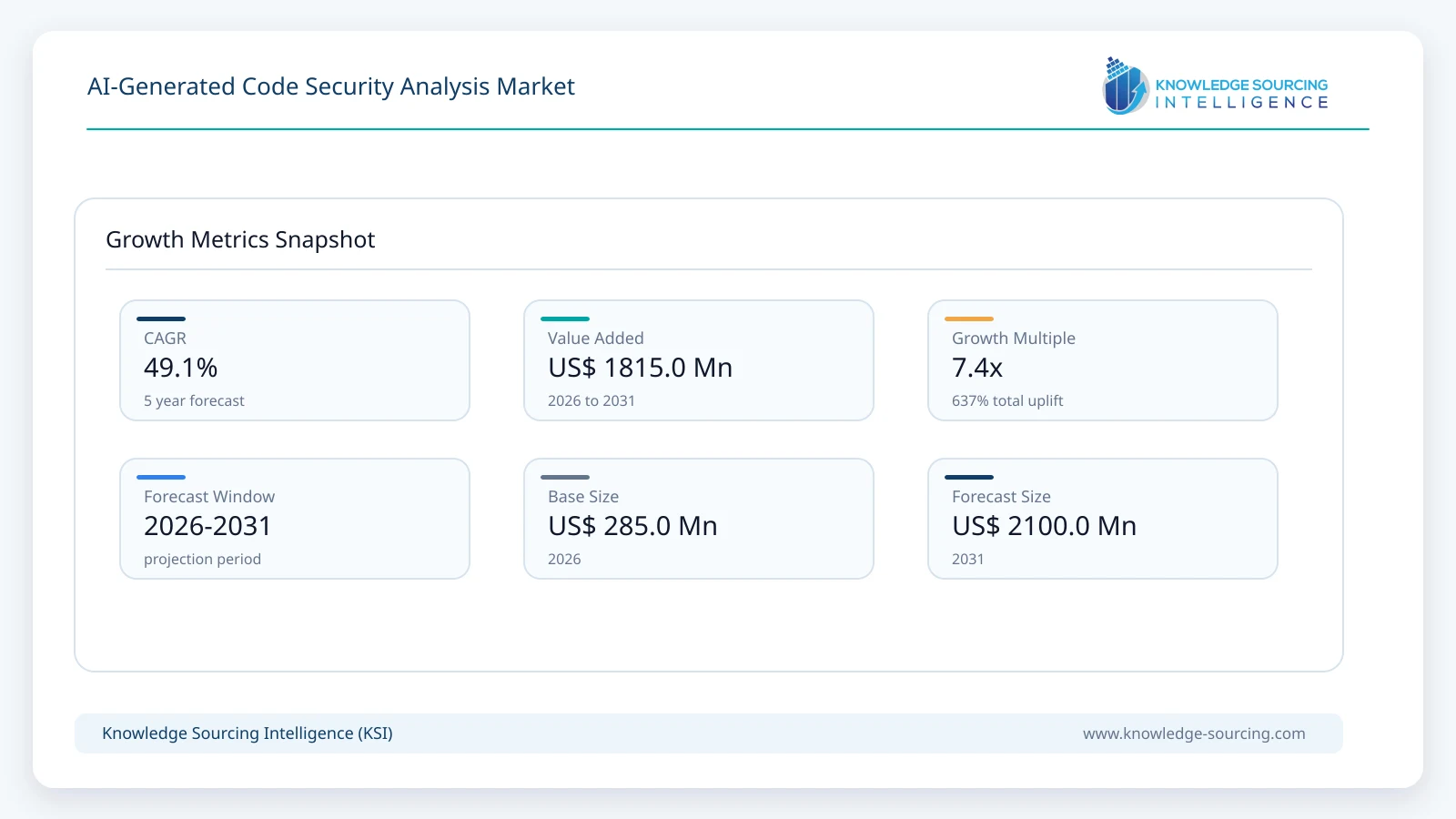
The AI-Generated Code Security Analysis Market is forecast to grow at a CAGR of 49.1%, reaching USD 2,100.0 million in 2031 from USD 285.0 million in 2026.
Highlights:
- 1AI-assisted coding creates demand for pre-merge security verification of machine-written changes, not only periodic repository scans.
- 2Attributable security-analysis modules form the largest commercial offering, with a modeled value of USD 950 million in 2031.
- 3Contextual security checks grow alongside deterministic static analysis as suppliers target authorization and business-logic vulnerabilities.
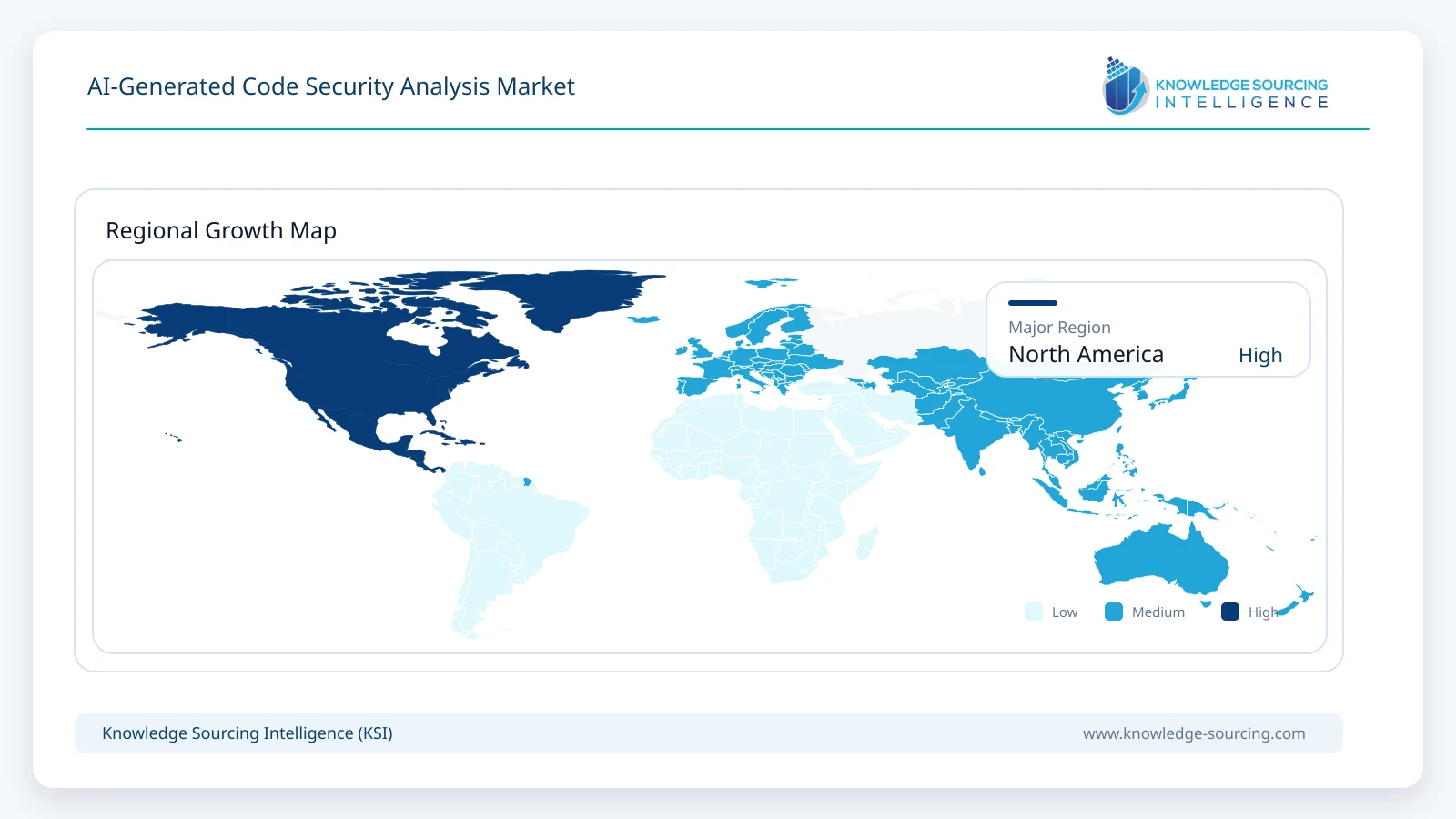
- 4North America is projected to retain the largest regional market at USD 819 million in 2031.
- 5Asia Pacific is modeled as the fastest-growing major region, reaching USD 609 million in 2031.
- 6Commercial revenue excludes stand-alone AI code generation, standard test execution and entire application-security subscriptions.
Security review is moving closer to the point at which an AI agent writes code. Semgrep Guardian analyzes generated code inside coding environments, while GitHub validates agent-created pull requests using code analysis, secret scanning, and dependency intelligence. Earlier detection can reduce rework, but enterprise purchasers still require evidence of finding accuracy, useful remediation, and compatibility with their source-control policies. Organizations generally retain human responsibility for approval even when an agent proposes a fix.
Technology suppliers monetize the function through developer-linked subscriptions, enterprise contracts and metered security-analysis capacity, although not every AI code scan creates incremental revenue. The forecast assumes paid adoption broadens as coding agents produce larger and more complex changes and buyers seek consistent controls across tools. Bundled scanning, open-source products and internal security teams will continue to place pressure on realized revenue per workflow.
Market Overview
Application-security teams historically monitored changes using static analysis, composition analysis, secret detection, and penetration testing at defined development gates. AI coding agents now submit larger volumes of changes across multiple files and dependencies, increasing the importance of linking findings to the code and context that generated them. Enterprises need security analysis that can distinguish exploitable issues from noisy alerts and route actionable evidence to developers before a change reaches production.
GitHub extended security validation to third-party coding agents in June 2026, checking new code with CodeQL, dependency advisories, and secret scanning. Sonar subsequently made Hunter Agent generally available to investigate business-logic and access-control flaws with deeper contextual analysis. These initiatives demonstrate complementary approaches: reliable deterministic checks for known defect classes and more expensive reasoning for problems where understanding intent, identity or cross-file behavior is important.
The supplier landscape includes application-security incumbents, developer platforms and specialists focused on agent-produced code. Providers that already own the code review or CI/CD workflow have a distribution advantage, but specialist products can differentiate through lower false-positive rates, language coverage, rapid integration and evidence-backed fix validation. Enterprise contracts frequently bundle several security functions, making the attributable AI-generated-code component more commercially relevant than headline platform sales.
Market Trends
Security Controls Move into AI Coding Agents
Generation-time security integration is changing the stage at which vulnerabilities are discovered. Security hooks and IDE integrations can examine AI-written changes before they are committed, reducing the cost of addressing insecure patterns after a pull request has been approved. Semgrep Guardian is designed to detect vulnerabilities as coding agents produce code, while Endor Labs provides AURI through developer-facing plugins, command-line tools and MCP integrations. Broad adoption depends on scan responsiveness, clear developer feedback, and the ability to keep sensitive code within approved environments.
Hybrid Code Analysis Gains Ground
Static rules and dataflow tracing remain important for finding familiar injection paths and insecure configuration. However, authorization flaws and business-logic errors often require information about intended behavior that is not obvious from a pattern match. SonarQube Hunter Agent combines contextual investigation with independent finding validation, illustrating the shift toward analysis pipelines that reserve reasoning-intensive review for selected high-risk changes. The economics favor hybrid workflows over unrestricted model calls on every line of code.
Pull Requests Become a Common Enforcement Boundary
Pull-request security checks provide an auditable handoff between autonomous code generation and human approval. GitHub added AI-powered detections to pull-request scanning in July 2026, while its security validation for third-party coding agents applies code, dependency and secret analysis to agent-submitted changes. This placement creates a common policy boundary across different code-generation tools and supports deployment by platform engineering teams, although teams still need exception handling and false-positive management.
Validated Fixes Replace Unchecked Remediation Suggestions
Security buyers increasingly evaluate whether automated fixes actually remove vulnerabilities rather than merely produce plausible code changes. GitHub agentic autofix explores relevant files and reruns analysis before proposing a pull request, making validation part of the remediation workflow. The commercial opportunity includes audit evidence and structured triage as well as detection. Unreviewed auto-remediation remains risky in sensitive systems, so organizations often require human approval and reproducible test results before release.
Segment Analysis
By Commercial Offering: Security-Analysis Add-Ons
Security-analysis add-ons are modeled to generate USD 950 million by 2031. Organizations adopt these products within coding, source-control, or application-security subscriptions, purchasing incremental protection for AI-assisted workflows rather than replacing every existing security tool. Published broad code security pricing, including GitHub Code Security and Semgrep paid tiers, demonstrates established per-contributor purchasing models; the attributable AI-code-analysis component is only a portion of such spending.
By Analysis Function: Vulnerability and Dataflow Detection
Vulnerability and insecure dataflow detection is expected to retain the largest function-level share, reaching USD 630 million by 2031. The segment covers injection weaknesses, unsafe data handling, authorization-related flows, and other defects in AI-generated changes. Demand is reinforced by organizations applying existing secure-coding standards to code written by both humans and AI agents, while contextual business-logic analysis expands from a smaller base.
By Integration Point: Pull-Request and CI/CD Review
Pull-request and CI/CD analysis is forecast at USD 819 million in 2031, remaining a large share despite growth in generation-time checks. Security teams can enforce consistent approval rules at the pull-request boundary regardless of which coding model produced a change. GitHub’s 2026 launches illustrate how automatic validation and AI-assisted detection can be embedded into this existing workflow, though scanning costs and alert volume affect adoption.
By Deployment Model: Multitenant Cloud SaaS
Multitenant cloud services are projected to account for USD 1.03 billion by 2031. SaaS deployment simplifies updates to vulnerability rules, model-assisted analysis, and cross-repository policy management. Banks, healthcare enterprises and public-sector buyers may favor private cloud or on-premises deployment when source-code confidentiality, residency and audit requirements prevent sending code snippets to shared analysis services.
Market Drivers
Rising Volume of Machine-Written Software
Increasing use of AI coding assistants exposes enterprise review processes to a larger number of changes that may be syntactically sound but insecure. Sonar’s January 2026 developer survey identified a substantial gap between AI-code use and consistent verification, supporting demand for automated checks before deployment. Security-analysis spending grows when enterprises cannot scale manual inspection in proportion to code output.
Expansion of Agentic Development Workflows
Autonomous coding agents can open files, select dependencies, execute tools and submit pull requests without continuous human direction. These workflows introduce both conventional software weaknesses and risks related to agent permissions and untrusted instructions. Snyk’s agentic development security approach and Endor Labs’ developer-facing integrations reflect demand for inspection at the point of agent action as well as repository-level review.
Need for Reliable Pre-Merge Security Evidence
Developers and application-security teams need prioritized, reproducible findings to decide whether AI-created code is safe to merge. Automated checks linked to source-control activity can record vulnerabilities, remediation attempts and final approval decisions. GitHub’s security validation for third-party agents illustrates a commercially important model because the same checks can apply across multiple code-generation tools.
Improving Analysis of Contextual Vulnerabilities
Cross-file authorization defects, authentication weaknesses, and business-logic failures remain difficult for simple signature-based systems. SonarQube Hunter Agent brings contextual investigation into mainstream developer workflows, expanding the categories of security problems that automated review may address. Better precision can increase willingness to pay when it reduces unnecessary investigations by scarce AppSec specialists.
Secure Development Governance and Procurement
Security frameworks increasingly require organizations to demonstrate repeatable secure-development processes, documented review and accountable release decisions. NIST’s Secure Software Development Framework provides a general practices baseline, while OWASP guidance addresses operational risks specific to AI coding agents. Enterprises adopting AI-enabled development may therefore fund attributable assurance controls as part of their existing DevSecOps programs.
Market Restraints
Bundled Pricing Limits Attributable Spend
Code-security vendors frequently package generated-code scanning within broad application-security contracts, while some developer protections are included at no charge. Customers may receive AI-related checks without purchasing a distinct product line. This bundling constrains measurable segment revenue even if use of security analysis increases.
False Positives and Limited Business Context
Security analyzers can produce findings that do not represent exploitable conditions, especially when code context is incomplete. Repeated noisy alerts undermine developer trust and create avoidable review work. Buyers may delay expansion until suppliers demonstrate precision, fix relevance and stable results across successive code changes.
Source-Code Confidentiality and Data Handling
Organizations in regulated industries may restrict transmission of proprietary code, secrets or repository context to external AI-analysis services. Private deployment, minimized data transfer and strong access controls can address these concerns but raise implementation and support costs. Procurement reviews may be lengthy when providers depend on third-party model infrastructure.
Runtime Cost and Release-Pipeline Latency
Reasoning-intensive scans and security fix validation can consume substantial inference resources on large repositories. Running deep analysis on every agent action can also slow iterative development. Enterprises balance broader vulnerability coverage against latency, metered usage and engineering productivity, favoring risk-based triggers instead of exhaustive evaluation.
Open-Source Tools and Internal Security Automation
Established static-analysis engines, open-source rules and custom CI/CD policies remain effective for many vulnerability classes. Internal platform teams can combine these controls with coding-agent hooks rather than purchasing specialized subscriptions. Commercial vendors must provide stronger contextual coverage, usable evidence or lower total operating cost to justify incremental spending.
Regional Outlook
North America
North America is expected to remain the largest market, reaching USD 819 million by 2031 from approximately USD 131 million in 2026. Demand is supported by concentrated software development activity, high application-security spending and mature deployment of cloud source-control and AI coding products. The United States accounts for most regional revenue, with GitHub, Semgrep, Snyk, Sonar and specialist application-security vendors competing to make code scanning part of everyday developer workflows.
Enterprise buyers in the United States increasingly assess whether AI-generated changes meet the same security rules as human-authored software. Financial institutions and major technology organizations are important early purchasers because they manage large code estates and cannot rely on informal review of autonomous changes. Canada adds demand from technology and regulated enterprise teams, while Mexico represents a smaller market linked to nearshore software delivery and multinational development operations.
Asia Pacific
Asia Pacific is projected to expand from approximately USD 60 million in 2026 to USD 609 million in 2031, making it the fastest-growing major regional market under the KSI forecast. India, China, Japan, South Korea, Singapore and Australia contain large software delivery, financial technology and cloud development ecosystems. Expansion of AI-assisted coding and pressure to secure globally distributed software supply chains create opportunities for embedded analysis, managed enterprise deployments and private-cloud security tools.
Indian software services firms and technology platforms are expected to increase spending as security obligations extend to AI-created deliverables for global customers. Japan and South Korea emphasize software reliability and industrial system protection, while Singapore and Australia support regional security governance and cloud procurement. Price sensitivity, differences in data residency rules and the availability of in-house security expertise will shape the pace of monetized adoption across Asia Pacific.
Competitive Landscape
AI-generated code security analysis brings together source-control platforms, established application-security suppliers and newer developer-tool specialists. GitHub can distribute CodeQL-based checks and AI detection within the pull-request workflow, while Semgrep focuses on low-friction rule-driven and AI-assisted analysis inside coding tools. Sonar differentiates through code-quality integration and contextual security investigation; Snyk emphasizes the wider controls needed when coding agents select dependencies and act across developer systems.
Endor Labs, Checkmarx, Veracode, GitLab, Cycode, Apiiro and other security vendors compete through vulnerability research, policy integration, remediation workflows and coverage of code supply chains. Market differentiation will depend more on actionable findings and validated risk reduction than on simply offering another AI assistant. Suppliers that minimize false positives and preserve source-code confidentiality have an advantage in large enterprise procurement.
Recent Developments
27 August 2026: Sonar made SonarQube Hunter Agent generally available, adding contextual analysis for broken access control, authentication, and business-logic vulnerabilities that deterministic pattern checks may overlook. Its security findings feed the existing SonarQube workflow.
14 July 2026: GitHub added AI-powered security detections to pull-request code scanning, extending issue coverage beyond CodeQL-supported languages and frameworks. Findings are labeled to distinguish them from conventional CodeQL results.
23 June 2026: Snyk announced Evo Agentic Development Security, combining controls on coding-agent tools and behavior with real-time checks on code generated during autonomous development.
9 June 2026: GitHub made automatic security validation generally available for third-party coding agents, applying CodeQL, dependency-advisory checks and secret scanning to code submitted by supported agents.
20 May 2026: Semgrep introduced Guardian product updates focused on vulnerabilities in AI-generated code inside coding tools. The company also detailed agent-related security rule packs and an autofix public beta.
3 March 2026: Endor Labs launched AURI, providing security intelligence to AI coding agents through plugins, MCP and CLI interfaces. Its initially free developer access illustrates both supplier commitment and monetization pressure.
Market Outlook
AI-generated code security analysis is expected to grow as machine-written software accounts for a larger share of enterprise change activity. Security checks integrated into coding agents, IDEs and pull-request systems can help maintain approval discipline without rebuilding the entire software delivery process. The main commercial opportunity lies in products that identify meaningful vulnerabilities early and supply evidence developers can use to approve a safe change.
Hybrid analysis will become increasingly important as enterprises extend security checks from familiar static-analysis findings to business-logic and cross-file vulnerabilities. Providers can improve operating economics by combining deterministic scanning with targeted contextual reasoning, reserving more expensive analysis for changes that carry higher security risk. Subscription and enterprise platform revenue will likely exceed one-time implementation work as products mature.
Revenue realization will depend on customers paying an identifiable premium for AI-code-specific assurance rather than receiving the capability within existing code-security subscriptions. The market therefore remains narrower than application security as a whole, despite strong supplier activity and continued expansion of AI-assisted software development. Organizations will continue to require human accountability, auditability and independent security evidence for production releases.
AI-Generated Code Security Analysis Market Scope:
| Report Metric | Details |
|---|---|
| Total Market Size in 2026 | USD 285.0 million |
| Total Market Size in 2031 | USD 2,100.0 million |
| Forecast Unit | USD Million |
| Growth Rate | 49.1% |
| Study Period | 2021 to 2031 |
| Historical Data | 2021 to 2024 |
| Base Year | 2025 |
| Forecast Period | 2026 – 2031 |
| Segmentation | Commercial Offering, Analysis Function, Analysis Technique, Integration Point |
| Companies |
|
| Customization Scope | 15% Free Customization included with purchase — Request Custom Breakdown → |
| Sample & Data Access | PDF Sample, Excel Databook & Analyst Briefing — Download Free Sample → |
Market Segmentation
By Commercial Offering
Security-analysis add-on subscriptions
Enterprise AI-code assurance platforms
Metered AI-code security analysis
Integration and validation services
By Analysis Function
Vulnerability and insecure dataflow detection
Authorization and business-logic assessment
Secrets and sensitive-data leakage
Dependency and software supply-chain exposure
Agent-specific configuration and instruction risk
Security fix and remediation validation
By Analysis Technique
Hybrid AI and deterministic static analysis
Contextual LLM and agentic review
Semantic code-graph analysis
Dynamic and sandbox-supported validation
By Integration Point
IDE and coding-agent generation hooks
Commit and pre-commit controls
Pull-request and CI/CD security review
Scheduled repository and release scans
By Deployment Model
Multitenant cloud SaaS
Dedicated or private-cloud deployment
On-premises analysis
Hybrid and managed private deployment
By Primary Customer
Enterprise application-security teams
Developer platform and DevSecOps teams
Software vendors and AI coding providers
Managed security and integration partners
Public-sector and research organizations
By End-user Industry
Information technology and software
Banking and financial services
Healthcare and life sciences
Retail and e-commerce
Manufacturing and engineering
Government and public services
Other industries
By Geography
North America
United States
Canada
Mexico
South America
Brazil
Argentina
Chile
Rest of South America
Europe
Germany
United Kingdom
France
Italy
Spain
Netherlands
Nordic Countries
Rest of Europe
Middle East and Africa
United Arab Emirates
Saudi Arabia
Israel
South Africa
Rest of Middle East and Africa
Asia Pacific
China
Japan
India
South Korea
Australia
Singapore
Rest of Asia Pacific
Table of Contents
1. EXECUTIVE SUMMARY
1.1. Research Highlights
1.2. Market Size and Forecast, 2026-2031
1.3. Market Opportunity and Outlook
2. MARKET SNAPSHOT
2.1. Definition and Commercial Scope
2.2. Market Dynamics
2.3. Pricing and Revenue Models
3. BUSINESS LANDSCAPE
3.1. Market Drivers
3.1.1. Rising Volume of Machine-Written Software
3.1.2. Expansion of Agentic Development Workflows
3.1.3. Need for Reliable Pre-Merge Security Evidence
3.1.4. Improving Analysis of Contextual Vulnerabilities
3.1.5. Secure Development Governance and Procurement
3.2. Market Restraints
3.2.1. Bundled Pricing Limits Attributable Spend
3.2.2. False Positives and Limited Business Context
3.2.3. Source-Code Confidentiality and Data Handling
3.2.4. Runtime Cost and Release-Pipeline Latency
3.2.5. Open-Source Tools and Internal Security Automation
3.3. Market Opportunities
3.4. Porter’s Five Forces Analysis
3.5. Industry Value Chain Analysis
3.6. Policies and Regulations
3.7. Strategic Recommendations
4. TECHNOLOGICAL OUTLOOK
4.1. Code Generation Provenance and Analysis Triggers
4.2. Static, Semantic and Dataflow Analysis
4.3. Contextual AI Security Reasoning
4.4. Secrets, Dependencies and Agent Skills
4.5. Security Fix Validation and Risk Scoring
5. AI-GENERATED CODE SECURITY ANALYSIS MARKET BY COMMERCIAL OFFERING
5.1. Security-analysis add-on subscriptions
5.2. Enterprise AI-code assurance platforms
5.3. Metered AI-code security analysis
5.4. Integration and validation services
6. AI-GENERATED CODE SECURITY ANALYSIS MARKET BY ANALYSIS FUNCTION
6.1. Vulnerability and insecure dataflow detection
6.2. Authorization and business-logic assessment
6.3. Secrets and sensitive-data leakage
6.4. Dependency and software supply-chain exposure
6.5. Agent-specific configuration and instruction risk
6.6. Security fix and remediation validation
7. AI-GENERATED CODE SECURITY ANALYSIS MARKET BY ANALYSIS TECHNIQUE
7.1. Hybrid AI and deterministic static analysis
7.2. Contextual LLM and agentic review
7.3. Semantic code-graph analysis
7.4. Dynamic and sandbox-supported validation
8. AI-GENERATED CODE SECURITY ANALYSIS MARKET BY INTEGRATION POINT
8.1. IDE and coding-agent generation hooks
8.2. Commit and pre-commit controls
8.3. Pull-request and CI/CD security review
8.4. Scheduled repository and release scans
9. AI-GENERATED CODE SECURITY ANALYSIS MARKET BY DEPLOYMENT MODEL
9.1. Multitenant cloud SaaS
9.2. Dedicated or private-cloud deployment
9.3. On-premises analysis
9.4. Hybrid and managed private deployment
10. AI-GENERATED CODE SECURITY ANALYSIS MARKET BY PRIMARY CUSTOMER
10.1. Enterprise application-security teams
10.2. Developer platform and DevSecOps teams
10.3. Software vendors and AI coding providers
10.4. Managed security and integration partners
10.5. Public-sector and research organizations
11. AI-GENERATED CODE SECURITY ANALYSIS MARKET BY END-USER INDUSTRY
11.1. Information technology and software
11.2. Banking and financial services
11.3. Healthcare and life sciences
11.4. Retail and e-commerce
11.5. Manufacturing and engineering
11.6. Government and public services
11.7. Other industries
12. AI-GENERATED CODE SECURITY ANALYSIS MARKET BY GEOGRAPHY
12.1. North America
12.1.1. United States
12.1.2. Canada
12.1.3. Mexico
12.2. South America
12.2.1. Brazil
12.2.2. Argentina
12.2.3. Chile
12.2.4. Rest of South America
12.3. Europe
12.3.1. Germany
12.3.2. United Kingdom
12.3.3. France
12.3.4. Italy
12.3.5. Spain
12.3.6. Netherlands
12.3.7. Nordic Countries
12.3.8. Rest of Europe
12.4. Middle East and Africa
12.4.1. United Arab Emirates
12.4.2. Saudi Arabia
12.4.3. Israel
12.4.4. South Africa
12.4.5. Rest of Middle East and Africa
12.5. Asia Pacific
12.5.1. China
12.5.2. Japan
12.5.3. India
12.5.4. South Korea
12.5.5. Australia
12.5.6. Singapore
12.5.7. Rest of Asia Pacific
13. COMPETITIVE ENVIRONMENT AND ANALYSIS
13.1. Market Share and Strategic Positioning
13.2. Competitive Benchmarking
13.3. Product and Commercial Strategy
13.4. Recent Developments
14. COMPANY PROFILES
14.1. GitHub (Microsoft Corporation)
14.2. Semgrep, Inc.
14.3. Snyk Limited
14.4. SonarSource SA
14.5. Endor Labs, Inc.
14.6. Checkmarx Ltd.
14.7. Veracode, Inc.
14.8. GitLab Inc.
14.9. Cycode Ltd.
14.10. Apiiro Ltd.
14.11. Qodo Ltd.
14.12. JFrog Ltd.
15. APPENDIX
15.1. Research Methodology
15.2. Currency and Units
15.3. Abbreviations





Frequently asked questions
What is the projected market size and growth rate for AI-Generated Code Security Analysis by 2031?
Market reaches USD 2,100 million in 2031, growing at 49.1% CAGR.
What is driving the growth in the AI-Generated Code Security Analysis market?
AI-assisted coding creating demand for pre-merge security verification.
Which region is projected to lead the AI-Generated Code Security Analysis market?
North America is projected to retain the largest market share.
Which region is forecast to be the fastest-growing in this market?
Asia Pacific is modeled as the fastest-growing major region.
What is the largest commercial offering within this security analysis market?
Attributable security-analysis modules form the largest commercial offering.
How do technology suppliers monetize AI-Generated Code Security Analysis?
Through developer subscriptions, enterprise contracts, and metered capacity.
Cite this report
Knowledge Sourcing Intelligence. (Oct 2026). AI-Generated Code Security Analysis Market Size, Share & Growth Forecast (2026-2031). https://www.knowledge-sourcing.com/report/ai-generated-code-security-analysis-market