
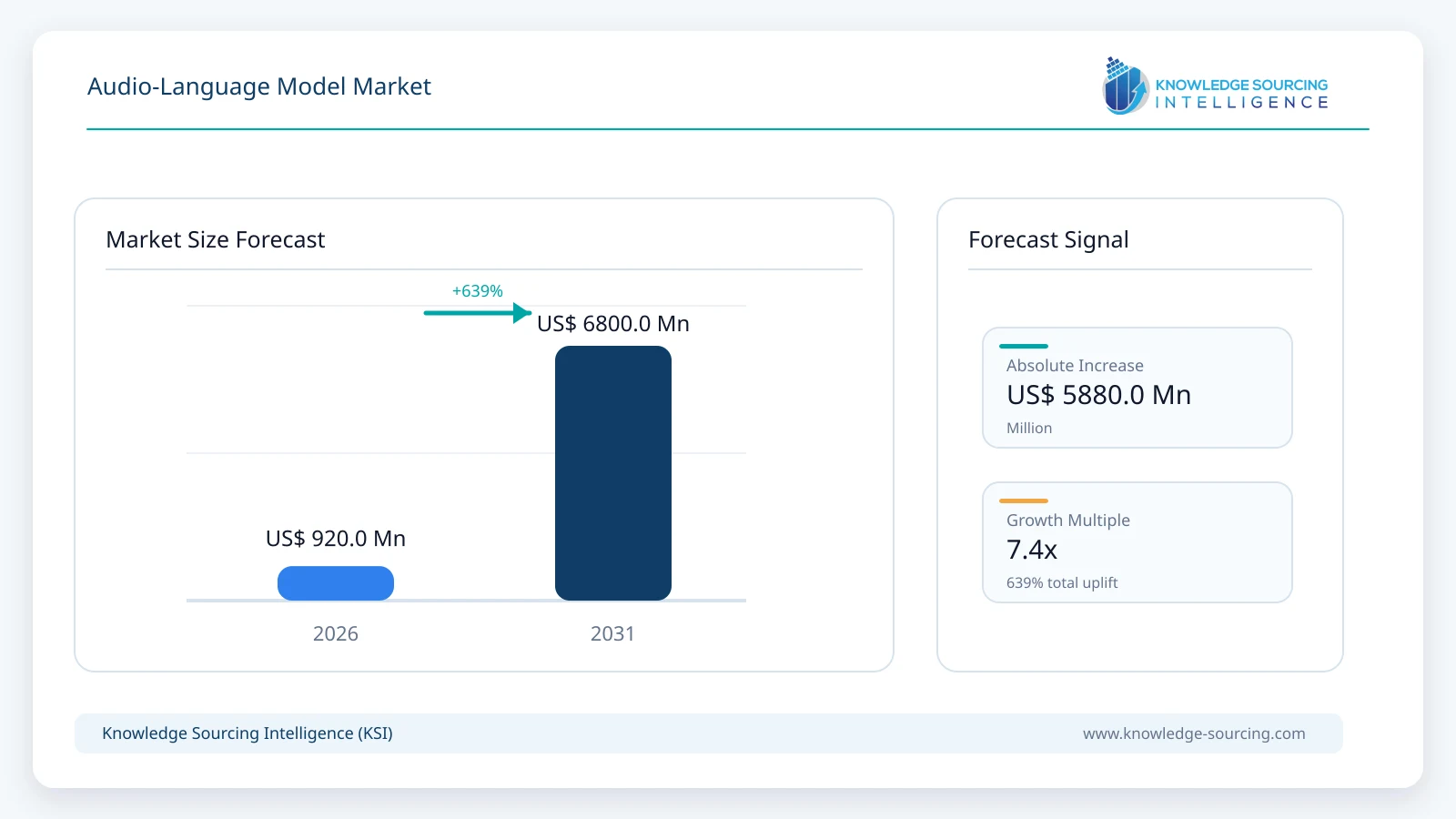
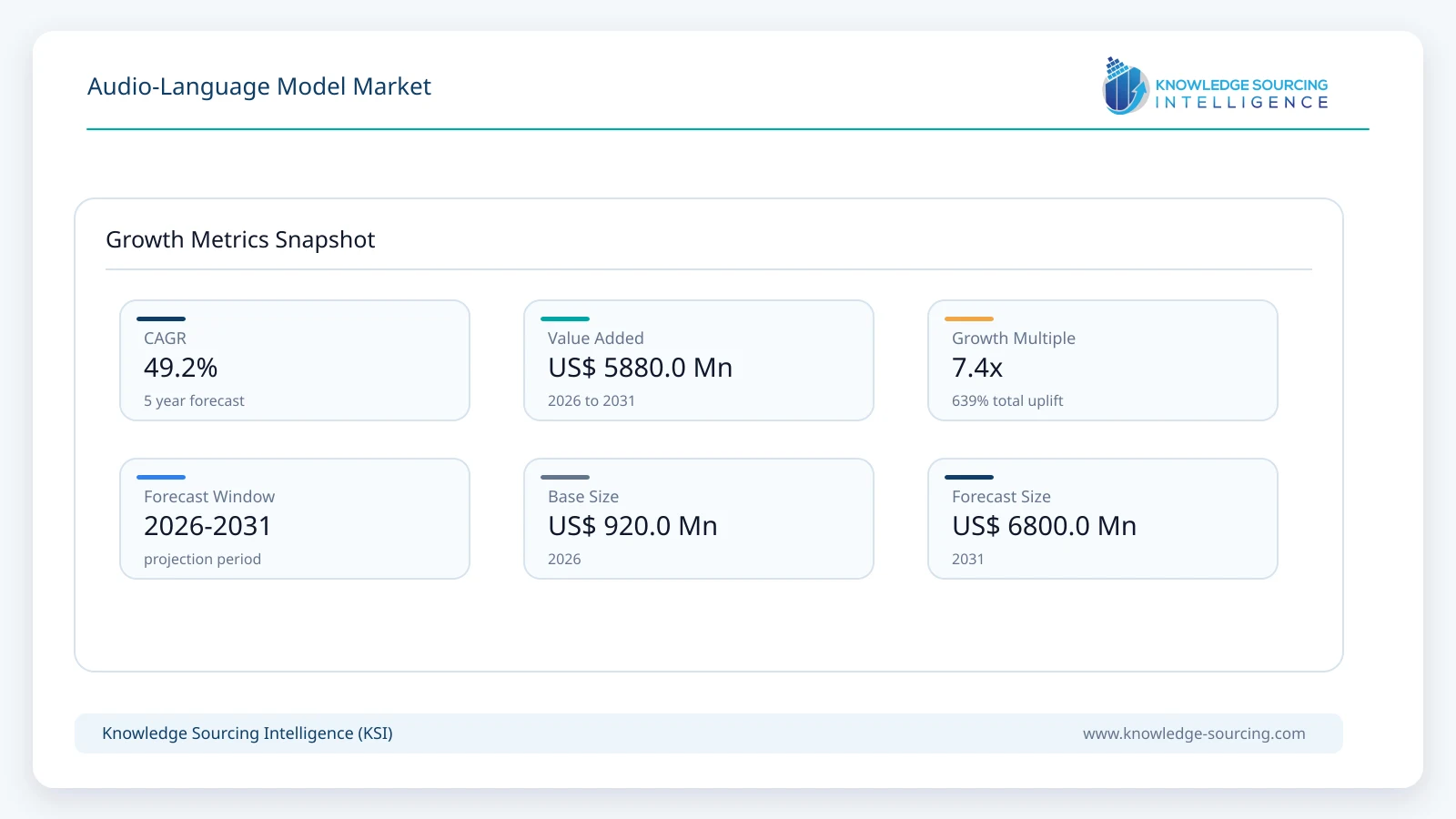
The Audio-Language Model Market is estimated at USD 920 million in 2026 and is forecast to reach USD 6,800 million by 2031, expanding at a CAGR of 49.2% during the forecast period.
Highlights:
- 1Native real-time audio-language APIs lead the attributable paid revenue model and increase in importance through 2031.
- 2Contact centers are the largest early application environment because voice traffic and resolution outcomes can be measured.
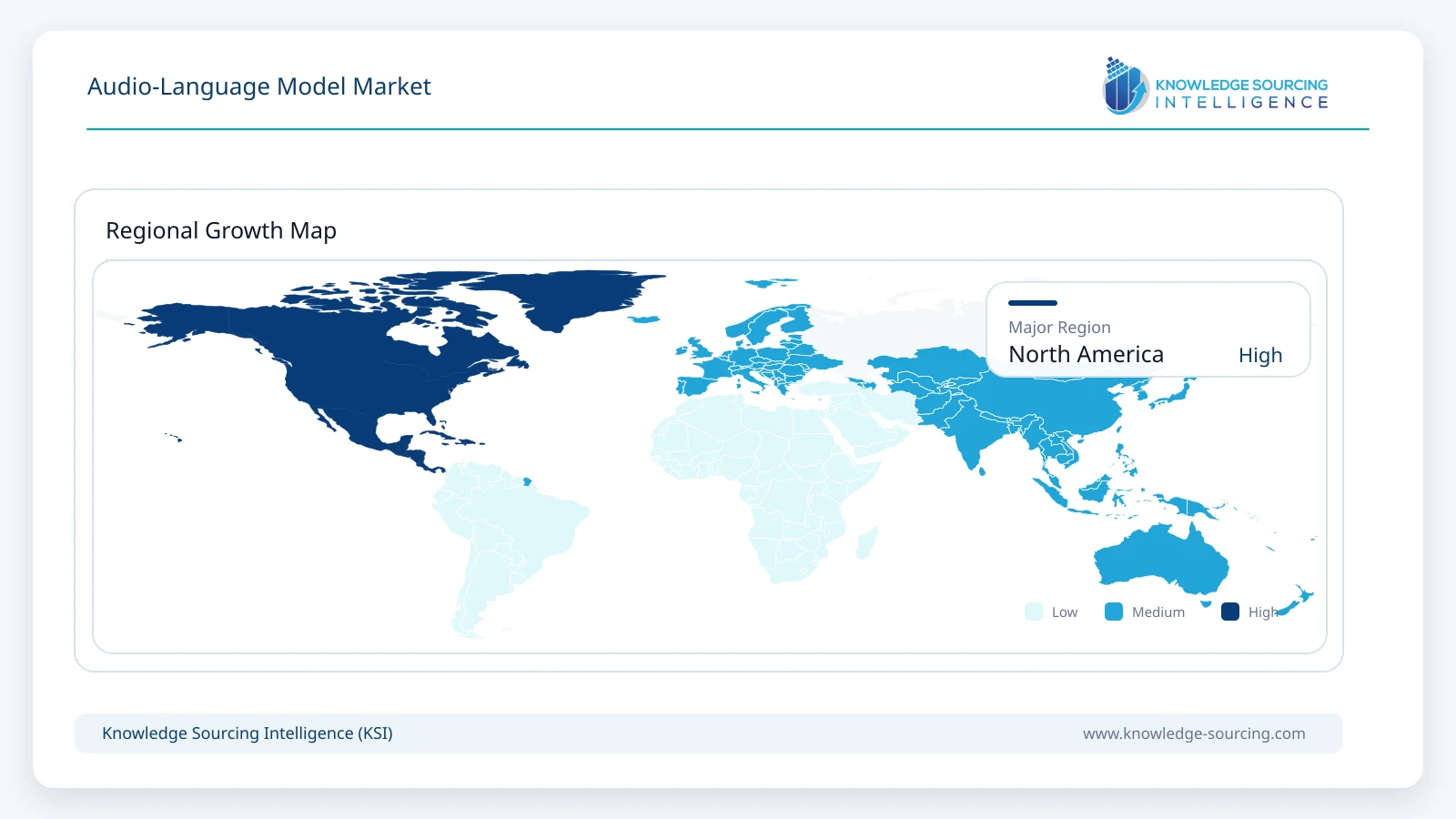
- 3North America leads 2026 spending, while Asia Pacific is the fastest-growing modeled regional market.
- 4Google, AWS, OpenAI and Alibaba demonstrate continued development of tool-enabled and multilingual realtime speech systems.
- 5Integration reliability, data protection and the cost per successful task remain key procurement controls.
The study covers directly attributable spending on models that process speech or recorded audio together with language understanding, reasoning, translation or generated spoken responses.
Commercial revenue includes paid realtime speech-to-speech APIs, asynchronous audio-language analysis APIs, dedicated enterprise model deployments and domain-specific model licenses. The study excludes generic automatic speech recognition, standalone text-to-speech, ordinary text-only inference, telephony carriage fees and the total subscription value of an agent application where only part of the payment supports the audio-language model.
The report analyzes seven independent segmentation dimensions: commercial offering, model architecture, primary function, input environment, deployment model, language capability and end-user industry. It evaluates five geographic regions, provides country-level allocations and compares suppliers whose products directly perform speech-language interpretation or interaction. Separate portfolio checks prevent double counting with KSI speech-recognition, foundation-model and conversational AI studies.
Market Overview
Audio-language models are changing the technical architecture of voice software by linking sound recognition with contextual language processing. Conventional systems often transcribe speech, pass the text to a language model and then synthesize an answer in separate steps. Newer speech-to-speech models can manage more of the interaction within a unified audio-language process, improving turn handling and preserving some cues from tone, pacing and conversational context.
Developer adoption is growing because customers can connect these models through cloud APIs without building training datasets, streaming audio infrastructure or accelerator clusters internally. OpenAI has introduced reasoning-oriented realtime models, AWS provides Nova Sonic through Bedrock, Google offers Gemini Live, and Alibaba Cloud has expanded Qwen Omni. Enterprise teams can evaluate model behavior in call centers, service portals and multilingual interfaces before committing to a large dedicated deployment.
The commercial opportunity is not identical to the broader voice and speech recognition industry. A general transcription system can convert speech to text without performing language reasoning or producing a contextual response. Similarly, a contact-center platform can charge for telephony, routing and CRM features that are outside the underlying audio-language model. Clear revenue attribution is essential when estimating this narrower market.
Market Trends
Native Speech-to-Speech Models Replace Some Cascaded Pipelines
Realtime audio-language models increasingly process spoken input and generate spoken responses without requiring every conversation to pass through a separately managed transcription, text LLM and speech-synthesis pipeline. OpenAI GPT Realtime 2, Amazon Nova 2.5 Sonic and Gemini 3.8 Live exemplify this architecture. Native processing can preserve conversational flow and reduce integration points for developers.
Cascaded systems remain important when buyers need independent control over transcription accuracy, language-model selection and voice branding. ElevenAgents supports both realtime and modular configurations, demonstrating that procurement will remain use-case-specific rather than shift uniformly to one architecture.
Spoken Language Reasoning and Tool Use Become Procurement Criteria
Model selection is moving beyond expressive speech toward reliable interpretation of multi-step requests. AWS highlights improved Nova Sonic tool calling, while OpenAI emphasizes reasoning during live voice interactions. This shifts evaluation toward successful service transactions, accurate data retrieval and controlled escalation rather than voice naturalness alone.
Enterprise deployments also depend on the relationship between an audio session and external applications. Telephony routing, CRM permissions, identity verification and transaction records remain separate responsibilities, making integration quality as important as the model’s conversational score.
Live Translation and Multilingual Spoken Interaction Expand
Cross-language speech services are moving from staged translation toward near-real-time conversation. Google has expanded its native audio translation lineup, ElevenLabs introduced live translation for enterprise developers, and Alibaba documents multilingual Omni realtime output. These capabilities are relevant to international support desks and accessibility services.
Commercial language expansion is uneven because recognition quality, accent handling and expressive output do not improve at identical rates. Companies are therefore likely to launch in selected markets before offering a consistent multilingual service across every language advertised by a model provider.
Usage-Based Audio Pricing Reshapes Product Economics
Suppliers increasingly expose audio token or per-minute tariffs that allow direct budgeting of realtime conversations. Google lists minute-equivalent rates for Gemini Live audio, while xAI publishes a speech-to-speech rate per minute. API billing helps software providers estimate revenue per interaction but creates sensitivity to average conversation duration and model latency.
High-volume enterprise users can also negotiate dedicated capacity and private hosting arrangements. The market therefore includes both metered API usage and separately attributable model deployment revenue, without counting broader contact-center software or speech-analytics contracts in full.
Segment Analysis
By Commercial Offering
Native realtime models form the largest revenue stream because they charge for ongoing conversational sessions and are increasingly integrated into enterprise voice products. Their modeled revenue rises from USD 440 million in 2026 to USD 3,630 million in 2031.
The native real-time audio-language apis segment is estimated to reach USD 3,630.00 million by 2031. Asynchronous audio understanding remains important for recorded meetings and media analysis, while dedicated deployments serve buyers with data-residency and predictable-capacity requirements.
By Model Architecture
Unified models lead the forecast architecture as speech comprehension, reasoning and response generation become more tightly coupled. They can make use of intonation and conversational context that a purely text-mediated system may discard.
The unified end-to-end speech-language models segment is estimated to reach USD 3,468.00 million by 2031. Cascaded speech and language stacks remain relevant where organizations want independent transcription or output controls, while smaller domain-adapted models gain adoption in constrained infrastructure.
By Primary Function
Conversational reasoning is the largest modeled functional segment as enterprises move from information-only voicebots toward agents that understand and resolve complete requests. AWS and OpenAI are direct suppliers of tool-enabled spoken dialogue.
The real-time conversational speech reasoning segment is estimated to reach USD 3,264.00 million by 2031. Recorded audio understanding, translation and audio-grounded question answering continue to expand, particularly in software productivity, international operations and media review.
By Input Environment
Telephony accounts for the largest initial portion of paid audio-language model usage because customer inquiries generate measurable call volumes and clear service metrics. Secure routing and interruption handling remain central purchasing criteria.
The contact center and telephony audio segment is estimated to reach USD 2,108.00 million by 2031. Embedded automotive, wearable and industrial devices grow faster as edge hardware improves, while recorded enterprise audio creates non-real-time analytical usage that follows different price economics.
By Deployment Model
Public-cloud developer APIs dominate the base year as suppliers handle accelerator hosting, voice transport and model upgrades. Enterprises can add multilingual conversational interfaces without training large audio models themselves.
The public cloud developer apis segment is estimated to reach USD 3,808.00 million by 2031. Private clouds and on-premise installations gain share in regulated environments where audio recordings, regional data controls and dependable inference capacity are procurement priorities.
By Language Capability
English-centric deployments currently represent the largest initial revenue pool because reference datasets, enterprise configurations and integration workflows are mature. The model projects their share declining as multilingual systems scale.
The primarily english-language models segment is estimated to reach USD 2,040.00 million by 2031. Native code-switching and regional-language systems grow as providers add language coverage, but actual buyer adoption depends on test-set accuracy and deployment support for local accents and dialects.
By End-User Industry
Contact centers are the largest modeled buyer segment because voice conversations are central to existing operations and can be evaluated on containment, cost per resolution and customer satisfaction.
The customer service and contact centers segment is estimated to reach USD 2,108.00 million by 2031. Software platforms remain major buyers of APIs, while healthcare, education and public services selectively adopt spoken interfaces under stronger quality and consent controls.
Market Drivers
Enterprise Voice-Agent Deployment
Enterprise voice agents increasingly need to interpret a caller’s intent and take action without requiring manual transcription review. OpenAI, AWS and Google package audio input, language reasoning, tool connections and spoken output through developer APIs. Customer service and field-service teams evaluate these capabilities against completion rates, escalation rates and labor cost rather than speech accuracy alone.
Improvements in Native Audio Reasoning
Native speech-language models can use vocal cues, conversational history and meaning within one response process. OpenAI’s GPT Realtime 2 and AWS Nova 2.5 Sonic show supplier investment in reasoning, instruction following and tool use during spoken conversations. More complex transactions become practical as models handle clarifications and multi-step tasks without restarting a separate chatbot pipeline.
Multilingual and Cross-Language Demand
Multinational contact centers, public services and travel platforms require voice systems that recognize a user’s language and respond naturally. Google’s live translation models and Alibaba’s Qwen-Omni extend language coverage, while ElevenLabs launched live translation for enterprise API customers. More languages and better code-switching expand the addressable pool beyond English-language deployments.
Developer API Availability and Cloud Integration
Managed audio-language APIs lower the burden of streaming media transport, endpoint detection and voice synthesis. Azure, Bedrock and Google Cloud make deployment accessible through established cloud procurement and developer workflows. Standard integration approaches make it easier to add spoken interaction to existing digital services while controlling security and session monitoring.
Cost Optimization and Smaller Models
Minute-based and token-based pricing gives buyers a way to compare audio AI against human-agent operating costs. Providers are releasing smaller variants and lower-latency models to accommodate high-volume workloads. Better model routing and reduced silence processing can improve the cost per successful conversation, encouraging deployment in lower-value customer inquiries.
Market Restraints
Latency and Conversation Interruption
Natural dialogue requires models to detect a turn, reason and begin responding quickly while allowing interruption. Network jitter, long tool calls and speech generation delays can produce awkward pauses or overlapping replies. Enterprise buyers must therefore test complete end-to-end interactions rather than rely only on vendor model benchmarks.
Privacy, Consent and Recorded-Speech Governance
Audio streams can include personally identifiable information, biometric characteristics and sensitive contextual cues. Healthcare, banking and public-service buyers must review data retention, user consent, recording policies and regional processing controls. These requirements can delay production use and favor private deployment options with auditable access.
Language Quality and Accent Variability
A model that performs well on standard English may struggle with regional accents, noisy environments, uncommon names and code-switching. Language coverage lists do not guarantee equal task completion performance across locations. Buyers need local test sets, human review and fallback workflows before expanding to high-stakes multilingual operations.
Unpredictable Usage and Inference Economics
Audio input and output generate costs during live sessions, sometimes including silence or repeated turns. Price reductions may also be offset by longer conversations and higher throughput requirements. Teams therefore need admission controls, session limits and model selection policies to prevent voice interaction from becoming uneconomic for routine tasks.
Model Reliability, Safety and Disclosure
Speech-language models can misinterpret a request, take an incorrect action or provide an overly confident spoken answer. Natural-sounding voice responses may make errors harder for users to recognize. Enterprises require robust permissioning, clear AI disclosure, human escalation and monitoring of task outcomes in regulated or financially consequential workflows.
Regional Outlook
North America
North America represents the largest modeled regional market at USD 386.40 million in 2026 and is forecast to reach USD 2,584.00 million by 2031. United States-based API providers, hyperscale infrastructure and enterprise customer-service software support early deployment. OpenAI, AWS, Google and xAI provide a growing range of commercially accessible speech-language services that developers can incorporate into contact centers, digital assistants and productivity products.
Canada contributes multilingual developer talent and cloud services, while Mexico supports Spanish-language service workflows and nearshore customer operations. Buyers prioritize secure, reliable voice workflows.
Asia Pacific
Asia Pacific is estimated at USD 207.00 million in 2026 and is projected to reach USD 1,904.00 million by 2031, the fastest growth among the five modeled regions. Regional expansion is supported by Alibaba Cloud’s Omni family, large smartphone-first user populations, customer-service modernization and demand for Asian-language speech systems. China, India, Japan and South Korea offer different combinations of local model development, enterprise procurement and embedded voice use cases.
China contributes domestic model ecosystems and cloud services, while Japan and South Korea offer opportunities for multilingual digital assistants and connected devices. India presents demand for diverse languages and high-volume service interactions, subject to localized accuracy and price sensitivity. Regional providers will need to manage code-switching, accents and sovereign data requirements as usage moves from pilot deployments toward routine production workloads.
Competitive Landscape
Competition includes foundation-model suppliers offering native speech-to-speech APIs, cloud services that distribute audio models and specialist vendors developing conversational speech components. OpenAI, Google, AWS, Alibaba, xAI and ElevenLabs participate through model or realtime API products, while Microsoft provides an important enterprise route to speech-capable model deployment. Mistral is active in audio model offerings; Deepgram, Cartesia and Speechmatics support selected audio-language workflows through their conversational speech capabilities.
Recent Developments
October 21, 2026: ElevenLabs launched Eleven Realtime Translation in alpha for enterprise API customers, offering live multilingual speech conversion during two-way conversation.
October 20, 2026: Mistral AI introduced the Voxtral 3 audio-model family in public preview, expanding streaming transcription and speech generation services.
October 5, 2026: AWS made Nova 2.5 Sonic generally available on Amazon Bedrock with improved reasoning, instruction following and voice-agent tool use.
September 15, 2026: Google DeepMind published the Gemini 3.8 Audio model card, describing live speech dialogue, extended-thinking audio and generative speech capabilities.
May 7, 2026: OpenAI introduced GPT Realtime 2, GPT Realtime Translate and Realtime Whisper for reasoning-aware voice interaction, multilingual translation and streaming transcription.
March 30, 2026: Alibaba Cloud released Qwen3.5 Omni models for multimodal audio-language comprehension, live spoken interaction and audio-visual analysis.
Market Outlook
Audio-language model adoption is expected to expand as businesses make spoken interaction a regular interface for service completion, knowledge access and multilingual assistance. Managed APIs will remain the most accessible route for developers, while dedicated model deployments increase where data handling and predictable capacity are critical.
Native speech-to-speech systems should gain share as they improve their ability to interpret natural conversation and use enterprise tools. Cascaded architectures will continue serving use cases requiring separately selected transcription, reasoning and speech models. Buyers will favor suppliers that document consistent quality and cost across the languages and audio environments actually encountered in production.
Commercial performance will depend on the cost per completed task, safe handling of personal speech data and the reliability of interruption and escalation. Faster models alone will not ensure buyer retention. Platforms capable of showing auditable results, stable application integrations and enterprise-grade controls are positioned for greater recurring demand.
Audio-Language Model Market Scope
| Report Metric | Details |
|---|---|
| Total Market Size in 2026 | USD 920 million |
| Total Market Size in 2031 | USD 6,800 million |
| Forecast Unit | Million |
| Growth Rate | 49.2% |
| Study Period | 2021 to 2031 |
| Historical Data | 2021 to 2024 |
| Base Year | 2025 |
| Forecast Period | 2026 – 2031 |
| Segmentation | Commercial Offering, Model Architecture, Primary Function, Input Environment, Deployment Model, Language Capability, End-User Industry, Geography |
| Companies |
|
| Customization Scope | 15% Free Customization included with purchase — Request Custom Breakdown → |
| Sample & Data Access | PDF Sample, Excel Databook & Analyst Briefing — Download Free Sample → |
Market Segmentation
By Commercial Offering
Native real-time audio-language APIs
Asynchronous audio-language understanding APIs
Enterprise dedicated deployments
Domain-tuned model licenses
By Model Architecture
Unified end-to-end speech-language models
Cascaded speech-text-language stacks
Omnimodal audio-text-language models
Domain-adapted and compact audio-language models
By Primary Function
Real-time conversational speech reasoning
Recorded audio understanding and dialogue
Live multilingual speech translation
Audio-grounded question answering and analysis
By Input Environment
Contact center and telephony audio
Web and mobile app voice input
Embedded automotive and edge audio
Recorded meetings, media and field audio
By Deployment Model
Public cloud developer APIs
Enterprise virtual private cloud deployments
On-premise and sovereign model hosting
Edge and embedded inference
By Language Capability
Primarily English-language models
Multilingual and code-switching models
Domain and regional language-specialized models
By End-User Industry
Customer service and contact centers
Software developers and AI platform providers
Media, communication and entertainment
Healthcare and life sciences
BFSI and insurance
Education, public services and other industries
By Geography
North America
United States
Canada
Mexico
South America
Brazil
Argentina
Rest of South America
Europe
United Kingdom
Germany
France
Netherlands
Italy
Spain
Rest of Europe
Middle East and Africa
United Arab Emirates
Saudi Arabia
Israel
South Africa
Rest of Middle East and Africa
Asia Pacific
China
Japan
India
South Korea
Australia
Singapore
Rest of Asia Pacific
Table of Contents
1. EXECUTIVE SUMMARY
1.1. Research Highlights
1.2. Market Size and Growth Outlook, 2026–2031
1.3. Strategic Market Perspective
2. MARKET SNAPSHOT
2.1. Market Overview
2.2. Market Definition
2.3. Scope of the Study
2.4. Market Segmentation
3. BUSINESS LANDSCAPE
3.1. Market Drivers
3.1.1. Enterprise Voice-Agent Deployment
3.1.2. Improvements in Native Audio Reasoning
3.1.3. Multilingual and Cross-Language Demand
3.1.4. Developer API Availability and Cloud Integration
3.1.5. Cost Optimization and Smaller Models
3.2. Market Restraints
3.2.1. Latency and Conversation Interruption
3.2.2. Privacy, Consent and Recorded-Speech Governance
3.2.3. Language Quality and Accent Variability
3.2.4. Unpredictable Usage and Inference Economics
3.2.5. Model Reliability, Safety and Disclosure
3.3. Market Opportunities
3.4. Porter’s Five Forces Analysis
3.5. Industry Value Chain Analysis
3.6. Policies and Regulations
3.7. Strategic Recommendations
4. TECHNOLOGICAL OUTLOOK
4.1. Native End-to-End Speech-to-Speech Models
4.2. Cascaded Audio-Text-Language Processing
4.3. Streaming Voice Transport and Interruption Handling
4.4. Multilingual Audio Reasoning and Translation
4.5. Secure Private Audio Inference and Observability
5. AUDIO-LANGUAGE MODEL MARKET BY COMMERCIAL OFFERING
5.1. Introduction
5.2. Native real-time audio-language APIs
5.3. Asynchronous audio-language understanding APIs
5.4. Enterprise dedicated deployments
5.5. Domain-tuned model licenses
6. AUDIO-LANGUAGE MODEL MARKET BY MODEL ARCHITECTURE
6.1. Introduction
6.2. Unified end-to-end speech-language models
6.3. Cascaded speech-text-language stacks
6.4. Omnimodal audio-text-language models
6.5. Domain-adapted and compact audio-language models
7. AUDIO-LANGUAGE MODEL MARKET BY PRIMARY FUNCTION
7.1. Introduction
7.2. Real-time conversational speech reasoning
7.3. Recorded audio understanding and dialogue
7.4. Live multilingual speech translation
7.5. Audio-grounded question answering and analysis
8. AUDIO-LANGUAGE MODEL MARKET BY INPUT ENVIRONMENT
8.1. Introduction
8.2. Contact center and telephony audio
8.3. Web and mobile app voice input
8.4. Embedded automotive and edge audio
8.5. Recorded meetings, media and field audio
9. AUDIO-LANGUAGE MODEL MARKET BY DEPLOYMENT MODEL
9.1. Introduction
9.2. Public cloud developer APIs
9.3. Enterprise virtual private cloud deployments
9.4. On-premise and sovereign model hosting
9.5. Edge and embedded inference
10. AUDIO-LANGUAGE MODEL MARKET BY LANGUAGE CAPABILITY
10.1. Introduction
10.2. Primarily English-language models
10.3. Multilingual and code-switching models
10.4. Domain and regional language-specialized models
11. AUDIO-LANGUAGE MODEL MARKET BY END-USER INDUSTRY
11.1. Introduction
11.2. Customer service and contact centers
11.3. Software developers and AI platform providers
11.4. Media, communication and entertainment
11.5. Healthcare and life sciences
11.6. BFSI and insurance
11.7. Education, public services and other industries
12. GEOGRAPHY
12.1. Introduction
12.2. North America
12.2.1. United States
12.2.2. Canada
12.2.3. Mexico
12.3. South America
12.3.1. Brazil
12.3.2. Argentina
12.3.3. Rest of South America
12.4. Europe
12.4.1. United Kingdom
12.4.2. Germany
12.4.3. France
12.4.4. Netherlands
12.4.5. Italy
12.4.6. Spain
12.4.7. Rest of Europe
12.5. Middle East and Africa
12.5.1. United Arab Emirates
12.5.2. Saudi Arabia
12.5.3. Israel
12.5.4. South Africa
12.5.5. Rest of Middle East and Africa
12.6. Asia Pacific
12.6.1. China
12.6.2. Japan
12.6.3. India
12.6.4. South Korea
12.6.5. Australia
12.6.6. Singapore
12.6.7. Rest of Asia Pacific
13. COMPETITIVE ENVIRONMENT AND ANALYSIS
13.1. Major Players and Strategy Analysis
13.2. Market Share Analysis
13.3. Mergers, Acquisitions, Agreements, and Collaborations
13.4. Competitive Dashboard
14. COMPANY PROFILES
14.1. OpenAI
14.2. Google DeepMind / Google Cloud
14.3. Amazon Web Services
14.4. Alibaba Cloud
14.5. ElevenLabs
14.6. xAI
14.7. Mistral AI
14.8. Microsoft
14.9. Deepgram
14.10. Cartesia
14.11. Speechmatics
15. APPENDIX
15.1. Currency
15.2. Assumptions
15.3. Base and Forecast Years Timeline
15.4. Key Benefits for Stakeholders
15.5. Research Methodology
15.6. Abbreviations





Frequently asked questions
What is the projected Audio-Language Model market size by 2031?
The Audio-Language Model Market is forecast to reach USD 6,800 million by 2031.
What is the growth forecast (CAGR) for Audio-Language Models?
The Audio-Language Model Market is expanding at a CAGR of 49.2% from 2026-2031.
Which end-user industry is the largest early application environment?
Contact centers are the largest early application environment.
Which region leads initial spending and which is fastest growing?
North America leads 2026 spending; Asia Pacific is fastest-growing.
Who are the key developers in the Audio-Language Model market?
Google, AWS, OpenAI, and Alibaba demonstrate continued development.
Which commercial offering leads attributable paid revenue?
Native real-time audio-language APIs lead attributable paid revenue.
Cite this report
Knowledge Sourcing Intelligence. (Oct 2026). Audio-Language Model Market Size, Share & Growth Forecast (2026-2031). https://www.knowledge-sourcing.com/report/audio-language-model-market