
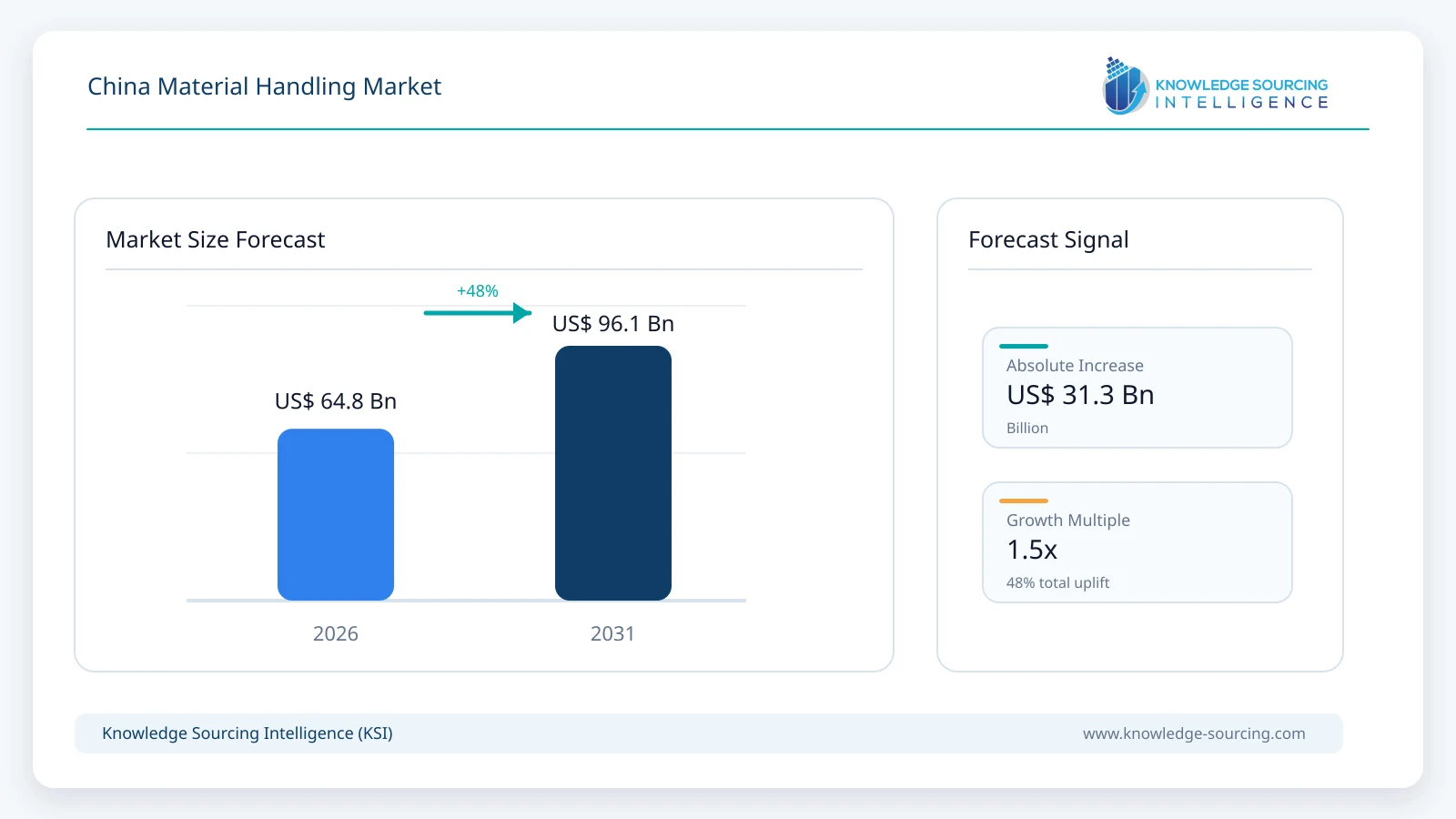
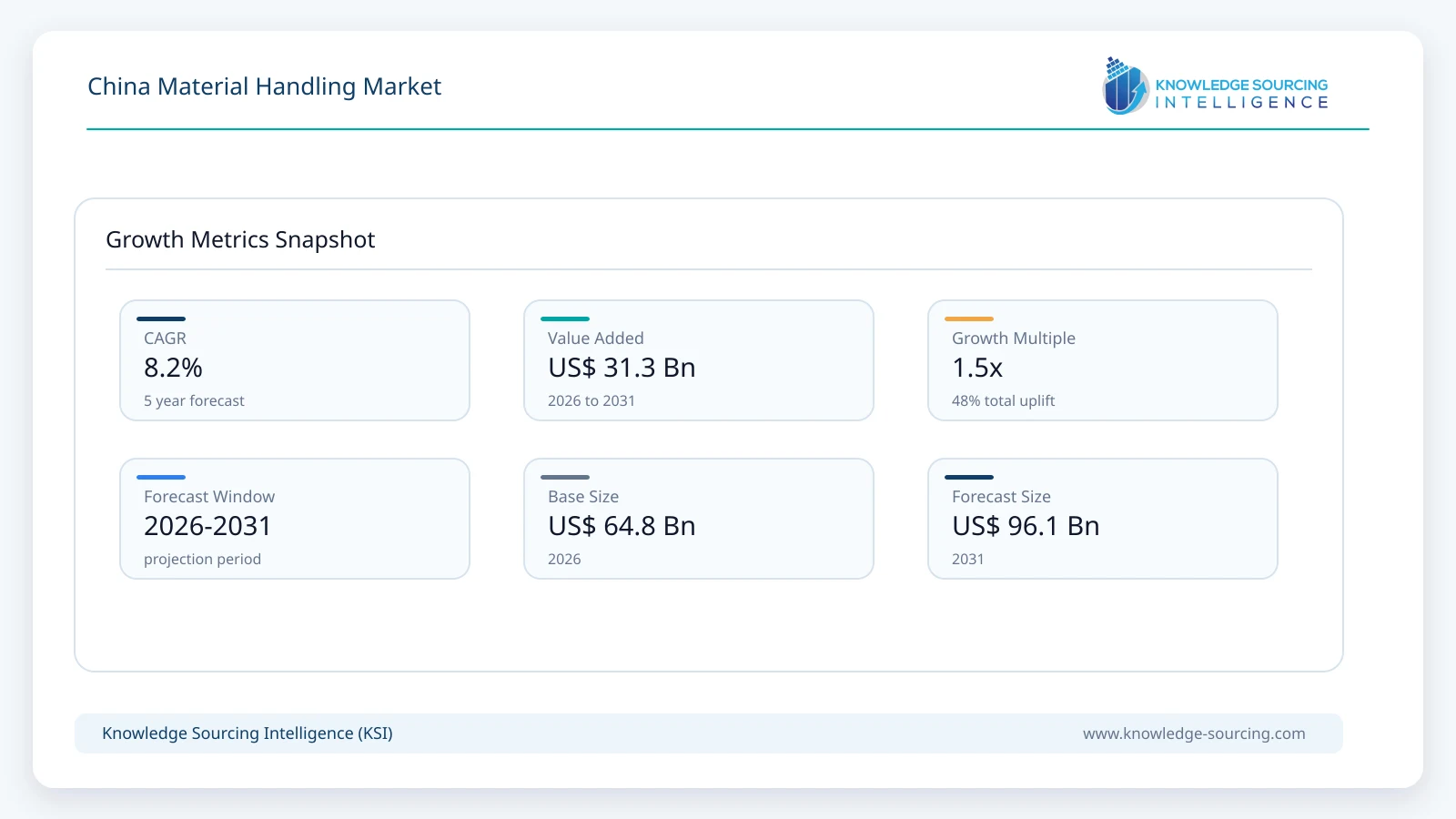
The Chinese material handling market is forecast to grow at a CAGR of 8.2%, reaching USD 96.1 billion in 2031 from USD 64.8 billion in 2026.
Highlights:
- 1China's manufacturing modernization and warehouse automation continue to expand demand for intelligent material handling systems.
- 2E-commerce fulfillment, industrial logistics, and smart factory deployment remain the primary demand centers.
- 3Automated solutions are increasingly replacing conventional equipment as labor availability, productivity, and traceability become purchasing priorities.
- 4Domestic manufacturers are expanding intelligent equipment portfolios while international suppliers compete through technology, service capability, and integrated warehouse solutions.
- 5Government policies supporting smart manufacturing, logistics cost reduction, and industrial digitalization are strengthening long-term investment conditions.
Industrial modernization has become a stronger purchasing driver than simple capacity expansion. Manufacturers across automotive, electronics, food processing, pharmaceuticals, chemicals, and consumer goods are investing in automated guided vehicles (AGVs), automated storage and retrieval systems (AS/RS), intelligent forklifts, and warehouse software to reduce manual handling while improving production continuity. Logistics operators are making similar investments as parcel volumes, omnichannel retail, and shorter delivery windows increase pressure on warehouse throughput.
Government policy also supports this transition. The Ministry of Industry and Information Technology (MIIT) continues to promote intelligent manufacturing, while national logistics policies emphasize lower logistics costs, warehouse modernization, and expansion of national logistics hubs. According to the China Federation of Logistics and Purchasing (CFLP), China's total social logistics value reached RMB 360.6 trillion in 2024, while the ratio of logistics costs to GDP declined to 14.1%, reflecting improving logistics efficiency. China had also established 151 national logistics hubs and more than 2,500 overseas warehouses by the end of 2024, creating additional demand for warehouse automation and material handling equipment.
Commercial competition increasingly extends beyond equipment pricing. Buyers evaluate system integration capability, software compatibility, lifecycle maintenance, energy efficiency, operator safety, and after-sales support before selecting suppliers. As warehouse automation projects become larger and technically more complex, system engineering, installation expertise, and long-term service contracts are becoming important sources of competitive differentiation.
Key Market Indicators
Indicator | Latest Evidence | Commercial Meaning |
Total social logistics value | RMB 360.6 trillion (2024) | Demonstrates sustained logistics activity supporting equipment demand. |
Industrial logistics value | RMB 318.4 trillion (2024) | Manufacturing remains the largest source of material handling investment. |
Logistics cost to GDP | 14.1% (2024) | Efficiency improvement encourages further warehouse automation. |
National logistics hubs | 151 (2024) | Continued logistics infrastructure expansion increases equipment procurement. |
Overseas warehouses | 2,500+ (2024) | Cross-border logistics requires modern warehouse handling systems. |
Market Drivers
Expansion of intelligent manufacturing under national industrial policy.
China's manufacturing sector is replacing labor-intensive material movement with automated systems capable of supporting higher production consistency and digital factory operations. MIIT reports that China has developed more than 30,000 basic smart factories, over 1,200 advanced smart factories, and more than 230 excellence-level smart factories. These facilities increasingly incorporate intelligent warehousing, automated logistics, digital production scheduling, and quality traceability, creating sustained demand for AGVs, AS/RS, automated forklifts, and integrated warehouse management systems. Equipment suppliers are responding by expanding intelligent product portfolios and providing integrated automation solutions rather than individual machines.
Warehouse modernization driven by logistics efficiency requirements.
Warehouse operators are under increasing pressure to improve storage density, reduce order processing times, and maintain inventory accuracy. China's logistics system continues to expand while national policy emphasizes lower logistics costs across industrial supply chains. According to CFLP data, logistics costs represented 14.1% of GDP in 2024, while logistics activity continued to grow across manufacturing, retail, and high-technology industries. Modern warehouses therefore require automated storage systems, intelligent forklifts, conveyor solutions, and warehouse software capable of supporting continuous operations with lower labor dependence. Suppliers increasingly compete through integrated warehouse design, software compatibility, and lifecycle service capabilities rather than equipment pricing alone.
Rapid growth of high-value manufacturing industries.
Demand for sophisticated material handling equipment increasingly originates from electronics, semiconductor manufacturing, electric vehicles, battery production, precision engineering, and pharmaceutical manufacturing. CFLP reported that logistics demand linked to high-technology manufacturing expanded faster than overall industrial logistics, while industrial robot logistics volumes increased markedly during 2025. These industries require precise, contamination-controlled, and highly reliable material movement systems that conventional forklifts cannot consistently provide. Equipment suppliers are investing in autonomous navigation, machine vision, fleet management software, and warehouse connectivity to address these specialized industrial requirements.
Expansion of e-commerce fulfillment and parcel logistics.
China's large e-commerce sector continues to increase warehouse throughput requirements across distribution centers and parcel sorting facilities. Faster delivery commitments require higher storage density, continuous equipment availability, and automated order fulfillment. Warehouse operators are therefore investing in AGVs, automated conveyors, pallet handling systems, and intelligent storage technologies that support high daily order volumes while minimizing manual handling. Material handling suppliers increasingly develop modular automation systems that can be expanded as warehouse capacity requirements evolve, reducing disruption during facility upgrades.
Market Restraints and Challenges
High capital investment for integrated automation projects.
Complete warehouse automation projects require considerably higher investment than conventional material handling equipment because buyers must purchase software platforms, navigation systems, warehouse control systems, sensors, installation services, and systems integration alongside physical equipment. Small and medium-sized manufacturers often struggle to justify these investments unless labor savings or production efficiency improvements can be demonstrated within acceptable payback periods. Suppliers increasingly offer modular deployment strategies and phased automation projects to reduce initial investment barriers.
Complex system integration across existing facilities.
Many Chinese manufacturing facilities continue to operate legacy warehouse infrastructure that was not designed for autonomous equipment or digital warehouse management systems. Integrating AGVs, AS/RS, warehouse management software, enterprise resource planning platforms, and production scheduling systems frequently requires customized engineering work. These implementation challenges extend project timelines and increase deployment costs. System integrators with software expertise and multi-vendor compatibility therefore possess a competitive advantage in larger industrial projects.
Price competition in standardized equipment categories.
Conventional forklifts, pallet trucks, and standard warehouse equipment remain highly competitive product categories with numerous domestic manufacturers serving similar customer groups. Buyers often prioritize acquisition cost for standard applications, reducing pricing flexibility for equipment suppliers. International manufacturers increasingly differentiate themselves through energy efficiency, automation capability, digital fleet management, maintenance services, and operator safety technologies rather than competing solely on equipment price. Domestic suppliers are simultaneously expanding intelligent product portfolios to protect margins.
Supply chain uncertainty and component availability.
Advanced material handling equipment increasingly depends on semiconductors, industrial sensors, lithium batteries, precision controllers, navigation technologies, and industrial software. Although supply conditions have improved since earlier global disruptions, manufacturers continue to diversify suppliers and localize component sourcing to reduce procurement risks. International trade restrictions affecting selected electronic components and industrial technologies may also increase sourcing complexity for some automation products, particularly those requiring specialized control hardware or imported industrial electronics.
Major Segment Analysis
Automated Guided Vehicles (AGVs)
Automated Guided Vehicles represent one of the most commercially important product categories within China's material handling market because they directly address labor efficiency, flexible manufacturing, and warehouse automation requirements. Manufacturing facilities, third-party logistics providers, e-commerce fulfillment centers, and automotive plants increasingly deploy AGVs to automate repetitive transport tasks while improving workplace safety and operational consistency.
Buyer priorities extend beyond vehicle performance alone. Fleet management software, navigation accuracy, interoperability with warehouse management systems, battery performance, maintenance support, and scalability increasingly influence purchasing decisions. Large industrial customers frequently require suppliers to integrate AGVs with existing production equipment and warehouse software, making engineering capability as important as hardware quality.
Compared with conventional trucks and lifts, AGVs generally involve higher initial investment but deliver stronger long-term value where continuous operation, labor optimization, and production traceability justify automation. Competition therefore increasingly centers on software capability, autonomous navigation performance, and lifecycle support rather than equipment pricing alone.
Competitive Landscape
China's material handling market combines domestic equipment manufacturers with international suppliers that compete across different technology and customer segments. Domestic companies such as Siasun Robot & Automation Co. Ltd, Noblelift Intelligent Equipment Co. Ltd, Shanghai Triowin Automation Machinery Co. Ltd, Shenzhen Casun Intelligent Robot Co. Ltd, Zowell Trucks, and Xilin benefit from local manufacturing, established distribution networks, and cost-competitive product portfolios. Their presence is particularly strong in industrial trucks, AGVs, warehouse automation, and customized solutions for manufacturing and logistics customers.
International suppliers, including Linde Material Handling GmbH, Toyota Material Handling Group, KION Group, and Crown Equipment, compete through integrated warehouse solutions, digital fleet management, energy-efficient equipment, and extensive after-sales service capabilities. Competition increasingly extends beyond equipment specifications to include software integration, predictive maintenance, operator training, and lifecycle support. As warehouse automation projects become more complex, buyers increasingly prefer suppliers capable of delivering turnkey systems, reducing implementation risk, and supporting long-term operational performance. Investments in local production, research and development, and service infrastructure remain common strategies for addressing customer demand, regulatory expectations, and supply chain resilience.
Recent Developments
January 2026: Jungheinrich officially introduced the AntOn by Jungheinrich brand in Shanghai. The initiative established a Global OEM Center in Shanghai and strengthened cooperation with EP Equipment to manufacture and distribute intelligent material handling equipment worldwide from China.
July 2025: Manitou Group and China's Hangcha Group agreed to establish a joint venture for lithium-ion battery production. The partnership supports electrified material handling equipment by developing advanced battery systems for forklifts and industrial vehicles, reinforcing both companies' electric product strategies.
May 2025: Jungheinrich entered a strategic partnership with China's EP Equipment. The collaboration combines German engineering with Chinese manufacturing capabilities to develop cost-effective electric forklifts and warehouse equipment, accelerating electrification and expanding global material handling product portfolios.
Regulatory and Policy Environment
China's policy framework continues to support modernization of industrial logistics, warehouse automation, and intelligent manufacturing. Made in China 2025, together with subsequent intelligent manufacturing initiatives led by the Ministry of Industry and Information Technology (MIIT), has encouraged manufacturers to adopt digital production systems, industrial robotics, and automated internal logistics. These initiatives support investment in equipment that improves production efficiency, product quality, and operational traceability.
National logistics policies have also become an important demand catalyst. The State Council's Action Plan for Effectively Reducing Whole-Society Logistics Costs promotes warehouse modernization, multimodal transportation, logistics hub development, and digital supply chain management. These measures aim to improve logistics efficiency while lowering transportation and inventory costs across industrial value chains.
Equipment suppliers must also comply with China's safety, environmental, and product certification requirements. Material handling equipment deployed in industrial facilities is subject to national standards covering machinery safety, electrical systems, lifting equipment, industrial vehicles, and occupational safety. Increasing adoption of lithium-ion batteries, autonomous navigation technologies, and industrial software is also expanding compliance requirements related to functional safety, cybersecurity, and system interoperability. Suppliers with established engineering, testing, and certification capabilities are generally better positioned to meet these evolving customer and regulatory expectations.
Outlook and Strategic Implications
China's material handling market is expected to remain closely linked to industrial modernization, logistics efficiency, and factory automation rather than simple warehouse capacity expansion. Manufacturing investment, e-commerce fulfillment, advanced production technologies, and government-backed logistics infrastructure are likely to sustain demand for intelligent handling equipment throughout the forecast period. Buyers are expected to prioritize solutions that improve warehouse utilization, reduce labor dependence, strengthen inventory visibility, and integrate with broader digital manufacturing systems.
Commercial success will increasingly depend on a supplier's ability to deliver complete automation solutions rather than standalone equipment. System integration expertise, software compatibility, predictive maintenance, cybersecurity, and lifecycle service capabilities are becoming important purchasing considerations as projects increase in scale and technical complexity. Domestic manufacturers are expected to strengthen their positions through localized production, competitive pricing, and expanding automation portfolios, while international suppliers are likely to continue differentiating themselves through advanced technologies, engineering support, and global application experience.
Strategic priorities across the value chain are expected to include:
Manufacturers: Expand intelligent equipment portfolios, strengthen software capabilities, and localize critical component sourcing to improve supply resilience.
Warehouse operators and logistics providers: Prioritize scalable automation investments that improve throughput, storage density, and labor productivity while maintaining operational flexibility.
Technology providers and system integrators: Develop interoperable platforms capable of integrating warehouse management systems, enterprise software, autonomous vehicles, and industrial robotics.
Investors: Monitor opportunities associated with smart manufacturing, logistics automation, lithium-powered industrial vehicles, and intelligent warehouse infrastructure, while evaluating policy implementation, industrial investment trends, and competitive pricing pressures.
Policymakers: Continue supporting logistics efficiency, industrial digitalization, and technical standardization to encourage wider adoption of automated material handling technologies across manufacturing and logistics sectors.
China Material Handling Market Scope:
| Report Metric | Details |
|---|---|
| Total Market Size in 2026 | USD 64.8 billion |
| Total Market Size in 2031 | USD 96.1 billion |
| Forecast Unit | Billion |
| Growth Rate | 8.2% |
| Study Period | 2021 to 2031 |
| Historical Data | 2021 to 2024 |
| Base Year | 2025 |
| Forecast Period | 2026 – 2031 |
| Segmentation | Product, Application, Industry Vertical |
| Companies |
|
Market Segmentation
By Product
- Automated Guided Vehicles
- Automated Storage and Retrieval Systems
- Trucks and Lifts
- Cranes
- Others
By Application
- Warehousing and Distribution
- Airport Baggage Handling
- Bulk Handling
- Postal and Parcel Delivery
- Assembly
- Packaging
By Industry Vertical
- Manufacturing
- Healthcare
- Chemical
- Paper
- Food and Beverage
- Others
Table of Contents
1. INTRODUCTION
1.1. Market Overview
1.2. Market Definition
1.3. Scope of the Study
1.4. Market Segmentation
1.5. Currency
1.6. Assumptions
1.7. Base and Forecast Years Timeline
2. RESEARCH METHODOLOGY
2.1. Research Data
2.2. Assumptions
3. EXECUTIVE SUMMARY
3.1. Research Highlights
4. MARKET DYNAMICS
4.1. Market Drivers
4.2. Market Restraints
4.3. Porter’s Five Force Analysis
4.3.1. Bargaining Power of Suppliers
4.3.2. Bargaining Power of Buyers
4.3.3. Threat of New Entrants
4.3.4. Threat of Substitutes
4.3.5. Competitive Rivalry in the Industry
4.4. Industry Value Chain Analysis
5. CHINA MATERIAL HANDLING MARKET, BY PRODUCT
5.1. Introduction
5.2. Automated Guided Vehicles
5.3. Automated Storage and Retrieval Systems
5.4. Trucks and Lifts
5.5. Cranes
5.6. Others
6. CHINA MATERIAL HANDLING MARKET, BY APPLICATION
6.1. Introduction
6.2. Warehousing and Distribution
6.3. Airport Baggage Handling
6.4. Bulk Handling
6.5. Postal and Parcel Delivery
6.6. Assembly
6.7. Packaging
7. CHINA MATERIAL HANDLING MARKET, BY INDUSTRY VERTICAL
7.1. Introduction
7.2. Manufacturing
7.3. Healthcare
7.4. Chemical
7.5. Paper
7.6. Food and Beverage
7.7. Others
8. COMPETITIVE ENVIRONMENT AND ANALYSIS
8.1. Major Players and Strategy Analysis
8.2. Emerging Players and Market Lucrativeness
8.3. Mergers, Acquisitions, Agreements, and Collaborations
8.4. Vendor Competitiveness Matrix
9. COMPANY PROFILES
9.1. Siasun Robot & Automation Co. Ltd
9.2. Noblelift Intelligent Equipment Co. Ltd
9.3. Shanghai Triowin Automation Machinery Co. Ltd
9.4. Shenzhen Casun Intelligent Robot Co. Ltd
9.5. Zowell Trucks
9.6. Linde Material Handling GmbH
9.7. Toyota Material Handling Group
9.8. KION Group
9.9. Xilin
9.10. Crown Equipment
LIST OF FIGURES
LIST OF TABLES
Navigate
Trusted by the world's leading organizations











