
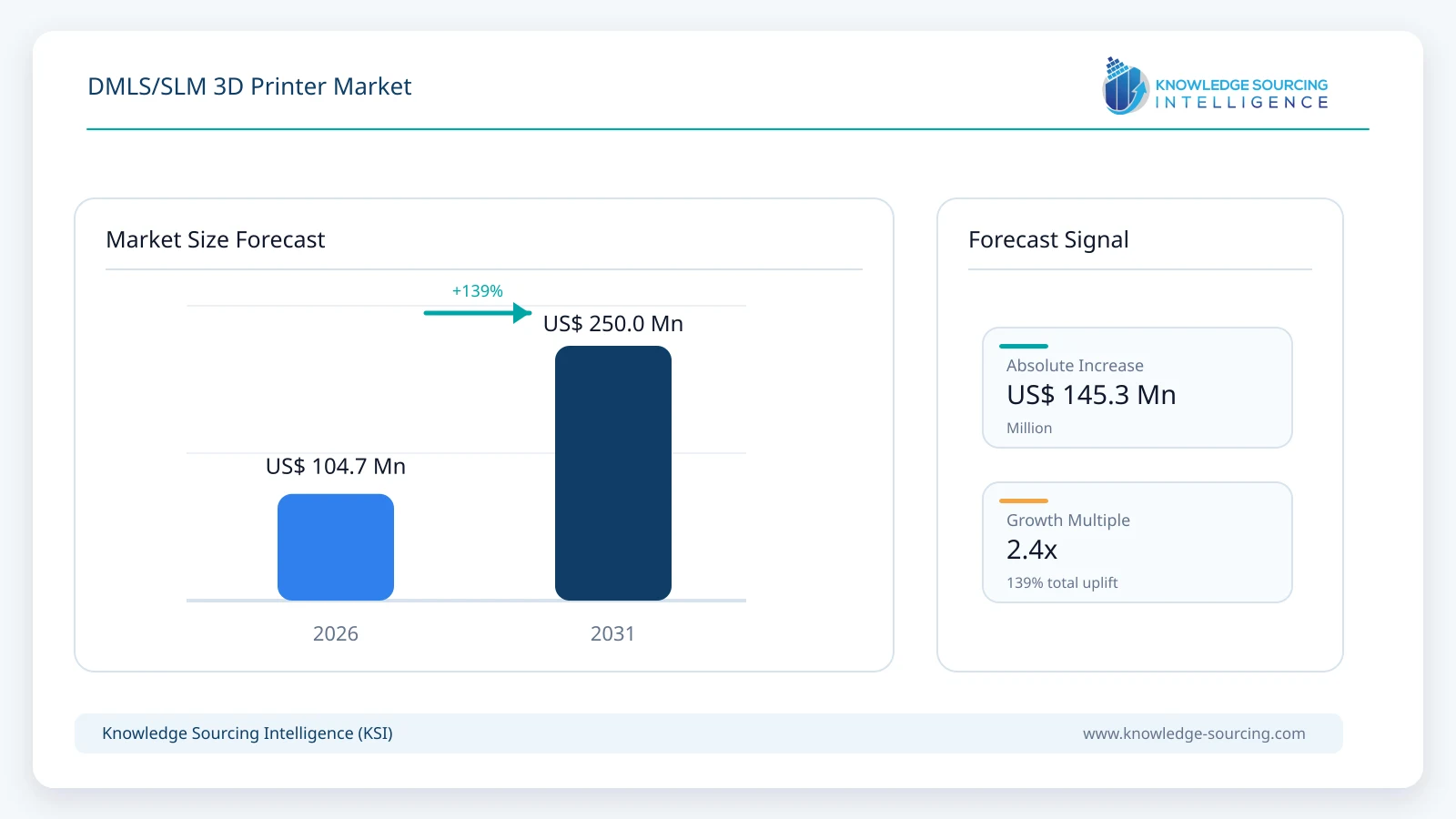
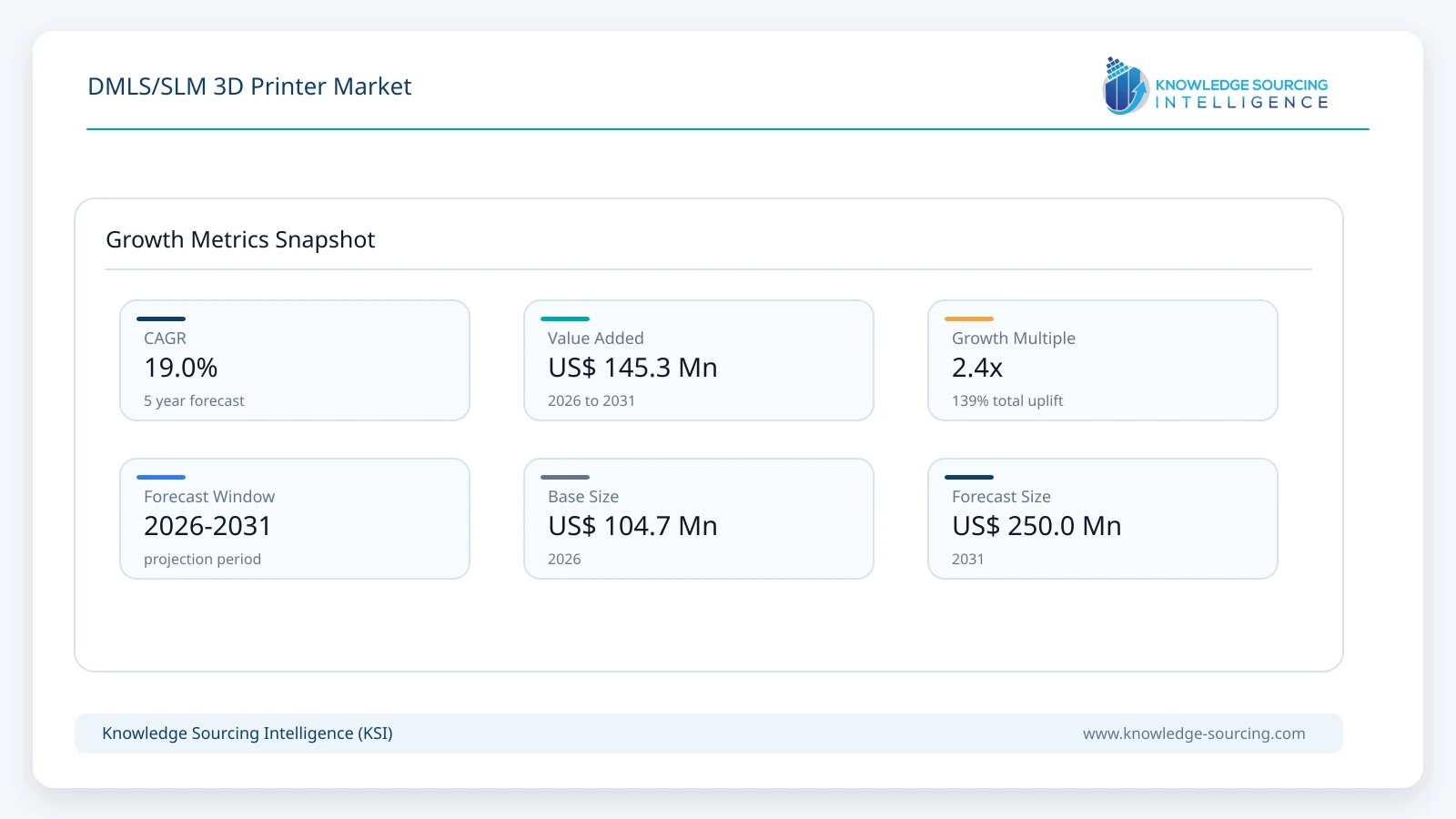
Direct Metal Laser Sintering (DMLS)/Selective Laser Melting (SLM) Technology 3D Printer Market is forecast to grow at a CAGR of 19.0%, reaching USD 250.0 million in 2031 from USD 104.7 million in 2026.
Highlights:
- 1Metal additive manufacturing adoption is expanding across aerospace, medical, and industrial production applications.
- 2Titanium, nickel alloys, and aluminum remain critical materials for high-value printed components.
- 3Aerospace qualification requirements continue shaping machine, material, and process development.
- 4Manufacturers are improving productivity through multi-laser systems and larger build volumes.
- 5Industrial buyers increasingly evaluate printers based on total production economics.
- 6Competition is shifting toward integrated hardware, software, materials, and service ecosystems.
Demand is concentrated in applications where component performance, weight reduction, design flexibility, and production complexity justify higher equipment and material costs. Aerospace manufacturers use metal additive manufacturing for lightweight structural parts, engine components, and production tooling. Medical companies apply the technology for patient-specific implants and surgical devices, while industrial manufacturers use it for low-volume production, spare parts, and specialized equipment.
Buyer decisions are increasingly influenced by production economics rather than printer capability alone. Companies evaluate laser power, build volume, material availability, repeatability, qualification support, software integration, and post-processing requirements before adopting systems. The value chain includes printer manufacturers, metal powder suppliers, software providers, contract manufacturers, and service bureaus that support companies without internal additive manufacturing capacity.
The market structure is shifting from equipment sales toward integrated manufacturing solutions. Printer suppliers are expanding material portfolios, improving automation, and developing production monitoring systems because industrial customers require consistent output quality and reduced operator involvement. Aerospace and medical applications continue to require extensive validation, creating high entry barriers but also supporting long-term demand for qualified suppliers.
Key Market Indicators
Indicator | Latest Evidence | Commercial Meaning |
Metal additive manufacturing materials | EOS supports multiple metal powders including titanium, aluminum, nickel, steel, and cobalt-chrome alloys | Broader material availability expands industrial use cases |
Aerospace adoption | GE Aerospace has incorporated additive manufacturing into production engine component programs | Aerospace qualification supports higher-value applications |
Medical applications | Titanium additive manufacturing is used for patient-specific implants and orthopedic devices | Medical demand supports specialized production requirements |
Multi-laser systems | SLM Solutions developed machines with multiple laser configurations for industrial production | Productivity improvements address cost-per-part concerns |
Industrial applications | Manufacturers use metal AM for tooling, spare parts, and complex components | Industrial buyers are moving beyond prototyping applications |
Market Drivers
Aerospace demand for lightweight and complex components
Aircraft manufacturers and suppliers continue adopting metal additive manufacturing because weight reduction and component consolidation directly affect aircraft performance. Titanium and nickel alloy components produced through DMLS and SLM processes can replace assemblies made from multiple conventional parts, reducing manufacturing steps and improving design flexibility.
GE Aerospace has used additive manufacturing for components such as fuel nozzles produced through its LEAP engine program. This demonstrates the ability of metal AM processes to meet demanding aerospace production requirements after extensive qualification. Aerospace customers typically prioritize process stability, certification support, material traceability, and supplier reliability over initial equipment cost.
Printer manufacturers are responding by increasing build volumes, improving laser configurations, and strengthening process monitoring capabilities. The aerospace sector is expected to remain an important demand source because manufacturers continue exploring lightweight structures, replacement parts, and localized production models.
Expansion of patient-specific medical applications
Medical device manufacturers use DMLS and SLM technology for implants and instruments requiring customized geometries. Titanium alloys are particularly important because of their biocompatibility, corrosion resistance, and mechanical properties. Additive manufacturing allows producers to create porous structures that support bone integration, which is difficult to achieve using traditional manufacturing methods.
Medical adoption is supported by the ability to produce patient-specific implants without requiring expensive tooling changes. Dental applications also benefit from metal additive manufacturing for customized crowns, bridges, and frameworks.
However, medical customers require strict process validation, quality control, and regulatory compliance. Suppliers that provide validated materials, documentation support, and repeatable manufacturing processes have stronger access to regulated applications.
Shift from prototyping toward production manufacturing
Industrial users are increasingly evaluating metal additive manufacturing for end-use production rather than only prototype development. Improvements in machine productivity, powder management, process monitoring, and automation are helping manufacturers consider additive processes for small-batch and complex components.
Companies such as EOS and Nikon SLM Solutions have expanded industrial machine capabilities by increasing build sizes and improving multi-laser systems. These developments address customer concerns regarding throughput and production costs.
The strongest adoption potential exists where conventional manufacturing involves expensive tooling, complex machining operations, or limited production volumes. Metal AM provides economic advantages when design complexity and customization are more important than achieving the lowest possible unit cost.
Development of broader metal material portfolios
Material availability remains central to commercial adoption. Stainless steel, aluminum alloys, titanium alloys, cobalt-chrome, nickel-based alloys, and copper materials serve different industrial requirements, including strength, corrosion resistance, thermal performance, and electrical conductivity.
Printer manufacturers and powder suppliers are expanding qualified material options to support new applications. Broader material choices allow customers to move additive manufacturing into additional industrial environments where traditional materials remain difficult to replace.
Material qualification remains a long process, especially in aerospace, medical, and energy sectors. Companies that can provide consistent powder quality, process parameters, and certification support gain an advantage in commercial applications.
Market Restraints and Challenges
High equipment and operating costs
Metal additive manufacturing systems require substantial investment in printers, metal powders, post-processing equipment, environmental controls, and skilled operators. The total cost of ownership remains a major consideration for manufacturers comparing additive production with conventional machining.
Metal powders are also considerably more expensive than many traditional manufacturing inputs. Powder handling, recycling procedures, and quality testing add operational costs. Smaller manufacturers may find it difficult to justify internal printer ownership unless they have recurring production demand.
Equipment suppliers are addressing this challenge through automation, improved productivity, and larger build platforms. However, cost competitiveness remains dependent on application complexity and production volume.
Qualification requirements slow industrial adoption
Aerospace, medical, and energy customers require extensive validation before approving additively manufactured components. Testing includes material characterization, mechanical performance evaluation, process repeatability checks, and production monitoring.
These qualification cycles increase time-to-market and raise development costs for suppliers. Companies entering regulated industries must invest in quality systems and technical expertise before securing commercial contracts.
The requirement for validated processes also limits rapid switching between suppliers because customers often require detailed approval procedures before accepting new materials or manufacturing partners.
Post-processing requirements affect production economics
Metal AM components often require additional processing steps, including heat treatment, surface finishing, machining, and inspection. These steps can influence production costs and reduce the speed advantage compared with traditional manufacturing.
For industries requiring high surface quality or tight dimensional accuracy, post-processing represents an important part of the manufacturing workflow. Companies are investing in integrated solutions that combine printing, monitoring, and finishing technologies, but complete automation remains difficult for many applications.
Skilled workforce limitations
Operating DMLS and SLM systems requires expertise in machine parameters, powder behavior, metallurgy, design optimization, and quality control. A shortage of experienced additive manufacturing engineers can slow adoption, particularly among smaller manufacturers.
Companies expanding additive manufacturing capabilities often require internal training programs or partnerships with specialized service providers. Workforce availability influences how quickly organizations can move from experimentation to production.
Major Segment Analysis
Titanium and Titanium Alloys
Titanium and titanium alloys represent a commercially important material category for DMLS and SLM systems because they combine high strength-to-weight ratios with corrosion resistance and biocompatibility. These characteristics make titanium valuable in aerospace structures, engine components, and medical implants.
Aerospace manufacturers use titanium additive manufacturing where weight savings and complex geometries provide economic benefits. Medical companies also rely on titanium for customized implants because additive processes can create porous structures that support biological integration.
Purchasing decisions in this segment are driven by material consistency, certification support, machine reliability, and process repeatability. Powder quality and manufacturing controls are particularly important because small variations can affect component performance.
The segment also faces challenges from material costs and strict qualification requirements. Suppliers compete by improving process databases, expanding validated parameters, and supporting customers through certification activities.
Regional Analysis
Region | Main Demand Signal | Principal Constraint |
North America | Aerospace, defense, medical device manufacturing, and industrial automation adoption | Qualification costs and skilled workforce availability |
Europe | Strong additive manufacturing ecosystem and industrial engineering base | Energy costs and regulatory complexity |
Asia Pacific | Aerospace expansion, electronics manufacturing, and industrial production growth | Uneven adoption maturity across countries |
Middle East and Africa | Aerospace maintenance, energy applications, and localized manufacturing initiatives | Limited additive manufacturing infrastructure |
North America remains an important market due to aerospace programs, defense manufacturing, and medical device production. Companies in the region have invested in additive manufacturing capabilities for both production and research applications. Government-supported manufacturing programs and aerospace supply chains continue supporting adoption.
Europe has a strong presence of metal additive manufacturing equipment manufacturers and research institutions. Germany, the United Kingdom, and other industrial economies have developed expertise in precision engineering and advanced manufacturing. However, higher operating costs and complex regulatory requirements influence investment decisions.
Asia Pacific demand is supported by industrial expansion, aerospace manufacturing growth, and government initiatives promoting domestic manufacturing capabilities. China, Japan, South Korea, and India are increasing investments in additive manufacturing research and industrial applications.
The Middle East is exploring additive manufacturing for aerospace maintenance, energy equipment, and localized production. Adoption remains dependent on infrastructure development, technical expertise, and availability of qualified suppliers.
Competitive Landscape
The DMLS/SLM technology 3D printer market is technology-led and increasingly focused on integrated production solutions rather than standalone equipment sales. Competition is shaped by machine performance, material qualification, software capabilities, automation, and customer support.
Companies including EOS Group, 3D Systems, SLM Solutions, Renishaw, GE Additive, Trumpf, Additive Industries, Sisma, Nikon SLM Solutions, and Desktop Metal compete across industrial, aerospace, medical, and research applications.
EOS has focused on industrial metal additive manufacturing platforms and material development. Nikon SLM Solutions emphasizes multi-laser production systems, while Renishaw combines additive manufacturing equipment with precision engineering expertise. Trumpf and Additive Industries target industrial production environments requiring automation and scalability.
Competitive differentiation increasingly depends on reducing production costs, improving reliability, expanding materials, and supporting customers through qualification processes. Companies are also strengthening partnerships with software providers, powder suppliers, and manufacturing service firms.
Recent Developments
September 2026: EOS introduced a new Ti64 60 µm parameter set for the six-laser EOS M4 ONYX, targeting faster builds, improved microstructure, reduced porosity, better surface finish, and higher titanium productivity.
August 2026: 3D Systems received a $9 million U.S. Air Force contract to extend its GEN-II DMP-1000 large-format metal 3D-printing technology demonstration for high-temperature, flight-relevant applications.
July 2026: EOS and Constellium announced a strategic partnership expanding EOS’s metal-AM materials portfolio with Aheadd® CP1 and Al5X1 aluminium alloys for industrial additive manufacturing.
June 2026: Beehive Industries committed to 30 EOS M4 ONYX systems for the production of its Frenzy™ 8 propulsion engines, taking its EOS metal-AM fleet to 50 machines across U.S. facilities.
June 2026: Incodema3D announced orders for 14 additional EOS metal 3D printers, including M4 ONYX, M 400-4 and M 300-4 systems, expanding its EOS machine portfolio beyond 50 units.
Regulatory and Policy Environment
Regulatory requirements influence adoption primarily in aerospace, medical, and defense applications. These sectors require manufacturers to demonstrate material traceability, process control, and component reliability before approving additive manufacturing production.
Organizations such as the Federal Aviation Administration (FAA), European Union Aviation Safety Agency (EASA), and medical device regulators establish requirements that affect qualification procedures. Aerospace suppliers must demonstrate that additive manufacturing processes consistently meet safety and performance standards.
Standards organizations, including ASTM International and ISO, have developed additive manufacturing standards covering terminology, testing methods, and process qualification. These standards help manufacturers establish common procedures but also increase compliance requirements.
Government manufacturing programs in North America, Europe, and Asia support additive manufacturing research, workforce development, and industrial capability building. These initiatives influence technology adoption by reducing barriers for research institutions and manufacturers.
Outlook and Strategic Implications
Metal additive manufacturing is expected to gain adoption where component complexity, customization, and performance requirements justify higher production costs. Aerospace, medical, and industrial applications are likely to remain central because these sectors value design flexibility and specialized production.
Printer manufacturers will need to improve productivity, automation, and material availability to expand beyond specialized applications. Customers increasingly evaluate systems based on complete production economics, including powder costs, labor requirements, post-processing, and qualification expenses.
Future competition will depend on the ability to provide reliable production ecosystems rather than individual machines. Companies with strong material portfolios, software capabilities, service networks, and application expertise will be better positioned to support industrial customers.
For manufacturers, investment decisions will depend on identifying applications where additive manufacturing provides measurable advantages over conventional production. For suppliers, reducing process complexity and improving qualification support will remain critical factors affecting market expansion through 2031.
DMLS/SLM Technology 3D Printer Market Scope:
| Report Metric | Details |
|---|---|
| Total Market Size in 2026 | USD 104.7 million |
| Total Market Size in 2031 | USD 250.0 million |
| Forecast Unit | Million |
| Growth Rate | 19.0% |
| Study Period | 2021 to 2031 |
| Historical Data | 2021 to 2024 |
| Base Year | 2025 |
| Forecast Period | 2026 – 2031 |
| Segmentation | Material, Application, Geography |
| Companies |
|
Market Segmentation
By Material
Stainless Steel
Aluminum and Aluminum Alloys
Titanium and Titanium Alloys
Cobalt-Chrome Alloys
Nickel-Based Alloys
Tool Steel
Copper and Copper Alloys
Others
By Application
Aerospace and Defense
Automotive
Medical and Dental
Industrial Manufacturing
Tooling and Mold Manufacturing
Energy
Research and Education
Others
By Geography
North America
USA
Canada
Mexico
South America
Brazil
Argentina
Others
Europe
Germany
France
United Kingdom
Spain
Others
Middle East and Africa
Saudi Arabia
Israel
Others
Asia Pacific
China
Japan
South Korea
India
Others
Table of Contents
1. INTRODUCTION
2. RESEARCH METHODOLOGY
3. KEY FINDINGS OF THE STUDY
4. MARKET DYNAMICS
5. DIRECT METAL LASER SINTERING (DMLS)/SELECTIVE LASER MELTING (SLM) TECHNOLOGY 3D PRINTER MARKET BY MATERIAL
5.1. Stainless Steel
5.2. Aluminum and Aluminum Alloys
5.3. Titanium and Titanium Alloys
5.4. Cobalt-Chrome Alloys
5.5. Nickel-Based Alloys
5.6. Tool Steel
5.7. Copper and Copper Alloys
5.8. Others
6. DIRECT METAL LASER SINTERING (DMLS)/SELECTIVE LASER MELTING (SLM) TECHNOLOGY 3D PRINTER MARKET BY APPLICATION
6.1. Aerospace and Defense
6.2 Automotive
6.3 Medical and Dental
6.4 Industrial Manufacturing
6.5 Tooling and Mold Manufacturing
6.6 Energy
6.7 Research and Education
6.8 Others
7. DIRECT METAL LASER SINTERING (DMLS)/SELECTIVE LASER MELTING (SLM) TECHNOLOGY 3D PRINTER MARKET BY GEOGRAPHY
7.1. North America
7.1.1. Usa
7.1.2. Canada
7.1.3. Mexico
7.2. South America
7.2.1. Brazil
7.2.2. Argentina
7.2.3. Others
7.3. Europe
7.3.1. Germany
7.3.2. France
7.3.3. United Kingdom
7.3.4. Spain
7.3.5. Others
7.4. Middle East And Africa
7.4.1. Saudi Arabia
7.4.2. Israel
7.4.3. Others
7.5. Asia Pacific
7.5.1. China
7.5.2. Japan
7.5.3. South Korea
7.5.4. India
7.5.5. Others
8. COMPETITIVE INTELLIGENCE
9. COMPANY PROFILES
9.1. EOS Group
9.2. 3D Systems, Inc.
9.3. SLM Solutions Group AG
9.4. Renishaw plc
9.5. Sisma SpA
9.6. GE Additive (Concept Laser GmbH & Arcam AB)
9.7. Additive Industries
9.8. Trumpf
9.9. Nikon SLM Solutions AG
9.10. Desktop Metal, Inc.
List of Figures
List of Tables
Navigate
Trusted by the world's leading organizations











