
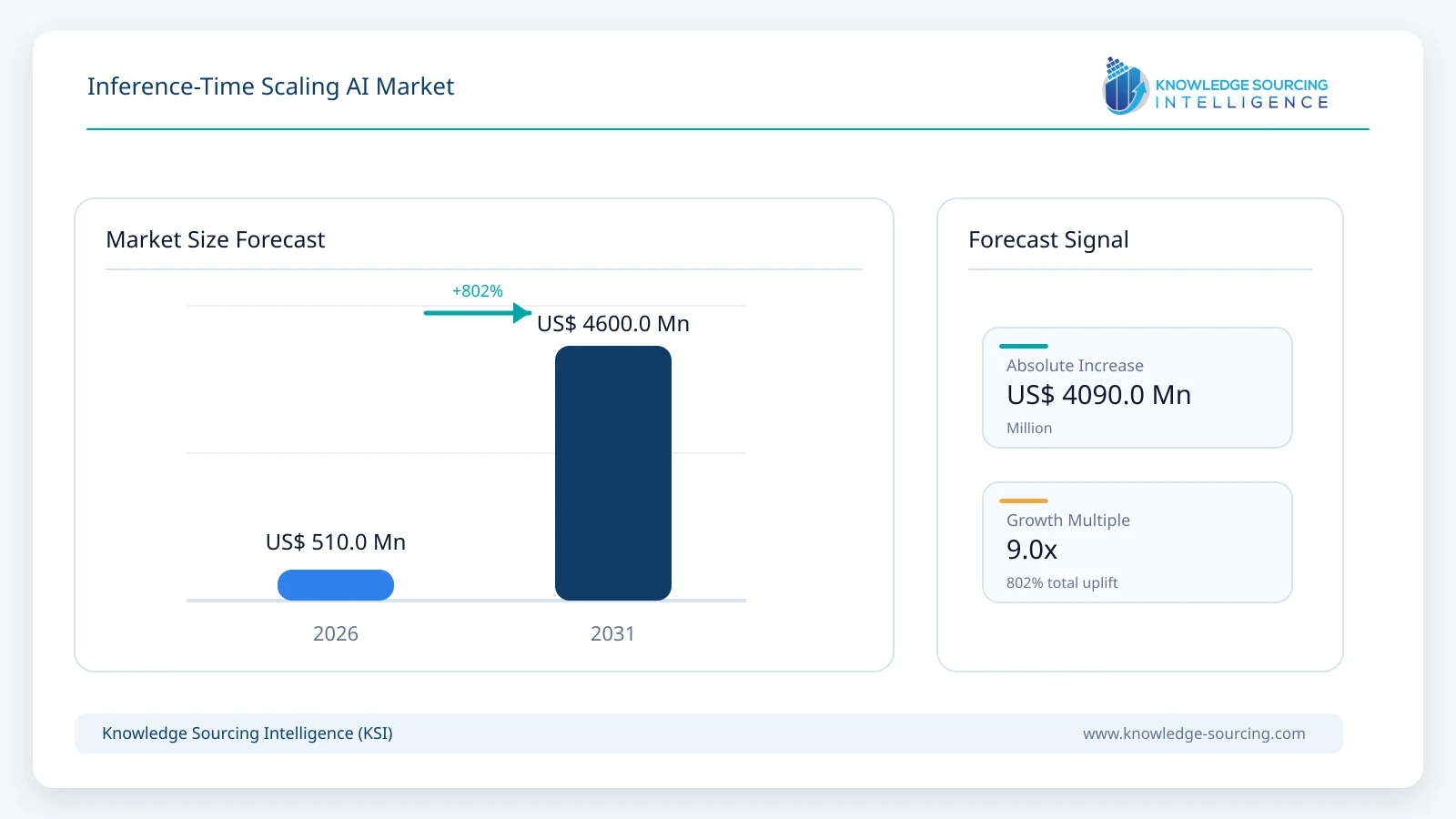
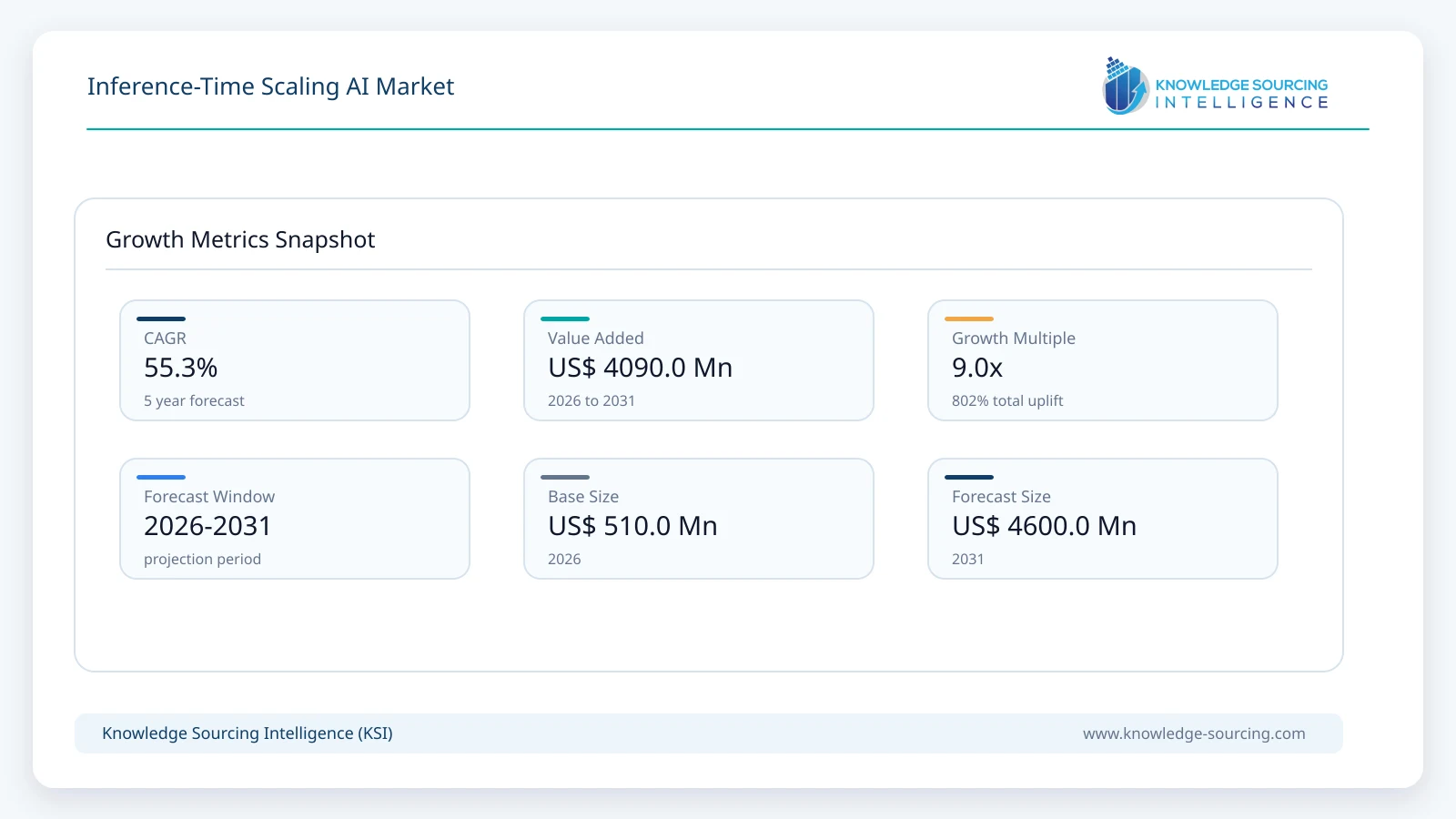
The inference-time scaling AI market is estimated at USD 510 million in 2026 and forecast to reach USD 4,600 million in 2031, expanding at a CAGR of 55.3% during the forecast period.
Highlights:
- 1Adaptive reasoning budget control represents USD 185 million in 2026 and is forecast at USD 1.51 billion in 2031, the largest scaling-technique segment.
- 2Metered incremental reasoning compute accounts for USD 330 million in 2026, or 64.7% of the modeled market, and reaches USD 2.98 billion by 2031.
- 3Software engineering and code agents represent USD 150 million of 2026 demand and are expected to reach USD 1.30 billion in 2031.
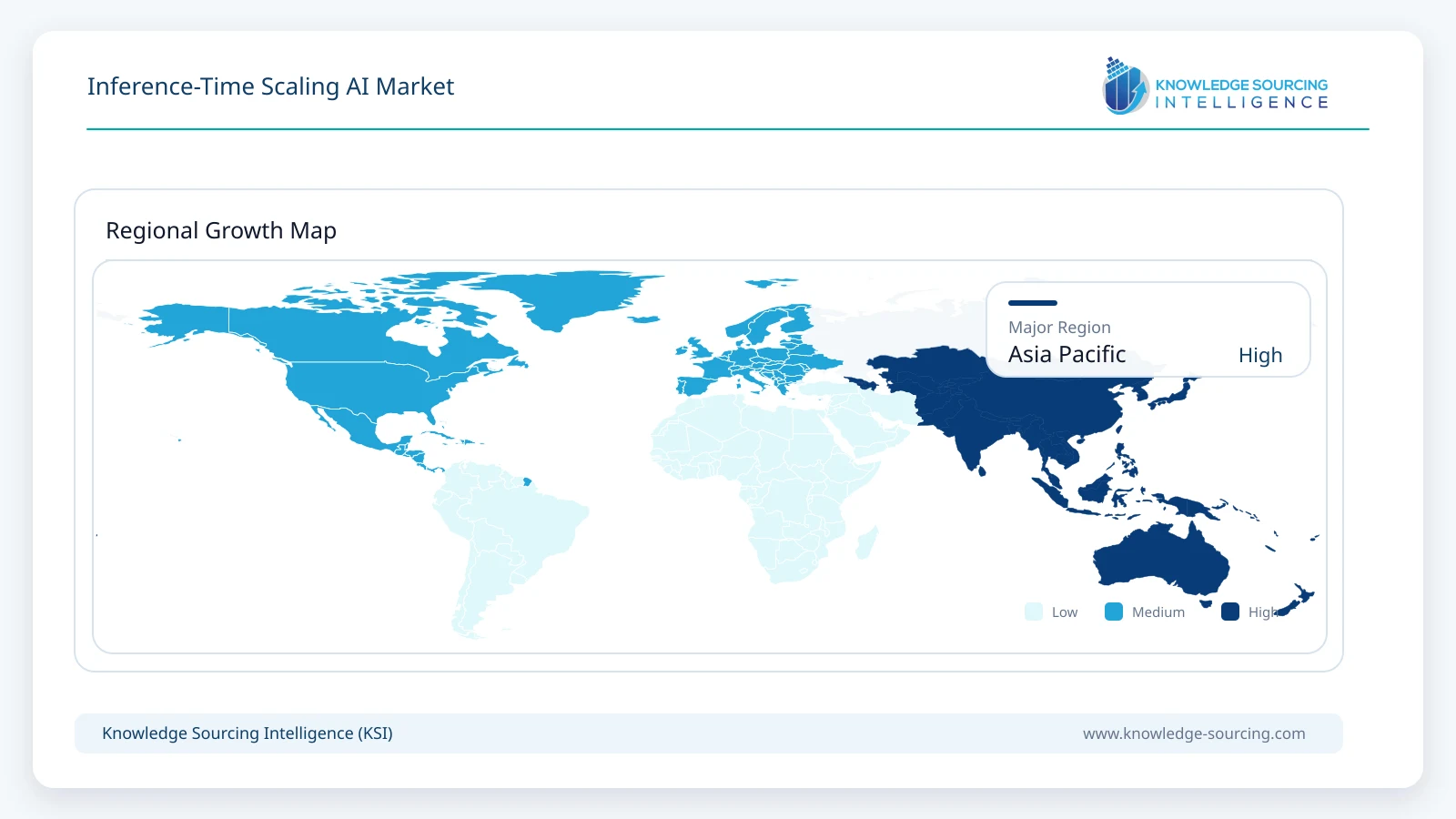
- 4North America leads with USD 220 million in 2026 and a projected USD 1.82 billion by 2031 as enterprise API usage and inference platforms expand.
- 5Asia Pacific advances from USD 145 million in 2026 to USD 1.36 billion in 2031, supported by hosted open-weight models and regional developer adoption.
Market revenue represents incremental model deliberation, paid multi-candidate inference, verification and specialized runtimes used to improve response quality after a prompt is received. Vendors increasingly offer deeper processing as selectable, usage-based capability, allowing customers to compare higher-effort processing against routine inference on price and response quality.
Commercial reasoning APIs increasingly let developers allocate additional deliberation according to request complexity, turning inference computation into a controllable operational resource. OpenAI provides developer-selectable reasoning effort for supported models; Anthropic introduced adaptive thinking with selectable effort levels in Claude Opus 4.6; and Google supports thinking-level controls in Gemini. Organizations can use those controls to reduce unnecessary computation for routine tasks while allocating additional steps to coding failures, analytical uncertainty or long-horizon software agents. Developers measure success through answer acceptance, task completion, latency and spend per resolved request rather than token volume alone.
Specialist inference providers are also improving the economics of longer reasoning traces through caching, speculative decoding, scheduling and differentiated capacity. Together AI introduced provisioned throughput and production deployment controls in 2026, while Baseten documented high-throughput serving for the GLM-5.2 model using multi-token prediction and cache-aware routing.
Market Overview
Inference-time scaling changes the amount of computational effort assigned to each request while leaving model weights unchanged. A developer may raise reasoning effort for an unfamiliar coding problem, generate alternative candidates for a sensitive analytical conclusion, or use a separate evaluator to select the most defensible response. These workflows can improve difficult-task accuracy but create variable token consumption, longer queues and higher operating costs. Suppliers therefore need controls that connect the amount of reasoning to workload difficulty, customer service commitments and measured value.
Sequential deliberation, parallel candidate sampling, search-based planning and independent verifier scoring each address different problems in inference-time scaling. Sequential deliberation gives a reasoning model more opportunity to inspect intermediate steps; parallel sampling produces alternatives that can be compared for agreement; search and planning explore possible solution paths; and verifier models score or reject weak candidates. Speculative inference and optimized serving do not inherently create better reasoning, but they can lower the expense of supporting larger inference budgets.
Enterprise demand is most visible in software engineering, specialist research and multi-step digital agents, where an initially plausible answer may still fail a test or business rule. Model providers and infrastructure companies operate at different points in the value chain: OpenAI, Anthropic and Google expose the reasoning capability, while managed inference platforms such as Together AI and Baseten provide performance and capacity controls.
Market Trends
Dynamic Test-Time Budgets Are Becoming Standard Controls
Reasoning models are moving toward selective allocation of effort because every additional deliberation step competes with user response-time targets. OpenAI offers multiple reasoning-effort settings on supported models, while Anthropic announced adaptive thinking and low, medium, high and max effort levels with Claude Opus 4.6. These mechanisms allow developers to route simple queries to modest budgets and reserve extended computation for tasks that exceed a complexity threshold or fail an initial check.
Cost-aware policies are particularly important for applications serving uneven workloads, where the average request can be handled quickly but a small subset requires substantial search or verification. Enterprises increasingly test whether higher effort improves successful task completion rather than assuming that longer reasoning always produces better answers.
Candidate Verification and Search Are Extending Reasoning Workflows
Multi-candidate sampling, reranking and independent checks provide ways to improve reliability without retraining the underlying model. Coding agents may compile proposed changes, test alternate fixes and retain the candidate that passes automated checks; analytical systems can compare multiple solution paths before presenting a recommendation.
Specialized reasoning applications also need to distinguish a model-generated critique from an independently grounded verification step. Runtime vendors can pair iterative generation with retrieval, deterministic tests or formal rule checks, but those services must be scoped carefully to avoid counting general data access or standard application testing as new inference-time-scaling revenue.
Inference Infrastructure Is Being Optimized for Long Reasoning Traces
Long reasoning outputs create sustained decode demand and place pressure on cache capacity, throughput and tail latency. Together AI reported production coding-agent performance improvements in May 2026, while Baseten outlined speculative decoding, cache reuse and batching methods in July 2026. NVIDIA Dynamo and the vLLM software ecosystem provide serving techniques that separate prefill from decode or accelerate acceptable token generation.
Specialized test-time runtime capacity, orchestration and optimized serving services generate attributable revenue when customers pay specifically for additional reasoning computation, rather than for entire GPU clusters or AI networking equipment. This distinction matters as open-source serving features spread and place downward pressure on the price of standalone optimization software.
Open-Weight Reasoning Models Are Increasing Deployment Choice
DeepSeek-R1 made openly licensed reasoning model weights and commercial API access available in January 2025, providing enterprises with another route to deploy test-time deliberation outside proprietary closed-model services. Open-weight models support customer-controlled hosting, specialized inference engines and application-specific cost policies, although free weights do not themselves create software revenue.
Private deployment is increasingly relevant where organizations cannot send documents or code to external model endpoints. Customer-controlled capacity can support fixed reasoning budgets, controlled logging and more predictable security settings, while hosted options reduce the operational burden of maintaining high-throughput model servers.
Segment Analysis
By Scaling Technique: Adaptive Reasoning Budget Control
Adaptive reasoning budget control assigns additional computation according to the difficulty or importance of an individual request. Applications can start with a lower effort level and increase the budget when preliminary output fails evaluation or when a user requests deeper analysis. The segment is estimated at USD 185 million in 2026 and projected at USD 1.51 billion in 2031, reflecting growing paid use of explicit reasoning-effort controls across model platforms.
By Commercial Offering: Metered Incremental Reasoning Compute
Metered incremental reasoning compute is the principal identifiable revenue stream because model API providers already charge for output tokens, including internal reasoning tokens where applicable. KSI estimates this segment at USD 330 million in 2026, rising to USD 2.98 billion in 2031. Customers pay for additional deliberation and execution above the cost of a baseline model response.
By Primary Application: Software Engineering and Code Agents
Software engineering and code agents generate early demand because their proposed outputs can often be assessed through build, test and execution feedback. Complex repository changes, debugging and multi-file refactoring may require several candidate solutions, repeated tool calls and additional model deliberation before code passes validation. The segment is estimated at USD 150 million in 2026 and projected to reach USD 1.30 billion by 2031.
Market Drivers
Growth in Multi-Step AI Software Agents
Software agents increasingly combine planning, execution, observation and corrective reasoning across many application steps. Complex agent runs can require repeated candidate generation or deeper deliberation after a failed tool result, creating measurable incremental inference consumption. Enterprises willing to pay for dependable task completion support adoption of budget-aware scaling rather than uncontrolled generation.
More Configurable Reasoning Models and APIs
OpenAI, Anthropic and Google have exposed controls that let developers vary deliberation effort without retraining models. These settings make inference-time scaling easier to evaluate in production because developers can compare response quality and latency at different compute budgets. Software providers can then package premium processing levels with application plans or charge directly for additional execution.
Increasing Need for Verified Analytical Outputs
Financial, technical and scientific users frequently need more than a plausible language-model answer. Candidate comparison, evidence checks and deterministic validation create additional paid processing opportunities when they reduce expensive downstream rework. The strongest demand arises from workloads whose success can be objectively measured, including code tests and rule-based calculations.
Improving Performance of Specialized Inference Runtimes
Reasoning workloads can consume substantial decode capacity, making speculative execution, KV-cache reuse and optimized scheduling valuable for deploying longer computation budgets. Together AI, Baseten, NVIDIA and Groq address throughput and runtime control in different ways. Better inference efficiency lowers the price of a successful scaled-reasoning response and expands the range of applications that can justify it.
Growth of Customer-Controlled Model Deployment
Organizations adopting open-weight models can establish their own reasoning budgets and verification pipelines within customer-managed environments. Private execution supports code confidentiality, data governance and audit requirements while creating demand for optimized inference runtime contracts. Commercial revenue is generated by attributable software or service purchases, not by freely downloaded model weights.
Market Restraints
Rising Latency and Compute Expenditure
Additional reasoning steps increase the computational cost of some requests and can create inconsistent user response times. Applications with strict latency budgets may not tolerate iterative search or repeated model calls even when answer quality improves. Buyers therefore impose caps on reasoning effort and may reserve deeper execution for exceptional cases, limiting total paid consumption.
Uncertain Returns from Longer Deliberation
More generated tokens or candidate answers do not guarantee higher correctness, particularly when all candidates share an underlying model error. Companies must run workload-specific evaluations and understand where verification genuinely changes outcomes. Weak or unstable benefits can reduce willingness to pay for additional scaling services.
Revenue Bundling with Reasoning Engine Platforms
Inference-time scaling is often supplied inside a broader foundation-model subscription or API without a separate invoice line. Vendors may compete by including higher effort allowances within existing contracts, making reported category revenue difficult to isolate. KSI models only an attributable incremental component, and the market cannot be added to the broader reasoning-engine category without removing overlap.
Reliability, Privacy and Audit Requirements
Deeper reasoning can involve repeated access to sensitive prompts, retrieved records and external tools. Enterprises must assess logging, retention, permissions and handling of intermediate artifacts, particularly in regulated industries. Verification workflows require transparent controls so additional model-generated explanations are not mistaken for independently established facts.
Open-Source Substitution and Pricing Pressure
Frameworks for speculative decoding, reasoning parsing and scalable serving are widely available, reducing differentiation for basic optimization functions. Competition from lower-priced open-weight models and improvements in base-model efficiency can compress paid tokens per task. Supplier growth will depend on measurable operational advantages and managed reliability rather than licensing commodity inference techniques.
Regional Outlook
North America
North America is estimated to generate USD 220 million in 2026 and USD 1.82 billion in 2031, making it the leading market for paid inference-time scaling services. The United States combines leading reasoning-model developers with specialized inference providers and a large enterprise software ecosystem. Coding agents, research workloads and operational decision support are prominent applications because buyers can link additional reasoning to measurable task outcomes and development productivity.
North American expansion also reflects the availability of managed inference capacity and private cloud procurement options. Together AI, Baseten and other service providers are investing in production serving efficiency, while enterprises increasingly evaluate latency, token use, verified outcomes and security in purchasing decisions. Canada and Mexico contribute through enterprise software adoption, cloud development and regionally connected application delivery, although the United States remains the largest country allocation.
Asia Pacific
Asia Pacific is forecast to advance from USD 145 million in 2026 to USD 1.36 billion in 2031 as local AI platforms, coding applications and enterprise developers adopt paid reasoning controls. China benefits from its open and commercial reasoning-model ecosystem, while Japan, India and South Korea provide growing enterprise demand for private deployments and scalable AI application infrastructure. Hosted open-weight models allow developers to choose serving architectures suited to local pricing and latency conditions.
Asia Pacific purchasing decisions vary by data localization requirements, multilingual response quality and the price sensitivity of paid reasoning budgets. Inference-time scaling products able to reduce cost per accepted task will be particularly important where application volumes are high and customers resist premium token prices.
Competitive Landscape
Commercial inference-time scaling reaches buyers through reasoning-model APIs, high-throughput inference platforms and customer-managed runtime infrastructure. OpenAI, Anthropic and Google expose reasoning controls through their model services; DeepSeek and other open-weight ecosystems support alternative deployments. Together AI, Baseten, Groq, Cerebras and Fireworks AI compete through managed inference performance, capacity and model support, while NVIDIA supplies runtime infrastructure used by model and cloud operators.
Model developers and inference-platform operators increasingly compete on the cost per successfully verified complex request. Adaptive effort controls, consistent production latency, support for long contexts and integration with verifiers matter when customers deploy coding agents or analytical workflows at scale. Procurement decisions also reflect regional availability, enterprise agreements, uptime commitments and the ease of connecting inference budgets with application-specific evaluation results.
Recent Developments
October 2026: Together AI announced an expansion of enterprise inference capacity with IBM Cloud and NVIDIA, including infrastructure designed to support production model serving.
July 2026: Together AI introduced production inference-platform updates supporting controlled deployments, traffic testing and scaling across regions.
July 2026: Together AI introduced provisioned throughput with reserved capacity and an availability service-level agreement for supported models.
June 2026: Baseten described optimized serving for GLM-5.2 using KV-aware routing, multi-token prediction and separated prefill and decode.
March 2026: OpenAI launched GPT-5.4 with selectable reasoning effort options for developers building complex professional and agentic applications.
February 2026: Anthropic introduced Claude Opus 4.6 with adaptive thinking and multiple effort levels, allowing developers to adjust the use of deeper reasoning.
Market Outlook
Inference-time scaling expenditure will rise as coding agents, analytical systems and enterprise assistants shift from one-pass generation toward repeated planning, testing, revision and verification. The strongest commercial growth is expected in paid adaptive deliberation and controlled model execution, especially for code generation and enterprise analysis.
Managed runtimes and private deployments will become more important as longer reasoning workloads place pressure on decode throughput and operating budgets. Speculative execution, scheduling and cache management can improve efficiency, but open-source alternatives will constrain standalone software pricing. Providers that combine production reliability with measurable cost controls have a better path to sustained revenue than suppliers offering only longer generation budgets.
Inference-time scaling platforms will gain sustained enterprise budgets only when additional test-time processing improves accepted answers enough to offset higher computation costs. This distinction will shape customer procurement, product packaging and supplier differentiation over the forecast period.
Inference-Time Scaling AI Market Scope
| Report Metric | Details |
|---|---|
| Total Market Size in 2026 | USD 510 million |
| Total Market Size in 2031 | USD 4,600 million |
| Forecast Unit | Million |
| Growth Rate | 55.3% |
| Study Period | 2021 to 2031 |
| Historical Data | 2021 to 2024 |
| Base Year | 2025 |
| Forecast Period | 2026 – 2031 |
| Segmentation | Scaling Technique, Commercial Offering, Deployment Model, Model Family, Primary Application, Customer Type, End-User Industry, Geography |
| Companies |
|
| Customization Scope | 15% Free Customization included with purchase — Request Custom Breakdown → |
| Sample & Data Access | PDF Sample, Excel Databook & Analyst Briefing — Download Free Sample → |
Market Segmentation
By Scaling Technique
Adaptive Reasoning Budget Control
Parallel Candidate Sampling and Self-Consistency
Verification and Reranking
Iterative Search and Planning
Speculative Reasoning Execution
By Commercial Offering
Metered Incremental Reasoning Compute
Dedicated Inference Runtime and Orchestration
Verification and Candidate Evaluation
Specialist Deployment and Optimization
By Deployment Model
Multitenant Model APIs
Customer-Controlled Private Cloud
On-Premises Deployment
Hybrid and Managed Private Deployment
By Model Family
Proprietary Frontier Reasoning Models
Hosted Open-Weight Reasoning Models
Domain-Adapted and Specialist Models
By Primary Application
Software Engineering and Code Agents
Research and Analytical Workflows
Agentic Planning and Execution
Enterprise Decision Support
Safety, Evaluation and Assurance
By Customer Type
AI Application Developers and ISVs
Large Enterprises
Cloud and Model Service Providers
Research Institutions and Public Buyers
By End-User Industry
Information Technology and Software
Banking and Financial Services
Professional and Scientific Services
Healthcare and Life Sciences
Manufacturing and Engineering
Other Industries
By Geography
North America
United States
Canada
Mexico
South America
Brazil
Argentina
Rest of South America
Europe
Germany
United Kingdom
France
Netherlands
Italy
Spain
Rest of Europe
Middle East and Africa
United Arab Emirates
Saudi Arabia
Israel
Rest of Middle East and Africa
Asia Pacific
China
India
Japan
South Korea
Singapore
Australia
Rest of Asia Pacific
Table of Contents
1. EXECUTIVE SUMMARY
1.1. Research Highlights
1.2. Market Size and Forecast, 2026-2031
1.3. Strategic Market Outlook
2. MARKET SNAPSHOT
2.1. Definition and Scope
2.2. Market Dynamics
2.3. Commercial Adoption and Pricing
3. BUSINESS LANDSCAPE
3.1. Market Drivers
3.1.1. Growth in Multi-Step AI Software Agents
3.1.2. More Configurable Reasoning Models and APIs
3.1.3. Increasing Need for Verified Analytical Outputs
3.1.4. Improving Performance of Specialized Inference Runtimes
3.1.5. Growth of Customer-Controlled Model Deployment
3.2. Market Restraints
3.2.1. Rising Latency and Compute Expenditure
3.2.2. Uncertain Returns from Longer Deliberation
3.2.3. Revenue Bundling with Reasoning Engine Platforms
3.2.4. Reliability, Privacy and Audit Requirements
3.2.5. Open-Source Substitution and Pricing Pressure
3.3. Market Opportunities
3.4. Porter’s Five Forces Analysis
3.5. Industry Value Chain Analysis
3.6. Policies and Regulations
3.7. Strategic Recommendations
4. TECHNOLOGICAL OUTLOOK
4.1. Adaptive Test-Time Compute Allocation
4.2. Multi-Candidate Generation and Self-Consistency
4.3. Verification and Candidate Reranking
4.4. Iterative Search and Planning
4.5. Speculative Decoding and Runtime Optimization
4.6. Measurement of Quality, Latency and Cost
5. INFERENCE-TIME SCALING AI MARKET BY SCALING TECHNIQUE
5.1. Adaptive Reasoning Budget Control
5.2. Parallel Candidate Sampling and Self-Consistency
5.3. Verification and Reranking
5.4. Iterative Search and Planning
5.5. Speculative Reasoning Execution
6. INFERENCE-TIME SCALING AI MARKET BY COMMERCIAL OFFERING
6.1. Metered Incremental Reasoning Compute
6.2. Dedicated Inference Runtime and Orchestration
6.3. Verification and Candidate Evaluation
6.4. Specialist Deployment and Optimization
7. INFERENCE-TIME SCALING AI MARKET BY DEPLOYMENT MODEL
7.1. Multitenant Model APIs
7.2. Customer-Controlled Private Cloud
7.3. On-Premises Deployment
7.4. Hybrid and Managed Private Deployment
8. INFERENCE-TIME SCALING AI MARKET BY MODEL FAMILY
8.1. Proprietary Frontier Reasoning Models
8.2. Hosted Open-Weight Reasoning Models
8.3. Domain-Adapted and Specialist Models
9. INFERENCE-TIME SCALING AI MARKET BY PRIMARY APPLICATION
9.1. Software Engineering and Code Agents
9.2. Research and Analytical Workflows
9.3. Agentic Planning and Execution
9.4. Enterprise Decision Support
9.5. Safety, Evaluation and Assurance
10. INFERENCE-TIME SCALING AI MARKET BY CUSTOMER TYPE
10.1. AI Application Developers and ISVs
10.2. Large Enterprises
10.3. Cloud and Model Service Providers
10.4. Research Institutions and Public Buyers
11. INFERENCE-TIME SCALING AI MARKET BY END-USER INDUSTRY
11.1. Information Technology and Software
11.2. Banking and Financial Services
11.3. Professional and Scientific Services
11.4. Healthcare and Life Sciences
11.5. Manufacturing and Engineering
11.6. Other Industries
12. INFERENCE-TIME SCALING AI MARKET BY GEOGRAPHY
12.1. North America
12.1.1. United States
12.1.2. Canada
12.1.3. Mexico
12.2. South America
12.2.1. Brazil
12.2.2. Argentina
12.2.3. Rest of South America
12.3. Europe
12.3.1. Germany
12.3.2. United Kingdom
12.3.3. France
12.3.4. Netherlands
12.3.5. Italy
12.3.6. Spain
12.3.7. Rest of Europe
12.4. Middle East and Africa
12.4.1. United Arab Emirates
12.4.2. Saudi Arabia
12.4.3. Israel
12.4.4. Rest of Middle East and Africa
12.5. Asia Pacific
12.5.1. China
12.5.2. India
12.5.3. Japan
12.5.4. South Korea
12.5.5. Singapore
12.5.6. Australia
12.5.7. Rest of Asia Pacific
13. COMPETITIVE ENVIRONMENT AND ANALYSIS
13.1. Major Players and Strategy Analysis
13.2. Market Share Analysis
13.3. Mergers, Acquisitions, Agreements and Collaborations
13.4. Competitive Dashboard
14. COMPANY PROFILES
14.1. OpenAI
14.2. Anthropic
14.3. Google (Alphabet)
14.4. DeepSeek
14.5. Together AI
14.6. Baseten
14.7. Groq
14.8. Cerebras Systems
14.9. Fireworks AI
14.10. NVIDIA Corporation
14.11. Microsoft Corporation
14.12. Amazon Web Services (Amazon)
15. APPENDIX
15.1. Currency
15.2. Assumptions
15.3. Market Estimation Methodology
15.4. Research Sources
15.5. Abbreviations





Frequently asked questions
What is the projected market size for inference-time scaling AI by 2031?
The Inference-Time Scaling AI Market is forecast to reach USD 4,600 million by 2031.
What is the compound annual growth rate (CAGR) for this market?
The Inference-Time Scaling AI Market expands at a 55.3% CAGR from 2026 to 2031.
Which scaling technique segment holds the largest market share?
Adaptive reasoning budget control is the largest scaling-technique segment.
Which region leads the inference-time scaling AI market?
North America leads with USD 1.82 billion projected by 2031.
What constitutes market revenue for inference-time scaling AI?
Revenue comes from incremental deliberation, multi-candidate inference, and specialized runtimes.
How do organizations use inference-time scaling AI?
They optimize computation, allocating more for complex tasks, less for routine.
Cite this report
Knowledge Sourcing Intelligence. (Oct 2026). Inference-Time Scaling AI Market Size, Share & Growth Forecast (2026-2031). https://www.knowledge-sourcing.com/report/inference-time-scaling-ai-market