
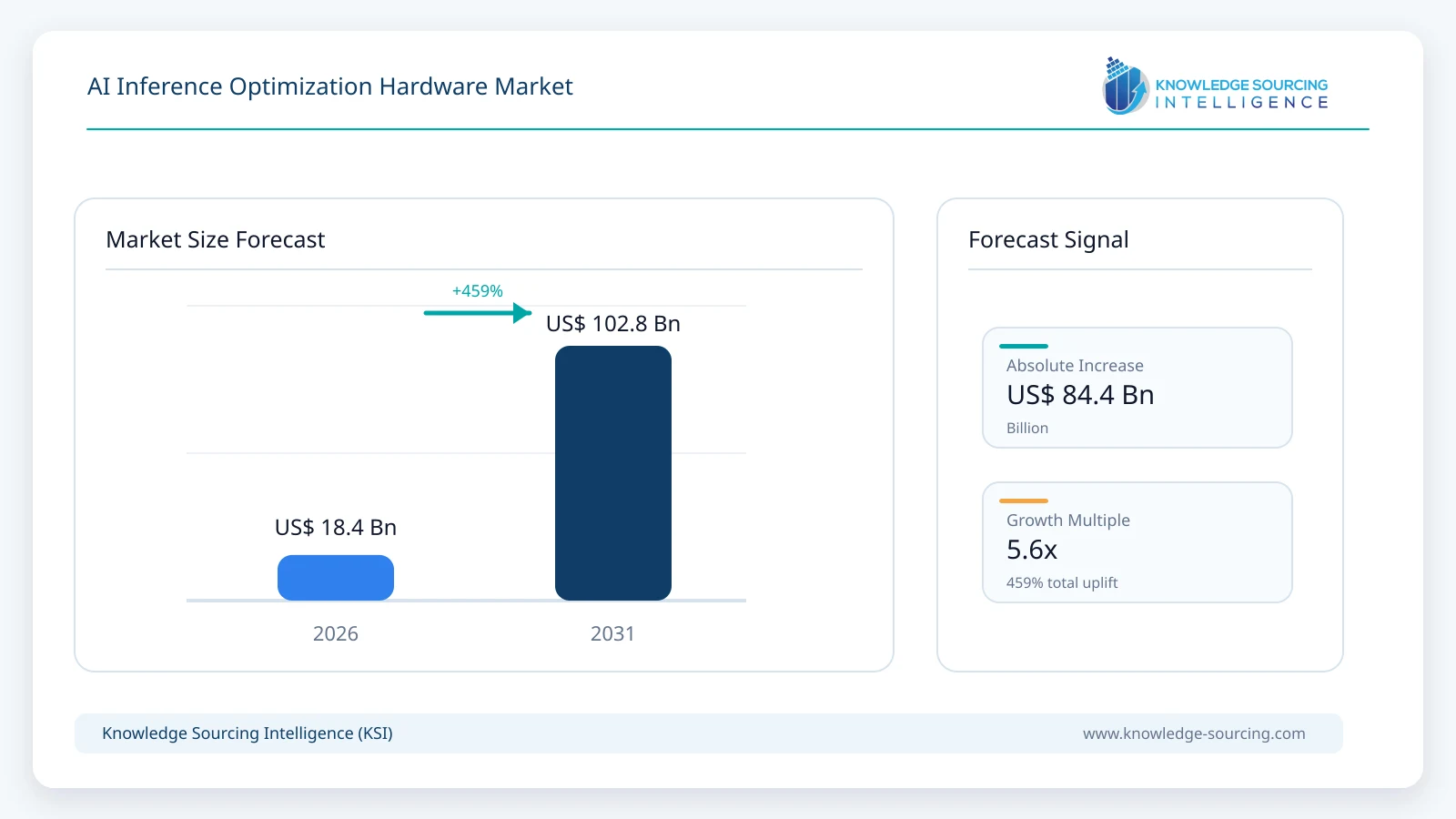
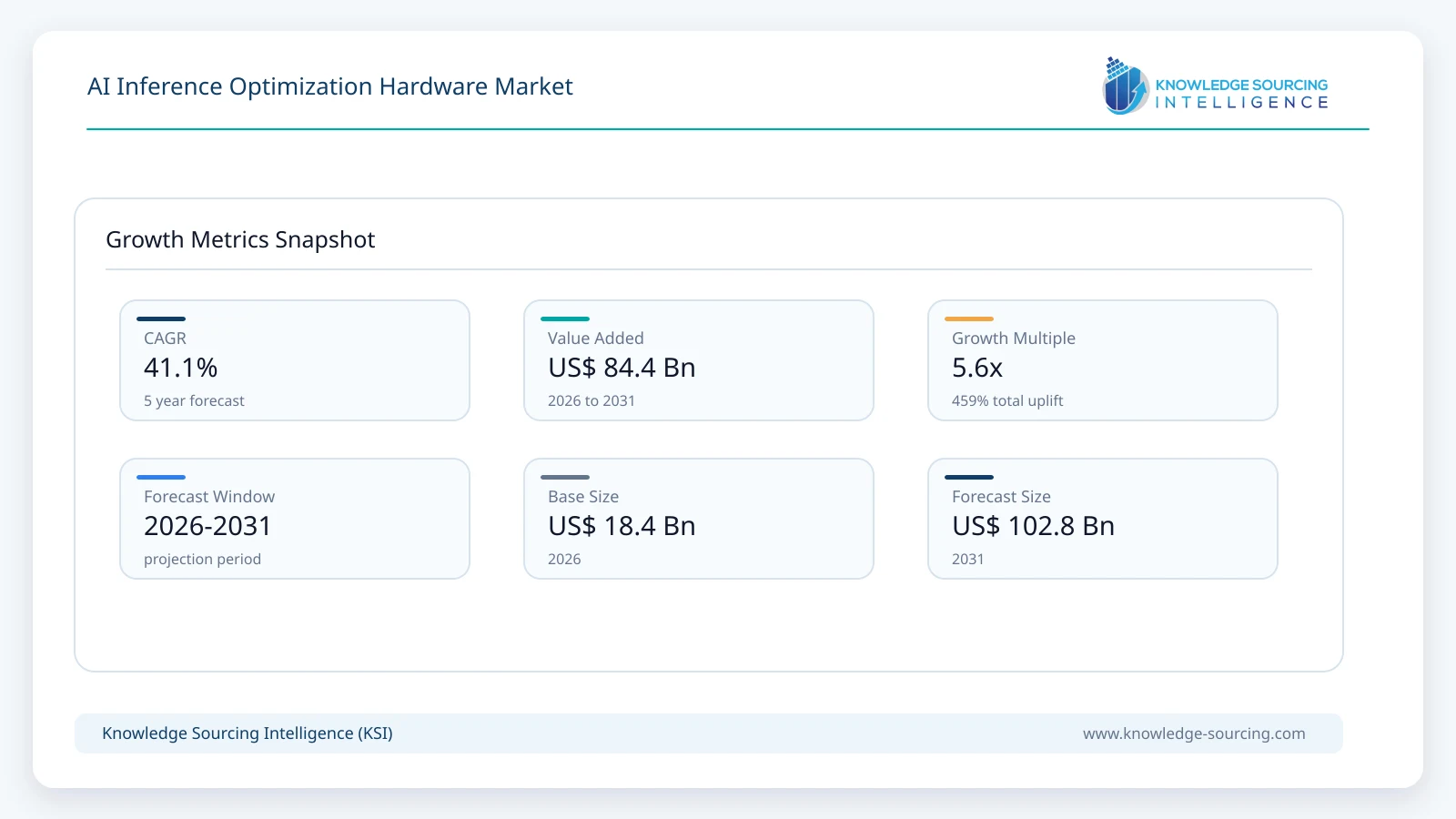
The AI Inference Optimization Hardware Market is estimated at USD 18.4 billion in 2026 and is projected to reach USD 102.8 billion by 2031, representing a CAGR of 41.1% during the forecast period.
Highlights:
- 1Custom hyperscaler inference ASICs account for USD 9.20 billion, or 50.0%, of the estimated 2026 market and are projected to reach USD 55.00 billion by 2031.
- 2Generative decoding and agentic inference represent the largest workload at USD 6.50 billion in 2026, increasing to USD 41.00 billion by 2031.
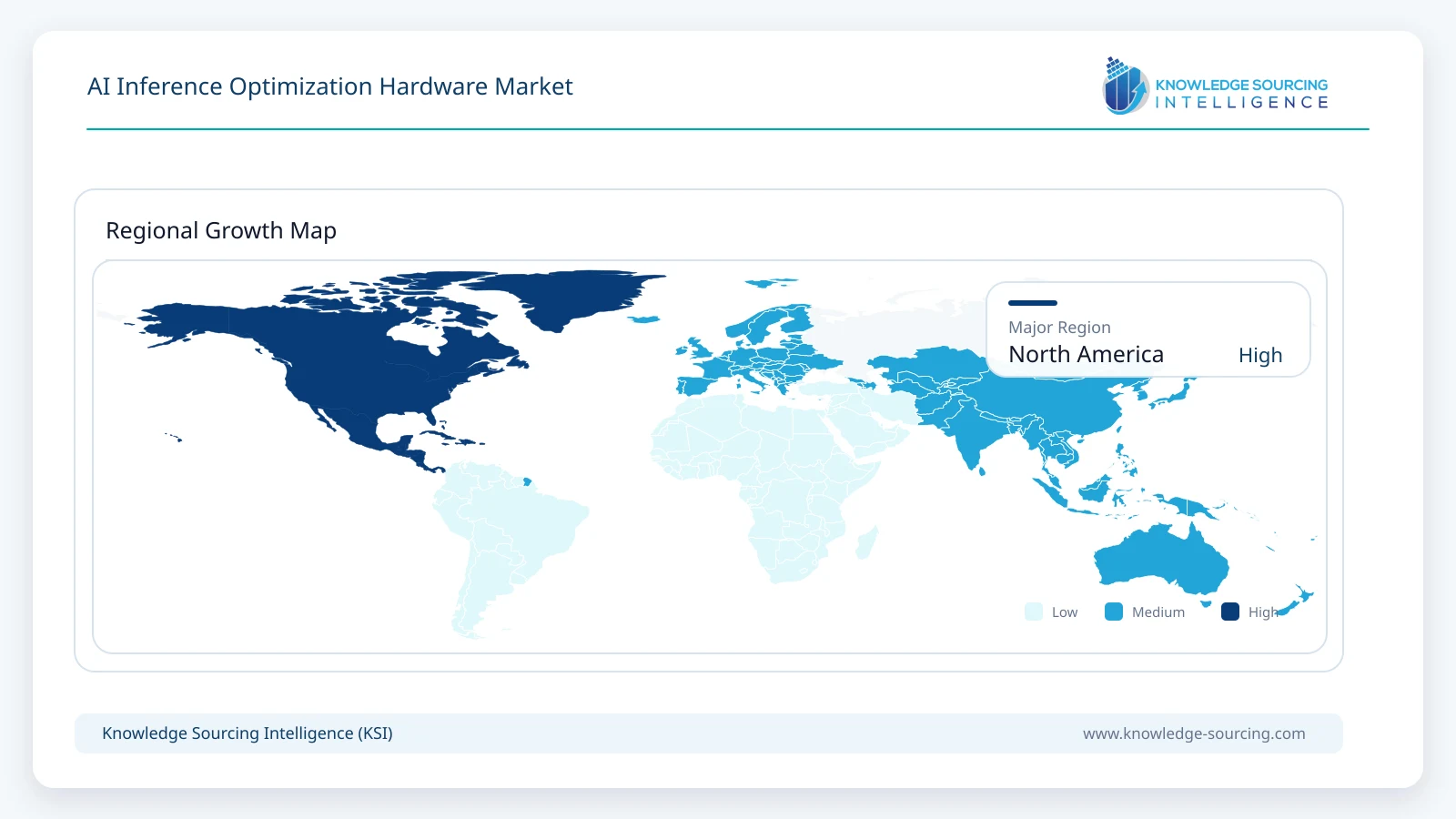
- 3North America leads with USD 9.50 billion in 2026 and is projected to reach USD 50.40 billion in 2031 as major cloud operators deploy dedicated silicon.
- 4Asia Pacific is the faster-growing principal region, rising from USD 5.70 billion in 2026 to USD 35.20 billion in 2031, supported by custom-chip supply and sovereign inference demand.
- 5Memory capacity, bandwidth, latency predictability and cost per served token increasingly determine chip selection alongside conventional peak compute specifications.
The market measures commercial hardware value associated with purpose-built AI inference accelerators, specialized inference ASICs, memory-centric inference processors, embedded inference modules and complete inference-optimized computing systems.
Inference optimization differs from general accelerated computing because the hardware design is primarily intended to improve the serving of deployed models rather than to support a broad mix of training and scientific tasks. Microsoft Maia 200, Qualcomm Cloud AI 100 Ultra and d-Matrix Corsair exemplify distinct inference-oriented approaches using specialized tensor processing, local memory and memory-efficient dataflows.
Growing deployment of agentic applications, model serving for enterprise users and large-volume recommendation systems is driving demand for architecture-specific performance and predictable power economics. Hardware manufacturers increasingly deliver accelerated computing as cards, integrated servers or complete racks alongside inference runtimes and memory management tools.
Market Overview
Large language model inference places different demands on computing hardware during prompt processing and response generation. Prefill operations process input sequences with substantial parallel arithmetic, while decoding repeatedly accesses model weights and key-value cache to produce tokens under user-facing latency constraints. Dedicated inference designs seek to reduce the energy and time associated with those memory accesses.
Custom accelerators are also becoming an important procurement alternative for large cloud operators that can match silicon capabilities to stable model-serving requirements. Microsoft introduced Maia 200 in January 2026 with dedicated inference features and an extensive memory subsystem, while AWS describes broad use of Trainium for Bedrock model serving. Google Cloud has deployed Ironwood TPUs for training and inference.
Specialized merchant suppliers are pursuing lower-latency deployments for AI clouds, sovereign infrastructure and private enterprises. Cerebras CS-4 uses wafer-scale engines with integrated SRAM, Rebellions offers RebelRack systems built on its inference accelerators, and FuriosaAI provides the RNGD neural processing unit for language and vision applications. Edge suppliers such as Axelera AI address smaller power envelopes.
Market Trends
Disaggregated Inference Is Reshaping Accelerator Design
NVIDIA announced in August 2026 that Groq 3 LPX was in full production, extending its Vera Rubin infrastructure with an accelerator designed for rapid, predictable token generation. The design assigns complementary inference functions to different computing engines so customers can use high-throughput accelerators for some phases and latency-optimized hardware for others. d-Matrix similarly promotes combinations of its Corsair processors and GPUs to improve response speed in heterogeneous deployments.
The commercial value of disaggregation depends on routing requests without expensive data transfers between machines. An operator must compare actual time to first token, decode throughput, network overhead and infrastructure utilization under production traffic, not just headline peak operations. As agentic workflows generate multiple sequential model calls, low tail latency can justify inference-specific hardware even where general GPU fleets remain in service.
Hyperscalers Are Building Silicon Around Token Economics
Microsoft launched Maia 200 in January 2026 as an inference-focused accelerator with low-precision compute and a memory subsystem optimized for serving models. AWS stated that Trainium powered the majority of inference on Bedrock, and Google made its Ironwood TPU available for large-scale training and inference.
Large operators can amortize semiconductor engineering over sizable fleets and tune hardware around recurring model classes, but custom design also exposes them to production and integration risks. The relevant commercial comparison is delivered throughput at a service-level target across electricity, memory, system packaging and maintenance.
Memory-Centric Designs Are Targeting Decoder Bottlenecks
d-Matrix moved Corsair into production in June 2026 using an SRAM-based chiplet architecture and LPDDR memory to reduce dependence on certain high-bandwidth-memory package configurations. FuriosaAI RNGD combines on-chip SRAM with HBM3 and a tensor-contraction architecture, while Qualcomm Cloud AI 100 Ultra uses substantial SRAM and lower-power memory to support inference in PCIe form factors. The suppliers address different combinations of bandwidth, capacity, energy use and manufacturing cost.
Memory architecture matters because a model must repeatedly access weights and attention states while serving each token. Products that reduce unnecessary data movement can improve useful throughput under constrained electricity supply, but a promising memory specification alone does not prove enterprise deployment readiness. Customers also test model support, batch size, long-context behavior and the ability to run multiple models without excessive conversion work.
Rack-Level Products Are Becoming the Unit of Procurement
Cerebras announced CS-4 in August 2026 as a rack-scale system using three wafer-scale engines, with a design focused on high-speed serving. Rebellions introduced RebelRack and RebelPOD in March 2026, and its September agreement in Japan demonstrated demand for packaged inference infrastructure in country-specific deployments. d-Matrix announced Squadron multi-rack inference clusters in October, extending Corsair beyond individual accelerator cards.
Buyers increasingly assess integrated systems because the accelerator cannot deliver its advertised output without suitable memory, power, cooling and software. Rack products can accelerate acceptance testing and reduce engineering work for customers, yet the hardware value must be recorded at the completed-system level. Semiconductor components inside those systems are not added again as separate market revenue.
Segment Analysis
By Accelerator Architecture: Custom Hyperscaler Inference ASICs
Custom hyperscaler inference ASICs account for approximately USD 9.20 billion in 2026 and are projected to generate USD 55.00 billion in 2031. Proprietary accelerator fleets enable cloud operators to tune memory, scheduling and arithmetic precision to model serving at scale. Microsoft Maia 200 and inference-attributed portions of AWS Trainium and Google TPU deployments exemplify the architecture, while custom silicon collaborations such as OpenAI and Broadcom broaden the supplier base.
The segment is shaped by internal design cycles, high upfront engineering costs and large deployments rather than conventional distributor sales. Operators benefit only when silicon utilization and cost per token outperform alternative merchant hardware over several years. Captive chip installations are valued once as hardware equivalents and are not supplemented by downstream cloud-inference revenue.
By Deployment Environment: Hyperscale Cloud AI Infrastructure
Hyperscale cloud infrastructure is estimated at USD 10.20 billion in 2026 and USD 61.00 billion in 2031 because public AI services and consumer-scale applications operate large, consistently utilized accelerator fleets. Inference systems are increasingly engineered for bursty requests, long context and variable token-generation loads. Procurement includes internally installed custom chips and acquired inference-specific hardware, but excludes multipurpose GPUs unless an identifiable inference-only hardware product is supplied.
By Inference Workload: Generative Model Decoding and Agentic Tasks
Dedicated hardware serving text generation and agentic task execution is projected to expand from USD 6.50 billion in 2026 to USD 41.00 billion in 2031. Repeated decoding, long context and multi-step tool workflows place a premium on low response latency and sustained output per watt.
Market Drivers
Rising Volume of AI Inference Requests
AI assistants, search experiences, customer-service applications and agentic workflows are multiplying the number of requests served after model training is complete. Inference clusters must maintain acceptable response times during both normal traffic and demand spikes, increasing the attraction of processors designed for sustained serving rather than peak training capability. Larger deployments support repeated orders for accelerator hardware, even as model efficiency improvements reduce computing needed for individual tasks.
Growing Pressure to Reduce Cost per Token
Inference providers increasingly compare useful token output per dollar rather than solely peak floating-point performance. Dedicated ASICs can improve economics by specializing precision formats, memory movement and scheduler behavior for common serving patterns. Microsoft has highlighted performance-per-dollar gains for Maia 200, and specialized hardware vendors compete using speed and energy metrics. Higher upfront hardware costs can be justified if utilization and operational savings persist through the equipment life.
Demand for Low-Latency Agentic Services
Interactive coding agents and real-time enterprise assistants frequently execute chains of dependent inference steps, making slow decoding a direct limitation on user experience. Purpose-built SRAM-rich and deterministic accelerators can reduce variability in sequential token production. NVIDIA Groq 3 LPX and d-Matrix Corsair are examples of architectures designed around this requirement.
Expansion of Sovereign and Private AI Infrastructure
Enterprises and governments increasingly need model serving within specified jurisdictions or private facilities, supporting demand for merchant cards and packaged racks rather than exclusively hyperscaler-hosted inference. Rebellions reported a Japanese deployment arrangement for RebelRack, while Qualcomm and FuriosaAI offer dedicated hardware options that can operate in controlled environments. Data residency, operational sovereignty and stable local capacity can influence procurement alongside raw compute cost.
Improvement in Low-Precision and Memory-Focused Designs
AI serving workloads increasingly use lower precision and model compression where accuracy requirements permit, opening room for accelerator designs built around FP8, FP4, INT8 and efficient memory placement. Microsoft Maia 200, Qualcomm inference cards and several custom ASIC suppliers place substantial emphasis on these characteristics. More efficient memory use can lower cost and power demand, although gains depend on model architecture, software support and workload-specific validation.
Market Restraints
Rapid Changes in Model Architectures
Purpose-built accelerators can deliver strong results for selected model families but may become less economical when attention mechanisms, mixtures of experts or context lengths change. A design optimized around one inference pattern can require new compiler work or hardware revisions as leading models evolve. Buyers therefore evaluate architectural flexibility and vendor roadmaps in addition to measured benchmark performance before committing to multi-year rollouts.
Software Portability and Integration Requirements
Enterprise inference platforms commonly depend on established frameworks, distributed serving tools and model conversion pipelines. Specialized ASICs require compiler support, runtime management and stable integrations before customers can migrate workloads at scale. These costs can offset chip-level advantages if operators must maintain separate model versions or specialized engineering teams. Merchant vendors need broad ecosystem partnerships to translate promising silicon into repeatable hardware orders.
Semiconductor Packaging and Capital Intensity
Inference-optimized cards and rack systems still depend on advanced fabrication, packaging, memory and power infrastructure even when their architecture reduces dependence on a particular HBM supply chain. Custom ASIC development requires substantial non-recurring engineering expense and long qualification cycles. Smaller vendors face the risk of delayed production ramps and concentrated buyers, while hyperscalers must commit capital before hardware efficiency can be observed in sustained operation.
Competition From Flexible GPU Infrastructure
Broadly programmable GPUs remain attractive to providers that train, fine-tune and serve changing model families on common hardware pools. A specialized inference chip may improve one metric yet reduce flexibility when workloads or service expectations change. GPU vendors are also developing lower-precision execution, memory enhancements and runtime optimization, raising the performance baseline that inference-only systems must exceed to win orders.
Deployment Timing and Benchmark Comparability
Announcements about chip availability, partnership capacity or planned data centers do not necessarily correspond to completed hardware shipments. Performance comparisons vary with models, precision, prompt lengths, batching, interactivity requirements and system power accounting. Enterprise customers often conduct lengthy acceptance tests before committing to inference platforms. Differences between announced capacity, shipment volumes and recurring cloud usage create additional uncertainty when converting technical momentum into market revenue.
Regional Outlook
North America
North America is the largest regional market, with an estimated USD 9.50 billion in 2026 and USD 50.40 billion in 2031. The United States combines large hyperscale demand, specialist processor design firms and extensive data-center integration capacity. Microsoft, AWS and Google design custom silicon, NVIDIA supplies inference-focused LPX hardware, and d-Matrix and Cerebras are developing commercial inference products.
Canadian data-center development and enterprise inference projects contribute to regional demand, while Mexico supports selected electronics manufacturing and distributed enterprise deployments. In the United States, large cloud platforms are expected to dominate installed hardware-equivalent spending, but merchant accelerator opportunities will expand where model developers and private infrastructure operators prioritize performance or specialized data protection.
Asia Pacific
Asia Pacific is projected to grow from USD 5.70 billion in 2026 to USD 35.20 billion in 2031, outpacing North America in percentage terms while remaining the second-largest regional market. China, South Korea, Japan and Taiwan are significant through cloud demand, semiconductor ecosystems and AI server supply chains.
Taiwan’s role in manufacturing and packaging differs from end-market spending, so hardware revenue is allocated by the buyer installing the inference system rather than automatically to the fabrication location. India, Singapore and Australia add opportunities in cloud services, enterprise deployments and locally governed AI infrastructure. Countries vary in advanced-chip access, sovereign procurement and electricity costs, which can favor different memory architectures and levels of specialization.
Competitive Landscape
The competitive environment includes hyperscaler custom-chip developers, merchant inference ASIC suppliers and integrated rack-system manufacturers. Microsoft Maia 200 represents a cloud-owned inference architecture; AWS and Google deploy custom processors across mixed training and serving workloads, requiring careful attribution. Broadcom participates in custom silicon design relationships, while NVIDIA offers inference-specific Groq 3 LPX alongside its broader GPU portfolio.
Cerebras and d-Matrix seek differentiated data-center inference performance through wafer-scale and memory-centric architectures. Rebellions, FuriosaAI and Qualcomm serve enterprise, regional cloud and edge opportunities with NPUs and dedicated inference cards. Axelera AI addresses selected industrial and enterprise deployments, while SambaNova supplies SN40 and SN50 reconfigurable dataflow inference processors. Flexible AMD GPUs remain an alternative benchmark rather than separately modeled inference-only hardware.
Recent Developments
October 2026: d-Matrix announced Squadron multi-rack inference clusters using Corsair processors, extending commercial configurations beyond standalone cards and single servers.
September 2026: Rebellions and ai& announced an initial RebelRack deployment in Japan, with plans for expansion subject to project execution.
August 2026: NVIDIA announced that Groq 3 LPX had entered full production, with Nebius identified as its first adopting cloud provider.
August 2026: Cerebras unveiled the CS-4 rack-scale inference system using three Wafer-Scale Engines, targeting higher throughput and lower token latency.
June 2026: OpenAI and Broadcom unveiled Jalapeño, a custom processor designed specifically for large language model inference.
January 2026: Microsoft introduced Maia 200, a purpose-built inference accelerator emphasizing low-precision compute, high-speed memory and serving efficiency.
Market Outlook
Purpose-built inference processors are expected to gain share of new model-serving deployments as response speed, predictable latency and compute cost become central to cloud and enterprise AI economics. The largest opportunity lies in custom accelerator fleets and integrated systems where organizations can measure sustained throughput and optimize hardware deployment around recurring model demand. Specialized suppliers will increasingly compete on useful performance under realistic production workloads rather than isolated chip specifications.
The expansion of long-context applications, multimodal services and agentic task chains will favor architectures that reduce expensive movement of model data and maintain efficient utilization across variable request loads. At the same time, changes in model design and improvements in flexible GPUs will limit how narrowly vendors can specialize.
AI Inference Optimization Hardware Market Scope
| Report Metric | Details |
|---|---|
| Total Market Size in 2026 | USD 18.4 billion |
| Total Market Size in 2031 | USD 102.8 billion |
| Forecast Unit | Billion |
| Growth Rate | 41.1% |
| Study Period | 2021 to 2031 |
| Historical Data | 2021 to 2024 |
| Base Year | 2025 |
| Forecast Period | 2026 – 2031 |
| Segmentation | Accelerator Architecture, Deployment Environment, Hardware Delivery Format, Inference Workload, Memory and Data Movement Architecture, Buyer Type, Inference System Form Factor, Geography |
| Companies |
|
| Customization Scope | 15% Free Customization included with purchase — Request Custom Breakdown → |
| Sample & Data Access | PDF Sample, Excel Databook & Analyst Briefing — Download Free Sample → |
Market Segmentation
By Accelerator Architecture
Custom Hyperscaler Inference ASICs
Merchant Inference NPUs and ASICs
Wafer-Scale and Spatial Accelerators
SRAM and Deterministic Dataflow Engines
Edge Inference Accelerators
Novel and In-Memory Inference Engines
By Deployment Environment
Hyperscale Cloud AI Infrastructure
Private Enterprise Data Centers
Industrial and Distributed Edge
Sovereign and Telecom AI Infrastructure
OEM-Embedded Inference Systems
By Hardware Delivery Format
Captive Custom Silicon Equivalent
Merchant Accelerator Cards and Modules
Rack and Server Inference Systems
Compact Edge Inference Modules
By Inference Workload
Generative Model Decoding and Agentic Tasks
Multimodal Generative Inference
Recommendation and Ranking
Computer Vision and Perception
Speech and Conventional Predictive Inference
By Memory and Data Movement Architecture
HBM-Centric Inference Accelerators
On-Chip SRAM and Dataflow Designs
LPDDR-Optimized Accelerators
Wafer-Local and Integrated Memory
Novel or Other Memory Integration
By Buyer Type
Hyperscale Cloud Providers
AI Cloud Operators and Model Developers
Private Enterprise Customers
Sovereign and Public-Sector Buyers
Edge Equipment and System OEMs
By Inference System Form Factor
Custom AI ASIC Tiles and Boards
PCIe and Standalone Accelerator Cards
Integrated Inference Server and Rack Systems
Embedded and Compact Edge Modules
By Geography
North America
United States
Canada
Mexico
South America
Brazil
Chile
Argentina
Rest of South America
Europe
Germany
United Kingdom
France
Netherlands
Ireland
Sweden
Italy
Rest of Europe
Middle East and Africa
Saudi Arabia
United Arab Emirates
Israel
South Africa
Rest of Middle East and Africa
Asia Pacific
China
South Korea
Japan
Taiwan
India
Singapore
Australia
Rest of Asia Pacific
Table of Contents
1. EXECUTIVE SUMMARY
1.1. Market Opportunity and Key Findings
1.2. Global Market Size and Forecast, 2026-2031
1.3. Market Outlook
2. MARKET SNAPSHOT
2.1. Industry Definition and Scope
2.2. Market Dynamics at a Glance
2.3. Technology and Adoption Outlook
3. BUSINESS LANDSCAPE
3.1. Market Drivers
3.1.1. Rising Volume of AI Inference Requests
3.1.2. Growing Pressure to Reduce Cost per Token
3.1.3. Demand for Low-Latency Agentic Services
3.1.4. Expansion of Sovereign and Private AI Infrastructure
3.1.5. Improvement in Low-Precision and Memory-Focused Designs
3.2. Market Restraints
3.2.1. Rapid Changes in Model Architectures
3.2.2. Software Portability and Integration Requirements
3.2.3. Semiconductor Packaging and Capital Intensity
3.2.4. Competition From Flexible GPU Infrastructure
3.2.5. Deployment Timing and Benchmark Comparability
3.3. Market Opportunities
3.4. Porter’s Five Forces Analysis
3.5. Industry Value Chain Analysis
3.6. Policies and Regulations
3.7. Strategic Recommendations
4. TECHNOLOGICAL OUTLOOK
4.1. Purpose-Built Inference ASIC Architectures
4.2. Memory-Centric and Dataflow Processing
4.3. Low-Precision Inference Compute
4.4. Prefill-Decode Disaggregation
4.5. Rack Integration and Power Efficiency
4.6. Software Compatibility and Model Portability
5. AI INFERENCE OPTIMIZATION HARDWARE MARKET BY ACCELERATOR ARCHITECTURE
5.1. Custom Hyperscaler Inference ASICs
5.2. Merchant Inference NPUs and ASICs
5.3. Wafer-Scale and Spatial Accelerators
5.4. SRAM and Deterministic Dataflow Engines
5.5. Edge Inference Accelerators
5.6. Novel and In-Memory Inference Engines
6. AI INFERENCE OPTIMIZATION HARDWARE MARKET BY DEPLOYMENT ENVIRONMENT
6.1. Hyperscale Cloud AI Infrastructure
6.2. Private Enterprise Data Centers
6.3. Industrial and Distributed Edge
6.4. Sovereign and Telecom AI Infrastructure
6.5. OEM-Embedded Inference Systems
7. AI INFERENCE OPTIMIZATION HARDWARE MARKET BY HARDWARE DELIVERY FORMAT
7.1. Captive Custom Silicon Equivalent
7.2. Merchant Accelerator Cards and Modules
7.3. Rack and Server Inference Systems
7.4. Compact Edge Inference Modules
8. AI INFERENCE OPTIMIZATION HARDWARE MARKET BY INFERENCE WORKLOAD
8.1. Generative Model Decoding and Agentic Tasks
8.2. Multimodal Generative Inference
8.3. Recommendation and Ranking
8.4. Computer Vision and Perception
8.5. Speech and Conventional Predictive Inference
9. AI INFERENCE OPTIMIZATION HARDWARE MARKET BY MEMORY AND DATA MOVEMENT ARCHITECTURE
9.1. HBM-Centric Inference Accelerators
9.2. On-Chip SRAM and Dataflow Designs
9.3. LPDDR-Optimized Accelerators
9.4. Wafer-Local and Integrated Memory
9.5. Novel or Other Memory Integration
10. AI INFERENCE OPTIMIZATION HARDWARE MARKET BY BUYER TYPE
10.1. Hyperscale Cloud Providers
10.2. AI Cloud Operators and Model Developers
10.3. Private Enterprise Customers
10.4. Sovereign and Public-Sector Buyers
10.5. Edge Equipment and System OEMs
11. AI INFERENCE OPTIMIZATION HARDWARE MARKET BY INFERENCE SYSTEM FORM FACTOR
11.1. Custom AI ASIC Tiles and Boards
11.2. PCIe and Standalone Accelerator Cards
11.3. Integrated Inference Server and Rack Systems
11.4. Embedded and Compact Edge Modules
12. AI INFERENCE OPTIMIZATION HARDWARE MARKET BY GEOGRAPHY
12.1. North America
12.1.1. United States
12.1.2. Canada
12.1.3. Mexico
12.2. South America
12.2.1. Brazil
12.2.2. Chile
12.2.3. Argentina
12.2.4. Rest of South America
12.3. Europe
12.3.1. Germany
12.3.2. United Kingdom
12.3.3. France
12.3.4. Netherlands
12.3.5. Ireland
12.3.6. Sweden
12.3.7. Italy
12.3.8. Rest of Europe
12.4. Middle East and Africa
12.4.1. Saudi Arabia
12.4.2. United Arab Emirates
12.4.3. Israel
12.4.4. South Africa
12.4.5. Rest of Middle East and Africa
12.5. Asia Pacific
12.5.1. China
12.5.2. South Korea
12.5.3. Japan
12.5.4. Taiwan
12.5.5. India
12.5.6. Singapore
12.5.7. Australia
12.5.8. Rest of Asia Pacific
13. COMPETITIVE ENVIRONMENT AND ANALYSIS
13.1. Major Players and Strategy Analysis
13.2. Market Share Analysis
13.3. Mergers, Acquisitions, Agreements and Collaborations
13.4. Competitive Dashboard
14. COMPANY PROFILES
14.1. NVIDIA Corporation
14.2. Microsoft Corporation
14.3. Amazon Web Services, Inc.
14.4. Google LLC (Alphabet Inc.)
14.5. Broadcom Inc.
14.6. Cerebras Systems, Inc.
14.7. d-Matrix, Inc.
14.8. Qualcomm Technologies, Inc.
14.9. Rebellions Inc.
14.10. FuriosaAI, Inc.
14.11. Axelera AI B.V.
14.12. SambaNova Systems, Inc.
15. APPENDIX
15.1. Currency
15.2. Assumptions
15.3. Base and Forecast Years
15.4. Research Methodology
15.5. Abbreviations





Frequently asked questions
What is the projected market size for AI Inference Optimization Hardware by 2031?
The AI Inference Optimization Hardware Market is projected to reach USD 102.8 billion by 2031.
What is the compound annual growth rate (CAGR) for this market?
The AI Inference Optimization Hardware Market is projected to grow at a CAGR of 41.1% (2026-2031).
Which region leads the market share in 2026?
North America leads with USD 9.50 billion in 2026.
What is the fastest-growing principal region in the forecast period?
Asia Pacific is the faster-growing principal region.
What is the largest workload segment driving market demand?
Generative decoding and agentic inference represent the largest workload.
Which hardware type accounts for the largest market share?
Custom hyperscaler inference ASICs account for 50% in 2026.
Cite this report
Knowledge Sourcing Intelligence. (Oct 2026). AI Inference Optimization Hardware Market Size, Share & Growth Forecast (2026-2031). https://www.knowledge-sourcing.com/report/ai-inference-optimization-hardware-market