
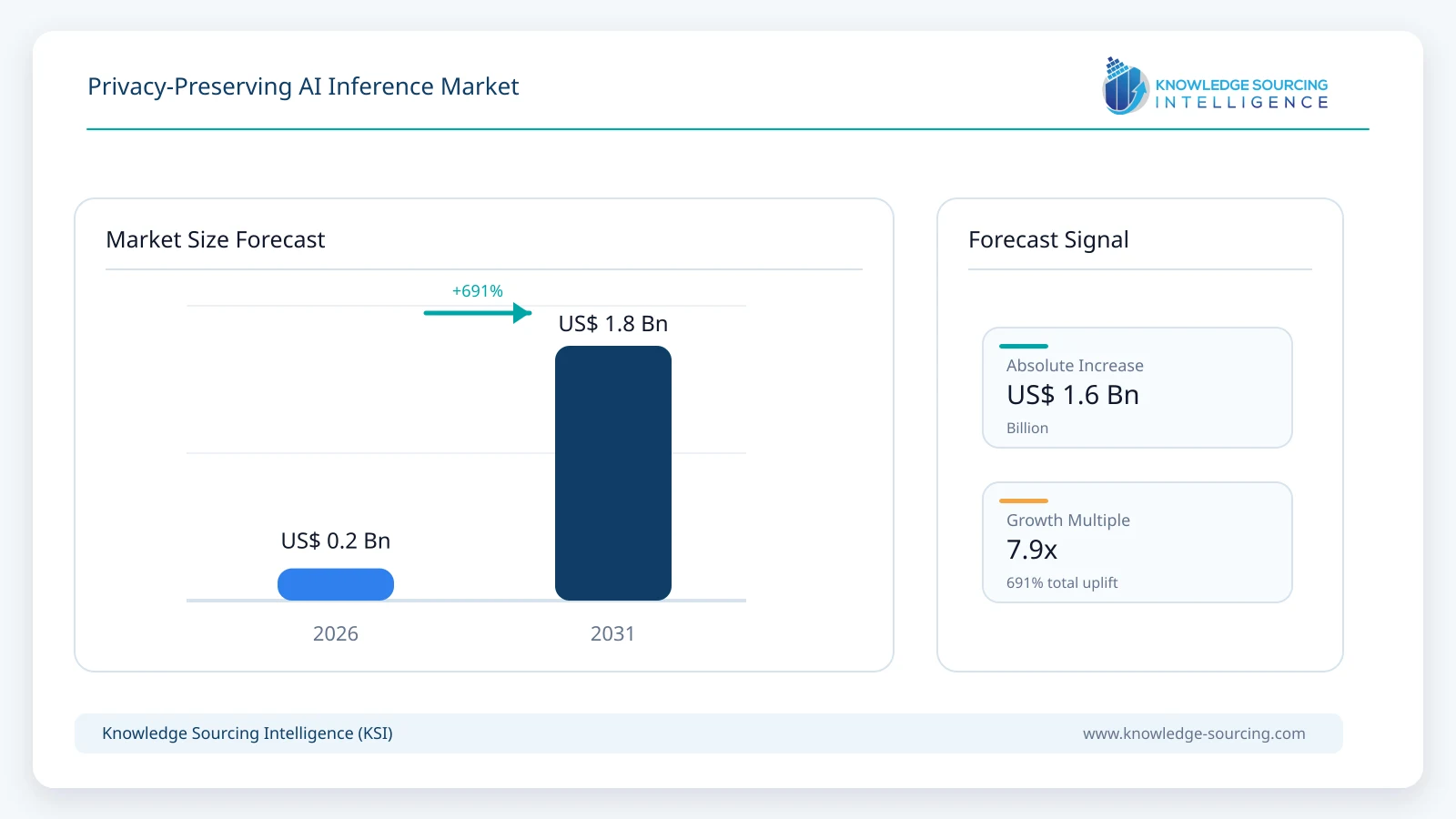
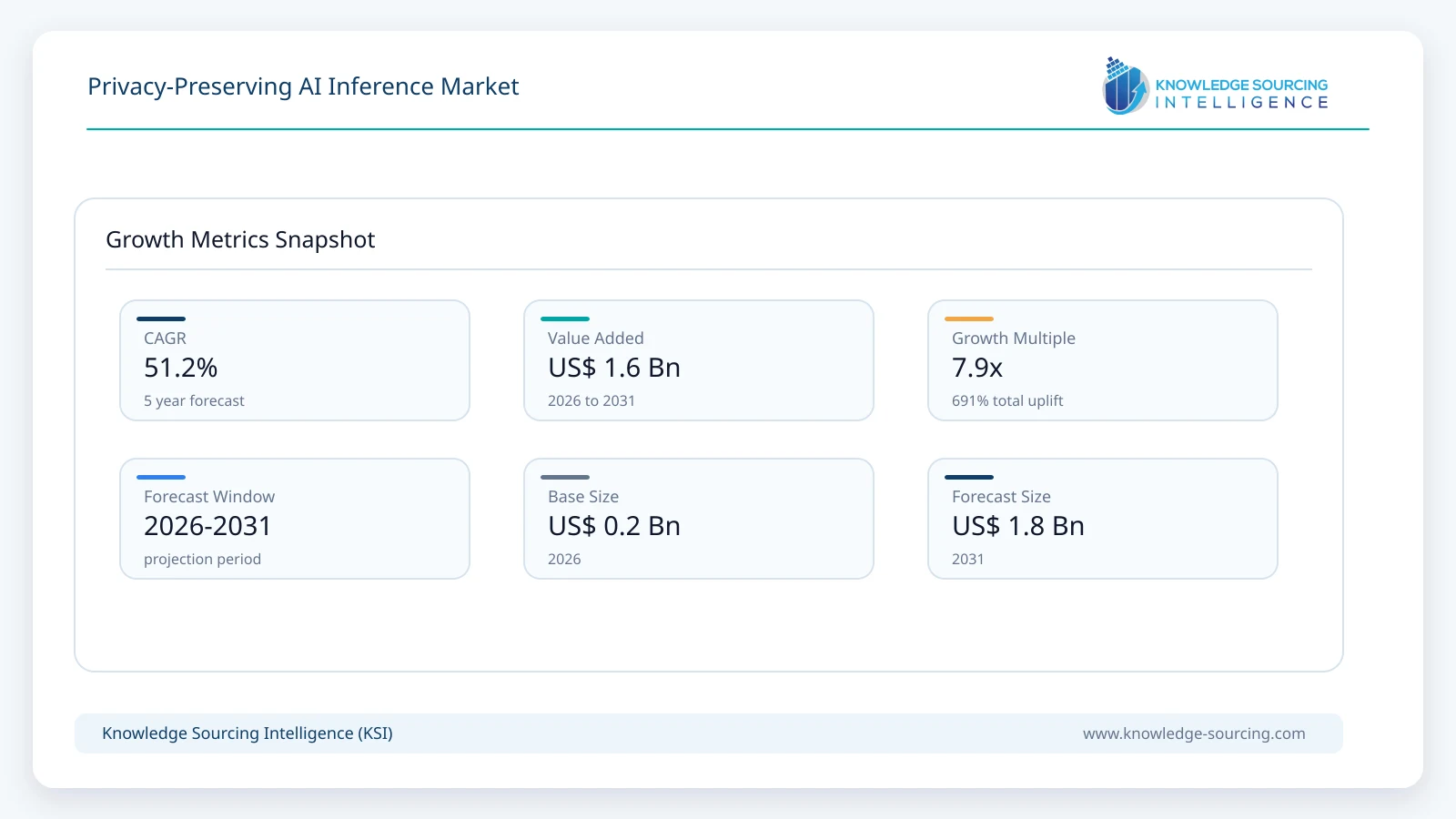
The Privacy-Preserving AI Inference Market is projected to grow from approximately USD 0.225 billion in 2026 to USD 1.78 billion in 2031, at a CAGR of 51.23% during the forecast period.
Highlights:
- 1Trusted execution environments account for approximately 55.6% of market revenue in 2026, reflecting the current commercial advantage of hardware-backed protected inference.
- 2Private inference APIs and managed endpoints represent approximately 42.2% of 2026 revenue, supported by applications that require protected prompts and responses without building dedicated infrastructure.
- 3Generative text and multimodal workloads contribute approximately 54.7% of demand in 2026 as enterprise assistants process confidential documents, customer records and proprietary context.
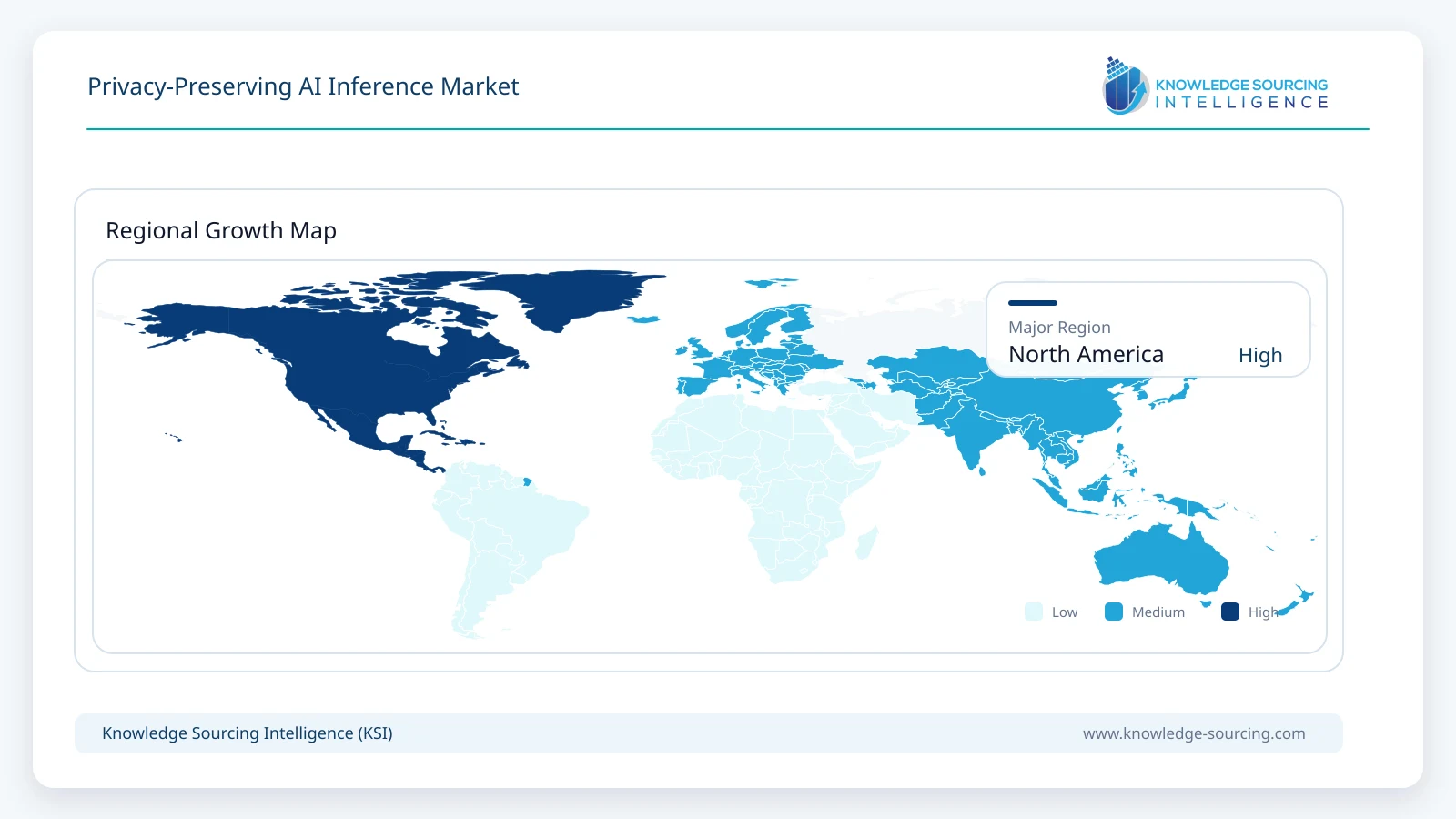
- 4North America leads with approximately 41.8% of global market value in 2026, supported by hyperscaler services, AI security suppliers and regulated enterprise spending.
- 5Asia Pacific is expected to grow faster than North America and Europe through 2031 as financial services, sovereign infrastructure and local AI deployments expand.
Sensitive AI inference creates a trust problem whenever a customer must disclose readable inputs to a model service or allow valuable model parameters to run on infrastructure controlled by another party. Standard transport encryption protects requests in transit but does not by itself prevent access to plaintext during processing. Privacy-preserving inference introduces additional protection at the execution layer, by splitting information across participants, computing directly on ciphertext or isolating workloads within verified hardware environments. The most practical approach depends on whether the customer primarily seeks prompt confidentiality, model intellectual property protection or cooperation among organizations that cannot disclose their raw records.
Hardware-backed inference has moved closer to mainstream deployment as NVIDIA and cloud suppliers extend confidential execution to accelerated instances. Google Cloud announced general availability of its confidential G4 series in October 2026 and publishes separate prices for privacy-enabling GPU configurations. Microsoft Azure provides confidential virtual machines and attestation components, while Fortanix offers enterprise controls that verify a protected environment before releasing model or data decryption keys. These products are particularly relevant where organizations need to prove that operators outside an approved trust boundary cannot inspect customer prompts or model weights.
Encrypted and multiparty methods offer different protections from confidential virtual machines. Zama’s Concrete ML demonstrates model execution on encrypted data, while secure multiparty computation distributes information among parties so no participant needs to hold the entire plaintext. Such techniques can be well suited to constrained prediction models or cross-organization analysis, but their computational requirements may limit applicability to large generative models. Apple’s Private Cloud Compute shows how privately designed model services can integrate with consumer applications; however, commercial market revenue is driven by paid enterprise products, protected inference services and software attached to customer workloads.
Market Trends
Confidential GPU Inference Is Becoming More Deployable
Production-oriented confidential GPU stacks are reducing the performance penalty associated with protecting data while transformer models generate tokens. In September 2026, NVIDIA reported that TensorRT-LLM adaptations running DeepSeek-R1 on eight B200 GPUs retained more than 96% of baseline output-token throughput in its tested configurations. Google Cloud followed in October with general availability of confidential G4 instances built around NVIDIA RTX PRO 6000 Blackwell GPUs, widening infrastructure choices for enterprises moving private inference beyond pilot projects.
The significance is commercial as well as technical: lower overhead makes secure execution more feasible for customer-facing assistants, document review and repeated automated decisions where response speed matters. Buyers nevertheless need to assess hardware availability, supported GPU features, attestation chains and the confidential-compute premium separately from ordinary GPU rental. Evidence of strong performance on a specific model and configuration should not be generalized to every workload.
Verified Inference Is Becoming a Procurement Requirement
Enterprises running third-party models on private datasets increasingly seek evidence that the inference environment has not been altered before granting it access to protected assets. Fortanix introduced a confidential AI offering in March 2026 focused on securing model intellectual property and enterprise data simultaneously, and expanded support for Confidential Containers in October 2026. In these architectures, cryptographic attestation connects workload identity, hardware state and controlled key release.
Encrypted Computation Is Creating Alternatives to Hardware Trust
Fully homomorphic encryption and secure multiparty computation offer approaches that avoid exposing complete input plaintext to a single computing party. Zama’s Concrete ML provides a developer route for encrypted model execution, while secure computation systems distribute protected intermediate operations among participating nodes. These methods can create opportunities in clinical risk scoring, private matching, collaborative financial analysis and other functions that need precise restrictions on which party may observe the underlying records.
Computational cost, model coverage and numerical compatibility remain important limits. Homomorphic schemes can impose considerable overhead on unsupported neural operations, and multiparty protocols introduce communication and synchronization requirements. Early commercial demand is therefore likely to concentrate on selected high-value tasks rather than immediate replacement of general-purpose GPU inference. Hybrid architectures that combine encrypted inputs with trusted execution or limited disclosures may be more economical for larger enterprise workflows.
Private Inference Is Extending Across Devices and Cloud Environments
Apple announced in June 2026 that its Private Cloud Compute architecture would extend to supported third-party data centers through collaboration with Google and NVIDIA. The development illustrates a shift toward privacy guarantees spanning device-side processing, protected network transport and verified server computation. Other organizations are designing similar boundaries for private assistants that must access both local business data and centralized reasoning resources.
Privacy-Preserving AI Inference Market Segment Analysis
By Privacy Technology
Trusted Execution Environments
Trusted execution environments hold the leading position because supported cloud and private infrastructure can protect existing AI models without fully redesigning their mathematics for encrypted computation. The segment is projected to reach approximately USD 1.02 billion in 2031, supported by confidential GPU instances, attested inference containers and software that manages workload measurement and key release. Google Cloud, Microsoft, NVIDIA and Fortanix provide identifiable components of this commercial stack, while specialist endpoint providers make protected execution accessible through familiar APIs.
The economic value of these systems lies in protecting both the customer’s inputs and the supplier’s model intellectual property during execution. Adoption still depends on specific CPU and GPU security boundaries, firmware support and the assurance buyers require from infrastructure operators. As cloud capacity increases, enterprise demand should extend beyond sensitive proof-of-concept workloads into recurring production inference.
By Offering
Private Inference APIs and Managed Endpoints
Private inference APIs and managed endpoints let developers route protected requests to models through managed services rather than maintaining every trusted virtual machine themselves. This offering is projected to reach approximately USD 650 million by 2031. Edgeless Systems’ Privatemode demonstrates client-verifiable inference delivered through familiar API patterns, while specialist cloud suppliers can package confidential hardware operations with usage metering and technical support.
Demand is strongest when privacy assurance is a contractual requirement but internal engineering teams lack experience with attestation, protected GPUs or encrypted communication. Buyers evaluate latency, model choice, logging restrictions, deployment region and the ability to audit privacy claims. Providers that bundle standard token charges into a private service need transparent differentiation between protected inference value and ordinary model processing.
By End User
Banking, Financial Services and Insurance
Banking, financial services and insurance represent one of the largest end-user markets because AI applications may process customer financial information, underwriting files, transaction records, fraud alerts and proprietary risk models. The segment is projected to reach approximately USD 480 million in 2031. Privacy-preserving inference can help organizations use third-party analytical capabilities without providing unnecessary access to readable records or exposing models in untrusted execution environments.
Financial institutions are also natural early adopters of collaborative prediction in which several firms need combined insights without unrestricted sharing of transaction-level data. Commercial deployments remain constrained by model validation, audit requirements and operational reliability, but recurring risk scoring and document workflows create a clearer route to paid volume than isolated research demonstrations.
Market Drivers
Regulated Enterprise Data Processing
Financial, healthcare and public-service organizations increasingly deploy AI against records whose disclosure can create legal, contractual or reputational exposure. Private inference gives these buyers additional execution controls beyond conventional transport encryption. The ability to run sensitive summarization, predictive scoring and document classification under verified boundaries expands the range of enterprise datasets that can support recurring inference workloads.
Expansion of Confidential GPU Availability
Google Cloud’s confidential G4 general availability and NVIDIA’s Blackwell inference work demonstrate that production deployment options are broadening. Buyers can increasingly select supported GPU configurations with hardware attestation rather than redesign every model for a specialized cryptographic backend. The resulting improvement in model compatibility is central to expanding protected inference from narrow pilot programs into mainstream applications.
Protection of Proprietary Models and Customer Inputs
Enterprises and model developers often require protection in both directions: customer data must remain hidden from unauthorized infrastructure access, and model weights must remain unavailable to the host operator. Fortanix’s confidential AI architecture specifically addresses these mutual-trust requirements. This demand can support secure on-premises delivery of proprietary models and negotiated private inference contracts.
Cross-Organization AI Collaboration
Hospitals, financial institutions and commercial partners may want shared predictions while retaining control of the underlying records. Homomorphic encryption and multiparty computation offer ways to exchange calculated outputs rather than unrestricted source data. These capabilities create high-value niches for encrypted inference engines, privacy tooling and deployment integration even where conventional model hosting is unsuitable.
Growing Need for Verifiable AI Operations
Model deployment teams increasingly need evidence of workload identity, signed measurements, access controls and policy-compliant secret release. Enterprise buyers cannot rely solely on a provider describing its service as secure. Demand for operational verification supports recurring software purchases for attestation integration, protected runtime management and monitoring of authorized inference sessions.
Market Restraints
Encryption Overhead and Model Compatibility
Cryptographic inference techniques may impose substantial runtime or memory overhead on operations not optimized for encrypted computation. Deep neural networks, long-context generation and multimodal pipelines are difficult to move unchanged into some homomorphic or multiparty systems. Providers must show that privacy benefits justify cost and response-time trade-offs for each workload.
Complex Trust and Attestation Configuration
Confidential inference requires correct combinations of firmware, CPU and GPU settings, measured software, workload identity and key policies. Misconfigured attestation or unsupported acceleration features can reduce the expected protections. Enterprises therefore need specialized security expertise and repeatable testing, creating adoption barriers for smaller deployment teams.
Limited Visibility into Protection Guarantees
Trusted hardware, cryptographic protocols and privacy-preserving output policies address different threats. Hardware isolation does not automatically prevent application-layer prompt leakage, unsafe tools or unintended disclosure in generated responses. Buyers may struggle to distinguish meaningful technical guarantees from broad marketing claims, prolonging vendor qualification and procurement.
Price Pressure from Bundled Cloud Security
Cloud providers can incorporate secure execution features into their standard AI offerings, reducing the revenue available to standalone vendors. Free developer toolkits and open-source implementations create a similar challenge for encrypted-computation suppliers. Specialist providers must differentiate through independent verification, usability, compliance support or stronger protection requirements.
Regional Infrastructure and Operational Constraints
Private inference services depend on availability of approved hardware, data-residency controls and operational support in relevant jurisdictions. Some GPU features remain restricted to specific instance types or provisioning models, and government or healthcare deployments may require additional validation. These constraints can delay scale-up even when underlying application demand is strong.
Regional Outlook
North America
North America is the largest regional privacy-preserving AI inference market, reflecting extensive enterprise cloud spending, specialist AI security suppliers and strong demand for protected customer data processing across finance, healthcare and technology organizations. The region is projected to reach approximately USD 680 million in 2031. The United States accounts for most demand through hyperscaler platforms, AI model developers and commercial users seeking confidential inference for regulated workflows.
Growth is supported by the availability of confidential AI infrastructure from major cloud suppliers and an ecosystem of attestation, encryption and managed inference vendors. Large buyers generally combine private inference with broader identity and data-access controls rather than purchasing a standalone privacy feature. Canadian healthcare and financial institutions add regional demand, while Mexico provides a smaller but developing opportunity through enterprise cloud adoption.
Asia Pacific
Asia Pacific is projected to reach approximately USD 480 million in 2031 and expand faster than North America and Europe over the forecast period. China, Japan, India, South Korea, Singapore and Australia provide demand across financial services, public-sector digital programs, semiconductor-related engineering, healthcare technology and enterprise software. Private model deployment is particularly relevant where organizations want advanced inference without transferring sensitive data outside approved jurisdictions.
Regional expansion depends on the ability to operate approved private or sovereign cloud environments, obtain supported confidential accelerators and meet organization-specific privacy requirements. Singapore and Australia are likely to remain important enterprise security procurement centers, while India and larger East Asian markets generate growing demand for protected local-language models and sensitive business workflows. Providers that support hybrid architectures and verifiable customer control should be better positioned than products requiring inflexible offshore processing.
Competitive Landscape
The market combines hyperscale cloud infrastructure suppliers, confidential AI software providers and companies developing privacy-enhancing computation techniques. Google Cloud and Microsoft supply the underlying confidential execution services, while NVIDIA contributes the accelerated computing and runtime capabilities needed for practical protected model execution. Fortanix competes through enterprise attestation, key release and confidential AI workload management. Edgeless Systems offers a managed inference interface built around client verification, providing an alternative for application teams that do not want to operate private infrastructure themselves.
Cryptographic methods create a separate area of competition. Zama emphasizes fully homomorphic encryption toolchains, while specialists working with secure computation, data collaboration and private analytics target cases in which sharing raw datasets is unacceptable. Hardware manufacturers and developer tools influence deployment patterns but should not be treated as evidence that all related semiconductor or cloud revenue belongs to this market. Commercial differentiation is increasingly based on measurable privacy guarantees, model support, inference latency, audit evidence and integration costs rather than encryption terminology alone.
Recent Developments
October 2026: Google Cloud made confidential G4 GPU instances generally available across multiple regions, extending access to protected inference using NVIDIA RTX PRO 6000 Blackwell accelerators.
October 2026: Fortanix announced Confidential Containers support for its enterprise Confidential AI offering, enabling protected AI workloads to use Kubernetes-oriented deployment patterns.
September 2026: NVIDIA published performance results for confidential DeepSeek-R1 inference on eight B200 GPUs, demonstrating high retained throughput under the specific configurations tested.
September 2026: Google DeepMind described a privacy-oriented secure server-side memory architecture for Private AI Compute, highlighting increasing demand for continuity without broad data exposure.
June 2026: Google Cloud introduced confidential G4 GPU instances in preview, widening the planned availability of hardware-backed private AI inference.
June 2026: Apple announced the expansion of Private Cloud Compute to supported third-party data centers through collaboration with Google and NVIDIA, extending privacy-designed server inference infrastructure.
Market Outlook
Enterprise adoption of private generative AI is expected to increase the value of protected inference services that can handle confidential prompts, proprietary model weights and regulated records without exposing those assets to unnecessary operational access. Hardware-backed execution should remain the largest technology group over the forecast period, while improved cryptographic software expands the range of private predictions and cross-organization use cases that can be supported commercially.
Growth will depend on the availability of supported accelerators, technical verification and clear pricing for the protection layer. Standardized APIs, confidential containers and repeatable attestation workflows can reduce deployment friction, while stronger encrypted inference methods are likely to serve selected high-value applications before moving into more computationally demanding generative workloads. North America should remain the largest regional market, with Asia Pacific gaining share as enterprise and sovereign AI infrastructure expands.
Privacy-Preserving AI Inference Market Scope:
| Report Metric | Details |
|---|---|
| Total Market Size in 2026 | USD 0.225 billion |
| Total Market Size in 2031 | USD 1.78 billion |
| Forecast Unit | USD Billion |
| Growth Rate | 51.23% |
| Study Period | 2021 to 2031 |
| Historical Data | 2021 to 2024 |
| Base Year | 2025 |
| Forecast Period | 2026 – 2031 |
| Segmentation | Offering, Privacy Technology, Deployment Model, Inference Workload, Privacy Objective, Organization Size, End User, Geography |
| Companies |
|
| Customization Scope | 15% Free Customization included with purchase — Request Custom Breakdown → |
| Sample & Data Access | PDF Sample, Excel Databook & Analyst Briefing — Download Free Sample → |
Market Segmentation
By Offering
Private Inference APIs and Managed Endpoints
Secure Inference Runtime and Attestation Software
Cryptographic Inference Software and Services
Specialist Implementation and Integration
By Privacy Technology
Trusted Execution Environments
Fully Homomorphic Encryption
Secure Multiparty Computation
Hybrid Privacy Controls and Protected Output
By Deployment Model
Cloud-Hosted Protected Inference
Hybrid and Dedicated Private-Cloud Inference
On-Premises and Edge Protected Inference
By Inference Workload
Generative Text and Multimodal AI
Predictive Analytics and Structured Models
Computer Vision and Speech Inference
By Privacy Objective
Input and Prompt Confidentiality
Model Intellectual Property Protection
Cross-Organization Private Inference
Output Confidentiality and Policy Controls
By Organization Size
Large Enterprises
Small and Medium Enterprises and Developers
By End User
Banking, Financial Services and Insurance
Healthcare and Life Sciences
Government and Defense
Technology and IT Services
Industrial and Other Enterprises
By Geography
North America
United States
Canada
Mexico
South America
Brazil
Argentina
Chile
Rest of South America
Europe
Germany
United Kingdom
France
Italy
Spain
Netherlands
Sweden
Rest of Europe
Middle East and Africa
Saudi Arabia
United Arab Emirates
South Africa
Israel
Rest of Middle East and Africa
Asia Pacific
China
Japan
India
South Korea
Australia
Singapore
Indonesia
Rest of Asia Pacific
Table of Contents
1. EXECUTIVE SUMMARY
1.1. Key Findings
1.2. Privacy-Preserving AI Inference Market Size, 2026-2031
1.3. Technology and Regional Outlook
2. MARKET SNAPSHOT
2.1. Market Overview
2.2. Market Definition
2.3. Scope of the Study
2.4. Market Segmentation
3. BUSINESS LANDSCAPE
3.1. Market Drivers
3.1.1. Regulated Enterprise Data Processing
3.1.2. Expansion of Confidential GPU Availability
3.1.3. Protection of Proprietary Models and Customer Inputs
3.1.4. Cross-Organization AI Collaboration
3.1.5. Growing Need for Verifiable AI Operations
3.2. Market Restraints
3.2.1. Encryption Overhead and Model Compatibility
3.2.2. Complex Trust and Attestation Configuration
3.2.3. Limited Visibility into Protection Guarantees
3.2.4. Price Pressure from Bundled Cloud Security
3.2.5. Regional Infrastructure and Operational Constraints
3.3. Market Opportunities
3.4. Porter’s Five Forces Analysis
3.5. Industry Value Chain Analysis
3.6. Policies and Regulations
3.7. Strategic Recommendations
4. TECHNOLOGICAL OUTLOOK
4.1. Confidential GPU and Trusted Execution Environments
4.2. Fully Homomorphic Encryption
4.3. Secure Multiparty Computation
4.4. Remote Attestation and Key Management
4.5. Private Inference API and Runtime Architecture
4.6. Performance and Privacy Trade-offs
5. PRIVACY-PRESERVING AI INFERENCE MARKET BY OFFERING
5.1. Introduction
5.2. Private inference APIs and managed endpoints
5.3. Secure inference runtime and attestation software
5.4. Cryptographic inference software and services
5.5. Specialist implementation and integration
6. PRIVACY-PRESERVING AI INFERENCE MARKET BY PRIVACY TECHNOLOGY
6.1. Introduction
6.2. Trusted execution environments
6.3. Fully homomorphic encryption
6.4. Secure multiparty computation
6.5. Hybrid privacy controls and protected output
7. PRIVACY-PRESERVING AI INFERENCE MARKET BY DEPLOYMENT MODEL
7.1. Introduction
7.2. Cloud-hosted protected inference
7.3. Hybrid and dedicated private-cloud inference
7.4. On-premises and edge protected inference
8. PRIVACY-PRESERVING AI INFERENCE MARKET BY INFERENCE WORKLOAD
8.1. Introduction
8.2. Generative text and multimodal AI
8.3. Predictive analytics and structured models
8.4. Computer vision and speech inference
9. PRIVACY-PRESERVING AI INFERENCE MARKET BY PRIVACY OBJECTIVE
9.1. Introduction
9.2. Input and prompt confidentiality
9.3. Model intellectual property protection
9.4. Cross-organization private inference
9.5. Output confidentiality and policy controls
10. PRIVACY-PRESERVING AI INFERENCE MARKET BY ORGANIZATION SIZE
10.1. Introduction
10.2. Large enterprises
10.3. Small and medium enterprises and developers
11. PRIVACY-PRESERVING AI INFERENCE MARKET BY END USER
11.1. Introduction
11.2. Banking, financial services and insurance
11.3. Healthcare and life sciences
11.4. Government and defense
11.5. Technology and IT services
11.6. Industrial and other enterprises
12. PRIVACY-PRESERVING AI INFERENCE MARKET BY GEOGRAPHY
12.1. North America
12.1.1. United States
12.1.2. Canada
12.1.3. Mexico
12.2. South America
12.2.1. Brazil
12.2.2. Argentina
12.2.3. Chile
12.2.4. Rest of South America
12.3. Europe
12.3.1. Germany
12.3.2. United Kingdom
12.3.3. France
12.3.4. Italy
12.3.5. Spain
12.3.6. Netherlands
12.3.7. Sweden
12.3.8. Rest of Europe
12.4. Middle East and Africa
12.4.1. Saudi Arabia
12.4.2. United Arab Emirates
12.4.3. South Africa
12.4.4. Israel
12.4.5. Rest of Middle East and Africa
12.5. Asia Pacific
12.5.1. China
12.5.2. Japan
12.5.3. India
12.5.4. South Korea
12.5.5. Australia
12.5.6. Singapore
12.5.7. Indonesia
12.5.8. Rest of Asia Pacific
13. COMPETITIVE ENVIRONMENT AND ANALYSIS
13.1. Major Players and Strategy Analysis
13.2. Market Share Analysis
13.3. Mergers, Acquisitions, Agreements and Collaborations
13.4. Competitive Dashboard
14. COMPANY PROFILES
14.1. Google LLC
14.2. Microsoft Corporation
14.3. NVIDIA Corporation
14.4. Fortanix Inc.
14.5. Edgeless Systems GmbH
14.6. Zama
14.7. Anjuna Security
14.8. Duality Technologies
14.9. Decentriq AG
14.10. Intel Corporation
14.11. Mithril Security
14.12. Confidential AI
15. APPENDIX
15.1. Research Methodology
15.2. Currency and Units
15.3. Assumptions
15.4. Base and Forecast Years
15.5. Abbreviations





Frequently asked questions
What is the projected market size and growth rate for Privacy-Preserving AI Inference?
Market to reach $1.78 billion by 2031, growing at 51.23% CAGR.
Which technology segment holds the largest market share initially?
Trusted execution environments account for 55.6% of 2026 market revenue.
What types of AI workloads primarily drive market demand?
Generative text and multimodal workloads contribute 54.7% of 2026 demand.
Which region is projected to dominate the market in 2026?
North America leads with approximately 41.8% of global market value in 2026.
Which region is forecast for the fastest growth through 2031?
Asia Pacific is expected to grow faster than North America and Europe.
What core problem does Privacy-Preserving AI Inference solve for enterprises?
The Privacy-Preserving AI Inference Market solves sensitive AI inference trust issues, protecting prompts and model IP.
Cite this report
Knowledge Sourcing Intelligence. (Oct 2026). Privacy-Preserving AI Inference Market Size, Share & Growth Forecast (2026-2031). https://www.knowledge-sourcing.com/report/privacy-preserving-ai-inference-market