
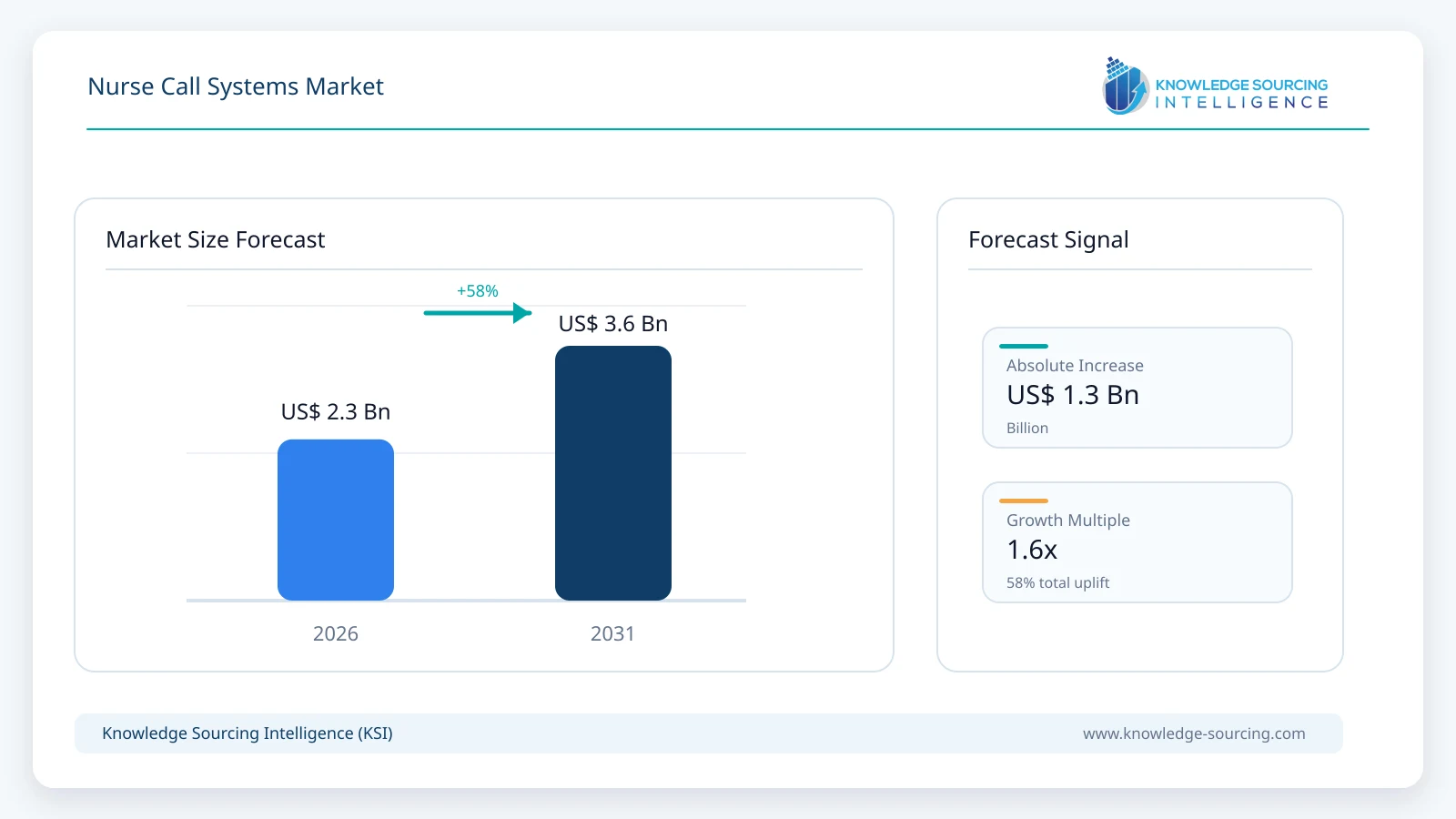
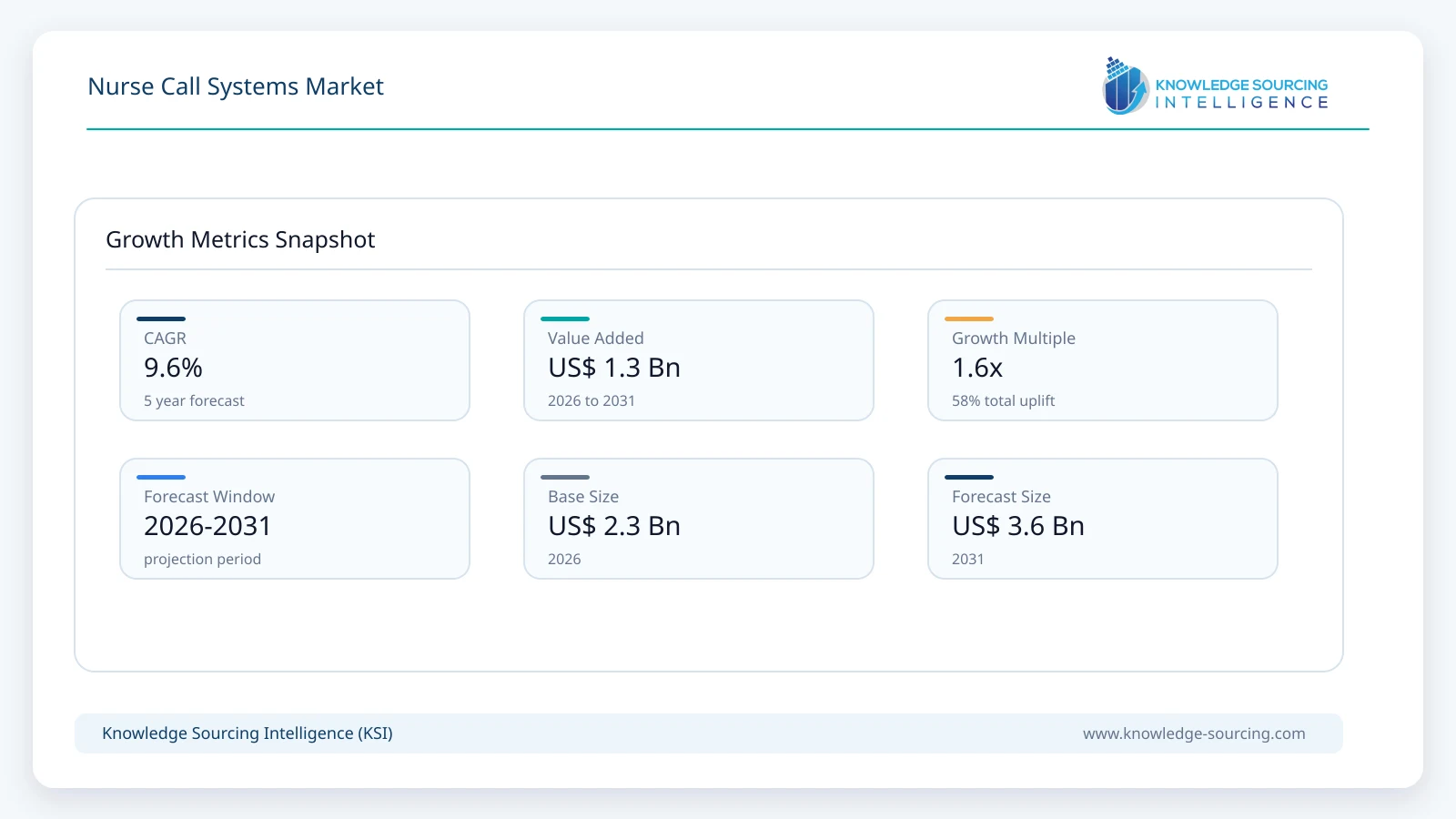
The nurse call systems market is projected to expand at a 9.6% CAGR, attaining USD 3.65 billion in 2031 from USD 2.31 billion in 2026.
Highlights:
- 1Rising hospital communication requirements are accelerating the adoption of integrated nurse call platforms.
- 2Patient safety initiatives are increasing investment in alarm management and fall-prevention systems.
- 3Digital and mobile nurse call solutions are replacing standalone audio-visual systems.
- 4Workforce shortages are driving demand for workflow optimization and staff productivity tools.
- 5Hospital modernization programs are expanding the deployment of interoperable communication infrastructure.
Demand is closely linked to healthcare facility modernization, rising patient acuity levels, workforce constraints, and increasing expectations for care quality. Hospitals, long-term care facilities, nursing homes, assisted living centers, and ambulatory care providers are under pressure to improve response times while managing staffing shortages and rising operational costs. Nurse call platforms are therefore being evaluated not only as communication systems but also as tools that support care coordination, patient safety, and workforce productivity.
Procurement decisions have become more complex than in previous generations of nurse call technology. Buyers increasingly assess interoperability with electronic medical records, integration with patient monitoring systems, mobile device compatibility, cybersecurity safeguards, alarm management capabilities, and vendor service support. The purchasing process often involves clinical leadership, information technology departments, biomedical engineering teams, and facility management personnel rather than nursing departments alone.
Value creation across the market is distributed among hardware suppliers, communication software providers, integration specialists, healthcare information technology vendors, installation contractors, maintenance providers, and service organizations. As healthcare facilities seek to consolidate communication technologies, suppliers capable of providing integrated platforms are positioned to secure larger and longer-duration contracts than vendors offering standalone alert systems.
The market's commercial importance extends beyond direct equipment sales. Nurse call infrastructure influences patient satisfaction scores, caregiver productivity, risk management, staff retention, and regulatory compliance. These broader operational impacts increasingly shape purchasing decisions and are likely to remain central to investment strategies through the forecast period.
Key Market Indicators
Indicator | Latest Evidence | Commercial Meaning |
Global population aged 65+ | 771 million people (UN, 2022) | Expands demand for long-term care and assisted living communication systems. |
Global nursing workforce | Approximately 29 million nurses (WHO) | Workforce shortages increase demand for workflow-support technologies. |
U.S. hospitals | More than 6,000 hospitals (American Hospital Association) | Creates a large installed base requiring periodic communication-system upgrades. |
Global dementia cases | Over 55 million people (WHO) | Supports demand for wanderer control and monitoring applications. |
Healthcare digitalization programs | Ongoing investments across North America, Europe, and Asia-Pacific | Encourages integration of nurse call platforms with broader clinical systems. |
Key Indicator: The United Nations estimates that people aged 65 years and older numbered approximately 771 million globally in 2022.
Commercial Meaning: Ageing populations are increasing utilization of long-term care facilities, where continuous communication and monitoring systems are operational necessities.
Market Drivers
Expansion of hospital communication and patient safety requirements.
Hospitals increasingly rely on coordinated communication between patients, nurses, physicians, and support staff. Regulatory focus on patient outcomes, adverse event reduction, and care quality measurement has increased the importance of rapid clinical communication. Nurse call systems support faster response times and escalation procedures, particularly in acute care environments where delays can affect patient outcomes. Suppliers have responded by integrating alarm management, staff location tracking, and mobile communications into broader clinical workflow platforms.
Healthcare workforce shortages are increasing the demand for workflow optimization.
Healthcare providers across multiple regions continue to report shortages of nurses and clinical personnel. Limited staffing availability has increased interest in technologies that improve workforce productivity without compromising patient care. Modern nurse call systems help prioritize alerts, automate routing, reduce unnecessary room visits, and improve staff coordination. This operational benefit has become an important procurement consideration for hospitals managing labor costs and staffing constraints.
Growing adoption of digital and mobile communication platforms.
Healthcare organizations are replacing legacy wired systems with mobile-enabled communication environments. Smartphones, wearable devices, wireless communication tools, and integrated clinical messaging applications allow caregivers to receive and respond to alerts regardless of location within a facility. Vendors such as Ascom and Hillrom have expanded investments in mobile workflow communication platforms to address demand for real-time clinical coordination and greater operational flexibility.
Increasing investment in long-term care and assisted living infrastructure.
Ageing populations continue to increase demand for nursing homes, assisted living centers, rehabilitation facilities, and long-term care institutions. These facilities require communication systems that support emergency alerts, fall detection, resident monitoring, and caregiver coordination. The expansion of long-term care infrastructure across developed economies is creating recurring demand for both new installations and replacement projects.
Integration of nurse call systems with broader healthcare technology ecosystems.
Healthcare facilities increasingly seek interoperability between communication systems, patient monitoring devices, electronic health records, building management systems, and clinical workflow applications. Procurement teams increasingly favor vendors capable of supporting integrated environments rather than standalone products. This trend is encouraging suppliers to invest in software development, interoperability standards, and cloud-enabled service offerings.
Market Restraints and Challenges
Complex integration requirements within healthcare environments.
Healthcare facilities operate diverse technology environments consisting of electronic medical records, monitoring equipment, communication platforms, and facility management systems. Integrating nurse call solutions with existing infrastructure often requires customization, testing, and validation. Implementation complexity can increase deployment timelines and project costs, particularly in large hospital networks.
High replacement and installation costs for legacy facilities.
Many healthcare facilities continue to operate with older communication infrastructure. Replacing these systems frequently requires cabling upgrades, software migration, network improvements, staff training, and operational disruption. Budget limitations can delay procurement decisions, particularly among smaller hospitals and long-term care facilities.
Cybersecurity and data protection requirements.
As nurse call systems become increasingly connected, healthcare providers face greater cybersecurity obligations. Communication platforms may transmit patient-related information and interact with clinical systems. Healthcare organizations therefore require vendors to support secure architectures, software updates, user authentication controls, and compliance with regional privacy regulations. These requirements increase development costs and extend product qualification processes.
Lengthy healthcare procurement and approval cycles.
Purchasing decisions for clinical communication infrastructure often involve multiple stakeholders, including clinical leadership, information technology departments, biomedical engineering teams, procurement groups, and facility managers. The resulting evaluation process can extend sales cycles and delay revenue realization for suppliers.
Interoperability limitations across legacy equipment.
Many hospitals operate equipment from multiple vendors installed over several decades. Compatibility challenges between older systems and modern communication platforms may restrict functionality or require additional integration investment. Suppliers must therefore maintain support for diverse hardware environments while continuing to develop new capabilities.
Major Segment Analysis
Hospitals
Hospitals represent the most commercially important end-user segment within the nurse call systems market. Acute care facilities operate complex communication environments where rapid information exchange directly influences patient outcomes, staff efficiency, and operational performance. Communication failures can affect clinical workflows, emergency response times, and patient satisfaction metrics, making nurse call infrastructure a critical operational requirement.
Purchasing decisions within hospitals increasingly prioritize integration capabilities rather than basic call functionality. Healthcare providers seek systems that connect bedside communication, mobile devices, patient monitoring equipment, alarm management platforms, and electronic health records. Procurement teams evaluate interoperability, cybersecurity, scalability, maintenance requirements, and workflow optimization features alongside hardware performance.
Hospital buyers also place greater emphasis on staff productivity and workforce management. Nurse shortages have increased demand for intelligent alert routing, automated escalation procedures, and mobile communication tools that reduce unnecessary staff movement. Suppliers that demonstrate measurable improvements in response times and workflow efficiency are often better positioned in competitive procurement processes.
Compared with physician offices and outpatient facilities, hospitals typically require larger-scale deployments, more extensive integration capabilities, and higher service support levels. As a result, hospital projects often generate greater revenue opportunities through software licensing, implementation services, maintenance contracts, and future system upgrades.
Regional Analysis
Region | Main Demand Signal | Principal Constraint |
North America | Hospital modernization and patient safety initiatives | High implementation costs |
Europe | Ageing populations and healthcare digitization | Budget pressures within public healthcare systems |
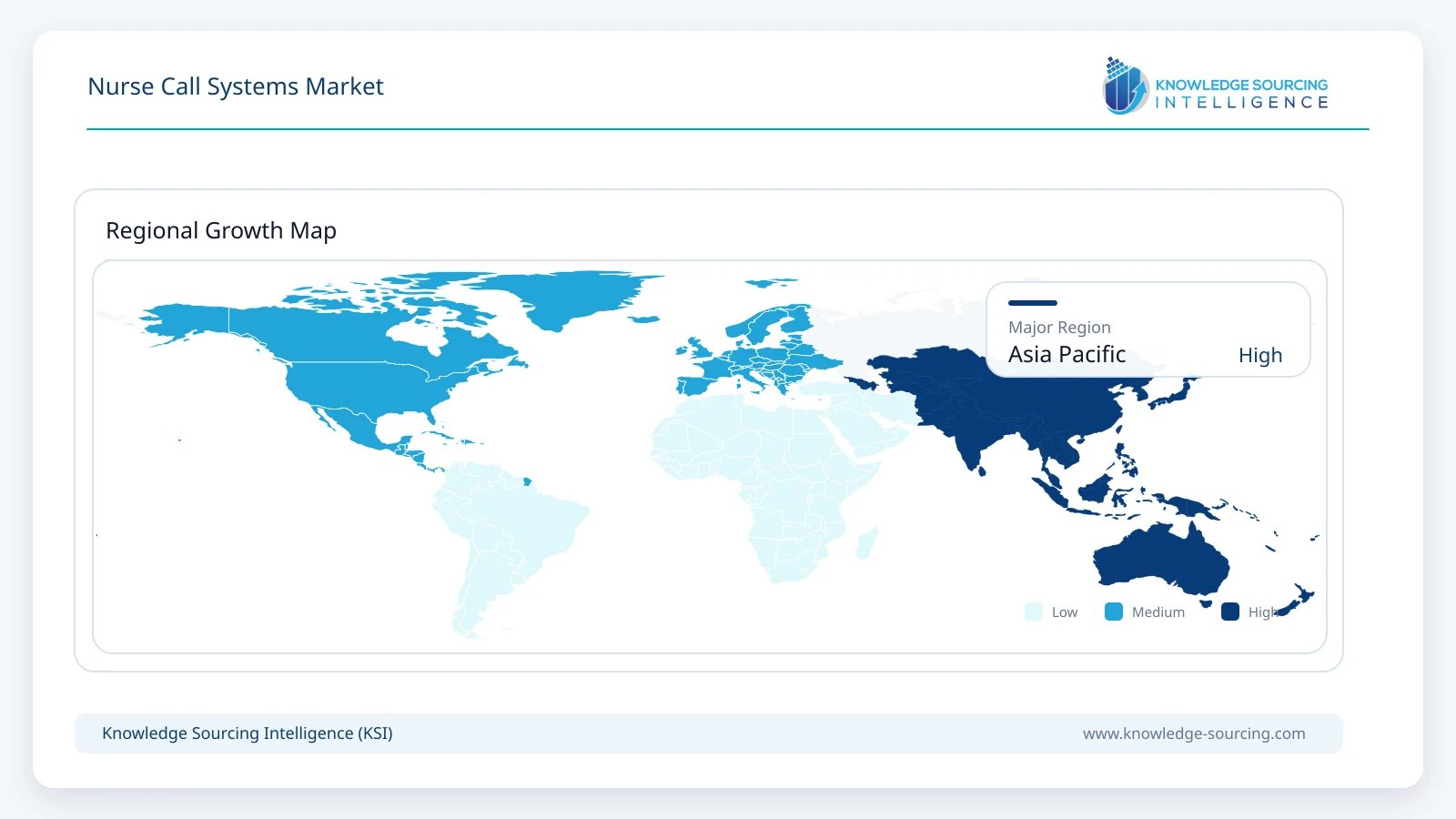
Asia Pacific | Healthcare infrastructure expansion and rising hospital capacity | Uneven digital maturity across markets |
Middle East and Africa | New healthcare facility development | Variable technology adoption levels |
South America | Public and private healthcare investment | Economic and budget volatility |
North America
North America remains an important market for nurse call systems due to extensive healthcare infrastructure, high technology adoption rates, and ongoing hospital modernization programs. The United States accounts for the largest share of regional demand, supported by investments in digital health infrastructure, patient safety initiatives, and workflow management technologies. Healthcare providers increasingly seek integrated communication platforms capable of supporting enterprise-wide clinical coordination.
Europe
European demand is supported by ageing populations, healthcare digitization initiatives, and long-term care expansion. Countries including Germany, France, and the United Kingdom continue to invest in healthcare facility modernization. Public healthcare systems often prioritize patient safety, care quality, and operational efficiency, creating demand for advanced communication platforms. Procurement processes can be lengthy due to public-sector purchasing requirements.
Asia Pacific
Asia Pacific is benefiting from healthcare infrastructure expansion, increasing hospital construction activity, and growing healthcare expenditure. China, India, Japan, and South Korea represent key markets. Demand is supported by both new facility construction and modernization of existing healthcare infrastructure. The region also presents opportunities for mobile-enabled communication systems due to expanding digital health adoption.
Middle East and Africa
Healthcare infrastructure investment programs in Gulf Cooperation Council countries continue to support market development. New hospital projects and healthcare modernization initiatives are increasing demand for integrated communication platforms. Adoption rates vary across the region, reflecting differences in healthcare spending, facility modernization, and technology readiness.
South America
Brazil represents the largest regional market due to its healthcare infrastructure base and ongoing investment in hospital modernization. Private healthcare providers increasingly seek technologies that improve operational efficiency and patient care quality. Economic volatility and public-sector budget limitations may affect procurement activity in certain countries.
Competitive Landscape
The nurse call systems market demonstrates characteristics of a technology-driven and service-intensive competitive environment. Product functionality remains important, but purchasing decisions increasingly depend on integration capability, software support, interoperability, implementation expertise, and long-term service delivery.
Ascom and Hillrom maintain strong positions through broad healthcare communication portfolios that combine nurse call functionality with mobile workflow management, clinical communication, and alarm management capabilities. Their strategies increasingly emphasize integrated healthcare communication ecosystems rather than standalone hardware offerings.
Jeron Electronic Systems, Intercall Systems, and Schrack Seconet compete through specialized healthcare communication expertise and tailored deployment capabilities. These suppliers often focus on healthcare-specific requirements, customization options, and facility-level implementation support.
Johnson Controls benefits from its broader building technologies presence, enabling integration between healthcare communication infrastructure and facility management systems. This approach appeals to healthcare organizations seeking operational convergence across clinical and building environments.
Vigil Health Solutions maintains a strong focus on senior care, assisted living, and long-term care applications. Its specialization aligns with increasing demand for resident monitoring, fall prevention, and caregiver communication solutions within ageing-care environments.
Barriers to entry remain moderate to high. New participants must demonstrate healthcare-specific expertise, interoperability capabilities, regulatory compliance, implementation support capacity, and long-term service reliability. Established vendor relationships and integration requirements can create switching costs for healthcare providers, particularly in large hospital environments.
Recent Developments
March 2026: Ascom reported a record-breaking 2025 with CHF 292 million in revenue, largely attributed to a massive contract with a major Canadian healthcare provider for their Telligence 7 platform.
October 2025: Ascom, in partnership with Dräger and B. Braun, announced the launch of the Silent ICU solution, introduced at the ESICM LIVES 2025 Congress in Munich.
October 2025: Ascom enhanced its integration with the Epic Rover app following the launch of new in-camera barcode scanning functionality within its Myco 4 Slim smartphone.
August 2025: Ascom and AvaSure signed a multi-year Interoperability Partner Agreement to integrate AvaSure's Virtual Care Platform with Ascom's Healthcare Platform suite and Myco devices.
March 2025: Baxter/Hill-Rom launched the Voalte Linq, a wearable voice-activated device that integrates with the Voalte Nurse Call system, enabling hands-free communication for clinicians in sterile environments.
Regulatory and Policy Environment
Healthcare communication systems operate within a regulatory environment focused on patient safety, privacy protection, medical device requirements, cybersecurity, and healthcare quality standards. Regulatory frameworks vary across jurisdictions, but most healthcare providers require communication systems capable of supporting compliance obligations while maintaining operational reliability.
Data protection requirements continue to influence product development priorities. Healthcare organizations increasingly require secure communication channels, access controls, audit capabilities, and software update processes that align with privacy regulations. Vendors must therefore allocate resources toward cybersecurity and compliance functions alongside product innovation.
Hospital accreditation standards and patient safety programs also influence purchasing behavior. Communication technologies that support response time management, alarm escalation, clinical coordination, and incident reduction can strengthen the business case for nurse call system investments.
Government-supported healthcare infrastructure programs across the Asia Pacific, the Middle East, and selected European markets are creating opportunities for new installations. Public-sector procurement processes often emphasize interoperability, long-term support capability, and compliance with healthcare technology standards.
Outlook and Strategic Implications
Demand during the forecast period is expected to be shaped by healthcare workforce constraints, ageing populations, hospital modernization programs, and increasing reliance on connected clinical communication environments. Procurement priorities are likely to continue shifting toward integrated platforms that combine nurse call functionality with workflow management, mobility, and data-driven operational support.
Several strategic themes are expected to influence market performance:
Healthcare providers will increasingly evaluate communication systems based on workflow outcomes rather than hardware specifications alone.
Integration capabilities will become a more important competitive differentiator than standalone communication functionality.
Long-term care facilities will remain an important source of demand as ageing populations increase care requirements.
Mobile-enabled communication platforms will continue replacing traditional fixed-location systems.
Cybersecurity, interoperability, and software support capabilities will gain importance in procurement evaluations.
For suppliers, future growth opportunities are likely to depend on software capabilities, service delivery, integration expertise, and long-term customer support rather than hardware differentiation alone. Companies that align communication technologies with broader healthcare workflow requirements are expected to strengthen their competitive position as healthcare organizations pursue greater operational efficiency and patient safety performance.
Nurse Call Systems Market Scope:
| Report Metric | Details |
|---|---|
| Total Market Size in 2026 | USD 2.31 billion |
| Total Market Size in 2031 | USD 3.65 billion |
| Forecast Unit | Billion |
| Growth Rate | 9.6% |
| Study Period | 2021 to 2031 |
| Historical Data | 2021 to 2024 |
| Base Year | 2025 |
| Forecast Period | 2026 – 2031 |
| Segmentation | Type, Application, End User, Geography |
| Companies |
|
Market Segmentation
By Type
By Application
By End-user
By Geography
Table of Contents
1. EXECUTIVE SUMMARY
2. MARKET SNAPSHOT
2.1. Market Overview
2.2. Market Definition
2.3. Scope of the Study
2.4. Market Segmentation
3. BUSINESS LANDSCAPE
3.1. Market Drivers
3.2. Market Restraints
3.3. Market Opportunities
3.4. Porter’s Five Forces Analysis
3.5. Industry Value Chain Analysis
3.6. Policies and Regulations
3.7. Strategic Recommendations
4. TECHNOLOGICAL OUTLOOK
5. NURSE CALL SYSTEMS MARKET BY TYPE
5.1. Introduction
5.2. Intercom Systems
5.3. Button-Based Systems
5.4. Integrated Communication Systems
5.5. Digital And Mobile Nurse Call Systems
5.6. Basic Audio/Visual Nurse Call Systems
5.7. Others
6. NURSE CALL SYSTEMS MARKET BY APPLICATION
6.1. Introduction
6.2. Alarms and Communications
6.3. Workflow Optimization
6.4. Wanderer Control
6.5. Fall Detection and Prevention
6.6. Visitor Management
7. NURSE CALL SYSTEMS MARKET BY END-USER
7.1. Introduction
7.2. Hospitals
7.3. Ambulatory Surgery Centers
7.4. Long-Term Care Facilities
7.5. Physician Offices
7.6. Medical Assisted Living Centers
7.7. Nursing Homes
7.8. Out Patient Departments
7.9. Others
8. NURSE CALL SYSTEMS MARKET BY GEOGRAPHY
8.1. Introduction
8.2. North America
8.2.1. USA
8.2.2. Canada
8.2.3. Mexico
8.3. South America
8.3.1. Brazil
8.3.2. Argentina
8.3.3. Others
8.4. Europe
8.4.1. Germany
8.4.2. France
8.4.3. United Kingdom
8.4.4. Spain
8.4.5. Others
8.5. Middle East and Africa
8.5.1. Saudi Arabia
8.5.2. UAE
8.5.3. Others
8.6. Asia Pacific
8.6.1. China
8.6.2. India
8.6.3. Japan
8.6.4. South Korea
8.6.5. Indonesia
8.6.6. Thailand
8.6.7. Others
9. COMPETITIVE ENVIRONMENT AND ANALYSIS
9.1. Major Players and Strategy Analysis
9.2. Market Share Analysis
9.3. Mergers, Acquisitions, Agreements, and Collaborations
9.4. Competitive Dashboard
10. COMPANY PROFILES
10.1. Hill-Rom Services Inc.
10.2. Ascom
10.3. Jeron Electronics Systems Inc.
10.4. Johnson Control
10.5. Vigil Health Solutions Inc.
10.6. Schrack Seconet AG
10.7. Intercall Systems Inc
11. APPENDIX
11.1. Currency
11.2. Assumptions
11.3. Base and Forecast Years Timeline
11.4. Key benefits for the stakeholders
11.5. Research Methodology
11.6. Abbreviations
Navigate
Trusted by the world's leading organizations











