
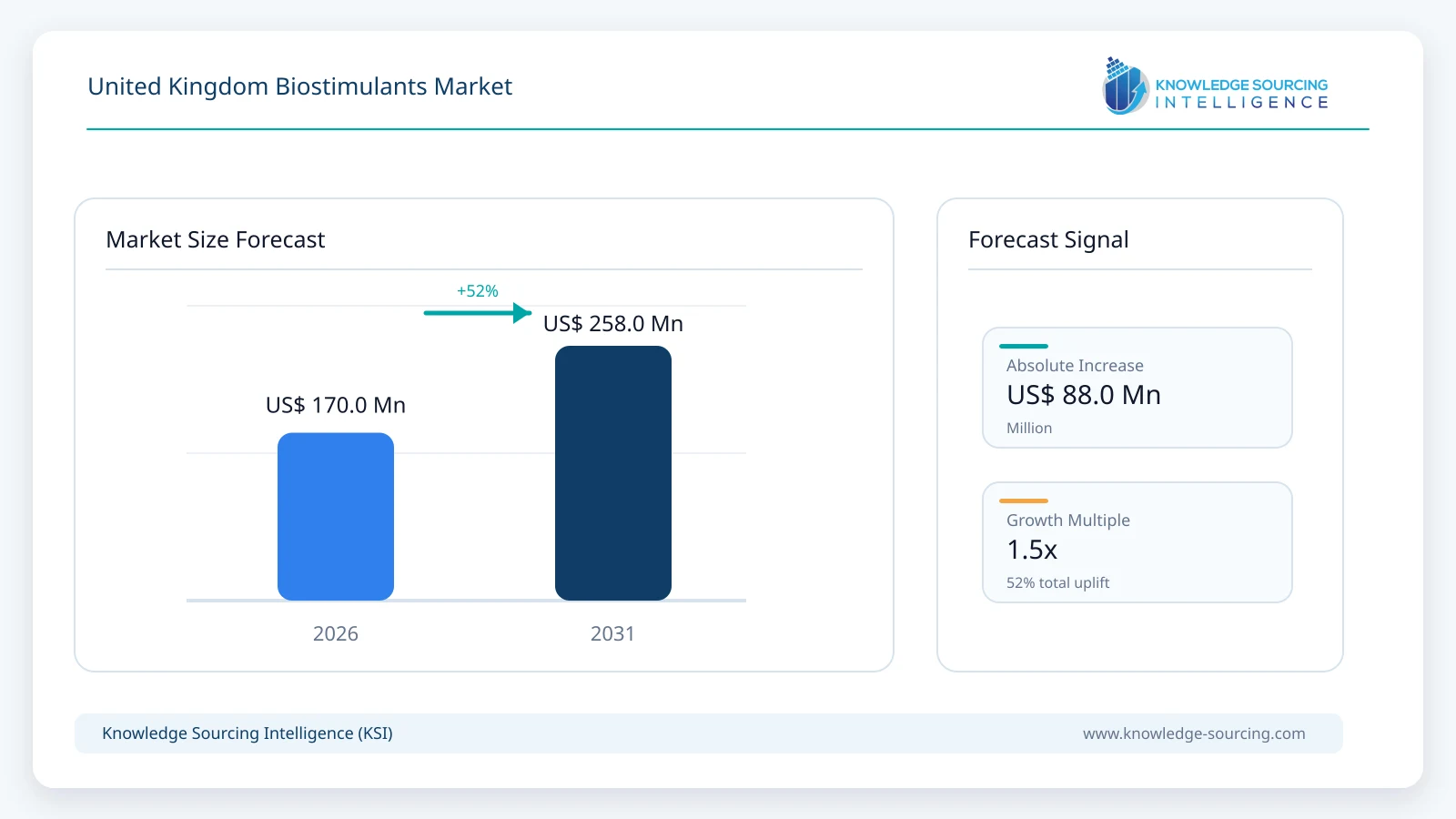
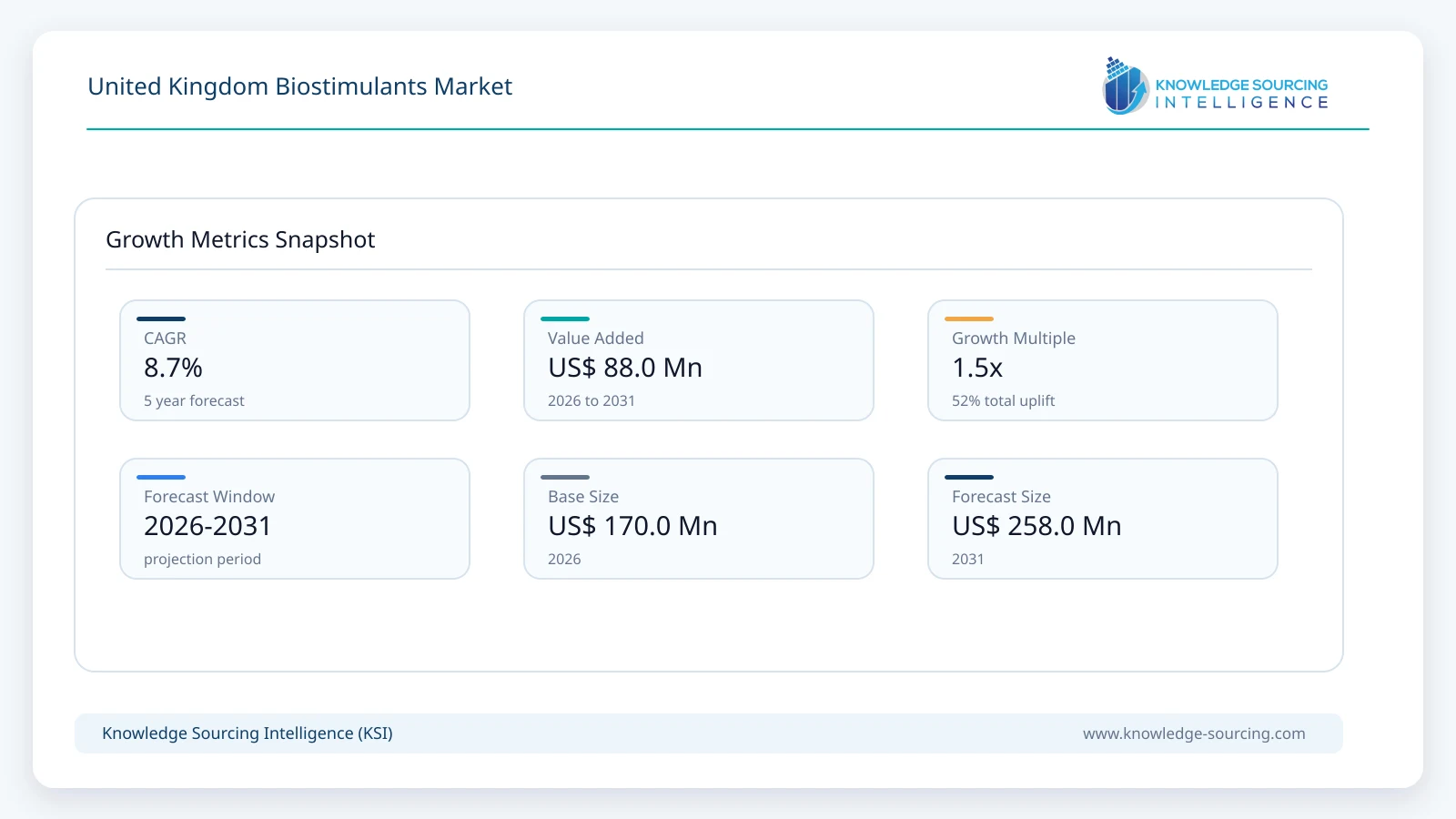
The United Kingdom biostimulants market is forecast to grow at a CAGR of 8.7%, increasing from around USD 170.0 million in 2026 to USD 258.0 million in 2031.
Highlights:
- 1Extract biostimulants account for approximately 64% of United Kingdom market value in 2026, supported by established use of seaweed extracts, amino-acid formulations and other plant-derived products.
- 2Row crops account for approximately 46% of market value in 2026, reflecting the scale of wheat, barley, oilseed and other broadacre cropping systems.
- 3Foliar application represents approximately 59% of market value in 2026 because it allows biostimulants to be incorporated relatively easily into existing crop-spraying programmes.
- 4Microbial nitrogen-fixing and nutrient-efficiency products are expected to outpace the broader market as suppliers expand biological seed-treatment and foliar solutions for cereals.
- 5UK organic farmland increased 7.3% in 2025 to 540 thousand hectares, while land undergoing organic conversion increased 63%, widening the addressable base for biological crop-input technologies.
The market includes non-microbial and microbial products applied to seeds, foliage, soil or the rhizosphere to improve nutrient-use efficiency, tolerance to abiotic stress, crop quality or the availability of nutrients without functioning primarily as conventional fertilisers or pesticides. HSE defines plant biostimulants around these functions and notes that claims made for a product are important in determining whether it instead falls within plant-protection-product regulation.
The addressable agricultural base remains substantial despite fluctuations in individual crop areas. UK utilised agricultural area reached approximately 17 million hectares in 2025, equivalent to 69% of the country’s land area, while 6.1 million hectares were classified as croppable and cereal crops occupied approximately 3.0 million hectares. Wheat alone covered around 1.7 million hectares. These large arable areas provide a substantial potential market for foliar, soil and seed-applied biostimulants where growers can demonstrate reliable agronomic and economic returns.
Biostimulants occupy an increasingly distinct position between conventional crop nutrition and crop protection. Their commercial role is primarily to improve how plants use available nutrients, establish roots, tolerate environmental stress or maintain physiological performance rather than supplying large quantities of nutrients directly. The UK market includes seaweed extracts, humic and fulvic substances, amino acids, microbial inoculants and other biological or naturally derived formulations. Seaweed products have a particularly established commercial position, with Syngenta currently marketing several Maxicrop formulations in the UK for rooting, establishment, nutrient uptake and stress management, while its biological portfolio also includes microbial nitrogen-fixing products such as NUVENIO, VIXERAN and NUELLO iN.
Domestic formulation and development capabilities are also strengthening. Yara’s Pocklington operation has long served as a global center for YaraVita foliar micronutrient products and analytical services, while the company is developing a significantly larger UK production facility for specialty crop nutrition and biostimulant products. The project was originally expected to double Yara’s production capacity, with most output intended for export, and company updates in 2025 indicated completion had shifted into 2026. OMEX similarly develops and manufactures biostimulant and crop-nutrition products in the UK and in January 2026 refreshed its Fortiflo range to place greater emphasis on nutrient efficiency and sustainable crop production.
Market Trends
Microbial Nitrogen-Fixing Products Are Moving Into Mainstream Arable Programs
Microbial biostimulants are becoming more commercially important as suppliers target one of the largest cost and environmental issues in UK arable farming: nitrogen use. Syngenta’s NUELLO iN biological seed treatment contains nitrogen-fixing endophytic bacteria and is marketed for cereal use, with company trials indicating an agronomic nitrogen effect equivalent to as much as 30 kg N/ha under suitable conditions. The company has also expanded its UK portfolio with NUVENIO and VIXERAN, both based on Azotobacter salinestris, which colonises leaves and roots and converts atmospheric nitrogen into plant-available forms. These products represent a shift away from biostimulants being marketed predominantly as general plant-vigour products toward formulations associated with measurable nutrient-efficiency objectives. Adoption is likely to remain strongly dependent on local trial performance, application timing and crop economics, but nutrient-related biologicals have a particularly large potential addressable area because UK cereals occupied around 3.0 million hectares in 2025.
Seaweed and Extract-Based Products Retain a Strong Commercial Position
Extract biostimulants remain the largest category because seaweed-based formulations already have widespread commercial availability and can be incorporated into conventional foliar and soil-treatment programmes with comparatively limited changes to farm operations. Syngenta markets Maxicrop Original, Maxicrop Concentrate, Maxicrop Triple and related products in the UK, while OMEX uses biological extracts and specialist formulations across its crop-establishment and horticultural ranges. Seaweed-based products are used principally to support rooting, establishment, nutrient uptake and tolerance to environmental stress rather than replace fertiliser outright. Their position is strengthened by comparatively broad crop applicability, covering cereals, horticulture, fruit, vegetables and turf. The category is also benefiting from greater emphasis on measurable agronomic outcomes and combinations of biostimulants with micronutrients or conventional crop-nutrition products, allowing suppliers to position these formulations as part of integrated crop-management programmes rather than as standalone biological inputs.
Regulation Is Moving Toward a More Defined UK Framework
The UK biostimulant industry currently operates without a dedicated regulatory framework equivalent to the EU Fertilising Products Regulation, creating uncertainty around classification, efficacy claims and market access. HSE states that whether a biostimulant falls within plant-protection legislation can depend on the claims made and its effects, while Defra is considering broader approaches to fertilisers and plant biostimulants. In March 2026, the UK government launched a consultation on reforming fertilising-product regulation, receiving 83 responses before the consultation closed in June. Defra’s supporting material explicitly acknowledged that plant biostimulants do not currently have a specific UK regulatory framework. A clearer system could raise documentation and testing requirements for suppliers, but it could also improve buyer confidence by creating more consistent definitions and evidence standards. Regulatory reform is therefore likely to become one of the most important structural changes affecting the market during the forecast period.
Market Drivers
Pressure to Improve Nutrient-Use Efficiency
UK agriculture is under continuing pressure to maintain output while reducing nutrient losses and using fertilisers more efficiently. Government agricultural statistics show that average nitrogen fertiliser application rates declined to 73 kg/ha in 2024, while phosphate application remained at a historically low 10 kg/ha. These conditions increase interest in technologies that can improve nutrient acquisition or maintain crop performance when fertiliser input is constrained. Biostimulants are particularly relevant where they can demonstrate measurable improvements in rooting, nutrient uptake or biological nitrogen availability. Syngenta’s NUELLO iN is marketed with an effect equivalent to up to 30 kg N/ha in company trials, while several seaweed- and amino-acid-based products target nutrient transport and root development. The commercial opportunity is not based on eliminating conventional fertiliser but on increasing output per unit of nutrient applied, which aligns closely with farm economics and the UK policy direction toward sustainable nutrient management.
Expansion of Organic and Lower-Input Farming
Organic farming provides a relatively concentrated market for biological inputs because permitted crop-management options are more restricted and growers place greater emphasis on soil health, biological activity and nutrient cycling. UK organic land increased 7.3% in 2025 to 540 thousand hectares, while land undergoing conversion rose 63% to 79 thousand hectares. The conversion area represented 15% of all UK organic land, indicating potential for further expansion of the fully organic production base. Although permanent pasture accounts for most organic land, the sector also included around 50 thousand hectares of cereals, 10 thousand hectares of vegetables and potatoes and growing areas of fruit and nuts. England’s Sustainable Farming Incentive is separately encouraging soil-health, nutrient-management, integrated-pest-management, organic and precision-farming activities, broadening interest in lower-input agronomic practices beyond formally certified organic farms. These trends provide a supportive environment for biological crop inputs where suppliers can demonstrate consistent field performance.
Abiotic Stress Is Increasing the Value of Crop-Resilience Products
Biostimulants are increasingly being positioned around crop resilience because irregular rainfall, heat, cold, establishment problems and nutrient stress can reduce yield even where conventional fertilisation is adequate. This is particularly relevant to UK arable systems where autumn establishment, winter conditions and variable spring rainfall can materially affect wheat, barley and oilseed rape performance. AHDB notes that interest in biostimulants has increased alongside fertiliser pressures and more frequent extreme-weather challenges, with seaweed extracts, humic substances, phosphites and plant-growth-promoting bacteria among the product groups showing evidence of yield benefits in at least some cereal experiments. Commercial suppliers are consequently developing products specifically around establishment and stress periods. OMEX’s Kickstart, for example, targets cereals, oilseed rape and sugar beet where cold soils, delayed drilling or poor growing conditions can restrict root development. The market opportunity is therefore strongest where biostimulants address identifiable agronomic stress rather than being applied as routine insurance.
Market Restraints
Field Performance Remains Inconsistent Across Products and Conditions
The largest commercial restraint is variability in field performance. AHDB’s assessment of biostimulants for cereals and oilseeds found evidence of statistically significant yield increases for several categories but also substantial differences between products and experiments. Seaweed extracts produced statistically significant cereal yield responses in three of seven reviewed experiments, while phosphite-related products did so in four of seventeen; plant-growth-promoting bacteria showed stronger evidence, with significant responses in thirteen of fifteen experiments. AHDB also noted that UK-specific field data remained limited and that evidence for oilseed rape was insufficient to draw firm conclusions. A broader European meta-analysis published in 2024 similarly found an average growth or yield increase of 9.3% across bio-effector treatments but reported substantial differences between crops and experimental environments. This variability makes return on investment less predictable and encourages growers to demand independent local trials before adopting higher-cost products at scale.
Regulatory Classification Remains Uncertain
The absence of a dedicated UK plant-biostimulant framework creates uncertainty for product developers and distributors because classification can depend on the claims made for a formulation. HSE states that products intended to influence plant life processes may fall under plant-protection-product legislation depending on their effect, while products meeting the narrower biostimulant definition focus on nutrient-use efficiency, abiotic-stress tolerance, quality characteristics or nutrient availability. Manufacturers are advised to contact HSE if classification is uncertain. Defra’s 2026 fertiliser-regulation consultation acknowledges that the UK currently lacks specific plant-biostimulant regulation and is considering a broader UK Fertiliser Product Regulation. Regulatory reform could ultimately strengthen the industry, but during the transition it creates uncertainty around future evidence standards, labelling, product categories and compliance costs, particularly for smaller suppliers entering the market with microbial or novel biological formulations.
Segment Analysis
By Active Ingredient: Extract Biostimulants
Extract biostimulants represent the largest active-ingredient category because seaweed, plant extracts, amino acids and related formulations have been commercially available for longer than many microbial alternatives and are used across a broad range of crops. The segment is projected to reach approximately USD 170 million by 2031, growing at around 9.3% annually from 2026. Seaweed-based products retain a particularly strong position because they can be used through foliar, soil and fertigation programmes and are marketed for rooting, crop establishment, nutrient uptake and tolerance to environmental stress. Syngenta’s Maxicrop portfolio provides multiple seaweed formulations for UK growers, while OMEX and other domestic suppliers incorporate extract-based technologies into crop-establishment and horticultural products. The segment’s continued growth will increasingly depend on suppliers supporting claims with replicated field trials and demonstrating measurable economic benefits, particularly as microbial nitrogen-fixing products compete for a larger share of new biological-input expenditure.
By Crop Type: Row Crops
Row crops represent the largest crop category due primarily to the scale of cereals and other broadacre production. The segment is projected to reach approximately USD 116 million by 2031, supported by biostimulant use in wheat, barley, oilseed rape, sugar beet and other arable crops. UK cereals occupied around 3.0 million hectares in 2025, including approximately 1.7 million hectares of wheat and 1.1 million hectares of barley, creating a substantially larger potential treated area than specialist fruit, vegetable or ornamental crops. The commercial challenge is that margins per hectare are lower than in high-value horticulture, making clear return on investment particularly important. This favors seed treatments, low-dose microbial products and foliar formulations that can be tank-mixed with existing crop-protection or nutrition applications. Syngenta’s NUELLO iN targets cereal seed treatment specifically, while OMEX markets biostimulant products for cereal establishment and stress management, indicating growing supplier focus on broadacre adoption.
By Application: Foliar
Foliar application remains the leading route because it can be integrated into existing spraying programmes and allows growers to target particular crop-development or stress periods without requiring separate soil-application equipment. The segment is projected to reach approximately USD 158 million by 2031, representing growth of around 9.5% annually from 2026. Foliar use is particularly established for seaweed extracts, amino acids, micronutrient-biostimulant combinations and newer microbial products capable of colonising leaf and root tissues. Syngenta’s VIXERAN and NUVENIO, for example, are designed for foliar application with recommendations covering water volume, crop-growth conditions and compatibility with other crop inputs. Foliar application also benefits from comparatively low operational barriers because products can often be added to planned crop-protection or nutrition passes, reducing incremental application cost. Seed treatment is expected to gain share in cereals, particularly for microbial products, but foliar programmes remain the largest value pool through 2031.
Competitive Environment and Analysis
The UK biostimulants market combines large multinational crop-input companies with specialist biological-product developers and domestic crop-nutrition manufacturers. Syngenta has expanded its biological portfolio through Valagro technologies and currently markets multiple seaweed and microbial products to UK growers, while Yara combines specialty crop nutrition, biostimulants and analytical services with an expanding domestic production footprint. OMEX maintains a strong UK manufacturing and agronomy position and refreshed its Fortiflo crop-nutrition and biostimulant range in January 2026. Other important participants include ICL Growing Solutions, UPL, BASF, Rovensa Next, Koppert, BioAtlantis, Bionema, Micromix Plant Health and Hello Nature. Competition is increasingly moving away from broad claims around plant vigour toward evidence relating to nutrient-use efficiency, stress tolerance, nitrogen contribution and yield response. Companies with UK field trials, agronomy teams and established distributor relationships hold an advantage because variable product performance makes independent validation and correct application timing central to purchasing decisions.
Market Share Analysis
The UK market remains fragmented, with no single supplier controlling all major biostimulant technologies or crop categories. Syngenta has one of the broadest commercial portfolios following its expansion in seaweed-derived and microbial biological products, while Yara and OMEX benefit from established UK crop-nutrition distribution and domestic production capabilities. Yara’s expansion is strategically important because its planned facility is intended to double production capacity for YaraVita specialty crop-nutrition and biostimulant products, although most output is aimed at international markets rather than UK consumption alone. Specialist companies compete through narrower biological technologies and crop-specific products, while larger fertiliser and crop-protection groups can bundle biostimulants with existing agronomy, nutrition and crop-protection programmes. Market share is therefore influenced not only by product efficacy but also by agronomic support, distribution coverage, field evidence and the ability to integrate products into established spray and fertiliser schedules. Microbial products are expected to increase competitive intensity as biological nitrogen fixation and nutrient-efficiency technologies move into mainstream cereal programmes.
Recent Developments
July 2026: Syngenta updated its UK NUELLO iN biological seed-treatment offering, highlighting nitrogen-fixing endophytic bacteria for cereals and trial effects equivalent to up to 30 kg N/ha.
June 2026: ICL continued expanding its biological crop-input portfolio and highlighted biostimulants as an increasingly established agronomic management tool alongside nutrient-efficiency technologies.
April 2026: Syngenta updated its UK NUVENIO, VIXERAN and NIENTRIS biological products based on nitrogen-fixing microorganisms for foliar and root colonisation.
March 2026: Defra launched consultation on a new UK fertilising-products regulatory framework, including consideration of plant biostimulants; the consultation received 83 responses before closing in June.
January 2026: OMEX Agriculture refreshed its Fortiflo range of crop-nutrition products, including biostimulants and fertiliser additives aimed at improving nutrient efficiency and supporting lower-emission farming.
October 2025: Yara completed a major expansion of its Pocklington soil-analysis laboratory, doubling analytical capacity to support soil-health and regenerative-agriculture programmes.
Market Outlook
The United Kingdom biostimulants market is forecast to increase from approximately USD 170.0 million in 2026 to USD 258.0 million in 2031 at a CAGR of around 8.7%. Growth is expected to remain above that of many conventional crop-input categories because biostimulants are expanding from specialist horticultural and organic applications into mainstream arable programmes focused on nutrient efficiency, crop establishment and stress management. Extract-based products remain the largest category through 2031 because of their established commercial base, although microbial products are expected to capture an increasing share of new investment as nitrogen-fixing and nutrient-mobilising technologies gain wider field experience. Row crops provide the largest addressable area, supported by approximately 3.0 million hectares of UK cereals, while foliar treatments remain the principal application route because they can be incorporated relatively easily into existing spray programmes.
Market development will nevertheless depend on stronger evidence and regulatory clarity. AHDB’s reviews show meaningful agronomic potential but also considerable variability between products and trials, reinforcing the need for UK-specific field data and crop-management guidance. At the same time, Defra’s proposed fertilising-products reform could introduce a more consistent framework for definitions, claims and product quality. Suppliers able to combine validated agronomic performance with established distribution, technical support and clear product positioning are therefore expected to gain share as the market matures from a broad biological-input category into a more evidence-driven crop-management segment.
United Kingdom Biostimulants Market Scope
| Report Metric | Details |
|---|---|
| Total Market Size in 2026 | USD 170.0 million |
| Total Market Size in 2031 | USD 258.0 million |
| Forecast Unit | Million |
| Growth Rate | 8.7% |
| Study Period | 2021 to 2031 |
| Historical Data | 2021 to 2024 |
| Base Year | 2025 |
| Forecast Period | 2026 – 2031 |
| Segmentation | Active Ingredient, Crop Type, Application |
| Companies |
|
Market Segmentation
By Active Ingredient
Acidic Biostimulants
Extract Biostimulants
By Crop Type
Fruits
Vegetables
Turfs
Ornamentals
Row Crops
By Application
Foliar
Soil
Seed
Table of Contents
Table of Contents
1. INTRODUCTION
1.1. Market Overview
1.2. Market Definition
1.3. Scope of the Study
1.4. Market Segmentation
1.5. Currency
1.6. Assumptions
1.7. Base and Forecast Years
1.8. Key Benefits to Stakeholders
2. RESEARCH METHODOLOGY
2.1. Research Design
2.2. Secondary Research
2.3. Primary Research
2.4. Market Estimation
2.5. Segment Modelling
2.6. Data Triangulation and Validation
3. EXECUTIVE SUMMARY
3.1. Key Findings
3.2. United Kingdom Biostimulants Market Size, 2026-2031
3.3. Active Ingredient Outlook
3.4. Crop Type Outlook
3.5. Application Outlook
4. MARKET DYNAMICS
4.1. Market Drivers
4.1.1. Pressure to Improve Nutrient-Use Efficiency
4.1.2. Expansion of Organic and Lower-Input Farming
4.1.3. Increasing Need for Crop Resilience to Abiotic Stress
4.2. Market Restraints
4.2.1. Variable Field Performance Across Products and Conditions
4.2.2. Regulatory Classification and Evidence Requirements
4.3. Porter’s Five Forces Analysis
4.4. Industry Value Chain Analysis
4.5. Regulatory Environment
5. UNITED KINGDOM BIOSTIMULANTS MARKET BY ACTIVE INGREDIENT
5.1. Introduction
5.2. Acidic Biostimulants
5.3. Extract Biostimulants
6. UNITED KINGDOM BIOSTIMULANTS MARKET BY CROP TYPE
6.1. Introduction
6.2. Fruits
6.3. Vegetables
6.4. Turfs
6.5. Ornamentals
6.6. Row Crops
7. UNITED KINGDOM BIOSTIMULANTS MARKET BY APPLICATION
7.1. Introduction
7.2. Foliar
7.3. Soil
7.4. Seed
8. COMPETITIVE ENVIRONMENT AND ANALYSIS
8.1. Major Players and Strategy Analysis
8.2. Market Share Analysis
8.3. Mergers, Acquisitions, Agreements, and Collaborations
8.4. Competitive Dashboard
9. COMPANY PROFILES
9.1. Syngenta Biologicals
9.2. Yara International ASA
9.3. OMEX Agriculture Ltd.
9.4. ICL Growing Solutions
9.5. UPL Limited
9.6. BASF SE
9.7. Rovensa Next
9.8. Koppert
9.9. Bionema Group Ltd.
9.10. BioAtlantis Ltd.
9.11. Micromix Plant Health Ltd.
9.12. Hello Nature
9.13. FMC Corporation
9.14. Certis Belchim
9.15. Rovensa Next
10. APPENDIX
Navigate
Trusted by the world's leading organizations











