Introduction: Global carbon emissions are increasing at an unprecedented rate. According to the International Energy Agency, it has reached an all-time high of 36.8 gigatons. Industrial processes, transportation, electricity generation, manufacturing, and construction are the lar...

Biomethane in Detail:
-
What is Biomethane and how it is produced
- Biogas produced by anaerobic digestion of organic waste in an oxygen-free environment resulting in a mixture of 70-75% methane, 20-25% carbon dioxide, water, and some contaminants are upgraded by using various technologies to remove C02 and other contaminants. 90% of total biomethane can be produced through this method only.
- Biomethane is also produced through thermal gasification, where woody biomass is broken down at high temperatures and pressure. The resultant gas mixture is cleaned to remove any acidic and corrosive components, followed by a methanation process to produce methane.
-
Benefits offered by Biomethane
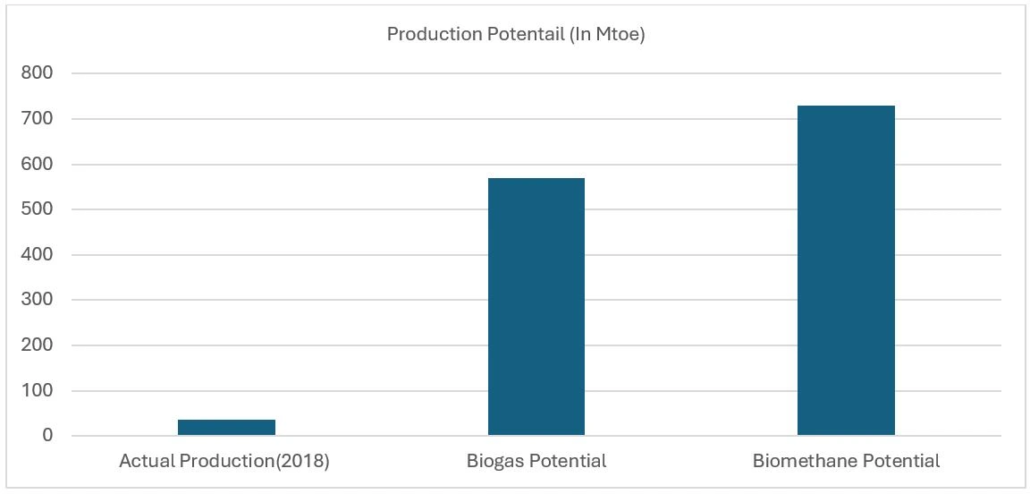 Source: International Energy Agency, World Energy Outlook Report
Biomethane in the Transport Sector
In 2019, direct greenhouse emissions from the transport sector were 8.7GtCO2 compared to 5.0GtCO2 in 1990. The transport sector is the 3rd largest contributor to CO2 emissions, accounting for 23% of global energy-related CO2 emissions. Biomethane is a green fuel that has huge potential to significantly reduce carbon emissions as it is a cleaner, renewable alternative to fossil fuels. Biomethane can be compressed to make Compressed Biomethane Gas (CBG), which can be used in vehicles in the same infrastructure as compressed natural gas. It can be used in trucks, buses, cars, and other things. These vehicles already have the infrastructure to run on compressed natural gas and can be easily converted to run on compressed biomethane gas. Further, biomethane gas requires distribution infrastructure, which can be done through dedicated retail filling stations, and fuelling stations of the gas grid can be used to offer natural gas blended with biomethane. As per the IPCC Sixth Assessment Report, out of the transport sector, 70% of carbon emissions are from road vehicles. Hence, a major chunk of transport decarbonization can happen using compressed biomethane gas. Using Biomethane in the transport sector has many benefits. It will have a very low carbon footprint when compared with equivalent fossils. It also has indirect environmental benefits like circular economy and waste management and can make the community self-reliant for their energy needs, reducing the energy gap. Taking Europe as an example, out of 343 million road vehicles, only 1.2 million ran on natural gas and biomethane together in 2014, which is only 0.7% of the total vehicle market. Road transport is still heavily dependent on fossil fuels. Biomethane has huge potential as an alternative fuel to reduce transport decarbonization for all world regions. There is a need to take policy measures to reduce carbon dioxide emissions in the transport sector. Thus, it is crucial to realize and utilize the valuable role that biomethane can play in decarbonizing the transport sector.Biomethane in Industry
Greenhouse gas emissions in the industrial sector are attributed to originate from fuel combustion, process emissions, product use, and waste. The industrial sector accounts for 14.1 gigatons of carbon dioxide as per the IPCC report of 2019. It is 24% of all the greenhouse gas produced. Biomethane can also play a significant role in the industry in the decarbonization process. It is a carbon-neutral gas that can be used interchangeably with traditional natural gas and can be distributed through the same infrastructure. Biomethane has numerous ways in which it can be used in industries, helping industries to have renewable and sustainable energy sources. Since it is carbon-neutral, it can significantly help industries, which is the 2nd largest contributor to greenhouse gas emissions. Biomethane can be used to generate heat and electricity for industrial processes. All industries, like boilers, require a lot of energy for their processes to run, and furnaces need fuel. Traditionally, they use coal and natural gas for their industrial applications. Biomethane can be used in place of these traditional sources. It can also be used as fuel to run heavy industrial vehicles and machinery such as tractors, cranes, etc. It can be used in steam production, particularly in pharmaceuticals, textiles, food, and beverage industries. It can also be used as an alternative to natural gas in the glass and ceramic industry. Since biomethane is a combustible gas, it can be used in industries in almost all places where traditional fuels are used. This will substantially reduce carbon emissions, as 50% of industrial sector emissions are due to direct fuel combustion. Usage of Biogas and Biomethane in Industry by different countries: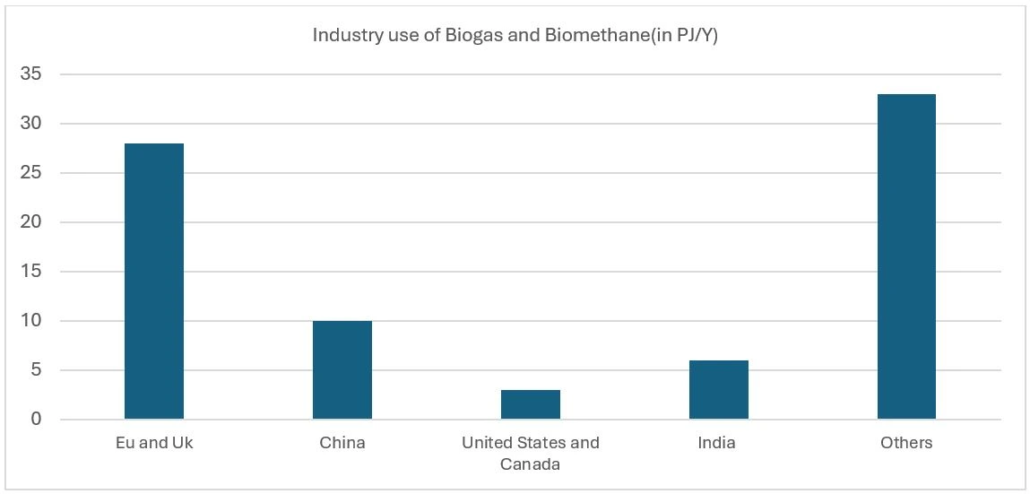 Source: International Energy Agency
Role Biomethane Can Play in Decarbonizing Transport and Industry in the Future
Currently, 35 Mtoe of biomethane are produced worldwide. The vast majority of biomethane production lies in the European and North American markets; still, biomethane represents 0.1% of natural gas demand. Thus, for now, biogas and biomethane are only a small part of overall bioenergy consumption, and in the transport and industry sectors, their consumption is too low. There is a range of technologies available for biogas production, like decentralized biodigesters that can be used in households, centralized biodigesters systems, existing wastewater treatment, and landfill gas recovery systems. In 2019, there was 15,19,650 TJ/Y global production of biogas, and in 2023, it reached 16,28,551 TJ/y of global production of biogas. This amount is insignificant compared to the benefits that biogas and biomethane can provide. Biomethane has huge potential to reduce carbon dioxide emissions. It can play a significant role in the transport and industry sectors to decarbonize it. Yet, it is not utilized to the extent that it can potentially disrupt greenhouse gas reduction. The major reason behind the low utilization of biomethane to decarbonize is strict measures and policies that are not implemented by governments. According to NGVA Europe’s estimates, about 3.3 million m3 of methane is used as transport fuel in Europe. According to the same report, biomethane can provide at least 20% of the total demand for gaseous transport fuel with the right infrastructure and incentives. This suggests that if the government passes and implements the right infrastructure and policies, biomethane has huge potential to reduce carbon dioxide emissions. Find some of our related studies:Need specialized data cuts or competitive intelligence?
Our analyst team provides bespoke market sizing, supplier audits, and country-level feasibility reports tailored to your enterprise roadmap.
Speak With an Industry Analyst →Ask an Industry Analyst
Have questions regarding this briefing or market projections? Inquire with our sector lead.
Related Blogs
View All →
How America’s Aging Population is Reshaping Healthcare Demand
Jul 14, 2026
Which OSAT Companies Are Best Positioned for AI and HPC Chip Demand?
Jun 29, 2026
Wearable Health Devices and Their Role in Modern Healthcare
Jun 11, 2026
Beyond the Glass: The Decisive Transition to Computational Tissue Intelligence
May 25, 2026
Companion Diagnostics for Targeted Therapies Market: The U.S. Edge In Personalized Medicine
May 21, 2026More Blogs
Clinical Decision Support Diagnostic Systems Market: Why the U.S. Healthcare System Is Quietly Rebuilding Diagnosis Around Algorithms
The U.S. clinical decision support diagnostic systems market is rapidly evolving as hospitals adopt AI-driven tools to manage rising diagnostic complexity, workforce shortages, and operational pressures. Growth is fueled by demand for faster, accurate diagnoses, workflow efficiency, interoperability, and value-based care, while physician trust, cybersecurity, and regulatory compliance increasingly determine long-term market success.
Top U.S. Healthcare Industry Trends to Watch in 2026 for the Global Healthcare Market
The global healthcare industry in 2026 is shifting toward AI-driven efficiency, stronger cybersecurity, outpatient care expansion, and domestic pharmaceutical manufacturing. U.S. healthcare leaders are prioritizing workforce support, operational resilience, value-based care, and integrated digital systems to improve patient outcomes while controlling costs.
How AI Is Reshaping the American Healthcare Industry
The U.S. healthcare industry is rapidly integrating artificial intelligence across clinical, administrative, and pharmaceutical operations. AI is improving diagnostics, automating workflows, reducing clinician burden, accelerating drug discovery, and enhancing personalized care. With strong adoption by hospitals and tech companies, AI is transforming healthcare delivery while driving the U.S. AI healthcare market toward significant growth by 2031.