
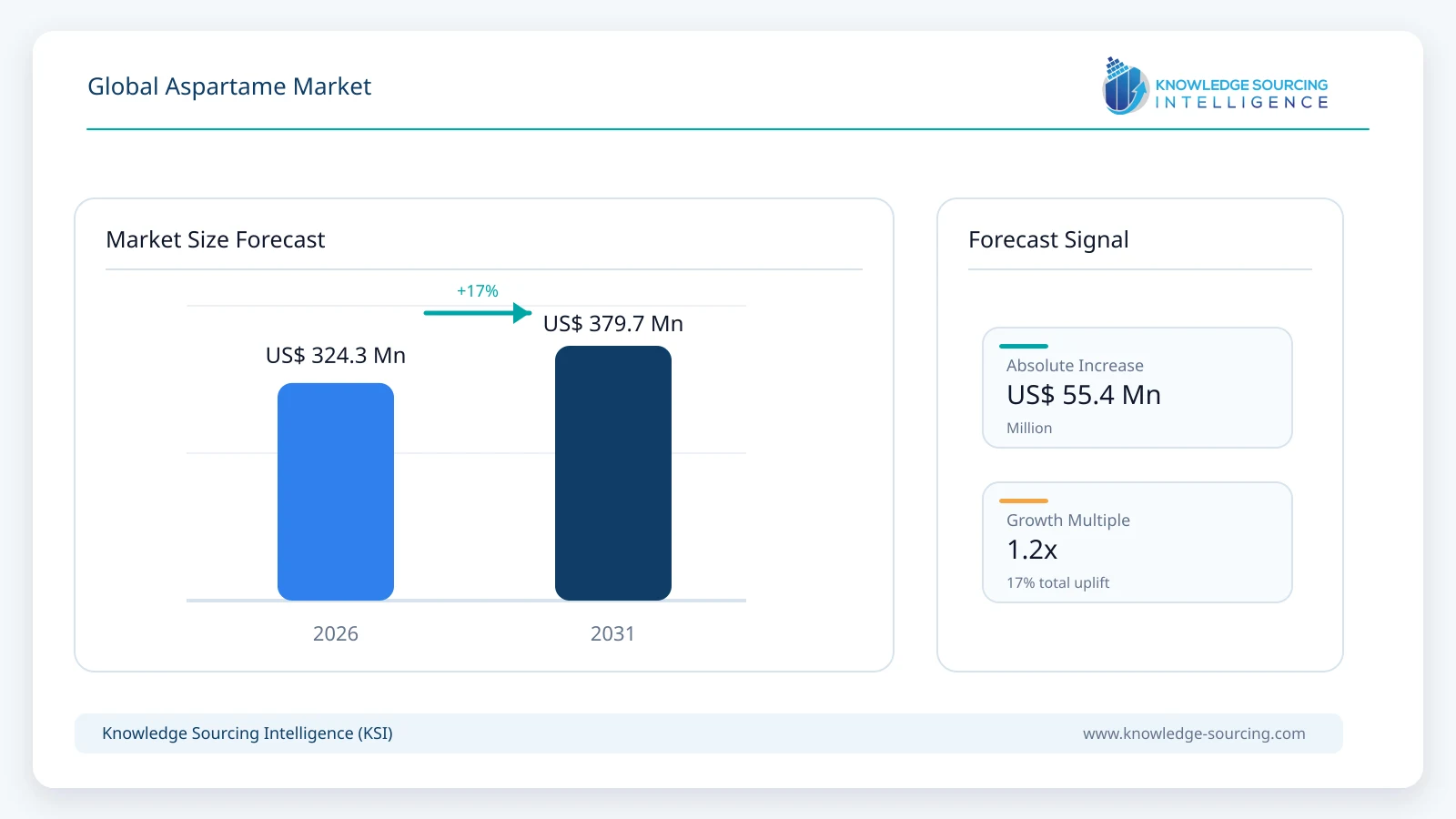
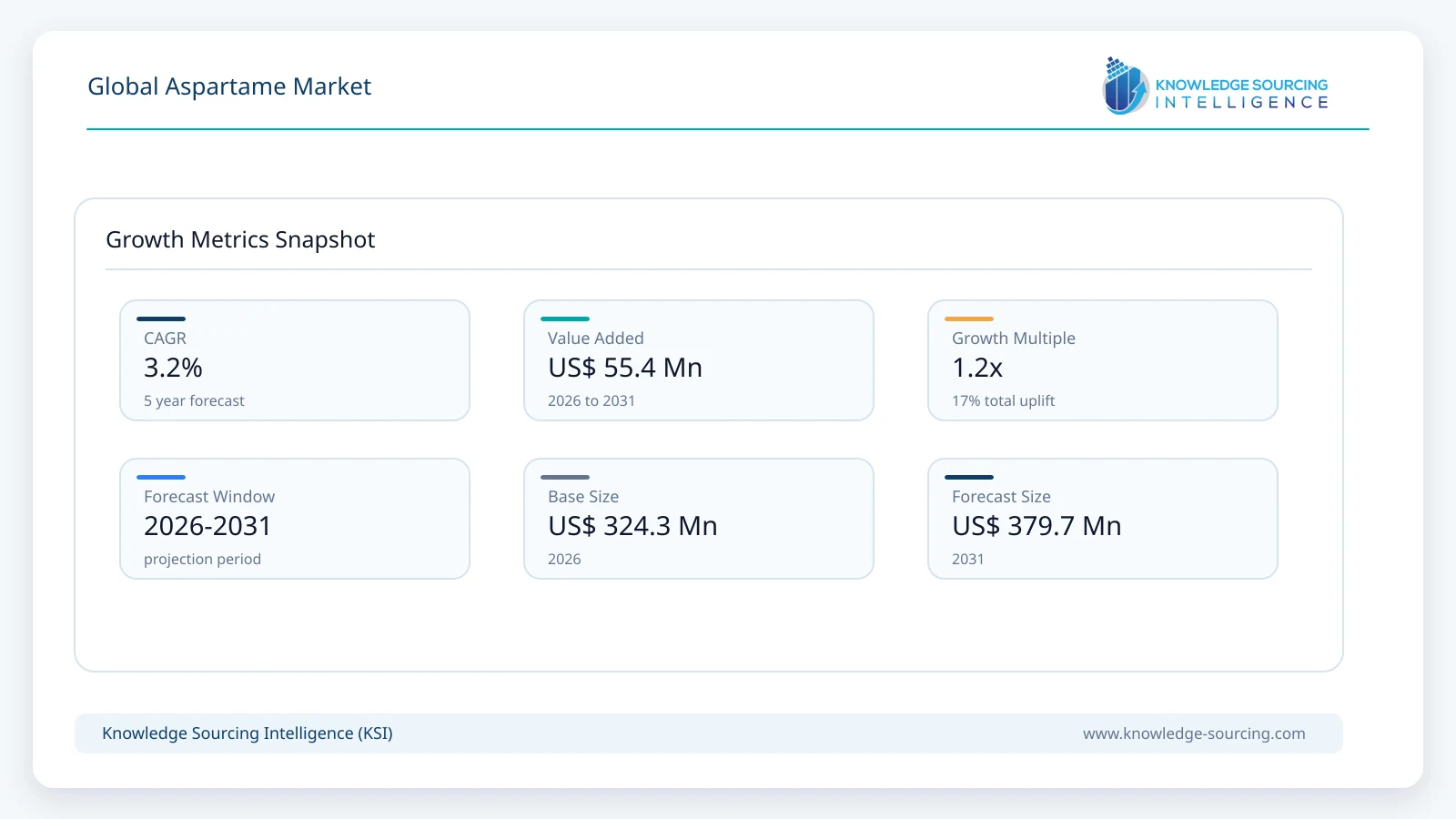
The aspartame market is forecast to grow at a CAGR of 3.20%, reaching USD 379.7 million in 2031 from USD 324.3 million in 2026.
Highlights:
- 1Food and beverages represents the commercially important end-user segment, supported by broad applications across beverages, dairy, confectionery, and processed foods.
- 2Powder and granular forms serve distinct handling and formulation requirements across food manufacturers, distributors, and industrial ingredient buyers.
- 3North America and Europe retain established regulatory markets, while Asia Pacific combines production capacity with expanding food manufacturing demand.
- 4Aspartame's approximately 200-times-sugar sweetness intensity supports formulations seeking sugar reduction with controlled ingredient quantities and familiar taste profiles.
- 5Regulatory scrutiny remains commercially relevant, with JECFA retaining its 40 mg/kg ADI and EFSA updating related sweetener specifications in 2026.
- 6Market value is projected to rise from USD 324.3 million in 2026 to USD 379.7 million by 2031 at a 3.20% CAGR.
Market Overview
The global Aspartame Market covers the production and supply of a high-intensity sweetener used to reduce sugar content while maintaining a familiar sweetness profile. The market is supplied through ingredient manufacturers, specialty sweetener companies, distributors, and food-ingredient channels, with demand concentrated in food and beverage formulations and additional use in pharmaceuticals and other processed products. Aspartame is approximately 200 times sweeter than sucrose, so relatively small quantities can deliver the required sweetness intensity.
The moderate growth profile reflects a mature ingredient category rather than an early-stage market. Demand depends on formulation economics, sugar-reduction strategies, taste requirements, regulatory permissions, customer specifications, and the availability of alternative high-intensity sweeteners. Suppliers therefore compete not only on price, but also on purity, specification compliance, consistency, documentation, delivery reliability, and the ability to support food manufacturers across different regulatory markets.
Buyer decisions are closely tied to formulation performance. Food and beverage manufacturers generally assess sweetness intensity, taste profile, stability within the intended product, permitted use levels, product specifications, supply continuity, and total formulation cost. The FDA identifies aspartame as a non-nutritive sweetener and permits its use under specified conditions, while EFSA identifies applications across drinks, desserts, sweets, dairy products, chewing gum, low-calorie and weight-control products, and tabletop sweeteners.
Regulatory interpretation remains commercially important because aspartame is consumed across multiple markets with different food-additive frameworks. JECFA reaffirmed an acceptable daily intake of 0–40 mg/kg body weight in 2023 and concluded that the available exposure estimates did not exceed that level. The U.S. FDA maintains a separate ADI of 50 mg/kg body weight per day and continues to state that it has no safety concerns when aspartame is used under approved conditions.
The commercial structure also reflects the maturity of the ingredient. Ajinomoto's historical disclosures show that industrial aspartame supply has experienced periods of excess capacity and price pressure, particularly following the entry of additional Asian suppliers. The company's disclosures also describe production-scale optimisation and a shift toward higher-value sweetener applications. This history remains relevant to current supplier economics because a modest market growth rate can place pressure on manufacturers to control plant utilisation, production cost, product mix, and distribution efficiency.
Key Market Indicators
Indicator | Latest Evidence | Commercial Meaning |
|---|---|---|
Sweetness intensity | About 200 times sucrose | High sweetness intensity limits the quantity required per formulation and supports use where sugar reduction is required. |
JECFA acceptable daily intake | 0–40 mg/kg body weight | The internationally recognised exposure benchmark remains an important reference for product formulation and regulatory compliance. |
FDA acceptable daily intake | 50 mg/kg body weight/day | The U.S. framework permits use under specified conditions and provides a separate exposure benchmark for manufacturers. |
EU status | E951, re-evaluated by EFSA in 2013 | EU manufacturers operate within an established additive framework with ongoing review of related sweeteners and specifications. |
Documented food applications | More than 4,000 food and beverage types cited by Niutang | Broad application coverage supports demand across multiple formulation categories rather than a single product class. |
Global regulatory reach | Approved in more than 125 countries and territories, according to Ajinomoto | Broad regulatory acceptance supports cross-border supply and multinational food formulation strategies. |
Market Drivers
Sugar reduction without a major change in sweetness profile. Food manufacturers can use high-intensity sweeteners to reduce the amount of conventional sugar while retaining a sweet taste. FDA describes sweeteners such as aspartame as ingredients used in sugar-free and diet products across beverages, powdered drink mixes, candy, puddings, dairy products, and other processed foods. This creates recurring ingredient demand where manufacturers need to manage sugar content, calorie contribution, and sensory performance at the same time.
Broad formulation use across processed foods and beverages. Aspartame is not limited to a single application. EFSA lists drinks, desserts, sweets, dairy products, chewing gum, low-calorie and weight-control products, and tabletop sweeteners among its permitted European uses. Niutang similarly lists dairy products, frozen beverages, confectionery, bakery products, beverages, jelly, condiments, and other food categories for its aspartame products. This breadth reduces dependence on one downstream category and gives suppliers access to different formulation cycles.
Established taste and formulation familiarity. Formulators often value ingredients with established sensory behaviour because changing sweetener systems can require recipe adjustment, consumer testing, stability checks, labelling review, and regulatory assessment. Ajinomoto describes aspartame as having a sweetness profile similar to sugar and notes its use in sugar-reduction applications across food and beverage products. Existing technical familiarity can therefore reduce the practical switching burden for manufacturers that already use the ingredient.
Demand from multinational food formulation networks. Global food manufacturers often sell similar product families across multiple markets, which increases the value of ingredients that can be sourced under recognised international specifications. Ajinomoto states that aspartame is approved in more than 125 countries and territories. Niutang reports conformity with FCC, USP/NF, JECFA, EP, and JP specifications for its product. Such specification coverage can simplify supplier qualification where manufacturers require consistent ingredient standards across several production locations.
Supplier focus on production efficiency and product mix. Mature sweetener markets place pressure on producers to manage manufacturing economics rather than rely solely on volume expansion. Ajinomoto's disclosures describe historical global overcapacity, declining unit selling prices, production restructuring, and efforts to optimise aspartame manufacturing scale. This creates an incentive for suppliers to improve process efficiency, manage capacity, and target applications where technical support and product differentiation can support better margins.
Market Restraints and Challenges
Competition from alternative high-intensity sweeteners. Aspartame competes with acesulfame potassium, sucralose, saccharin, steviol glycosides, neotame, and other sweetening systems. FDA currently lists six approved high-intensity sweeteners in the United States, while EFSA's European framework covers a broader group. Manufacturers can therefore reformulate products when taste, processing conditions, consumer positioning, cost, or regulatory considerations favour another sweetener.
Temperature limitations restrict some applications. FDA notes that aspartame is not heat stable and loses sweetness when heated, which limits its suitability for certain baking and high-temperature processing applications. This technical constraint gives heat-stable alternatives an advantage in product categories where processing conditions expose the sweetener to elevated temperatures. Suppliers must therefore compete within application boundaries rather than across the full processed-food market.
Regulatory and labelling requirements increase formulation complexity. Aspartame is subject to food-additive rules and labelling requirements that vary across jurisdictions. In the European Union, products must identify the ingredient by name or E number E951. In the United States, permitted uses are governed under food-additive regulations, while products containing aspartame must also address phenylalanine labelling because of the needs of consumers with phenylketonuria. These requirements affect packaging, formulation review, regulatory documentation, and market-entry procedures.
Public health debate can affect formulation and brand decisions. The 2023 IARC classification of aspartame as possibly carcinogenic to humans created a distinction between hazard identification and exposure-based risk assessment. JECFA did not change its 40 mg/kg body-weight ADI, while the FDA disagreed with the IARC classification and continued to state that approved uses do not raise safety concerns. For manufacturers, the commercial issue is not only regulatory status but also how retailers, brand owners, and consumers respond to differing scientific messages.
Mature supply economics can limit margin expansion. Historical supplier disclosures indicate that the entry of additional Chinese and South Korean producers contributed to excess global supply and lower selling prices in industrial aspartame. While market conditions can change, the history illustrates the sensitivity of mature sweetener production to capacity additions, utilisation, export pricing, and customer bargaining power. Suppliers with limited scale or weak distribution may face greater margin pressure when buyers can qualify multiple sources.
Major Segment Analysis
Food and Beverages
Food and beverages represent the most commercially important end-user category because regulatory frameworks and supplier product specifications support use across a wide set of consumer products. FDA lists diet and sugar-free beverages, powdered drink mixes, candy, puddings, dairy products, and other processed foods among sweetener applications, while EFSA identifies drinks, desserts, sweets, dairy products, chewing gum, low-calorie products, and weight-control products.
Purchasing decisions in this segment extend beyond sweetness intensity. Large food manufacturers typically need consistent purity, predictable sensory performance, reliable batch quality, regulatory documentation, stable supply, and competitive delivered cost. Niutang's published specifications illustrate the technical nature of supplier qualification, including purity, loss on drying, residue on ignition, pH, heavy metals, and other quality parameters. Such specifications make quality control and documentation important parts of supplier selection.
The segment also contains different economic profiles. Carbonated and other beverages can require large recurring ingredient volumes, while confectionery, dairy, tabletop products, and specialised formulations may place greater emphasis on taste, blending, packaging, or application support. Suppliers that can provide consistent grades, multiple particle forms, and regulatory documentation can serve a wider customer base. Ajinomoto's experience also shows why manufacturers may seek higher-value sweetener applications when commodity pricing and excess capacity restrict returns.
Regional Analysis
North America
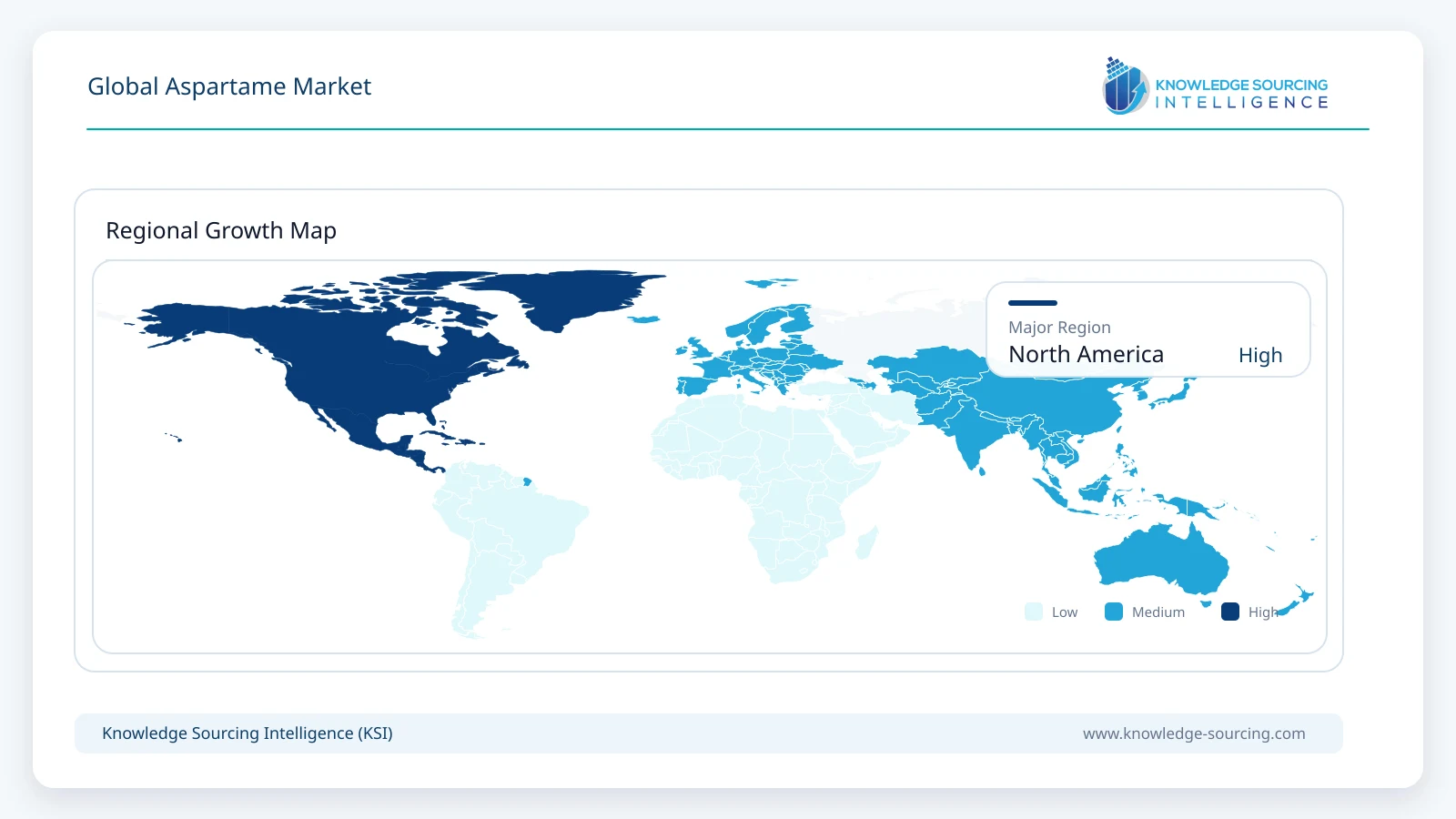
North American demand is shaped by established food-additive regulation, a large processed-food sector, and widespread use of sugar-reduction products. The U.S. FDA continues to permit aspartame under specified conditions and maintains an ADI of 50 mg/kg body weight per day. The agency also continues to monitor scientific literature and exposure information, which keeps regulatory review relevant even though approved use remains permitted.
Canada applies a 40 mg/kg body-weight ADI and requires manufacturers to submit food-additive information before permission is granted. Health Canada reviewed the 2023 JECFA and IARC assessments and stated in its August 2025 update that it would take no further action at that time. The region therefore combines mature regulatory acceptance with continued scrutiny of scientific evidence.
Europe
Europe has a well-defined regulatory framework for aspartame under E951. EFSA completed its full re-evaluation of aspartame in 2013 and retained an ADI of 40 mg/kg body weight per day. Current European policy continues to require food additives to be authorised and labelled, while EFSA's wider re-evaluation programme is updating the evidence base for other sweeteners.
The European market also illustrates how regulation can influence supplier requirements beyond the direct safety assessment of aspartame. In September 2026, EFSA completed its re-evaluation of the salt of aspartame-acesulfame, E962, and recommended updated specifications, including a review of arsenic and lead limits in the specifications for E951. This keeps raw-material quality, analytical testing, and documentation relevant to suppliers serving European manufacturers.
Asia Pacific
Asia Pacific is important to the supply structure as well as downstream consumption. Niutang, based in China, markets aspartame in powder and granular specifications and reports compliance with several international standards. Ajinomoto's history also shows long-standing aspartame production and commercial activity in Japan and international markets. The region therefore contains both manufacturing capability and large food and beverage markets.
China, Japan, India, South Korea, Taiwan, Thailand, and Indonesia differ in regulatory systems, food manufacturing structure, and sweetener consumption patterns. For suppliers, regional competition is influenced by production cost, export logistics, specification compliance, distributor relationships, and access to multinational food manufacturers. Buyers with multi-country production footprints are likely to place greater weight on consistent quality and documentation across sites.
South America
South America provides an established application base for low-calorie sweetener products, with Brazil representing an important food and beverage manufacturing market. Ajinomoto has documented the use of aspartame in its Refresco FIT powdered juice product sold in Brazil and describes its sweetener technologies as supporting sugar-reduction needs across food and beverage applications.
Regional demand is influenced by packaged beverages, processed foods, distribution reach, and local formulation economics. Suppliers must also account for import logistics and local registration requirements, particularly when products are sold through distributors rather than directly to large food manufacturers.
Competitive Landscape
The competitive structure combines ingredient manufacturing, international sweetener supply, technical qualification, and distribution. The companies covered in this market include Niutang Chemical Ltd., Hermes Sweeteners Ltd., Ajinomoto Co., Inc., Foodchem International Corporation, Vitasweet Co., Ltd., Heartland Food Products Group, LLC, and Ingredion Incorporated. Their commercial roles differ, so competition cannot be assessed only through product availability.
Niutang's published product information illustrates a specification-led model. Its aspartame is offered in powder and granular forms, with stated conformity to FCC, USP/NF, JECFA, EP, and JP requirements. Such coverage can support customers that operate across several regulatory markets and need documented quality specifications.
Ajinomoto provides a different competitive reference because of its long history in amino-acid-based sweeteners and its experience managing aspartame manufacturing economics. Company disclosures describe earlier global overcapacity, pressure on unit selling prices, and the restructuring of production scale. Its current public material continues to position aspartame within broader sugar-reduction applications and describes approval across more than 125 countries and territories.
The market therefore has several competitive dimensions: ingredient price, quality consistency, production scale, regulatory documentation, supply reliability, customer qualification, and application support. Switching can be relatively straightforward for standardised formulations in which several suppliers meet the same specification, but qualification becomes more demanding when a customer requires specific particle characteristics, purity limits, documentation, or consistent performance across multiple production facilities.
Price competition remains relevant because aspartame is a mature ingredient with established manufacturing technology. Suppliers can protect commercial returns by improving process efficiency, controlling capacity, reducing logistics costs, offering differentiated grades, or supporting blended sweetener solutions. Buyers, in turn, have an incentive to maintain qualified secondary sources where regulatory approval and formulation consistency permit.
Recent Developments
September 2026: EFSA completed its re-evaluation of the salt of aspartame-acesulfame, E962, and concluded that current reported uses do not raise safety concerns. The assessment retained the 40 mg/kg body-weight ADI for aspartame and recommended specification updates affecting E951-related controls.
August 2025: Health Canada stated that it would take no further action on aspartame after reviewing the 2023 JECFA and IARC assessments, while retaining the 40 mg/kg body-weight ADI. The position supports continued permitted use while preserving the regulator's ability to respond to new evidence.
July 2025: EFSA concluded that neotame, a sweetener manufactured from aspartame, raised no safety concern at currently permitted uses and levels. The decision adds to the evolving regulatory framework for sweeteners that compete with or derive from the aspartame value chain.
Regulatory and Policy Environment
Aspartame regulation is based primarily on pre-market safety review, permitted-use conditions, exposure limits, specifications, and labelling. In the United States, FDA regulates aspartame as a food additive under 21 CFR 172.804 and requires compliance with approved conditions of use. The agency also states that consumers with phenylketonuria should avoid or restrict aspartame and that labels must provide information concerning phenylalanine.
The international reference point remains JECFA's 0–40 mg/kg body-weight ADI, reaffirmed in 2023. JECFA assessed technical, toxicological, epidemiological, and dietary-exposure evidence and concluded that the available exposure estimates did not exceed the ADI. This distinction between hazard classification and exposure-based risk assessment remains commercially important because product formulation and actual intake determine the regulatory risk assessment.
The EU framework adds another layer of oversight. Aspartame is authorised as E951, while EFSA completed its full safety re-evaluation in 2013. The European Commission and national authorities determine permitted uses and levels within the EU framework, while EFSA provides scientific assessments. The September 2026 E962 assessment also recommended reviewing arsenic and lead limits in E951 specifications, reinforcing the importance of ingredient purity and analytical control for European suppliers.
Regulation therefore affects the market through more than approval status. Suppliers must maintain specifications, traceability, analytical testing, technical documentation, and customer support for regulatory submissions. Food manufacturers must also account for labelling and formulation rules when selling products across jurisdictions with different additive frameworks.
Outlook and Strategic Implications
The Aspartame Market forecast indicates a measured expansion path, with commercial performance likely to depend more on application retention, formulation demand, supplier efficiency, and competitive pricing than on rapid volume expansion.
The strongest opportunities are likely to remain in established food and beverage applications where manufacturers require high sweetness intensity and controlled sugar content. Suppliers that maintain consistent quality, regulatory documentation, reliable delivery, and competitive pricing should be better positioned to retain multinational customers. Product form also matters because powder and granular grades serve different handling, blending, and distribution requirements.
For buyers, supplier qualification and regulatory documentation will remain central purchasing considerations. Maintaining alternative approved suppliers can reduce exposure to production interruptions and price changes, but switching suppliers may require technical validation and packaging or labelling review. Manufacturers should therefore evaluate supply security alongside unit price.
For producers, capacity discipline is important. Historical overcapacity and price pressure show that adding output without matching customer demand can weaken margins. Investment priorities are more likely to favour manufacturing efficiency, quality control, differentiated grades, regional distribution, and customer support than indiscriminate capacity growth.
Regulatory monitoring will remain necessary through 2031. The 2026 EFSA assessment of E962 and its recommendations concerning specifications connected with E951 show that regulatory attention can extend into impurity limits and technical standards even when the core ADI remains unchanged. Companies serving several markets will need regulatory teams capable of tracking different exposure limits, permitted uses, specifications, and labelling rules.
Overall, the market's commercial performance will depend on the ability of suppliers and food manufacturers to balance price, sensory performance, regulatory compliance, supply reliability, and formulation flexibility. The moderate forecast growth leaves limited room for inefficient production or weak customer retention, increasing the importance of cost control and dependable supply relationships.
Aspartame Market Scope:
| Report Metric | Details |
|---|---|
| Total Market Size in 2026 | USD 324.3 million |
| Total Market Size in 2031 | USD 379.7 million |
| Forecast Unit | Million |
| Growth Rate | 3.20% |
| Study Period | 2021 to 2031 |
| Historical Data | 2021 to 2024 |
| Base Year | 2025 |
| Forecast Period | 2026 – 2031 |
| Segmentation | Product Type, Sales Channel, End-User Industry, Geography |
| Companies |
|
Market Segmentation
By Product Type
Powder
Granular
By Sales Channel
Online
Offline
By End-User Industry
Food and Beverages
Pharmaceuticals
Others
By Geography
North America
United States
Canada
Mexico
South America
Brazil
Argentina
Rest of South America
Europe
United Kingdom
Germany
France
Italy
Spain
Rest of Europe
Middle East and Africa
Saudi Arabia
United Arab Emirates
Rest of the Middle East and Africa
Asia-Pacific
China
India
Japan
South Korea
Taiwan
Thailand
Indonesia
Rest of Asia-Pacific
Table of Contents
1. INTRODUCTION
1.1. Market Overview
1.2. Market Definition
1.3. Scope of the Study
1.4. Market Segmentation
1.5. Currency
1.6. Assumptions
1.7. Base and Forecast Years Timeline
1.8. Key Benefits for Stakeholders
2. RESEARCH METHODOLOGY
2.1. Research Design
2.2. Research Process
3. EXECUTIVE SUMMARY
3.1. Key Findings
3.2. Analyst View
4. MARKET DYNAMICS
4.1. Market Drivers
4.1.1. Growing Demand for Low-Calorie Sweeteners
4.1.2. Rising Health Awareness
4.2. Market Restraints
4.2.1. Threats from Substitutes
4.3. Porter’s Five Forces Analysis
4.3.1. Bargaining Power of Suppliers
4.3.2. Bargaining Power of Buyers
4.3.3. Threat of New Entrants
4.3.4. Threat of Substitutes
4.3.5. Competitive Rivalry in the Industry
4.4. Industry Value Chain Analysis
5. ASPARTAME MARKET BY PRODUCT TYPE
5.1. Introduction
5.2. Powder
5.3. Granular
6. ASPARTAME MARKET BY SALES CHANNEL
6.1. Introduction
6.2. Online
6.3. Offline
7. ASPARTAME MARKET BY END-USER INDUSTRY
7.1. Introduction
7.2. Food and Beverages
7.3. Pharmaceuticals
7.4. Others
8. ASPARTAME MARKET BY GEOGRAPHY
8.1. Global Overview
8.2. North America
8.2.1. United States
8.2.2. Canada
8.2.3. Mexico
8.3. South America
8.3.1. Brazil
8.3.2. Argentina
8.3.3. Rest of South America
8.4. Europe
8.4.1. United Kingdom
8.4.2. Germany
8.4.3. France
8.4.4. Italy
8.4.5. Spain
8.4.6. Rest of Europe
8.5. Middle East and Africa
8.5.1. Saudi Arabia
8.5.2. United Arab Emirates
8.5.3. Rest of the Middle East and Africa
8.6. Asia-Pacific
8.6.1. China
8.6.2. India
8.6.3. Japan
8.6.4. South Korea
8.6.5. Taiwan
8.6.6. Thailand
8.6.7. Indonesia
8.6.8. Rest of Asia-Pacific
9. COMPETITIVE ENVIRONMENT AND ANALYSIS
9.1. Competitive Positioning and Strategy Analysis
9.2. Market Share Analysis
9.3. Mergers, Acquisitions, Agreements, and Collaborations
9.4. Competitive Dashboard
10. REGULATORY AND POLICY ENVIRONMENT
10.1. Food Additive Regulations
10.2. Acceptable Daily Intake and Safety Assessments
10.3. Labeling and Usage Requirements
10.4. Recent Regulatory Developments
11. COMPANY PROFILES
11.1. Niutang Chemical Ltd.
11.2. Hermes Sweeteners Ltd.
11.3. Ajinomoto Co., Inc.
11.4. Foodchem International Corporation
11.5. Vitasweet Co., Ltd.
11.6. Heartland Food Products Group, LLC
11.7. Ingredion Incorporated
LIST OF TABLES
LIST OF FIGURES
Navigate
Trusted by the world's leading organizations











