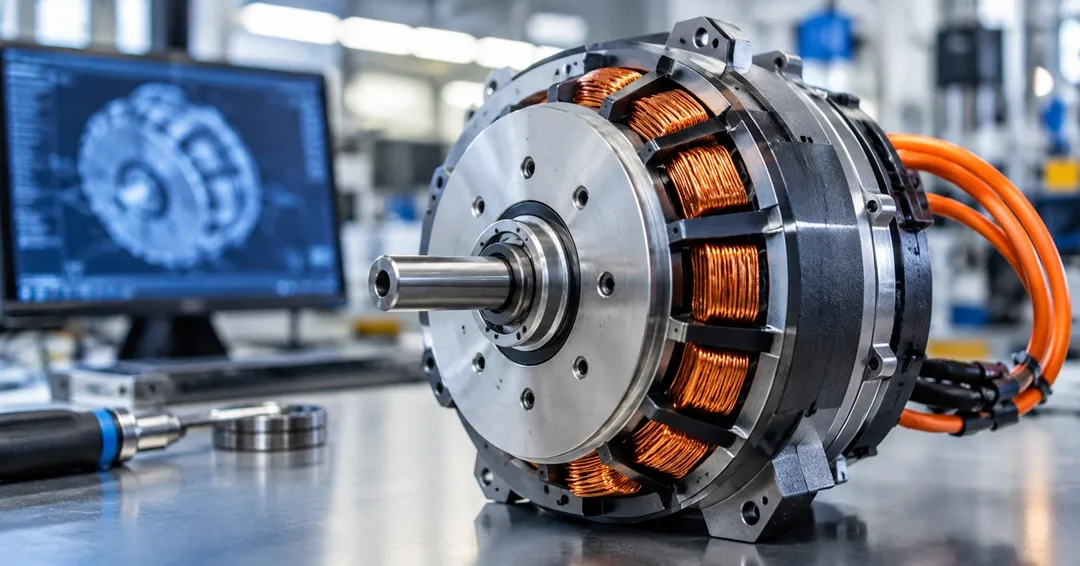
The global axial flux motor market is expanding as demand for compact, lightweight, and high-power-density propulsion systems increases. Advancements in motor design, thermal management, and manufacturing technologies are supporting adoption across automotive, aerospace, marine, and industrial applications. Growing investments in commercialization are creating new opportunities for technology developers.
The global axial flux motor market is projected to grow from USD 1.12 billion in 2026 to USD 2.85 billion by 2031, registering a compound annual growth rate (CAGR) of 20.5%, according to Knowledge Sourcing Intelligence (KSI). Demand for compact electric propulsion systems, lightweight vehicle architectures, and high-power-density motors is supporting market expansion. Axial flux technology offers potential advantages in torque density and packaging, creating opportunities across automotive, aerospace, marine, and industrial applications.
Manufacturers are increasingly evaluating axial flux technology alongside conventional radial flux designs, particularly where space, weight, and performance are critical. Wider commercialization, however, will depend on manufacturing scalability, thermal reliability, material availability, and competitive production costs.
Request a free sample copy or view the report summary: Axial Flux Motor Market Report
Key Growth Drivers
Demand for Compact and Lightweight EV Powertrains
Automakers are pursuing compact propulsion systems to optimize vehicle packaging, weight distribution, and performance. Axial flux motors can deliver high torque density within relatively short axial dimensions, making them attractive for performance EVs and integrated electric drivetrains. According to KSI, automotive applications account for approximately 46% of global axial flux motor revenue in 2026, highlighting the importance of vehicle electrification to market growth.
Advances in High-Power-Density Motor Technology
Advances in electromagnetic design, cooling, and motor materials are improving achievable power density. In October 2025, YASA reported a 12.7 kg axial flux prototype delivering 750 kW of short-term peak power, equivalent to approximately 59 kW/kg. The company estimated continuous output at approximately 350–400 kW. Although peak prototype ratings do not establish sustained operating performance, the achievement demonstrates the technology's potential for weight-sensitive propulsion applications.
Manufacturing Scale-Up and Automotive Integration
Commercial adoption requires repeatable production, consistent quality, and competitive costs. Investments in automated assembly, advanced winding technologies, and dedicated manufacturing facilities are addressing production challenges. Scaling these capabilities could extend adoption beyond premium vehicles, provided manufacturers demonstrate durability, efficiency, and cost competitiveness against established motor architectures.
Expanding Applications Beyond Passenger Vehicles
Axial flux motors are attracting interest in electric aviation, unmanned aerial vehicles (UAVs), marine propulsion, commercial vehicles, and industrial machinery. Their compact geometry can benefit applications where installation space and weight are constrained. KSI forecasts approximately 27.5% CAGR for aerospace and UAV applications through 2031, although certification, specialized engineering, and reliability requirements may influence commercialization timelines.
Latest Industry Developments
September 2026: Turntide announced its axial flux electric drive unit, electric power take-off, and hybrid systems for commercial vehicle applications at IAA Transportation in Hannover, Germany.
August 2026: Turntide announced selection for Project SUPREME, a £17 million matched-funded initiative intended to accelerate automated axial flux motor production. UK government grant funding remains subject to approval.
August 2026: YASA secured UK government funding through Project Resilience to develop fully rare-earth-free and heavy-rare-earth-free axial flux motor technologies for future electric and hybrid vehicles.
March 2026: Magnax announced a €35.5 million investment involving Pan-International Industrial Corp., Foxconn Group, and incoming management members to support industrialization of its axial flux technology.
Market Segmentation and Regional Outlook
The market is segmented by motor configuration, cooling technology, power rating, application, and geography. Configurations include single-rotor/single-stator, dual-rotor/single-stator, single-rotor/dual-stator, and multi-disc designs. Cooling categories cover air-cooled, liquid-cooled, and combined systems. Applications include automotive, industrial machinery and HVAC, aerospace, UAV and eVTOL, marine, off-highway equipment, and robotics.
Europe accounts for approximately 38% of global market revenue in 2026, according to KSI, supported by specialist motor developers and established automotive manufacturing capabilities. Germany and the United Kingdom remain important centres for technology development and commercialization.
Asia Pacific offers opportunities through vehicle electrification, industrial manufacturing, and expanding electric mobility supply chains, particularly in China, Japan, India, and South Korea.
North America presents opportunities in commercial vehicles, aerospace, and industrial electrification, where compact propulsion systems can address specialized engineering requirements.
Competitive Landscape
Key market participants include YASA Limited, Turntide Technologies, Magnax BV, Infinitum, Evolito, and EMRAX. Their technologies address different applications, from automotive propulsion and aerospace to industrial equipment. Competition centres on power density, thermal performance, manufacturing scalability, cost efficiency, and system integration.
In March 2026, Magnax announced a €35.5 million investment involving Pan-International Industrial Corp., Foxconn Group, and incoming management members to support industrialization of its axial flux technology. The investment supports efforts to expand manufacturing capacity, although broader adoption will depend on reliable performance and competitive production economics.
Market Outlook
As axial flux motor technology moves towards broader commercialization, manufacturers are increasingly focused on translating high power density into scalable, cost-effective solutions. Manufacturing efficiency, thermal performance, and integration into production-ready powertrains will be important factors influencing adoption across automotive, aerospace, and industrial applications.
What the Study Covers
The report provides market estimates and forecasts through 2031, analysis of growth drivers and restraints, segmentation by motor configuration, cooling technology, power rating, and application, regional assessments, competitive intelligence, company profiles, and technology developments.
Have questions?
More Press Releases
Global Automotive Thermal Comfort Systems Market to Reach USD 22.5 Billion by 2031, Driven by Heat Pump Adoption in Electric Vehicles
The global automotive thermal comfort systems market is projected to reach USD 22.5 billion by 2031, driven by electric vehicle adoption, heat pump integration, and energy-efficient cabin heating. Advances in integrated thermal management, localized heating, and intelligent climate control are creating opportunities for automotive suppliers worldwide.
Liquid Air Energy Storage Market to Reach USD 2.25 Billion by 2032 as Commercial-Scale Projects Gain Momentum
The global liquid air energy storage market is gaining momentum as renewable energy integration and long-duration electricity storage requirements drive investment. Commercial-scale project development, cryogenic technology advancements, thermal integration, and grid-stability applications are creating new opportunities, while project financing, capital costs, and operational efficiency remain important considerations for market expansion.
Semiconductor Process Cooling Market to Reach USD 5.65 Billion by 2032, Driven by Demand for Precision Temperature Control in Advanced Chip Manufacturing
The semiconductor process cooling market is expanding as advanced chip manufacturing increases demand for precision temperature control, energy efficiency, and specialized cooling systems. Growth in advanced logic, high-bandwidth memory, and semiconductor fabrication capacity is creating opportunities for ultra-low-temperature chillers, multi-channel systems, and sustainable cooling technologies across major manufacturing regions.