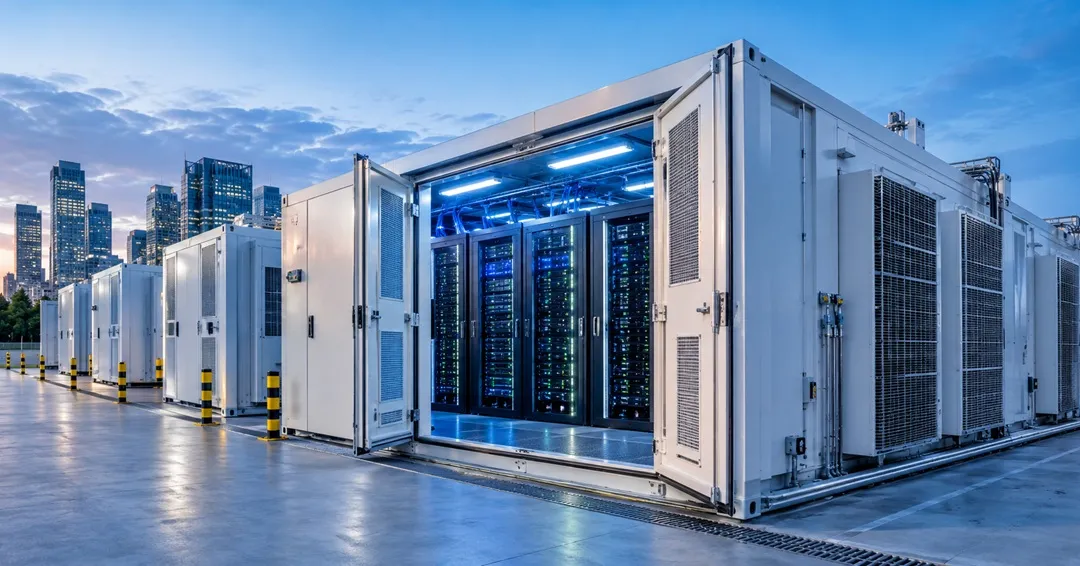
The global modular AI data center infrastructure market is expanding as demand for high-density computing and faster AI infrastructure deployment increases. Prefabricated power modules, integrated cooling systems, and turnkey AI factory solutions are gaining traction among hyperscale operators and neocloud providers seeking scalable, energy-efficient infrastructure to support increasingly complex AI workloads.
Knowledge Sourcing Intelligence (KSI) projects the global modular AI data center infrastructure market is projected to grow at a CAGR of 32.6%, reaching USD 8.71 billion by 2032 from USD 1.60 billion in 2026. Rising investments in artificial intelligence (AI) infrastructure, increasing demand for high-density computing, and the need for faster data center deployment are driving market expansion. Prefabricated infrastructure is gaining traction as hyperscale operators, neocloud providers, and enterprises seek integrated power, cooling, and computing solutions to accommodate increasingly demanding AI workloads.
The expansion of generative AI, large language models, and GPU-intensive computing is increasing the complexity of data center construction. Conventional development approaches involve extensive on-site electrical installation, cooling integration, equipment testing, and commissioning. Modular infrastructure addresses these challenges through factory-engineered and preassembled systems that can be manufactured and tested alongside site preparation. This approach can reduce on-site installation requirements, improve deployment predictability, and support phased capacity expansion. However, grid connectivity, permitting, equipment availability, and site readiness remain important considerations influencing project timelines.
Request a free sample copy or view the report summary: Modular AI Data Center Infrastructure Market Report
Key Growth Drivers
Rapid Deployment of Prefabricated AI Data Centers
Accelerating investment in AI computing infrastructure is increasing demand for shorter data center construction and commissioning cycles. Prefabricated power modules, cooling systems, and IT infrastructure pods enable critical components to be assembled, integrated, and tested in controlled factory environments before delivery. Manufacturing activities can proceed alongside site preparation, reducing on-site coordination requirements and supporting faster infrastructure deployment.
Standardized modular configurations also allow operators to replicate validated infrastructure designs across multiple facilities while expanding capacity in phases. This approach is particularly relevant for hyperscale cloud providers and neocloud operators seeking to establish AI computing capacity without relying entirely on conventional site-based construction.
Growing Demand for High-Density AI Computing
The expansion of GPU-intensive AI training and inference workloads is increasing rack-level power consumption and thermal management requirements. High-density computing environments require coordinated electrical distribution, advanced cooling technologies, and reliable infrastructure monitoring to maintain operational performance.
Liquid cooling, coolant distribution units, high-capacity power distribution systems, and integrated controls are becoming increasingly important components of next-generation AI data centers. Vertiv's OneCore architecture demonstrates the industry's movement toward integrated infrastructure combining power, thermal management, and IT systems. Such solutions support standardized deployment while addressing the technical requirements of increasingly power-intensive computing environments.
Expansion of Hyperscale and Neocloud Infrastructure
Hyperscale cloud providers and specialized GPU cloud operators are expanding infrastructure to support growing demand for AI training, inference, and high-performance computing. Modular deployment enables these operators to add computing capacity through repeatable infrastructure blocks rather than depending exclusively on large, traditionally constructed facilities.
The expansion of AI infrastructure is also increasing demand for turnkey data center solutions that combine IT white space, electrical systems, backup power, and cooling infrastructure. Nevertheless, access to electricity, grid interconnection timelines, land availability, and regulatory approvals remain important factors affecting the pace of new deployments.
Increasing Adoption of Integrated Power and Cooling Systems
Higher computing densities are increasing the importance of integrated electrical and thermal infrastructure. AI data centers require coordinated power conversion, uninterruptible power supply (UPS) systems, power distribution, liquid cooling, and monitoring technologies to support continuous operation.
Pre-engineered modular solutions can combine these components into factory-tested configurations, reducing the complexity of integrating equipment from multiple suppliers at the project site. The adoption of integrated systems is expected to increase as operators prioritize operational reliability, scalability, energy efficiency, and compatibility with evolving AI hardware platforms.
Latest Industry Developments
October 2026 – Flex AI Modules: Flex expanded its prefabricated modular data center portfolio with AI Modules integrating power, high-density computing, and advanced liquid cooling. The company stated that the factory-built solutions could reduce deployment timelines by up to 50% compared with traditional construction approaches.
September 2026 – Schneider Electric: Schneider Electric introduced prefabricated power modules and power skids in 2 MW, 2.25 MW, and 2.5 MW configurations for hyperscale, neocloud, and colocation facilities. Developed around NVIDIA-aligned GB300 NVL72 reference designs, the solutions integrate power management and liquid-cooling controls to support AI infrastructure deployment.
September 2026 – Compu Dynamics Modular: Compu Dynamics Modular (CDM) launched an expanded modular AI infrastructure portfolio featuring configurations ranging from 750 kW all-in-one modules to 5–6 MW turnkey AI factories. The solutions integrate IT infrastructure, electrical systems, power, and hybrid cooling to support scalable AI deployments.
September 2026 – UL Solutions: UL Solutions introduced a certification program for prefabricated data center power distribution assemblies and awarded its first certification to Schneider Electric. The UL 2140 framework provides a standardized safety evaluation pathway for factory-built integrated power systems used in modular data center deployments.
Market Segmentation and Regional Outlook
The market is segmented by modular infrastructure type, deployment scale, rack density, power architecture, cooling architecture, and geography. Categories include prefabricated power modules and skids, thermal and liquid-cooling modules, white-space and IT pods, integrated AI-factory infrastructure blocks, turnkey modular AI data centers, and factory integration and deployment services. According to KSI, prefabricated power modules represent the largest 2026 revenue segment, while integrated AI-factory blocks are expected to grow fastest through 2032.
North America leads early adoption through hyperscale investment, neocloud expansion, and established infrastructure suppliers. Europe presents opportunities through data center modernization and prefabricated equipment manufacturing. Asia Pacific benefits from AI investment and power-electronics manufacturing capabilities, while the Middle East offers opportunities through sovereign AI initiatives and large-scale computing projects.
Competitive Landscape
Major participants include Schneider Electric, Vertiv, Delta Electronics, Eaton, ABB, Siemens, Huawei Digital Power, and Crusoe. Competition centers on manufacturing scalability, standardized designs, integrated power and cooling capabilities, and deployment efficiency. Suppliers offering factory-tested infrastructure and adaptable configurations are positioned to address increasingly complex AI facility requirements.
Analyst Perspective
"Modular AI data center infrastructure is gaining importance as operators expand computing capacity while managing increasingly complex power and cooling requirements. Prefabricated systems can improve deployment coordination, standardize infrastructure integration, and support phased capacity expansion. However, long-term market adoption will depend on reliable power availability, compatibility with evolving AI platforms, operational performance, and demonstrated project economics."
What the Study Covers
The Knowledge Sourcing Intelligence report provides an in-depth assessment of the global modular AI data center infrastructure market, including market estimates and forecasts through 2032. It examines key growth drivers, restraints, infrastructure segmentation, deployment-scale analysis, rack density, power and cooling architectures, regional market opportunities, competitive intelligence, and company profiles.
The study also evaluates relevant technology developments and industry strategies to help stakeholders understand emerging opportunities, assess competitive positioning, and make informed decisions across the global modular AI data center infrastructure ecosystem.
Have questions?
More Press Releases
Semiconductor Process Cooling Market to Reach USD 5.65 Billion by 2032, Driven by Demand for Precision Temperature Control in Advanced Chip Manufacturing
The semiconductor process cooling market is expanding as advanced chip manufacturing increases demand for precision temperature control, energy efficiency, and specialized cooling systems. Growth in advanced logic, high-bandwidth memory, and semiconductor fabrication capacity is creating opportunities for ultra-low-temperature chillers, multi-channel systems, and sustainable cooling technologies across major manufacturing regions.
AI Data Center Microgrids Market Projected to Reach USD 3.38 Billion by 2032 Amid Grid Constraints and Rising On-Site Power Demand
The AI data center microgrids market is expanding as grid constraints, interconnection delays, and rising AI computing power requirements increase demand for reliable on-site electricity. Hybrid generation, battery storage, advanced energy management, and islandable power systems are creating opportunities for suppliers supporting resilient, flexible, and efficient data center energy infrastructure.
Automotive Smart Seating Market to Reach USD 16.40 Billion by 2031 as AI-Enabled Comfort and Personalization Gain Traction
The global automotive smart seating market is expanding as automakers integrate AI-enabled personalization, occupant sensing, connected controls, and intelligent comfort technologies. Rising demand for premium cabin experiences and software-defined vehicles is creating opportunities for advanced seating systems, while affordability, software reliability, data protection, and vehicle safety integration remain key considerations.