
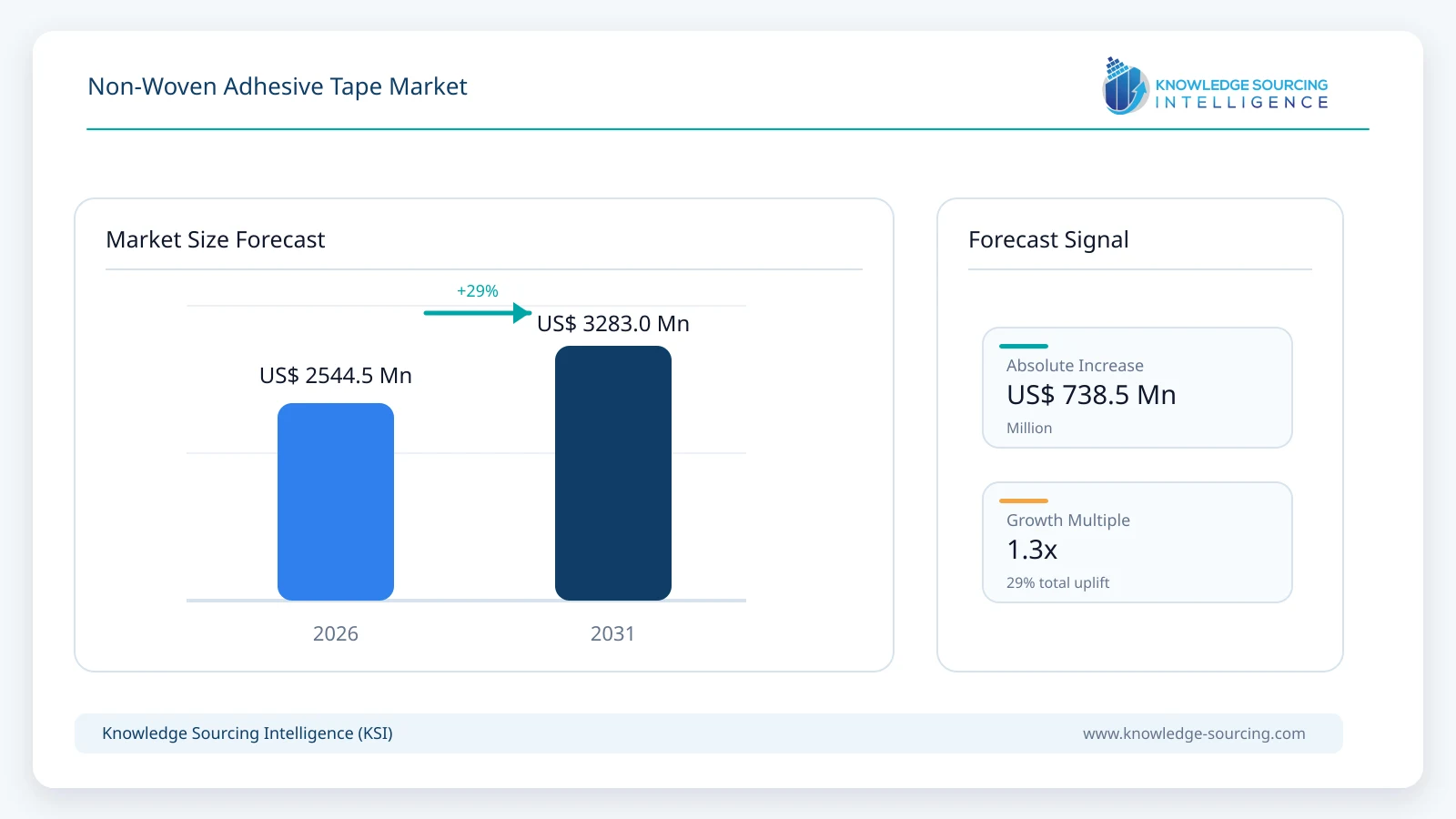
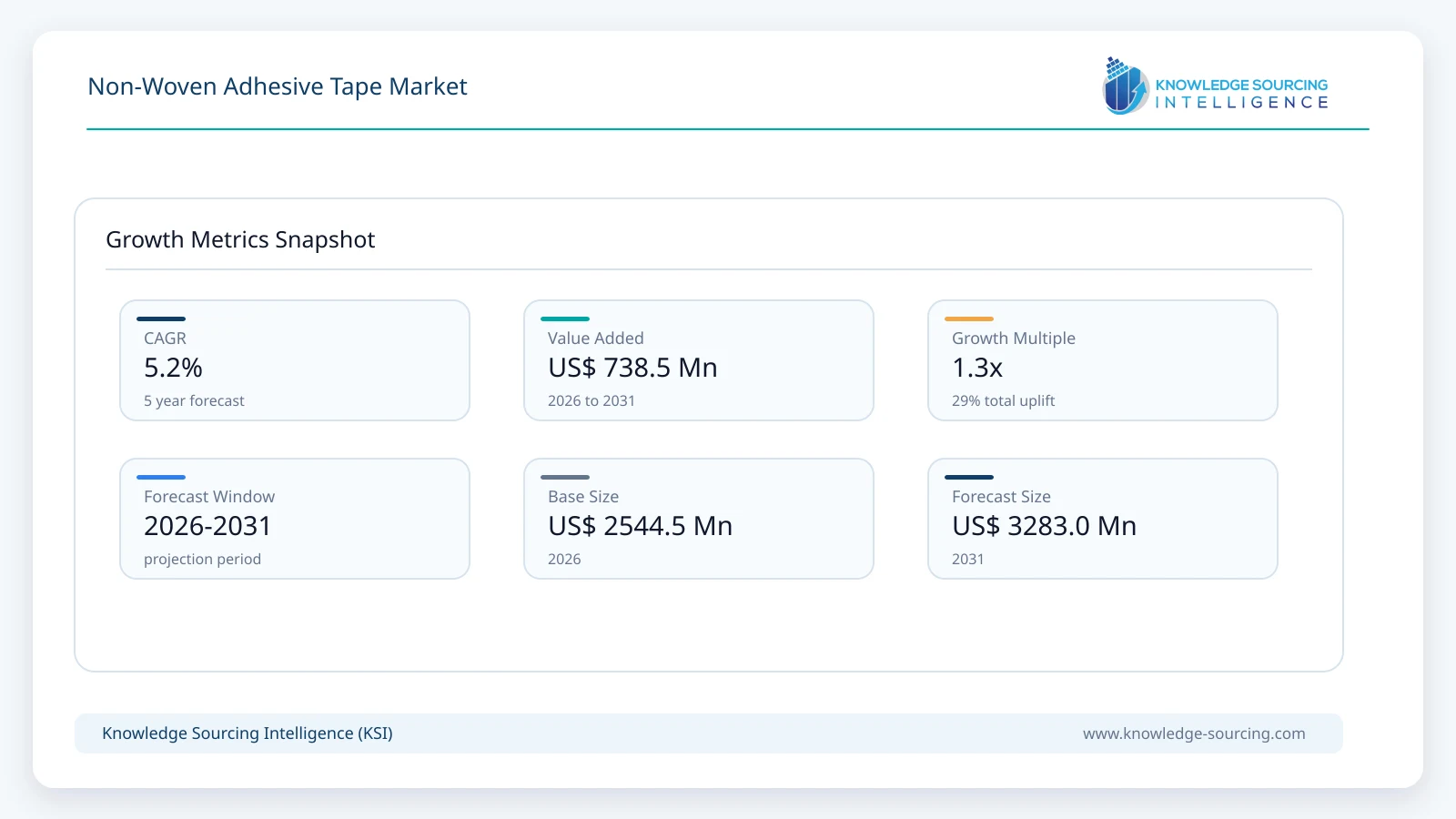
The Non-Woven Adhesive Tape Market is forecast to grow at a CAGR of 5.2%, reaching USD 3,283.0 million in 2031 from USD 2,544.5 million in 2026.
Highlights:
- 1Packaging remains a broad demand baseCarton closure, bundling, mounting, splicing, labeling, and packaging assembly create recurring requirements for pressure-sensitive tape products.
- 2Engineered bonding is commercially importantAutomotive, electronics, healthcare, and industrial customers increasingly evaluate tapes according to application performance rather than simply adhesive cost.
- 3Acrylic systems have strong positioningAcrylic adhesives can offer useful combinations of aging resistance, temperature stability, and substrate compatibility, supporting applications where long service life matters.
- 4Sustainability is shifting product specificationsEuropean packaging regulation is increasing attention on recyclability, material composition, waste prevention, and packaging design.
- 5Asia Pacific remains strategically importantElectronics manufacturing, automotive production, consumer goods, packaging conversion, and industrial manufacturing provide a broad downstream base for adhesive tape consumption.
- 6Competition is moving toward application engineeringProduct differentiation increasingly depends on adhesive formulation, coating precision, converting capabilities, technical qualification, and geographic supply reliability.
The Non-Woven Adhesive Tape Market covers pressure-sensitive and related adhesive tape products that use non-woven substrates as the carrier or functional backing and combine them with adhesive systems such as acrylic, rubber, silicone, and other formulations. These tapes are generally engineered for bonding, mounting, joining, protection, insulation, masking, sealing, splicing, and assembly applications where flexibility, conformability, controlled adhesion, and clean processing are more important than the structural strength of conventional film-backed tapes.
Commercial demand is spread across packaging, consumer and office products, healthcare, automotive, electrical and electronics, building and construction, and other industrial uses. The market is therefore not driven by one end-use cycle. Instead, demand reflects the production volumes of multiple downstream industries and the gradual substitution of mechanical fastening, liquid adhesives, clips, screws, staples, and thicker bonding materials with thin adhesive constructions.
The commercial value of non-woven adhesive tape lies in its ability to perform several functions within a small material footprint. A converter or OEM can use a double-sided non-woven tape to join two substrates without drilling or mechanical fastening. In automotive interiors, the tape can support trim attachment while accommodating differences in surface geometry. In electronics, thin adhesive constructions can support component assembly where space is limited. In healthcare, the adhesive system must additionally address skin contact, removability, wear duration, and biocompatibility.
The buyer, therefore, does not normally evaluate non-woven adhesive tape only on price per roll. Procurement decisions can depend on peel adhesion, shear resistance, tack, temperature performance, aging behavior, liner release, thickness tolerance, substrate compatibility, unwind characteristics, residue, converting efficiency, and application speed. For medical applications, biological safety and documentation can become decisive purchasing criteria. FDA guidance confirms that manufacturers of medical devices assess material composition, intended use, manufacturing processes, and biological response when evaluating biocompatibility.
The industry has a layered supply structure. Upstream participants supply polymers, resins, additives, fibers, release materials, and other coating inputs. Tape manufacturers then formulate adhesives, coat or laminate substrates, cure or dry the adhesive, slit master rolls, and convert the material into application-specific formats. Downstream customers include packaging converters, automotive suppliers, electronics manufacturers, medical-device companies, construction-material producers, distributors, and industrial users.
This structure creates two distinct competitive models. Commodity-oriented tape applications are more exposed to raw-material prices, production efficiency, and distribution reach. Engineered applications depend more heavily on formulation know-how, qualification history, process consistency, technical support, and the ability to meet customer-specific specifications. Suppliers serving high-value applications can therefore defend pricing more effectively when their products become embedded in a customer's manufacturing process.
The demand environment entering the 2026–2031 forecast period is shaped by three commercial forces. First, manufacturers continue to seek assembly methods that reduce process steps and improve throughput. Second, packaging and consumer-goods producers face pressure to reduce material intensity and improve recyclability. Third, electronics, automotive, healthcare, and other precision industries require thinner bonding solutions with increasingly specific performance characteristics.
Environmental requirements are also changing the product-development equation. The European Union's Packaging and Packaging Waste Regulation, Regulation (EU) 2025/40, entered into force on February 11, 2025, and generally applies from August 12, 2026. It establishes requirements covering packaging manufacturing, composition, reuse, recoverability, waste management, and prevention. For adhesive tape suppliers, the commercial implication is indirect but important: packaging customers are likely to scrutinize the compatibility of tape constructions with their broader packaging design and recycling objectives.
Market Drivers
Expansion of Lightweight and Process-Efficient Assembly
Manufacturers increasingly evaluate fastening methods according to total assembly economics rather than the purchase price of the fastening component. Non-woven adhesive tapes can combine bonding and joining functions without drilling, riveting, curing liquid adhesives, or installing separate mechanical hardware.
This matters most where production lines require high repeatability. A tape can arrive as a roll, die-cut component, sheet, or customer-specific format and can be integrated into semi-automated or automated assembly processes. The economic benefit depends on application geometry, labor requirements, takt time, rework rates, and the cost of alternative fastening methods.
Automotive suppliers are a particularly relevant buyer group because interior components, emblems, moldings, insulation materials, wiring-related components, and other parts require controlled attachment without adding excessive weight. Electronics manufacturers have similar requirements because component miniaturization leaves less physical space for traditional fastening.
Tape manufacturers respond by developing products with controlled thickness, consistent coat weight, predictable liner release, improved temperature resistance, and better adhesion to difficult substrates. The commercial result is a shift from general-purpose tape toward application-specific constructions that can command higher margins.
Growth in Electronics and Precision Assembly
Electrical and electronic applications place demanding requirements on pressure-sensitive tapes. The adhesive must perform consistently across narrow thickness tolerances while maintaining insulation, dimensional stability, clean removal or permanent bonding, and resistance to environmental exposure.
ASTM D1000-24 provides test methods for pressure-sensitive adhesive-coated tapes used for electrical insulation and covers multiple backing categories, demonstrating the technical requirements associated with electrical and electronic tape applications.
The underlying commercial driver is not simply higher electronics consumption. Manufacturers are also changing product architecture. Compact devices, increasingly dense assemblies, displays, batteries, sensors, and electronic modules require thin bonding and insulation materials that occupy limited space.
Tape suppliers consequently compete on engineering support as much as on tape supply. Qualification data, dimensional consistency, die-cutting capability, clean processing, and long-term reliability can determine whether a tape becomes part of a customer's approved bill of materials.
Rising Demand for Functional Packaging Materials
Packaging is a recurring demand source because tape is used for carton sealing, bundling, mounting, splicing, labeling, temporary closure, and other converting functions. ASTM's packaging specification for pressure-sensitive tapes covers film, paper, and cloth tape constructions used for box closure and sealing and includes performance considerations such as adhesion, break strength, thickness, water resistance, and weathering.
For non-woven adhesive tapes, the opportunity extends beyond basic carton sealing. Converters use adhesive constructions where controlled bonding, conformability, or clean application is required. E-commerce, logistics, consumer packaging, and industrial shipping create recurring requirements, although the precise opportunity differs according to the packaging substrate and application.
Procurement teams increasingly examine total packaging performance. A lower-cost tape that produces failures, residue, poor unwind, or inconsistent sealing can increase labor and claims costs. Consequently, reliability can outweigh nominal tape price in high-volume operations.
The EU's PPWR adds another layer to this procurement decision. Since the regulation applies broadly to packaging placed on the EU market and establishes requirements related to composition, recyclability, reuse, and waste management, tape selection can become part of a wider packaging-compliance assessment.
Healthcare Demand for Skin-Friendly and Application-Specific Adhesives
Healthcare is a technically attractive application because adhesive performance must coexist with biological and user-safety requirements. Non-woven carriers can offer flexibility and conformability for dressings, fixation products, medical devices, and other applications where movement and skin contact are involved.
The FDA's biocompatibility framework evaluates materials and device components according to their intended contact with the human body, exposure conditions, and potential biological response.
This raises the qualification threshold for suppliers. Healthcare buyers may require detailed formulation documentation, controlled manufacturing, consistency between production lots, aging data, and evidence supporting the intended application. The resulting sales cycle can be longer than in conventional industrial tape markets, but successful qualification can produce relatively stable customer relationships.
Development of Lower-Impact Adhesive Technologies
Environmental requirements are encouraging tape manufacturers to examine adhesive chemistry, solvent use, substrate selection, liner construction, and production energy consumption. The transition does not imply that one adhesive chemistry will replace another. Instead, product developers are balancing environmental attributes against tack, adhesion, temperature performance, durability, removability, and production economics.
Lintec's March 2025 launch of a removable labelstock using a low-environmental-impact hot-melt adhesive illustrates this direction. The company stated that hot-melt coating avoids organic solvents in the coating process and eliminates the drying process.
Although the product is a labelstock rather than a direct measure of the entire non-woven tape market, the development illustrates how adhesive technology is being redesigned around both application performance and manufacturing impact.
Market Restraints and Challenges
Volatility in Polymer, Resin, Energy, and Logistics Costs
Adhesive tapes combine several cost-sensitive inputs. Polymer substrates, adhesive chemicals, release liners, packaging materials, energy, and transportation all affect manufacturing economics. Changes in crude-oil-linked feedstocks can influence polymer and synthetic rubber economics, while energy and logistics costs affect coating and converting operations.
The problem becomes more pronounced for contracts with fixed pricing or limited pass-through mechanisms. Tape producers may experience margin compression when input costs rise faster than customer pricing can be adjusted.
Lintec's November 2025 announcement illustrates the issue. The company announced price increases of 10% or more for certain converted products from April 1, 2026, citing higher raw-material, fuel, ancillary, logistics, and labor costs.
Suppliers can mitigate exposure through formulation optimization, sourcing diversification, inventory planning, energy efficiency, and contractual pricing mechanisms. However, these measures do not eliminate the underlying commodity-cycle risk.
Recycling and Material-Compatibility Constraints
Adhesive tape can complicate recycling when its carrier and adhesive behave differently from the principal packaging material. A packaging producer may therefore prefer a tape that satisfies application requirements while creating minimal disruption to the recovery process.
The PPWR increases the importance of this issue because it introduces requirements concerning packaging composition, recyclability, reuse, and waste management.
The challenge is technical rather than simply regulatory. Improving recyclability may require changes in adhesive chemistry, coating weight, backing, liner, or application method. A formulation that improves recyclability but loses adhesion under moisture or temperature extremes may not be commercially acceptable.
Tape manufacturers therefore need to validate environmental claims alongside functional performance. Customers will increasingly demand evidence that a product works within the actual recycling or packaging system rather than relying solely on a material-level sustainability statement.
Qualification Barriers in Healthcare and Electronics
High-value applications often require extensive testing before a tape can enter production. Electronics customers may assess insulation, thermal behavior, aging, residue, adhesion, and dimensional characteristics. Healthcare customers face additional requirements concerning biocompatibility and intended body contact.
These qualification requirements protect incumbent suppliers but also increase the cost and time required for new-product adoption. Smaller manufacturers may struggle to absorb testing, certification, application engineering, and customer-support costs.
The mitigation strategy is specialization. Suppliers that focus on clearly defined applications can develop repeatable testing protocols, technical documentation, and application expertise that shorten customer qualification cycles.
Substitution from Alternative Bonding Technologies
Non-woven adhesive tapes compete with liquid adhesives, hot-melt adhesives, mechanical fasteners, foam tapes, transfer adhesives, films, and other joining technologies. The threat varies by application.
For a customer seeking permanent structural bonding, a structural adhesive may be preferable. For heavy loads, mechanical fastening can remain necessary. For gap filling, foam-based products can offer properties that a thin non-woven tape cannot provide.
The commercial response is to target applications where thinness, process speed, clean application, conformability, or removability create a measurable advantage. Tape suppliers that compete only on adhesive price are more vulnerable to substitution.
Supply Reliability and Geographic Concentration
Global customers increasingly expect consistent product availability across manufacturing sites. A disruption at one coating, substrate, liner, or converting facility can affect customers operating just-in-time production systems.
This makes geographic manufacturing coverage commercially valuable. Companies with multiple production locations can offer customers regional supply options, although maintaining duplicate capacity also raises fixed costs.
The strategic balance is therefore between local responsiveness and manufacturing efficiency. Suppliers must decide where additional capacity produces meaningful customer value and where centralized production remains more economical.
Major Segment Analysis
By Adhesive Type: Acrylic
Acrylic adhesive non-woven tapes represent one of the most commercially important technology segments because acrylic formulations can be engineered across a broad performance range and are suitable for applications requiring durable adhesion, environmental resistance, and controlled bonding.
The main purchasing advantage is performance stability. In demanding applications, buyers often need adhesion to remain reliable across temperature changes, aging, humidity, and different substrate surfaces. Acrylic chemistry can be formulated to address these requirements, making it relevant to automotive, electronics, healthcare, industrial assembly, and selected packaging applications.
Buyer priorities vary by end use. Automotive customers may emphasize temperature resistance, long-term adhesion, plastic compatibility, and clean converting. Electronics manufacturers may place greater weight on thickness control, insulation, dimensional stability, and residue. Healthcare customers focus on skin interaction, wear performance, removability, and biocompatibility documentation.
The competitive environment is consequently specification-driven. A supplier does not necessarily win because its acrylic tape has the highest peel adhesion. It must deliver the correct balance between tack, peel, shear, temperature resistance, substrate compatibility, liner release, and converting performance.
Acrylic systems also benefit from their compatibility with premium engineered-tape strategies. A manufacturer can differentiate products through formulation changes rather than competing solely on substrate cost. This creates opportunities for customized grades designed around particular surfaces or operating environments.
However, acrylic tape suppliers face a recurring trade-off between performance and manufacturing economics. Higher-performance formulations, specialized coatings, controlled coat weights, and tighter quality tolerances increase production complexity. Customers will accept the premium only when the tape produces measurable savings elsewhere in their assembly or operating process.
The segment's commercial relevance should therefore be assessed through application value rather than volume alone. Growth in electronics, automotive components, medical products, and precision assembly can increase demand for higher-specification acrylic non-woven tapes even when basic packaging tape remains more price-sensitive.
Regional Analysis
North America
North American demand is supported by automotive production, healthcare manufacturing, electronics, packaging, construction, and industrial assembly. The region has a mature converting industry and a strong base of multinational tape suppliers.
The United States also imposes chemical-management requirements through the Toxic Substances Control Act. EPA states that TSCA covers the evaluation and management of new and existing chemicals and maintains an inventory of chemical substances used in U.S. commerce. Importers of chemical substances and mixtures must also meet applicable TSCA certification requirements.
For tape manufacturers, this creates a compliance requirement extending beyond the finished roll. Chemical inputs, formulations, and imported materials can require regulatory review or documentation.
North American buyers also tend to value supply assurance, technical support, product consistency, and short lead times. The region therefore favors suppliers capable of supporting qualification-intensive applications and maintaining reliable distribution.
Europe
Europe has a particularly important regulatory influence on the tape market because packaging producers are adjusting to Regulation (EU) 2025/40. The PPWR entered into force in February 2025 and generally applies from August 12, 2026. The European Commission also issued implementation guidance in June 2026 to clarify provisions and support economic operators and Member States.
This regulatory environment increases attention on packaging design, material efficiency, recyclability, waste prevention, and hazardous substances. Tape suppliers serving European packaging customers therefore face a stronger need to document material composition and demonstrate compatibility with customer sustainability requirements.
Germany remains important for adhesive and converting technology, while the United Kingdom, France, Italy, Spain, and other European markets provide diverse industrial demand. Competition is likely to favor companies combining application engineering with compliance support.
Asia Pacific
Asia Pacific is strategically important because it combines large-scale manufacturing with substantial electronics, automotive, consumer goods, packaging, and healthcare production.
Japan has a particularly developed adhesive-material ecosystem, while China is important because of its manufacturing scale and electronics supply chain. India, South Korea, Taiwan, Thailand, and Indonesia add manufacturing capacity across automotive, electronics, consumer products, and industrial goods.
Lintec's 2025 reporting provides an indication of the electronics-driven demand environment. The company reported that semiconductor-related adhesive tapes and equipment, together with multilayer ceramic capacitor-related tapes, reached record-high sales for the fiscal year ended March 31, 2025, against the backdrop of global AI-related investment.
The regional opportunity therefore extends beyond conventional packaging. Semiconductor manufacturing, electronic components, batteries, displays, automotive electronics, and precision industrial assembly create opportunities for higher-value adhesive constructions.
The principal constraints include raw-material volatility, intense price competition in standardized products, local supplier competition, and varying regulatory requirements between countries.
Middle East & Africa
Demand in the Middle East and Africa is more concentrated by application and geography. Packaging, construction, consumer products, healthcare, logistics, and industrial maintenance provide the principal demand pools.
The Gulf states offer opportunities through infrastructure investment, construction activity, manufacturing diversification, healthcare expansion, and logistics development. Saudi Arabia and the United Arab Emirates are particularly relevant for suppliers seeking regional distribution hubs.
However, the region remains more sensitive to imported materials, currency movements, logistics costs, and differences in industrial depth between individual markets. Suppliers with regional distribution and technical support can therefore have an advantage over producers competing solely through low manufacturing cost.
South America
South American demand is supported by food and beverage packaging, consumer products, automotive activity, construction, healthcare, and general industrial applications. Brazil provides the largest manufacturing base within the regional scope, while Argentina and other markets provide additional demand.
The commercial environment is more sensitive to currency fluctuations, import costs, and economic cycles than mature North American and European markets. Local stocking and distributor relationships can therefore influence purchasing decisions.
Suppliers seeking expansion in the region will need to balance market potential against logistics costs and the economics of local conversion versus imported finished tape.
Competitive Landscape
The competitive structure includes 3M, Nitto Denko Corporation, tesa SE, Avery Dennison Corporation, Intertape Polymer Group Inc., LINTEC Corporation, Berry Global Group, Inc., Mativ Holdings, Inc. (formerly Scapa Group plc), and Lohmann GmbH & Co. KG.
Competition is not uniform across the market. These companies operate across different application clusters, geographic markets, and levels of product specialization. Their competitive positions depend on adhesive formulation, coating technology, substrate selection, converting capability, application engineering, customer qualification, manufacturing footprint, and distribution.
The presence of multiple large manufacturers creates a market where technical differentiation can be more valuable than simple production scale. Automotive and electronics customers typically require application-specific performance and consistent quality, while packaging customers can place greater emphasis on cost, throughput, supply availability, and sustainability attributes.
Avery Dennison's published 2025 annual and integrated reports demonstrate the company's continued reporting across its materials-oriented operations and sustainability activities. Berry Global's portfolio actions provide another example of strategic repositioning. Berry announced the sale of its Tapes business and subsequently completed its combination with Amcor in April 2025.
This portfolio activity is commercially relevant because it shows that tape manufacturing assets can become part of broader corporate decisions concerning capital allocation, end-market exposure, debt management, and strategic focus.
The competitive model is consequently likely to develop along four dimensions: specialized products for difficult applications, regional production and supply assurance, sustainability-oriented formulations, and customer-specific converting. Partnerships with equipment manufacturers and packaging or industrial customers can also improve market access by integrating tape into complete application systems.
Recent Developments
June 2026: Lohmann highlighted its DuploMED 45150 nonwoven-backed adhesive construction for ostomy applications, providing surface texture and breathability while supporting bonding and welding requirements in medical-device designs.
March 2026: tesa updated its converter portfolio for double-sided non-woven and cloth tapes, highlighting flexible, conformable constructions designed for irregular surfaces, die cutting and hand-tearability across converting applications.
March 2026: tesa introduced the new tesa® 8864x Series Double Coated Tissue Tape, offering balanced tack, adhesion and shear resistance, conformability, removable liners and improved die-cutting for converting applications.
Regulatory and Policy Environment
The regulatory environment for non-woven adhesive tape is application-dependent rather than governed by one global tape-specific law.
For packaging applications in Europe, Regulation (EU) 2025/40 is becoming a major commercial consideration. The regulation covers packaging and packaging waste regardless of material or origin and introduces requirements relating to manufacturing, composition, reuse, recoverability, and waste management. The European Commission's 2026 guidance indicates that implementation questions from economic operators and Member State authorities required additional clarification.
The practical effect is that tape suppliers serving packaging manufacturers may need to provide clearer information on material composition, recyclability, and compatibility with packaging systems. The impact will vary according to whether the tape forms an integral part of packaging, how it is applied, and how the final package enters the waste stream.
In the United States, TSCA establishes federal requirements governing chemical substances. EPA maintains an inventory of existing chemical substances and administers requirements covering chemical evaluation, reporting, testing, significant new uses, and import/export activities. These obligations matter to adhesive formulators and manufacturers because adhesive products contain chemical substances that may fall within TSCA's regulatory framework.
For healthcare applications, regulatory scrutiny is more demanding. FDA guidance states that medical-device manufacturers must consider the material composition, manufacturing process, clinical use, anatomical location, and duration of exposure when assessing biocompatibility. ISO 10993-1 provides an internationally recognized framework for biological evaluation within a risk-management process.
Industry standards also influence buyer specifications. ASTM D5486/D5486M covers pressure-sensitive tapes used for packaging, box closure, and sealing, while ASTM D1000-24 addresses test methods for pressure-sensitive adhesive-coated electrical and electronic tapes. These standards do not replace national regulations, but they provide technical benchmarks that can support procurement specifications and product qualification.
The regulatory direction through 2031 is therefore likely to favor suppliers with strong material documentation, traceability, standardized testing, and the ability to adapt formulations without compromising validated performance.
Outlook and Strategic Implications
The 2026–2031 outlook for the Non-Woven Adhesive Tape Market will depend less on one broad consumption trend and more on the changing economics of individual bonding applications.
Investment priorities are likely to concentrate on coating precision, formulation development, automated converting, release-liner technology, quality control, and regional production capacity. Producers serving electronics and healthcare customers will have stronger incentives to invest in controlled manufacturing because qualification requirements reward consistency.
Procurement trends should increasingly move toward total cost of ownership. Buyers will evaluate tape performance against labor savings, application speed, downtime, scrap, rework, warranty exposure, and material consumption. This favors products that demonstrate a measurable manufacturing benefit even when their unit price exceeds commodity alternatives.
Technology development will continue across acrylic, rubber, silicone, and other adhesive chemistries. Acrylic systems should remain important where long-term durability and environmental resistance are required, while rubber systems can retain advantages where high initial tack and cost-effective bonding are priorities. Silicone formulations will remain relevant in applications requiring specialized temperature, surface, or medical performance.
The sustainability agenda will increasingly affect product development. European packaging rules create a clear incentive for suppliers to understand how tape interacts with the recyclability and material composition of finished packaging. Similar customer-driven requirements are likely to emerge in other regions even where regulation develops more slowly.
Competitive evolution will favor companies capable of combining scale with specialization. Large manufacturers can spread R&D and qualification costs across global customers, while specialized producers can compete through rapid customization, niche application knowledge, and flexible production.
Portfolio restructuring will remain a relevant risk and opportunity. Berry's sale of its Tapes business and subsequent combination with Amcor demonstrates how major manufacturers can change exposure to specific tape categories as part of wider capital-allocation decisions.
Supply-chain risk will remain important. Adhesive tapes depend on polymers, resins, release materials, fibers, energy, and logistics. Price shocks or shortages in any major input can pressure margins. LINTEC's 2025 pricing action, which cited raw-material, fuel, logistics, and labor costs, provides a recent example of how these pressures can reach converted adhesive-product pricing.
The strongest strategic opportunity lies in application-specific non-woven tape solutions rather than undifferentiated volume products. Automotive electronics, medical devices, semiconductor-related applications, consumer electronics, precision assembly, sustainable packaging, and specialty industrial bonding can support higher-value products because customers have greater switching costs once a tape has been qualified.
Asia Pacific should remain central to the industry's manufacturing and demand equation because of its electronics and industrial production base. Europe will exert disproportionate influence on sustainability and packaging specifications. North America should remain attractive for healthcare, automotive, electronics, packaging, and industrial applications where technical qualification and supply reliability carry significant value.
Non-Woven Adhesive Tape Market Scope:
| Report Metric | Details |
|---|---|
| Total Market Size in 2026 | USD 2,544.5 million |
| Total Market Size in 2031 | USD 3,283.0 million |
| Forecast Unit | Million |
| Growth Rate | 5.2% |
| Study Period | 2021 to 2031 |
| Historical Data | 2021 to 2024 |
| Base Year | 2025 |
| Forecast Period | 2026 – 2031 |
| Segmentation | Adhesive Type, Material, End-User Industry, Geography |
| Companies |
|
Market Segmentation
By Adhesive Type
Acrylic
Rubber
Silicone
Others
By Material
Polypropylene (PP)
Paper
Polyvinyl Chloride (PVC)
Others
By End-User Industry
Packaging, Consumer, and Office
Healthcare
Automotive
Electrical and Electronics
Building and Construction
Others
By Geography
North America
United States
Canada
Mexico
South America
Brazil
Argentina
Others
Europe
United Kingdom
Germany
France
Italy
Spain
Others
Middle East and Africa
Saudi Arabia
United Arab Emirates
Others
Asia Pacific
China
Japan
India
South Korea
Taiwan
Thailand
Indonesia
Others
Table of Contents
1. EXECUTIVE SUMMARY
2. MARKET SNAPSHOT
2.1. Market Overview
2.2. Market Definition
2.3. Scope of the Study
2.4. Market Segmentation
3. BUSINESS LANDSCAPE
3.1. Market Drivers
3.2. Market Restraints
3.3. Market Opportunities
3.4. Porter’s Five Forces Analysis
3.5. Industry Value Chain Analysis
3.6. Policies and Regulations
3.7. Strategic Recommendations
4. TECHNOLOGICAL OUTLOOK
5. NON-WOVEN ADHESIVE TAPE MARKET BY ADHESIVE TYPE
5.1. Introduction
5.2. Acrylic
5.3. Rubber
5.4. Silicone
5.5. Others
6. NON-WOVEN ADHESIVE TAPE MARKET BY MATERIAL
6.1. Introduction
6.2. Polypropylene (PP)
6.3. Paper
6.4. Polyvinyl Chloride (PVC)
6.5. Others
7. NON-WOVEN ADHESIVE TAPE MARKET BY END-USERS INDUSTRY
7.1. Introduction
7.2. Packaging, Consumer and Office
7.3. Healthcare
7.4. Automotive
7.5. Electrical And Electronics
7.6. Building And Construction
7.7. Others
8. NON-WOVEN ADHESIVE TAPE MARKET BY GEOGRAPHY
8.1. Introduction
8.2. North America
8.2.1. USA
8.2.2. Canada
8.2.3. Mexico
8.3. South America
8.3.1. Brazil
8.3.2. Argentina
8.3.3. Others
8.4. Europe
8.4.1. United Kingdom
8.4.2. Germany
8.4.3. France
8.4.4. Italy
8.4.5. Spain
8.4.6. Others
8.5. Middle East and Africa
8.5.1. Saudi Arabia
8.5.2. UAE
8.5.3. Others
8.6. Asia Pacific
8.6.1. China
8.6.2. Japan
8.6.3. India
8.6.4. South Korea
8.6.5. Taiwan
8.6.6. Thailand
8.6.7. Indosneisa
8.6.8. Others
9. COMPETITIVE ENVIRONMENT AND ANALYSIS
9.1. Major Players and Strategy Analysis
9.2. Market Share Analysis
9.3. Mergers, Acquisitions, Agreements, and Collaborations
9.4. Competitive Dashboard
10. COMPANY PROFILES
10.1. 3M
10.2. Nitto Denko Corporation
10.3. Tesa SE
10.4. Avery Dennison Corporation
10.5. Intertape Polymer Group Inc.
10.6. LINTEC Corporation
10.7. Berry Global Group, Inc.
10.8. Scapa Group plc
10.9. Lohmann GmbH & Co.KG
11. APPENDIX
11.1. Currency
11.2. Assumptions
11.3. Base and Forecast Years Timeline
11.4. Key Benefits for the Stakeholders
11.5. Research Methodology
11.6. Abbreviations
Navigate
Trusted by the world's leading organizations











