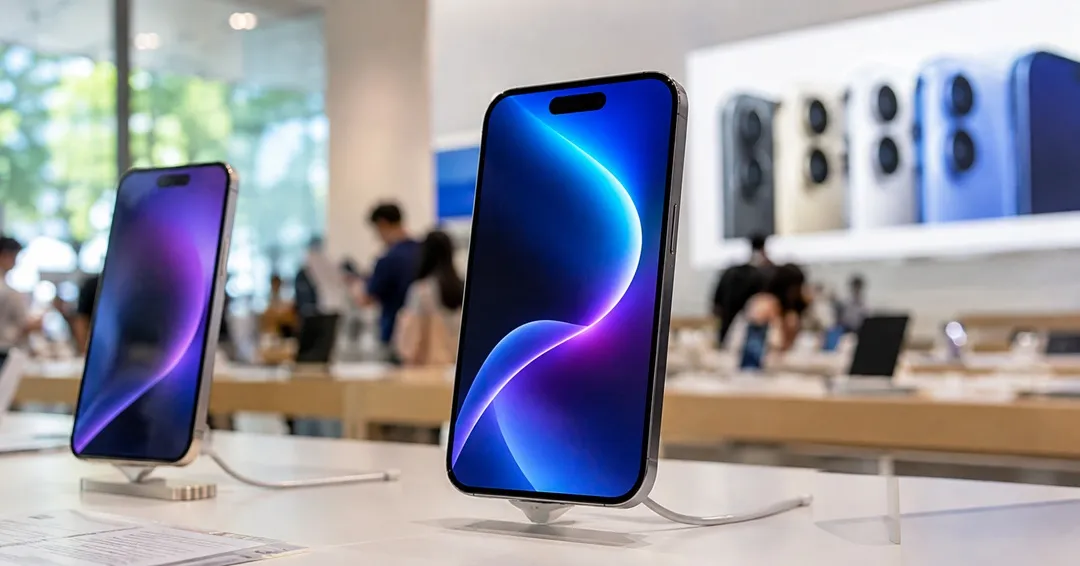
Apple's September 9, 2026 “Surprise and Shine” event will introduce the iPhone 18 Pro, iPhone 18 Pro Max, and the company's first foldable iPhone, each carrying an LTPO+ OLED display upgrade and, in the case of the foldable model, a crease-resistant flexible panel. The launch reinforces demand for premium OLED and flexible display technologies within the global smartphone display market, as outlined in a new report by Knowledge Sourcing Intelligence (KSI), which values the market at USD 58.69 billion in 2026, growing to USD 76.32 billion by 2031.
How iPhone 18 Launch Will Impact the Smartphone Display Market
On September 9, 2026, Apple will host its “Surprise and Shine” event at Apple Park in Cupertino, where the iPhone 18 Pro, and the iPhone 18 Pro Max are expected to be revealed, all being dubbed the iPhone Ultra. The standard iPhone 18 won't be included in this year's lineup, and Apple has scheduled the iPhone 18e and second-generation iPhone Air for launch in the spring of 2027. The split-launch approach enables Apple to focus on the display technology for its 2026 update program, with this year's focus on the Pro versions being the main means of differentiating its hardware offerings.
According to Knowledge Sourcing Intelligence (KSI), the global smartphone display market is expected to expand at a CAGR of 5.39%, growing from USD 58.69 billion in 2026 to USD 76.32 billion by 2031, owing to the increasing adoption of OLED and flexible display technologies, increasing foldable smartphone development, and the use of display specifications as a purchasing and product-differentiation factor across price segments. The use of a more advanced OLED backplane in Apple's higher-end model, as well as the provision of a foldable model for the first time, are telling indicators for the suppliers and investors who are watching the direction of premium display demand.
The iPhone 18 Pro and iPhone 18 Pro Max are expected to retain OLED displays, with reports pointing to a brighter and more power-efficient panel while maintaining the 120Hz adaptive refresh rate. Apple is also rumored to introduce a smaller Dynamic Island, potentially enabled by moving some Face ID components beneath the display, although the extent of the under-display Face ID implementation remains uncertain.
Recent Developments in the Smartphone Display Market
July 2026: . Samsung Electronics announced the next generation of Galaxy foldable devices are bringing new Flex Titanium technology to the market. The display structure's re-designed has been developed over seven generations of folding innovation and engineering, offering a more refined display experience while supporting increased durability and decreased visibility of the fold.
March 2026: Apple announced a new family of displays. The new Studio Display boasts a 12MP Center Stage camera that provides better image quality and supports Desk View, a studio-grade three-microphone array and an immersive sound system of six speakers with Spatial Audio.
Display Supply Chain Shift Adds to Market Momentum
The iPhone 18 cycle is expected to influence the competitive dynamics of the smartphone display industry, with Samsung Display and LG Display reportedly positioned as the primary OLED panel suppliers for the iPhone 18 Pro and iPhone 18 Pro Max. Industry reports indicate that the two Korean suppliers could collectively provide around 90 million OLED panels for the Pro models, while BOE is reportedly excluded from the premium iPhone 18 Pro supply chain amid quality and yield challenges related to LTPO+ technology. However, Apple has not officially disclosed its display supplier allocations or procurement volumes.
How Knowledge Sourcing Intelligence's (KSI) Smartphone Display Market Report Helps
Knowledge Sourcing Intelligence's (KSI) Global Smartphone Display Market report provides a comprehensive and structured analysis of the market, breaking it down into various segments such as Display Technology, Resolution, Display Size, Display Features, Smartphone Segment, and Geography, enabling stakeholders to identify key segments for demand, investment, and competitive opportunities along the value chain.
By Display Technology: This segment separates OLED, AMOLED, TFT-LCD, IPS LCD, and Flexible OLED. Flexible OLED is a key sub-segment, as it will enable the production of foldable and curved devices like Apple's rumored foldable iPhone, and it demands other manufacturing processes and materials than rigid devices.
By Display Features: This segment covers Foldable Displays, Curved Displays, High Refresh Rate Displays, HDR Displays, and Under-Display Fingerprint Displays. It is directly relevant to the iPhone 18 line-up, which is expected to combine a foldable form factor with high refresh rate ProMotion screening and, on the Pro models, under-display biometric sensing.
These segment views enable suppliers, investors, and OEM strategists to see how an individual flagship launch, like the iPhone 18, fits into bigger trends in the adoption of display technologies, regional manufacturing capabilities, and demand for smartphones.
Request a free sample copy or view the report summary: Global Smartphone Display Market Report
Smartphone Display Market Report Highlights
By Display Technology, OLED and AMOLED panels continue to expand across premium and select mid-range smartphones, gaining commercial importance for their use in flexible designs and thinner form factors, while TFT-LCD and IPS LCD continue to serve cost-sensitive categories.
By Display Features, foldable and high-refresh-rate displays are seeing strong investment from leading device manufacturers, with flexible OLED remaining strategically important for new smartphone form factors such as book-style foldables.
Premium smartphone manufacturers are more concerned about the display performance, flexibility and energy efficiency of their smartphones, whereas the manufacturers in the mid-range and entry-level segments are more focused on cost control and supply reliability.
Geographically, Asia Pacific is the hub of global display panel production capacity, with its key markets being China, South Korea, Japan and Taiwan, with North America and Europe having high premium device demand and early adoption of advanced display features.
Smartphone Display Market Growth Drivers and Restraints
Growth Drivers:
Expansion of Premium Smartphone Specifications: Premium smartphone makers are bringing panels with higher resolution, higher refresh rates and are utilizing OLED panels, including LTPO+ displays, which are anticipated on the iPhone 18 Pro family.
Growth of Flexible and Foldable Smartphone Designs: Foldable smartphones, such as Apple's upcoming first foldable iPhone, demand a specialized flexible display architecture and materials, which are expected to generate investment in flexible OLED technology.
Restraints:
High Manufacturing Complexity and Cost: Producing flexible OLED and LTPO+ panels requires specialized equipment and precise process control; yield challenges, such as those reportedly affecting BOE's LTPO+ output, can raise production costs.
Price Pressure Across Smartphone Categories: Manufacturers continue to manage component costs closely, particularly in mid-range and entry-level segments, pressuring display suppliers to balance performance with competitive pricing.
Market Segmentation:
Segmentation | Subsegments |
|---|---|
Display Technology | OLED, AMOLED, TFT-LCD, IPS LCD, Flexible OLED, Others |
Resolution | HD (720p), Full HD / Full HD+, QHD / QHD+, 4K and Above, Others |
Display Size | Below 5 Inches, 5 – 6 Inches, 6 – 6.5 Inches, Above 6.5 Inches |
Display Features | Foldable Displays, Curved Displays, High Refresh Rate Displays, HDR Displays, Under-Display Fingerprint Displays, Others |
Smartphone Segment | Premium Smartphones, Mid-Range Smartphones, Entry-Level Smartphones |
Geography | North America, South America, Europe, Middle East and Africa, Asia Pacific |
Smartphone Display Market Key Players
Samsung Display
LG Display
BOE Technology Group Co., Ltd.
TCL CSOT
Visionox Technology Inc.
Sharp Corporation
Japan Display Inc.
AUO Corporation
Innolux Corporation
Apple Inc.
Similar Reports:
Have questions?
More Press Releases
Autonomous Vehicle Interior Market to Reach USD 26.53 Billion by 2031, Driven by AI-Powered Smart Cockpits and Human-Machine Interfaces
The global autonomous vehicle interior market is expanding as AI-powered smart cockpits, advanced human-machine interfaces, and occupant monitoring technologies transform in-vehicle experiences. Growing adoption of software-defined vehicle architectures, connected infotainment, and personalized cabin systems is creating opportunities for automotive suppliers as higher-level vehicle automation advances across global markets.
Data Center Silicon Photonics Market to Reach USD 23.1 Billion by 2032, Driven by AI Infrastructure and Co-Packaged Optics Adoption
The global data center silicon photonics market is expanding as AI infrastructure, hyperscale computing, and high-bandwidth networking increase demand for advanced optical connectivity. Innovations in co-packaged optics, photonic integrated circuits, and energy-efficient interconnects are creating growth opportunities, while manufacturing scalability, thermal management, and integration costs remain important industry considerations.
Global Automotive Thermal Comfort Systems Market to Reach USD 22.5 Billion by 2031, Driven by Heat Pump Adoption in Electric Vehicles
The global automotive thermal comfort systems market is projected to reach USD 22.5 billion by 2031, driven by electric vehicle adoption, heat pump integration, and energy-efficient cabin heating. Advances in integrated thermal management, localized heating, and intelligent climate control are creating opportunities for automotive suppliers worldwide.