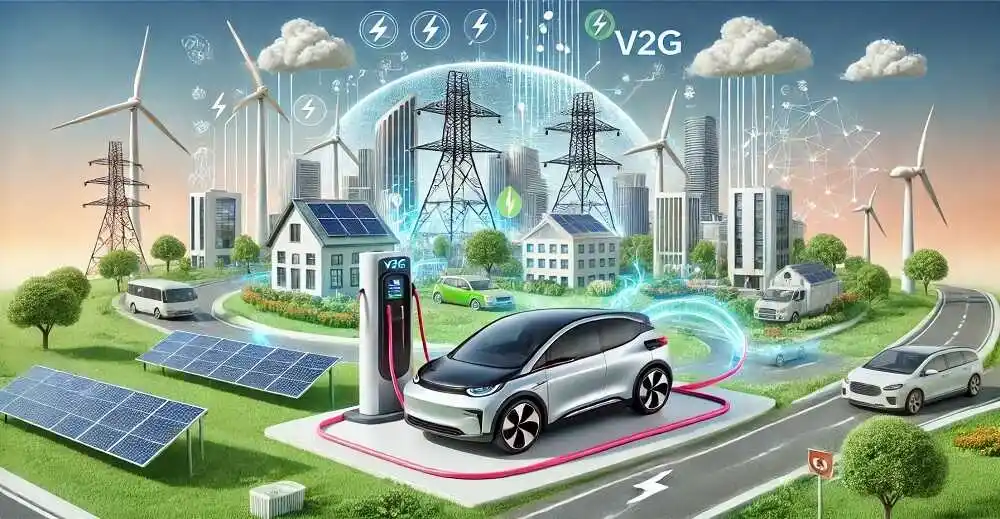
Vehicle-to-grid (V2G) is a technology that provides electric vehicles (EVs) to form a two-way association with the public power grid. The innovation of V2G makes it possible for EVs to not only utilize electricity from the grid but also recharge the framework in case power is abundant within the veh...
 Source: International Energy Agency (IEA)
In addition, it is estimated that the Asia Pacific region will have a substantial share in the V2G market enfolding EVs in grid stabilization, which will primarily be due to increasing government policies and funding on EVs and V2G implementation. The emerging Asia Pacific region incorporates one of the largest and the most growing EV markets in the world with several developed and developing countries such as China, India, Japan, Vietnam, and Malaysia, and several others witnessing development in the EV industry which has resulted in increased energy and power demand in the region.
The Asia Pacific region is ranked among the largest regions carrying out vehicle electrification at the global scale with a large portion of EVs manufactured and consumed from Asia commencing with China, followed by India and Japan. Development of important networks necessary for the functioning of EVs is witnessed in these countries which is further expected to accelerate several EV-centric technologies such as V2G, V2H, and V2X. According to the Malaysian Green Technology and Climate Change Corporation, total sales of electric vehicles in Malaysia increased in 2023 reaching a growth of around 286% when compared to 2022. The number of EVs that were registered and sold in Malaysia in 2023 was approximately 10,159 vehicles, while it was only 2,631 vehicles that were sold back in 2022. Also, the International Trade Administration of the USA stated that the number of registered EVs in Taiwan increased from about 7,064 in 2021 to 16,106 in the year 2022. Moreover, this organization indicated that in 2022, approximately 3.4% of all new vehicle registrations in the country were for EV passenger cars.
Key Developments:
Source: International Energy Agency (IEA)
In addition, it is estimated that the Asia Pacific region will have a substantial share in the V2G market enfolding EVs in grid stabilization, which will primarily be due to increasing government policies and funding on EVs and V2G implementation. The emerging Asia Pacific region incorporates one of the largest and the most growing EV markets in the world with several developed and developing countries such as China, India, Japan, Vietnam, and Malaysia, and several others witnessing development in the EV industry which has resulted in increased energy and power demand in the region.
The Asia Pacific region is ranked among the largest regions carrying out vehicle electrification at the global scale with a large portion of EVs manufactured and consumed from Asia commencing with China, followed by India and Japan. Development of important networks necessary for the functioning of EVs is witnessed in these countries which is further expected to accelerate several EV-centric technologies such as V2G, V2H, and V2X. According to the Malaysian Green Technology and Climate Change Corporation, total sales of electric vehicles in Malaysia increased in 2023 reaching a growth of around 286% when compared to 2022. The number of EVs that were registered and sold in Malaysia in 2023 was approximately 10,159 vehicles, while it was only 2,631 vehicles that were sold back in 2022. Also, the International Trade Administration of the USA stated that the number of registered EVs in Taiwan increased from about 7,064 in 2021 to 16,106 in the year 2022. Moreover, this organization indicated that in 2022, approximately 3.4% of all new vehicle registrations in the country were for EV passenger cars.
Key Developments:
| Year | Development |
| November 2024 | Nuvve Holding Corp. partnered with Las Cruces Public Schools in New Mexico and successfully commenced the deployment of its first-ever electric school buses with vehicle-to-grid connection (V2G) technology. The development is a big step towards growing the EVs in schools with the assistance of Nuvve and their platform is even due for rapid growth in the transport sector electrification. |
| June 2024 | Toyota and Pepco conducted studies on V2G systems for battery electric vehicles (BEVs) in Maryland. The partnership focused on bidirectional charged power generated technology with redistributive capabilities that allow charging of the BEV and even provision of electric power back to the grid. This enhances energy reliability, and resilience, assists in better integration of renewables, and even helps in lowering energy tariffs. The partnership also focused on consumers’ EV ownership and use with the intent of encouraging the installation of V2G systems. |
| May 2024 | Tata Power Delhi Distribution Limited, a prominent power utility in North Delhi, entered into a Memorandum of Understanding (MoU) with the India Smart Grid Forum for setting up a V2G Technology Demonstration Project. The purpose of the pilot project is to demonstrate the key components in the operation of EVs with the grid, to promote low-carbon transportation and energy systems. |
| November 2023 | Blink Charging UK unveiled the new EQ 200 advanced charger technology set to be used in the UK and Ireland. EQ 200 is a V2G-enabled scalable bi-directional charging solution intended to facilitate the establishment of a robust EV charging ecosystem and bridge the gap between fixed charging and more active, renewable energy management. It consists of Bluetooth, Wi-Fi, and Ethernet connection, as well as 2G and 4G enabled to communicate with load balancing systems and intelligent energy management systems enabling the V2G and VTX, where the vehicle can communicate with everything. |
Have questions?
More Thought Articles
How EV Charger Manufacturers Can Capitalize on India’s Home Charging Revolution
India’s residential EV charging opportunity is expanding as policy support, EV adoption, and private parking infrastructure develop. Manufacturers can capture value beyond AC chargers through installation, smart charging, load management, solar integration, software, and after-sales services. Housing societies, automakers, and property developers offer scalable routes to residential charging customers.
Second-Life EV Battery Market in India: What Is Driving Demand from Manufacturers?
India’s second-life EV battery market is gaining relevance as electric vehicle adoption expands and batteries retain useful capacity after automotive service. Growing stationary-storage demand, battery data, refurbishment capabilities, EPR obligations, and critical-mineral policies are encouraging manufacturers to extend battery value through reuse before eventual recycling within India’s emerging circular battery ecosystem.
The Rise of Locally Manufactured Battery Separators in India’s EV Ecosystem
India’s battery industry is progressing from pack assembly toward domestic cell and material manufacturing, creating opportunities for lithium-ion battery separators. Policy support, ACC capacity expansion and R&D initiatives are strengthening the ecosystem. However, technical complexity, manufacturing yields, qualification requirements and economics mean localisation will likely advance gradually through coatings, testing and finishing.