
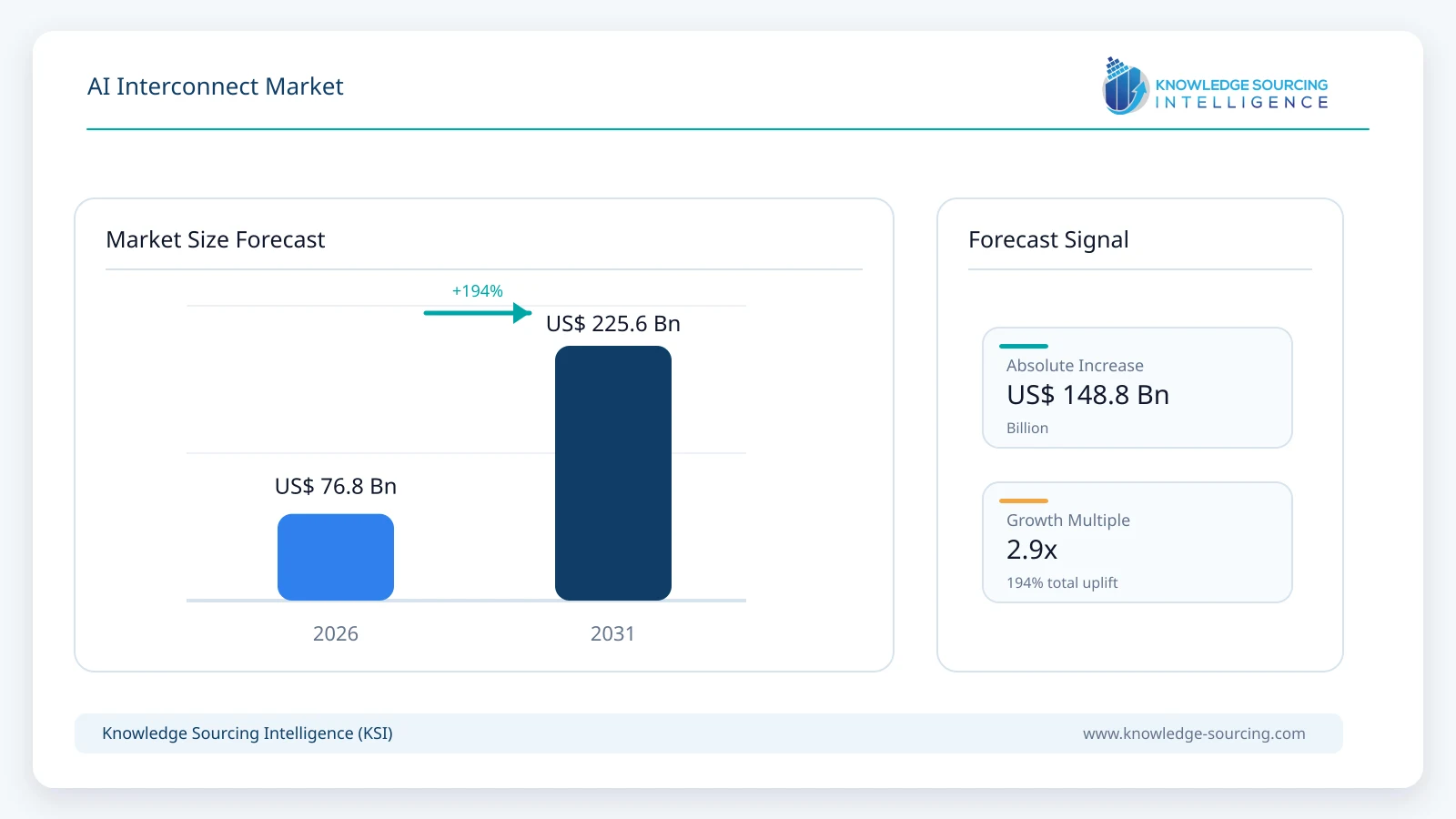
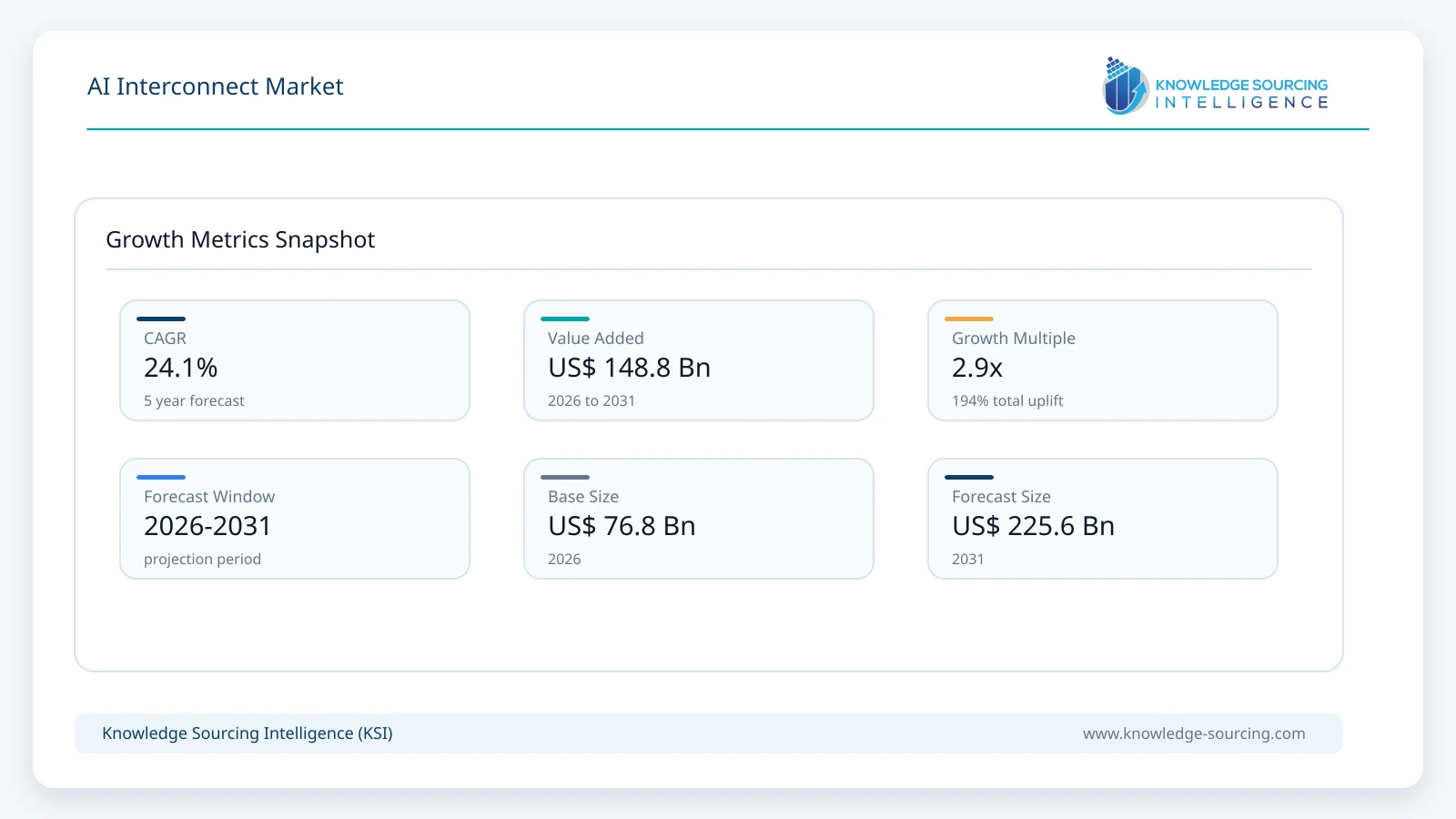
The AI Interconnect Market is projected to expand at a CAGR of 24.1%, increasing from USD 76.8 billion in 2026 to USD 225.6 billion by 2031.
Highlights:
- 1Complete switching and fabric systems are estimated to represent 53.0% of 2026 AI interconnect market value, supported by complex accelerator scale-up and scale-out deployments.
- 2Scale-out cluster fabrics account for approximately 51.8% of market revenue in 2026, reflecting the need to connect GPUs across numerous servers and racks.
- 3Proprietary accelerator fabrics contribute about 37.8% of 2026 market value, while AI-optimized Ethernet represents a growing multi-vendor alternative.
- 4North America contributes approximately 60.0% of estimated 2026 revenue because major frontier AI and hyperscale data-center deployments remain concentrated in the United States.
- 5Asia Pacific is forecast to show the strongest regional growth through 2031, supported by large domestic AI infrastructure programs and expanding advanced networking supply chains.
The market includes network switching and accelerator-fabric systems, network adapters, qualified optical modules, cables and merchant connectivity components installed to connect AI processors within racks, across clusters and between data centers. Purchases are increasingly driven by AI training communications and by the sustained token-generation demands of large inference services.
Integrated accelerator fabrics and scale-out network platforms now require close coordination between GPU architecture, switch silicon, congestion-control software and physical transmission media. NVIDIA supplies NVLink, Spectrum-X Ethernet and Quantum InfiniBand systems; Broadcom and Cisco provide high-bandwidth switching technology, while specialist optical and cable suppliers deliver the links required at rising port speeds. The commercial value of connectivity depends not simply on the number of accelerators installed but also on network topology, bandwidth per processor, oversubscription, distance and equipment refresh cycles.
Market Overview
Distributed AI training relies on frequent collective communication between accelerator devices. Operations such as all-reduce and all-to-all exchange can slow a cluster when packets encounter congestion, uneven routing, or insufficient link capacity. Each requires different bandwidth, distance, latency, and software characteristics, so the interconnect system is designed alongside the compute platform rather than procured as an ordinary office network.
NVIDIA reported USD 31.376 billion of Data Center networking revenue in its fiscal year ended January 2026, compared with USD 12.990 billion in the preceding year. The company attributed the increase partly to NVLink compute fabric adoption alongside Ethernet and InfiniBand growth. The rapid increase in networking investment demonstrates how bandwidth and fabric architecture have become strategic features of AI infrastructure.
Optical connectivity is advancing alongside electrical scale-up links. Marvell has expanded 1.6 Tbps optical DSP products, Coherent has demonstrated higher-density optical module architectures, and Credo supplies active cable technologies for short-reach connectivity. Customers may continue using copper inside a rack while shifting more high-bandwidth links to optics between racks, and a supplier qualified in one part of the fabric is not automatically qualified across every application.
Market Trends
Scale-Up Networks Are Expanding Beyond the Traditional Server Boundary
Rack-scale accelerator systems increasingly organize dozens of GPUs around a low-latency switching fabric, allowing processors to exchange data at higher bandwidth than conventional external networking. As accelerator density increases, connectors, cable reach, and switch power constrain how far an electrical fabric can be extended without changing the system architecture.
The Ultra Accelerator Link Consortium is developing an open scale-up standard intended to connect large groups of accelerators without relying on one supplier ecosystem. Open fabric products will require real qualification and deployment time, but they could alter procurement choices for operators planning multi-generation accelerator estates.
AI-Optimized Ethernet Is Challenging Traditional Cluster Networking
Large GPU clusters place unusual demands on Ethernet switches because synchronized model-training traffic can create rapid bursts and congestion hotspots. Buyers increasingly examine actual workload completion time and sustained fabric utilization instead of treating nominal port speed as the sole measure of network quality.
The Ultra Ethernet Consortium released Specification 1.0 in June 2025, covering improvements across networking adapters, switches, optics and cabling. These developments broaden the potential multi-vendor Ethernet ecosystem, although interoperability validation, software maturity and congestion behavior remain important selection criteria.
Optical Bandwidth Is Moving Toward 1.6 Terabits Per Second
Higher port speeds increase the optical capacity required between switches and racks, particularly as 800G networks scale and 1.6T interfaces enter newer designs. Optical module revenue is therefore affected by both the number of links installed and the shift to higher-value transceiver formats.
The economics of photonics differ by distance and integration. CPO-based network designs could change component packaging and maintenance procedures, influencing suppliers that provide optics, switch silicon and system integration.
Power and Reliability Are Becoming Primary Procurement Tests
Interconnect power consumption is growing as AI factories add network ports and increase speed per lane. Cisco has introduced liquid-cooled high-capacity switching configurations, and NVIDIA is advancing silicon-photonics switches to reduce power consumption in very large AI networks.
Operators also evaluate the cost of dropped links and intermittent faults because a single impaired network path can delay many GPUs working on the same model. Shorter and more reliable job completion times can justify higher interconnect spending even when two vendors offer similar headline throughput.
Distributed AI Sites Are Creating a Scale-Across Market
Frontier AI operators are beginning to link computing resources across multiple buildings, campuses and metropolitan locations rather than relying exclusively on one cluster room. Marvell introduced 1.6T ZR/ZR+ products, while Ciena has documented WaveLogic-based data-center interconnect deployments.
Inter-site networks face different engineering constraints from intra-rack links because fiber reach, latency, and network resilience can limit which AI workloads are practically distributed. As a result, scale-across revenue should increase without being assumed to replace local scale-out networking.
Segment Analysis
By Hardware and Offering: Complete Switches and Fabric Systems
Complete switching and fabric systems are the largest spending category because accelerator pods require many coordinated links, switch devices, software, and validated configurations. Customers often buy complete platforms to reduce design risk, even when merchant semiconductors are available separately.
Global revenue from complete switches and fabric systems is projected to reach approximately USD 115.4 billion in 2031, compared with USD 40.7 billion in 2026. Integrated suppliers increasingly differentiate through validated system performance, support arrangements and the speed of deploying complete accelerator clusters.
By Interconnect Role: Scale-Out Cluster Fabrics
Scale-out networks connect GPUs across server trays, racks and complete cluster halls, making them essential to distributed training and expanding inference platforms. AI-specific features, including traffic balancing and congestion response, help maintain useful compute throughput during synchronized collective communication.
Scale-out interconnect spending is projected to rise from approximately USD 39.8 billion in 2026 to USD 111.3 billion by 2031. The segment will face competition between integrated fabric platforms and more open Ethernet designs, rather than between nominal interface speeds alone.
By Networking Technology: AI Ethernet and RoCE
AI Ethernet and RoCE networks increasingly offer an alternative to proprietary or InfiniBand-centered cluster fabrics. Broadcom, Cisco, Arista, NVIDIA and AMD participate at different layers of the emerging ecosystem, from switching silicon to finished networking systems and adapters.
The AI Ethernet, RoCE and UEC-ready category is estimated to expand from USD 25.6 billion in 2026 to approximately USD 91.1 billion in 2031. Growing protocol openness does not eliminate testing costs or guarantee simple cross-vendor substitution.
Market Drivers
Expansion of Large-Scale Accelerator Clusters
New AI factories connect accelerators through several fabric layers, generating interconnect demand with each added GPU rack. Network equipment spending is influenced by the number of active accelerator ports, switch radix, redundancy, and the length of the installed links, not merely by aggregate data-center floor space.
Growth is particularly meaningful for operators deploying very large training clusters, where collective communication requires high bandwidth between compute domains. Higher computing densities also increase the specification requirements for adapters, optics and physical cable assemblies.
Increasing Bandwidth per Accelerator
Each generation of AI processors increases the need to exchange model states and move data without leaving compute units idle. This generates upgrade demand even when an operator does not increase its installed accelerator count.
Port density changes network architecture and link economics. Higher-performance silicon can consequently shift spending among switches, modules and cables without producing one-for-one growth in every product category.
Growth of Distributed Inference Capacity
High-volume generative inference increasingly uses clusters serving many customers, with traffic patterns that differ from those of batch model training. More inference infrastructure expands demand for high-availability fabrics and network performance isolation, especially when multiple tenants share accelerator pools.
Network adapters and switching platforms that maintain stable tail latency can improve the productive output of costly processors. Inference growth broadens the buyer base beyond a small number of frontier model-development groups.
Adoption of Open Network and Accelerator Standards
The Ultra Ethernet Consortium and UALink Consortium are developing standards intended to widen equipment and accelerator interoperability. Broader participation can increase the number of suppliers competing for a defined portion of AI infrastructure spending.
Open standards also create an avenue for silicon and connector vendors to design products with larger addressable customer bases. Those requirements are substantial, but their completion can support repeat procurement across data-center generations.
Expansion of High-Capacity Optical Links
Dense clusters require more optical connections as the distance between computing domains increases and electrical links reach thermal and signal-integrity limits. Marvell, Coherent and Lumentum are developing products for 800G, 1.6T and later optical configurations, while NVIDIA is adopting co-packaged optical approaches for selected high-capacity switches.
Optics can command a larger share of the interconnect bill when longer reach and higher bandwidth become necessary. This differentiated media mix supports growth in several product families rather than a uniform replacement cycle.
Market Restraints
High Power Consumption and Cooling Requirements
AI networking equipment contributes to a computing facility’s power demand through high-capacity switch ASICs, optical modules, cables with active electronics, and network adapters. Operators must evaluate electrical infrastructure and thermal performance before adopting the newest interfaces.
Alternative designs can reduce one cost while raising another. These trade-offs can slow platform changes when power availability or service risk is already limiting deployment.
Interoperability and Software Qualification
Multi-vendor AI networks must coordinate adapters, switch firmware, traffic management, and host networking software under intense synchronized workloads. Failure diagnosis also becomes more complex when hardware comes from several suppliers.
The deployment burden is particularly high for organizations moving from one fabric architecture to another. Open standards may improve competition over time, but qualification spending remains necessary during transitions between generations.
Optical Component Capacity and Yield Constraints
Advanced transceivers depend on optical engines, lasers, DSPs, packaging and test processes that cannot always be expanded as quickly as data-center purchase commitments. Products operating at 1.6T require tighter signal-integrity and thermal tolerances, while new co-packaged approaches involve complex optical integration alongside switch silicon.
Constrained component yields or qualified-factory capacity can delay whole-cluster commissioning because a fabric requires many matched links. This makes supplier qualification and capacity commitments important factors in sourcing strategy.
Rapid Technology Replacement and Capital Allocation
High-speed network platforms move through generations of faster switch silicon, NICs and optical standards over relatively short periods. New equipment may offer lower cost per transmitted bit but require meaningful replacement expenditure.
Investment decisions become more difficult when AI infrastructure projects are subject to uncertain capacity schedules. Delays can create idle hardware, while a premature platform transition may increase integration work without immediately improving workload economics.
Concentration of Large AI Infrastructure Buyers
The highest-bandwidth AI fabrics are often purchased by a relatively small group of hyperscalers, frontier AI organizations and GPU-cloud providers. Supplier success may therefore depend heavily on a limited number of large design wins.
Demand concentration also increases the impact of project postponements or changes in accelerator architectures. Diversified customer coverage and compatibility with alternative platforms can reduce this exposure, although both require additional development investment.
Regional Outlook
North America
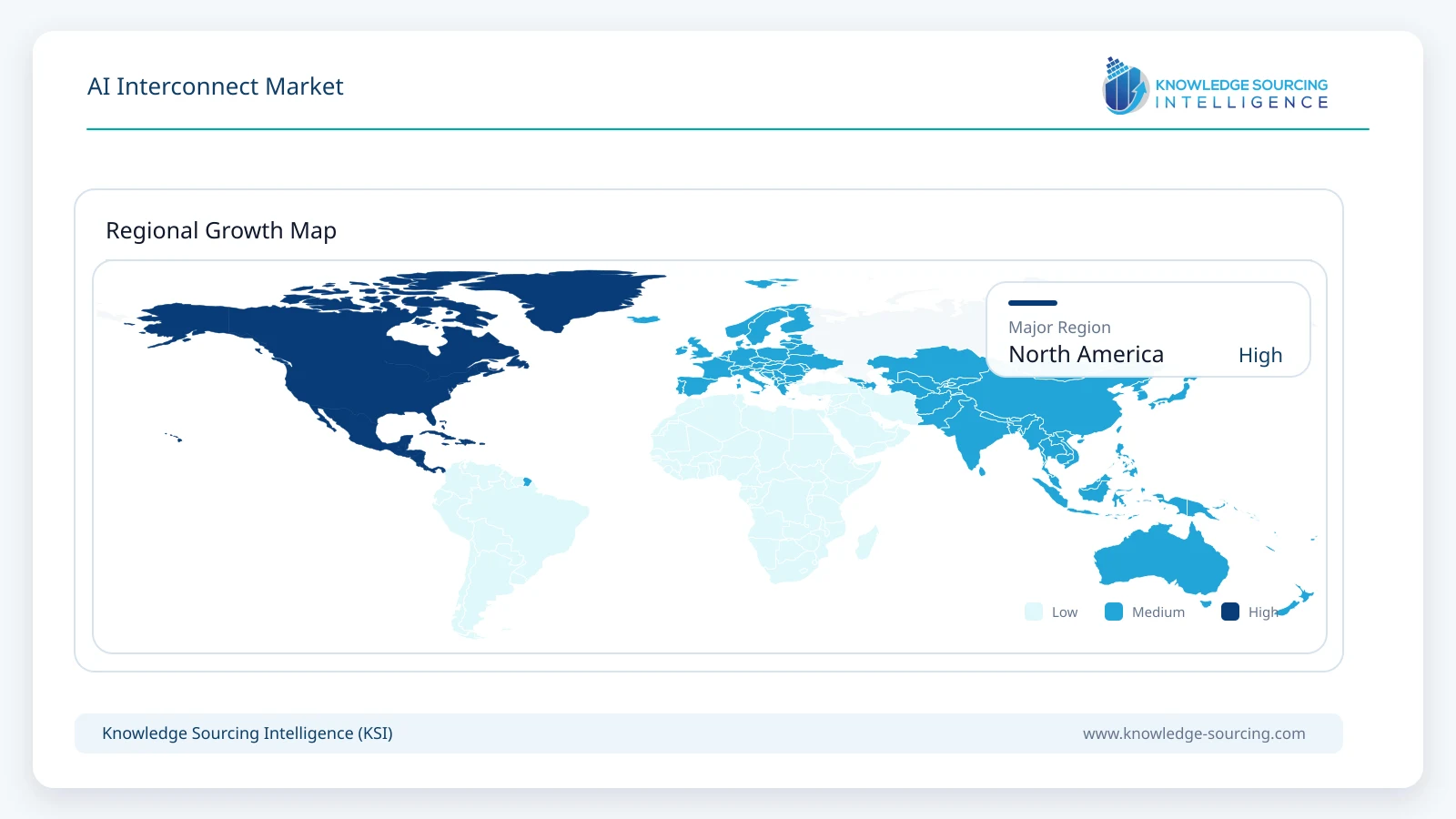
North America is estimated to account for USD 46.1 billion, or approximately 60.0%, of the global AI interconnect market in 2026. The United States hosts many of the largest cloud, frontier model, and AI infrastructure operators, and their cluster buildouts require dense accelerator fabrics, high-speed switches, and qualified optical supply. The region also contains major vendors developing switching systems, programmable NICs and interconnect semiconductors, supporting relatively rapid equipment qualification and deployment.
Regional market value is projected to reach approximately USD 113.6 billion by 2031 as computing capacity expands and installed clusters adopt newer interconnect generations. Growth will be supported by AI training and inference deployments, but the regional share is expected to decline as Asia Pacific builds out more domestic AI capacity. North American operators are also likely to influence industry standards through large-scale testing and purchasing specifications.
Asia Pacific
Asia Pacific combines large AI compute markets with substantial semiconductor assembly, optical-component and electronics-manufacturing capabilities. China, Japan, South Korea, India, Taiwan and Singapore differ in cloud adoption, access to accelerators and domestic infrastructure policy. However, regional demand for high-speed switching, optical links and accelerator connectivity is strengthening as more organizations deploy purpose-built AI clusters.
Asia Pacific market revenue is projected to grow from approximately USD 18.5 billion in 2026 to USD 76.7 billion in 2031, making it the fastest-growing major region in the forecast. The commercial mix should increasingly include high-speed Ethernet, domestically integrated systems and higher-density optical interconnects. Trade restrictions, local ecosystem compatibility and facility power availability will influence which technologies gain share in individual countries.
Competitive Landscape
NVIDIA occupies a strong integrated position through accelerator-scale NVLink fabrics, Spectrum-X Ethernet, Quantum InfiniBand and network adapters sold into AI computing systems. Other vendors compete through merchant silicon, finished networking systems and dedicated optical products rather than through a single interchangeable product class.
Broadcom supplies switching silicon and high-speed connectivity components used by system manufacturers, while Cisco and Arista offer network systems with AI-focused management and traffic capabilities. These participants can benefit from growing Ethernet interoperability, although design wins, validation cycles and delivery capacity affect the speed of revenue conversion.
The optical and physical connectivity ecosystem includes Coherent, Lumentum, Credo, Amphenol and related module or cable suppliers. Astera Labs develops fabric switching technology for accelerator connectivity, while Ciena supplies coherent systems for larger inter-site connections. The strongest company position in one technology does not automatically imply leadership across the full interconnect market.
Recent Developments
October 2026: Cisco announced initial shipments of G300-powered AI switching systems and introduced its G302 51.2T top-of-rack silicon roadmap, expanding its options for AI fabric deployments.
October 2026: Credo unveiled its 1.6T ZeroFlap active light cable architecture for row-scale AI networking, signaling growing interest in lower-power optical links over intermediate distances.
October 2026: Lumentum, Astera Labs and Corning demonstrated PCIe-over-optics connectivity for AI rack-scale systems, providing a development reference for optical alternatives to some electrical links.
July 2026: NVIDIA announced Spectrum-6 102.4 Tbps networking systems for Vera Rubin AI platforms, highlighting the continued increase in bandwidth required by large AI factories.
March 2026: Broadcom announced production-volume shipments of its Tomahawk 6 102.4 Tbps switch family, supporting higher-capacity AI Ethernet architectures.
February 2026: Marvell completed its acquisition of XConn Technologies, adding PCIe and CXL switching capabilities and strengthening its development route for future open accelerator fabrics.
Market Outlook
AI interconnect architecture will remain closely tied to the commercial performance of accelerator platforms. Scale-out networking should remain a major revenue pool as training and inference workloads expand beyond individual racks and campuses.
Optical connectivity is expected to capture an increasing share of market value as 1.6T interfaces and more integrated optical switching products enter customer deployments. The pace of change will depend on qualified manufacturing supply, interoperability and serviceability rather than headline throughput alone.
North America is expected to retain the largest market position through 2031, while Asia Pacific increases its contribution as domestic AI infrastructure grows. Customers will judge offerings on sustained model-training and inference performance alongside total infrastructure cost.
AI Interconnect Market Scope:
| Report Metric | Details |
|---|---|
| Total Market Size in 2026 | USD 76.8 billion |
| Total Market Size in 2031 | USD 225.6 billion |
| Forecast Unit | USD Billion |
| Growth Rate | 24.1% |
| Study Period | 2021 to 2031 |
| Historical Data | 2021 to 2024 |
| Base Year | 2025 |
| Forecast Period | 2026 – 2031 |
| Segmentation | Hardware And Offering, Interconnect Role, Networking Technology, Transmission Medium |
| Companies |
|
| Customization Scope | 15% Free Customization included with purchase — Request Custom Breakdown → |
| Sample & Data Access | PDF Sample, Excel Databook & Analyst Briefing — Download Free Sample → |
Market Segmentation
By Hardware And Offering
Complete switches and fabric systems
Network adapters, SuperNICs and DPUs
Optical modules and engines
Electrical cables and connectors
Direct merchant silicon, retimers and IP
By Interconnect Role
Scale-up accelerator fabrics
Scale-out cluster fabrics
Scale-across inter-data-center fabrics
By Networking Technology
AI Ethernet, RoCE and UEC-ready
InfiniBand
Proprietary accelerator fabrics
Open accelerator fabrics, PCIe and CXL
By Transmission Medium
Primarily electrical interconnects
Primarily optical interconnects
By Customer Type
Hyperscalers and frontier AI labs
Neocloud and GPU-cloud operators
Enterprise, sovereign AI and HPC operators
By AI Workload
Training-dominant clusters
Inference-dominant clusters
Mixed training and inference
By Procurement Approach
Integrated OEM or platform fabrics
Standalone merchant fabric systems
Component-only merchant procurement
By Geography
North America
United States
Canada
Mexico
South America
Brazil
Argentina
Rest of South America
Europe
Germany
United Kingdom
France
Netherlands
Italy
Spain
Rest of Europe
Middle East and Africa
United Arab Emirates
Saudi Arabia
South Africa
Rest of Middle East and Africa
Asia Pacific
China
Japan
South Korea
India
Taiwan
Singapore
Australia
Rest of Asia Pacific
Table of Contents
1. EXECUTIVE SUMMARY
1.1. Market Opportunity and Key Findings
1.2. AI Interconnect Market Size and Forecast, 2026-2031
1.3. Technology and Regional Outlook
2. MARKET SNAPSHOT
2.1. Market Overview
2.2. Market Definition and Scope
2.3. Value Chain and Revenue Boundary
2.4. Market Segmentation
3. BUSINESS LANDSCAPE
3.1. Market Drivers
3.1.1. Expansion of Large-Scale Accelerator Clusters
3.1.2. Increasing Bandwidth per Accelerator
3.1.3. Growth of Distributed Inference Capacity
3.1.4. Adoption of Open Network and Accelerator Standards
3.1.5. Expansion of High-Capacity Optical Links
3.2. Market Restraints
3.2.1. Power Consumption and Cooling Requirements
3.2.2. Interoperability and Software Qualification
3.2.3. Optical Component Capacity and Yield Constraints
3.2.4. Rapid Technology Replacement and Capital Allocation
3.2.5. Concentration of Large AI Infrastructure Buyers
3.3. Market Opportunities
3.4. Porter’s Five Forces Analysis
3.5. Industry Value Chain Analysis
3.6. Standards, Trade and Regulatory Environment
3.7. Strategic Recommendations
4. TECHNOLOGICAL OUTLOOK
4.1. GPU and Accelerator Scale-Up Fabrics
4.2. AI-Optimized Ethernet and UEC
4.3. InfiniBand and Network Offload
4.4. Optical Transceivers and 1.6T Connectivity
4.5. Co-Packaged Optics and Short-Reach Electrical Links
4.6. Scale-Across Optical Interconnects
5. AI INTERCONNECT MARKET BY HARDWARE AND OFFERING
5.1. Introduction
5.2. Complete switches and fabric systems
5.3. Network adapters, SuperNICs and DPUs
5.4. Optical modules and engines
5.5. Electrical cables and connectors
5.6. Direct merchant silicon, retimers and IP
6. AI INTERCONNECT MARKET BY INTERCONNECT ROLE
6.1. Introduction
6.2. Scale-up accelerator fabrics
6.3. Scale-out cluster fabrics
6.4. Scale-across inter-data-center fabrics
7. AI INTERCONNECT MARKET BY NETWORKING TECHNOLOGY
7.1. Introduction
7.2. AI Ethernet, RoCE and UEC-ready
7.3. InfiniBand
7.4. Proprietary accelerator fabrics
7.5. Open accelerator fabrics, PCIe and CXL
8. AI INTERCONNECT MARKET BY TRANSMISSION MEDIUM
8.1. Introduction
8.2. Primarily electrical interconnects
8.3. Primarily optical interconnects
9. AI INTERCONNECT MARKET BY CUSTOMER TYPE
9.1. Introduction
9.2. Hyperscalers and frontier AI labs
9.3. Neocloud and GPU-cloud operators
9.4. Enterprise, sovereign AI and HPC operators
10. AI INTERCONNECT MARKET BY AI WORKLOAD
10.1. Introduction
10.2. Training-dominant clusters
10.3. Inference-dominant clusters
10.4. Mixed training and inference
11. AI INTERCONNECT MARKET BY PROCUREMENT APPROACH
11.1. Introduction
11.2. Integrated OEM or platform fabrics
11.3. Standalone merchant fabric systems
11.4. Component-only merchant procurement
12. AI INTERCONNECT MARKET BY GEOGRAPHY
12.1. North America
12.1.1. United States
12.1.2. Canada
12.1.3. Mexico
12.2. South America
12.2.1. Brazil
12.2.2. Argentina
12.2.3. Rest of South America
12.3. Europe
12.3.1. Germany
12.3.2. United Kingdom
12.3.3. France
12.3.4. Netherlands
12.3.5. Italy
12.3.6. Spain
12.3.7. Rest of Europe
12.4. Middle East and Africa
12.4.1. United Arab Emirates
12.4.2. Saudi Arabia
12.4.3. South Africa
12.4.4. Rest of Middle East and Africa
12.5. Asia Pacific
12.5.1. China
12.5.2. Japan
12.5.3. South Korea
12.5.4. India
12.5.5. Taiwan
12.5.6. Singapore
12.5.7. Australia
12.5.8. Rest of Asia Pacific
13. COMPETITIVE ENVIRONMENT AND ANALYSIS
13.1. Major Players and Strategy Analysis
13.2. Market Share Analysis
13.3. Mergers, Acquisitions, Agreements and Collaborations
13.4. Competitive Dashboard
14. COMPANY PROFILES
14.1. NVIDIA Corporation
14.2. Broadcom Inc.
14.3. Cisco Systems, Inc.
14.4. Arista Networks, Inc.
14.5. Marvell Technology, Inc.
14.6. Advanced Micro Devices, Inc.
14.7. Coherent Corp.
14.8. Lumentum Holdings Inc.
14.9. Astera Labs, Inc.
14.10. Credo Technology Group Holding Ltd
14.11. Amphenol Corporation
14.12. Ciena Corporation
14.13. Hewlett Packard Enterprise Company
15. APPENDIX
15.1. Definitions and Acronyms
15.2. Research Methodology and Sources
15.3. Forecast Assumptions





Frequently asked questions
What is the projected AI Interconnect market size by 2031?
The AI Interconnect Market is forecast to reach USD 225.6 billion by 2031.
What is the Compound Annual Growth Rate (CAGR) for the AI Interconnect market?
The AI Interconnect Market is projected to expand at a 24.1% CAGR.
Which region holds the largest share of the AI Interconnect market?
North America contributes approximately 60.0% of estimated 2026 revenue.
Which region is forecast for the strongest growth in AI Interconnects?
Asia Pacific is forecast for the strongest regional growth through 2031.
What is the largest segment of the AI Interconnect market in 2026?
Complete switching and fabric systems represent 53.0% of 2026 market value.
What are the main drivers for AI Interconnect market growth?
AI training communications and large inference services drive purchases.
Cite this report
Knowledge Sourcing Intelligence. (Oct 2026). AI Interconnect Market Size, Share & Growth Forecast (2026-2031). https://www.knowledge-sourcing.com/report/ai-interconnect-market