
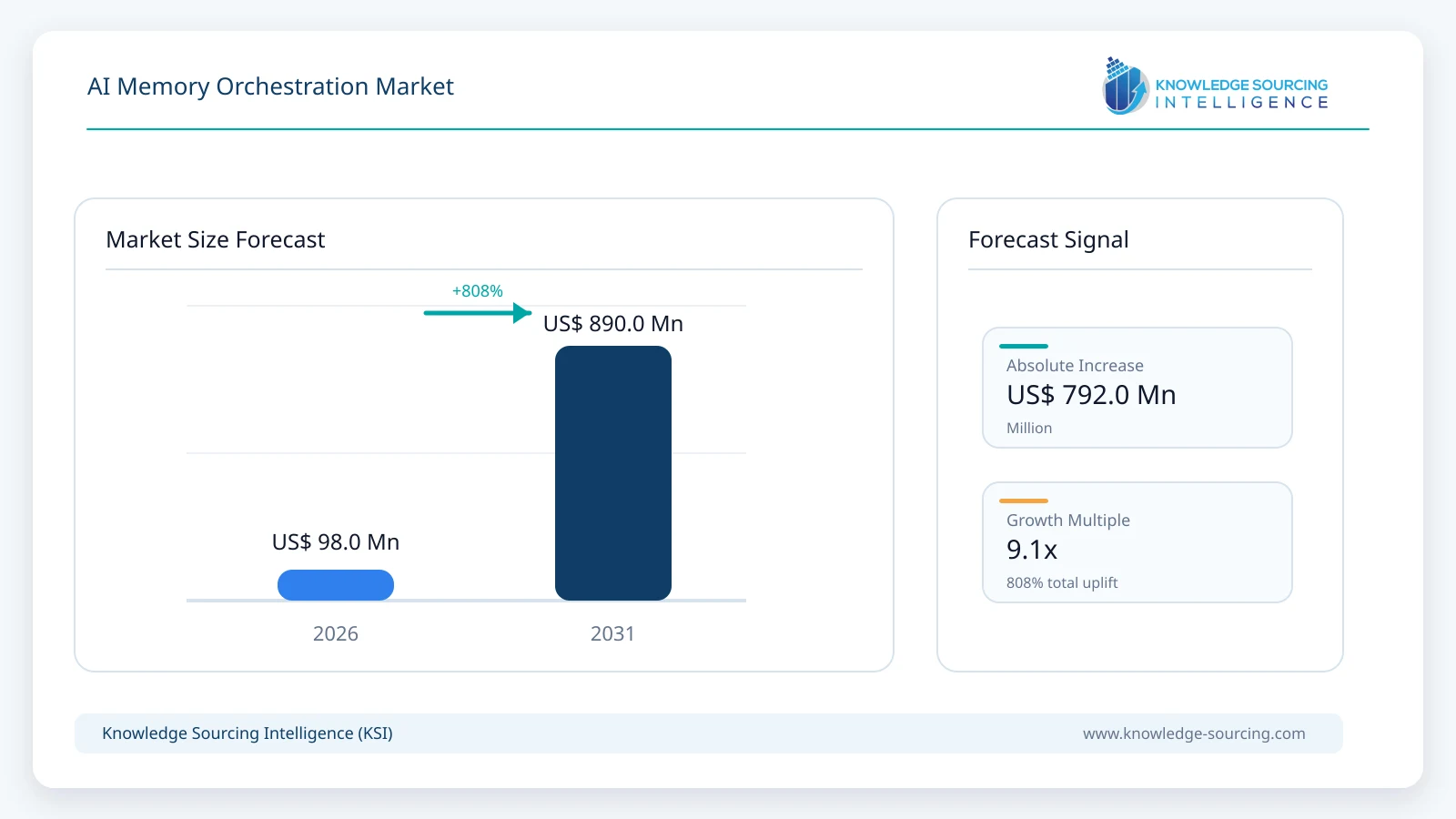
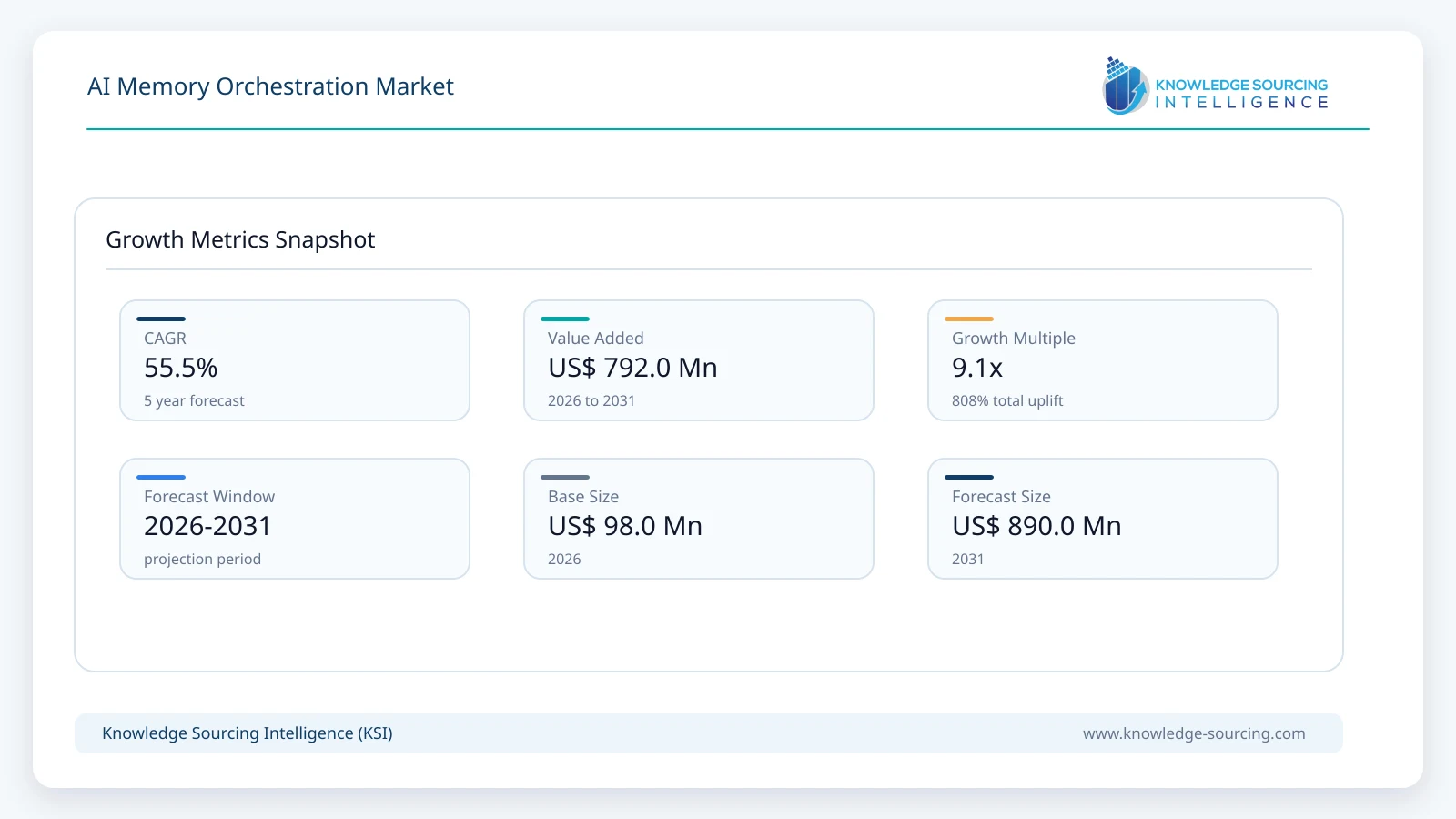
The AI Memory Orchestration Market is estimated at USD 98 million in 2026 and is projected to reach USD 890 million by 2031, growing at a CAGR of 55.47% during the forecast period.
Highlights:
- 1AWS published AgentCore memory lifecycle recommendations in September 2026, describing retention, consolidation and relevance controls for long-running agents.
- 2MongoDB launched Atlas Agent Engine in September 2026 with integrated execution, memory, retrieval and governance capabilities.
- 3Dedicated cloud strategy and routing APIs are forecast to represent an increasing share of attributable memory-orchestration spending.
- 4Multi-store memory architectures increase the need for deduplication, source priority rules and governed information sharing across agents.
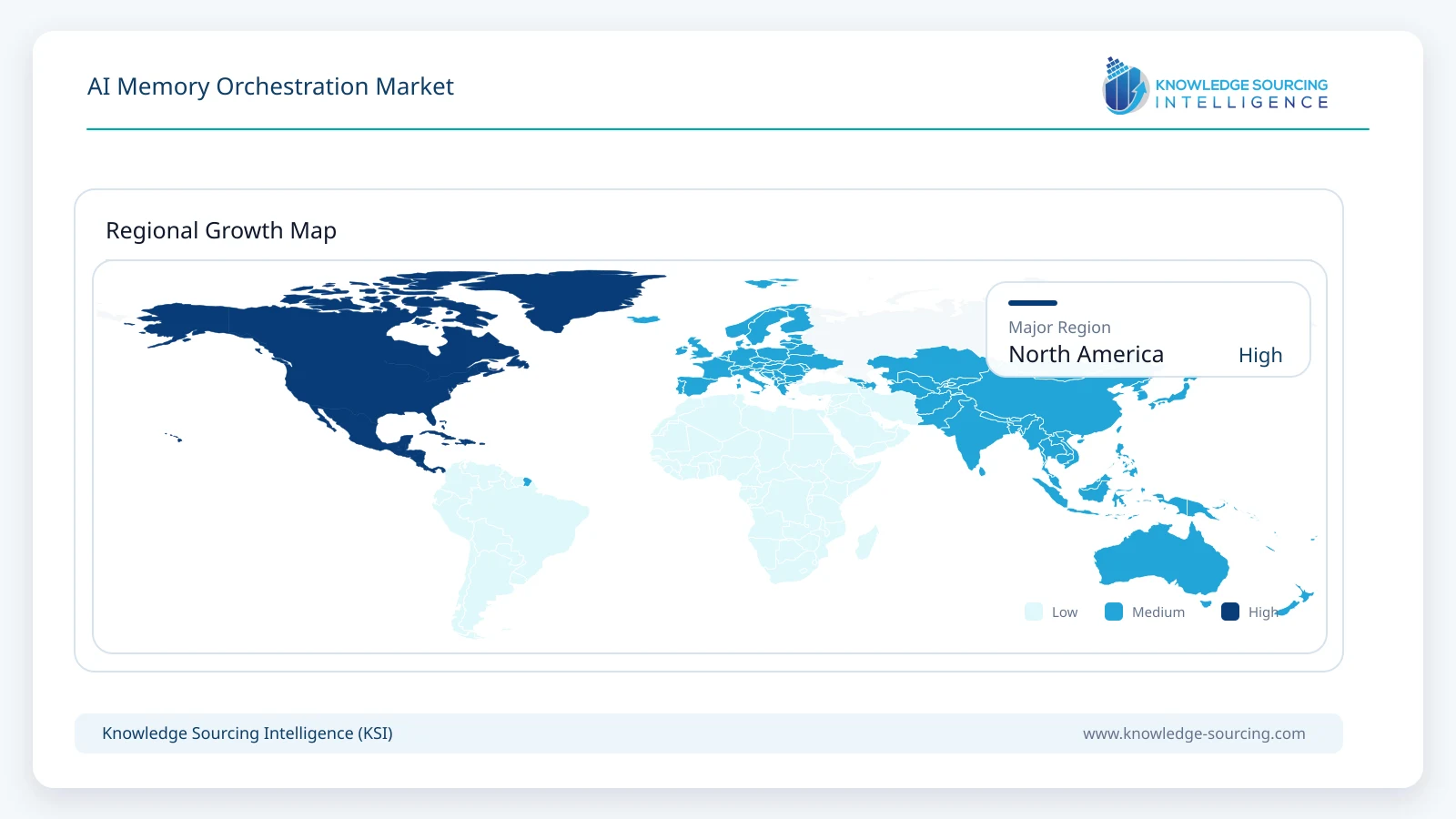
- 5North America leads the 2026 revenue model, while Asia Pacific contributes the strongest forecast growth through 2031.
Commercial expansion is driven by the need to coordinate several memory sources, rather than simply adding more vector storage or lengthening prompts, as enterprises introduce multi-step AI agents into business processes.
AI memory orchestration refers to the software control functions that determine which memory store to access, which observations to preserve, which outdated records to revise and how information moves between session, semantic, episodic and procedural layers. Revenue includes separately paid memory-orchestration subscriptions, attributable managed cloud routing and strategy APIs, incremental governance modules and private implementation services. General memory storage, model inference and unbilled features are not included.
The analysis examines commercial offerings, orchestration architectures, leading functions, deployment models, memory interfaces, applications and end-user industries. Market adoption is expected to reflect the number of production agents, the variety of managed memory stores, the quality of memory-selection policies and the cost of complying with security and retention requirements.
Enterprise AI agents need more than a searchable history to make dependable decisions across repeated interactions. A customer-support agent may require the current ticket status from working memory, a durable account preference from semantic memory and a previous resolution pattern from episodic memory. Memory orchestration determines the sequence, authority and expiry of those sources, helping the agent avoid relying on irrelevant transcripts or contradictory facts.
Commercial supplier activity shows how orchestration is moving from custom application logic to managed infrastructure. AWS supports distinct memory strategies and namespace rules; Redis Agent Memory combines session history, summarization and long-term extraction; and Zep organizes changing facts within temporal context graphs. In September 2026 MongoDB introduced Atlas Agent Engine to connect execution, memory, retrieval and governance within one platform. Each example demonstrates the control problem, although much of the underlying storage and runtime revenue lies outside this market.
The principal buying criteria are accuracy of selected memories, update consistency, policy transparency and secure access. Enterprises need to know why a fact was retrieved, whether it has been superseded and which agent is authorized to reuse it. Orchestration services also need to control token costs and response latency, making relevance scoring and memory consolidation important differentiators as agent workloads scale.
Market Trends
Memory Lifecycle Policies Move Beyond Basic Retention
Production agent systems increasingly classify memories by how they should be used and retained. AWS described lifecycle design for episodic, semantic and procedural memory in September 2026, including expiry rules, relevance scoring and consolidation. The approach reduces the risk that an old interaction will override newer instructions or that useful procedural knowledge will be deleted prematurely.
Memory policy services can become paid enterprise features when teams need traceability, retention customization and monitored consolidation across multiple applications. However, the orchestration charge must be measured separately from storage volume, semantic extraction and the base agent runtime, particularly where providers include basic lifecycle rules in a platform subscription.
Routing Moves Across Working, Semantic and Episodic Memory
Specialized memory types serve different stages of the agent workflow. Redis described combined short-term and long-term memory designs in July 2026, while Google ADK exposes separate session history and persistent MemoryService operations. Routing tools can decide when recent context is sufficient and when older factual or experience records materially improve the next action.
A higher-value orchestration layer also prioritizes sources and reconciles inconsistent evidence across stores. Enterprise teams increasingly require an agent to distinguish live account status from old transcripts and to handle memory permissions according to the user or business task. These controls can support managed subscriptions and routing APIs that sit above existing storage investments.
Background Consolidation and Governed Sharing Gain Importance
Mem0 discussed background memory consolidation in September 2026 and temporal memory management in October, reflecting a shift toward continually refreshed context rather than append-only archives. Zep uses temporal relationships to retain changing factual histories, while AWS namespaces and metadata features support more consistent grouping and tenant isolation.
Shared memory introduces a further commercial requirement as specialized agents exchange information. Workflow teams need to identify which observations should become shared knowledge, which should remain private and how corrections propagate. Vendors with reliable consolidation, selective recall and policy-aware handoffs can earn incremental value even when vector retrieval remains inexpensive.
AI Memory Orchestration Market Segment Analysis
By Commercial Offering
Attributed Managed-Cloud Memory Strategy and Routing APIs
Attributed managed-cloud memory strategy and routing APIs represent USD 30 million in 2026 and are expected to reach USD 370 million by 2031. This stream expands as cloud providers expose configurable strategy selection, retrieval metadata and policy-based memory flows as separately identifiable services.
Cloud strategy orchestration is typically bought alongside agent deployment services, making its direct revenue harder to observe than standalone subscriptions. The modeled stream therefore includes only the portion of charges attributable to memory routing and policy execution, excluding underlying memory storage, generic agent runtime and foundation-model inference.
By Orchestration Architecture
Policy-Driven Distributed Memory Mesh
Policy-driven distributed memory mesh architectures are modeled at 17% of the market in 2026 and 22% in 2031, equivalent to USD 195.8 million in 2031. This approach lets teams coordinate information across distinct databases, application memory and enterprise systems without relocating every record into a central provider.
Distributed approaches are attractive where organizations retain separate systems for customer data, agent checkpoints and audited knowledge. Buying decisions emphasize interoperable APIs, cross-store identity controls and explainable retrieval priorities because poorly governed routing can make multiple memory sources less reliable rather than more useful.
By Primary Orchestration Function
Memory Selection and Retrieval Routing
Memory selection and retrieval routing accounts for 29% of the 2026 scenario and 30% in 2031, reaching USD 267 million. The function determines whether an agent needs working-state records, durable facts, previous experiences or external knowledge before it commits additional tokens to a model call.
The commercial opportunity depends on measurable improvements in recall quality, latency and correctness. Providers will need to show that policy-directed selection outperforms default retrieval paths and does not reveal confidential memory across users or business units.
By Memory System Interface
Episodic and Procedural Memory Services
Episodic and procedural interfaces increase from 21% of modeled revenue in 2026 to 24% by 2031, reaching USD 213.6 million. Agents performing repeated investigations, coding work and operational tasks benefit from selectively recalling previously successful action patterns alongside durable factual information.
Enterprise integration becomes more complex when practical experience needs to be validated before reuse. Memory orchestration can help distinguish successful procedures from outdated attempts, while security and audit requirements favor explicit control over which historical episodes an agent is permitted to apply.
By Primary Agent Application
Enterprise Operations and Multi-Agent Workflows
Enterprise operations and multi-agent workflows contribute 28% of 2026 modeled spending and 32% by 2031, or USD 284.8 million. Multiple collaborating agents need a coherent view of task outcomes and customer context without granting every participant unrestricted access to the same memory collection.
Orchestration products can address source selection, memory handoffs, ownership rules and post-task consolidation as enterprises deploy agents across finance, service operations and software delivery. Premium adoption should favor workflows in which stale or duplicated information creates meaningful operating costs.
Market Drivers
Increasing Complexity of Multi-Store Agent Memory
Enterprise agents now combine short-lived task state, persistent facts, episodic histories and external knowledge. A routing layer must decide what to retrieve, when to consolidate it and how to avoid contradictory context across overlapping stores. For procurement, the orchestrator must sit above existing investments in databases and agent frameworks and demonstrate a measurable improvement in answer freshness and traceability.
Growth of Persistent Multi-Agent Workflows
Long-running autonomous workflows exchange discoveries between specialized agents and revisit prior decisions. Memory orchestration coordinates shared information without copying entire histories into every agent and consuming excessive inference tokens. The same information may be needed by a servicing agent, a risk reviewer and an operations planner, but each requires different retention and visibility rules.
Demand for Fresh, Consistent and Relevant Context
Stale facts, duplicate observations and superseded instructions can degrade agent decisions. Suppliers such as Zep, Mem0 and AWS demonstrate the practical need for version-aware updates, lifecycle policies and relevance-based recall. Policy-controlled updates can preserve provenance while demoting superseded records, helping teams investigate which context influenced a customer response or automated recommendation.
Commercial Packaging of Memory Strategies and Context Layers
AWS memory strategies, Redis Iris and managed memory products expose integration points for policy, consolidation and retrieval. Their commercialization supports incremental premium routing and governance spending beyond base storage and raw event ingestion. Contracts can distinguish the orchestration control plane from separately metered storage or retrieval, allowing enterprise customers to evaluate premium features without paying twice for the same memory event.
Enterprise Governance and Tenant Isolation Requirements
Financial services, healthcare and large software deployments must control which agents and users can retrieve particular memories. Scoped namespaces, identity-aware filtering and deletion policies favor commercially supported memory-control services. Vendors must support scoping by individual, workspace and application and allow a buyer to demonstrate that deletion or correction rules actually propagate across connected stores.
Market Restraints
Bundled Functions and Open-Source Control Tools Constrain Pricing
Major cloud platforms incorporate memory selection and routing within existing agent platforms. Free LangGraph interfaces and custom policies can substitute for independent services, making fully attributable paid orchestration a narrower pool than aggregate agent spending. Organizations with a small number of agents may configure policies themselves, leaving external vendors to compete primarily on integration reliability, support and quality monitoring.
Complex Memory Quality Evaluation and Weak Benchmarks
A routing policy can appear efficient while omitting a critical instruction or retaining a false fact. Letta and other developers are building evaluations, but enterprises still lack universal measures for stale-memory risk, recall quality and consolidation correctness. Testing also needs to cover cases in which an agent encounters conflicting records from two authorized sources and must avoid treating one as current without sufficient provenance.
Privacy and Access-Control Exposure Across Stores
Coordinating memory across databases, tools and users expands the number of authorization boundaries. An incorrectly scoped namespace or retrieval path can expose confidential information and prolong security reviews before production rollout. Cross-agent sharing should default to least-privilege access and retain audit evidence when an administrator changes a memory policy or grants another team access.
Additional Latency and Cost from Policy Evaluation
Metadata checks, routing decisions and duplicate detection add computation before retrieval completes. Enterprises may reject premium orchestration when straightforward session storage or a single memory source already meets their performance needs.
Severe Revenue Overlap with Adjacent Memory Infrastructure
Semantic storage, working-memory APIs, vector search, context engineering and orchestration are frequently packaged together. Counting an entire vendor subscription or memory request in multiple markets would inflate the estimated revenue base.
Regional Outlook
North America
North America leads the AI memory orchestration market at USD 42.14 million in 2026 and USD 338.2 million by 2031. United States cloud platforms, specialist agent-memory developers and enterprise database suppliers create concentrated demand for governed memory routing. AWS, Mem0, MongoDB, Redis and related ecosystem participants offer distinct implementation paths as organizations move agent programs into production.
The regional opportunity is shifting from developer-managed memory calls toward contracted orchestration controls, including tenant-specific routing, history correction and retention management. Financial services, software and healthcare buyers are expected to prioritize permission boundaries and reproducible results, although inclusive platform bundling can limit the standalone revenue collected from basic functions.
Asia Pacific
Asia Pacific is estimated at USD 25.48 million in 2026 and USD 284.8 million in 2031, representing the fastest-growing region in the model. Enterprise agent adoption across China, India, Japan and South Korea supports demand for context policies that work across languages, applications and diverse cloud environments. Regional engineering teams also have incentives to limit repeated retrieval and model-input costs.
Growth is expected to favor flexible hybrid integrations, localized data controls and cross-store memory routing rather than a single default memory backend. As production agent fleets expand, orchestration products can coordinate existing databases and managed AI platforms while enforcing region-specific retention, access and audit policies.
Competitive Landscape
The AI memory orchestration ecosystem combines specialist memory platforms, hyperscalers, databases and agent-development frameworks. AWS and Google expose memory strategies and integration APIs, while Redis and MongoDB connect persistent and active context to broader data infrastructure. Mem0, Zep and Letta focus on memory-management capabilities, and LangChain and Mastra provide developer pathways into managed agent applications.
Competitive positioning is shaped by policy flexibility, memory freshness, cross-store compatibility, tenant isolation and measurable quality gains. Suppliers with transparent APIs and evidence-aware consolidation can be selected even when a buyer retains its existing vector store or agent framework. Revenue capture will depend on premium strategy execution, governance and orchestration support rather than the total value of bundled agent platforms.
Recent Developments
October 2026: Mem0 published an update on managing time in AI memory, detailing the need to control how remembered information changes and remains relevant.
September 2026: MongoDB launched Atlas Agent Engine to bring execution, memory, retrieval and governance into a unified production-agent infrastructure.
September 2026: AWS published AgentCore memory lifecycle policy designs covering expiry, relevance scoring and consolidation of different memory types.
August 2026: Mem0 introduced Dream, describing background memory consolidation to improve the quality of agent memory over time.
August 2026: Redis announced its Agent Memory offering on the Snowflake Marketplace, enabling persistent context for Snowflake Cortex Agents.
May 2026: Redis introduced Iris, combining a context retriever and agent-memory capabilities within its enterprise context platform.
Market Outlook
AI memory orchestration will become increasingly relevant as enterprise agents interact with several types of retained information during long-running work. The transition from a single session log to a governed combination of active state, persistent facts and experience history creates demand for memory-source selection and update logic that can be reused across applications.
Commercial growth will depend on the ability to charge for orchestration beyond storage and model calls. Cloud strategies, premium memory consolidation and private cross-store integrations provide distinct purchasing routes, while bundled framework functions and open-source implementations will continue to limit price realization for basic retrieval routing.
Providers that make memory freshness, access scope and context quality observable are positioned to support production agent deployments. The strongest demand should arise when an outdated memory can influence a regulated decision or when multiple agents must coordinate with one another without duplicating confidential data or fragmenting the record of work.
AI Memory Orchestration Market Scope:
| Report Metric | Details |
|---|---|
| Total Market Size in 2026 | USD 98 million |
| Total Market Size in 2031 | USD 890 million |
| Forecast Unit | USD Million |
| Growth Rate | 55.47% |
| Study Period | 2021 to 2031 |
| Historical Data | 2021 to 2024 |
| Base Year | 2025 |
| Forecast Period | 2026 – 2031 |
| Segmentation | Commercial Offering, Orchestration Architecture, Primary Orchestration Function, Deployment Model, Memory System Interface, Primary Agent Application, End-User Industry, Geography |
| Companies |
|
| Customization Scope | 15% Free Customization included with purchase — Request Custom Breakdown → |
| Sample & Data Access | PDF Sample, Excel Databook & Analyst Briefing — Download Free Sample → |
Market Segmentation
By Commercial Offering
Dedicated Memory Orchestration Platform Subscriptions
Attributed Managed-Cloud Memory Strategy and Routing APIs
Premium Memory Lifecycle and Governance Modules
Private Orchestration Deployments and Integration
By Orchestration Architecture
Centralized Cross-Memory Control Plane
Policy-Driven Distributed Memory Mesh
Agent-Framework Embedded Orchestrators
Hybrid Graph and Vector Orchestration
By Primary Orchestration Function
Memory Selection and Retrieval Routing
Memory Consolidation, Update and Deduplication
Lifecycle, Expiry and Forgetting Policies
Cross-Agent Sharing and Scoped Governance
By Deployment Model
Public Cloud Managed Services
Hybrid Cloud
Private Cloud
On-Premises and Edge
By Memory System Interface
Semantic and Contextual Memory Services
Working-Memory and Session-State Services
Episodic and Procedural Memory Services
Federated and Multi-Store Memory Stacks
By Primary Agent Application
Customer-Facing Service and Commerce Agents
Software Engineering and Research Agents
Enterprise Operations and Multi-Agent Workflows
Personalized Employee and Knowledge Assistants
By End-User Industry
Technology, Cloud and Software
Banking and Financial Services
Retail and Customer Services
Healthcare and Life Sciences
Manufacturing and Logistics
Public Sector and Other Industries
By Geography
North America
United States
Canada
Mexico
South America
Brazil
Argentina
Rest of South America
Europe
Germany
United Kingdom
France
Netherlands
Italy
Spain
Rest of Europe
Middle East and Africa
United Arab Emirates
Saudi Arabia
Israel
South Africa
Rest of Middle East and Africa
Asia Pacific
China
Japan
India
South Korea
Australia
Singapore
Rest of Asia Pacific
Table of Contents
1. EXECUTIVE SUMMARY
1.1. Research Highlights
1.2. Market Size and Growth Outlook, 2026–2031
1.3. Strategic Market Perspective
2. MARKET SNAPSHOT
2.1. Market Overview
2.2. Market Definition
2.3. Scope of the Study
2.4. Market Segmentation
3. BUSINESS LANDSCAPE
3.1. Market Drivers
3.1.1. Increasing Complexity of Multi-Store Agent Memory
3.1.2. Growth of Persistent Multi-Agent Workflows
3.1.3. Demand for Fresh, Consistent and Relevant Context
3.1.4. Commercial Packaging of Memory Strategies and Context Layers
3.1.5. Enterprise Governance and Tenant Isolation Requirements
3.2. Market Restraints
3.2.1. Bundled Functions and Open-Source Control Tools Constrain Pricing
3.2.2. Complex Memory Quality Evaluation and Weak Benchmarks
3.2.3. Privacy and Access-Control Exposure Across Stores
3.2.4. Additional Latency and Cost from Policy Evaluation
3.2.5. Severe Revenue Overlap with Adjacent Memory Infrastructure
3.3. Market Opportunities
3.4. Porter’s Five Forces Analysis
3.5. Industry Value Chain Analysis
3.6. Policies and Regulations
3.7. Strategic Recommendations
4. TECHNOLOGICAL OUTLOOK
4.1. Cross-Memory Retrieval and Policy Routing
4.2. Memory Consolidation and Conflict Resolution
4.3. Temporal Freshness and Retention Controls
4.4. Identity-Aware Multi-Agent Sharing
4.5. Quality Monitoring and Strategy Evaluation
5. AI MEMORY ORCHESTRATION MARKET BY COMMERCIAL OFFERING
5.1. Introduction
5.2. Dedicated memory orchestration platform subscriptions
5.3. Attributed managed-cloud memory strategy and routing APIs
5.4. Premium memory lifecycle and governance modules
5.5. Private orchestration deployments and integration
6. AI MEMORY ORCHESTRATION MARKET BY ORCHESTRATION ARCHITECTURE
6.1. Introduction
6.2. Centralized cross-memory control plane
6.3. Policy-driven distributed memory mesh
6.4. Agent-framework embedded orchestrators
6.5. Hybrid graph and vector orchestration
7. AI MEMORY ORCHESTRATION MARKET BY PRIMARY ORCHESTRATION FUNCTION
7.1. Introduction
7.2. Memory selection and retrieval routing
7.3. Memory consolidation, update and deduplication
7.4. Lifecycle, expiry and forgetting policies
7.5. Cross-agent sharing and scoped governance
8. AI MEMORY ORCHESTRATION MARKET BY DEPLOYMENT MODEL
8.1. Introduction
8.2. Public cloud managed services
8.3. Hybrid cloud
8.4. Private cloud
8.5. On-premises and edge
9. AI MEMORY ORCHESTRATION MARKET BY MEMORY SYSTEM INTERFACE
9.1. Introduction
9.2. Semantic and contextual memory services
9.3. Working-memory and session-state services
9.4. Episodic and procedural memory services
9.5. Federated and multi-store memory stacks
10. AI MEMORY ORCHESTRATION MARKET BY PRIMARY AGENT APPLICATION
10.1. Introduction
10.2. Customer-facing service and commerce agents
10.3. Software engineering and research agents
10.4. Enterprise operations and multi-agent workflows
10.5. Personalized employee and knowledge assistants
11. AI MEMORY ORCHESTRATION MARKET BY END-USER INDUSTRY
11.1. Introduction
11.2. Technology, cloud and software
11.3. Banking and financial services
11.4. Retail and customer services
11.5. Healthcare and life sciences
11.6. Manufacturing and logistics
11.7. Public sector and other industries
12. AI MEMORY ORCHESTRATION MARKET BY GEOGRAPHY
12.1. North America
12.1.1. United States
12.1.2. Canada
12.1.3. Mexico
12.2. South America
12.2.1. Brazil
12.2.2. Argentina
12.2.3. Rest of South America
12.3. Europe
12.3.1. Germany
12.3.2. United Kingdom
12.3.3. France
12.3.4. Netherlands
12.3.5. Italy
12.3.6. Spain
12.3.7. Rest of Europe
12.4. Middle East and Africa
12.4.1. United Arab Emirates
12.4.2. Saudi Arabia
12.4.3. Israel
12.4.4. South Africa
12.4.5. Rest of Middle East and Africa
12.5. Asia Pacific
12.5.1. China
12.5.2. Japan
12.5.3. India
12.5.4. South Korea
12.5.5. Australia
12.5.6. Singapore
12.5.7. Rest of Asia Pacific
13. COMPETITIVE ENVIRONMENT AND ANALYSIS
13.1. Major Players and Strategy Analysis
13.2. Market Share Analysis
13.3. Mergers, Acquisitions, Agreements, and Collaborations
13.4. Competitive Dashboard
14. COMPANY PROFILES
14.1. Amazon Web Services, Inc.
14.2. Google LLC
14.3. Redis Ltd.
14.4. Mem0
14.5. Zep AI
14.6. MongoDB, Inc.
14.7. LangChain, Inc.
14.8. Letta, Inc.
14.9. Microsoft Corporation
14.10. Neo4j, Inc.
14.11. Mastra
15. APPENDIX
15.1. Currency
15.2. Assumptions
15.3. Base and Forecast Years Timeline
15.4. Key Benefits for Stakeholders
15.5. Research Methodology
15.6. Abbreviations





Frequently asked questions
What is the projected AI Memory Orchestration market size by 2031?
The AI Memory Orchestration Market is projected to reach USD 890 million by 2031.
What is the growth forecast (CAGR) for 2026-2031?
The AI Memory Orchestration Market is growing at a 55.47% CAGR during the forecast period.
Which region leads the market in 2026, and which shows strongest growth?
North America leads 2026 revenue; Asia Pacific contributes strongest growth through 2031.
What are the key drivers for AI Memory Orchestration market expansion?
Coordinating multiple memory sources and multi-step AI agents drives growth.
What does AI Memory Orchestration specifically encompass?
Software control determining memory access, preservation, revision, and information movement.
What aspects of the market does the report analyze?
Analysis covers offerings, architectures, functions, deployment, interfaces, applications, and industries.
Cite this report
Knowledge Sourcing Intelligence. (Oct 2026). AI Memory Orchestration Market Size, Share & Growth Forecast (2026-2031). https://www.knowledge-sourcing.com/report/ai-memory-orchestration-market