
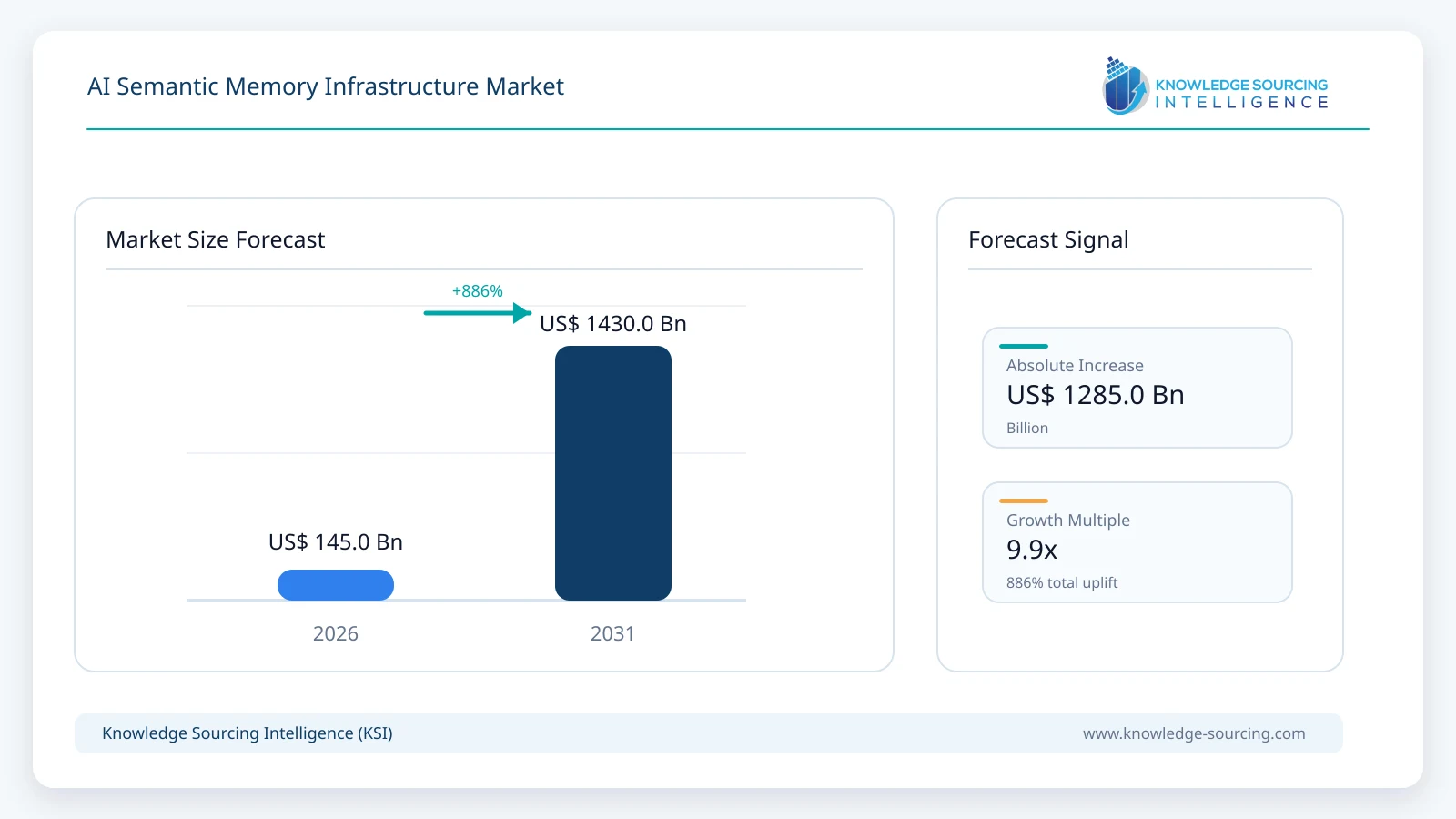
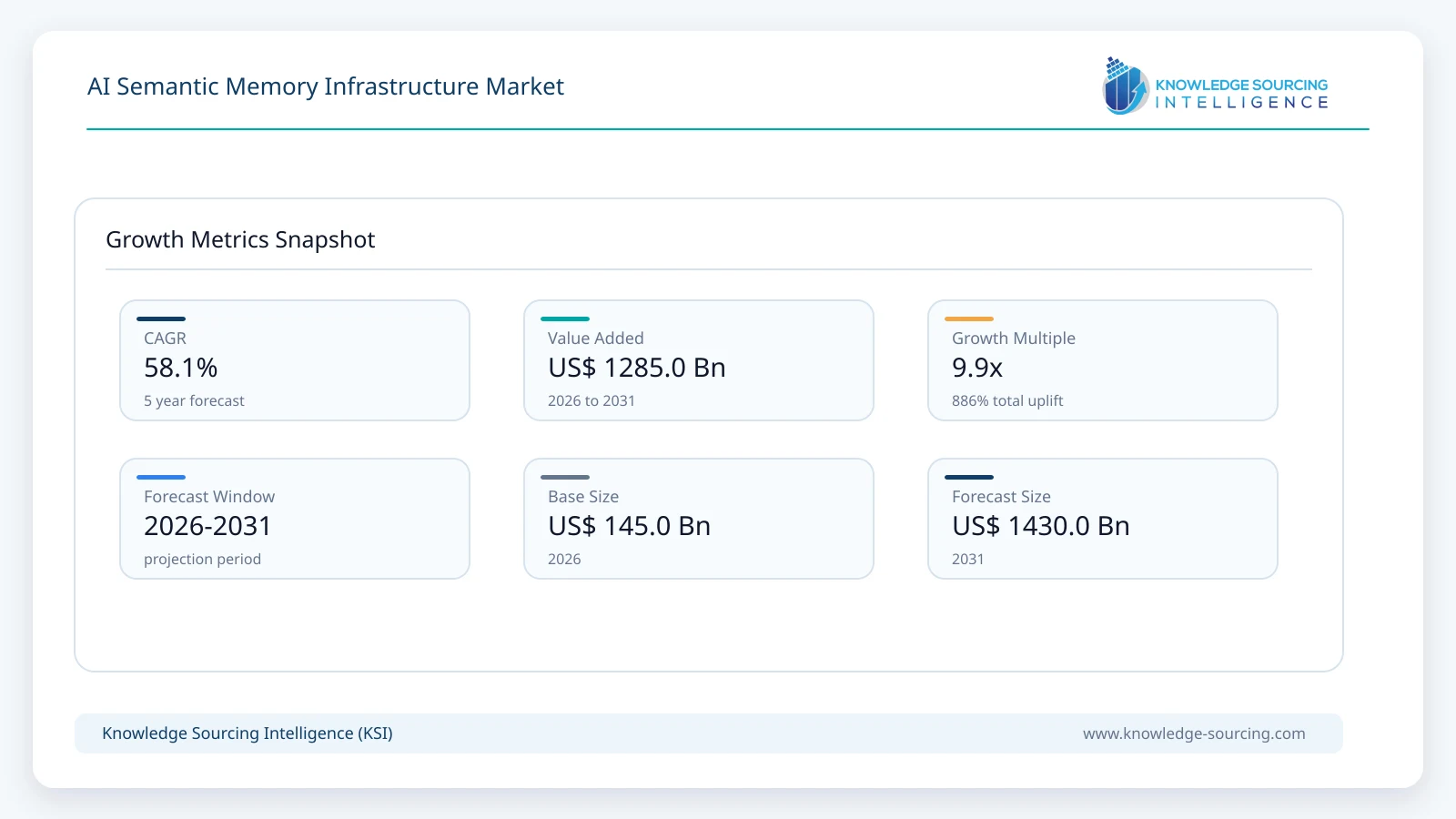
The AI Semantic Memory Infrastructure Market is forecast to grow at a CAGR of 58.1%, reaching USD 1,430.0 million in 2031 from USD 145.0 million in 2026.
Highlights:
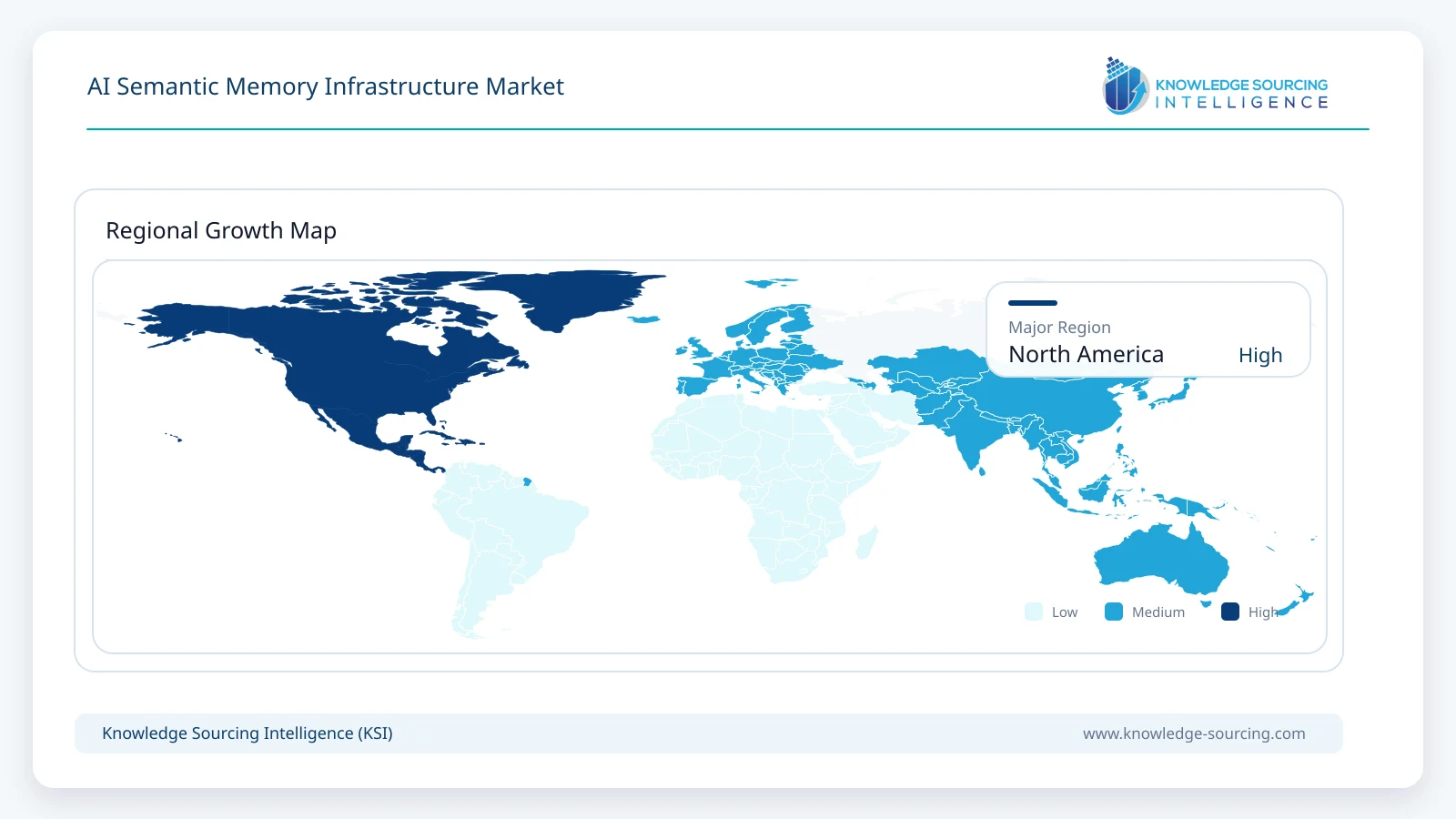
- 1North America accounts for an estimated 44% of the market in 2026, reflecting dense enterprise AI deployment and specialist supplier activity.
- 2Asia Pacific is modeled to increase from 25% of global revenue in 2026 to 29% by 2031, supported by growing AI application deployments.
- 3Managed native memory and premium semantic consolidation complement dedicated memory platforms, but overlapping supplier invoices are excluded.
- 4Semantic retrieval, factual consolidation and graph-linked temporal memory are the most commercially relevant functions.
- 5Enterprise adoption depends on correct fact updates, controlled access, lifecycle management and measurable retrieval quality.
The market covers software and managed services that extract, consolidate, govern, and retrieve durable semantic facts for AI agents across sessions. Cross-session factual memory differs from a general document vector store because the information is selected from changing interactions and retained with identity, scope, and update rules. Buyers pay for usable long-term memory records, retrieval, consolidation, and specialized infrastructure controls rather than for every token generated or every document indexed.
The commercial ecosystem combines standalone memory API suppliers, metered cloud services, premium graph and temporal consolidation, and customer-managed deployments. North America has the largest estimated demand base, while Asia Pacific is expected to show the fastest expansion as enterprise agent development and multilingual deployments scale.
Market Overview
AI agents that perform multi-session work need a way to separate durable knowledge from temporary prompts and chat logs. Semantic memory infrastructure extracts useful facts from interactions and operational records, then retrieves them on demand. A support agent can recall an approved account configuration during a later escalation, while an employee assistant can retain a project decision without repeatedly processing the entire conversation history.
AWS describes long-term memory extraction, consolidation, and retrieval as managed functions in Bedrock AgentCore Memory, including semantic fact strategies. MongoDB introduced Atlas Agent Engine in September 2026 with memory, runtime and governance modules that can be adopted independently. Such architectures establish memory as an observable software function, although a significant portion of the underlying database and runtime expense falls outside the category.
Specialists compete through better memory hygiene, time-aware updates, and relevant context assembly. Zep builds temporal context graphs, Neo4j supports graph-native memory management, and Mem0 offers paid memory tiers with consolidation and entity links. These differentiators are commercially meaningful when customers move from simple preference storage to persistent knowledge used across customer, operations, and development workflows.
Market Trends
From Simple Retrieval to Governed Memory Lifecycles
Persistent semantic memory is moving beyond a read-and-write vector index toward a controlled fact lifecycle. AWS added strict long-term memory metadata handling in June 2026, enabling application-supplied fields to remain consistent during extraction and consolidation. Enterprise teams gain a way to isolate memories by tenant, department, and workflow, which is important when one agent serves many accounts.
Memory vendors are also formalizing correction and versioning. Mem0 describes background consolidation that merges duplicates and supersedes stale information, while Zep manages temporal validity within context graphs. The market increasingly distinguishes services that return a relevant answer today from systems that can demonstrate when a fact was true and why it is still permitted to be recalled.
Managed Memory APIs Become Separate Infrastructure Purchases
Cloud vendors are commercializing semantic memory through metered service capabilities rather than requiring each application team to build memory storage and extraction independently. Amazon Bedrock AgentCore publishes charges for processed long-term records and retrieval calls, and MongoDB introduced consumption-based Atlas Agent Memory in its September 2026 preview.
Specialist providers offer different purchasing routes. Mem0 publicly lists Starter and Pro subscription plans with memory-add and retrieval allowances, while larger deployments can request enterprise terms. These published tariff structures support a modeled market based on eligible paid workloads and average realized revenue rather than a blanket percentage of all agent platform spending.
Semantic Memory Extends Beyond Conversation History
Persistent knowledge increasingly comes from structured activity logs, business records, and external systems. AWS added JSON event extraction in August 2026 and direct long-term ingestion in September, allowing factual memory workflows to operate without first converting data into artificial chat turns. This makes semantic memory more applicable to operations assistants, account management and business process automation.
Graph-linked and temporal context further improve retrieval where relationships or changing facts determine what information matters. Neo4j introduced its Agent Memory Service as a managed API layer, while Redis expanded its agent memory distribution through Snowflake Cortex Agents. The memory stack is consequently becoming more heterogeneous, combining durable fact storage, entity links, metadata filters, and controlled context packaging.
Enterprise Memory Portability and Context Ownership
Enterprise AI teams are increasingly examining who owns an agent’s accumulated knowledge when models or runtimes change. LangChain described identity-scoped memory for Managed Deep Agents in September 2026, while Supermemory positions its memory API as independent of any one model or harness. These approaches support deployment across different user interfaces without requiring the user to rebuild factual context after each platform change.
Portability also makes semantic memory a governance issue. A company may need to export durable facts, preserve their provenance, and delete sensitive records across multiple agents when authorization changes. Platform suppliers that can maintain consistent identity scoping and support practical migration tools should be better positioned for larger contracts than services focused on similarity search alone.
Segment Analysis
By Commercial Offering: Dedicated Semantic Memory Platforms
Dedicated semantic memory platforms account for USD 54 million in modeled 2026 revenue and are projected to reach USD 455 million by 2031. These services provide purpose-built memory APIs and subscriptions for extraction, storage, relevance retrieval, and administration, independent of a single foundation model.
Mem0 and Zep illustrate direct purchasing routes for persistent memory without rebuilding every capability within an application. The segment gains value when developers require consistent cross-session memory across multiple agent runtimes, but free SDKs and bundled platform features will continue to restrain average realized prices.
By Architecture: Knowledge-Graph and Temporal Memory
Knowledge-graph and temporal memory represent an estimated 22% of revenue in 2026, rising to 31% by 2031. The segment combines persistent facts with entity relationships, time validity, and rules for replacing outdated statements. Neo4j Agent Memory Service and Zep context graphs show how relational context can help agents retrieve information that vector similarity alone may rank incorrectly.
Growth is supported by complex customer histories and changing enterprise records, where agents must distinguish current instructions from superseded decisions. Graph-based memory introduces additional modeling and operational overhead, so its premium is more defensible in applications that can demonstrate improved factual continuity rather than simple single-turn retrieval.
By Primary Application: Customer Service and Relationship Agents
Customer service and relationship agents represent approximately 31% of modeled revenue in 2026 and are projected to generate USD 357.5 million by 2031. Multi-session customer interactions create repeated demand for approved preferences, prior cases, commitments and account facts. Persistent semantic memory can shorten repetitive exchanges and help agents respond with continuity.
Buyers must control who can read an account record and how corrections propagate after a customer updates a preference or a support case closes. Providers that combine tenant-scoped retrieval, retention policies and correction workflows may outperform generic chat-history storage in high-volume support environments.
By Memory Input Source: Structured Events and Application Telemetry
Structured events and application telemetry represent an estimated 15% of the market in 2026, rising to 21% by 2031. Applications generate durable facts from orders, ticket updates, operational incidents and product usage rather than exclusively from written conversations. Semantic extraction transforms these records into facts that the next authorized agent can retrieve without searching raw operational logs.
AWS extended Bedrock AgentCore Memory to JSON payloads and direct long-term ingestion in 2026, providing a commercial example of memory creation from structured events. Higher usage is expected where agents reconcile business-system updates with earlier conversations, but successful deployment depends on source provenance, permissions and rules for superseding stale facts.
Market Drivers
Rising Need for Persistent Context Across AI Sessions
Enterprise agents increasingly handle customer cases, software incidents and multistep workflows that exceed a single session. A semantic memory service saves durable facts and retrieves relevant context without replaying full histories, supporting repeat use and clearer production economics.
Growing Commercial Availability of Managed Memory APIs
AWS, MongoDB, Mem0 and Neo4j offer increasingly packaged extraction, consolidation and retrieval capabilities. Separate API consumption and subscription tiers make memory an identifiable infrastructure purchase rather than only a custom developer feature.
Demand for More Reliable Personalization and Account Knowledge
Customer support and employee agents need up-to-date account facts, preferences and past decisions. Scoped persistent memory improves continuity when authorized context can be reused across sessions, especially across recurring enterprise interactions.
Expansion of Knowledge-Graph and Temporal Recall Designs
Graph relationships and time-aware fact validity address conflicts between older and newer memories. Neo4j, Zep and Mem0 provide evidence of this migration beyond a simple similarity index, creating demand for paid extraction and consolidation.
Increasing Enterprise Controls on Memory Scope and Retention
Long-lived memory must respect identity, access boundaries, deletion and data residency requirements. Provider metadata filtering and tenant-specific memory scopes support adoption in governed workflows that would otherwise prevent persistent context storage.
Market Restraints
Free and Bundled Memory Functions Constrain Monetization
Agent frameworks and vector stores include low-cost persistence patterns. Cloud platforms can package memory within broader agent runtimes, limiting the premium attached to independent semantic memory infrastructure.
Unreliable Extraction and Conflicting Facts Create Trust Risks
Systems may convert transient statements into durable facts or retain outdated information. Correction, provenance, time windows and validation increase development cost and complicate mission-critical deployment.
Privacy, Consent and Deletion Obligations Increase Complexity
Cross-session memory may contain personal or confidential context. Enterprise purchasers require controlled storage, deletion, isolation and auditability before permitting durable agent knowledge in regulated workflows.
Latency and Processing Cost Remain Material
Fact extraction, deduplication, embedding and retrieval add processing stages to each interaction. Cost sensitivity is acute for high-volume assistants, particularly when memory stores unnecessary or repetitive facts.
Immature Cross-Vendor Portability and Integration Practices
Proprietary schemas, graph structures and tenancy semantics create migration work between memory providers. Many enterprises delay dedicated purchases while evaluating native memory in their preferred agent platform.
Regional Outlook
North America
North America leads the modeled market with USD 63.8 million in 2026 and USD 557.7 million in 2031. United States demand is supported by concentrated agent infrastructure development, enterprise SaaS vendors, and cloud services that expose separate memory APIs. Specialist suppliers such as Mem0 and Zep address teams that need persistent context independently of an underlying model provider.
As production agent deployments widen, North American purchases are expected to move from developer-tier subscriptions toward higher-throughput managed memory and premium governance features. Data isolation, contractual retention rules and measured memory utility remain critical buying criteria, particularly for support, financial and healthcare workflows.
Asia Pacific
Asia Pacific is estimated at USD 36.25 million in 2026 and USD 414.7 million in 2031, making it the fastest-growing regional market in the model. Demand is expected to increase across China, India, Japan, South Korea and Southeast Asian technology hubs as enterprises develop customer-facing and employee-support agents requiring persistent multilingual context.
Memory infrastructure providers will encounter region-specific language, latency and hosting requirements, creating opportunities for private deployments and adaptable retrieval design. Adoption is likely to be strongest where cloud-platform memory services reduce initial integration effort, while larger enterprises may retain hybrid architectures for security and data residency controls.
Competitive Landscape
AI semantic memory infrastructure combines specialist platforms, hyperscaler-managed memory services and data infrastructure suppliers that add a persistent memory layer to existing agent stacks. Mem0 and Zep concentrate on stored facts and context retrieval, while Neo4j and Redis offer graph and data-system foundations adapted for agent memory. AWS, Google Cloud and MongoDB combine memory with broader agent development services.
Competitive differentiation rests on context quality, fact-update reliability, latency, isolation, auditability and total operating cost. Separate agent runtime, model inference, broad vector search and database administration revenue are not interchangeable with semantic memory infrastructure spending. Enterprises are likely to favor providers that can document memory correction and lifecycle controls while integrating with their preferred application and model environment.
New specialist entrants such as Supermemory compete through portable memory services, while LangChain connects memory to agent execution and development environments. The market should not equate every long-context window or embedding search operation with a paid memory record: realized revenue is concentrated in durable extraction, verified updating and retrieval that continues to be useful on later sessions.
Recent Developments
September 29, 2026: MongoDB launched Atlas Agent Engine in public preview, introducing modular agent memory with consumption-based pricing alongside runtime and governance capabilities.
September 8, 2026: AWS introduced direct ingestion into Bedrock AgentCore long-term memory, so semantic extraction no longer required a preceding short-term conversation event.
August 20, 2026: AWS expanded AgentCore Memory extraction to non-conversational JSON payloads, allowing structured application events to be consolidated into durable memory.
August 6, 2026: Redis announced availability of Redis Agent Memory for Snowflake Cortex Agents, bringing cross-session persistence to agent-based analytics workflows.
June 23, 2026: Neo4j detailed its managed Agent Memory Service, providing API-based graph memory with entity extraction, deduplication and context retrieval.
May 12, 2026: Mem0 introduced temporal reasoning to distinguish current, historical, and upcoming facts within persistent agent memories.
Market Outlook
The AI semantic memory infrastructure market is expected to expand as production agents retain more business context across conversations, tasks and service channels. Paid memory API usage should rise with the number of deployed agent applications and with richer factual records generated from non-conversational data. Managed services will remain attractive to developers seeking fast deployment without maintaining separate extraction, storage and retrieval systems.
The sector will increasingly reward correction-aware memory that preserves the history of changed facts without presenting obsolete information as current. Temporal graphs, metadata filtering and long-term record governance are likely to become standard requirements in enterprise deployments. Providers will need to balance retrieval quality with latency and unit economics because uncontrolled memory writes can make persistent context expensive and unreliable.
Industry structure should remain mixed, with specialized memory providers selling APIs and premium graph capabilities while cloud platforms embed core memory into broader agent infrastructure. Bundling can reduce the revenue available to independent suppliers, but portability, governance and cross-platform retrieval offer opportunities for paid differentiation. Market growth will depend on how reliably customers convert memory usefulness into a measurable operating benefit.
AI Semantic Memory Infrastructure Market Scope:
| Report Metric | Details |
|---|---|
| Total Market Size in 2026 | USD 145.0 million |
| Total Market Size in 2031 | USD 1,430.0 million |
| Forecast Unit | USD Billion |
| Growth Rate | 58.1% |
| Study Period | 2021 to 2031 |
| Historical Data | 2021 to 2024 |
| Base Year | 2025 |
| Forecast Period | 2026 – 2031 |
| Segmentation | Commercial Offering, Memory Infrastructure Architecture, Memory Lifecycle Function, Deployment Model |
| Companies |
|
| Customization Scope | 15% Free Customization included with purchase — Request Custom Breakdown → |
| Sample & Data Access | PDF Sample, Excel Databook & Analyst Briefing — Download Free Sample → |
Market Segmentation
By Commercial Offering
Dedicated Semantic Memory Platforms
Attributed Cloud and Database Memory Services
Graph Memory and Consolidation Premiums
Private Deployments and Dedicated Integration
By Memory Infrastructure Architecture
Semantic Vector-Based Memory
Hybrid Vector and Structured Metadata
Knowledge-Graph and Temporal Memory
Managed Native Agent-Memory Service
By Memory Lifecycle Function
Durable Fact Extraction and Ingestion
Consolidation, Deduplication and Versioning
Semantic Retrieval and Context Assembly
Identity, Provenance and Retention Governance
By Deployment Model
Public-Cloud Managed Services
Hybrid Cloud
Private Cloud
On-Premises and Edge
By Memory Input Source
Conversational and Support Interactions
Enterprise Documents and Knowledge Records
Structured Events and Application Telemetry
Multisource Context and Connected Systems
By Primary Application
Customer Service and Relationship Agents
Enterprise Employee Copilots
Software Engineering and Developer Agents
Commerce and Personalization Agents
Research and Industry-Specific Agents
By End-User Industry
IT, Cloud and Software Services
Banking and Financial Services
Retail and Customer Services
Healthcare and Life Sciences
Manufacturing and Logistics
Public Sector and Other Industries
By Geography
North America
United States
Canada
Mexico
South America
Brazil
Argentina
Rest of South America
Europe
Germany
United Kingdom
France
Netherlands
Italy
Spain
Rest of Europe
Middle East and Africa
United Arab Emirates
Saudi Arabia
Israel
South Africa
Rest of Middle East and Africa
Asia Pacific
China
Japan
India
South Korea
Australia
Singapore
Rest of Asia Pacific
Table of Contents
1. EXECUTIVE SUMMARY
1.1. Research Highlights
1.2. Market Size and Growth Outlook, 2026–2031
1.3. Strategic Market Perspective
2. MARKET SNAPSHOT
2.1. Market Overview
2.2. Market Definition
2.3. Scope of the Study
2.4. Market Segmentation
3. BUSINESS LANDSCAPE
3.1. Market Drivers
3.1.1. Rising Need for Persistent Context Across AI Sessions
3.1.2. Growing Commercial Availability of Managed Memory APIs
3.1.3. Demand for More Reliable Personalization and Account Knowledge
3.1.4. Expansion of Knowledge-Graph and Temporal Recall Designs
3.1.5. Increasing Enterprise Controls on Memory Scope and Retention
3.2. Market Restraints
3.2.1. Free and Bundled Memory Functions Constrain Monetization
3.2.2. Unreliable Extraction and Conflicting Facts Create Trust Risks
3.2.3. Privacy, Consent and Deletion Obligations Increase Complexity
3.2.4. Latency and Processing Cost Remain Material
3.2.5. Immature Cross-Vendor Portability and Integration Practices
3.3. Market Opportunities
3.4. Porter’s Five Forces Analysis
3.5. Industry Value Chain Analysis
3.6. Policies and Regulations
3.7. Strategic Recommendations
4. TECHNOLOGICAL OUTLOOK
4.1. Semantic Fact Extraction and Durable Records
4.2. Context Graphs and Temporal Fact Validity
4.3. Memory Consolidation and Conflict Resolution
4.4. Tenant-Scoped Retrieval and Access Policies
4.5. Cross-Agent Context Assembly and Portability
5. AI SEMANTIC MEMORY INFRASTRUCTURE MARKET BY COMMERCIAL OFFERING
5.1. Introduction
5.2. Dedicated semantic memory platforms
5.3. Attributed cloud and database memory services
5.4. Graph memory and consolidation premiums
5.5. Private deployments and dedicated integration
6. AI SEMANTIC MEMORY INFRASTRUCTURE MARKET BY MEMORY INFRASTRUCTURE ARCHITECTURE
6.1. Introduction
6.2. Semantic vector-based memory
6.3. Hybrid vector and structured metadata
6.4. Knowledge-graph and temporal memory
6.5. Managed native agent-memory service
7. AI SEMANTIC MEMORY INFRASTRUCTURE MARKET BY MEMORY LIFECYCLE FUNCTION
7.1. Introduction
7.2. Durable fact extraction and ingestion
7.3. Consolidation, deduplication and versioning
7.4. Semantic retrieval and context assembly
7.5. Identity, provenance and retention governance
8. AI SEMANTIC MEMORY INFRASTRUCTURE MARKET BY DEPLOYMENT MODEL
8.1. Introduction
8.2. Public-cloud managed services
8.3. Hybrid cloud
8.4. Private cloud
8.5. On-premises and edge
9. AI SEMANTIC MEMORY INFRASTRUCTURE MARKET BY MEMORY INPUT SOURCE
9.1. Introduction
9.2. Conversational and support interactions
9.3. Enterprise documents and knowledge records
9.4. Structured events and application telemetry
9.5. Multisource context and connected systems
10. AI SEMANTIC MEMORY INFRASTRUCTURE MARKET BY PRIMARY APPLICATION
10.1. Introduction
10.2. Customer service and relationship agents
10.3. Enterprise employee copilots
10.4. Software engineering and developer agents
10.5. Commerce and personalization agents
10.6. Research and industry-specific agents
11. AI SEMANTIC MEMORY INFRASTRUCTURE MARKET BY END-USER INDUSTRY
11.1. Introduction
11.2. IT, cloud and software services
11.3. Banking and financial services
11.4. Retail and customer services
11.5. Healthcare and life sciences
11.6. Manufacturing and logistics
11.7. Public sector and other industries
12. AI SEMANTIC MEMORY INFRASTRUCTURE MARKET BY GEOGRAPHY
12.1. North America
12.1.1. United States
12.1.2. Canada
12.1.3. Mexico
12.2. South America
12.2.1. Brazil
12.2.2. Argentina
12.2.3. Rest of South America
12.3. Europe
12.3.1. Germany
12.3.2. United Kingdom
12.3.3. France
12.3.4. Netherlands
12.3.5. Italy
12.3.6. Spain
12.3.7. Rest of Europe
12.4. Middle East and Africa
12.4.1. United Arab Emirates
12.4.2. Saudi Arabia
12.4.3. Israel
12.4.4. South Africa
12.4.5. Rest of Middle East and Africa
12.5. Asia Pacific
12.5.1. China
12.5.2. Japan
12.5.3. India
12.5.4. South Korea
12.5.5. Australia
12.5.6. Singapore
12.5.7. Rest of Asia Pacific
13. COMPETITIVE ENVIRONMENT AND ANALYSIS
13.1. Major Players and Strategy Analysis
13.2. Market Share Analysis
13.3. Mergers, Acquisitions, Agreements, and Collaborations
13.4. Competitive Dashboard
14. COMPANY PROFILES
14.1. Mem0, Inc.
14.2. Zep
14.3. Amazon Web Services, Inc.
14.4. MongoDB, Inc.
14.5. Redis Ltd.
14.6. Neo4j, Inc.
14.7. Google LLC
14.8. Letta, Inc.
14.9. LangChain, Inc.
14.10. Weaviate B.V.
14.11. Supermemory
15. APPENDIX
15.1. Currency
15.2. Assumptions
15.3. Base and Forecast Years Timeline
15.4. Key Benefits for Stakeholders
15.5. Research Methodology
15.6. Abbreviations





Frequently asked questions
What is the projected market size for AI Semantic Memory Infrastructure by 2031?
The AI Semantic Memory Infrastructure Market is forecast to reach USD 1,430.0 million in 2031.
What is the Compound Annual Growth Rate (CAGR) for this market?
The AI Semantic Memory Infrastructure Market is forecast to grow at a 58.1% CAGR.
Which region holds the largest market share in 2026?
North America accounts for an estimated 44% of the market.
Which region is expected to show the fastest market expansion?
Asia Pacific is expected to show the fastest expansion.
What core function does AI Semantic Memory Infrastructure provide?
The AI Semantic Memory Infrastructure Market extracts, consolidates, and retrieves durable semantic facts for AI agents.
What are the most commercially relevant functions within this market?
Semantic retrieval, factual consolidation, and graph-linked temporal memory.
Cite this report
Knowledge Sourcing Intelligence. (Oct 2026). AI Semantic Memory Infrastructure Market Size, Share & Growth Forecast (2026-2031). https://www.knowledge-sourcing.com/report/ai-semantic-memory-infrastructure-market