
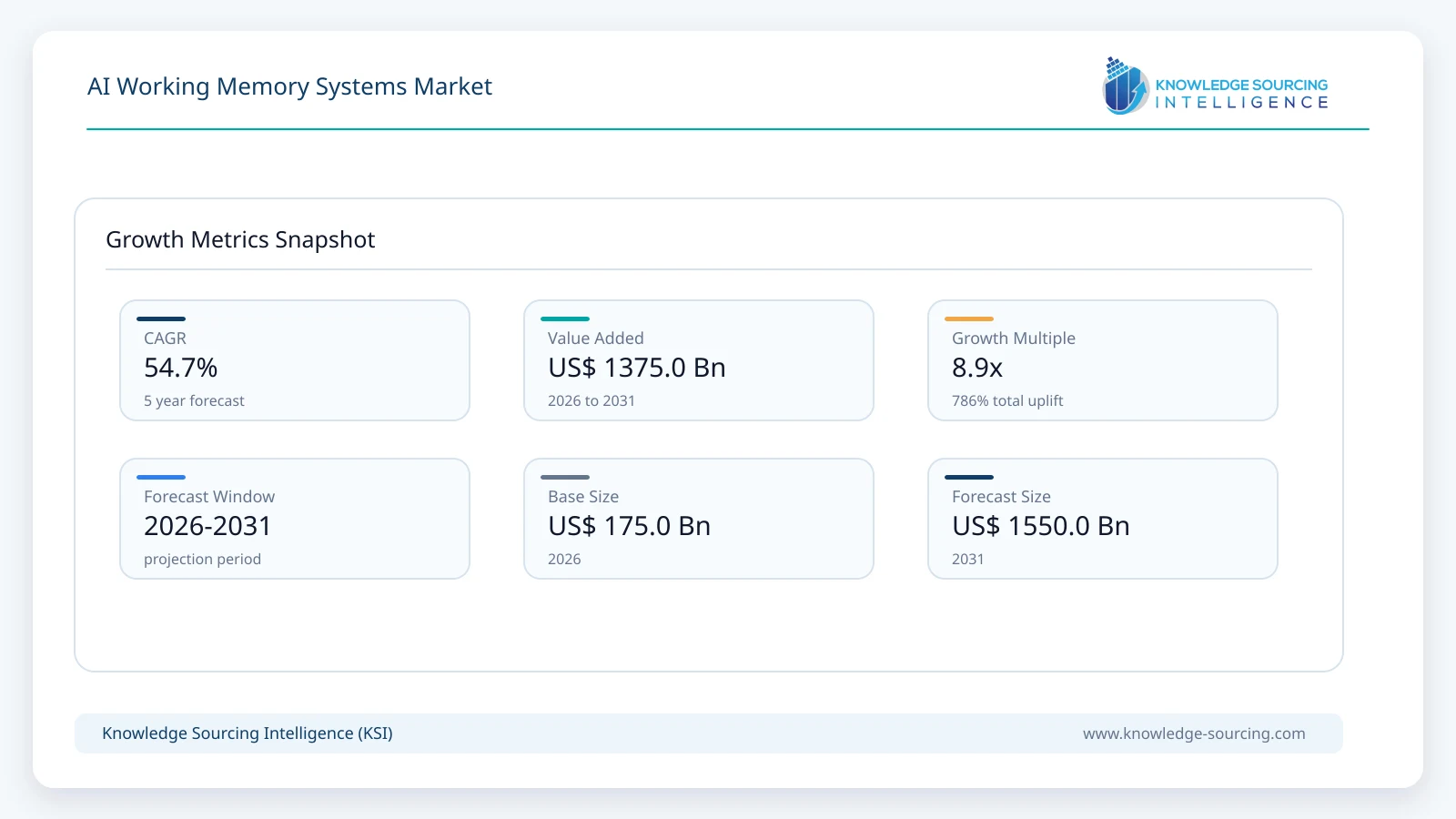
The AI Working Memory Systems Market is projected to expand at a CAGR of 54.7%, increasing from USD 175.0 million in 2026 to USD 1,550.0 million by 2031.
Highlights:
- 1Amazon Bedrock AgentCore introduced usage-based short-term memory ingestion, retrieval and storage pricing in October 2026, providing a direct monetization reference.
- 2Checkpoint-backed task state and resumable execution support production coding agents and multi-agent business processes that cannot reliably fit into one inference request.
- 3Managed cloud session-state APIs are expected to gain share as enterprises move from prototypes to governed, observable agent deployments.
- 4Context selection and compaction become increasingly important as tool outputs and conversation histories grow during long-running workflows.
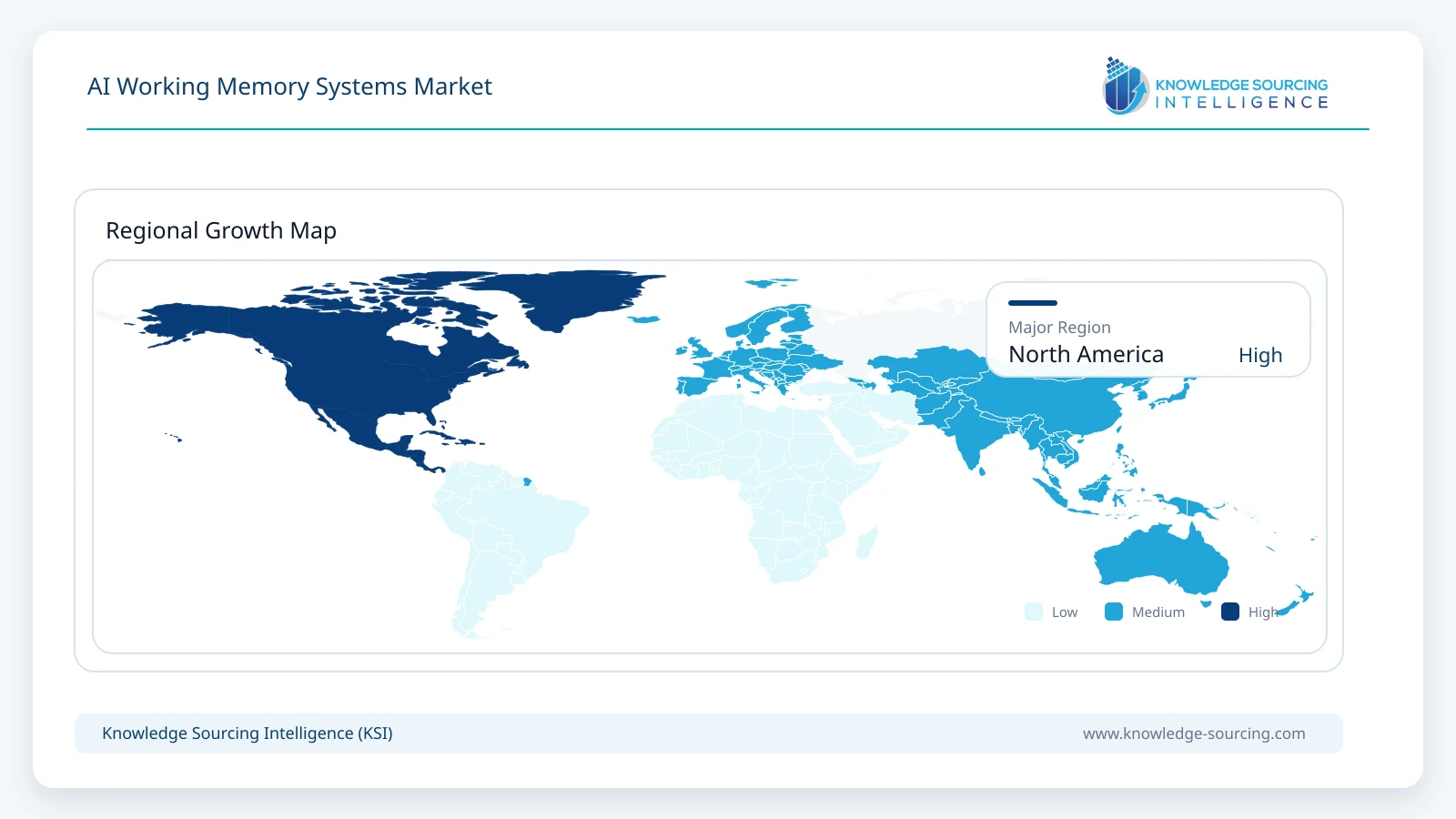
- 5North America is the largest regional market in the model, while Asia Pacific records the highest forecast growth rate.
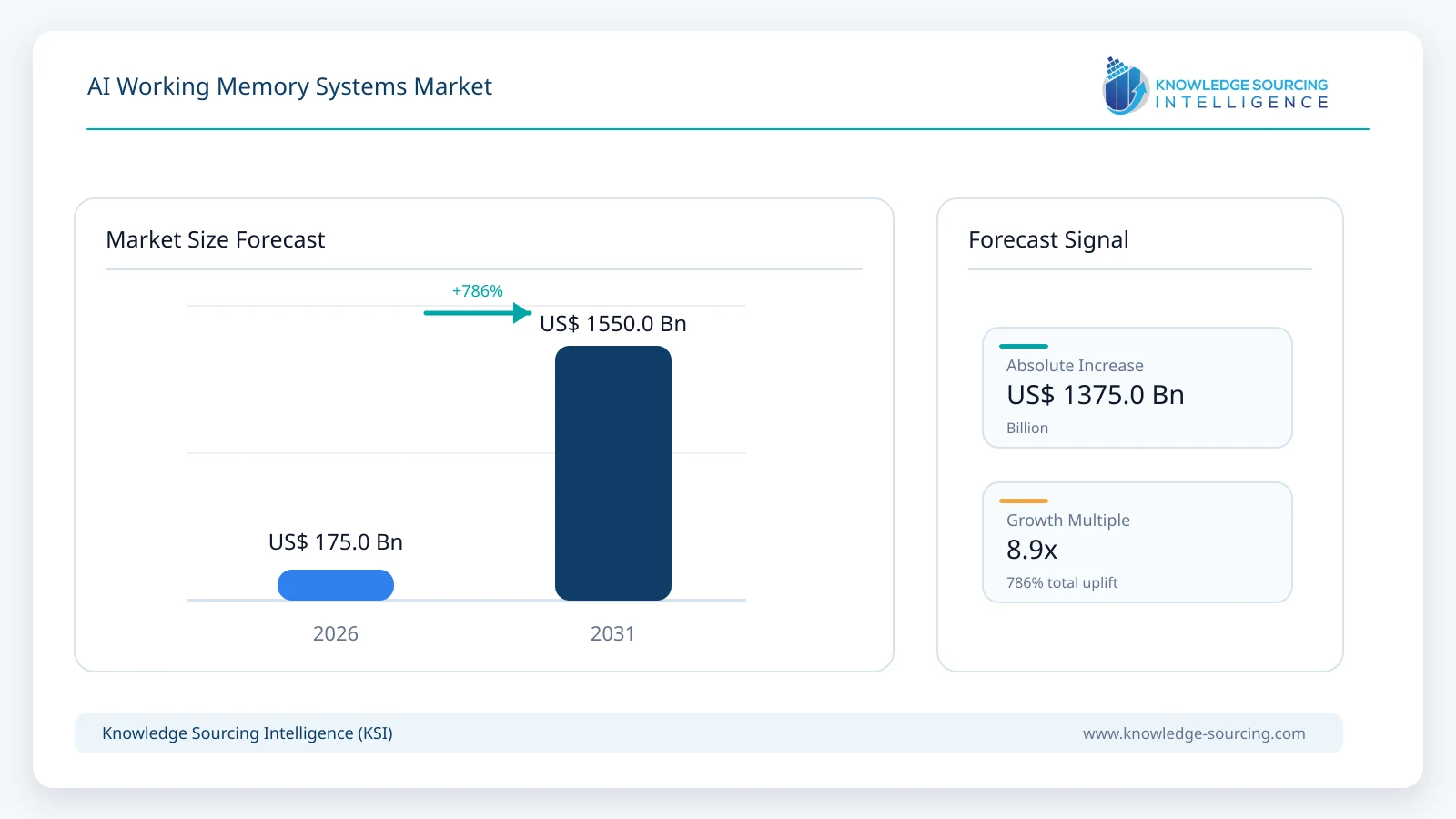
The market growth reflects the commercialization of session-state services, agent checkpointing, managed conversation events and context compaction for AI applications that carry out multi-step tasks rather than single-turn exchanges.
Working memory in this study comprises the active state of an agent: current instructions, recent messages, outstanding tool calls, temporary work products, intermediate reasoning artifacts and workflow checkpoints. It differs from semantic memory, which retains durable knowledge for later sessions. The study measures paid service and platform revenue attributable to active working memory, excluding foundation-model inference, unbilled local buffers and generic runtime charges.
The report evaluates working-memory architectures, core functions, deployment models, workloads, buyer types, and end-use industries. The forecast incorporates usage-metered services from hyperscalers, managed session and checkpoint layers, and dedicated enterprise deployments, with adoption shaped by data isolation, compaction quality, recovery needs, and observable charges.
Market Overview
AI agents conducting customer interactions, software maintenance, and enterprise workflows must repeatedly choose which information should remain immediately available to the model. A working-memory system assembles recent messages, task constraints, tool outputs, and intermediate state, then restores them during later turns or resumed execution. Without that layer, applications often reconstruct context manually and risk losing progress when a service restarts or a tool response arrives late.
The commercialization of active memory is becoming easier to observe. AWS priced short-term AgentCore Memory by ingested and retrieved data in October 2026, while Google Agent Engine publishes event-based session charges. Managed LangSmith Deployment supplies durable state and threading, and Redis Agent Memory offers session-scoped event history with automatic summarization. These offerings create several purchasing models, from narrowly metered events to a paid share of larger managed-agent deployments.
Production buyers evaluate state correctness as carefully as raw read/write throughput. Microsoft Agent Framework exposes workflow checkpoints containing executor status and pending messages, while Cloudflare supports recoverable agent sessions. A robust working-memory service must protect those records, manage expiration and choose which information to present in the next model request. The market therefore captures more than ordinary message storage but remains narrower than general agent infrastructure.
Market Trends
Session Memory Moves Toward Metered Infrastructure
Commercial agent services increasingly distinguish short-lived state from broader runtime and durable knowledge functions. AWS moved short-term memory charging to ingestion, retrieval, and temporary storage usage in October 2026. The tariff ties cost to data consumption, while TTL controls allow customers to reduce storage exposure when task context is no longer useful.
Google Agent Engine also provides paid session-event storage, showing how conversation state can become a measured platform service. Pricing mechanisms help procurement teams compare managed memory with self-hosted Redis or checkpoint stores, though separate charges remain small for lightweight applications and are not sufficient evidence for a broad platform revenue allocation.
Checkpoints Become a Standard for Resumable Agent Tasks
Long-running agents require recoverable snapshots of active work, particularly when awaiting human approval or tool completion. LangGraph supports thread-scoped checkpointers and LangSmith Deployment offers managed durability with state isolation. Microsoft Agent Framework similarly captures executor state, pending messages, and workflow position so tasks can resume without repeating completed work.
As multi-agent processes replace basic chat sequences, checkpoint consistency becomes a commercial differentiator. Enterprises need to decide which intermediate results are retained, how concurrent updates are controlled, and when a failed step should be replayed. Managed frameworks and backing stores can charge for higher availability, audit trails, and enterprise support rather than only storing a chat transcript.
Context Compaction Separates Useful State from Noise
AI agent histories grow quickly when connected tools return large documents, logs, or search results. Redis Agent Memory can summarize older session events while preserving more recent interactions, and Mastra introduced hooks in September 2026 that let developers filter noisy tool output and apply controls during observation and reflection cycles.
Context selection is increasingly tied to inference economics because every repeated message or irrelevant artifact can add tokens without improving decisions. Services that preserve active constraints, track outstanding tasks, and remove expired material may justify a premium, provided customers can test whether summarization accidentally discards instructions required later in the workflow.
Segment Analysis
By Commercial Revenue Stream: Attributed Managed Cloud State and Memory APIs
Attributed managed cloud state and memory APIs represent USD 49 million in modeled 2026 revenue and are projected to reach USD 535 million by 2031. The stream counts attributable paid short-term memory events, session storage and retrieval services sold within larger cloud platforms, rather than their full runtime or model inference bills.
AWS and Google provide the clearest public evidence of separately chargeable components. Enterprise adoption is expected to increase as developers replace manually maintained state stores with managed APIs, although bundled entry tiers and inexpensive event transactions can restrain revenue per active deployment.
By Architecture: Checkpoint-Backed State Stores
Checkpoint-backed state stores account for an estimated 32% of the market in 2026 and 35% by 2031, representing the largest architecture in the forecast period. Checkpoints preserve a task’s pending actions, intermediate results and workflow position so an agent can recover from interruptions without executing completed steps again.
LangGraph and Microsoft Agent Framework demonstrate mature approaches to checkpoint storage, while Cloudflare’s session runtime combines state persistence with recoverable execution. Buyers value these capabilities in coding agents, financial workflows and human-in-the-loop operations, where losing task position can trigger costly repetition or incorrect actions.
By Primary Memory Function: Task-State Checkpointing and Resumption
Task-state checkpointing and resumption accounts for 28% of modeled working-memory revenue in 2026 and 31% in 2031, equivalent to USD 480.5 million. The function enables a running agent to save intermediate decisions, pending tool requests, and execution position, then recover the same task after an interruption or change in computing environment. Its value rises as enterprises automate workflows that remain open for hours or require several approval stages.
Microsoft Agent Framework supports checkpoint storage with recovery of executor state and queued messages, while LangGraph provides thread-based checkpointers used in managed deployments. Enterprise purchasers are expected to prioritize replay safety, encrypted state storage, and defined recovery periods because a misrestored task can be costlier than a restarted chatbot interaction.
By Deployment Model: Hybrid Cloud
Hybrid-cloud deployments are projected to increase from 19% of AI working memory revenue in 2026 to 21% by 2031, producing USD 325.5 million in the forecast year. The architecture typically retains sensitive checkpoints or task records inside controlled infrastructure while accessing external models and managed orchestration services for other stages of an agent workflow.
Financial institutions, healthcare organizations and regulated industrial operators are likely to evaluate hybrid arrangements when active context contains customer identifiers, tool credentials or unreleased business plans. The additional integration effort is justified by controls over data movement and restoration, though simpler managed cloud sessions remain attractive for less sensitive workloads and faster initial development.
By Primary Agent Workload: Multi-Agent Business Operations
Multi-agent business operations are estimated to contribute 22% of global revenue in 2026, increasing to 27% by 2031, equivalent to USD 418.5 million. These workflows need consistent shared task state across specialized agents that exchange documents, approvals and tool results, without indiscriminately sharing an entire organization’s memory.
Growing workloads include research coordination, account servicing, transaction investigation and software release operations. Providers that isolate each workflow, support checkpoint handoffs and keep intermediate artifacts synchronized can offer differentiated services to application developers and enterprise platform teams.
Market Drivers
Growth of Long-Running, Multi-Step AI Agents
Production AI agents routinely accumulate instructions, tool results, and pending actions over many steps. Managed working-state infrastructure allows the agent to preserve active context, resume failed steps, and avoid recreating each prompt, expanding paid demand across enterprise deployments.
Commercialization of Short-Term Memory and Session APIs
Amazon Bedrock AgentCore and Google Agent Engine expose usage-metered session-memory functions. Explicit event, storage and retrieval charging allows providers and buyers to recognize working memory as an infrastructure line item rather than generic model inference.
Rising Requirement for Resumable Task-State Checkpoints
Coding, research, and operations agents often pause for approvals or await external tools. LangGraph, Microsoft Agent Framework, and Cloudflare support checkpoint-based state restoration, reducing duplicate execution and helping teams operate long-running tasks reliably.
Pressure to Reduce Context-Window and Token Costs
Repeatedly passing full transcripts can inflate inference expenses and lower relevance. Redis session summarization and Mastra memory controls offer alternative approaches that compact or filter active context before invoking a model, creating room for paid optimization layers.
Enterprise Need for Isolation, Expiry and Auditable State
Shared platforms must keep separate users, tenants, and agent tasks from reading one another’s working state. Session identifiers, scoped checkpoints, automatic expiry and guarded restoration become material buying criteria when agent applications handle confidential data.
Market Restraints
Bundled and Open-Source Session Features Limit Pricing
Open-source checkpointers and platform-included memory functions reduce the addressable paid share. Revenue models must not treat all applications using local message buffers or free SDKs as paying customers of a standalone memory provider.
Weak Monetization at Low Event Volumes
Per-GB or per-event rates for small session payloads can yield limited direct revenue. AWS’s October 2026 tariffs show why customer adoption counts cannot be translated into market revenue without realistic payload and usage assumptions.
Security Risks Around Replaying Untrusted Task State
Checkpoint contents may contain executable or sensitive state, unsanitized tool output, and credentials. Enterprises require access controls, integrity checks and safe deserialization, increasing deployment effort and creating procurement barriers.
Latency and Context Quality Trade-Offs
Working-memory compaction can discard details that a later task step needs. Frequent checkpoint writes and retrievals can also extend response times, so developers must balance persistence depth, summarization quality and operating cost.
Market Definition Overlap with Runtime and Durable Memory
Managed agent platforms sell execution, inference, vector retrieval, durable semantic memory, and task-state facilities together. The absence of separate invoice lines makes accurate attribution difficult and increases the risk of double counting adjacent market estimates.
Regional Outlook
North America
North America leads the modeled AI working memory systems market at USD 78.75 million in 2026 and USD 604.5 million by 2031. Cloud providers, enterprise software vendors and specialist state-management platforms create a concentrated commercialization base in the United States. AWS, LangChain, Cloudflare and other ecosystem participants provide purchasing routes for session persistence and agent workflow recovery.
North American demand is expected to move from basic developer utilities toward managed checkpointing, controlled replay and context compaction as agents handle sensitive business operations. Procurement decisions will increasingly consider isolation guarantees, audit records and price visibility across memory, runtime and model services, rather than comparing context-window sizes alone.
Asia Pacific
Asia Pacific is estimated at USD 43.75 million in 2026 and USD 465.0 million in 2031, making it the fastest-growing region in the model. China, India, Japan, South Korea and regional cloud hubs support expanding customer, coding, and business automation agents, creating demand for low-latency active context that remains coherent across language and workflow changes.
Regional deployments will emphasize flexible data residency, integration with existing enterprise systems, and cost-sensitive event processing. Cloud-managed state can accelerate adoption among small engineering teams, while regulated and large enterprises may prefer hybrid architectures and locally controlled checkpoint stores to meet isolation and security requirements.
Competitive Landscape
The AI working memory systems ecosystem includes cloud platforms, in-memory data suppliers, agent orchestration frameworks, and specialists that manage active context. AWS and Google offer separately metered session facilities, Redis provides session memory infrastructure, and LangChain connects checkpoint architecture with managed deployment. Microsoft, Cloudflare and MongoDB make task-state resilience part of broader enterprise platforms.
Competitive selection depends on checkpoint reliability, latency, replay safety, context relevance, tenancy controls, and the share of the bill attributable to memory. Open-source framework adoption gives some vendors distribution reach but does not itself generate booked market revenue. Providers that package secure state restoration and intelligent compaction without forcing a full-stack migration are positioned to address enterprise demand.
Recent Developments
October 12, 2026: AWS introduced consumption-based short-term memory pricing for AgentCore, billing ingestion, retrieval, and temporary storage by data volume.
October 1, 2026: Upstash introduced AgentKit for TanStack AI, adding Redis-backed chat persistence, resumable streams, and agent-state controls.
September 29, 2026: Mastra introduced memory lifecycle and transformation hooks, enabling developers to inspect and filter information used during observation and reflection.
September 29, 2026: MongoDB launched Atlas Agent Engine, bringing managed agent execution and memory capabilities into a unified production infrastructure offering.
August 7, 2026: AWS extended AgentCore Memory and managed agent harness capabilities into AWS GovCloud (US-West), supporting regulated deployment requirements.
May 20, 2026: Google introduced Agent Executor, an open-source runtime with event logs and snapshots for durable agent execution and recovery.
Market Outlook
AI working memory systems will become a more identifiable part of agent infrastructure purchasing as enterprises demand recoverable workflows, persistent thread state, and controlled context packaging. Cloud API tariffs make part of the value directly measurable, while managed frameworks and private installations address requirements for advanced orchestration, security and service reliability.
Growth will depend on moving beyond free buffers and prototypes to production workloads with meaningful event volumes and paid checkpoint guarantees. Session isolation, safe restoration and context compaction can command premium value when they measurably reduce abandoned tasks and duplicated inference, but platform bundling and low per-event prices will keep buyers focused on attributable cost.
The strongest opportunities lie in large-scale agent operations that need to resume after interruptions and preserve current work across multiple participants. Providers that integrate short-term memory with durable knowledge without double-charging for the same event will be better positioned as enterprises standardize memory architectures across applications.
AI Working Memory Systems Market Scope:
| Report Metric | Details |
|---|---|
| Total Market Size in 2026 | USD 175.0 million |
| Total Market Size in 2031 | USD 1,550.0 million |
| Forecast Unit | USD Billion |
| Growth Rate | 54.7% |
| Study Period | 2021 to 2031 |
| Historical Data | 2021 to 2024 |
| Base Year | 2025 |
| Forecast Period | 2026 – 2031 |
| Segmentation | Commercial Revenue Stream, Working-Memory Architecture, Primary Memory Function, Deployment Model |
| Companies |
|
| Customization Scope | 15% Free Customization included with purchase — Request Custom Breakdown → |
| Sample & Data Access | PDF Sample, Excel Databook & Analyst Briefing — Download Free Sample → |
Market Segmentation
By Commercial Revenue Stream
Dedicated Session and Working-Memory Services
Attributed Managed Cloud State and Memory APIs
Paid Checkpoint, Task-State and Context Modules
Private Session-State Deployments and Integration
By Working-Memory Architecture
Session Event and Message Buffers
Checkpoint-Backed State Stores
Context Selection and Compaction Layers
Shared Multi-Agent Working-State Layers
By Primary Memory Function
Session Context Assembly and Retrieval
Task-State Checkpointing and Resumption
Context Pruning, Ranking and Summarization
Isolation, Expiry and Working-State Governance
By Deployment Model
Public Cloud Managed Services
Hybrid Cloud
Private Cloud
On-Premises and Edge
By Primary Agent Workload
Interactive Customer and Employee Agents
Software Engineering and Coding Agents
Research and Analytical Agents
Multi-Agent Business Operations
By Buyer and Integration Model
AI Infrastructure and Platform Teams
Enterprise Application Development Teams
SaaS Product Vendors
Systems Integrators and Private Operations
By End-user Industry
Technology, Cloud and Software
Banking and Financial Services
Retail, Commerce and Customer Services
Healthcare and Life Sciences
Manufacturing and Logistics
Public Sector and Other Industries
By Geography
North America
United States
Canada
Mexico
South America
Brazil
Argentina
Rest of South America
Europe
Germany
United Kingdom
France
Netherlands
Italy
Spain
Rest of Europe
Middle East and Africa
United Arab Emirates
Saudi Arabia
Israel
South Africa
Rest of Middle East and Africa
Asia Pacific
China
Japan
India
South Korea
Australia
Singapore
Rest of Asia Pacific
Table of Contents
1. EXECUTIVE SUMMARY
1.1. Research Highlights
1.2. Market Size and Growth Outlook, 2026–2031
1.3. Strategic Market Perspective
2. MARKET SNAPSHOT
2.1. Market Overview
2.2. Market Definition
2.3. Scope of the Study
2.4. Market Segmentation
3. BUSINESS LANDSCAPE
3.1. Market Drivers
3.1.1. Growth of Long-Running, Multi-Step AI Agents
3.1.2. Commercialization of Short-Term Memory and Session APIs
3.1.3. Rising Requirement for Resumable Task-State Checkpoints
3.1.4. Pressure to Reduce Context-Window and Token Costs
3.1.5. Enterprise Need for Isolation, Expiry and Auditable State
3.2. Market Restraints
3.2.1. Bundled and Open-Source Session Features Limit Pricing
3.2.2. Weak Monetization at Low Event Volumes
3.2.3. Security Risks Around Replaying Untrusted Task State
3.2.4. Latency and Context Quality Trade-Offs
3.2.5. Market Definition Overlap with Runtime and Durable Memory
3.3. Market Opportunities
3.4. Porter’s Five Forces Analysis
3.5. Industry Value Chain Analysis
3.6. Policies and Regulations
3.7. Strategic Recommendations
4. TECHNOLOGICAL OUTLOOK
4.1. Active Context Buffers and Session Event Stores
4.2. Checkpoint Serialization and Resumable State
4.3. Context Compaction, Ranking and Expiry
4.4. Multi-Agent Shared State and Tenant Isolation
4.5. Safe Replay, Observability and Recovery
5. AI WORKING MEMORY SYSTEMS MARKET BY COMMERCIAL REVENUE STREAM
5.1. Introduction
5.2. Dedicated session and working-memory services
5.3. Attributed managed cloud state and memory APIs
5.4. Paid checkpoint, task-state and context modules
5.5. Private session-state deployments and integration
6. AI WORKING MEMORY SYSTEMS MARKET BY WORKING-MEMORY ARCHITECTURE
6.1. Introduction
6.2. Session event and message buffers
6.3. Checkpoint-backed state stores
6.4. Context selection and compaction layers
6.5. Shared multi-agent working-state layers
7. AI WORKING MEMORY SYSTEMS MARKET BY PRIMARY MEMORY FUNCTION
7.1. Introduction
7.2. Session context assembly and retrieval
7.3. Task-state checkpointing and resumption
7.4. Context pruning, ranking and summarization
7.5. Isolation, expiry and working-state governance
8. AI WORKING MEMORY SYSTEMS MARKET BY DEPLOYMENT MODEL
8.1. Introduction
8.2. Public cloud managed services
8.3. Hybrid cloud
8.4. Private cloud
8.5. On-premises and edge
9. AI WORKING MEMORY SYSTEMS MARKET BY PRIMARY AGENT WORKLOAD
9.1. Introduction
9.2. Interactive customer and employee agents
9.3. Software engineering and coding agents
9.4. Research and analytical agents
9.5. Multi-agent business operations
10. AI WORKING MEMORY SYSTEMS MARKET BY BUYER AND INTEGRATION MODEL
10.1. Introduction
10.2. AI infrastructure and platform teams
10.3. Enterprise application development teams
10.4. SaaS product vendors
10.5. Systems integrators and private operations
11. AI WORKING MEMORY SYSTEMS MARKET BY END-USER INDUSTRY
11.1. Introduction
11.2. Technology, cloud and software
11.3. Banking and financial services
11.4. Retail, commerce and customer services
11.5. Healthcare and life sciences
11.6. Manufacturing and logistics
11.7. Public sector and other industries
12. AI WORKING MEMORY SYSTEMS MARKET BY GEOGRAPHY
12.1. North America
12.1.1. United States
12.1.2. Canada
12.1.3. Mexico
12.2. South America
12.2.1. Brazil
12.2.2. Argentina
12.2.3. Rest of South America
12.3. Europe
12.3.1. Germany
12.3.2. United Kingdom
12.3.3. France
12.3.4. Netherlands
12.3.5. Italy
12.3.6. Spain
12.3.7. Rest of Europe
12.4. Middle East and Africa
12.4.1. United Arab Emirates
12.4.2. Saudi Arabia
12.4.3. Israel
12.4.4. South Africa
12.4.5. Rest of Middle East and Africa
12.5. Asia Pacific
12.5.1. China
12.5.2. Japan
12.5.3. India
12.5.4. South Korea
12.5.5. Australia
12.5.6. Singapore
12.5.7. Rest of Asia Pacific
13. COMPETITIVE ENVIRONMENT AND ANALYSIS
13.1. Major Players and Strategy Analysis
13.2. Market Share Analysis
13.3. Mergers, Acquisitions, Agreements, and Collaborations
13.4. Competitive Dashboard
14. COMPANY PROFILES
14.1. Amazon Web Services, Inc.
14.2. Google LLC
14.3. Redis Ltd.
14.4. LangChain, Inc.
14.5. MongoDB, Inc.
14.6. Mastra
14.7. Letta, Inc.
14.8. Microsoft Corporation
14.9. Cloudflare, Inc.
14.10. Upstash, Inc.
15. APPENDIX
15.1. Currency
15.2. Assumptions
15.3. Base and Forecast Years Timeline
15.4. Key Benefits for Stakeholders
15.5. Research Methodology
15.6. Abbreviations





Frequently asked questions
What is the forecasted market size of AI Working Memory Systems by 2031?
The AI Working Memory Systems Market is projected to reach USD 1,550.0 million by 2031.
What is the Compound Annual Growth Rate (CAGR) for this market?
The AI Working Memory Systems Market is expanding at a significant CAGR of 54.7%.
Which region holds the largest market share in AI Working Memory Systems?
North America is currently the largest regional market.
Which region exhibits the highest growth rate in the forecast period?
Asia Pacific records the highest forecast growth rate.
What are the key drivers for market growth?
Commercialization of session-state services and agent checkpointing drives growth.
How is AI working memory defined in this report?
The AI Working Memory Systems Market comprises an agent's active state: instructions, messages, tool calls.
Cite this report
Knowledge Sourcing Intelligence. (Oct 2026). AI Working Memory Systems Market Size, Share & Growth Forecast (2026-2031). https://www.knowledge-sourcing.com/report/ai-working-memory-systems-market