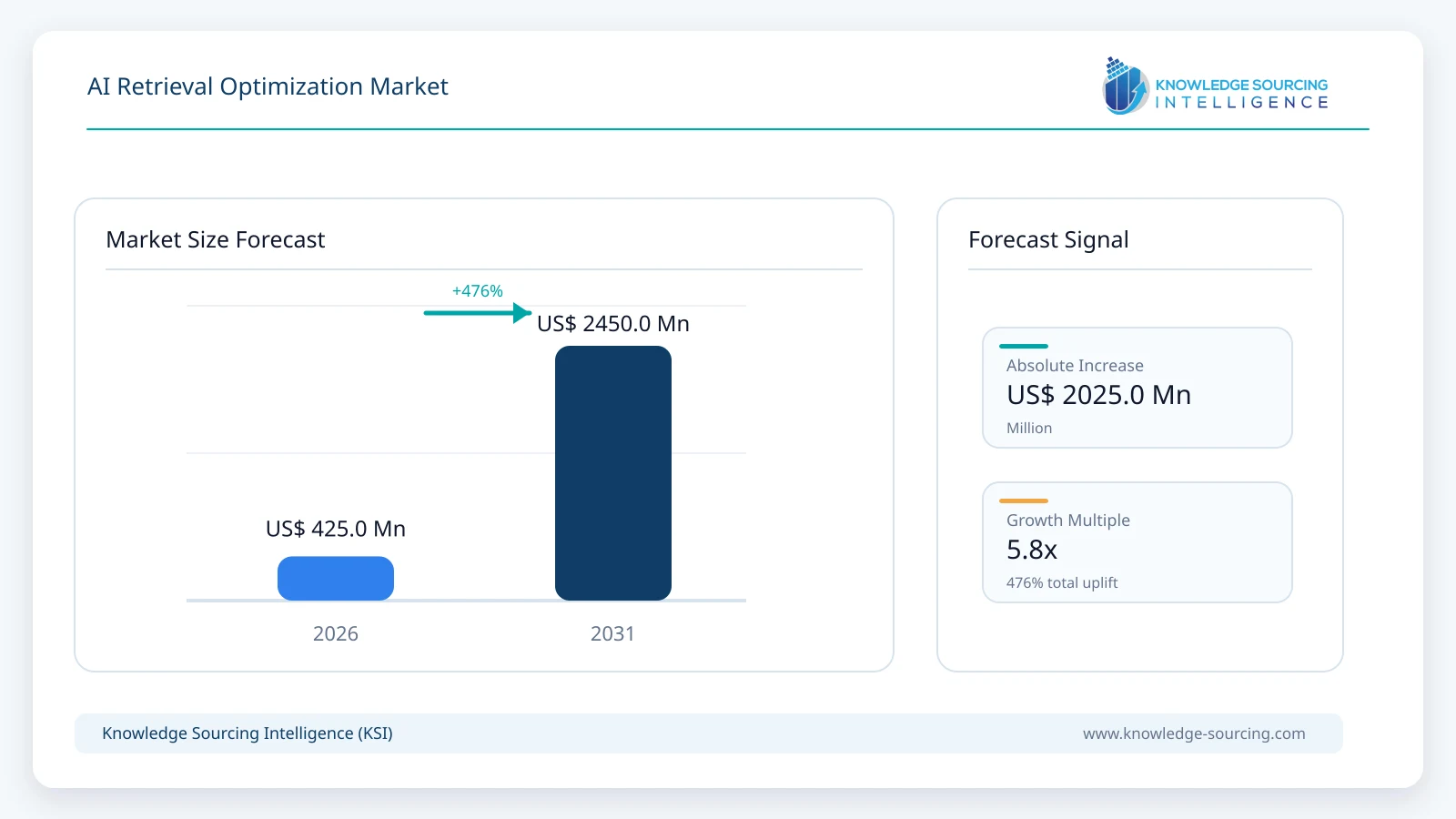
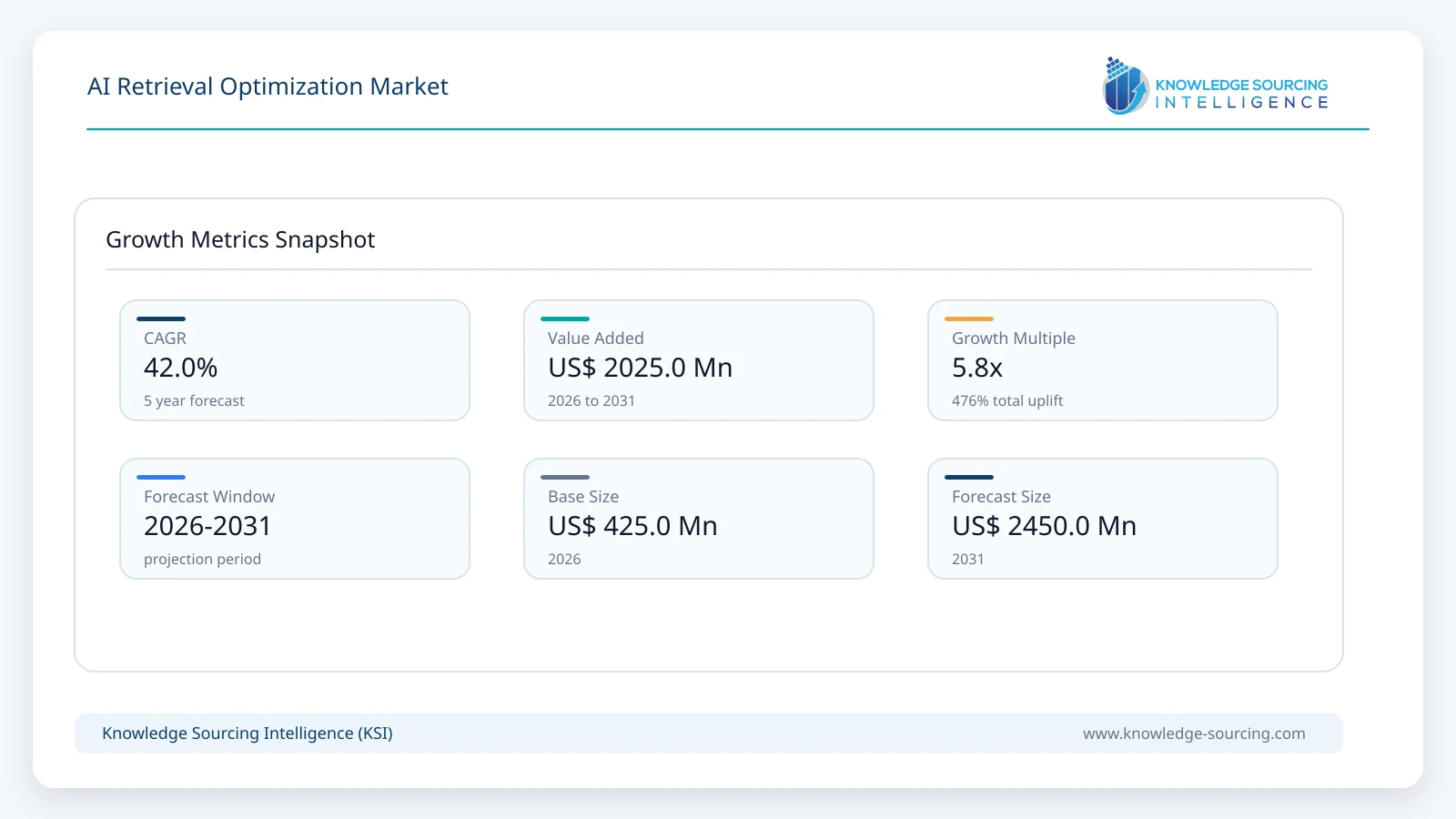
The AI Retrieval Optimization Market is projected to grow from USD 425 million in 2026 to USD 2,450 million by 2031, at a CAGR of 41.96% during the forecast period.
Highlights:
- 1Separately metered semantic ranking, reranking models and managed retrieval features are turning search relevance into an identifiable optimization budget.
- 2Neural reranking leads the technique mix, while complex query decomposition benefits from the expansion of agentic and multi-hop information requests.
- 3Managed cloud APIs maintain the largest deployment share, with hybrid and private systems remaining relevant for governed enterprise content.
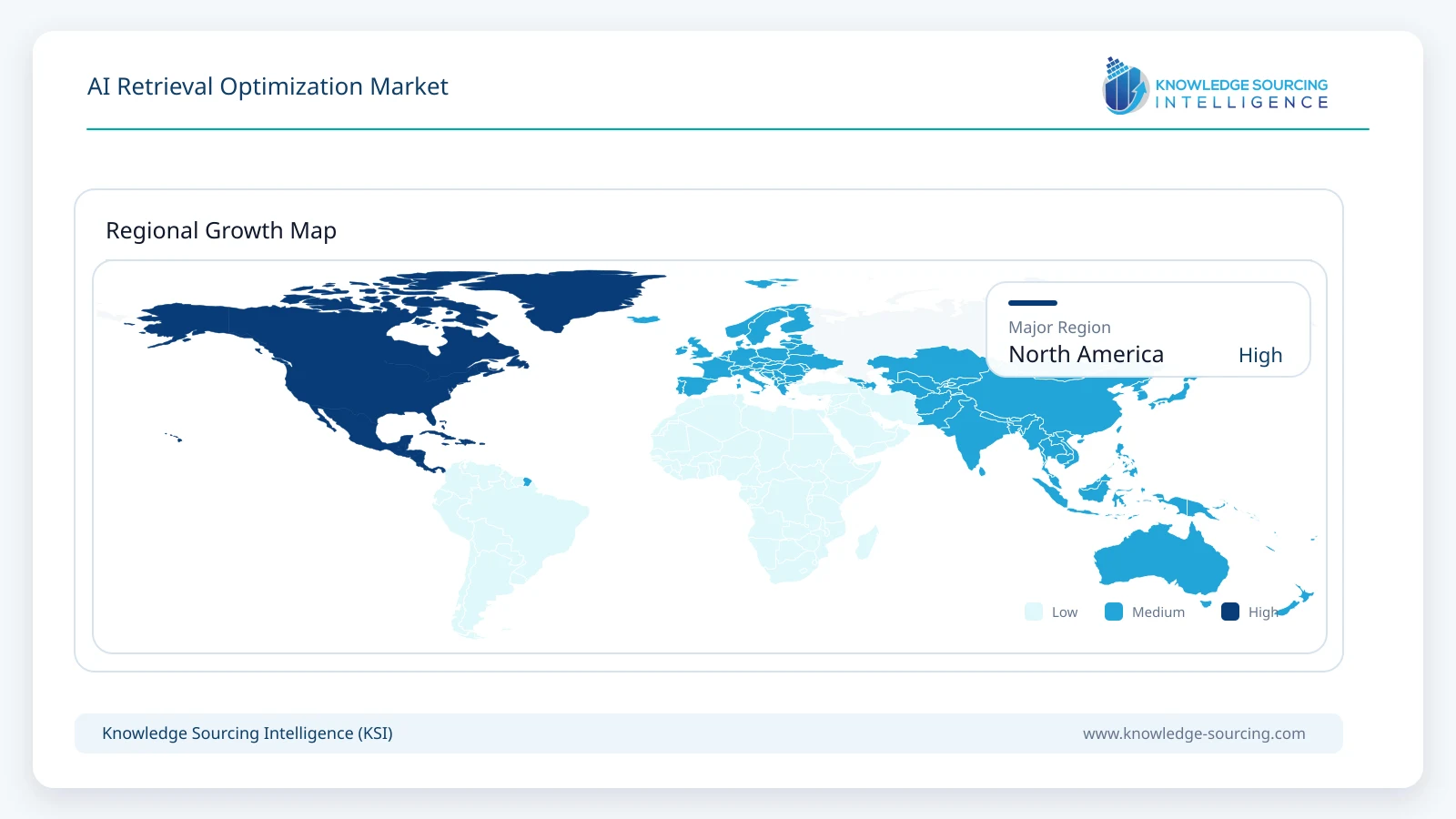
- 4North America leads initial spending, while Asia Pacific is projected to gain share through expanding enterprise AI and multilingual retrieval use.
- 5Growth depends on suppliers proving higher evidence precision without excessive latency, duplicate platform charges or weak access-control handling.
The market comprises paid software, managed features and metered services that improve retrieval relevance through query reformulation, hybrid retrieval decisions, neural reranking, selection diversity and performance feedback. It does not represent the entire RAG, vector database or enterprise search software market.
Search systems feeding AI agents often return a large set of technically similar but unevenly useful results. Cohere, Microsoft, Weaviate, Google, AWS and Pinecone provide different combinations of ranking models, query planning and retrieval controls that help select stronger evidence before model generation. Production buyers increasingly compare accuracy improvements with the latency, API usage and infrastructure costs added by further retrieval stages.
The report analyzes seven independent market dimensions covering commercial offering, technique, pipeline stage, data type, deployment, application and end-user industry. It assesses regional adoption, monetization constraints and competitive strategies in advanced search and enterprise AI workflows, together with the most relevant market developments and purchasing considerations.
Enterprise adoption of retrieval-based AI is changing the economics of search from finding possible matches to identifying evidence that can be trusted by a language model or automation agent. A relevant result must answer the actual information request, carry the right source and permissions, and arrive within an acceptable response time. Hybrid search and neural reranking address different parts of that requirement, making optimization a distinct engineering and purchasing activity.
Cloud platforms increasingly expose optimization as a managed and, in several cases, chargeable feature. Microsoft documents pay-as-you-go semantic ranker and agentic retrieval billing; Cohere offers Rerank 5 through hosted and enterprise deployments; Oracle provides Rerank 4 on demand and in dedicated clusters. AWS includes query planning, document ranking and agentic retrieval in its managed knowledge-base product, requiring careful attribution of the paid optimization component instead of the complete subscription.
A market constraint is that simple relevance tuning is frequently included in existing search products or can be assembled using open-source tools. Specialized suppliers must therefore demonstrate consistent gains across document types, languages and access-control environments. Organizations evaluating a solution increasingly require offline retrieval benchmarks and live task-level evidence, rather than generic claims of higher semantic similarity.
Market Trends
Reranking Becomes a Separate, Measurable Retrieval Layer
The commercial separation of first-stage candidate retrieval from neural reranking is making relevance quality easier to price and benchmark. Cohere introduced Rerank 5 Pro and Fast in October 2026 with models tuned for more demanding enterprise retrieval and lower-latency usage, respectively. Microsoft Azure AI Search operates a semantic ranking service with usage-based billing, while Oracle provides Cohere Rerank 4 through OCI Generative AI.
Buyers can add a second-stage ranker to an existing keyword or vector search stack without replacing the underlying index. The tradeoff is additional processing cost and latency, particularly when candidate lists are long. Successful deployments tune the number of candidates, relevance thresholds and the frequency of reranking against measurable improvements in grounded response quality.
Adaptive Multi-Query Retrieval Expands in Agentic Workflows
Agentic retrieval systems increasingly reformulate complex requests into narrower subqueries and select search effort according to task requirements. Microsoft Azure AI Search supports query planning and parallel execution, while Weaviate introduced an effort control that increases recall and reranking activity for harder searches. AWS Managed Knowledge Base also provides agentic retrieval capabilities for multi-hop questions.
This architecture can improve coverage where one query misses evidence distributed across several document collections or terminology systems. The commercial opportunity is an attributable premium for intelligent routing, search-policy management and retrieval monitoring, rather than treating every underlying search or model token as new optimization-market revenue.
Hybrid Search, Diversity and Governance Converge
Weaviate 1.39 made query-time boosting and maximal marginal relevance diversity selection generally available in August 2026. Combining lexical retrieval, semantic vectors and reranking allows systems to capture both exact identifiers and conceptual similarity, while diversity controls reduce repeated versions of the same evidence. Such controls become more important as enterprise agents search product catalogs, technical manuals and regulated policies.
Production adoption depends on honoring access restrictions and ensuring that relevance tuning does not favor outdated or unauthorized content. Enterprises can differentiate retrieval optimization providers by testing permission-aware filtering, freshness weighting, multilingual terminology and error handling as part of the complete retrieval pipeline.
AI Retrieval Optimization Market Segment Analysis
By Commercial Offering
Metered Reranking and Adaptive Retrieval APIs
Metered reranking and adaptive retrieval APIs are estimated at USD 145 million in 2026 and USD 875 million by 2031. They comprise attributable payments for relevance-model calls, expanded retrieval passes and optimization-specific API usage, excluding the ordinary embedding, storage and foundation-model charges associated with the same workflow.
API-based pricing allows teams to adopt stronger ranking without committing to a full search-platform replacement. Enterprise usage can scale rapidly as agents repeat retrieval during multi-stage tasks, but providers must maintain predictable throughput and demonstrate whether each extra relevance pass materially improves task results.
By Optimization Technique
Query Rewriting and Decomposition
Query rewriting and decomposition represent 20% of revenue in 2026 and are forecast to reach 23% by 2031, equivalent to USD 563.5 million. The technique reformulates ambiguous or multi-part questions into focused requests that can use keyword, semantic and hybrid search more effectively.
Microsoft and Weaviate provide relevant examples through managed agentic retrieval and effort-aware search. Buyers should measure the incremental benefit of additional subqueries, because uncontrolled search expansion can produce more irrelevant results and raise cost faster than answer quality improves.
By Pipeline Stage
Second-Stage Reranking and Filtering
Second-stage reranking and filtering account for 37% of the market in 2026 and 38% in 2031, reaching USD 931 million. This stage reorders and filters a smaller shortlist returned by the primary search system and is one of the clearest sources of separable optimization spending.
Cohere, Oracle, Google and Microsoft offer commercial ranking features, although the associated billing structures differ. Enterprises may use cross-encoders for high-value research queries while applying lower-cost models or simpler thresholds to high-volume routine retrieval.
By Deployment Model
Managed Cloud and API Services
Managed cloud and API services increase from 58% of modeled 2026 revenue to 63% by 2031, representing USD 1.54 billion at the forecast endpoint. Hosted reranking models, cloud semantic-ranker services and managed agentic retrieval are attractive when application teams want operational search quality without maintaining separate model-serving infrastructure.
Private cloud and hybrid alternatives remain important where source documents are sensitive, retrieval volumes are predictable or organizations require dedicated throughput. Suppliers that support consistent relevance testing across cloud and private settings may retain enterprise customers as deployment requirements change.
By Application
Agentic Multi-Step Research and Task Execution
Agentic multi-step research and task execution expands from 15% in 2026 to 24% in 2031, equivalent to USD 588 million. These systems search repeatedly, refine unanswered subquestions and combine evidence across repositories, increasing the value of adaptive strategy selection and result evaluation.
The opportunity is especially relevant to research assistants, compliance workflows and operational copilots that must cite reliable records. Buyers should assess evidence recall, ranking diversity and retrieval cost per completed task rather than rewarding a higher count of returned documents.
Market Drivers
Growth of Production Retrieval-Augmented Generation
Production retrieval-augmented generation requires relevant evidence from business documents, support records and structured repositories before an answer can be generated. As enterprise assistants move beyond pilots, retrieval accuracy affects support resolution, research throughput and decision quality. This supports dedicated budget for advanced reranking, search tuning and evaluation where basic keyword or vector retrieval is insufficient for complex questions.
Rising Complexity of Multi-Step Agent Retrieval
Autonomous research and workflow agents search repeatedly, revisit partial answers and divide complex questions across sources. Microsoft Azure AI Search and Weaviate demonstrate how query planning, wider recall and adjustable retrieval effort can address these needs. Multiple search passes also increase operating expense, supporting commercial optimization tools that decide when extra work is justified by the likely quality improvement.
Separately Monetized Neural Reranking Services
Enterprise providers increasingly expose neural reranking as a recognizable billing item. Cohere offers hosted reranking models, Microsoft documents pay-as-you-go semantic ranking, and Oracle supports on-demand rerank inference. This creates a direct path from ranking workload to supplier revenue without requiring the buyer to replace its database. Commercial success nevertheless depends on whether improvements offset the additional API and processing charges.
Demand for Higher-Quality Hybrid and Multilingual Retrieval
Enterprise knowledge is distributed across prose, codes, product identifiers, local languages and structured metadata. Retrieval pipelines must combine exact lexical signals with semantic relevance to avoid missing technical terms, names or numeric requirements. Weaviate diversity controls and cloud reranking offerings illustrate a move toward multi-stage ranking that can select useful evidence from heterogeneous collections and reduce duplicate matches.
More Rigorous Evaluation of Enterprise AI Grounding
Enterprises using AI-generated answers for regulated or customer-facing activities need to measure whether the retrieved sources actually support the response. Search relevance, authorization, document freshness and citation quality are therefore becoming operational performance indicators. Retrieval optimizers that expose quality metrics and controlled relevance experiments can secure a stronger commercial position than basic query-tuning features embedded in standard search systems.
Market Restraints
Retrieval Enhancements Bundled into Search Platforms
Vector databases, cloud knowledge bases and enterprise search products increasingly include hybrid retrieval, relevance tuning and basic reranking. AWS Managed Knowledge Base illustrates the bundling challenge because a broad managed service contains several advanced retrieval functions. Dedicated suppliers may struggle to sell a separate optimization license unless they demonstrate material incremental quality improvements or capabilities that operate across competing search platforms.
Added Latency and Compute Cost from Multi-Stage Ranking
Cross-encoder models, repeated query decomposition and larger candidate sets increase compute use. A search may return more relevant answers but still be commercially unattractive if extra passes delay customer-facing responses or amplify metered model charges. Enterprises often require different settings for low-value routine queries and high-stakes research requests, limiting uniform deployment of expensive optimization methods.
Fragmented Data Permissions and Inconsistent Source Quality
Enterprise collections contain outdated documents, duplicated versions and inconsistent permission metadata. A relevance algorithm can rank an incorrect or unauthorized record highly unless access controls and freshness filters are applied before or during retrieval. Integration teams must therefore validate source governance across search indexes, files, knowledge graphs and transactional systems, increasing rollout cost and constraining paid adoption.
Uncertain Attribution of Shared Platform Revenue
Advanced ranking is often purchased as part of a managed search, database, agent platform or broader inference contract. Providers rarely disclose separately attributable retrieval-optimization revenue, making category valuation sensitive to assumptions about paid feature attachment. For customers, a vendor claiming optimization benefit without a separately metered component may provide little reason to pay for another software layer.
Limited Transferability of Retrieval Benchmarks
Retrieval precision measured on one dataset may not transfer to another with specialized terminology, multilingual content, tabular documents or unusual access restrictions. Organizations often need their own labeled queries and judgment criteria to compare ranking models fairly. Evaluation maintenance, relevance drift and the difficulty of linking retrieval scores to completed business tasks can delay procurement and encourage simpler open-source solutions.
Regional Outlook
North America
North America is estimated at USD 182.75 million in 2026 and is projected to reach USD 906.50 million in 2031. The United States anchors the regional market through major cloud providers, enterprise search platforms, software developers and early RAG deployments. Microsoft, AWS, Google, Cohere-related cloud channels and specialist infrastructure providers support demand for more accurate search in production AI agents.
Financial services, healthcare, enterprise software and professional research organizations are expected to prioritize traceable search results and authorization-aware ranking. The region also has substantial existing search budgets, creating a clear opportunity for higher-value semantic ranking but limiting the case for simply repackaging features already included in subscriptions.
Asia Pacific
Asia Pacific is estimated at USD 93.50 million in 2026 and USD 735.00 million in 2031, indicating the fastest modeled regional growth. China, India, Japan, South Korea, Australia and Singapore provide a widening base of enterprise assistants, multilingual knowledge systems and software-enabled services in which retrieval reliability affects business outcomes.
Growth is likely to favor hosted ranking services and flexible hybrid retrieval that supports local-language data, varied document structures and differing cloud deployments. As the number of production applications rises, enterprises will demand ranking methods that balance accuracy with inference budgets, private-data controls and efficient routing across domestic and global search infrastructure.
Competitive Landscape
AI retrieval optimization spans specialist reranking model developers, vector search suppliers and global cloud platforms. Cohere competes through dedicated Rerank models, while Microsoft, AWS, Google and Oracle provide paid or bundled retrieval capabilities within managed enterprise AI services. Weaviate, Pinecone, Elastic, Databricks, Vectara and Qdrant contribute ranking or hybrid-retrieval technology in existing search and knowledge ecosystems.
Market share depends on attribution of specific optimization charges, not the total size of a database or cloud contract. Suppliers can differentiate through measured relevance gains, model-independent integration, query-effort controls, private deployment, multilingual quality, permission-sensitive filtering and transparent cost per grounded answer. Free or bundled capabilities constrain willingness to pay for basic ranking features.
Recent Developments
October 2026: Cohere launched Rerank 5 Pro and Fast, adding Context Focus passage spans for precision-oriented enterprise retrieval.
August 2026: Weaviate released version 1.39 with general availability of query-time Boost and maximal marginal relevance diversity selection.
June 2026: AWS made Amazon Bedrock Managed Knowledge Base generally available with hybrid search, document ranking and agentic retrieval.
June 2026: Microsoft introduced a public preview of Semantic Reranker in Azure Cosmos DB for NoSQL.
May 2026: Oracle released support for Cohere Rerank 4 in OCI Generative AI with on-demand and dedicated serving choices.
Market Outlook
Enterprise retrieval optimization spending is expected to grow as AI agents depend on increasingly diverse business documents, search sources and multi-stage research tasks. The main commercial requirement is not retrieving the greatest number of matches, but providing accurate, current and authorized evidence while containing search and reranking cost.
Providers offering separately priced neural reranking, adaptive query execution and relevance monitoring should gain the clearest incremental revenue opportunities. Basic vector retrieval and hybrid search will increasingly be bundled in large data platforms, requiring vendors to demonstrate improvements over the incumbent baseline. Query decomposition and second-stage relevance controls will become particularly valuable for complex, high-stakes applications.
Buyers should benchmark recall, precision, citation quality, access controls, multilingual accuracy and latency using their own document collections. The most durable suppliers will combine consistent relevance gains with transparent metering and avoid duplicate billing for search infrastructure, context assembly, memory storage and the AI model used to generate the final answer.
AI Retrieval Optimization Market Scope:
| Report Metric | Details |
|---|---|
| Total Market Size in 2026 | USD 425 million |
| Total Market Size in 2031 | USD 2,450 million |
| Forecast Unit | USD Million |
| Growth Rate | 41.96% |
| Study Period | 2021 to 2031 |
| Historical Data | 2021 to 2024 |
| Base Year | 2025 |
| Forecast Period | 2026 – 2031 |
| Segmentation | Commercial Offering, Primary Optimization Technique, Retrieval Pipeline Stage, Data and Content Type, Deployment Model, Primary Application, End-User Industry, Geography |
| Companies |
|
| Customization Scope | 15% Free Customization included with purchase — Request Custom Breakdown → |
| Sample & Data Access | PDF Sample, Excel Databook & Analyst Briefing — Download Free Sample → |
Market Segmentation
By Commercial Offering
Dedicated Retrieval Optimization and Relevance Software
Attributable Cloud Search and RAG Optimization Modules
Metered Reranking and Adaptive Retrieval APIs
Enterprise Retrieval Evaluation and Integration Services
By Primary Optimization Technique
Neural Semantic Reranking
Query Rewriting and Decomposition
Hybrid Retrieval Strategy Selection
Result Diversification and Relevance Filtering
Feedback-Driven Relevance Tuning
By Retrieval Pipeline Stage
Query Preparation and Routing
First-Stage Candidate Selection
Second-Stage Reranking and Filtering
Retrieval Evaluation and Adaptive Feedback
By Data and Content Type
Enterprise Documents and Unstructured Text
Knowledge-Base Records and Support Content
Code and Developer Repositories
Structured and Transactional Information
Multimodal and Mixed-Source Content
By Deployment Model
Managed Cloud and API Services
Hybrid Cloud
Private Cloud
On-Premises and Edge
By Primary Application
Enterprise RAG and Knowledge Assistants
Customer Service and Support Retrieval
Agentic Multi-Step Research and Task Execution
Developer and Code Retrieval
Commerce, Analytics and Other Search
By End-User Industry
Technology, Cloud and Software
Banking and Financial Services
Retail and Professional Services
Healthcare and Life Sciences
Manufacturing and Logistics
Government, Education and Others
By Geography
North America
United States
Canada
Mexico
South America
Brazil
Argentina
Rest of South America
Europe
Germany
United Kingdom
France
Netherlands
Italy
Spain
Rest of Europe
Middle East and Africa
United Arab Emirates
Saudi Arabia
Israel
South Africa
Rest of Middle East and Africa
Asia Pacific
China
Japan
India
South Korea
Australia
Singapore
Rest of Asia Pacific
Table of Contents
1. EXECUTIVE SUMMARY
1.1. Research Highlights
1.2. Market Size and Growth Outlook, 2026–2031
1.3. Strategic Market Perspective
2. MARKET SNAPSHOT
2.1. Market Overview
2.2. Market Definition
2.3. Scope of the Study
2.4. Market Segmentation
3. BUSINESS LANDSCAPE
3.1. Market Drivers
3.1.1. Growth of Production Retrieval-Augmented Generation
3.1.2. Rising Complexity of Multi-Step Agent Retrieval
3.1.3. Separately Monetized Neural Reranking Services
3.1.4. Demand for Higher-Quality Hybrid and Multilingual Retrieval
3.1.5. More Rigorous Evaluation of Enterprise AI Grounding
3.2. Market Restraints
3.2.1. Retrieval Enhancements Bundled into Search Platforms
3.2.2. Added Latency and Compute Cost from Multi-Stage Ranking
3.2.3. Fragmented Data Permissions and Inconsistent Source Quality
3.2.4. Uncertain Attribution of Shared Platform Revenue
3.2.5. Limited Transferability of Retrieval Benchmarks
3.3. Market Opportunities
3.4. Porter’s Five Forces Analysis
3.5. Industry Value Chain Analysis
3.6. Policies and Regulations
3.7. Strategic Recommendations
4. TECHNOLOGICAL OUTLOOK
4.1. Neural Semantic Reranking and Candidate Filtering
4.2. Adaptive Query Rewriting and Multi-Hop Decomposition
4.3. Hybrid Search Fusion and Retrieval Diversity
4.4. Search-Effort Controls and Retrieval Cost Management
4.5. Relevance Evaluation, Access Control and Feedback Tuning
5. AI RETRIEVAL OPTIMIZATION MARKET BY COMMERCIAL OFFERING
5.1. Introduction
5.2. Dedicated retrieval optimization and relevance software
5.3. Attributable cloud search and RAG optimization modules
5.4. Metered reranking and adaptive retrieval APIs
5.5. Enterprise retrieval evaluation and integration services
6. AI RETRIEVAL OPTIMIZATION MARKET BY PRIMARY OPTIMIZATION TECHNIQUE
6.1. Introduction
6.2. Neural semantic reranking
6.3. Query rewriting and decomposition
6.4. Hybrid retrieval strategy selection
6.5. Result diversification and relevance filtering
6.6. Feedback-driven relevance tuning
7. AI RETRIEVAL OPTIMIZATION MARKET BY RETRIEVAL PIPELINE STAGE
7.1. Introduction
7.2. Query preparation and routing
7.3. First-stage candidate selection
7.4. Second-stage reranking and filtering
7.5. Retrieval evaluation and adaptive feedback
8. AI RETRIEVAL OPTIMIZATION MARKET BY DATA AND CONTENT TYPE
8.1. Introduction
8.2. Enterprise documents and unstructured text
8.3. Knowledge-base records and support content
8.4. Code and developer repositories
8.5. Structured and transactional information
8.6. Multimodal and mixed-source content
9. AI RETRIEVAL OPTIMIZATION MARKET BY DEPLOYMENT MODEL
9.1. Introduction
9.2. Managed cloud and API services
9.3. Hybrid cloud
9.4. Private cloud
9.5. On-premises and edge
10. AI RETRIEVAL OPTIMIZATION MARKET BY PRIMARY APPLICATION
10.1. Introduction
10.2. Enterprise RAG and knowledge assistants
10.3. Customer service and support retrieval
10.4. Agentic multi-step research and task execution
10.5. Developer and code retrieval
10.6. Commerce, analytics and other search
11. AI RETRIEVAL OPTIMIZATION MARKET BY END-USER INDUSTRY
11.1. Introduction
11.2. Technology, cloud and software
11.3. Banking and financial services
11.4. Retail and professional services
11.5. Healthcare and life sciences
11.6. Manufacturing and logistics
11.7. Government, education and others
12. AI RETRIEVAL OPTIMIZATION MARKET BY GEOGRAPHY
12.1. North America
12.1.1. United States
12.1.2. Canada
12.1.3. Mexico
12.2. South America
12.2.1. Brazil
12.2.2. Argentina
12.2.3. Rest of South America
12.3. Europe
12.3.1. Germany
12.3.2. United Kingdom
12.3.3. France
12.3.4. Netherlands
12.3.5. Italy
12.3.6. Spain
12.3.7. Rest of Europe
12.4. Middle East and Africa
12.4.1. United Arab Emirates
12.4.2. Saudi Arabia
12.4.3. Israel
12.4.4. South Africa
12.4.5. Rest of Middle East and Africa
12.5. Asia Pacific
12.5.1. China
12.5.2. Japan
12.5.3. India
12.5.4. South Korea
12.5.5. Australia
12.5.6. Singapore
12.5.7. Rest of Asia Pacific
13. COMPETITIVE ENVIRONMENT AND ANALYSIS
13.1. Major Players and Strategy Analysis
13.2. Market Share Analysis
13.3. Mergers, Acquisitions, Agreements, and Collaborations
13.4. Competitive Dashboard
14. COMPANY PROFILES
14.1. Cohere Inc.
14.2. Microsoft Corporation
14.3. Amazon Web Services, Inc.
14.4. Google LLC
14.5. Weaviate B.V.
14.6. Pinecone Systems, Inc.
14.7. Elastic N.V.
14.8. Oracle Corporation
14.9. Databricks, Inc.
14.10. Vectara, Inc.
14.11. Qdrant Solutions GmbH
15. APPENDIX
15.1. Currency
15.2. Assumptions
15.3. Base and Forecast Years Timeline
15.4. Key Benefits for Stakeholders
15.5. Research Methodology
15.6. Abbreviations




Frequently asked questions
What is the projected growth of the AI Retrieval Optimization market?
Market grows from $425M (2026) to $2,450M (2031) at 41.96% CAGR.
What are the primary growth drivers for this market?
Neural reranking, agentic requests, and identifiable search relevance budgets drive growth.
Which regions lead AI Retrieval Optimization market adoption?
North America leads initial spending; Asia Pacific gains share via enterprise AI.
What are the leading techniques in AI Retrieval Optimization?
Neural reranking, query reformulation, and hybrid retrieval decisions are key.
Which deployment models are prominent in the market?
Managed cloud APIs lead; hybrid and private systems are relevant for enterprise.
What does this market specifically optimize for AI?
The AI Retrieval Optimization Market optimizes retrieval relevance for AI agents, identifying trusted evidence.
Cite this report
Knowledge Sourcing Intelligence. (Oct 2026). AI Retrieval Optimization Market Size, Share & Growth Forecast (2026-2031). https://www.knowledge-sourcing.com/report/ai-retrieval-optimization-market