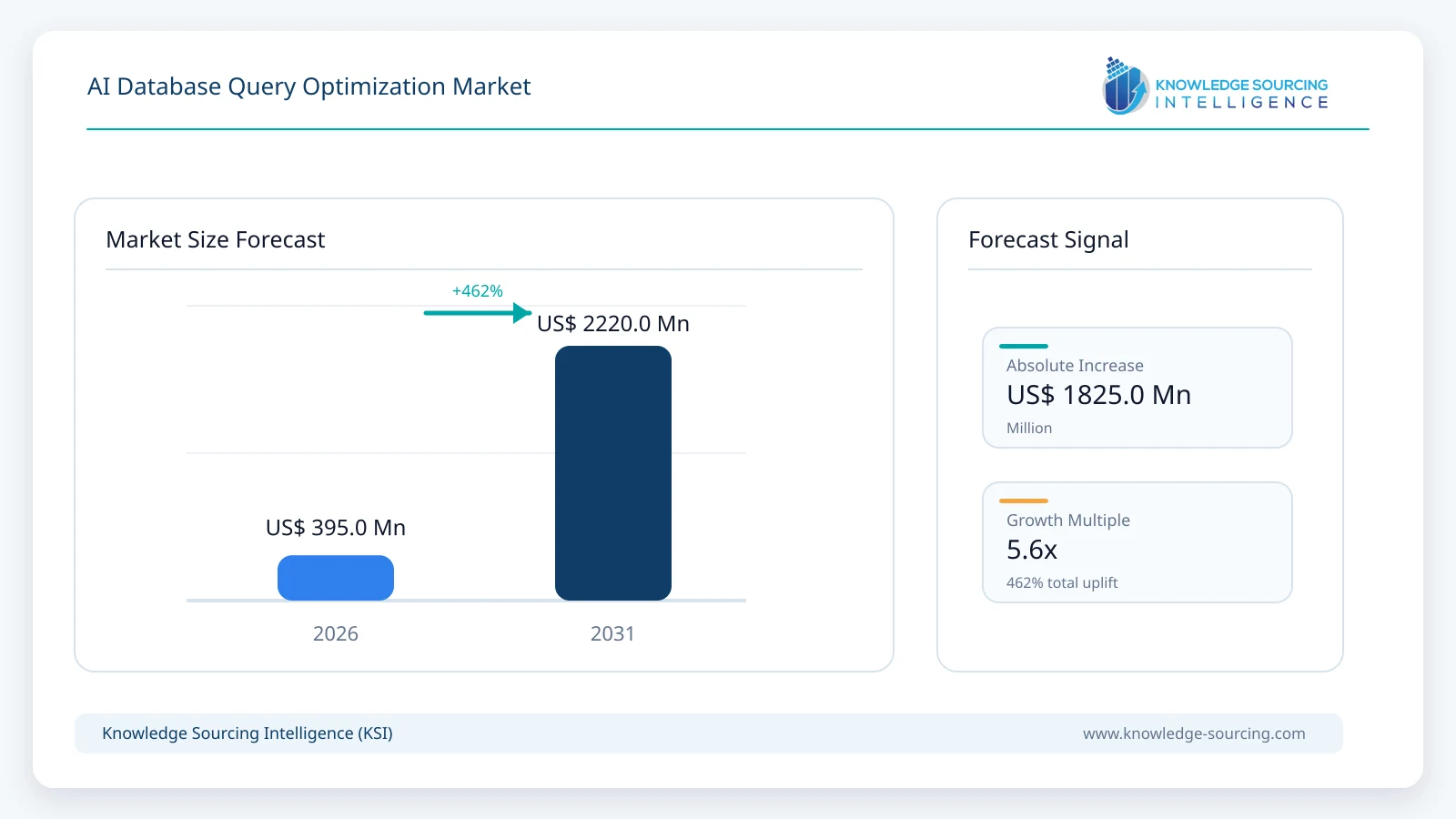
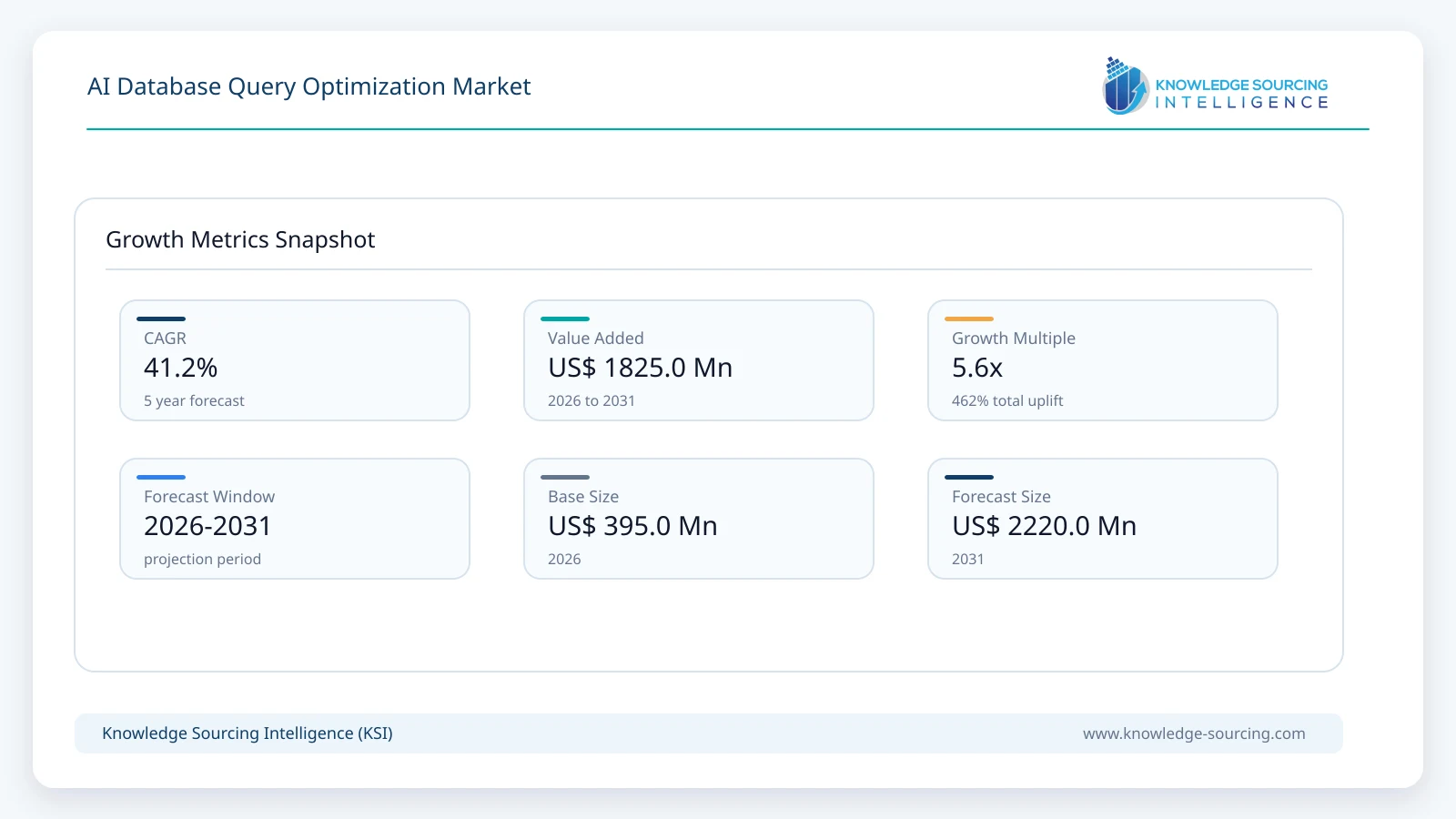
The AI Database Query Optimization Market is forecast to grow at a CAGR of 41.2%, reaching USD 2,220.0 million in 2031 from USD 395.0 million in 2026.
Highlights:
- 1Analytical warehouses and OLAP workloads represent approximately 46% of the market in 2026, increasing to 52% by 2031 as agent-generated analytics expand.
- 2Embedded platform optimization is the largest 2026 commercial offering, while specialist optimizer licenses increase their share as independent tools mature.
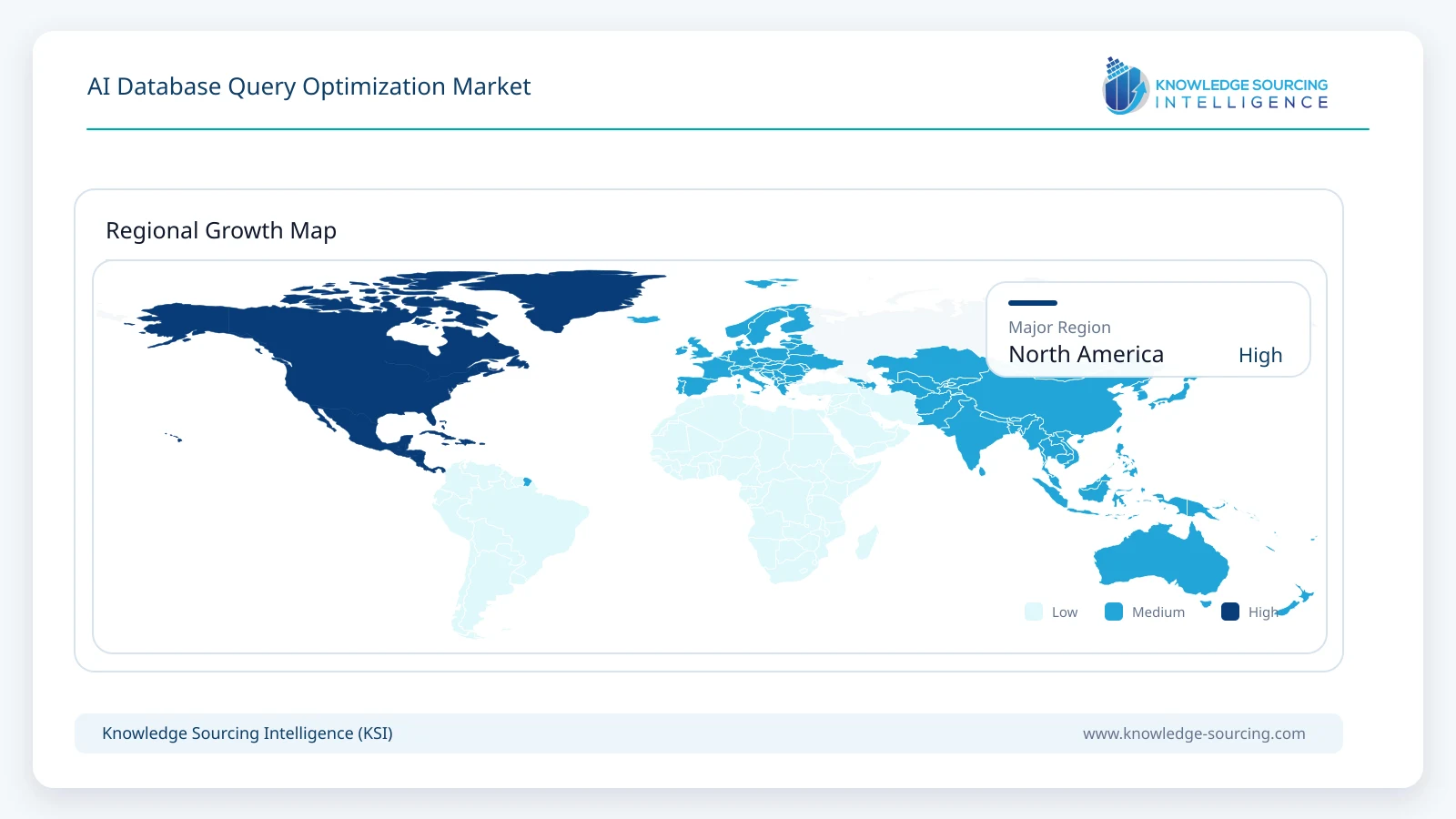
- 3North America accounts for 43% of 2026 revenue; Asia Pacific is forecast to expand more rapidly and reach approximately USD 688 million by 2031.
- 4Guardrailed automated optimization becomes the leading automation mode as enterprises demand controlled index, query and runtime changes.
- 5Supplier competition increasingly centers on sustained performance improvement, safety of recommended changes and demonstrable reductions in paid database compute.
Modern database engines must select among query plans, determine data access methods, balance execution resources and cope with rapidly changing workload patterns. Snowflake Optima Planning improves recurring plan decisions using observed execution evidence, while Google Cloud has introduced BigQuery improvements addressing analytical runtime and query efficiency. AWS Redshift uses workload-aware optimization and resource decisions to support serverless analytic execution. These examples demonstrate that database performance is becoming a continually managed software function rather than an occasional tuning project.
Enterprises purchase optimization when a reduction in query latency, cloud capacity or database administrator effort produces measurable economic value. DBtune addresses PostgreSQL configuration and index decisions; Keebo focuses on cloud warehouse workload efficiency; CAST AI applies performance advice and learned caching to operational databases. The commercial opportunity is concentrated where suppliers can attribute paid functionality to optimization outcomes, especially among high-volume workloads and customers operating multiple production database environments.
Market Overview
AI-driven database query optimization combines workload telemetry, statistical models and automated decision policies to improve the way SQL requests are prepared and executed. A conventional optimizer chooses a legal execution plan based largely on estimated costs and database statistics; an AI-supported layer can learn from earlier executions, diagnose recurring slow-query patterns, and recommend or apply adjustments when workload conditions change. The distinction grows as applications generate SQL faster than teams can review it.
Cloud analytics platforms are incorporating increasingly autonomous techniques. Snowflake Optima improves repeated access patterns and query plans, Google BigQuery can recommend SQL optimizations through Gemini Cloud Assist, and AWS Redshift manages physical data optimization and serverless capacity against observed workloads. Oracle continues to integrate automatic indexing and optimizer statistics into its autonomous database offering. These technologies reduce the amount of manual intervention needed, although their commercial pricing varies and several improvements are included within existing platform entitlements.
Specialist solutions remain relevant where organizations operate heterogeneous databases or want direct control over optimization decisions. DBtune ranks index opportunities and tunes PostgreSQL parameters, while Keebo can route queries and adjust warehouse-related settings. CAST AI provides query performance recommendations for supported relational databases, and Datadog exposes database bottlenecks through monitoring and AI-guided diagnosis. Buyers generally retain human approval for high-impact schema changes, making transparent recommendations and reversible automation important adoption requirements.
Market Trends
Execution-History Learning Is Improving Query Plans
Database engines increasingly use actual execution outcomes to supplement optimizer estimates when a query is repeated. Snowflake Optima Planning learns from previously observed cardinality and join behavior, allowing later executions to avoid some expensive plan choices. The commercial importance is strongest in scheduled reports, repeated application queries, and high-volume analytics, where a corrected plan can save resources many times after the first observation.
Snowflake expanded Optima Planning in August 2026 with dynamic sampling for cases in which current data selectivity differs from earlier behavior. This illustrates a wider shift from static configuration toward feedback-driven query planning. Vendors must still prevent a locally successful plan from causing regressions on another data distribution or workload, so reliable monitoring and rollback remain essential.
AI-Assisted SQL Recommendations Are Moving Into Analyst Workflows
Database analysts increasingly receive optimization suggestions inside the same interface used to write and inspect SQL. Google introduced a Gemini Cloud Assist preview for analyzing BigQuery SQL and recommending performance improvements in June 2026. The functionality can identify inefficient query structures and propose alternatives, reducing the time spent interpreting query stages and searching for tuning opportunities.
Enterprises still need to validate generated rewrites against business logic, data permissions, and actual execution cost. A rewrite that appears cleaner may produce a less efficient plan for a particular schema. Commercial products that combine recommendations with execution-plan comparisons and approval controls are better positioned than generic text generation tools that only restate or refactor SQL syntax.
Database Optimization Is Becoming More Autonomous
The scale of cloud data processing is encouraging vendors to automate index maintenance, table layout and capacity decisions around measured workload needs. AWS made AI-driven Redshift Serverless scaling and optimization the default for new workgroups in April 2026, while Oracle Autonomous AI Database supports automatic index management as workloads evolve. These functions bring optimization closer to everyday database operations rather than periodic administrator-led tuning.
Specialist suppliers are following the same direction but offer more explicit controls over changes. DBtune expanded its PostgreSQL product in October 2026 with generally available index optimization and autovacuum monitoring. Database owners can identify index opportunities and evaluate the expected effect before making changes, balancing speed improvements against storage overhead, write amplification and operational risk.
Optimization Economics Are Shifting Toward Measured Savings
Increasingly variable query volumes make customer spending on database compute difficult to predict. Snowflake expanded Query Acceleration Service coverage and enabled it by default on certain new warehouse types in May 2026, while describing usage-based charges only for accelerated eligible queries. Platforms are therefore combining automated no-charge improvements with separately billable performance capacity.
Independent optimizers face pressure to justify incremental licensing when cloud platforms improve their native capabilities. A subscription is easier to defend when it supplies cross-platform governance, compares actual performance before and after a change, or reduces customer spending beyond what bundled features provide. Such outcomes influence specialist software purchases.
Segment Analysis
By Optimization Mechanism: Learned Query-Plan Selection
Learned query-plan selection represents 28% of the 2026 market and is expected to reach approximately USD 555 million by 2031. The segment improves the selection of joins, access paths and execution strategies by incorporating observed workload behavior. Snowflake Optima Planning provides a direct commercial example of feedback-informed plan quality for recurring queries.
Repeated analytics workloads provide a particularly attractive operating environment because historical execution results can inform later decisions. Growth is supported by more automated reporting, agentic SQL workloads and the need to limit plan regressions without expanding manual database operations teams.
By Database Workload: Analytical Warehouses and OLAP
Analytical warehouses and OLAP workloads account for approximately USD 182 million in 2026 and are forecast to reach USD 1.15 billion by 2031. Analytical databases expose large scan volumes, complex joins and changing concurrency levels, creating opportunities to improve execution cost and capacity allocation. Snowflake, Google BigQuery and Amazon Redshift are prominent suppliers integrating such capabilities.
The fastest-growing usage patterns include frequent automated BI refreshes and SQL submitted by AI-driven applications. Transactional relational databases remain a substantial adjacent demand source, particularly where index maintenance and application query latency constrain performance.
By Deployment Model: Public-Cloud Managed Databases
Public-cloud managed databases represent 64% of the 2026 market and are expected to reach USD 1.55 billion by 2031. Managed infrastructure gives optimization engines consistent access to query telemetry, resource controls and repeatable execution histories. Cloud operators can deploy automatic improvements across many tenants without requiring each customer to maintain specialist tuning skills.
Private and hybrid environments retain demand where data residence, change management or application architecture limits fully managed adoption. DBtune and CAST AI show how independent optimization products can address supported operational databases while leaving change approval and security controls under customer supervision.
Market Drivers
Rapid Growth in Automatically Generated SQL
AI agents, analytics applications and business intelligence platforms are generating SQL at a pace that manual optimization teams cannot consistently manage. Google has highlighted the operational challenge created by agentic workloads with many short and variable queries. Enterprises increasingly need automatic detection of expensive patterns, learned planning decisions and safer recommendations to maintain performance as the number of requesting applications expands.
Rising Pressure to Reduce Database Compute Costs
Cloud database expenses are sensitive to data scanned, concurrency, inefficient joins and capacity provisioning. Query optimization reduces unnecessary work and can postpone additional compute purchases when a measurable bottleneck is removed. Snowflake and AWS both link autonomous optimization capabilities to improved price-performance. Buyers are more willing to pay for a standalone tool when it demonstrates cost savings above the functionality already included in their platform.
Expansion of Adaptive Query and Index Management
Workloads change as schemas evolve, new application features are added and data volumes grow. DBtune now supplies workload-aware PostgreSQL index recommendations, while Oracle supports automatic indexing and plan controls. These features reduce recurring administration effort and expand the addressable customer base beyond organizations with large dedicated database engineering teams, provided that changes can be assessed and reversed.
Need for Predictable Performance Across Hybrid Data Estates
Large enterprises often operate operational databases, analytics warehouses, and lakehouse services simultaneously. Performance policies must account for multiple workloads rather than optimizing one query in isolation. Dedicated tools can add value through common reporting, cross-estate prioritization and policy-driven recommendations, especially where different database suppliers provide uneven levels of native automation.
Increasing Commercial Maturity of Optimization Automation
Recent product releases show more sophisticated automation entering mainstream database management. Snowflake Optima Planning uses recurring execution evidence, AWS Redshift adapts resources to workload characteristics, and DBtune supports automated parameter tuning and index recommendations. This supplier activity creates more opportunities for customers to purchase optimization as a managed capability rather than as an occasional consulting service.
Market Restraints
Bundled Database Optimizers Limit Separate Revenue
Major cloud platforms deliver many performance improvements as included features rather than separately priced products. AWS Redshift and Snowflake describe significant automatic optimizations available without distinct feature charges. This limits standalone monetization and makes vendor comparisons difficult. Specialist suppliers must demonstrate incremental performance or coverage that customers cannot obtain from their existing database subscriptions.
Risk of Regressions and Unintended Data-Path Changes
Index additions, SQL rewrites and changes to execution policies can accelerate one query while harming write throughput or another workload. Organizations therefore require staged tests, explainable recommendations and reversal procedures before granting optimization software autonomous control. Regulated applications and high-availability transaction systems are especially sensitive to changes made without adequate review.
Inconsistent Telemetry Across Database Technologies
Query plans, runtime metrics and administrative permissions differ widely between managed databases and self-hosted systems. A technique tuned for PostgreSQL may not transfer directly to Snowflake or BigQuery. Supporting more engines raises connector maintenance costs and can delay deployment, especially when organizations restrict telemetry exports and production database access.
Difficulty Attributing Financial Savings
A faster query does not always translate into a lower cloud invoice because reservation terms, minimum charges, and workload scheduling influence realized spending. Google advises that improved BigQuery slot efficiency does not always reduce billed cost. Vendors selling optimization on return on investment must therefore measure workload-wide outcomes instead of extrapolating from selected query benchmarks.
Shortage of Trusted Automation and Approval Processes
Database administrators retain responsibility for availability, data integrity, and change control. Even when an AI system proposes a promising index or rewritten query, teams may require review windows, integration tests, and security approval. These controls can slow adoption and reduce how much of the theoretically addressable optimization workload converts into recurring commercial revenue.
Regional Outlook
North America
North America accounts for approximately USD 170 million in the 2026 market and is forecast to reach USD 866 million by 2031. The United States leads regional demand because it hosts major data-cloud suppliers, large enterprise software buyers and substantial cloud database deployment. Snowflake, Google Cloud, AWS and Oracle continue integrating database performance improvements into managed platforms, while specialist suppliers compete for complementary workload tuning opportunities.
Enterprise procurement in North America places particular weight on cost accountability and production reliability. Large software, financial and retail organizations seek lower warehouse costs and predictable transactional latency, but the prevalence of included native features also makes separate optimizer pricing competitive. Opportunities are strongest for providers that demonstrate consistent savings across many databases or offer controls unavailable in the core cloud platform.
Asia Pacific
Asia Pacific is expected to be the fastest-growing regional market, rising from approximately USD 95 million in 2026 to USD 688 million by 2031. China, India, Japan, South Korea and Australia contain expanding enterprise data platforms and increasingly automated analytics workloads. The region benefits from cloud migration, data-intensive digital services and rising demand for database performance management without corresponding increases in specialized administrator staffing.
India and Southeast Asian markets provide a growing base of software providers and midmarket cloud customers, while Japan and Australia contain established enterprise analytics estates. Data residency requirements, different database architectures and budget sensitivity can favor controlled deployments and consumption-based services. Suppliers with measurable query savings and straightforward deployment are better positioned than tools requiring extensive upfront platform redesign.
Competitive Landscape
Competition combines hyperscale cloud platforms, database software vendors and independent workload-optimization specialists. Snowflake, AWS and Google deliver optimization close to the database execution engine, benefiting from privileged telemetry and the ability to roll out platform-wide changes. Oracle and Microsoft integrate automatic tuning into relational database management, while Databricks uses predictive maintenance to improve the performance of managed lakehouse tables. These providers increasingly treat optimization as part of the platform experience rather than a wholly standalone product.
Independent suppliers compete where customers need different engines, approval-controlled recommendations or clearer savings attribution. DBtune offers PostgreSQL-focused configuration and index optimization; Keebo optimizes Snowflake-oriented warehouse spend; CAST AI brings performance advice and learned caching to operational database deployments. Datadog contributes AI-guided diagnosis but its entire database monitoring revenue is not equivalent to query optimization. Competitive success depends on proving incremental value beyond native database features.
Recent Developments
October 6, 2026: DBtune released version 4.0 with generally available index optimization and autovacuum monitoring for PostgreSQL environments.
August 7, 2026: Snowflake detailed Optima Planning dynamic sampling to improve plan choices when predicate selectivity shifts across query executions.
August 6, 2026: Google Cloud described BigQuery runtime optimizations for query efficiency, including automated vectorization and short-query improvements.
June 15, 2026: Google Cloud introduced a preview of Gemini Cloud Assist recommendations for improving executed BigQuery SQL queries.
May 29, 2026: Snowflake presented Optima Planning, which learns from historical query execution to improve recurring plan performance.
April 27, 2026: AWS made AI-driven scaling and optimization the default for newly created Amazon Redshift Serverless workgroups.
Market Outlook
AI-driven database query optimization will benefit from the growing cost and complexity of enterprise data workloads. The market expands as customers adopt more learned plan management, automated index decisions and query-specific optimization advice. Large cloud vendors will continue embedding improvements in their database services, making performance and availability more predictable for mainstream customers. Specialist vendors will concentrate on incremental gains that can be independently measured and billed.
As automated analytics and AI agents submit more variable SQL workloads, optimization will increasingly evaluate performance over a distribution of queries rather than one slow statement at a time. Policy-controlled automation, performance regression checks and workload-wide cost measurement will become stronger selection criteria. Adoption should increase faster where databases are managed in the cloud, although operational PostgreSQL and hybrid estates remain important markets for paid optimization software.
Long-term commercial differentiation will depend on a supplier proving that changes remain effective and safe after customer workloads evolve. Native bundled optimizations will constrain standalone pricing, but cross-platform management and accountable savings can sustain independent demand. The market will increasingly reward solutions that combine query knowledge, automation controls and measurable operating economics rather than isolated SQL suggestions.
AI Database Query Optimization Market Scope:
| Report Metric | Details |
|---|---|
| Total Market Size in 2026 | USD 395.0 million |
| Total Market Size in 2031 | USD 2,220.0 million |
| Forecast Unit | USD Million |
| Growth Rate | 41.2% |
| Study Period | 2021 to 2031 |
| Historical Data | 2021 to 2024 |
| Base Year | 2025 |
| Forecast Period | 2026 – 2031 |
| Segmentation | Optimization Mechanism, Commercial Offering, Deployment Model, Database Workload |
| Companies |
|
| Customization Scope | 15% Free Customization included with purchase — Request Custom Breakdown → |
| Sample & Data Access | PDF Sample, Excel Databook & Analyst Briefing — Download Free Sample → |
Market Segmentation
By Optimization Mechanism
Learned Query-plan Selection
AI-assisted SQL Rewriting
Intelligent Index and Materialization Recommendations
Workload-aware Resource and Execution Tuning
Query Diagnostics and Automated Remediation
By Commercial Offering
Standalone AI Database Optimization Licenses
Embedded Database Optimization Capabilities
Metered Optimization Assessments
Integration and Managed Tuning Services
By Deployment Model
Public-cloud Managed Databases
Private Cloud and On-premises
Hybrid and Multicloud Deployments
By Database Workload
Analytical Warehouses and OLAP
Transactional Relational and OLTP
Hybrid and Real-time Workloads
Lakehouse and Federated Analytics
By Automation Level
Advisor-led with Human Approval
Guardrailed Automated Execution
Fully Autonomous Optimization
By Customer Type
Cloud and Database Platform Providers
Large Enterprise IT and Data Teams
Midmarket Software and Data Teams
Public Institutions and Research
By End-user Industry
IT and Software Services
Banking and Financial Services
Retail and E-commerce
Manufacturing and Logistics
Healthcare and Life Sciences
Other Industries
By Geography
North America
United States
Canada
Mexico
South America
Brazil
Argentina
Rest of South America
Europe
Germany
United Kingdom
France
Netherlands
Italy
Spain
Rest of Europe
Middle East and Africa
United Arab Emirates
Saudi Arabia
Israel
South Africa
Rest of Middle East and Africa
Asia Pacific
China
Japan
India
South Korea
Australia
Rest of Asia Pacific
Table of Contents
1. EXECUTIVE SUMMARY
1.1. Research Highlights
1.2. Market Size and Growth Outlook, 2026–2031
1.3. Strategic Market Perspective
2. MARKET SNAPSHOT
2.1. Market Overview
2.2. Market Definition
2.3. Scope of the Study
2.4. Market Segmentation
3. BUSINESS LANDSCAPE
3.1. Market Drivers
3.1.1. Rapid Growth in Automatically Generated SQL
3.1.2. Rising Pressure to Reduce Database Compute Costs
3.1.3. Expansion of Adaptive Query and Index Management
3.1.4. Need for Predictable Performance Across Hybrid Data Estates
3.1.5. Increasing Commercial Maturity of Optimization Automation
3.2. Market Restraints
3.2.1. Bundled Database Optimizers Limit Separate Revenue
3.2.2. Risk of Regressions and Unintended Data-Path Changes
3.2.3. Inconsistent Telemetry Across Database Technologies
3.2.4. Difficulty Attributing Financial Savings
3.2.5. Shortage of Trusted Automation and Approval Processes
3.3. Market Opportunities
3.4. Porter’s Five Forces Analysis
3.5. Industry Value Chain Analysis
3.6. Policies and Regulations
3.7. Strategic Recommendations
4. TECHNOLOGICAL OUTLOOK
4.1. Learned Query-Plan Selection
4.2. SQL Rewrite and Plan Explanation
4.3. Automated Index and Materialization Design
4.4. Workload-Aware Runtime Scheduling
4.5. Optimization Verification and Regression Protection
5. AI DATABASE QUERY OPTIMIZATION MARKET BY OPTIMIZATION MECHANISM
5.1. Introduction
5.2. Learned query-plan selection
5.3. AI-assisted SQL rewriting
5.4. Intelligent index and materialization recommendations
5.5. Workload-aware resource and execution tuning
5.6. Query diagnostics and automated remediation
6. AI DATABASE QUERY OPTIMIZATION MARKET BY COMMERCIAL OFFERING
6.1. Introduction
6.2. Standalone AI database optimization licenses
6.3. Embedded Database Optimization Capabilities
6.4. Metered optimization assessments
6.5. Integration and managed tuning services
7. AI DATABASE QUERY OPTIMIZATION MARKET BY DEPLOYMENT MODEL
7.1. Introduction
7.2. Public-cloud managed databases
7.3. Private cloud and on-premises
7.4. Hybrid and multicloud deployments
8. AI DATABASE QUERY OPTIMIZATION MARKET BY DATABASE WORKLOAD
8.1. Introduction
8.2. Analytical warehouses and OLAP
8.3. Transactional relational and OLTP
8.4. Hybrid and real-time workloads
8.5. Lakehouse and federated analytics
9. AI DATABASE QUERY OPTIMIZATION MARKET BY AUTOMATION LEVEL
9.1. Introduction
9.2. Advisor-led with human approval
9.3. Guardrailed automated execution
9.4. Fully autonomous optimization
10. AI DATABASE QUERY OPTIMIZATION MARKET BY CUSTOMER TYPE
10.1. Introduction
10.2. Cloud and database platform providers
10.3. Large enterprise IT and data teams
10.4. Midmarket software and data teams
10.5. Public institutions and research
11. AI DATABASE QUERY OPTIMIZATION MARKET BY END-USER INDUSTRY
11.1. Introduction
11.2. IT and software services
11.3. Banking and financial services
11.4. Retail and e-commerce
11.5. Manufacturing and logistics
11.6. Healthcare and life sciences
11.7. Other industries
12. AI DATABASE QUERY OPTIMIZATION MARKET BY GEOGRAPHY
12.1. North America
12.1.1. United States
12.1.2. Canada
12.1.3. Mexico
12.2. South America
12.2.1. Brazil
12.2.2. Argentina
12.2.3. Rest of South America
12.3. Europe
12.3.1. Germany
12.3.2. United Kingdom
12.3.3. France
12.3.4. Netherlands
12.3.5. Italy
12.3.6. Spain
12.3.7. Rest of Europe
12.4. Middle East and Africa
12.4.1. United Arab Emirates
12.4.2. Saudi Arabia
12.4.3. Israel
12.4.4. South Africa
12.4.5. Rest of Middle East and Africa
12.5. Asia Pacific
12.5.1. China
12.5.2. Japan
12.5.3. India
12.5.4. South Korea
12.5.5. Australia
12.5.6. Rest of Asia Pacific
13. COMPETITIVE ENVIRONMENT AND ANALYSIS
13.1. Major Players and Strategy Analysis
13.2. Market Share Analysis
13.3. Mergers, Acquisitions, Agreements, and Collaborations
13.4. Competitive Dashboard
14. COMPANY PROFILES
14.1. Snowflake Inc.
14.2. Amazon Web Services (Amazon)
14.3. Google Cloud (Alphabet)
14.4. Oracle Corporation
14.5. Microsoft Corporation
14.6. Databricks, Inc.
14.7. DBtune AB
14.8. Keebo, Inc.
14.9. CAST AI, Inc.
14.10. Datadog, Inc.
15. APPENDIX
15.1. Currency
15.2. Assumptions
15.3. Base and Forecast Years Timeline
15.4. Key Benefits for Stakeholders
15.5. Research Methodology
15.6. Abbreviations




Frequently asked questions
What is the forecast market size for AI database query optimization by 2031?
Market projected to reach USD 2,220.0 million by 2031.
What is the compound annual growth rate (CAGR) forecast for this market?
The AI Database Query Optimization Market is forecast to grow at a 41.2% CAGR (2026-2031).
Which region holds the largest market share in 2026 and which grows fastest?
North America leads 2026 revenue; Asia Pacific is forecast to expand rapidly.
What are the primary drivers for purchasing AI database query optimization?
Reduced latency, cloud capacity, DBA effort, and measurable economic value.
Which workload segment represents the largest market share in 2026?
Analytical warehouses and OLAP workloads represent 46% of 2026 market.
What is the leading automation mode emerging in this market?
Guardrailed automated optimization becomes the leading automation mode.
Cite this report
Knowledge Sourcing Intelligence. (Oct 2026). AI Database Query Optimization Market Size, Share & Growth Forecast (2026-2031). https://www.knowledge-sourcing.com/report/ai-database-query-optimization-market