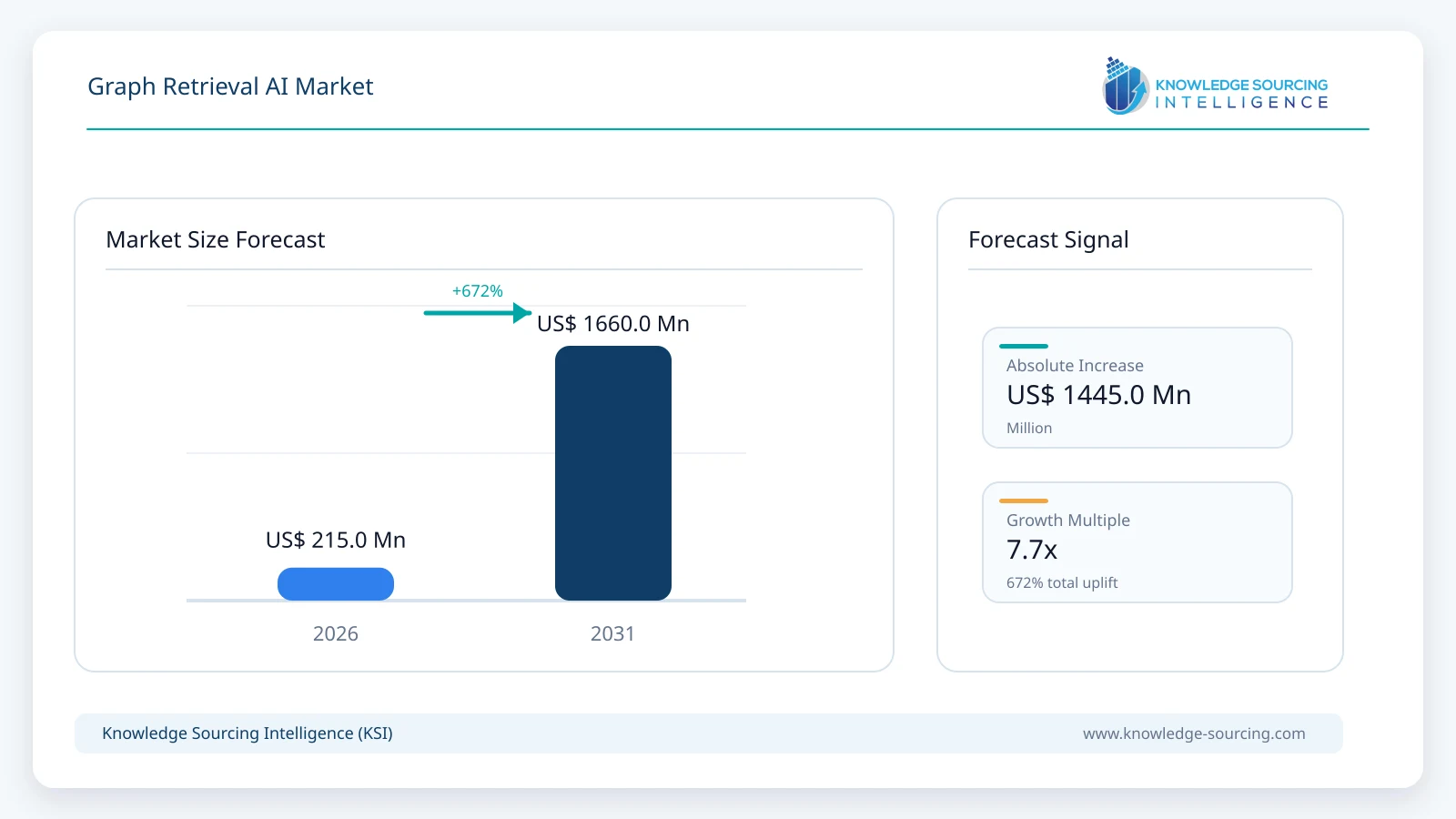
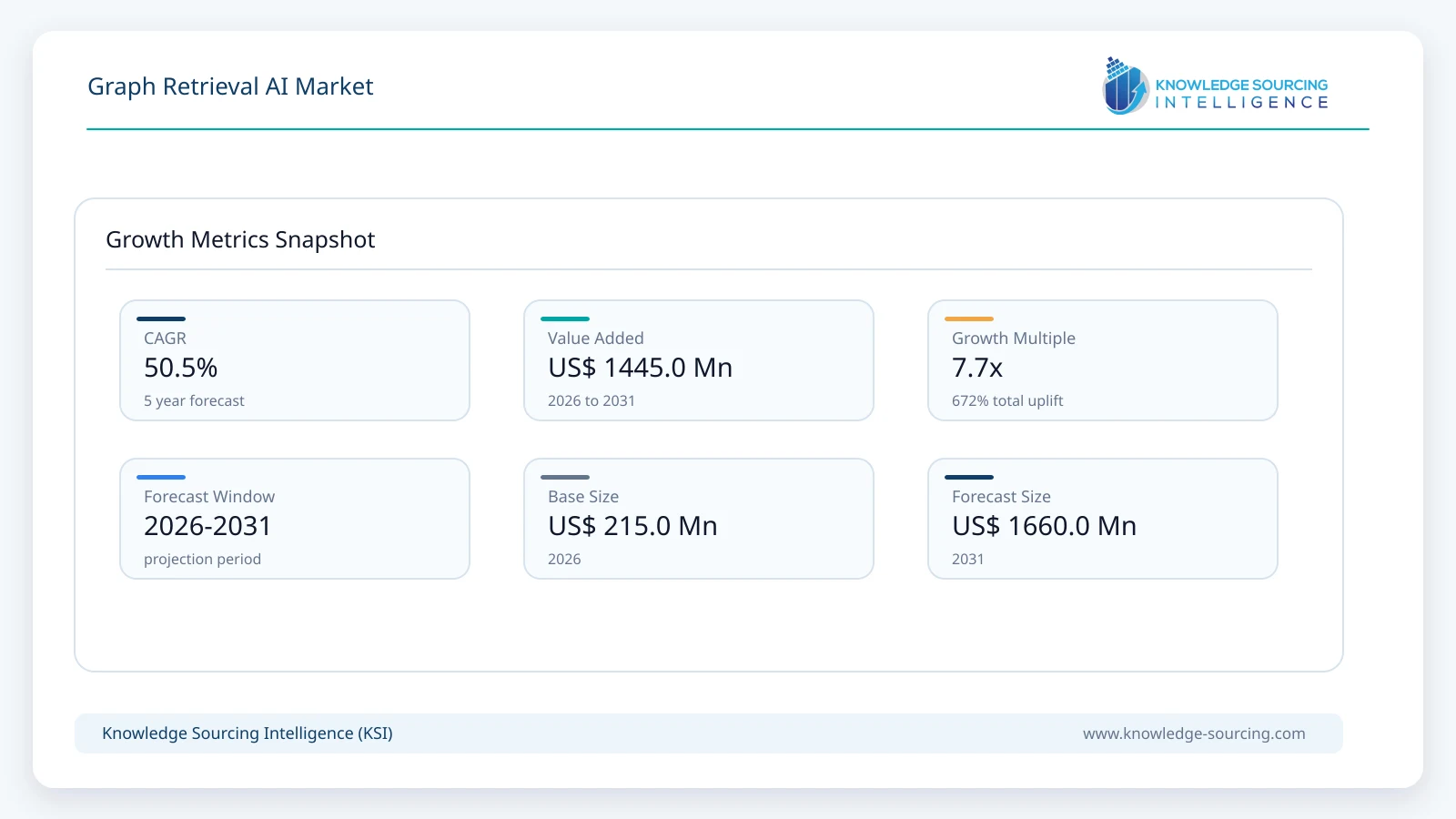
The Graph Retrieval AI Market is estimated at USD 215 million in 2026 and is forecast to reach USD 1,660 million by 2031, growing at a CAGR of 50.5% during the forecast period.
Highlights:
- 1Hybrid vector-to-graph retrieval accounts for the largest method segment as enterprises connect semantic matching with entity traversal.
- 2Dedicated GraphRAG platform subscriptions lead the commercial offering mix, while managed traversal APIs expand with production usage.
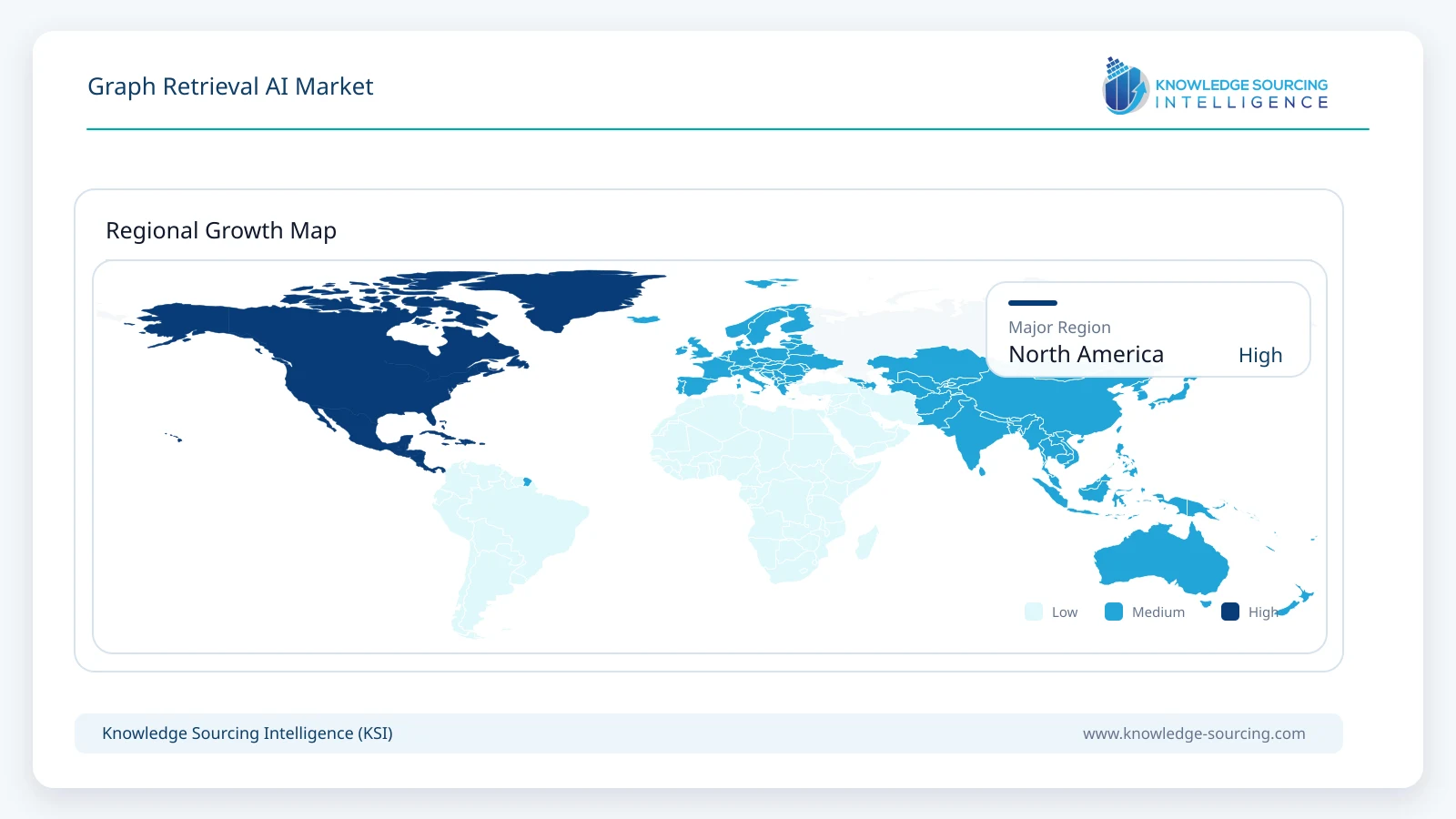
- 3North America is the largest regional market; Asia Pacific shows the fastest modeled growth as enterprise agents and graph applications expand.
- 4Schema-aware retrieval, permission controls and traceable graph paths help suppliers differentiate from conventional search.
- 5The category remains closely linked to larger graph and RAG platforms, requiring revenue attribution that avoids counting those invoices twice.
The market includes attributable paid graph-aware search, traversal, retrieval routing and ranking services for AI applications, excluding undifferentiated graph-database infrastructure and general inference revenue.
Graph retrieval connects semantic relevance with knowledge-graph structure. A search can first locate a person, product or document and then follow organizational, financial or operational relationships to supporting facts. This approach can produce more complete context for enterprise questions that require several logical steps, while making it easier to inspect which records contributed to an answer.
The report evaluates seven independent segmentation dimensions and regional demand across five regions and detailed countries. It considers dedicated GraphRAG software, usage-billed retrieval services, commercial ranking or policy modules, and private deployments. The scope is separated from the existing Agentic Knowledge Graph, Knowledge Graph Reasoning, Retrieval Optimization and Knowledge Grounding markets.
Market Overview
Enterprise AI questions often depend on relationships that cannot be recovered from the most similar document chunk alone. A compliance analyst may need the ownership chain between suppliers and subsidiaries, while a service agent may need to connect equipment, service records and product defects. Graph retrieval follows documented relationships to assemble evidence.
Commercial systems increasingly combine vectors, entity search, Cypher or SPARQL queries and controlled graph traversal. Neo4j offers graph-grounded agents, TigerGraph has developed agentic GraphRAG workflows and Stardog Voicebox plans multiple semantic queries in sequence. AWS Bedrock Knowledge Bases embeds managed GraphRAG with Neptune, showing how graph retrieval can be delivered within broader cloud services.
Economic differentiation depends on how much relationship-aware retrieval improves results after accounting for graph preparation and extra query execution. Buyers will evaluate relevance, path traceability, latency, data-access permissions and the ability to adapt retrieval strategies across different enterprise domains. Paid graph retrieval remains a specialized functional market rather than a proxy for total graph or generative AI spending.
Market Trends
Hybrid Retrieval Becomes the Default GraphRAG Entry Point
Enterprise GraphRAG increasingly starts with semantic similarity to locate likely entities and documents, then follows edges that explain why sources belong together. Neo4j and Memgraph describe vector-to-graph flows that reduce reliance on isolated passages, while TigerGraph offers hybrid search as its officially supported backend retrieval method. The result is a broader evidence set when questions span several organizations, products or events.
Hybrid execution does not make the entire graph database a retrieval-product sale. Graph vendors often bundle indexing, storage, traversal and AI tooling in one contract. Dedicated commercial opportunity arises where the buyer purchases a graph-aware retrieval service, premium search execution, or an independently measurable GraphRAG entitlement.
Agent-Directed Search Plans Adapt to Complex Questions
Agentic retrieval selects graph tools and traversal depth according to the question, rather than executing an identical pipeline for every request. TigerGraph GraphRAG 2.0 introduced planned and reactive modes in July 2026, and Neo4j described agentic graph retrieval in October. These developments matter for questions where the first graph lookup reveals a second entity or path worth exploring.
Adaptive retrieval increases execution cost and therefore requires controls on traversal length, tool permissions, and repeated calls. Enterprises will pay for orchestration where improved answer quality offsets these costs, particularly when graph queries are logged, replayable, and linked to cited source records.
Schema and Ontology Context Improve Retrieval Precision
Graph retrieval systems use schema labels, relationship direction and domain ontologies to constrain the search to commercially meaningful paths. Stardog Voicebox queries a governed semantic graph through multiple steps, while Graphwise combines RDF knowledge with search workflows. Schema guidance helps distinguish, for example, a supplier-of relationship from a same-named product mention.
Graph relevance depends on trustworthy entity mapping and relationship maintenance. Providers with reusable ontologies and permissions-aware retrieval can reduce setup time for regulated buyers. Implementation remains more complex than plain vector search because graph structure must match the business domain before multi-hop traversal is reliable.
Virtual and Federated Graph Retrieval Reduce Data Duplication
Enterprises increasingly want graph-aware retrieval over warehouse and operational data without rebuilding all content into a separate database. Neo4j introduced Virtual Graph in preview during May 2026, demonstrating that logical relationships can be queried over existing systems. Federated access can expose important connections between customer records, supplier networks and operational logs.
Preview technology should not be valued as broadly monetized production revenue. The commercial forecast attributes only paid retrieval processing, dedicated connectors and deployed graph-aware query functionality, while normal warehouse storage and underlying operational data access remain outside the narrow market.
Retrieval Evaluation and Governance Become Production Requirements
Production GraphRAG teams increasingly test answer provenance, retrieval completeness and the paths used to reach a result. TigerGraph added trace logs and query debugging, while Graphwise expanded guardrails for missing or unsuitable context. These features help customers detect whether a graph search stopped too early or followed a permitted but irrelevant relationship.
Independent evaluation and policy entitlements support a differentiated paid segment when they specifically manage graph retrieval. Standalone post-generation verification, general observability subscriptions and foundation-model guardrails are excluded, avoiding overlap with the existing AI Verification Engine and Knowledge Grounding markets.
Segment Analysis
By Commercial Offering: Dedicated GraphRAG platforms
Dedicated GraphRAG software supports customers requiring repeatable graph exploration and source-aware response assembly. The category includes application-level retrieval entitlements, not the full revenue of a graph database sold for unrelated workloads. The segment is estimated at USD 72.00 million in 2026 and USD 570.00 million in 2031, reflecting wider deployment of graph-aware retrieval across enterprise AI workloads.
By Retrieval Method: Hybrid vector-to-graph retrieval
Hybrid retrieval remains the largest method because semantic matching provides a practical starting point before entity expansion. Agentic planning grows as organizations introduce tasks that require several dependent graph queries. The segment is estimated at USD 75.25 million in 2026 and USD 498.00 million in 2031, reflecting wider deployment of graph-aware retrieval across enterprise AI workloads.
By Graph Data Representation: Property graph and Cypher
Property graphs provide accessible traversal syntax for entity-centric enterprise information. RDF and ontology-based representations retain a strong role when regulated semantics and linked-data standards guide retrieval policies. The segment is estimated at USD 92.45 million in 2026 and USD 630.80 million in 2031, reflecting wider deployment of graph-aware retrieval across enterprise AI workloads.
By Deployment Model: Managed public-cloud services
Managed GraphRAG lowers the operational burden for teams that cannot maintain their own graph and retrieval infrastructure. Private deployments remain meaningful when source records carry legal or contractual restrictions. The segment is estimated at USD 103.20 million in 2026 and USD 929.60 million in 2031, reflecting wider deployment of graph-aware retrieval across enterprise AI workloads.
By Retrieval Input: Enterprise document and content graphs
Connected enterprise documents allow agents to retrieve supporting passages alongside relevant entity relationships. Customer and supplier graphs contribute material demand in investigative and business-intelligence workflows. The segment is estimated at USD 73.10 million in 2026 and USD 498.00 million in 2031, reflecting wider deployment of graph-aware retrieval across enterprise AI workloads.
By Primary Application: Enterprise assistant and knowledge search
Enterprise assistants generate the largest initial search workload because users ask relationship-aware questions over distributed knowledge. Agentic workflow context grows faster as applications combine graph retrieval with action-oriented decisions. The segment is estimated at USD 73.10 million in 2026 and USD 481.40 million in 2031, reflecting wider deployment of graph-aware retrieval across enterprise AI workloads.
By End-User Industry: Technology, software and cloud services
Technology and cloud providers embed graph retrieval into AI product development and customer solutions. Banking and healthcare adoption depends more on governance, access management and demonstrated query correctness. The segment is estimated at USD 70.95 million in 2026 and USD 498.00 million in 2031, reflecting wider deployment of graph-aware retrieval across enterprise AI workloads.
Market Drivers
Demand for Relationship-Aware Enterprise Answers
Enterprise questions frequently connect facts stored in different documents or systems. GraphRAG retrieves linked entities and the supporting evidence rather than relying only on text similarity, making it attractive in account intelligence, financial risk and technical knowledge support. Vendors such as Neo4j and AWS demonstrate the mechanism through property-graph traversal and managed GraphRAG. Spending concentrates where the extra retrieval steps materially improve decision quality.
Expansion of Agentic Enterprise Search
Enterprise agents require retrieval paths that can be adjusted as a task develops. TigerGraph’s agentic retrieval and Neo4j Aura Agent illustrate the transition from one-shot search to repeated structured queries. Buyers seeking auditable agent workflows can justify premium search orchestration, particularly when a retrieval engine limits graph depth, exposes intermediate query results and enforces access policies.
Growth of Connected Operational and Customer Data
Operational systems record relationships between customers, assets, products, employees and suppliers. Graph-aware retrieval exposes these connections to generative AI without requiring a model to infer every relationship from text. Graphwise, Stardog and TigerGraph help commercialize this capability through semantic graph querying and GraphRAG applications. Growing data volumes make relevance selection and controlled path expansion more valuable.
Maturation of Hybrid Graph and Vector Tools
Graph and vector interfaces increasingly operate within the same retrieval workflow. Memgraph offers combined vector matching and graph traversal, and AWS integrates Neptune Analytics with Bedrock Knowledge Bases. This architecture allows development teams to add relationship context to existing retrieval applications, supporting conversion from experimental pilots into metered services and enterprise entitlements.
Governance Requirements for Explainable Retrieval
Regulated enterprises need to establish which relationships and documents supported a generated response. Multi-hop graph retrieval can expose evidence paths, query traces and source citations, making it suitable for compliance reviews, insurance investigations and complex supply-chain decisions. The ability to reproduce graph queries and retain access-control boundaries underpins demand for governed retrieval rather than opaque similarity ranking alone.
Market Restraints
Cost and Complexity of Graph Preparation
Entity resolution, relationship extraction and schema design consume specialist effort before graph retrieval can deliver consistently useful results. A poorly constructed graph may expand into irrelevant paths or overlook important relationships. These preparation expenses slow buyer conversion, especially when a conventional document search system already answers simpler questions acceptably.
Latency and Compute Costs in Multi-Hop Workflows
Dynamic graph expansion can require several database queries and additional language-model calls before a final context bundle is ready. Each stage adds delay and operating expense, creating trade-offs between answer completeness and response time. Workloads involving many connected entities may require traversal limits and caching, reducing the advantage of unrestricted agentic search.
Difficulty Attributing Revenue from Bundled Platforms
Major suppliers sell GraphRAG functions inside broader graph databases, knowledge bases or agent platforms. AWS states that its managed GraphRAG capability has no additional GraphRAG charge beyond underlying services. As a result, full platform sales cannot be treated as graph retrieval revenue, complicating market sizing, procurement comparisons and supplier share analysis.
Graph Quality, Permissions and Updating Risks
Enterprise graphs change as businesses add customers, revise hierarchies and retire outdated relationships. Unless retrieval respects current permissions and timestamps, the resulting context may be incomplete or inappropriate. Maintaining secure traversal policies across federated systems adds engineering overhead and can delay adoption in financial services, healthcare and government.
Competition from Simpler Retrieval Architectures
Improved vector search, semantic ranking and context-window selection can answer many common enterprise questions without building a graph. Customers will therefore compare relationship-aware retrieval against hybrid keyword-vector alternatives based on observed answer gains, development costs and latency. GraphRAG remains strongest where connected evidence is necessary, not as a universal replacement for ordinary search.
Regional Outlook
North America
North America leads the Graph Retrieval AI Market, with estimated revenue of USD 94.60 million in 2026 and USD 614.20 million by 2031. The United States supports a strong concentration of graph-platform suppliers, enterprise AI developers and early adoption in banking, software and business services. U.S. demand is supported by applications that need connected records across customers, compliance events, supply chains and technical knowledge bases.
Buyers across North America are increasingly testing whether graph traversal produces verifiable improvements in source completeness and explainability compared with standard RAG. Neo4j, TigerGraph, AWS and other vendors provide multiple deployment options, but customers will distinguish retrieval-specific entitlements from broader database subscriptions. Canadian technology and financial-services organizations add demand for permission-aware deployments, while Mexico contributes a smaller enterprise integration opportunity.
Asia Pacific
Asia Pacific is the fastest-growing regional market in the model, increasing from USD 43.00 million in 2026 to USD 498.00 million by 2031. China, Japan, India and South Korea combine investment in enterprise AI with complex industrial and commercial data networks. Graph retrieval can connect supplier, equipment, product, customer and knowledge-base records where relationships are important to operational decisions.
Regional expansion will depend on local language support, graph schema accuracy, cloud accessibility and appropriate data-residency options. Tencent Cloud and other regional platforms can extend GraphRAG capabilities to new users, while multinational suppliers serve enterprises operating across jurisdictions. Higher adoption does not eliminate the costs of building trustworthy entity graphs, which will influence deployment timing and the commercial mix.
Competitive Landscape
The competitive landscape includes graph-native software vendors, semantic graph specialists, managed cloud services and retrieval-framework providers. Neo4j, TigerGraph, Stardog, Graphwise, Franz and Memgraph provide direct graph-search capabilities, while AWS and Tencent Cloud distribute graph-based retrieval through wider enterprise AI services. The market also includes specialist integration partners that package graph traversal, search policy and evidence assembly.
Competition centers on retrieval accuracy, multi-hop performance, query transparency, domain-schema support and the ability to enforce access rights during traversal. Platform vendors benefit from installed graph datasets, but open-source GraphRAG frameworks constrain premium pricing. Commercial differentiation therefore requires measurable retrieval improvements and clear usage or entitlement terms rather than graph-database capacity alone.
Recent Developments
October 21, 2026: TigerGraph released GraphRAG v2.0.4, improving schema-aware agent answer planning and structured-query traces.
October 20, 2026: Neo4j announced Context Engine with GraphRAG retrievers for governed enterprise knowledge access.
October 19, 2026: Franz introduced AllegroGraph 9.1 and GraphTalker 2.0 with expanded graph-based enterprise analysis.
August 28, 2026: Stardog generally released Voicebox 1.0, supporting planned multi-step knowledge-graph queries.
June 5, 2026: Graphwise published GraphRAG 1.2 with vector-search tool routing and improved insufficient-context guardrails.
February 3, 2026: Neo4j made Aura Agent generally available for creating knowledge-graph-grounded AI agents.
Market Outlook
Graph Retrieval AI revenue is expected to expand as organizations operationalize assistants and agents that require connected evidence rather than isolated search results. Hybrid vector and graph pipelines will remain the most practical adoption route, while agentic traversal and schema-aware tool selection broaden the range of complex enterprise questions that can be addressed.
Commercial growth will favor suppliers that make graph retrieval observable, governed and economical. Customers are likely to compare dedicated modules with managed GraphRAG and general-purpose retrieval services, placing pressure on vendors to demonstrate incremental value. The best positioned products will combine reliable relationship discovery with controlled source access, explainable paths and integration with enterprise systems.
Implementation cost and bundle attribution will remain restraints through the forecast period. Graph retrieval should see strongest adoption in investigative, operational and customer-intelligence tasks where relationships are central to the answer and can justify the additional engineering effort.
Graph Retrieval AI Market Scope
| Report Metric | Details |
|---|---|
| Total Market Size in 2026 | USD 215 million |
| Total Market Size in 2031 | USD 1,660 million |
| Forecast Unit | Million |
| Growth Rate | 50.5% |
| Study Period | 2021 to 2031 |
| Historical Data | 2021 to 2024 |
| Base Year | 2025 |
| Forecast Period | 2026 – 2031 |
| Segmentation | Commercial Offering, Retrieval Method, Graph Data Representation, Deployment Model, Retrieval Input, Primary Application, End-User Industry, Geography |
| Companies |
|
| Customization Scope | 15% Free Customization included with purchase — Request Custom Breakdown → |
| Sample & Data Access | PDF Sample, Excel Databook & Analyst Briefing — Download Free Sample → |
Market Segmentation
By Commercial Offering
Dedicated GraphRAG Platforms
Managed Graph Retrieval and Traversal APIs
Ranking, Routing and Governance Add-ons
Private Graph-Retrieval Deployments
By Retrieval Method
Hybrid Vector-to-Graph Retrieval
Graph Traversal and Multi-Hop Expansion
Entity-Centric and Schema-Guided Retrieval
Graph Community and Global-Theme Retrieval
Adaptive Agentic Retrieval Planning
By Graph Data Representation
Property Graph and Cypher
RDF, SPARQL and Ontology-Driven Graphs
Hybrid Graph-Vector Document Structures
Federated and Virtual Graph Interfaces
By Deployment Model
Managed Public-Cloud Services
Hybrid and Dedicated Private Cloud
On-Premises and Self-Managed Software
By Retrieval Input
Enterprise Document and Content Graphs
Customer, Supplier and Account Relationship Graphs
Product, Asset and Operations Knowledge Graphs
Scientific, Healthcare and Regulated Entity Graphs
By Primary Application
Enterprise Assistant and Knowledge Search
Agentic Decision and Workflow Context
Risk, Fraud and Intelligence Investigations
Customer and Product Relationship Intelligence
Scientific and Clinical Discovery
By End-User Industry
Technology, Software and Cloud Services
Banking, Financial Services and Insurance
Healthcare, Pharma and Life Sciences
Manufacturing, Industrial and Energy
Government, Defense and Public Sector
Retail, Telecom and Other Services
By Geography
North America
United States
Canada
Mexico
South America
Brazil
Argentina
Rest of South America
Europe
Germany
United Kingdom
France
Netherlands
Italy
Spain
Rest of Europe
Middle East and Africa
United Arab Emirates
Saudi Arabia
Israel
South Africa
Rest of Middle East and Africa
Asia Pacific
China
Japan
India
South Korea
Australia
Singapore
Rest of Asia Pacific
Table of Contents
1. EXECUTIVE SUMMARY
1.1. Research Highlights
1.2. Market Size and Growth Outlook, 2026–2031
1.3. Strategic Market Perspective
2. MARKET SNAPSHOT
2.1. Market Overview
2.2. Market Definition
2.3. Scope of the Study
2.4. Market Segmentation
3. BUSINESS LANDSCAPE
3.1. Market Drivers
3.1.1. Demand for Relationship-Aware Enterprise Answers
3.1.2. Expansion of Agentic Enterprise Search
3.1.3. Growth of Connected Operational and Customer Data
3.1.4. Maturation of Hybrid Graph and Vector Tools
3.1.5. Governance Requirements for Explainable Retrieval
3.2. Market Restraints
3.2.1. Cost and Complexity of Graph Preparation
3.2.2. Latency and Compute Costs in Multi-Hop Workflows
3.2.3. Difficulty Attributing Revenue from Bundled Platforms
3.2.4. Graph Quality, Permissions and Updating Risks
3.2.5. Competition from Simpler Retrieval Architectures
3.3. Market Opportunities
3.4. Porter’s Five Forces Analysis
3.5. Industry Value Chain Analysis
3.6. Policies and Regulations
3.7. Strategic Recommendations
4. TECHNOLOGICAL OUTLOOK
4.1. Hybrid Vector-to-Graph Retrieval
4.2. Multi-Hop Traversal and Entity Expansion
4.3. Schema-Aware and Ontology-Guided Retrieval
4.4. Agent-Directed Retrieval Planning
4.5. Graph-Retrieval Evaluation and Access Controls
5. GRAPH RETRIEVAL AI MARKET BY COMMERCIAL OFFERING
5.1. Introduction
5.2. Dedicated GraphRAG platforms
5.3. Managed graph retrieval and traversal APIs
5.4. Ranking, routing and governance add-ons
5.5. Private graph-retrieval deployments
6. GRAPH RETRIEVAL AI MARKET BY RETRIEVAL METHOD
6.1. Introduction
6.2. Hybrid vector-to-graph retrieval
6.3. Graph traversal and multi-hop expansion
6.4. Entity-centric and schema-guided retrieval
6.5. Graph community and global-theme retrieval
6.6. Adaptive agentic retrieval planning
7. GRAPH RETRIEVAL AI MARKET BY GRAPH DATA REPRESENTATION
7.1. Introduction
7.2. Property graph and Cypher
7.3. RDF, SPARQL and ontology-driven graphs
7.4. Hybrid graph-vector document structures
7.5. Federated and virtual graph interfaces
8. GRAPH RETRIEVAL AI MARKET BY DEPLOYMENT MODEL
8.1. Introduction
8.2. Managed public-cloud services
8.3. Hybrid and dedicated private cloud
8.4. On-premises and self-managed software
9. GRAPH RETRIEVAL AI MARKET BY RETRIEVAL INPUT
9.1. Introduction
9.2. Enterprise document and content graphs
9.3. Customer, supplier and account relationship graphs
9.4. Product, asset and operations knowledge graphs
9.5. Scientific, healthcare and regulated entity graphs
10. GRAPH RETRIEVAL AI MARKET BY PRIMARY APPLICATION
10.1. Introduction
10.2. Enterprise assistant and knowledge search
10.3. Agentic decision and workflow context
10.4. Risk, fraud and intelligence investigations
10.5. Customer and product relationship intelligence
10.6. Scientific and clinical discovery
11. GRAPH RETRIEVAL AI MARKET BY END-USER INDUSTRY
11.1. Introduction
11.2. Technology, software and cloud services
11.3. Banking, financial services and insurance
11.4. Healthcare, pharma and life sciences
11.5. Manufacturing, industrial and energy
11.6. Government, defense and public sector
11.7. Retail, telecom and other services
12. GRAPH RETRIEVAL AI MARKET BY GEOGRAPHY
12.1. North America
12.1.1. United States
12.1.2. Canada
12.1.3. Mexico
12.2. South America
12.2.1. Brazil
12.2.2. Argentina
12.2.3. Rest of South America
12.3. Europe
12.3.1. Germany
12.3.2. United Kingdom
12.3.3. France
12.3.4. Netherlands
12.3.5. Italy
12.3.6. Spain
12.3.7. Rest of Europe
12.4. Middle East and Africa
12.4.1. United Arab Emirates
12.4.2. Saudi Arabia
12.4.3. Israel
12.4.4. South Africa
12.4.5. Rest of Middle East and Africa
12.5. Asia Pacific
12.5.1. China
12.5.2. Japan
12.5.3. India
12.5.4. South Korea
12.5.5. Australia
12.5.6. Singapore
12.5.7. Rest of Asia Pacific
13. COMPETITIVE ENVIRONMENT AND ANALYSIS
13.1. Major Players and Strategy Analysis
13.2. Market Share Analysis
13.3. Mergers, Acquisitions, Agreements, and Collaborations
13.4. Competitive Dashboard
14. COMPANY PROFILES
14.1. Neo4j
14.2. TigerGraph
14.3. Stardog
14.4. Graphwise
14.5. Amazon Web Services
14.6. Franz Inc.
14.7. Memgraph
14.8. LlamaIndex
14.9. Tencent Cloud
14.10. NebulaGraph
14.11. FalkorDB
15. APPENDIX
15.1. Currency
15.2. Assumptions
15.3. Base and Forecast Years Timeline
15.4. Key Benefits for Stakeholders
15.5. Research Methodology
15.6. Abbreviations




Frequently asked questions
What is the estimated market size of Graph Retrieval AI in 2026?
The Graph Retrieval AI Market is estimated at USD 215 million in 2026.
What is the projected Graph Retrieval AI market size by 2031?
The Graph Retrieval AI Market is forecast to reach USD 1,660 million by 2031.
What is the forecast CAGR for Graph Retrieval AI from 2026-2031?
The Graph Retrieval AI Market is growing at a 50.5% CAGR during the forecast period.
Which region currently dominates the Graph Retrieval AI market?
North America is currently the largest regional market.
Which region shows the fastest growth in Graph Retrieval AI?
Asia Pacific shows the fastest modeled growth.
What is the leading commercial offering in Graph Retrieval AI?
Dedicated GraphRAG platform subscriptions lead the commercial offering mix.
Cite this report
Knowledge Sourcing Intelligence. (Oct 2026). Graph Retrieval AI Market Size, Share & Growth Forecast (2026-2031). https://www.knowledge-sourcing.com/report/graph-retrieval-ai-market