
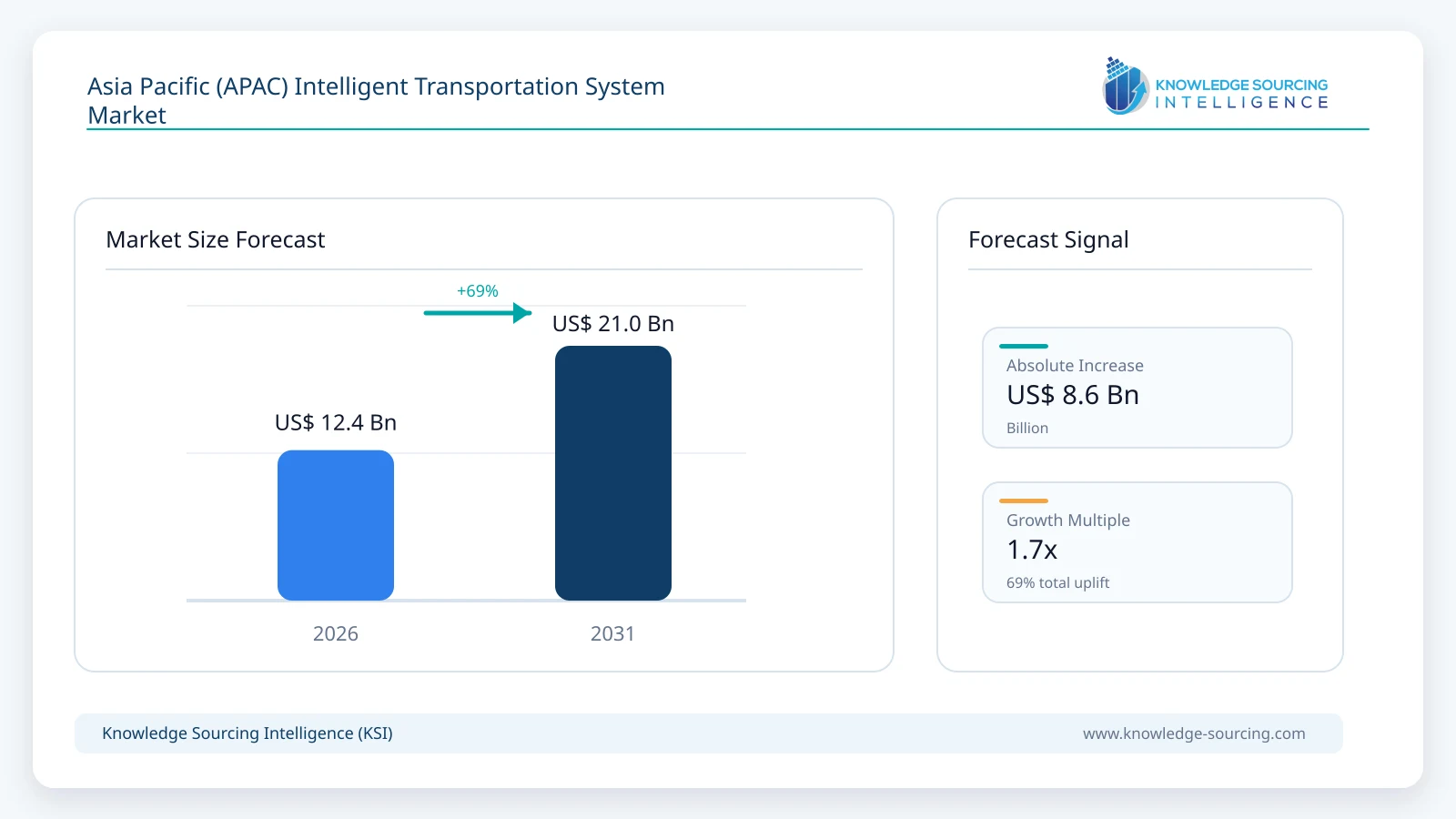
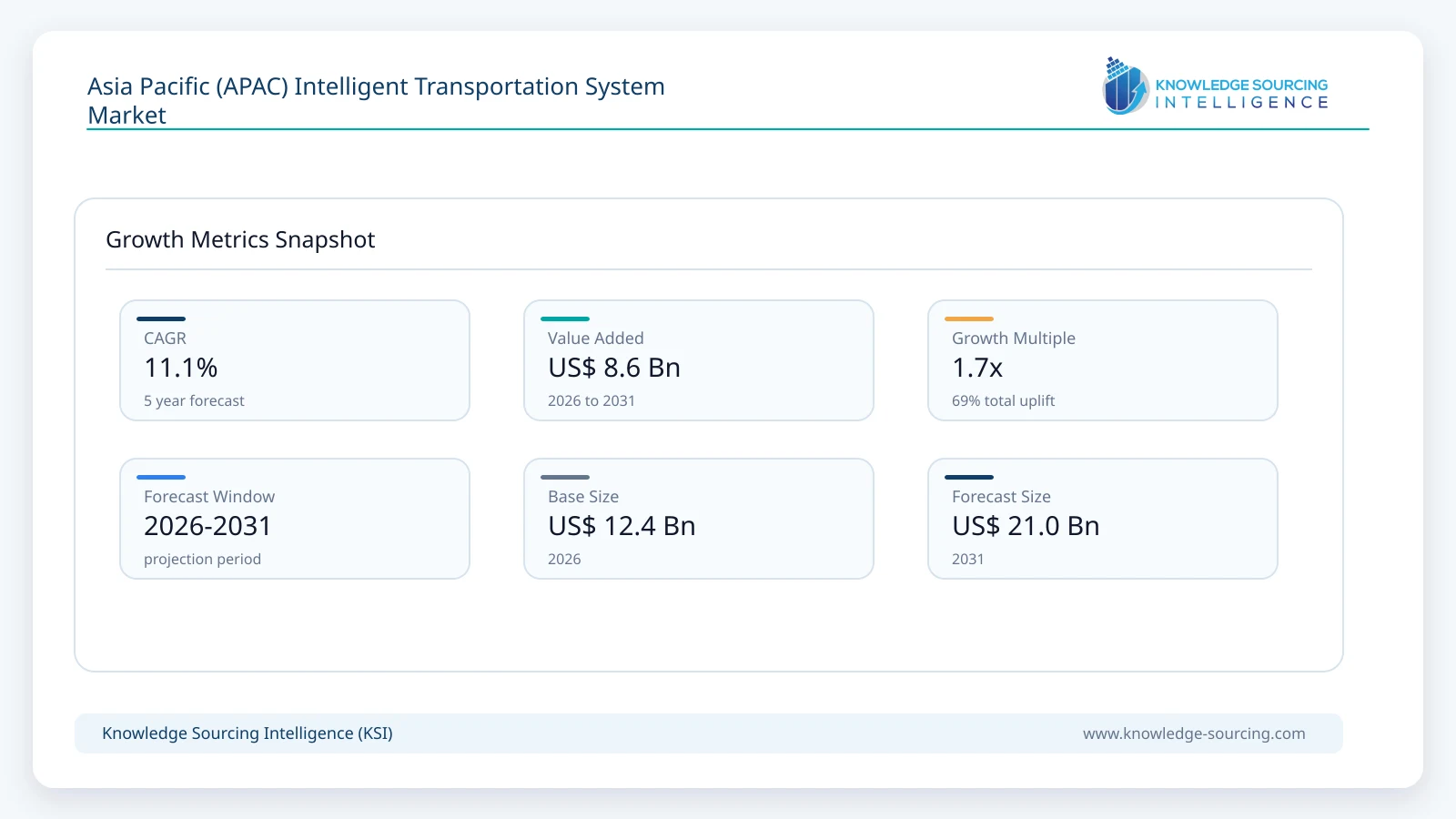
Asia Pacific (APAC) Intelligent Transportation System Market is forecast to grow at a CAGR of 11.1%, reaching USD 21.0 billion in 2031 from USD 12.4 billion in 2026.
Highlights:
- 1Growing urban congestion is accelerating investment in integrated traffic management and connected transport infrastructure.
- 2National intelligent transport policies are shifting procurement toward interoperable and data-driven mobility platforms.
- 3Public agencies increasingly prioritize lifecycle service capability alongside hardware performance during supplier selection.
- 4Cooperative Intelligent Transport Systems (C-ITS) deployments are expanding to support connected and automated mobility applications.
- 5Smart city programs and expressway modernization projects continue to broaden demand across the Asia Pacific region.
Government investment remains the principal source of demand, although concession operators, toll road developers, airport authorities, logistics operators, and public transport agencies are expanding procurement activity as digital traffic management becomes central to network efficiency. Buyers increasingly evaluate suppliers based on system interoperability, cybersecurity capability, software scalability, maintenance support, compliance with national ITS architectures, and the ability to integrate existing infrastructure instead of replacing it entirely. These considerations have increased the commercial value of long-term software, analytics, maintenance, and managed service contracts alongside traditional equipment supply.
Deployment priorities differ across Asia Pacific economies. China continues investing in digital highway infrastructure and connected mobility initiatives, while Japan emphasizes traffic safety, automated driving support, and disaster-resilient transport systems. India's transport modernization programs, electronic tolling expansion, and smart city initiatives are increasing procurement of intelligent traffic management and surveillance technologies. Other regional markets, including South Korea, Singapore, Australia, and Southeast Asian economies, are strengthening ITS investments to improve congestion management, public transport efficiency, freight movement, and environmental performance.
Competition extends beyond conventional transport equipment suppliers. Software developers, communications providers, cloud service companies, and artificial intelligence specialists increasingly participate in large public tenders, reflecting a gradual shift from hardware-centric procurement toward integrated mobility platforms capable of supporting future connected vehicle ecosystems.
Key Market Indicators
Indicator | Latest Evidence | Commercial Meaning |
UN urban population in Asia | More than 2.2 billion people (2024) | Expanding urban mobility increases pressure on road infrastructure and traffic management systems. |
India National Highway network | Approximately 146,000 km | Highway expansion creates long-term demand for traffic monitoring, tolling, and incident management solutions. |
China Expressway Network | Over 190,000 km operational | Large-scale expressway infrastructure supports continuous ITS upgrades and digital traffic management investments. |
Electronic Toll Collection deployment in India | FASTag implemented nationwide on National Highways | Digital tolling increases demand for integrated ITS platforms and traffic data analytics. |
Global road safety challenge (WHO) | Around 1.19 million road fatalities annually | Governments continue investing in intelligent safety systems and incident response technologies. |
Key Indicator: China operates one of the world's largest expressway networks, exceeding 190,000 km.
Commercial Meaning: Large-scale road infrastructure provides a sustained upgrade cycle for traffic management, roadside communication, surveillance, and connected mobility technologies.
Market Drivers
Expansion of digitally managed highway infrastructure
Highway authorities across Asia Pacific are increasingly integrating digital traffic management into new road construction and modernization programs rather than treating ITS as a separate investment. China's Ministry of Transport continues promoting digital highway development through integrated sensing, cloud platforms, vehicle-road coordination, and smart infrastructure initiatives. India's National Highways Authority of India has similarly expanded intelligent traffic management systems across strategic highway corridors while strengthening electronic tolling infrastructure. These projects increase demand for traffic detection equipment, control centers, video analytics, communications networks, and lifecycle maintenance services, encouraging suppliers to expand software capability alongside conventional roadside equipment.
Government policies supporting connected and cooperative mobility
National transport strategies increasingly recognize connected vehicle infrastructure as a prerequisite for safer and more efficient mobility. Japan has continued expanding Cooperative Intelligent Transport Systems (C-ITS) through collaboration between government agencies, vehicle manufacturers, and transport operators to improve road safety and support automated driving. South Korea, Singapore, and China have introduced pilot deployments combining roadside communication units, vehicle connectivity, and real-time traffic management platforms. These programs create procurement opportunities for roadside communication equipment, edge computing, cybersecurity solutions, traffic analytics software, and systems integration providers capable of supporting interoperable mobility ecosystems across multiple transport modes.
Growing reliance on real-time traffic analytics for congestion management
Transport authorities are placing greater emphasis on data-driven traffic operations as congestion imposes economic costs through longer travel times, fuel consumption, freight delays, and reduced network reliability. Urban authorities increasingly combine surveillance cameras, connected sensors, automatic incident detection, weather monitoring, and predictive analytics within unified traffic management centers. Suppliers are responding by integrating artificial intelligence into video analytics, adaptive signal control, and incident response systems that improve operational efficiency without requiring major road expansion. The shift from reactive traffic control toward predictive traffic management also increases recurring demand for software upgrades, cloud services, cybersecurity, and analytics support.
Public transport modernization and multimodal mobility initiatives
Public transport agencies throughout Asia Pacific are investing in intelligent passenger information systems, fleet monitoring, automated fare collection, and operational analytics to improve service reliability and encourage greater public transport use. Singapore's Land Transport Authority continues expanding digital mobility services through integrated transport management, while metropolitan authorities in India, Australia, Japan, and Southeast Asia increasingly deploy intelligent bus management and passenger information platforms. These investments strengthen demand for Advanced Public Transportation Systems (APTS), communications infrastructure, fleet management software, and integrated mobility platforms capable of connecting buses, metro systems, regional rail, and emerging shared mobility services into unified passenger information networks.
Market Restraints and Challenges
Complex system integration across legacy transport infrastructure. Many transport authorities continue operating traffic control equipment, surveillance networks, tolling platforms, and communication systems supplied over different procurement cycles, often using proprietary interfaces. Integrating these assets into a unified Intelligent Transportation System increases implementation complexity, extends project schedules, and raises engineering costs. Suppliers such as Siemens AG, Yunex Traffic, Hitachi, and Thales increasingly emphasize open architectures, modular software platforms, and standardized communication protocols to reduce compatibility issues. Nevertheless, interoperability remains a practical challenge, particularly for metropolitan authorities upgrading infrastructure without replacing existing assets.
Lengthy public procurement and regulatory approval processes. ITS deployment across the Asia Pacific region is largely dependent on government-funded infrastructure programs. Multi-stage feasibility studies, technical evaluations, cybersecurity assessments, budget approvals, and public tender procedures frequently extend project implementation over several years. Large urban traffic management systems and expressway modernization projects also require coordination among transport agencies, municipal authorities, telecommunications providers, and public safety organizations. These extended procurement cycles create uneven revenue recognition for suppliers and increase bid preparation costs while delaying the commercial deployment of new technologies.
Growing cybersecurity and data governance requirements. Modern ITS platforms continuously exchange operational data between roadside infrastructure, vehicles, cloud platforms, and traffic management centers. As connected transport systems become more digitally integrated, transport authorities increasingly require compliance with national cybersecurity regulations, data protection frameworks, and critical infrastructure security standards. Suppliers must invest in secure software architecture, encryption, continuous monitoring, and lifecycle security updates throughout project operation. These additional requirements raise implementation costs and extend product qualification timelines, particularly for Cooperative Intelligent Transport Systems and cloud-based traffic management platforms.
High lifecycle investment and maintenance obligations. Although digital traffic management improves operational efficiency, transport authorities evaluate projects over their full operating life rather than initial installation costs alone. Communications infrastructure, roadside sensors, software licensing, equipment calibration, cybersecurity upgrades, and field maintenance generate recurring expenditure throughout the contract period. Budget constraints are particularly evident among municipal authorities with ageing infrastructure, where modernization projects often compete with broader transport expansion priorities. Consequently, suppliers increasingly offer phased deployment strategies and long-term service agreements to improve affordability while maintaining operational performance.
Major Segment Analysis
Advanced Traffic Management Systems (ATMS)
Among the market segments covered, Advanced Traffic Management Systems (ATMS) represent the most commercially important area because they provide the operational foundation for traffic monitoring, adaptive signal control, incident detection, congestion management, and integrated command centers. Rather than procuring standalone equipment, road authorities increasingly invest in centralized platforms capable of combining video surveillance, traffic sensors, weather information, variable message signs, and predictive analytics within a single operating environment. This integrated approach improves network efficiency while supporting future expansion into connected vehicle applications.
Purchasing decisions increasingly emphasize interoperability, software scalability, cybersecurity, and lifecycle support rather than hardware specifications alone. National highway authorities, metropolitan transport agencies, and smart city administrators typically require ATMS platforms to integrate with tolling systems, public transport operations, emergency response services, and traveler information networks. Suppliers including Yunex Traffic, Siemens AG, Hitachi, Thales Group, Huawei Technologies, and Kapsch TrafficCom continue expanding cloud-enabled traffic management, artificial intelligence-based analytics, and digital twin capabilities to strengthen long-term service revenues. Although Cooperative Intelligent Transport Systems receive growing policy attention, ATMS remains the operational backbone supporting broader ITS deployment across the region.
Regional Analysis
Region / Country | Primary Demand Drivers | Principal Constraints |
China | Digital highway construction, smart city investment, connected vehicle infrastructure | Regional interoperability, cybersecurity compliance, large-scale system integration |
Japan | Road safety initiatives, C-ITS deployment, automated driving support | Ageing infrastructure replacement, stringent technical certification |
India | National highway expansion, electronic tolling, urban traffic modernization | Budget limitations across municipalities, complex procurement processes |
Rest of APAC | Smart mobility projects, public transport digitization, congestion management | Uneven digital infrastructure and varying regulatory maturity |
China remains the region's largest source of Intelligent Transportation System deployment activity because of sustained investment in expressway expansion, smart city development, and digital transport infrastructure. Government initiatives supporting vehicle-road coordination, digital highways, and connected mobility continue creating demand for integrated traffic management platforms, roadside communications equipment, video analytics, and cloud-based operational systems. Domestic technology providers compete alongside international suppliers, increasing emphasis on localized manufacturing, software capability, and compliance with national technical standards.
Japan's ITS market is shaped primarily by road safety objectives, disaster resilience, and preparation for higher levels of connected and automated mobility. Public agencies continue expanding Cooperative Intelligent Transport Systems, advanced traffic information services, and intelligent highway infrastructure to improve traffic flow while reducing accident risk. Procurement priorities typically favor high system reliability, long operational life, interoperability with existing transport infrastructure, and strict compliance with national safety requirements, supporting demand for premium integrated solutions rather than price-driven procurement.
India continues expanding Intelligent Transportation System deployment through national highway modernization, FASTag-enabled electronic toll collection, Smart Cities Mission projects, metro rail expansion, and urban traffic management initiatives. Metropolitan authorities increasingly invest in adaptive traffic signal control, integrated command centers, automated enforcement systems, and public transport information platforms to address growing urban congestion. However, procurement timelines, funding availability, and varying implementation capacity across municipalities create differences in project execution speed between major metropolitan areas and smaller cities.
The remaining Asia Pacific markets, including Singapore, South Korea, Australia, and several Southeast Asian economies, continue strengthening ITS investment through urban mobility modernization, digital public transport services, and integrated traffic management programs. These countries generally prioritize interoperability, cybersecurity, predictive traffic analytics, and multimodal transport integration, although procurement approaches vary according to national transport policy, infrastructure maturity, and local regulatory frameworks.
Competitive Landscape
The Asia Pacific Intelligent Transportation System market remains technology-led and project-driven, with competition determined less by equipment supply than by the ability to deliver integrated platforms that combine hardware, software, communications, cybersecurity, and long-term operational support. Public infrastructure contracts typically require suppliers to demonstrate proven deployment experience, compliance with national ITS standards, system interoperability, and the capability to maintain complex installations over extended contract periods. These requirements create relatively high barriers to entry, particularly for suppliers lacking regional implementation experience or established service networks.
Siemens AG, Yunex Traffic, Thales Group, Hitachi, Huawei Technologies, Kapsch TrafficCom, Denso, and 3M compete across different parts of the value chain rather than through identical product portfolios. Competition increasingly centers on cloud-enabled traffic management platforms, artificial intelligence-assisted traffic analytics, connected vehicle infrastructure, adaptive signal control, and integrated mobility management. Suppliers are expanding regional engineering capability, strengthening cybersecurity expertise, investing in software development, and forming partnerships with telecommunications providers and local system integrators to address evolving customer requirements. Long-term maintenance contracts, software upgrades, and lifecycle support are becoming increasingly important sources of recurring revenue alongside conventional infrastructure deployment projects.
Recent Developments
May 2026 – Kapsch TrafficCom Wins India Connected Vehicle Project: Kapsch TrafficCom secured a landmark connected-vehicle deployment in India, delivering cooperative intelligent transportation technologies that enhance vehicle-to-infrastructure communication, road safety, traffic efficiency, and real-time mobility management across national road networks.
May 2026 – Kapsch TrafficCom Awarded Melbourne Tolling System Upgrade: Kapsch TrafficCom won a major contract to upgrade Melbourne’s tolling infrastructure with advanced intelligent transportation technologies, improving traffic flow, digital toll collection, operational reliability, and future mobility scalability across Australia's urban network.
March 2026 – Q-Free Partners with Sony Semiconductor Solutions: Q-Free announced a collaboration with Sony Semiconductor Solutions to develop satellite-based GNSS road-user charging technology, advancing precise distance-based tolling, connected mobility services, and next-generation intelligent transportation systems across Asia-Pacific markets.
Regulatory and Policy Environment
National transport policy remains one of the most influential factors shaping Intelligent Transportation System investment across the Asia Pacific region. Unlike conventional transport infrastructure, ITS deployment depends not only on capital expenditure but also on technical standards governing communications, cybersecurity, data management, interoperability, and system reliability. These regulatory requirements increasingly influence procurement specifications, supplier qualification, and long-term operational support.
China continues advancing intelligent transport infrastructure through policies supporting digital highways, connected vehicle development, and integrated transport digitalization under the Ministry of Transport. National guidance encourages deployment of roadside sensing, vehicle-road coordination, and digital traffic management platforms capable of supporting future automated mobility applications. Compliance with domestic cybersecurity and data governance requirements has become an increasingly important consideration for technology providers participating in public infrastructure projects.
Japan maintains one of the region's most mature ITS policy environments through long-standing collaboration between transport authorities, automotive manufacturers, and technology suppliers. National programs promoting Cooperative Intelligent Transport Systems (C-ITS), traffic safety improvement, and automated driving continue encouraging deployment of roadside communication infrastructure and intelligent traffic management technologies while maintaining rigorous technical certification requirements.
India's regulatory environment increasingly supports ITS adoption through the Ministry of Road Transport and Highways, the National Highways Authority of India, and urban mobility initiatives implemented under national infrastructure development programs. Expansion of electronic toll collection, intelligent traffic management systems, and integrated command centers continues creating procurement opportunities for technology providers while promoting greater standardization across highway and urban transport projects.
Outlook and Strategic Implications
Demand for Intelligent Transportation Systems across Asia Pacific is expected to remain closely aligned with government transport modernization programs, urban mobility investment, and digital infrastructure development during the forecast period. Procurement priorities are gradually shifting from standalone hardware installations toward integrated platforms capable of combining traffic management, connected vehicle support, predictive analytics, cybersecurity, and cloud-based operational services. This evolution is expected to increase the commercial importance of software capability, systems integration expertise, and long-term service delivery.
Several strategic developments are likely to influence competitive positioning between 2026 and 2031:
Transport authorities are expected to prioritize interoperable platforms that reduce future integration costs and support connected mobility initiatives.
Technology suppliers will continue increasing investment in artificial intelligence, cybersecurity, edge computing, and digital traffic analytics to strengthen recurring software and service revenues.
System integrators and telecommunications providers are likely to play a larger role as roadside infrastructure becomes increasingly connected through high-speed communication networks.
Infrastructure operators will place greater emphasis on lifecycle operating costs, predictive maintenance, and software scalability when evaluating procurement alternatives.
National governments are expected to strengthen technical standards covering cybersecurity, data governance, and connected vehicle communication, increasing compliance requirements for technology providers.
Commercial success during the forecast period will depend less on supplying individual traffic management products and more on delivering interoperable, secure, and scalable mobility ecosystems that remain adaptable as transport networks evolve toward higher levels of automation and digital connectivity.
Asia Pacific (APAC) Intelligent Transportation System Market Scope:
| Report Metric | Details |
|---|---|
| Total Market Size in 2026 | USD 12.4 billion |
| Total Market Size in 2031 | USD 21.0 billion |
| Forecast Unit | Billion |
| Growth Rate | 11.1% |
| Study Period | 2021 to 2031 |
| Historical Data | 2021 to 2024 |
| Base Year | 2025 |
| Forecast Period | 2026 – 2031 |
| Segmentation | Type, Application, Geography |
| Companies |
|
Market Segmentation
By Type
ATMS (Advanced Traffic Management System)
ATIS (Advanced Traffic Information System)
APTS (Advanced Public Transportation System)
ATPS (Advanced Transportation Pricing System)
Cooperative Intelligent Transport Systems (C-ITS)
By Application
Collision Avoidance System
Traffic Monitoring
Parking Availability
Traffic Signal Control System
Fleet Management and Asset Monitoring
Road User Charging / Electronic Toll Collection
Smart Mobility Management
Emergency Vehicle Notification
Incident Management
Connected Vehicle Services
Public Transport Passenger Information
Others
By Geography
China
Japan
India
South Korea
Australia
Singapore
Others
Table of Contents
1. Introduction
2. Research Methodology
3. Executive Summary
4. Market Dynamics
4.1. Market Overview and Segmentations
4.2. Drivers
4.3. Restraints
4.4. Opportunities
4.5. Porter's Five Forces
4.6. Supplier Outlook
4.7. Industry Outlook
4.8. Industry Value Chain Analysis
4.9. Scenario Analysis
5. Asia Pacific Intelligent Transportation System Market Forecast By Type
5.1. ATMS (Advanced Traffic Management System)
5.2. ATIS (Advanced Traffic Information System)
5.3. APTS (Advanced Public Transportation System)
5.4. ATPS (Advanced Transportation Pricing System)
5.5. Cooperative Intelligent Transport Systems (C-ITS)
6. Asia Pacific Intelligent Transportation System Market Forecast By Application
6.1. Collision Avoidance System
6.2. Traffic Monitoring
6.3. Parking Availability
6.4. Traffic Signal Control System
6.5. Fleet Management and Asset Monitoring
6.6. Road User Charging / Electronic Toll Collection
6.7. Smart Mobility Management
6.8. Emergency Vehicle Notification
6.9. Incident Management
6.10. Connected Vehicle Services
6.11. Public Transport Passenger Information
6.12. Others
7. Asia Pacific Intelligent Transportation System Market Forecast By Geography
7.1. China
7.2. Japan
7.3. India
7.4. South Korea
7.5. Australia
7.6. Singapore
7.7. Others
8. Competitive Intelligence
8.1. Market Share of Key Players
8.2. Investment Analysis
8.3. Recent Deals
8.4. Strategies of Key Players
9. Company Profiles
9.2. Yunex Traffic
9.3. Denso
9.4. Thales Group
9.5. Siemens AG
9.6. Kapsch Traffic Com
9.7. Huawei Technologies
9.8. Hitachi
Navigate
Trusted by the world's leading organizations











