
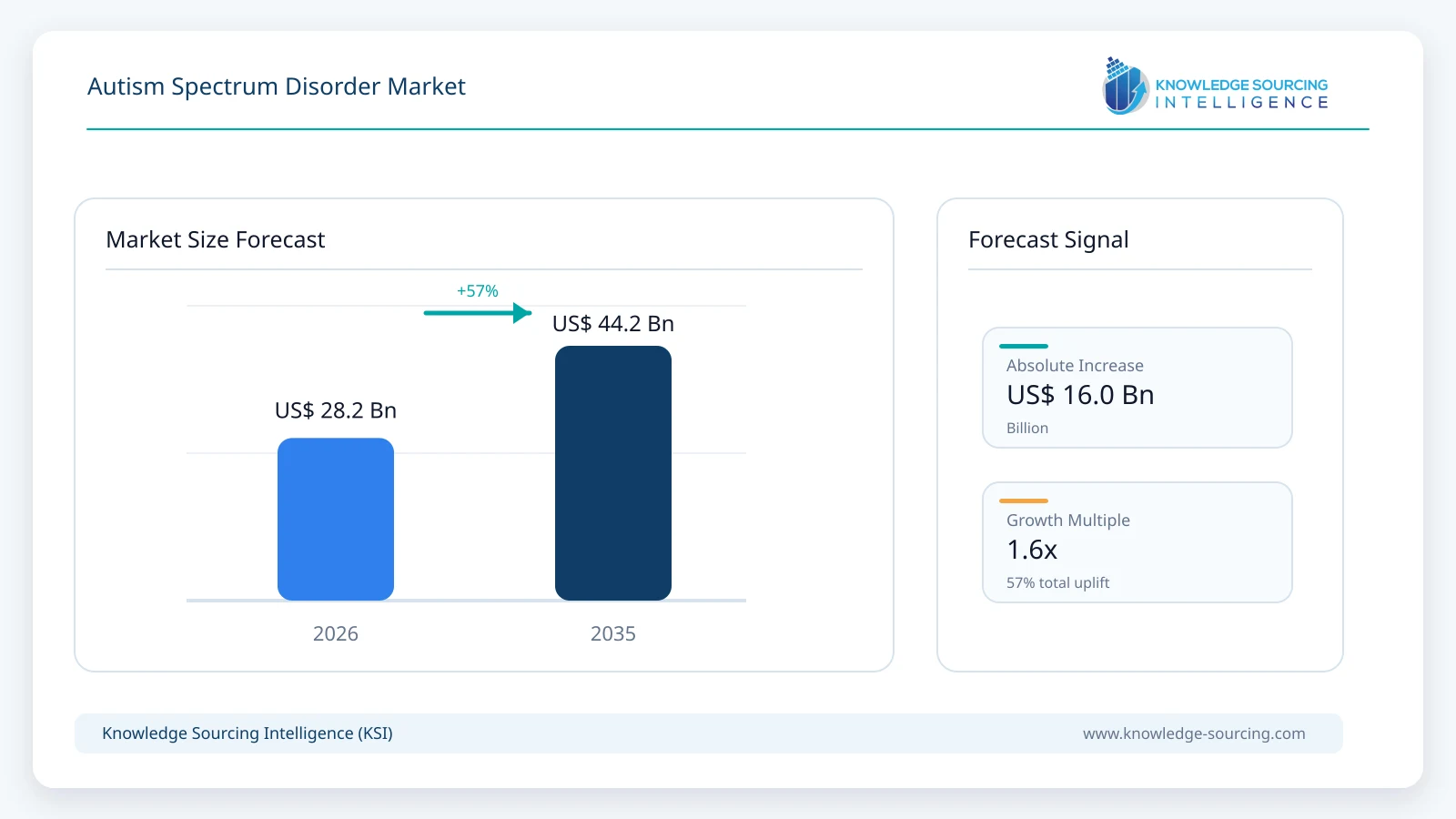
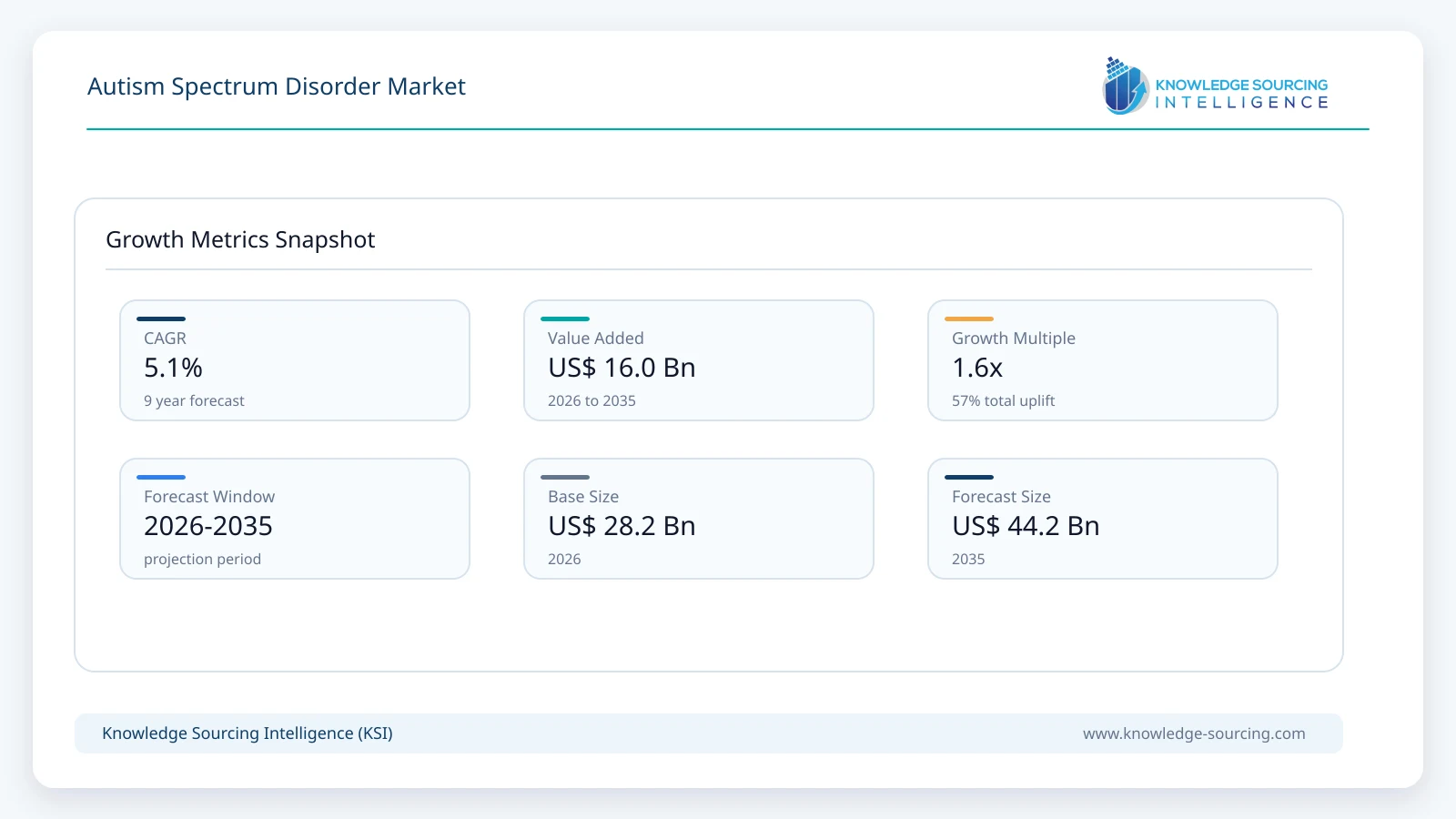
The Global Autism Spectrum Disorder Market is set to reach USD 44.2 billion in 2035, growing at a CAGR of 5.1% from USD 28.2 billion in 2026.
Highlights:
- 1Diagnosed ASD populations are increasing because screening programs are identifying children at younger ages.
- 2Treatment utilization continues expanding because awareness among caregivers and healthcare professionals is improving.
- 3Level 1 ASD represents a substantial proportion of diagnosed cases because milder presentations are increasingly recognized.
- 4Level 2 and Level 3 ASD populations are generating significant demand for multidisciplinary intervention programs.
ASD is a neurodevelopmental disorder characterized by challenges in social communication, repetitive behaviors, and restricted interests. Management strategies focus on improving communication skills, adaptive functioning, behavioral regulation, and educational participation. Treatment demand increases because symptom presentation often requires long-term intervention across multiple developmental stages.
Healthcare systems increasingly emphasize early intervention because developmental gains achieved during childhood can improve long-term outcomes. Screening programs are expanding identification rates. More patients are entering treatment pathways. Demand for evidence-based therapies consequently continues to increase.
ASD represents a heterogeneous neurodevelopmental condition characterized by challenges in social communication, restricted interests, repetitive behaviors, and varying functional support requirements. Disease severity classifications help healthcare providers determine treatment intensity, educational support needs, and long-term care planning.
Population growth is increasingly influenced by improved screening practices rather than solely by changes in underlying disease occurrence. Diagnostic pathways are becoming more standardized across healthcare systems. Earlier identification consequently expands access to evidence-based interventions and increases the proportion of patients receiving formal treatment.
Market Dynamics
Market Drivers
Early intervention improves developmental outcomes and reduces long-term support requirements. Healthcare systems are increasing investment in early diagnosis and treatment programs. Demand for reimbursed services continues expanding. Treatment accessibility therefore improves.
Untreated or inadequately managed ASD increases educational, healthcare, and social support costs. Policymakers are recognizing the value of early therapeutic engagement. Reimbursement support is expanding across multiple intervention categories. Long-term resource utilization consequently becomes more manageable.
ASD management requires coordinated therapeutic approaches addressing communication, behavior, social interaction, and daily functioning. Integrated care programs are expanding. Payers are supporting broader intervention coverage. Comprehensive treatment access therefore improves.
Market Restraints
Significant variation exists in reimbursement policies across regions.
Long-term therapy requirements create substantial cumulative costs.
Emerging therapies may face stringent cost-effectiveness evaluations.
Market Opportunities
Healthcare systems increasingly prioritize developmental screening. Diagnostic identification is occurring at younger ages. Intervention access improves accordingly. Long-term patient outcomes therefore benefit.
Demand for localized care continues increasing. Community treatment programs are expanding. Service accessibility improves. Treatment participation consequently rises.
Technology-assisted screening supports earlier recognition of developmental concerns. Digital health platforms are becoming more common. Diagnostic efficiency improves. Patient identification therefore accelerates.
Disease & Epidemiology Analysis
ASD prevalence continues increasing globally because diagnostic criteria, healthcare awareness, and screening coverage are improving. Earlier recognition expands diagnosed populations and increases demand for therapeutic interventions. Healthcare systems consequently face growing requirements for specialized developmental services.
Disease burden varies according to severity level because support requirements increase as functional impairment becomes more pronounced. Level 1 ASD often requires targeted educational and behavioral interventions, while Level 2 and Level 3 ASD frequently require intensive multidisciplinary support. Resource utilization therefore rises with increasing disease severity.
Treatment Guidelines Landscape
Guideline Organization | Geographic Scope | Primary Recommendation | Diagnostic Focus | Treatment Focus |
World Health Organization | Global | Early identification and intervention | Developmental surveillance | Multidisciplinary support |
American Academy of Pediatrics | United States | Universal developmental screening | Early childhood assessment | Behavioral intervention |
National Institute for Health and Care Excellence | United Kingdom | Comprehensive multidisciplinary evaluation | Structured diagnosis | Individualized support planning |
American Academy of Child and Adolescent Psychiatry | United States | Standardized clinical assessment | Psychiatric and developmental evaluation | Symptom management |
Canadian Paediatric Society | Canada | Early developmental surveillance | Multidisciplinary diagnosis | Family-centered intervention |
Market Segmentation
Behavioral Therapies
Behavioural therapies represent the most established intervention category because they address core functional challenges associated with ASD. Applied Behaviour Analysis, Early Intensive Behavioral Intervention, Cognitive Behavioural Therapy, and social skills training continue to receive strong clinical support. Early diagnosis is increasing enrollment into these programs. Treatment utilisation, therefore, continues expanding throughout the forecast period.
Developmental Therapies
Developmental interventions and relationship-based therapies continue gaining importance because treatment strategies increasingly emphasise individualised developmental support. Earlier diagnosis is increasing the demand for these services. Healthcare providers are integrating developmental approaches into comprehensive care pathways. Utilization consequently continues rising.
Speech and Language Therapy
Speech and language therapy remains essential because communication impairment is among the most common ASD-related challenges. Early intervention programs are expanding referrals to speech services. Treatment duration often extends across multiple developmental stages. Demand therefore remains consistently strong.
Regional Analysis
North America
North America maintains one of the largest diagnosed ASD populations because developmental screening programs and healthcare awareness remain highly established. Earlier diagnosis continues increasing treatment enrollment. Specialized autism centers are expanding service capacity. The treated population therefore continues growing throughout the region.
Europe
European healthcare systems continue strengthening developmental assessment and intervention programs because public health authorities recognize the importance of early diagnosis. Screening utilization is increasing. Multidisciplinary care access remains a priority. Diagnosed and treated populations consequently continue expanding.
Asia Pacific
Asia Pacific is experiencing substantial growth in diagnosed ASD populations because awareness campaigns and pediatric developmental screening programs continue expanding. Healthcare infrastructure improvements are increasing access to assessment services. Earlier diagnosis is becoming more common. Treatment participation therefore rises steadily across the region.
Rest of the World
Emerging healthcare markets continue improving developmental disorder recognition because government initiatives increasingly support child health programs. Diagnostic accessibility remains variable. Service capacity is expanding gradually. Patient identification and treatment uptake consequently continue improving.
Regulatory Landscape
Healthcare authorities increasingly support standardized ASD screening because earlier diagnosis improves developmental outcomes and reduces long-term support requirements. Clinical guidelines continue emphasizing evidence-based intervention strategies. Diagnostic consistency therefore improves across healthcare systems.
Regulatory attention increasingly focuses on improving access to developmental services because rising patient populations place pressure on healthcare infrastructure. Policy initiatives are supporting earlier identification and intervention. Treatment accessibility consequently continues advancing
Pipeline Analysis
The autism pipeline increasingly focuses on biomarkers, genetics, digital diagnostics, and targeted therapeutic interventions because disease heterogeneity limits the effectiveness of uniform approaches. Research institutions are investigating biological markers that may improve diagnostic precision and support earlier identification. These efforts seek to complement behavioral assessments that currently remain the foundation of diagnosis.
Genomic research continues expanding because genetic factors contribute significantly to autism risk. Sequencing technologies are identifying novel variants associated with neurodevelopmental pathways, which improves understanding of disease mechanisms. Researchers are integrating genomic findings with clinical phenotypes to create more refined patient classifications. This strategy supports precision medicine initiatives and enhances epidemiological characterization.
Digital health technologies represent another important area of development because workforce shortages continue limiting specialist access. Artificial intelligence-assisted screening tools, digital behavioral assessments, and remote monitoring platforms are undergoing evaluation across multiple research programs. These innovations seek to improve scalability and reduce diagnostic delays. Successful implementation could substantially increase identification rates and strengthen population-level surveillance capabilities.
Reimbursement Landscape
Reimbursement policies significantly influence autism diagnosis and treatment access because multidisciplinary evaluations and long-term interventions often generate substantial costs. Public healthcare systems in many developed countries provide partial or comprehensive coverage for diagnostic assessments, behavioral therapies, speech therapy, and occupational therapy. Coverage expansion is increasing utilization of autism-related healthcare services and encouraging earlier engagement with care pathways.
Private insurance participation also continues expanding because autism is increasingly recognized as a lifelong condition requiring ongoing support. Coverage requirements are improving access to evidence-based interventions and reducing financial barriers for affected families. Reimbursement variation nevertheless remains substantial across regions and healthcare systems. This disparity contributes to unequal access to diagnosis and treatment services. The overall outcome is growing recognition that sustainable reimbursement frameworks are essential for supporting expanding diagnosed populations.
Competitive Landscape
Roche
Roche remains strategically differentiated through extensive neuroscience research capabilities and experience in biomarker-driven development. Future pricing strategies are likely to emphasize value demonstration and outcome-based access models.
Yamo Pharmaceuticals
Yamo Pharmaceuticals focuses on targeted neurological interventions addressing core ASD manifestations. Future reimbursement positioning is expected to depend on demonstration of meaningful functional improvements.
Stalicla SA
Stalicla emphasizes precision medicine approaches designed for biologically defined patient populations. This strategy may support differentiated reimbursement discussions through targeted therapeutic value propositions.
Axial Therapeutics
Axial Therapeutics pioneered microbiome-focused ASD development. Future pricing considerations are likely to reflect clinical differentiation and evidence supporting gut-brain therapeutic mechanisms.
SciSparc Ltd.
SciSparc explores cannabinoid-related therapeutic approaches. Reimbursement success will depend on generation of robust efficacy and safety evidence supporting clinical value.
Oryzon Genomics S.A.
Oryzon applies expertise in epigenetic regulation to neurological disorders. Future market access strategies are expected to emphasize innovation and targeted patient benefit.
Curemark, LLC
Curemark historically focused on gastrointestinal and metabolic pathways associated with ASD. Reimbursement positioning may benefit from demonstration of differentiated biological mechanisms.
Neurochlore SAS
Neurochlore concentrates on mechanism-based neurological interventions. Clinical differentiation and measurable patient outcomes are likely to shape future pricing potential.
Jazz Pharmaceuticals plc
Jazz Pharmaceuticals possesses extensive neuroscience commercialization experience. This expertise may support future reimbursement negotiations if ASD-focused programs advance clinically.
Servier
Servier maintains broad neurological research capabilities and global market access expertise. Future pricing strategies are expected to align with value-based healthcare principles.
Key Developments
January 2025 – Stalicla advanced precision medicine programs targeting biologically defined ASD patient populations.
October 2024 – Yamo Pharmaceuticals continued preparations supporting the later-stage development of L1-79 following positive clinical observations.
September 2024 – Axial Therapeutics maintained development activities for microbiome-based ASD therapeutic candidates.
July 2024 – Oryzon Genomics expanded its neuroscience development activities to support neurodevelopmental research programs.
Strategic Insights and Future Market Outlook
ASD treatment demand continues expanding because earlier diagnosis is increasing participation in structured intervention programs. Behavioral, developmental, and speech-based therapies remain the foundation of care because they address core functional challenges and support long-term developmental progress. Service utilization therefore continues increasing across healthcare systems.
Treatment delivery models are evolving because growing patient populations require scalable and accessible intervention approaches. Digital health platforms, telehealth services, and community-based treatment programs are expanding. Healthcare providers consequently are improving service reach and efficiency.
Through 2035, treatment demand is expected to remain driven by earlier diagnosis, increasing awareness, and expanding intervention access. Behavioral therapies will likely retain a central role in care delivery, while developmental and communication-focused interventions continue supporting comprehensive management strategies. The ASD treatment landscape is therefore expected to become increasingly integrated, personalized, and outcome oriented.
Market Segmentation
By Treatment Type
By Disease Severity
By Disease Type
By Age Group
By End User
By Geography
Key Countries Analysis
Table of Contents
1. EXECUTIVE SUMMARY
1.1 Report Scope and Objectives
1.2 Key Findings
1.3 Market Snapshot
1.4 Growth Outlook (2025–2035)
1.5 Key Market Drivers
1.6 Market Challenges
1.7 Emerging Opportunities
1.8 Analyst Perspective
2. AUTISM SPECTRUM DISORDER MARKET OVERVIEW
2.1 Introduction to Autism Spectrum Disorder
2.2 Disease Classification
2.2.1 Level 1 ASD
2.2.2 Level 2 ASD
2.2.3 Level 3 ASD
2.2.4 Syndromic Autism
2.2.5 Non-Syndromic Autism
2.3 Disease Burden Assessment
2.4 Patient Journey Analysis
2.5 Current Treatment Landscape
2.6 Emerging Treatment Landscape
2.7 Unmet Needs Assessment
2.8 Market Evolution Overview
3. MARKET DYNAMICS
3.1 Market Drivers
3.1.1 Rising Autism Diagnosis Rates
3.1.2 Increasing Awareness Programs
3.1.3 Expansion of Early Intervention Programs
3.1.4 Growing Healthcare Expenditure
3.1.5 Advancements in Precision Medicine
3.2 Market Restraints
3.2.1 Limited Approved Pharmacological Therapies
3.2.2 High Cost of Behavioral Interventions
3.2.3 Reimbursement Challenges
3.2.4 Workforce Shortages
3.3 Market Opportunities
3.3.1 Novel Therapeutic Development
3.3.2 Biomarker-Based Patient Stratification
3.3.3 Digital Therapeutics Expansion
3.3.4 Personalized Treatment Approaches
3.4 Market Challenges
3.5 Porter’s Five Forces Analysis
3.6 PESTLE Analysis
4. MARKET SIZE AND FORECAST ANALYSIS (2025–2035)
4.1 Global Market Revenue Forecast
4.2 Historical Market Analysis (2021–2024)
4.3 Market Forecast Methodology
4.4 Base Case Forecast Scenario
4.5 Optimistic Forecast Scenario
4.6 Conservative Forecast Scenario
4.7 Absolute Dollar Opportunity Analysis
4.8 Incremental Revenue Opportunity Analysis
4.9 Market Attractiveness Analysis
5. MARKET SEGMENTATION BY TREATMENT TYPE
5.1 Behavioral Therapies
5.1.1 Applied Behavior Analysis (ABA)
5.1.2 Early Intensive Behavioral Intervention (EIBI)
5.1.3 Cognitive Behavioral Therapy (CBT)
5.1.4 Social Skills Training
5.1.5 Revenue Forecast (2025–2035)
5.2 Developmental Therapies
5.2.1 Developmental Interventions
5.2.2 Relationship-Based Therapies
5.2.3 Revenue Forecast (2025–2035)
5.3 Speech and Language Therapy
5.3.1 Service Utilization Trends
5.3.2 Revenue Forecast (2025–2035)
5.4 Occupational Therapy
5.4.1 Service Utilization Trends
5.4.2 Revenue Forecast (2025–2035)
5.5 Educational Interventions
5.5.1 Special Education Programs
5.5.2 School-Based Interventions
5.5.3 Revenue Forecast (2025–2035)
5.6 Pharmacological Therapies
5.6.1 Antipsychotic Therapies
5.6.2 ADHD Symptom Management Therapies
5.6.3 Anxiety and Mood Management Therapies
5.6.4 Revenue Forecast (2025–2035)
5.7 Emerging Therapies
5.7.1 Precision Medicine Approaches
5.7.2 Microbiome-Based Therapies
5.7.3 Novel Neurodevelopmental Therapies
5.7.4 Revenue Forecast (2025–2035)
6. MARKET SEGMENTATION BY DISEASE SEVERITY
6.1 Level 1 ASD
6.1.1 Market Size
6.1.2 Forecast Analysis
6.2 Level 2 ASD
6.2.1 Market Size
6.2.2 Forecast Analysis
6.3 Level 3 ASD
6.3.1 Market Size
6.3.2 Forecast Analysis
7. MARKET SEGMENTATION BY DISEASE TYPE
7.1 Syndromic Autism
7.1.1 Market Size
7.1.2 Forecast Analysis
7.2 Non-Syndromic Autism
7.2.1 Market Size
7.2.2 Forecast Analysis
8. MARKET SEGMENTATION BY AGE GROUP
8.1 Pediatric Population (0–12 Years)
8.1.1 Market Size
8.1.2 Forecast Analysis
8.2 Adolescent Population (13–17 Years)
8.2.1 Market Size
8.2.2 Forecast Analysis
8.3 Adult Population (18 Years and Above)
8.3.1 Market Size
8.3.2 Forecast Analysis
9. MARKET SEGMENTATION BY END USER
9.1 Hospitals and Specialty Clinics
9.1.1 Market Size
9.1.2 Forecast Analysis
9.2 Autism Treatment Centers
9.2.1 Market Size
9.2.2 Forecast Analysis
9.3 Rehabilitation Centers
9.3.1 Market Size
9.3.2 Forecast Analysis
9.4 Educational Institutions
9.4.1 Market Size
9.4.2 Forecast Analysis
9.5 Home-Based Care Settings
9.5.1 Market Size
9.5.2 Forecast Analysis
10. GEOGRAPHICAL ANALYSIS
10.1 North America
10.1.1 Market Size and Forecast
10.1.2 Treatment Adoption Trends
10.1.3 Reimbursement Environment
10.1.4 Competitive Landscape
10.1.5 Growth Opportunities
10.2 Europe
10.2.1 Market Size and Forecast
10.2.2 Treatment Adoption Trends
10.2.3 Reimbursement Environment
10.2.4 Competitive Landscape
10.2.5 Growth Opportunities
10.3 Asia-Pacific
10.3.1 Market Size and Forecast
10.3.2 Treatment Adoption Trends
10.3.3 Reimbursement Environment
10.3.4 Competitive Landscape
10.3.5 Growth Opportunities
10.4 Latin America
10.4.1 Market Size and Forecast
10.4.2 Treatment Adoption Trends
10.4.3 Reimbursement Environment
10.4.4 Competitive Landscape
10.4.5 Growth Opportunities
10.5 Middle East & Africa
10.5.1 Market Size and Forecast
10.5.2 Treatment Adoption Trends
10.5.3 Reimbursement Environment
10.5.4 Competitive Landscape
10.5.5 Growth Opportunities
11. KEY COUNTRIES ANALYSIS
11.1 United States
11.1.1 Market Size and Forecast
11.1.2 Treatment Adoption Trends
11.1.3 Reimbursement Environment
11.1.4 Competitive Landscape
11.1.5 Growth Opportunities
11.2 Canada
11.2.1 Market Size and Forecast
11.2.2 Treatment Adoption Trends
11.2.3 Reimbursement Environment
11.2.4 Competitive Landscape
11.2.5 Growth Opportunities
11.3 Germany
11.3.1 Market Size and Forecast
11.3.2 Treatment Adoption Trends
11.3.3 Reimbursement Environment
11.3.4 Competitive Landscape
11.3.5 Growth Opportunities
11.4 United Kingdom
11.4.1 Market Size and Forecast
11.4.2 Treatment Adoption Trends
11.4.3 Reimbursement Environment
11.4.4 Competitive Landscape
11.4.5 Growth Opportunities
11.5 France
11.5.1 Market Size and Forecast
11.5.2 Treatment Adoption Trends
11.5.3 Reimbursement Environment
11.5.4 Competitive Landscape
11.5.5 Growth Opportunities
11.6 Italy
11.6.1 Market Size and Forecast
11.6.2 Treatment Adoption Trends
11.6.3 Reimbursement Environment
11.6.4 Competitive Landscape
11.6.5 Growth Opportunities
11.7 Spain
11.7.1 Market Size and Forecast
11.7.2 Treatment Adoption Trends
11.7.3 Reimbursement Environment
11.7.4 Competitive Landscape
11.7.5 Growth Opportunities
11.8 China
11.8.1 Market Size and Forecast
11.8.2 Treatment Adoption Trends
11.8.3 Reimbursement Environment
11.8.4 Competitive Landscape
11.8.5 Growth Opportunities
11.9 Japan
11.9.1 Market Size and Forecast
11.9.2 Treatment Adoption Trends
11.9.3 Reimbursement Environment
11.9.4 Competitive Landscape
11.9.5 Growth Opportunities
11.10 India
11.10.1 Market Size and Forecast
11.10.2 Treatment Adoption Trends
11.10.3 Reimbursement Environment
11.10.4 Competitive Landscape
11.10.5 Growth Opportunities
11.11 South Korea
11.11.1 Market Size and Forecast
11.11.2 Treatment Adoption Trends
11.11.3 Reimbursement Environment
11.11.4 Competitive Landscape
11.11.5 Growth Opportunities
11.12 Australia
11.12.1 Market Size and Forecast
11.12.2 Treatment Adoption Trends
11.12.3 Reimbursement Environment
11.12.4 Competitive Landscape
11.12.5 Growth Opportunities
12. COMPETITIVE LANDSCAPE
12.1 Market Share Analysis
12.2 Competitive Benchmarking
12.3 Strategic Positioning Matrix
12.4 Pipeline Competitiveness Assessment
12.5 Partnership and Collaboration Analysis
12.6 Mergers and Acquisitions Analysis
12.7 Licensing and Co-Development Agreements
12.8 Future Competitive Outlook
13. COMPANY PROFILES
13.1 Roche
13.1.1 Overview
13.1.2 Financials
13.1.3 Autism Spectrum Disorder Portfolio Overview
13.1.4 Clinical Development Strategy
13.1.5 Key Drug Candidates
13.1.6 Commercial Strategy
13.1.7 Strategic Collaborations
13.1.8 Recent Developments
13.2 Yamo Pharmaceuticals
13.2.1 Overview
13.2.2 Financials
13.2.3 Autism Spectrum Disorder Portfolio Overview
13.2.4 Clinical Development Strategy
13.2.5 Key Drug Candidates
13.2.6 Commercial Strategy
13.2.7 Strategic Collaborations
13.2.8 Recent Developments
13.3 Stalicla SA
13.3.1 Overview
13.3.2 Financials
13.3.3 Autism Spectrum Disorder Portfolio Overview
13.3.4 Clinical Development Strategy
13.3.5 Key Drug Candidates
13.3.6 Commercial Strategy
13.3.7 Strategic Collaborations
13.3.8 Recent Developments
13.4 Axial Therapeutics
13.4.1 Overview
13.4.2 Financials
13.4.3 Autism Spectrum Disorder Portfolio Overview
13.4.4 Clinical Development Strategy
13.4.5 Key Drug Candidates
13.4.6 Commercial Strategy
13.4.7 Strategic Collaborations
13.4.8 Recent Developments
13.5 SciSparc Ltd.
13.5.1 Overview
13.5.2 Financials
13.5.3 Autism Spectrum Disorder Portfolio Overview
13.5.4 Clinical Development Strategy
13.5.5 Key Drug Candidates
13.5.6 Commercial Strategy
13.5.7 Strategic Collaborations
13.5.8 Recent Developments
13.6 Oryzon Genomics S.A.
13.6.1 Overview
13.6.2 Financials
13.6.3 Autism Spectrum Disorder Portfolio Overview
13.6.4 Clinical Development Strategy
13.6.5 Key Drug Candidates
13.6.6 Commercial Strategy
13.6.7 Strategic Collaborations
13.6.8 Recent Developments
13.7 Curemark, LLC
13.7.1 Overview
13.7.2 Financials
13.7.3 Autism Spectrum Disorder Portfolio Overview
13.7.4 Clinical Development Strategy
13.7.5 Key Drug Candidates
13.7.6 Commercial Strategy
13.7.7 Strategic Collaborations
13.7.8 Recent Developments
13.8 Neurochlore SAS
13.8.1 Overview
13.8.2 Financials
13.8.3 Autism Spectrum Disorder Portfolio Overview
13.8.4 Clinical Development Strategy
13.8.5 Key Drug Candidates
13.8.6 Commercial Strategy
13.8.7 Strategic Collaborations
13.8.8 Recent Developments
13.9 Jazz Pharmaceuticals plc
13.9.1 Overview
13.9.2 Financials
13.9.3 Autism Spectrum Disorder Portfolio Overview
13.9.4 Clinical Development Strategy
13.9.5 Key Drug Candidates
13.9.6 Commercial Strategy
13.9.7 Strategic Collaborations
13.9.8 Recent Developments
13.10 Servier
13.10.1 Overview
13.10.2 Financials
13.10.3 Autism Spectrum Disorder Portfolio Overview
13.10.4 Clinical Development Strategy
13.10.5 Key Drug Candidates
13.10.6 Commercial Strategy
13.10.7 Strategic Collaborations
13.10.8 Recent Developments
14. MARKET OPPORTUNITY ASSESSMENT
14.1 Total Addressable Market (TAM)
14.2 Serviceable Addressable Market (SAM)
14.3 Serviceable Obtainable Market (SOM)
14.4 Untreated Patient Opportunity Assessment
14.5 Emerging Therapy Opportunity Analysis
14.6 Regional Opportunity Assessment
14.7 Investment Opportunity Analysis
15. RESEARCH METHODOLOGY
15.1 Primary Research
15.2 Secondary Research
15.3 Market Modeling Methodology
15.4 Forecasting Methodology
15.5 Data Validation and Triangulation
15.6 Assumptions and Limitations
16. APPENDIX
16.1 Abbreviations
16.2 Glossary of Terms
16.3 References
16.4 List of Tables
16.5 List of Figures
16.6 Clinical Literature Sources
16.7 Company Sources
16.8 Healthcare Organization Sources
16.9 Market Data Sources
Navigate
Trusted by the world's leading organizations











