
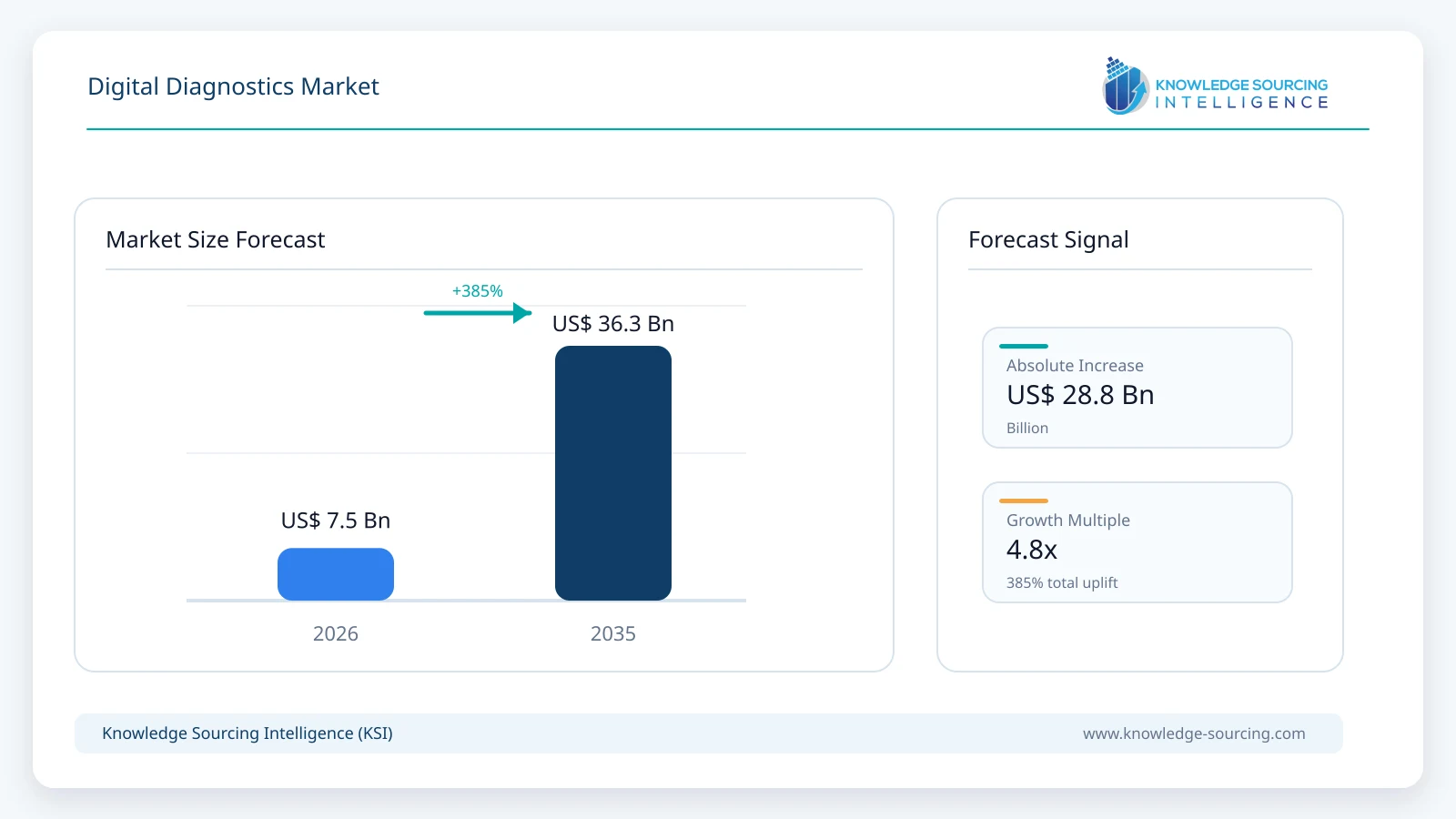
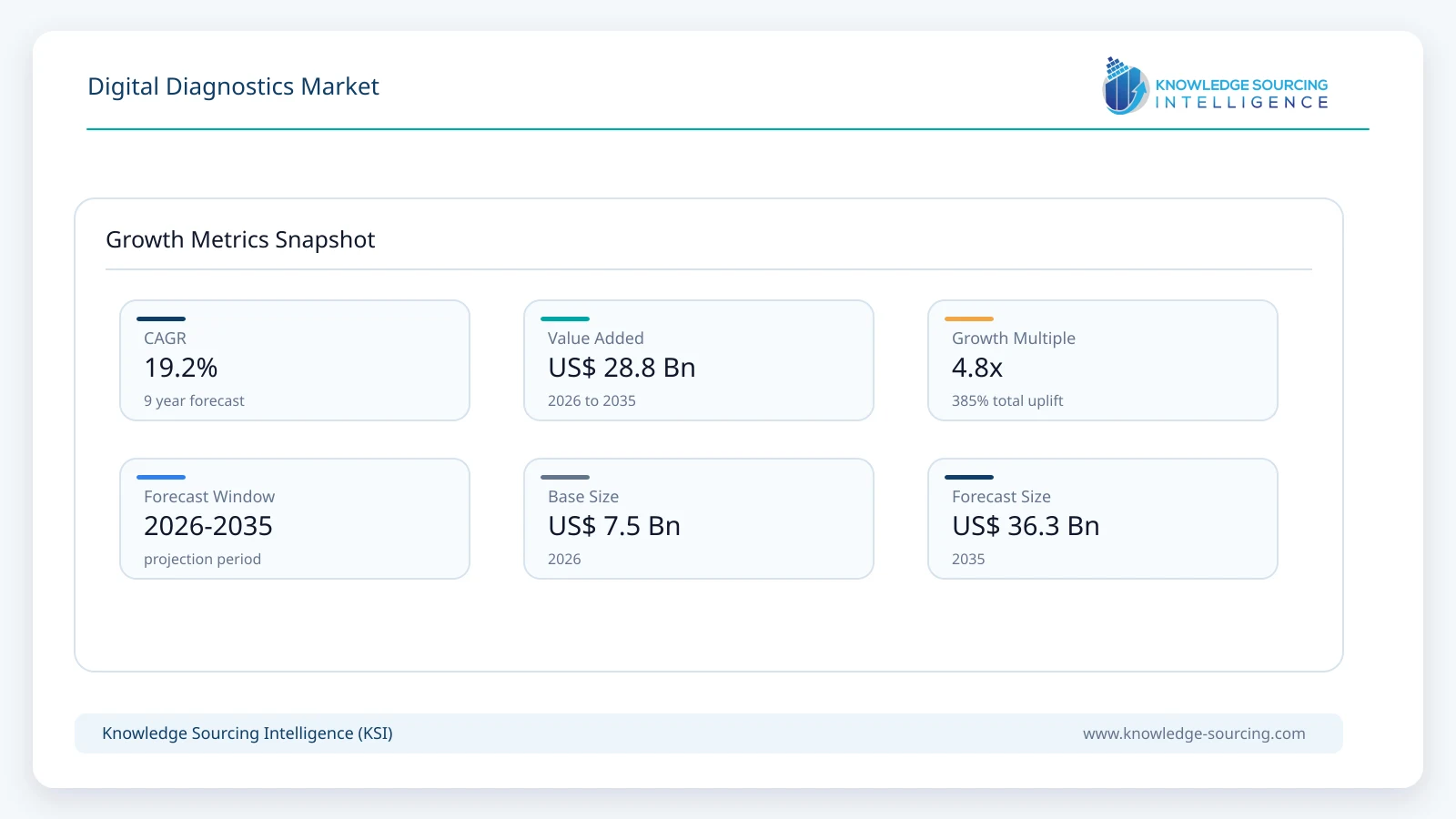
The Digital Diagnostics Market is forecast to grow at a CAGR of 19.2%, reaching USD 36.27 billion in 2035 from USD 7.48 billion in 2026.
Highlights:
- 1Rising chronic disease prevalence increases diagnostic workload, accelerating demand for AI-assisted clinical interpretation and workflow automation.
- 2Healthcare providers are adopting integrated digital diagnostic platforms because interoperable systems improve operational efficiency and multidisciplinary collaboration.
- 3Regulatory agencies are expanding guidance for AI-enabled medical devices, encouraging continuous software validation and lifecycle monitoring.
- 4Digital pathology adoption is increasing because remote consultation and computational pathology improve specialist accessibility.
Digital diagnostics encompasses connected diagnostic technologies that digitally acquire, process, analyze, interpret, and communicate clinical information across healthcare settings. The market includes AI-assisted imaging platforms, digital pathology systems, electrodiagnostic solutions, cloud-enabled radiology platforms, and integrated diagnostic software that support evidence-based clinical decision-making.
Healthcare delivery increasingly depends on rapid diagnostic interpretation because patient volumes continue to rise while specialist availability remains constrained. Diagnostic workflows are becoming more data-intensive as multimodal imaging, molecular diagnostics, wearable devices, and electronic health records generate expanding volumes of clinical information. This complexity increases demand for intelligent software capable of prioritizing findings, automating repetitive tasks, and supporting physician interpretation without replacing clinical judgment.
Government digital health initiatives, reimbursement modernization, interoperability standards, and artificial intelligence regulations are influencing procurement strategies across hospitals and diagnostic laboratories. Healthcare organizations increasingly evaluate vendors based on software scalability, cybersecurity compliance, interoperability, regulatory approvals, and clinical validation rather than hardware specifications alone. These purchasing priorities are strengthening long-term investment in enterprise-wide digital diagnostic infrastructure.
Digital diagnostics also supports pharmaceutical research, companion diagnostics, decentralized clinical trials, and personalized medicine by improving biomarker identification and longitudinal patient monitoring. The technology therefore occupies a strategically important position across both healthcare delivery and life sciences innovation.
Market Dynamics
Market Drivers
Increasing Adoption of Artificial Intelligence in Clinical Decision Support: Artificial intelligence enhances diagnostic consistency by rapidly analyzing complex clinical datasets that exceed manual interpretation capacity. Healthcare providers are increasingly integrating AI-assisted imaging, pathology, and radiology solutions because growing patient volumes are creating sustained pressure on specialist availability. This workforce constraint increases demand for automated prioritization, lesion detection, and quantitative image analysis that reduce reporting time while maintaining diagnostic quality. Technology developers are expanding clinically validated algorithms across multiple disease areas, allowing hospitals to standardize diagnostic workflows without proportionally increasing staffing levels.
Expansion of Digital Healthcare Infrastructure and Interoperability: Digital diagnostics depends on connected healthcare ecosystems that enable seamless exchange of imaging, laboratory, pathology, and clinical information. National healthcare systems are continuing to invest in interoperable digital infrastructure because fragmented clinical data limits diagnostic efficiency and coordinated patient management. Inconsistent information sharing delays treatment decisions, particularly for complex diseases requiring multidisciplinary care. Healthcare providers are implementing cloud-enabled diagnostic platforms, standardized imaging archives, and interoperable electronic health record integration to improve accessibility across distributed care networks. This infrastructure expansion increases demand for enterprise-wide digital diagnostic solutions capable of supporting collaborative clinical decision-making.
Rising Burden of Chronic and Complex Diseases: Chronic diseases require continuous monitoring, repeated diagnostic assessments, and multidisciplinary evaluation throughout the patient care pathway. Healthcare systems are experiencing increasing demand for advanced diagnostic technologies because cancer, cardiovascular diseases, neurological disorders, and metabolic conditions continue to require earlier detection and precision-guided treatment. Higher diagnostic complexity increases dependence on multimodal digital platforms capable of integrating imaging, pathology, laboratory, and clinical information within unified workflows. Diagnostic technology companies are responding through AI-enabled analytics, quantitative imaging, and computational pathology that improve clinical confidence across multiple specialties.
Growing Adoption of Precision Medicine and Biomarker-Based Diagnostics: Precision medicine relies on accurate diagnostic information to match patients with targeted therapeutic interventions. Healthcare providers are increasingly incorporating digital pathology, molecular diagnostics, and AI-assisted image analysis because personalized treatment strategies require comprehensive characterization of disease biology. Traditional diagnostic workflows often limit efficient biomarker interpretation across expanding therapeutic indications. Diagnostic manufacturers are integrating computational pathology, genomic analysis, and digital imaging into unified clinical platforms that support biomarker identification and treatment selection.
Market Restraints
High implementation costs, including digital infrastructure upgrades, software integration, cybersecurity investment, and workforce training, limit adoption among resource-constrained healthcare providers.
Regulatory requirements for AI-enabled medical devices continue evolving, creating extended validation timelines, post-market monitoring obligations, and uncertainty regarding continuously learning algorithms.
Interoperability challenges among legacy hospital information systems, imaging archives, laboratory platforms, and electronic health records reduce the efficiency of enterprise-wide digital diagnostic deployment.
Market Opportunities
Expansion of AI-Enabled Digital Pathology Across Clinical Practice: Digital pathology strengthens diagnostic collaboration by enabling high-resolution slide digitization, computational image analysis, and remote specialist consultation. Healthcare organizations are increasingly digitizing pathology laboratories because cancer incidence and precision medicine programs are creating greater demand for standardized tissue evaluation. Conventional microscopy limits workflow scalability across geographically distributed healthcare networks, particularly where pathology expertise remains scarce. Technology developers are integrating artificial intelligence with whole-slide imaging, biomarker quantification, and cloud-based pathology platforms to improve diagnostic consistency and multidisciplinary collaboration.
Growing Integration of Digital Diagnostics with Precision Oncology: Precision oncology depends on comprehensive diagnostic information that combines imaging, pathology, molecular profiling, and clinical decision support. Healthcare providers are expanding integrated diagnostic workflows because targeted therapies require increasingly complex biomarker identification before treatment selection. Fragmented diagnostic pathways prolong clinical decision-making and reduce treatment efficiency. Diagnostic companies are developing platforms that combine artificial intelligence, digital pathology, genomic interpretation, and companion diagnostic support within unified clinical environments. This integration creates significant opportunities for vendors capable of supporting oncology care from early detection through therapy monitoring.
Increasing Adoption of Cloud-Based Diagnostic Platforms: Cloud-enabled diagnostics improves accessibility by allowing healthcare providers to securely share diagnostic data across hospitals, laboratories, and specialist networks. Health systems are modernizing diagnostic infrastructure because distributed healthcare delivery requires rapid access to imaging, pathology, and laboratory information regardless of physical location. Local data storage and fragmented information systems increase operational complexity while limiting collaborative care. Technology providers are expanding secure cloud architectures with integrated cybersecurity, interoperability, and artificial intelligence capabilities that support enterprise-wide diagnostic workflows.
Expansion of Digital Diagnostics in Emerging Healthcare Systems: Emerging economies increasingly recognize digital diagnostics as an essential component of healthcare modernization. Governments are investing in national digital health strategies because expanding healthcare access requires scalable diagnostic capacity despite specialist shortages. Conventional diagnostic infrastructure often cannot support growing patient populations or geographically dispersed care delivery. Medical technology companies are introducing cloud-enabled, AI-assisted, and portable digital diagnostic solutions that reduce infrastructure dependency while improving diagnostic accessibility.
Disease & Epidemiology Analysis
Digital diagnostics is experiencing sustained demand because the global burden of chronic, infectious, neurological, and age-related diseases continues increasing across healthcare systems. Cancer remains one of the largest drivers of digital pathology, radiology, and molecular diagnostic adoption since accurate disease characterization increasingly determines targeted treatment selection. Cardiovascular diseases continue to require advanced imaging, electrodiagnostic systems, and AI-assisted risk stratification because early diagnosis significantly influences patient outcomes. Neurological disorders are increasing demand for digital neuroimaging and electrodiagnostic technologies as aging populations expand worldwide. These disease trends strengthen long-term investment in intelligent diagnostic platforms capable of supporting multidisciplinary clinical decision-making.
Infectious diseases continue influencing digital diagnostics because healthcare providers require rapid identification, surveillance, and treatment monitoring during both endemic and outbreak conditions. Respiratory infections, antimicrobial resistance, and emerging pathogens are increasing demand for connected laboratory diagnostics integrated with digital reporting systems. Traditional diagnostic workflows often delay public health responses when large testing volumes require rapid interpretation and coordinated reporting. Healthcare organizations are implementing AI-assisted laboratory analytics and cloud-enabled diagnostic platforms that improve surveillance while supporting timely clinical intervention. This evolution broadens digital diagnostics beyond hospital-based care into national disease monitoring and public health preparedness.
Metabolic disorders, ophthalmic diseases, and chronic respiratory conditions are expanding the role of continuous digital diagnostics because long-term disease management increasingly depends on repeated clinical assessment. Healthcare providers are integrating digital imaging, AI-enabled screening, and remote diagnostic technologies into chronic disease management pathways that improve early intervention and treatment monitoring. The growing prevalence of multimorbidity increases dependence on interoperable diagnostic ecosystems capable of combining imaging, laboratory, physiological, and clinical information within a unified patient record.
Treatment Guidelines Landscape
Disease Area | Major Guideline Organization | Diagnostic Focus | Role of Digital Diagnostics |
Oncology | NCCN, ESMO, ASCO | Imaging, pathology, molecular biomarker testing | AI-assisted imaging, digital pathology, companion diagnostics, computational pathology |
Cardiology | American Heart Association (AHA), European Society of Cardiology (ESC) | ECG, echocardiography, cardiac imaging | AI-enabled ECG interpretation, digital imaging analytics, remote cardiac diagnostics |
Neurology | American Academy of Neurology (AAN), European Academy of Neurology (EAN) | MRI, CT, EEG, neurophysiology | AI-supported neuroimaging, digital electrodiagnostic systems |
Infectious Diseases | WHO, IDSA | Laboratory diagnostics, molecular testing | Digital laboratory reporting, AI-assisted interpretation, surveillance platforms |
Market Segmentation
By Diagnostic Modality
Digital imaging diagnostics forms the largest technological foundation within the market because it supports disease detection across oncology, cardiology, neurology, respiratory disorders, and emergency medicine. Healthcare providers are increasingly integrating artificial intelligence into imaging workflows because growing examination volumes are creating sustained pressure on radiologists and imaging specialists. Manual image interpretation limits reporting efficiency as multimodal imaging datasets continue expanding in size and complexity. Technology developers are incorporating automated lesion detection, image reconstruction, quantitative measurements, and workflow prioritization into enterprise imaging platforms that improve diagnostic consistency. This evolution positions digital imaging diagnostics as the primary driver of digital transformation across modern diagnostic services.
By Clinical Application
Oncology represents the leading clinical application because cancer management increasingly depends on accurate imaging, pathology, molecular profiling, and biomarker identification. Healthcare systems are expanding investment in integrated digital diagnostics because precision oncology requires comprehensive evaluation before targeted therapy selection. Conventional diagnostic pathways often delay multidisciplinary treatment planning when imaging, pathology, and laboratory information remain fragmented across healthcare departments. Diagnostic companies are developing interoperable platforms that combine digital pathology, AI-assisted radiology, molecular diagnostics, and clinical decision support within unified oncology workflows. This integration strengthens personalized cancer care while improving treatment planning, disease monitoring, and clinical research capabilities.
By End User
Hospitals account for the largest end-user segment because they perform the majority of complex diagnostic procedures requiring multidisciplinary clinical coordination. Healthcare institutions are modernizing diagnostic infrastructure because rising patient volumes and specialist shortages demand greater workflow efficiency without compromising diagnostic quality. Legacy information systems frequently reduce operational effectiveness by limiting interoperability among imaging, pathology, laboratory, and electronic health record platforms. Hospitals are implementing enterprise-wide digital diagnostic ecosystems that integrate artificial intelligence, cloud connectivity, and centralized data management across multiple clinical departments. This modernization strengthens diagnostic accuracy, resource utilization, and coordinated patient care throughout integrated healthcare networks.
Regional Analysis
North America Market Analysis
North America maintains the largest share of the digital diagnostics market because the region combines advanced healthcare infrastructure, high digital health investment, and strong regulatory support for innovative medical technologies. Healthcare providers are increasingly deploying enterprise-wide digital diagnostic platforms because growing imaging volumes, aging populations, and workforce shortages are increasing operational pressure across hospitals and diagnostic laboratories. The widespread burden of chronic diseases increases demand for AI-assisted imaging, digital pathology, and integrated clinical decision support capable of improving diagnostic efficiency without reducing clinical accuracy. Technology vendors continue investing in cloud-enabled interoperability, cybersecurity, and software-as-a-medical-device capabilities that align with evolving regulatory expectations. The United States remains the primary innovation center due to extensive adoption of artificial intelligence in radiology, pathology, cardiovascular diagnostics, and oncology.
Europe Market Analysis
Europe represents a mature digital diagnostics market because its healthcare systems emphasize standardized clinical quality, interoperability, and evidence-based technology adoption. Healthcare providers are increasingly implementing AI-enabled diagnostic solutions as national digital health strategies and workforce shortages are accelerating demand for workflow automation across radiology, pathology, and laboratory medicine. Fragmented legacy infrastructure continues to limit seamless data exchange across healthcare institutions, creating demand for enterprise platforms that integrate imaging, laboratory information systems, and electronic health records within unified clinical environments. The European Union is strengthening the regulatory framework for software-enabled diagnostics through the Medical Device Regulation (MDR), In Vitro Diagnostic Regulation (IVDR), the European Health Data Space (EHDS), and the AI Act, encouraging manufacturers to invest in algorithm transparency, cybersecurity, and continuous clinical validation. Germany, France, the United Kingdom, Italy, Spain, and the Nordic countries remain major adopters because they continue expanding digital hospital infrastructure and precision medicine initiatives.
Asia Pacific Market Analysis
Asia Pacific is experiencing the fastest structural transformation because governments, healthcare providers, and technology companies are expanding digital healthcare infrastructure to address rapidly growing diagnostic demand. Rising urbanization, increasing chronic disease prevalence, aging populations, and improving healthcare accessibility are driving investment in AI-assisted imaging, digital pathology, and connected diagnostic systems. Healthcare systems continue facing shortages of radiologists and pathologists, increasing dependence on intelligent workflow automation capable of improving diagnostic capacity without proportionate workforce expansion. China is accelerating adoption through large-scale AI healthcare initiatives and domestic medical technology innovation, while Japan continues integrating digital diagnostics into aging-care strategies and precision medicine programs. India is expanding digital health infrastructure through nationwide digital health initiatives that encourage interoperability and electronic health record adoption.
Rest of the World
The Rest of the World region is gradually strengthening its digital diagnostics capabilities because healthcare modernization programs increasingly prioritize technology-enabled disease detection and specialist accessibility. Healthcare providers are adopting connected diagnostic solutions as governments invest in digital transformation initiatives that improve healthcare delivery across geographically dispersed populations. Limited specialist availability and uneven healthcare infrastructure continue constraining diagnostic capacity in many countries, increasing demand for cloud-enabled imaging platforms, telepathology, and AI-supported clinical decision support. Countries in the Middle East are expanding smart hospital projects and national digital health strategies, particularly across the Gulf Cooperation Council, where healthcare diversification initiatives encourage adoption of advanced diagnostic technologies. Latin American healthcare systems are increasing investments in hospital digitization and laboratory modernization to improve operational efficiency and patient outcomes despite resource limitations.
Regulatory Landscape
Digital diagnostics operates within an increasingly structured regulatory environment because software algorithms, artificial intelligence, and cloud-connected medical devices directly influence clinical decision-making. Regulatory agencies require manufacturers to demonstrate analytical validity, clinical performance, cybersecurity resilience, and lifecycle quality management before market authorization. As software functionality expands through continuous updates and machine learning capabilities, regulators are emphasizing post-market surveillance, algorithm transparency, and real-world performance monitoring alongside traditional premarket evaluation. These requirements are increasing development complexity while strengthening long-term confidence in clinically validated digital diagnostic technologies.
The U.S. Food and Drug Administration continues regulating Software as a Medical Device (SaMD) and AI-enabled diagnostic technologies through risk-based evaluation frameworks that address safety, effectiveness, and software lifecycle management. Within Europe, implementation of the Medical Device Regulation (MDR) and In Vitro Diagnostic Regulation (IVDR) is increasing evidence requirements for digital diagnostic manufacturers while improving harmonization across member states. Regulatory authorities throughout Asia-Pacific, including Japan's PMDA and China's NMPA, are also expanding dedicated review pathways for AI-enabled healthcare technologies, reflecting increasing adoption across regional healthcare systems.
Healthcare providers and technology developers are responding by incorporating regulatory planning into product development from the earliest design stages. Manufacturers are strengthening clinical validation programs, explainable AI capabilities, cybersecurity controls, interoperability standards, and post-market evidence generation because these factors increasingly influence procurement decisions as well as regulatory approvals. This evolution is shifting competitive differentiation from standalone technological performance toward long-term regulatory compliance and demonstrable clinical value.
Pipeline Analysis
Digital diagnostics pipelines are increasingly concentrating on software-driven innovation rather than standalone hardware development because healthcare providers require faster interpretation, improved workflow efficiency, and precision-guided clinical decision-making. Developers are expanding artificial intelligence algorithms across imaging, pathology, molecular diagnostics, and electrodiagnostic applications as diagnostic complexity continues increasing across oncology, cardiovascular diseases, neurology, and infectious diseases. Traditional image acquisition technologies are approaching technical maturity, encouraging sponsors to differentiate through automated lesion detection, predictive analytics, quantitative imaging, and integrated clinical decision-support platforms. This shift positions software and data intelligence as the primary drivers of future competitive advantage.
One of the strongest areas of pipeline activity is AI-assisted oncology diagnostics. Companies are developing algorithms capable of detecting subtle imaging abnormalities, quantifying tumor burden, predicting treatment response, and supporting biomarker identification from both radiological images and digitized pathology slides. Computational pathology platforms are increasingly combining whole-slide imaging with deep learning models that evaluate tissue architecture, cellular morphology, and immunohistochemistry patterns. Sponsors are simultaneously integrating radiomics, genomics, and pathology data into multimodal diagnostic platforms that strengthen personalized treatment planning.
Pipeline expansion is also occurring across cardiovascular and neurological diagnostics. AI-enabled electrocardiography, echocardiography, brain imaging, and electrodiagnostic interpretation platforms are progressing through prospective validation studies that compare algorithm performance with specialist interpretation. Technology developers are emphasizing explainable artificial intelligence, continuous software monitoring, and real-world evidence generation because regulators increasingly require transparency for adaptive machine-learning systems.
Reimbursement Landscape
Reimbursement remains a major determinant of digital diagnostics adoption because healthcare providers prioritize technologies that demonstrate measurable clinical and economic value. Public and private payers are increasingly evaluating digital diagnostic solutions based on improvements in diagnostic accuracy, workflow efficiency, patient outcomes, and overall healthcare resource utilization. Technologies that reduce unnecessary procedures, shorten reporting time, or enable earlier disease detection are receiving greater attention as healthcare systems continue transitioning toward value-based care models. This reimbursement environment encourages manufacturers to generate health economic evidence alongside traditional clinical validation.
Coverage policies for AI-enabled diagnostic software continue evolving across major healthcare markets. In the United States, reimbursement pathways increasingly recognize software-supported diagnostic services when they demonstrate clinically meaningful improvements and comply with applicable coding and payment requirements. European healthcare systems generally evaluate digital diagnostics through national health technology assessment frameworks that consider cost-effectiveness, clinical utility, and long-term healthcare benefits before widespread reimbursement adoption. Several Asia-Pacific countries are gradually incorporating digital diagnostic technologies into reimbursement systems as national digital health programs expand and healthcare modernization initiatives progress.
Competitive Landscape
Siemens Healthineers AG
Siemens Healthineers differentiates itself through one of the industry's most comprehensive digital diagnostics ecosystems, combining advanced imaging, laboratory diagnostics, artificial intelligence, digital pathology, and enterprise healthcare IT within an integrated platform. The company is strengthening its competitive position by embedding AI capabilities across radiology, oncology, cardiovascular imaging, and clinical workflow management rather than positioning artificial intelligence as a standalone product.
GE HealthCare Technologies Inc.
GE HealthCare maintains strategic differentiation through its integrated portfolio of diagnostic imaging systems, AI-enabled workflow software, cloud-based healthcare platforms, and digital clinical applications. The company is expanding intelligent imaging capabilities across radiology, cardiology, and oncology because healthcare providers increasingly require faster interpretation and standardized reporting.
Koninklijke Philips N.V.
Philips distinguishes itself through an integrated health technology strategy that combines diagnostic imaging, connected care, cloud informatics, and artificial intelligence into unified clinical workflows. The company is increasingly focusing on interoperability because healthcare organizations require seamless integration between imaging systems, patient monitoring platforms, and electronic health records.
Roche Diagnostics
Roche Diagnostics maintains a strong competitive advantage by integrating molecular diagnostics, digital pathology, companion diagnostics, and precision medicine capabilities within a unified oncology-focused strategy. The company is expanding computational pathology and biomarker interpretation platforms because targeted therapies increasingly depend on accurate molecular characterization.
Abbott Laboratories
Abbott Laboratories differentiates itself through a diversified diagnostics portfolio spanning laboratory diagnostics, point-of-care testing, cardiovascular diagnostics, molecular diagnostics, and connected digital health solutions. The company is expanding digital connectivity across diagnostic platforms because healthcare providers increasingly require continuous access to diagnostic information within integrated clinical workflows.
QIAGEN N.V.
QIAGEN strategically differentiates itself through expertise in molecular diagnostics, bioinformatics, genomic analysis, and digital interpretation platforms that support precision medicine. The company is increasingly integrating software-driven analytics with molecular testing because genomic data interpretation is becoming essential for personalized healthcare.
Key Developments
March 2026: Philips introduced its cloud-enabled IntelliSite Pathology Solution on HealthSuite, powered by Amazon Web Services. The platform is designed to help pathology laboratories scale digital workflows, securely manage high-resolution images, support remote collaboration, and integrate AI across diagnostic operations.
March 2025: NVIDIA highlighted Digital Diagnostics’ autonomous AI technology during its GTC 2025 keynote. The showcase featured LumineticsCore, an FDA-cleared autonomous system for detecting diabetic retinopathy and delivering real-time diagnostic results.
Strategic Insights and Future Market Outlook
Digital diagnostics is evolving from isolated diagnostic technologies into integrated clinical intelligence platforms that connect imaging, pathology, molecular diagnostics, laboratory medicine, and healthcare information systems. Healthcare providers are increasingly investing in enterprise-wide diagnostic ecosystems because growing patient volumes, chronic disease prevalence, and workforce shortages require greater automation without compromising clinical quality. This transformation is increasing demand for interoperable software, cloud connectivity, explainable artificial intelligence, and continuous clinical validation. Companies capable of combining these capabilities within scalable healthcare platforms are expected to strengthen their competitive positions throughout the forecast period.
Artificial intelligence is becoming the primary innovation driver because future competitive differentiation increasingly depends on software performance rather than imaging hardware alone. Technology developers are expanding multimodal diagnostic platforms that integrate radiology, digital pathology, genomic analysis, and clinical decision support into unified workflows supporting precision medicine. Regulatory agencies are simultaneously strengthening oversight of adaptive algorithms, encouraging manufacturers to invest in transparent AI, cybersecurity, post-market surveillance, and real-world evidence generation. These regulatory expectations are raising development standards while improving long-term market confidence.
Healthcare systems are expected to continue prioritizing diagnostic technologies that improve productivity, reduce reporting variability, and enable earlier disease detection across oncology, cardiovascular diseases, neurology, infectious diseases, and chronic disease management. Strategic partnerships between medical technology companies, software developers, healthcare providers, and pharmaceutical organizations are likely to accelerate commercialization of next-generation digital diagnostics while expanding their role in personalized healthcare and value-based care delivery.
Digital diagnostics remains one of the most strategically important segments of healthcare technology because it directly influences diagnostic accuracy, treatment selection, operational efficiency, and long-term patient outcomes. As healthcare delivery continues transitioning toward connected, data-driven clinical ecosystems, digital diagnostic platforms are expected to become an essential foundation for precision medicine, integrated care, and future healthcare innovation.
Digital Diagnostics Market Scope:
| Report Metric | Details |
|---|---|
| Total Market Size in 2026 | USD 7.48 billion |
| Total Market Size in 2035 | USD 36.27 billion |
| Forecast Unit | USD Billion |
| Growth Rate | 19.2% |
| Study Period | 2021 to 2035 |
| Historical Data | 2021 to 2024 |
| Base Year | 2025 |
| Forecast Period | 2026 – 2035 |
| Segmentation | Component, Technology, Diagnostic Modality, Application, End User, Geography |
| Companies |
|
Market Segmentation
Component
Technology
Diagnostic Modality, Application, End User
Geography
- North America
- South America
- Europe
- Middle East and Africa
- Asia Pacific
Table of Contents
1. EXECUTIVE SUMMARY
1.1 Market Snapshot
1.2 Key Findings
1.3 Analyst Insights
1.4 Strategic Recommendations
2. RESEARCH METHODOLOGY
2.1 Research Design
2.2 Data Collection Methodology
2.3 Market Size Estimation
2.4 Forecasting Model
2.5 Assumptions & Limitations
3. GLOBAL DIGITAL DIAGNOSTICS MARKET OVERVIEW, SIZE & FORECAST
3.1 Market Definition & Scope
3.2 Industry Overview
3.3 Industry Evolution
3.4 Key Market Trends
3.5 Historical Market Size Analysis (2021–2025)
3.6 Market Forecast (2026–2035)
3.7 Digital Diagnostics Ecosystem
3.8 Diagnostic Workflow Transformation
3.9 Disease Burden & Clinical Need Assessment
3.10 Adoption of AI-Enabled Clinical Decision Support
3.11 Digital Diagnostics Utilization Across Care Settings
4. MARKET DYNAMICS
4.1 Market Drivers
4.2 Market Restraints
4.3 Market Opportunities
4.4 Market Challenges
5. INDUSTRY LANDSCAPE
5.1 Industry Value Chain Analysis
5.2 Pricing Analysis
5.3 Reimbursement Landscape
6. INNOVATION LANDSCAPE
6.1 Emerging Technologies
6.2 Artificial Intelligence & Machine Learning Integration
6.3 Digital Biomarker Development
6.4 Product Innovation
6.5 Diagnostic Software & Algorithm Development Pipeline
6.6 Clinical Validation & Performance Evaluation Trends
6.7 Cloud, Edge Computing & Connectivity Roadmap
6.8 Digital Health Integration
7. REGULATORY LANDSCAPE
7.1 Regulatory Framework
7.2 Approval Pathways
7.3 Compliance Requirements
8. GLOBAL DIGITAL DIAGNOSTICS MARKET LANDSCAPE ANALYSIS
8.1 Analysis by Technology Platform
8.2 Analysis by Diagnostic Modality
8.3 Analysis by Deployment Model
8.4 Analysis by Clinical Application
8.5 Analysis by End-user Environment
8.6 Analysis by Level of Artificial Intelligence Integration
8.7 Analysis by Data Source
9. GLOBAL DIGITAL DIAGNOSTICS MARKET SEGMENT ANALYSIS (2021–2035)
9.1 By Component
9.1.1 Software
9.1.2 Hardware
9.1.3 Services
9.2 By Technology
9.2.1 Artificial Intelligence
9.2.2 Machine Learning
9.2.3 Deep Learning
9.2.4 Computer Vision
9.2.5 Natural Language Processing
9.2.6 Cloud Computing
9.2.7 Others
9.3 By Diagnostic Modality
9.3.1 Digital Imaging Diagnostics
9.3.2 Digital Pathology
9.3.3 Digital Radiology
9.3.4 Electrodiagnostic Systems
9.3.5 Others
9.4 By Application
9.4.1 Oncology
9.4.2 Cardiology
9.4.3 Neurology
9.4.4 Infectious Diseases
9.4.5 Respiratory Diseases
9.4.6 Endocrinology & Metabolic Disorders
9.4.7 Ophthalmology
9.4.8 Others
9.5 By End User
9.5.1 Hospitals
9.5.2 Diagnostic Laboratories
9.5.3 Academic & Research Institutes
9.5.4 Others
10. GLOBAL DIGITAL DIAGNOSTICS MARKET GEOGRAPHICAL ANALYSIS (2021–2035)
10.1 North America
10.2 Europe
10.3 Asia-Pacific
10.4 South America
10.5 Middle East & Africa
11. GLOBAL DIGITAL DIAGNOSTICS MARKET COUNTRY ANALYSIS (2021–2035)
11.1 United States
11.2 Canada
11.3 Germany
11.4 United Kingdom
11.5 France
11.6 Italy
11.7 Spain
11.8 Japan
11.9 China
11.10 India
11.11 South Korea
11.12 Australia
11.13 Brazil
11.14 Mexico
11.15 Saudi Arabia
11.16 United Arab Emirates
12. COMPETITIVE LANDSCAPE
12.1 Market Share Analysis
12.2 Strategic Developments
12.3 Mergers & Acquisitions, Partnerships & Collaborations
12.4 Product Launches
13. COMPANY PROFILES
13.1 Siemens Healthineers AG
13.1.1 Company Overview
13.1.2 Financials
13.1.3 Product Portfolio
13.1.4 Recent Developments
13.2 GE HealthCare Technologies Inc.
13.3 Koninklijke Philips N.V.
13.4 Roche Diagnostics
13.5 Abbott Laboratories
13.6 QIAGEN N.V.
13.7 Danaher Corporation
13.8 Fujifilm Holdings Corporation
13.9 Aidoc Medical Ltd.
13.10 Canon Inc.
14. GLOBAL DIGITAL DIAGNOSTICS MARKET COMMERCIAL FORECAST ANALYSIS
14.1 Digital Imaging Diagnostics
14.2 AI-Based Radiology Software
14.3 Digital Pathology Platforms
14.4 AI-Based Pathology Software
14.5 Clinical Decision Support Systems
14.6 Remote Diagnostic Platforms
14.7 Wearable Diagnostic Solutions
14.8 Digital Biomarker-Based Diagnostic Solutions
15. INVESTMENT & FUNDING ANALYSIS
15.1 Venture Capital Trends
15.2 Government Funding
15.3 R&D Investments
16. FUTURE OUTLOOK
16.1 Key Growth Opportunities
16.2 Future Industry Trends
Navigate
Trusted by the world's leading organizations











