
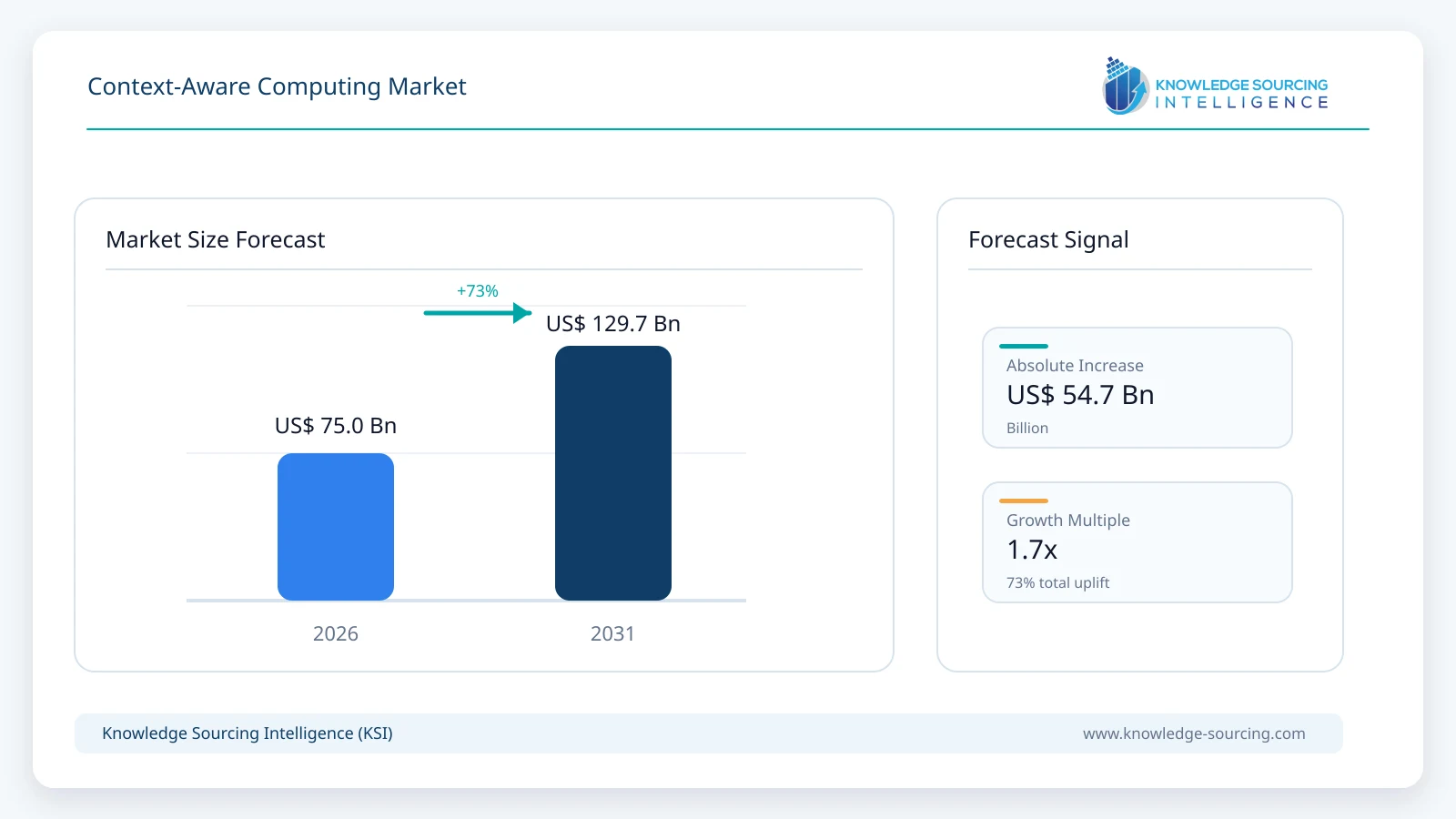
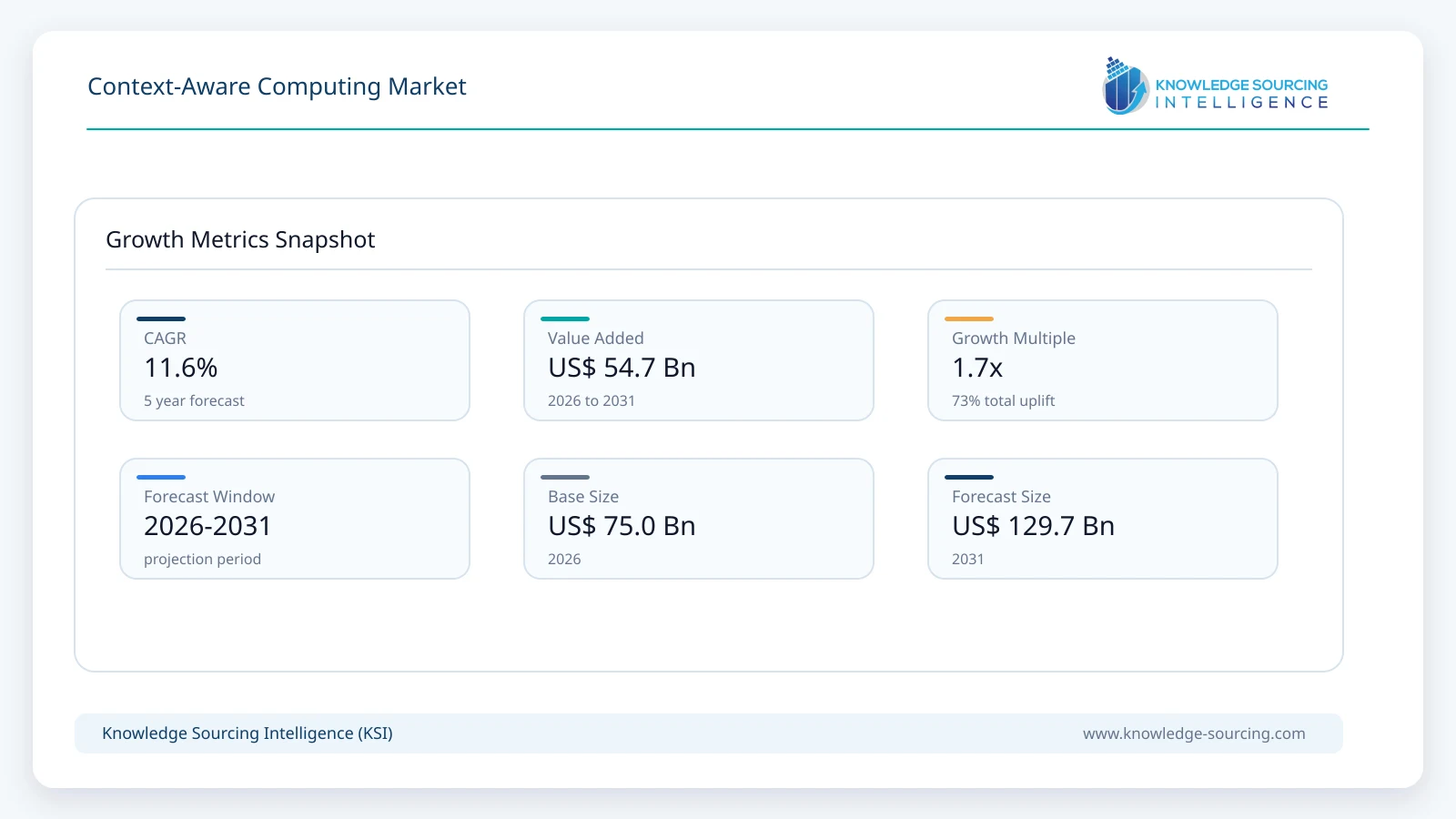
The Context-Aware Computing Market is forecast to grow at a CAGR of 11.6%, reaching USD 129.7 billion in 2031 from USD 75.0 billion in 2026.
Highlights:
- 1The proliferation of mobile and wearable devices, as well as the increased use of sensors and the Internet of Things are increasing the number and types of context signals available for context-aware, adaptive applications.
- 2As enterprise and consumer demand for personalized digital experiences grows in industries such as automotive, retail, and healthcare, context-awareness is being integrated directly into the core experience of a product, and not as an optional feature.
- 3The use of AI and Machine Learning models is being enhanced to better understand ambiguous multi-signal contextual data, leading to greater accuracy and commercial value of adaptive application behaviour.
Hardware, in the form of sensors, wearable devices, location tracking modules and edge processing units, accounts for the biggest share of the market, due to the significant amount of physical infrastructure needed to constantly collect the contextual signals that context-aware applications rely on.
Wireless connectivity is the biggest by technology segment, as it offers mobility and convenience to the smartphone, wearable and IoT-based context-aware applications. As per end-user, enterprises are the major contributors to the market spending due to the need for optimizing the operations based on contextual insights related to workforce management, supply-chain visibility, and personalizing customer experience, with consumer applications, particularly smart-home and wearable-technology applications, also making up a significant and growing share of total demand.
Shopping assistants, retail personalisation are one of the fastest-growing use cases being realised by retailers applying AI technology through contextual recommendation engines that boost customer engagement and incremental sales across mobile apps, in-store kiosks and wearable-device touchpoints. Time-context applications, applications that utilize temporal patterns to schedule optimisation, reminders and dynamic content delivery, are also one of the fastest-growing application categories, and there are growing applications in healthcare patient monitoring, smart-home energy management, and enterprise workflow automation.
Context-Aware Computing Market Key Market Highlights
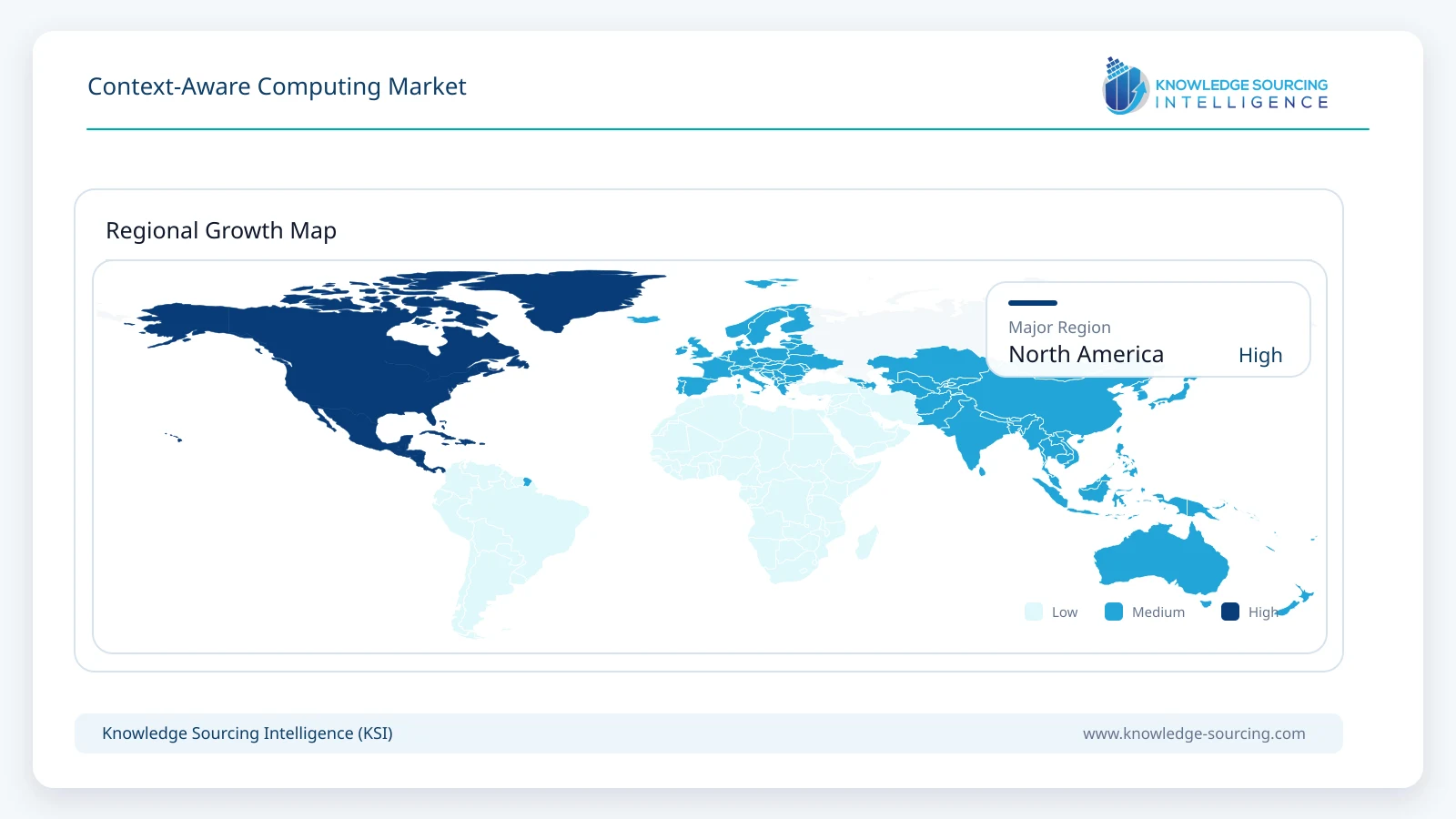
North America is the biggest region for the context-aware computing market as the technology and retail industry in the region have been early adopters of AI, machine learning, and IoT technologies.
The biggest category is hardware, which involves a significant amount of sensor, wearable-device and edge-processing hardware that must constantly collect and interpret contextual signals.
By connectivity type, wireless technology dominates the market, especially for smartphone, wearable and IoT-enabled context-aware applications' mobility and convenience.
For the market, the majority of spend comes from enterprises, which are looking for insights that can be used to optimise their operations, while smart-home and smart-wear applications driven by consumers, are a significant growth opportunity.
Retailers are increasingly implementing AI-driven, contextual recommendation engines on mobile, in-store and wearable devices, with shopping assistants and retail personalization apps among the most rapidly developing use cases.
Rapid smartphone and wearable-device penetration and growing investment in enterprise AI across Asia-Pacific's technology and manufacturing hotspots are making the area the fastest-growing.
Market Dynamics
Market Drivers
Market Restraints & Opportunities
A deep interdependency between the different device and data types, as well as the ongoing privacy and data security concerns around the collection of contextual signals, are still major factors in slowing the pace of contextual systems adoption.
However, data-driven personalization when done responsibly with clear privacy controls and consumer awareness and the proliferation of pre-made, industry-specific application templates that help with context understanding are opening significant opportunities for vendors who can make it easy for customers to deploy and meet legitimate privacy concerns.
Key Developments
August 2026: Seclore, the enterprise Data Security Intelligence company, announced an integration between ARMOR DSPM and Glean, the leading enterprise AI platform.
April 2026: Opsera announced the launch of Forge, the industry's first intent and context-aware Software Factory that transforms raw ideas into enterprise-ready code at AI speed.
March 2026: VDURA announced three major advances at NVIDIA GTC 2026, availability of Remote Direct Memory Access (RDMA) capability, the upcoming first phase of its Context-Aware Tiering technology planned by the end of 2026, and optimized infrastructure configurations for the VDURA Data Platform built on AMD EPYC Turin processors and NVIDIA ConnectX-7 high-speed networking adapters.
Market Segmentation
The market is segmented by component, technology, application, end-user, and geography.
By Component: Hardware
Market revenue for hardware is the largest, representing sensors, wearable devices, location tracking modules and edge processing units that are constantly capturing the contextual signals that underpin each context-aware application.
Apple Inc. has integrated ‘context-aware sensing & personalization’ into its device and wearable portfolio, encompassing both location and movement and health-related contextual data.
Qualcomm Incorporated provides chipsets and sensor-processing hardware to support context-aware functionality for smartphones, wearables and automotive devices.
By Technology: Wireless
With the rapid growth of the mobile and connected world, wireless connectivity is the largest technology share needed for context-aware applications to be ubiquitous across the range of smartphones, wearables, and distributed IoT sensor networks.
Cisco Systems, Inc. offers wireless networking infrastructure and solutions for location analytics and workforce optimization applications in the enterprise.
By End-User: Enterprises
Enterprises are the biggest end-user market due to the need to optimize operations with insights from context regarding staff management, supply chain visibility, and customer-experience personalization.
The IBM Corporation is a provider of context-aware analytics and artificial intelligence (AI) platform capabilities that are utilized by enterprise operational-optimization and customer-personalization applications.
Regional Analysis
North America Market Analysis
The region's retail, healthcare and automotive industries, as well as the prevalence of leading platform vendors, the early and deep integration of AI, machine learning and IoT in the region, and robust interest in context-aware computing, all have helped North America dominate the market.
Europe Market Analysis
The market in Europe is driven by robust data-privacy legislation that is driving adoption across automotive, retail and industrial applications and is fostering clear and consent-empowered context-aware architectures.
Asia-Pacific Market Analysis
Asia-Pacific is changing into the quickest rising area for context-aware computing, as it experiences a fast uptake of smart phones and wearables, plus the roll-out of 5G infrastructure and increasing enterprise investments in AI, particularly in China, Japan, South Korea and India.
Middle East and Africa Market Analysis
New investment opportunities are emerging in Middle East and Africa for the implementation of context-aware computing, as this technology is being integrated into smart cities and retail sector digitalization in the Gulf countries.
South America Market Analysis
South America is a developing market for context-aware computing, with both retail and telecom operators in Brazil beginning to use personalisation and location-based, contextual applications.
List of Companies
Apple Inc.
Cisco Systems, Inc.
Google LLC (Alphabet Inc.)
IBM Corporation
Intel Corporation
Microsoft Corporation
NVIDIA Corporation
Oracle Corporation
Qualcomm Incorporated
Samsung Electronics Co., Ltd.
Competitive Landscape
Apple Inc.
Apple embeds context-aware sensing and personalization capabilities deeply across its device and wearable ecosystem, using location, motion and health-related signals to power adaptive features across iPhone, Apple Watch and related products.
Google LLC (Alphabet Inc.)
Google integrates context-aware capabilities across its Android platform, Assistant and advertising ecosystem, leveraging location, search and behavioral signals to power personalized recommendations and adaptive application experiences.
Qualcomm Incorporated
Qualcomm supplies chipsets and on-device AI processing hardware that enable context-aware capabilities across smartphones, wearables and automotive applications, positioning the company as a foundational hardware enabler across the broader context-aware ecosystem.
Analyst View
The Context-Aware Computing market is maturing from a primarily consumer-facing personalization technology into a foundational enterprise capability, as organizations across retail, healthcare and automotive sectors embed contextual intelligence directly into core product and operational workflows. Hardware continues to anchor market revenue given the substantial sensor and connectivity infrastructure required for every deployment, while software and AI-driven interpretation capabilities are becoming the primary basis for competitive differentiation as the underlying hardware layer commoditizes. North America currently leads in adoption maturity and vendor concentration, while Asia-Pacific's rapid device penetration and expanding AI investment are positioning the region as the fastest-growing market over the forecast period. Vendors that can balance increasingly sophisticated, AI-driven personalization with transparent, privacy-respecting data practices are best positioned to capture enterprise and consumer trust as context-aware computing becomes an expected baseline of digital experience rather than a differentiating feature.
Context-Aware Computing Market Scope:
| Report Metric | Details |
|---|---|
| Total Market Size in 2026 | USD 75.0 billion |
| Total Market Size in 2031 | USD 129.7 billion |
| Forecast Unit | USD Billion |
| Growth Rate | 11.6% |
| Study Period | 2021 to 2031 |
| Historical Data | 2021 to 2024 |
| Base Year | 2025 |
| Forecast Period | 2026 – 2031 |
| Segmentation | Component, Technology, Application, Geography |
| Companies |
|
Market Segmentation
By Component
Hardware
Software
Services
By Technology
Wireless
Wired
By Application
Shopping Assistants & Retail Personalization
Time-Context Applications
Location-Based Services
Smart Homes & Wearables
Others
By Geography
North America
USA
Canada
Mexico
South America
Brazil
Others
Europe
Germany
France
United Kingdom
Others
Middle East and Africa
UAE
Saudi Arabia
Others
Asia Pacific
China
India
Japan
Others
Table of Contents
1. EXECUTIVE SUMMARY
2. MARKET SNAPSHOT
2.1. Market Overview
2.2. Market Definition
2.3. Scope of the Study
2.4. Market Segmentation
3. BUSINESS LANDSCAPE
3.1. Market Drivers
3.2. Market Restraints
3.3. Market Opportunities
3.4. Porter's Five Forces Analysis
3.5. Industry Value Chain Analysis
3.6. Policies and Regulations (Data Privacy & Consent)
3.7. Strategic Recommendations
4. TECHNOLOGICAL OUTLOOK
4.1. AI & Machine Learning for Context Interpretation
4.2. Sensor Fusion & Edge Processing
4.3. Generative & Agentic AI Personalization
4.4. Privacy-Preserving Context Architectures
5. CONTEXT-AWARE COMPUTING MARKET BY COMPONENT
5.1. Introduction
5.2. Hardware
5.3. Software
5.4. Services
6. CONTEXT-AWARE COMPUTING MARKET BY TECHNOLOGY
6.1. Introduction
6.2. Wireless
6.3. Wired
7. CONTEXT-AWARE COMPUTING MARKET BY APPLICATION
7.1. Introduction
7.2. Shopping Assistants & Retail Personalization
7.3. Time-Context Applications
7.4. Location-Based Services
7.5. Smart Homes & Wearables
7.6. Others
8. CONTEXT-AWARE COMPUTING MARKET BY GEOGRAPHY
8.1. Introduction
8.2. North America
8.2.1. USA
8.2.2. Canada
8.2.3. Mexico
8.3. South America
8.3.1. Brazil
8.3.2. Others
8.4. Europe
8.4.1. Germany
8.4.2. France
8.4.3. United Kingdom
8.4.4. Others
8.5. Middle East and Africa
8.5.1. UAE
8.5.2. Saudi Arabia
8.5.3. Others
8.6. Asia Pacific
8.6.1. China
8.6.2. India
8.6.3. Japan
8.6.4. Others
9. COMPETITIVE ENVIRONMENT AND ANALYSIS
9.1. Major Players and Strategy Analysis
9.2. Market Share Analysis
9.3. Mergers, Acquisitions, Agreements, and Collaborations
9.4. Competitive Dashboard
10. COMPANY PROFILES
10.1. Apple Inc.
10.2. Cisco Systems, Inc.
10.3. Google LLC (Alphabet Inc.)
10.4. IBM Corporation
10.5. Intel Corporation
10.6. Microsoft Corporation
10.7. NVIDIA Corporation
10.8. Oracle Corporation
10.9. Qualcomm Incorporated
10.10. Samsung Electronics Co., Ltd.
11. APPENDIX
11.1. Currency
11.2. Assumptions
11.3. Base and Forecast Years Timeline
11.4. Key Benefits for the Stakeholders
11.5. Research Methodology
11.6. Abbreviations
Navigate
Trusted by the world's leading organizations











