
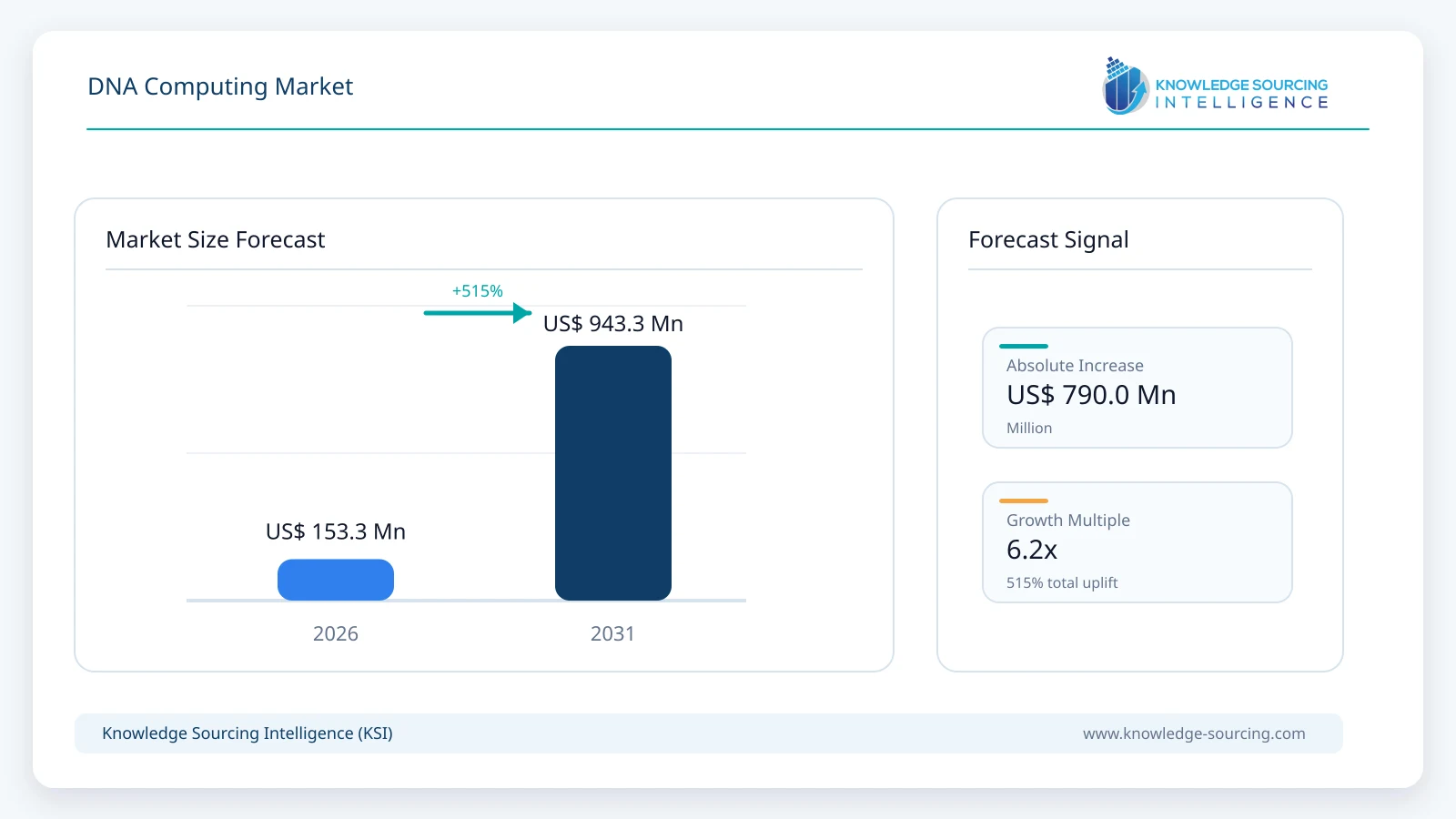
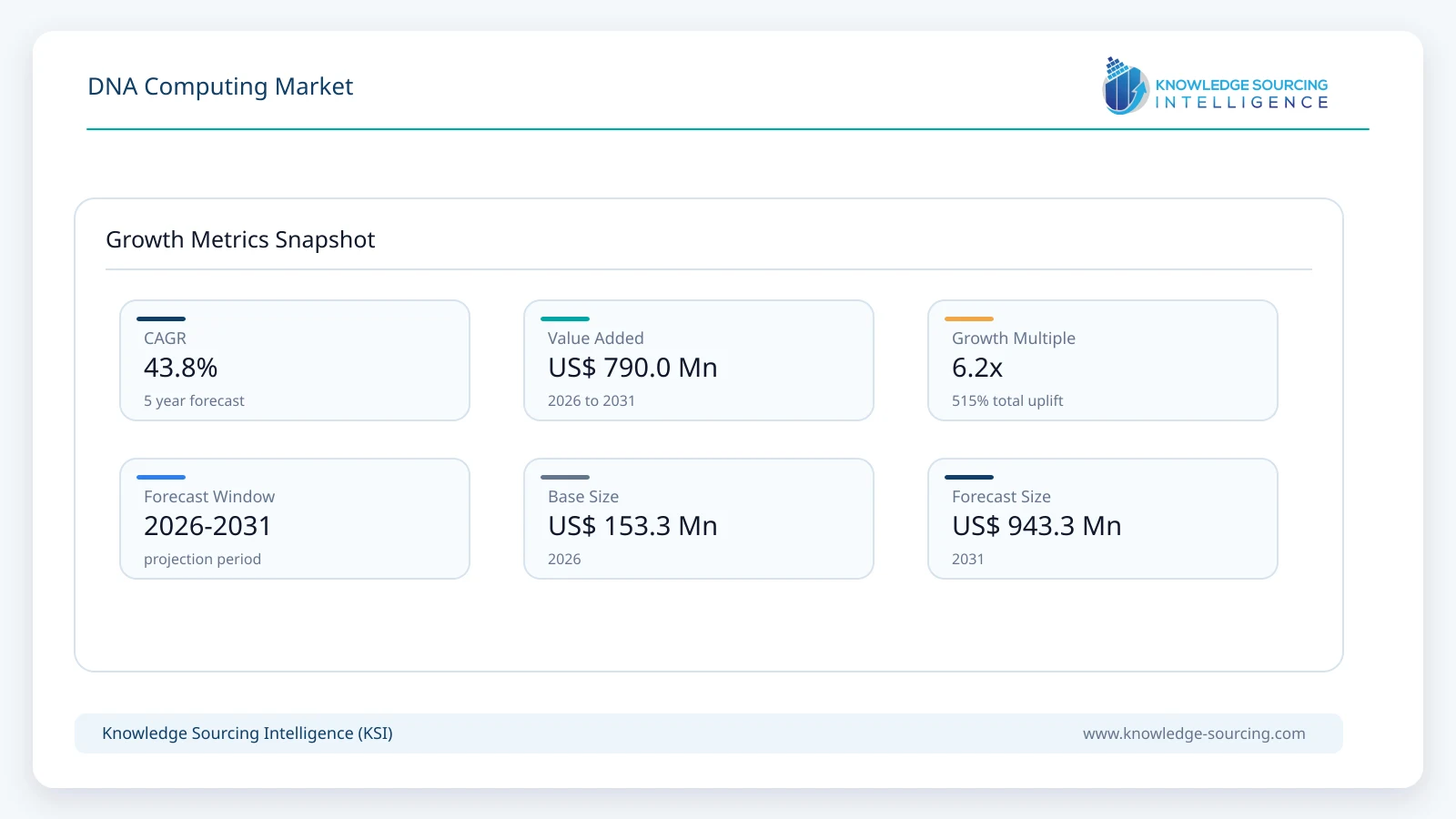
The DNA Computing Market is forecast to grow at a CAGR of 43.8%, reaching USD 943.3 million in 2031 from USD 153.3 million in 2026.
Highlights:
- 1Services now account for a large proportion of market activity, with a high amount of specialized expertise needed to design and conduct DNA-based computational experiments – this is limited to a few specialist labs and research institutions.
- 2DNA-based logic gates and DNA-based algorithms are the most commercially active categories of technologies, with researchers seeking real-world demonstrations of computational advantage for certain classes of combinatorial and optimization problems.
- 3The in-vitro methods of DNA computation are more mature technologically for DNA synthesis, amplification and readout, and hence currently dominate the market.
- 4The commonalities of the DNA computing and DNA data storage research are broadening the commercial applications, for instance, through partnerships like CATALOG and Seagate's partnership with DNA Computing and Storage Lab-on-a-Chip for exploring lab-on-a-chip DNA computing and data storage.
- 5Most of the activity in the present market is being conducted by academic and government research institutions, but a small number of technology and pharmaceutical companies are starting to investigate the use of DNA computing in specific high-value applications.
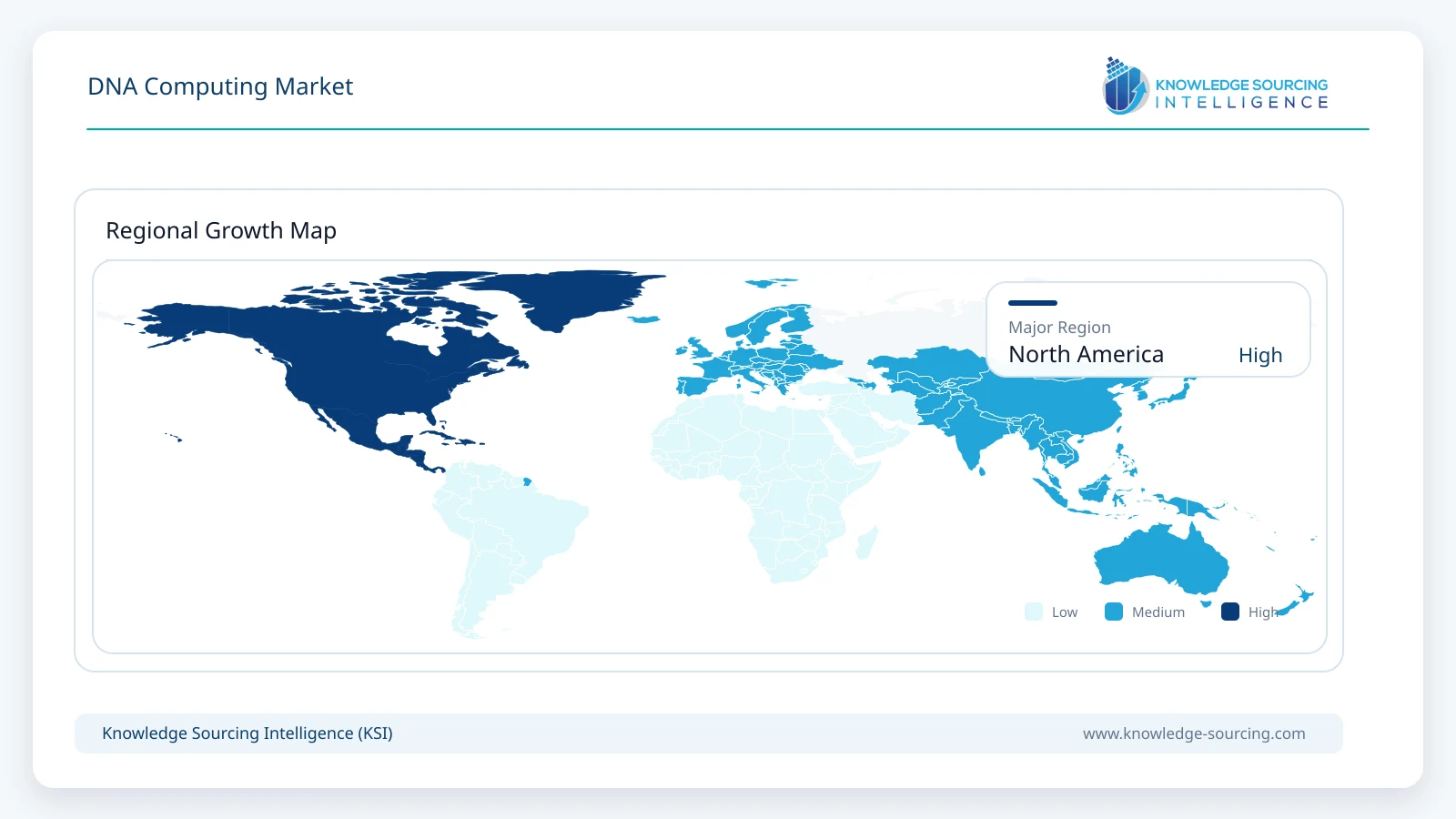
- 6The region of North America is also a global hotspot for DNA computing research activity due to the region's concentration of the leading academic programs in genomics and synthetic biology.
By providing, services now also play a major role in the market activity; most organisations do not have internal expertise to design, execute and interpret DNA computational experiments; they need to tap into specialised laboratories and research partners to provide the expertise.
As far as technology, DNA-based logic gates and DNA-based algorithms are the most active, with attempts to demonstrate practical computational benefit for specific combinatorial optimization and pattern-matching problems, while DNA nanotechnology applications including structural computation and molecular robotics are longer time horizons but still a potential game-changer direction of research. Current market activity is skewed in favor of in-vitro approaches in which synthesized DNA strands are used in laboratory settings, as the technology for synthesizing, amplifying and reading out DNA strands is the most advanced and well developed in comparison with the in-vivo computational approaches which are still predominantly academic based.
Using the application of cryptography and combinatorial optimization problems such as DNA satisfiability and variants of the traveling salesman, which DNA computing's parallel search capabilities naturally support, are prime near-term application areas, as is also the successful DNA-based biosensing/diagnostic application of computational logic to the analysis of biological sample. Academic and government research institutions dominate the market because DNA computing is still in its early days, but there are a few emerging technology companies and pharmaceutical firms in the market that are starting to investigate the technology for high-value niche applications.
Market Dynamics
Market Drivers
DNA computing's built-in massive parallelism, billions of DNA strands reacting at the same time continues to be a source of research funding for problem classes such as combinatorial and optimization problems that grow poorly with conventional silicon-based computing architectures.
Rapidly decreasing rates of DNA synthesis and sequencing costs, brought about through advances made in the life sciences and genomics, are reducing the practical cost barrier to meaningful scale runs of computational experiments on DNA.
Research in both DNA computing and DNA data storage is moving closer together and is attracting commercial interest in the molecular biology technologies used, as organizations investigate a unified computation and storage architecture for large-scale, long-term storage applications.
Market Restraints & Opportunities
Existing methods for DNA computation and sequencing are relatively slow, and are also prone to error, and require very specialized wet-lab skills to design and perform experiments using DNA.
However, advances in DNA synthesis and sequencing automation and the increased cross-pollination between DNA computing and the well-established and mature commercial DNA data storage industry are enabling significant progress toward making DNA-based computing a viable commercial technology for specialized, high-value applications integrating computation and storage capabilities.
Key Developments
March 2026: Biomemory, a leader in DNA Data Storage systems tailored for the IT and Cybersecurity industries, today announced the acquisition of the assets from Catalog Technologies, the Boston-based historical pioneer of DNA Data Storage and Computing.
2025: Atlas Data Storage, the leader in synthetic DNA data storage, announced Atlas Eon 100, the first scalable DNA data storage service. DNA is the only storage medium that preserves data permanently in nature's most enduring format.
Market Segmentation
The market is segmented by offering, technology, DNA computation method, application, end-user, and geography.
By Offering: Services
Services represent a significant share of current market activity, as the specialized wet-lab and computational-design expertise required to execute DNA-based computational experiments remains concentrated among a small number of specialized research laboratories and service providers.
Eurofins Scientific provides DNA synthesis and molecular biology services supporting research institutions exploring DNA computing and related synthetic-biology applications.
By Technology: DNA-Based Algorithms
DNA-based algorithms represent one of the most active near-term technology categories, as researchers design molecular encoding schemes that translate combinatorial and optimization problems into DNA strand sequences whose reactions can be read out to reveal computational solutions.
Twist Bioscience Corporation supplies synthetic DNA used in research applications spanning DNA data storage and DNA computing experimentation.
By Application: Combinatorial Optimization
Combinatorial optimization problems, including variants of classic computer-science problems such as the traveling salesman and Boolean satisfiability problems, represent a leading application area given DNA computing's natural suitability for massively parallel search across large solution spaces.
Agilent Technologies Inc. supplies DNA synthesis and sequencing equipment used across research applications including DNA computing and molecular-scale computational experimentation.
Regional Analysis
North America Market Analysis
North America holds a leading position in DNA computing research activity, supported by a concentration of leading academic genomics and synthetic-biology research programs, and continued government and private funding for molecular-scale computing research.
Europe Market Analysis
Europe maintains a strong academic research base in DNA computing and synthetic biology, with several leading universities and research institutes contributing foundational research to the field's theoretical and experimental development.
Asia-Pacific Market Analysis
Asia-Pacific is seeing growing research investment in DNA computing, driven by expanding synthetic-biology and genomics research infrastructure across China, Japan and South Korea.
Middle East and Africa Market Analysis
The Middle East and Africa represent an early-stage market for DNA computing, with research activity concentrated primarily within academic institutions exploring foundational synthetic-biology applications.
South America Market Analysis
South America represents a nascent market for DNA computing, with academic research institutions in Brazil beginning to explore synthetic-biology and molecular-computation research programs.
List of Companies
Microsoft Corporation
IBM Corporation
Twist Bioscience Corporation
GenScript Biotech Corporation
Agilent Technologies Inc.
Eurofins Scientific
Illumina, Inc.
Catalog Technologies, Inc.
Oxford Nanopore Technologies Plc.
Evonetix Ltd.
Competitive Landscape
Microsoft Corporation
Microsoft has conducted foundational research into DNA-based computing and data storage, exploring molecular computation as a potential future substrate for both data storage and specialized computational applications.
Catalog Technologies, Inc.
Catalog Technologies develops DNA-based computing and storage systems, and has expanded its collaboration with Seagate to explore lab-on-a-chip technology aimed at reducing the chemistry volume required for DNA-based computation.
Twist Bioscience Corporation
Twist Bioscience supplies synthetic DNA used across a range of research applications, including DNA data storage and DNA computing experimentation, benefiting from continued improvements in DNA synthesis cost and throughput.
Analyst View
The DNA Computing market remains an early-stage, research-intensive field, but is showing meaningful signs of commercial maturation as it converges with the more commercially advanced DNA data storage industry. The technology's fundamental value proposition -- massive molecular parallelism applied to combinatorial and optimization problems that scale poorly on conventional computing architectures -- continues to attract sustained academic and increasingly commercial research investment, even as practical, widely deployed applications remain a longer-term prospect. Collaborations such as CATALOG and Seagate's joint exploration of lab-on-a-chip DNA computing and storage technology signal a promising path toward combined computation-and-storage architectures that could offer a more near-term commercial entry point than standalone DNA computation. North America and Europe currently anchor the field's research base, while Asia-Pacific's expanding synthetic-biology infrastructure is positioning the region for accelerating research activity. Organizations that combine DNA synthesis and sequencing expertise with computational-design capability are best positioned to capture emerging commercial opportunities as DNA computing gradually transitions from a purely academic pursuit toward specialized, high-value applications.
DNA Computing Market Scope:
| Report Metric | Details |
|---|---|
| Total Market Size in 2026 | USD 153.3 million |
| Total Market Size in 2031 | USD 943.3 million |
| Forecast Unit | USD Million |
| Growth Rate | 43.8% |
| Study Period | 2021 to 2031 |
| Historical Data | 2021 to 2024 |
| Base Year | 2025 |
| Forecast Period | 2026 – 2031 |
| Segmentation | Offering, Technology, Application, Geography |
| Companies |
|
Market Segmentation
By Offering
Hardware
Software
Services
By Technology
DNA Nanotechnology
DNA-Based Algorithms
DNA-Based Logic Gates
By Application
Combinatorial Optimization
Cryptography
Biosensing & Diagnostics
Others
By Geography
North America
USA
Canada
Mexico
South America
Brazil
Others
Europe
Germany
France
United Kingdom
Others
Middle East and Africa
UAE
Saudi Arabia
Others
Asia Pacific
China
India
Japan
Others
Table of Contents
1. EXECUTIVE SUMMARY
2. MARKET SNAPSHOT
2.1. Market Overview
2.2. Market Definition
2.3. Scope of the Study
2.4. Market Segmentation
3. BUSINESS LANDSCAPE
3.1. Market Drivers
3.2. Market Restraints
3.3. Market Opportunities
3.4. Porter's Five Forces Analysis
3.5. Industry Value Chain Analysis
3.6. Policies and Regulations (Biosafety & Synthetic Biology)
3.7. Strategic Recommendations
4. TECHNOLOGICAL OUTLOOK
4.1. DNA-Based Logic Gates
4.2. DNA Nanotechnology
4.3. Convergence with DNA Data Storage
4.4. Lab-on-a-Chip Computation
5. DNA COMPUTING MARKET BY OFFERING
5.1. Introduction
5.2. Hardware
5.3. Software
5.4. Services
6. DNA COMPUTING MARKET BY TECHNOLOGY
6.1. Introduction
6.2. DNA Nanotechnology
6.3. DNA-Based Algorithms
6.4. DNA-Based Logic Gates
7. DNA COMPUTING MARKET BY APPLICATION
7.1. Introduction
7.2. Combinatorial Optimization
7.3. Cryptography
7.4. Biosensing & Diagnostics
7.5. Others
8. DNA COMPUTING MARKET BY GEOGRAPHY
8.1. Introduction
8.2. North America
8.2.1. USA
8.2.2. Canada
8.2.3. Mexico
8.3. South America
8.3.1. Brazil
8.3.2. Others
8.4. Europe
8.4.1. Germany
8.4.2. France
8.4.3. United Kingdom
8.4.4. Others
8.5. Middle East and Africa
8.5.1. UAE
8.5.2. Saudi Arabia
8.5.3. Others
8.6. Asia Pacific
8.6.1. China
8.6.2. India
8.6.3. Japan
8.6.4. Others
9. COMPETITIVE ENVIRONMENT AND ANALYSIS
9.1. Major Players and Strategy Analysis
9.2. Market Share Analysis
9.3. Mergers, Acquisitions, Agreements, and Collaborations
9.4. Competitive Dashboard
10. COMPANY PROFILES
10.1. Microsoft Corporation
10.2. IBM Corporation
10.3. Twist Bioscience Corporation
10.4. GenScript Biotech Corporation
10.5. Agilent Technologies Inc.
10.6. Eurofins Scientific
10.7. Illumina, Inc.
10.8. Catalog Technologies, Inc.
10.9. Oxford Nanopore Technologies Plc.
10.10. Evonetix Ltd.
11. APPENDIX
11.1. Currency
11.2. Assumptions
11.3. Base and Forecast Years Timeline
11.4. Key Benefits for the Stakeholders
11.5. Research Methodology
11.6. Abbreviations
Navigate
Trusted by the world's leading organizations











