
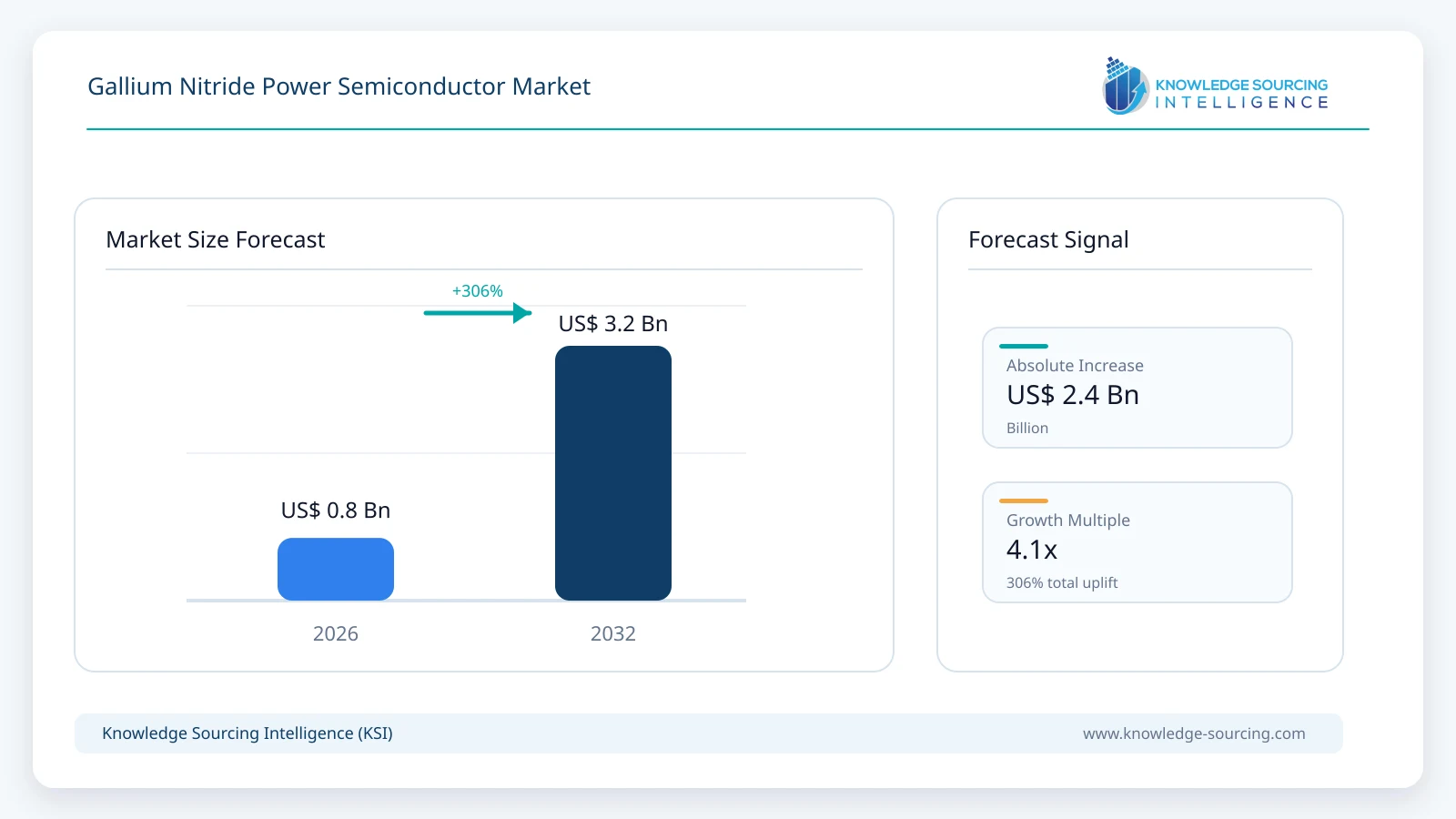
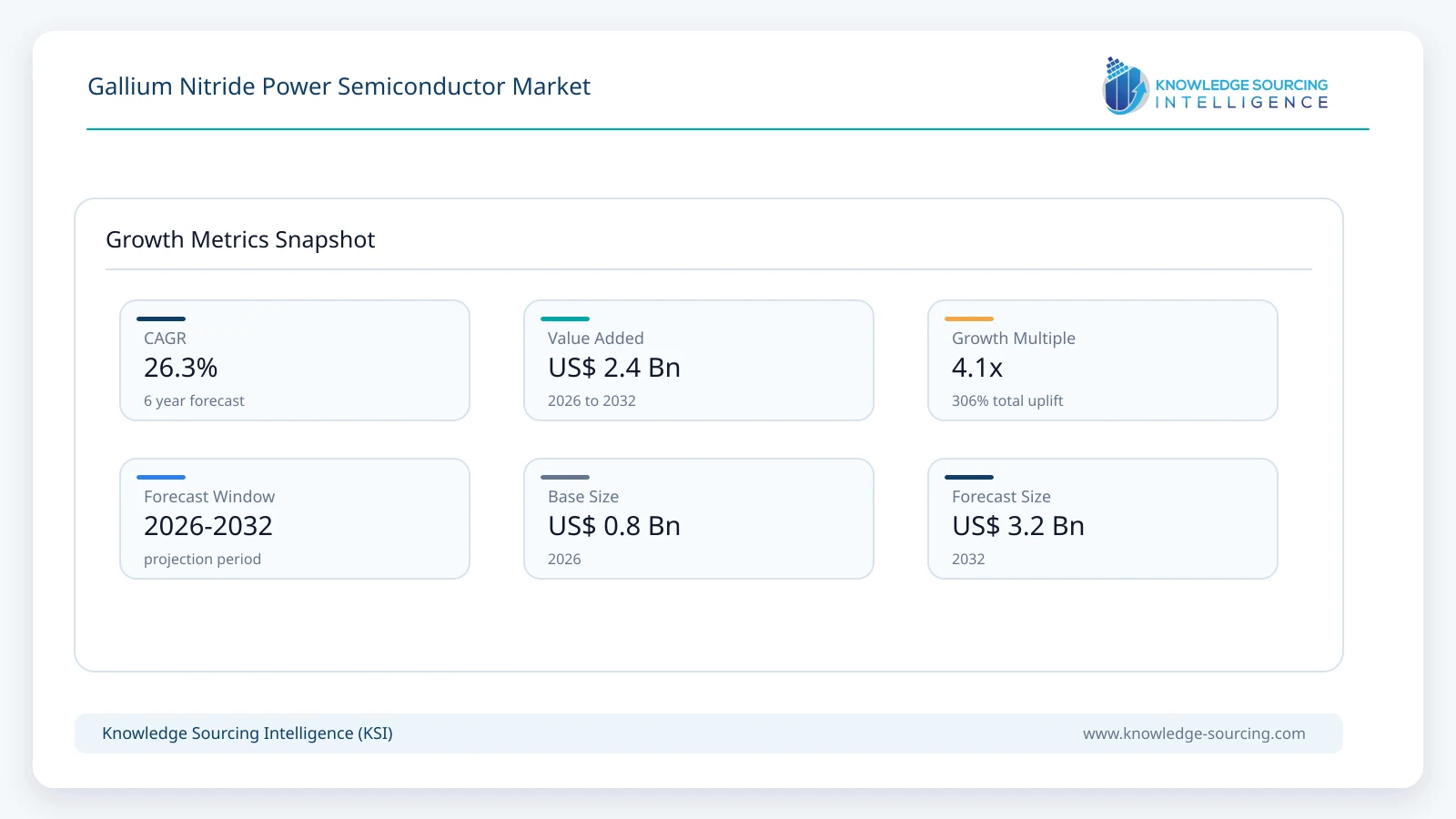
The Gallium Nitride Power Semiconductor Market is estimated at USD 0.78 billion in 2026 and is projected to reach USD 3.17 billion by 2032, representing a CAGR of 26.3%over 2026-2032.
Highlights:
- 1650 V GaN remains the largest commercial voltage class across power supplies and conversion.
- 2Integrated GaN power ICs and stages are expanding faster than standalone discrete devices.
- 3AI data-center power conversion is becoming a major high-growth demand source through 2032.
- 4Automotive GaN is progressing from auxiliary conversion toward onboard charging and traction applications.
- 5300 mm manufacturing and higher-voltage GaN are widening the technology's addressable power range.
GaN power devices compete primarily on switching speed, conduction loss, reverse-recovery behavior and the ability to raise switching frequency without excessive efficiency penalties. Higher switching frequency allows designers to reduce transformer, inductor and capacitor size, which can lower total power-system volume even when the semiconductor carries a higher unit cost than silicon. This advantage first gained commercial scale in consumer chargers and adapters, where compactness had direct customer value, and is now moving into server, telecom, automotive and industrial systems where conversion efficiency and power density are increasingly constrained.
The 650 V class remains the commercial center of gravity because it addresses common AC-DC power supplies, power-factor-correction stages, server power systems, industrial supplies, photovoltaic conversion and electric-vehicle onboard charging. Device suppliers are expanding from surface-mount packages into TOLL, TOLT and TO-247 formats to serve higher current and thermal loads. Nexperia's 2026 portfolio expansion and STMicroelectronics' 700 V PowerGaN introductions illustrate the shift toward higher-power applications without abandoning the fast-switching advantage that established GaN in compact consumer systems.
The voltage ceiling is also moving upward. Power Integrations has extended PowiGaN from 1250 V and 1700 V products to a demonstrated 2200 V technology, opening potential applications in 800 VDC AI data centers, renewable-energy conversion and high-voltage auxiliary systems. At the opposite end of the spectrum, EPC's seventh-generation 40 V eGaN devices target high-current DC-DC conversion, robotics and motor control. The market therefore spans a broad power range, with different device architectures and packaging approaches serving low-voltage high-current and high-voltage conversion requirements.
Market Drivers
AI data centers are increasing demand for high-efficiency power conversion
AI server racks are moving toward much higher electrical loads, increasing the cost of every conversion loss between the grid connection and the accelerator. GaN is gaining relevance in power-factor correction, intermediate bus conversion, auxiliary power and point-of-load architectures because higher switching frequencies can improve efficiency while reducing magnetics and power-supply size. Innoscience is developing all-GaN power delivery for the NVIDIA MGX ecosystem, while Power Integrations is commercializing 1250 V and 1700 V solutions for 800 VDC data-center architectures. Nexperia and ROHM also identify AI server power supplies as a major growth application for their 650 V GaN portfolios.
Automotive GaN is moving beyond low-power auxiliary electronics
GaN adoption in vehicles is broadening as suppliers improve automotive qualification, short-circuit robustness and thermal packaging. Innoscience's 650 V GaN devices are already integrated into a 6.6 kW onboard charger platform used in Changan vehicles, while its integrated SolidGaN power stage is qualified to automotive standards. Cambridge GaN Devices introduced a 650 V, 9 milliohm ICeGaN device in 2026 for automotive inverter applications. ROHM is building a broader supply system for 650 V GaN to support AI servers and electric vehicles, indicating that automotive demand is moving from demonstration toward platform qualification and production.
Manufacturing scale is improving GaN cost competitiveness
GaN-on-silicon benefits from the ability to use larger silicon-based manufacturing infrastructure. Infineon's 300 mm power GaN platform produces approximately 2.3 times more chips per wafer than 200 mm manufacturing, improving capital and material efficiency as volumes rise. Innoscience has already scaled mass production on 200 mm GaN-on-silicon and reports cumulative shipments above two billion devices. ROHM is transferring TSMC GaN process technology into its Hamamatsu operations with a production system targeted for 2027. Larger scale and multi-source manufacturing reduce one of the principal barriers to broader GaN adoption.
Higher-voltage products are expanding the addressable application range
GaN was historically strongest below the voltage levels served by silicon carbide, limiting its role in higher-voltage industrial and infrastructure systems. That boundary is shifting. Power Integrations' 2200 V PowiGaN demonstration extends the technology well above conventional 650 V and 900 V classes, while commercial 1250 V and 1700 V products are already being positioned for 800 VDC AI power systems. Higher voltage capability allows GaN to participate in applications that previously required stacked lower-voltage devices or alternative wide-bandgap technologies.
Restraints and Adoption Challenges
GaN adoption is constrained by device cost, design familiarity, qualification requirements and competition from both silicon and silicon carbide. Designers must manage fast switching edges, gate-drive requirements, electromagnetic interference and package parasitics to realize the technology's theoretical efficiency advantage. Silicon remains highly cost competitive in mature lower-frequency applications, while silicon carbide is well established in high-voltage traction, grid and industrial systems. Automotive adoption also requires long qualification cycles and proven field reliability. Integrated GaN products can simplify implementation but may increase supplier dependence because the power switch, driver and protection functions are bundled into one device.
Gallium Nitride Power Semiconductor Market Segment Analysis
By Device Type
Discrete GaN HEMTs and FETs represent the largest revenue contribution in 2026 because they are used across consumer, server, telecom, industrial and automotive designs and allow system makers to select gate drivers and controllers independently. The category includes low-voltage high-current eGaN devices and mainstream 650 V to 700 V transistors in surface-mount and higher-power packages.
Integrated GaN power ICs and power stages are expected to grow faster through 2032. Suppliers including Power Integrations, Texas Instruments, Innoscience, ROHM and Cambridge GaN Devices combine the GaN switch with gate-drive, sensing or protection functions to reduce parasitic inductance and simplify system design. Modules remain a smaller but expanding category as GaN moves toward multi-kilowatt server, automotive and industrial platforms.
Segment | Revenue Contribution | Growth Direction | Primary Application |
Discrete GaN HEMTs / FETs | Largest | Very strong | Server supplies, chargers, industrial conversion and automotive power |
Integrated GaN power ICs / stages | High | Fastest | Compact high-frequency conversion with simplified gate-drive design |
GaN power modules | Emerging | Very fast | Higher-power server, industrial and automotive systems |
Below 200 V devices | Established | Strong | DC-DC conversion, robotics, motor control and battery systems |
200-700 V devices | Largest voltage class | Very strong | AC-DC supplies, PFC, onboard charging and renewable conversion |
Above 700 V devices | Small 2026 base | Very fast | 800 VDC data centers, industrial and high-voltage auxiliary systems |
Market and Technology Indicators
Indicator | Revenue Contribution | Market Impact |
300 mm GaN manufacturing | Infineon states its 300 mm power GaN process yields about 2.3 times more chips per wafer than 200 mm. | Improves cost structure and supports larger-volume adoption. |
High-volume GaN shipments | Innoscience reported more than two billion GaN devices shipped worldwide by May 2026. | Demonstrates manufacturing scale beyond early specialist applications. |
2200 V GaN technology | Power Integrations demonstrated 2200 V PowiGaN in August 2026. | Extends GaN toward high-voltage data-center, renewable and HVDC applications. |
Higher-power 650 V portfolio | Nexperia expanded 650 V GaN into 35, 50 and 70 milliohm classes with TOLL, TOLT and TO-247 packages. | Broadens GaN adoption in multi-kilowatt power conversion. |
700 V mainstream devices | STMicroelectronics introduced 700 V PowerGaN devices for AI servers, industrial systems and robotics. | Expands competition among large diversified semiconductor suppliers. |
Automotive qualification | ROHM, Innoscience and Cambridge GaN Devices expanded automotive GaN programs during 2026. | Moves GaN toward production onboard chargers and higher-power vehicle systems. |
Regional Opportunity
Asia Pacific
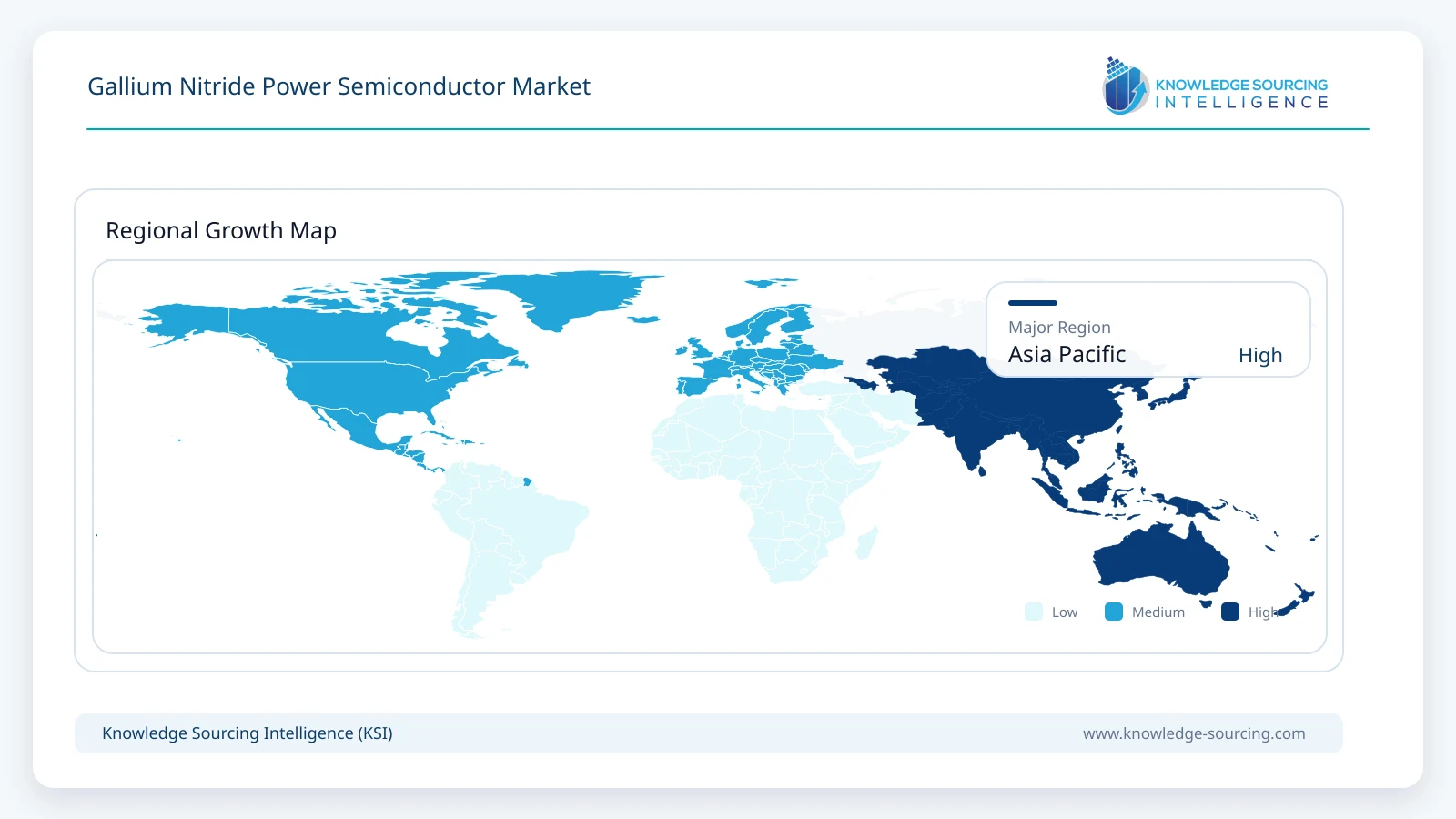
Asia Pacific is the largest manufacturing and demand region for GaN power semiconductors because it combines consumer-electronics production, electric-vehicle manufacturing, server and power-supply assembly, renewable-energy electronics and a rapidly expanding compound-semiconductor supply base. China is particularly important through Innoscience's high-volume GaN-on-silicon production and large downstream markets for chargers, data-center power, photovoltaic systems and electric vehicles. Japan contributes through ROHM, Panasonic, Renesas and other power-semiconductor suppliers, while Taiwan remains critical through foundry manufacturing and power-electronics assembly.
China is also becoming a major automotive GaN commercialization market. Innoscience and Inovance Automotive have integrated 650 V GaN devices into a 6.6 kW onboard-charger and DC-DC platform installed in Changan vehicles. The same supplier is extending GaN into AI-server power architectures and reported cumulative shipments above two billion devices, giving the region a substantial manufacturing-learning advantage. Rising domestic data-center construction and electronics exports further support device demand.
Japan's ecosystem is broadening supply diversity. ROHM is combining its own GaN development with licensed TSMC process technology and plans to establish an end-to-end production system at Hamamatsu in 2027. Renesas participates through the Transphorm acquisition, while Panasonic retains long-standing GaN power technology and partnership activity. These suppliers complement larger Taiwanese foundry capacity and regional packaging infrastructure, reducing reliance on one production model.
North America remains important in GaN design, intellectual property and high-growth data-center applications through Power Integrations, Texas Instruments, EPC, Navitas, Alpha and Omega Semiconductor and several specialist companies. Europe contributes through Infineon, Nexperia, STMicroelectronics and Cambridge GaN Devices. The geographic market therefore combines Asia Pacific manufacturing scale with strong device innovation and application development in North America and Europe.
Competitive Landscape
The competitive landscape combines diversified semiconductor companies, high-volume GaN specialists and integrated power-IC suppliers. Infineon has expanded its GaN position through GaN Systems and 300 mm manufacturing, while Innoscience competes on large-scale GaN-on-silicon production and a broad low- to high-voltage device portfolio. Power Integrations differentiates through highly integrated PowiGaN conversion ICs and unusually high voltage capability. Nexperia, STMicroelectronics and ROHM are expanding mainstream discrete GaN portfolios using established power-semiconductor sales channels.
Specialist suppliers continue to influence device architecture and application development. EPC focuses on enhancement-mode low-voltage eGaN devices, Cambridge GaN Devices integrates gate-interface functionality into ICeGaN products, and Navitas combines GaNFast power ICs with a broader high-power strategy. Renesas gained a 650 V GaN platform through Transphorm, while VisIC Technologies and NexGen Power Systems target differentiated automotive and high-power implementations.
Competitive advantage increasingly depends on manufacturing scale, voltage coverage, package thermal performance, gate-drive simplicity, qualification data and application-level reference designs rather than transistor figures of merit alone. The market is moving toward device families that span chargers, servers, industrial systems and vehicles while allowing customers to reuse controller, driver and packaging expertise across power ranges.
Major companies and ecosystem participants covered: Infineon Technologies, Innoscience, Power Integrations, Navitas Semiconductor, Renesas Electronics / Transphorm, Nexperia, Texas Instruments, STMicroelectronics, ROHM, Efficient Power Conversion, Cambridge GaN Devices, Panasonic Industry, VisIC Technologies, NexGen Power Systems and Alpha and Omega Semiconductor.
Recent Developments
August 2026: Power Integrations demonstrated 2200 V PowiGaN technology for next-generation high-voltage power systems including AI data centers, electric vehicles and renewable-energy infrastructure.
July 2026: Innoscience's automotive-grade SolidGaN integrated power device received a CSPSD market-performance award following large-scale commercialization and automotive qualification.
June 2026: Nexperia expanded its 650 V GaN FET portfolio across 35, 50 and 70 milliohm classes in TOLL, TOLT and TO-247 packages.
June 2026: Cambridge GaN Devices introduced a 650 V, 9 milliohm ICeGaN device aimed at automotive inverter applications.
May 2026: STMicroelectronics introduced 700 V PowerGaN devices targeting AI servers, industrial systems, robotics and advanced consumer power applications.
May 2026: Innoscience joined the NVIDIA MGX ecosystem and detailed all-GaN power-delivery architectures from 800 VDC distribution toward GPU-level conversion.
February 2026: ROHM announced a technology-license arrangement with TSMC to establish an end-to-end 650 V GaN production system at its Hamamatsu site.
February 2026: EPC moved its seventh-generation 40 V EPC2366 eGaN transistor into mass production for high-current, high-frequency power applications.
Gallium Nitride Power Semiconductor Market Scope:
| Report Metric | Details |
|---|---|
| Total Market Size in 2026 | 0.78 billion |
| Total Market Size in 2032 | USD 3.17 billion |
| Forecast Unit | USD Billion |
| Growth Rate | 26.3% |
| Study Period | 2021 to 2032 |
| Historical Data | 2021 to 2024 |
| Base Year | 2025 |
| Forecast Period | 2026 – 2032 |
| Segmentation | Device Type, Voltage Range, Application, End User, Manufacturing Model, Geography |
| Companies |
|
Market Segmentation
By Device Type
Discrete GaN HEMTs and FETs
Integrated GaN Power ICs and Power Stages
GaN Power Modules
By Voltage Range
Below 200 V
200-700 V
Above 700 V
By Application
AC-DC Power Supplies and Power-Factor Correction
DC-DC Conversion
Electric-Vehicle Onboard Charging and Auxiliary Power
AI Data Centers and Server Power
Renewable Energy and Energy Storage
Industrial Drives and Automation
Consumer Chargers and Adapters
By End User
Data Centers and Computing
Automotive
Consumer Electronics
Industrial
Renewable Energy and Storage
Telecommunications
By Manufacturing Model
Integrated Device Manufacturers
Fabless GaN Suppliers
Foundry-Based GaN Manufacturing
By Geography
Asia Pacific
China
Japan
South Korea
Taiwan
India and Southeast Asia
North America
Europe
Rest of World
Table of Contents
1. EXECUTIVE SUMMARY
1.1. Market Opportunity and Key Findings
1.2. GaN Power Semiconductor Commercialization Outlook
1.3. Principal Revenue Pools
2. MARKET OVERVIEW
2.1. GaN Power Device Architecture
2.2. Discrete versus Integrated GaN
2.3. Voltage and Power-Class Evolution
2.4. GaN-on-Silicon Manufacturing Scale
2.5. GaN versus Silicon and Silicon Carbide
3. MARKET SIZE AND FORECAST, 2026-2032
3.1. Global Market Revenue
3.2. Annual Growth Analysis
3.3. Device Revenue by Power Class
4. MARKET BY DEVICE TYPE
4.1. Discrete GaN HEMTs and FETs
4.2. Integrated GaN Power ICs and Power Stages
4.3. GaN Power Modules
5. MARKET BY VOLTAGE RANGE
5.1. Below 200 V
5.2. 200-700 V
5.3. Above 700 V
6. MARKET BY APPLICATION
6.1. AC-DC Power Supplies and Power-Factor Correction
6.2. DC-DC Conversion
6.3. Electric-Vehicle Onboard Charging and Auxiliary Power
6.4. AI Data Centers and Server Power
6.5. Renewable Energy and Energy Storage
6.6. Industrial Drives and Automation
6.7. Consumer Chargers and Adapters
7. MARKET BY END USER
7.1. Data Centers and Computing
7.2. Automotive
7.3. Consumer Electronics
7.4. Industrial
7.5. Renewable Energy and Storage
7.6. Telecommunications
8. MARKET BY MANUFACTURING MODEL
8.1. Integrated Device Manufacturers
8.2. Fabless GaN Suppliers
8.3. Foundry-Based GaN Manufacturing
9. REGIONAL MARKET
9.1. Asia Pacific
9.1.1. China
9.1.2. Japan
9.1.3. South Korea
9.1.4. Taiwan
9.1.5. India and Southeast Asia
9.2. North America
9.3. Europe
9.4. Rest of World
10. MARKET DYNAMICS
10.1. Drivers
10.1.1. AI Data Center Power-Conversion Demand
10.1.2. Automotive GaN Commercialization
10.1.3. Larger-Wafer Manufacturing and Cost Reduction
10.1.4. Expansion into Higher-Voltage Power Systems
10.2. Restraints
10.2.1. Silicon and Silicon-Carbide Competition
10.2.2. Gate-Drive and EMI Design Complexity
10.2.3. Automotive Qualification and Reliability Requirements
10.2.4. Device Cost and Customer Requalification
11. COMPETITIVE LANDSCAPE
11.1. Market Structure and Competitive Intensity
11.2. Voltage, Integration and Packaging Positioning
11.3. Manufacturing Scale and Foundry Strategies
11.4. AI Data Center and Automotive Platform Positioning
11.5. Device, Controller and System Ecosystem Partnerships
12. COMPANY PROFILES
12.1. Infineon Technologies
12.2. Innoscience
12.3. Power Integrations
12.4. Navitas Semiconductor
12.5. Renesas Electronics / Transphorm
12.6. Nexperia
12.7. Texas Instruments
12.8. STMicroelectronics
12.9. ROHM
12.10. Efficient Power Conversion
12.11. Cambridge GaN Devices
12.12. Panasonic Industry
12.13. VisIC Technologies
12.14. NexGen Power Systems
12.15. Alpha and Omega Semiconductor
13. RECENT DEVELOPMENTS
14. APPENDIX
Navigate
Trusted by the world's leading organizations











