
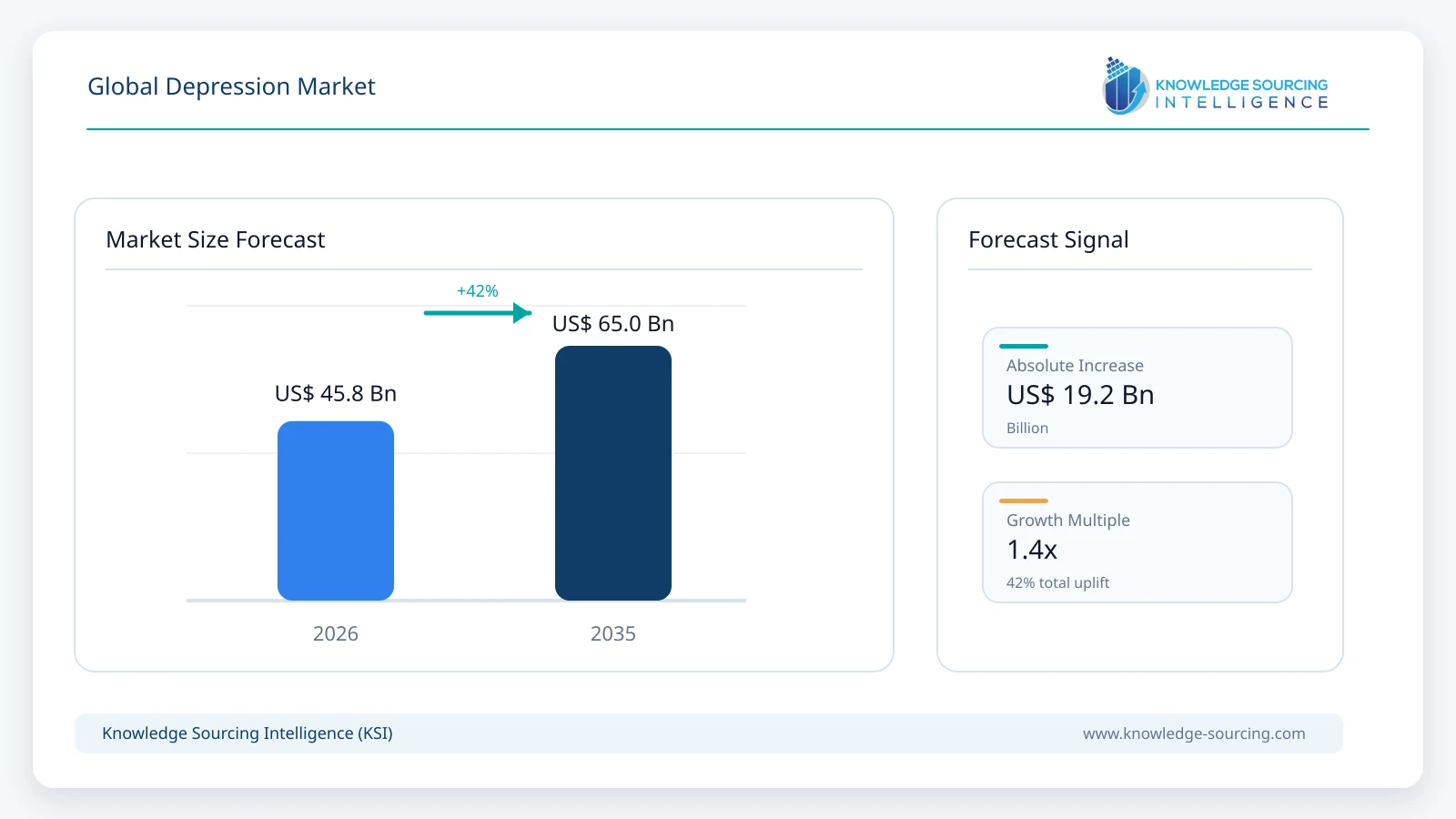
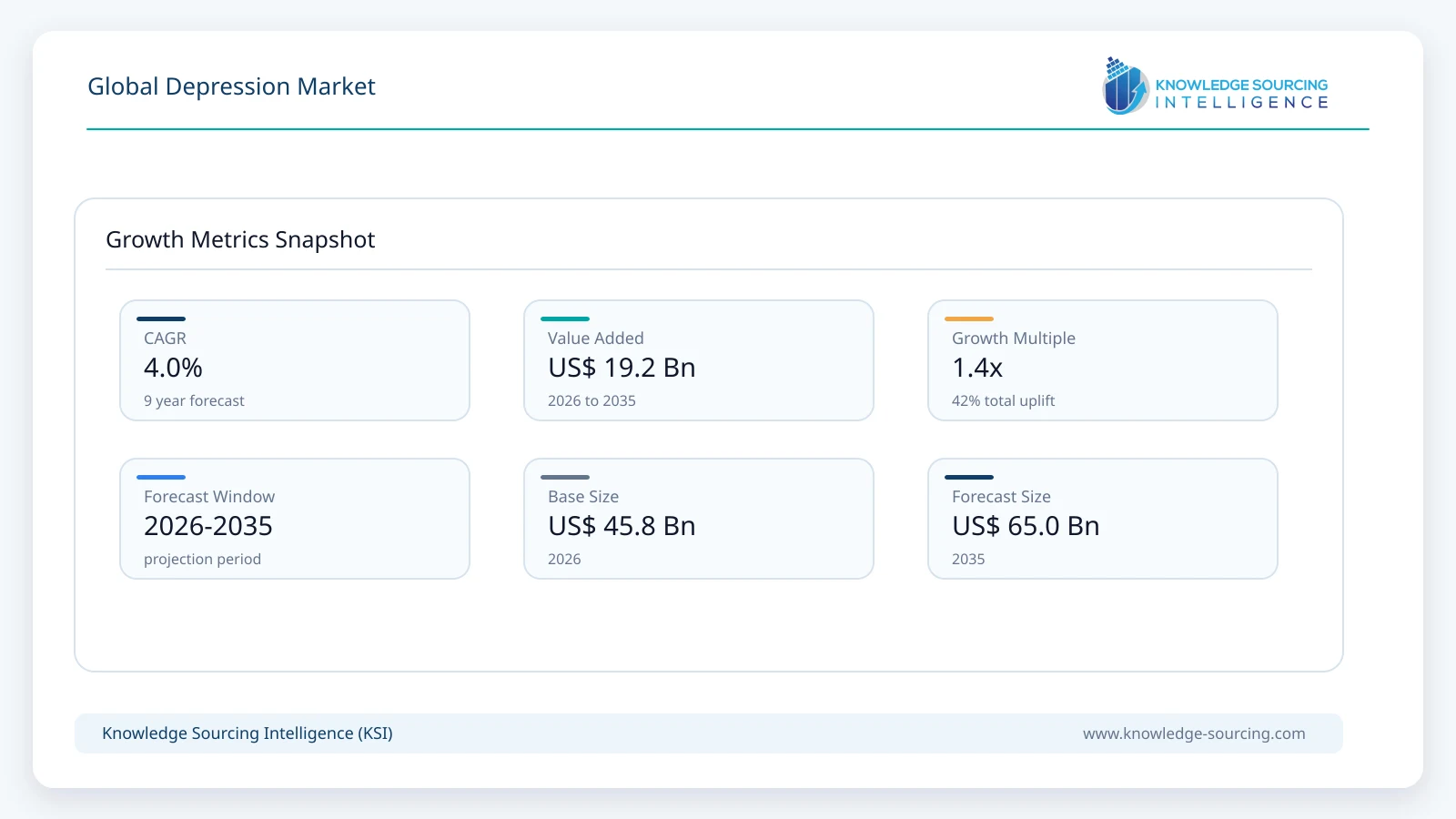
The Global Depression Market is set to reach USD 64.98 billion in 2035, growing at a CAGR of 4.0% from USD 45.78 billion in 2026.
Highlights:
- 1Rising depression prevalence continues expanding the addressable patient population.
- 2Treatment-resistant depression remains a major driver of therapeutic innovation.
- 3Rapid-acting antidepressants are transforming treatment expectations.
- 4Digital mental health technologies are gaining importance within treatment pathways.
Depression is among the most common psychiatric disorders globally and remains a leading cause of disability, reduced productivity, and diminished quality of life. The disease affects individuals across all age groups and socioeconomic backgrounds, creating a substantial burden on healthcare systems and society. Although conventional antidepressants remain the cornerstone of treatment, significant unmet needs persist due to delayed onset of action, inadequate response rates, and high relapse frequency.
The market is evolving rapidly with the introduction of novel therapeutic mechanisms, digital mental health solutions, and personalized treatment approaches. Pharmaceutical companies, biotechnology firms, healthcare providers, and policymakers continue investing in innovative strategies to improve patient outcomes and expand treatment accessibility.
Market Dynamics
Market Drivers
Increasing Global Prevalence of Depression
Growing mental health awareness, urbanisation, economic stress, social isolation, and changing lifestyles have contributed to rising depression prevalence worldwide. Improved diagnosis rates are expanding treatment demand across healthcare systems.
Demand for Novel Therapies
Limitations associated with traditional antidepressants have increased demand for therapies capable of delivering faster symptom improvement and improved remission rates. This trend continues driving research and development investment.
Expanding Mental Health Infrastructure
Governments and healthcare organisations are strengthening mental health services through policy initiatives, expanded reimbursement programs, and increased healthcare spending.
Technological Advancements
Digital therapeutics, telepsychiatry, artificial intelligence, and remote patient monitoring technologies are improving treatment accessibility and supporting long-term patient management.
Market Restraints
Delayed diagnosis and treatment gaps persist in several regions.
Social stigma surrounding mental illness remains a barrier to treatment.
High development costs and clinical trial failure rates challenge innovation.
Reimbursement limitations may restrict the adoption of premium-priced therapies.
Market Opportunities
Treatment-Resistant Depression Market Expansion
The growing treatment-resistant depression population creates substantial opportunities for advanced therapies and premium-priced treatment solutions.
Psychedelic-Assisted Therapies
Emerging psychedelic-based treatments may create entirely new therapeutic categories within depression management.
Precision Psychiatry
Biomarker-driven treatment approaches offer opportunities to improve outcomes and enhance healthcare efficiency.
Emerging Market Growth
Improving healthcare infrastructure and increasing mental health awareness support future expansion across developing regions.
Disease & Epidemiology Analysis
Depression remains among the most prevalent mental health disorders globally because biological, psychological, environmental, and social factors collectively influence disease development. The disorder contributes substantially to disability, healthcare utilisation, reduced productivity, and diminished quality of life. Improvements in mental health awareness are increasing diagnosis rates, which is strengthening epidemiological visibility across healthcare systems.
Major Depressive Disorder represents the largest disease burden because recurrent episodes frequently require long-term clinical management. Persistent Depressive Disorder contributes to chronic mental health impairment due to prolonged symptom duration. Treatment-Resistant Depression is becoming increasingly important because affected patients often require intensive healthcare resources and specialised interventions. Postpartum Depression continues receiving greater attention due to increasing maternal mental health screening initiatives. Seasonal Affective Disorder remains geographically influenced, while Bipolar Depression contributes significantly to psychiatric disease burden because of diagnostic complexity and recurrent symptom patterns.
Demographic trends indicate increasing prevalence among adolescents and young adults because social, educational, economic, and digital lifestyle pressures continue affecting mental health outcomes. Ageing populations are also contributing to disease burden due to increasing rates of depression associated with chronic illness, social isolation, and cognitive decline. These trends are expected to influence patient population growth through the forecast period.
Treatment Guidelines Landscape
Organization | Guideline Focus | First-Line Recommendations | Advanced / Resistant Depression Recommendations | Key Considerations |
American Psychiatric Association | Major Depressive Disorder | SSRIs, SNRIs, psychotherapy, shared decision-making | Esketamine, ECT, TMS, augmentation strategies | Individualized treatment selection |
National Institute for Health and Care Excellence | Adult Depression | CBT, behavioral therapies, antidepressants based on severity | Specialist referral, combination therapy, intensive interventions | Stepped-care treatment model |
Canadian Network for Mood and Anxiety Treatments | Mood Disorders | SSRIs, SNRIs, bupropion, psychotherapy | Ketamine-based therapies, neuromodulation, augmentation | Evidence-based treatment sequencing |
World Health Organization | Global Mental Health Management | Psychosocial interventions and antidepressants | Referral for specialized psychiatric care | Improved access to mental healthcare |
World Federation of Societies of Biological Psychiatry | Biological Psychiatry Treatment | Pharmacotherapy and psychotherapy | ECT, combination therapy, treatment-resistant depression interventions | Long-term disease management |
Royal Australian and New Zealand College of Psychiatrists | Depression Management | Lifestyle modification, psychotherapy, antidepressants | Advanced psychiatric interventions and specialist care | Recovery-oriented treatment approach |
Veterans Affairs/Department of Defense | Depression in Military and Veterans | Evidence-based psychotherapy and antidepressants | TMS, ECT, ketamine-based therapies | Suicide prevention and functional recovery |
International Society for Affective Disorders | Mood Disorder Treatment | Pharmacological and psychological therapies | Personalized treatment strategies | Long-term relapse prevention |
Market Segmentation
By Disease Type
Major Depressive Disorder (MDD) represents the largest market segment and is expected to maintain dominance throughout the forecast period due to its high prevalence, broad treatment utilization, and continuous introduction of novel therapies. Treatment-Resistant Depression (TRD) is projected to experience the fastest growth owing to increasing adoption of advanced treatments including NMDA receptor modulators, neuroactive steroids, and emerging psychedelic therapies. Persistent Depressive Disorder contributes a stable market share through long-term treatment requirements, while postpartum depression continues benefiting from growing awareness and targeted therapeutic options. Seasonal Affective Disorder and other depression subtypes collectively contribute to market expansion through improved diagnosis and specialized treatment approaches.
By Drug Class
The depression market remains largely driven by Selective Serotonin Reuptake Inhibitors (SSRIs) and Serotonin-Norepinephrine Reuptake Inhibitors (SNRIs) due to their established efficacy, broad physician familiarity, and widespread generic availability. Atypical antidepressants maintain significant utilization by addressing specific patient needs and treatment limitations. Tricyclic antidepressants and Monoamine Oxidase Inhibitors continue serving niche patient populations despite declining market share. The fastest-growing segments are expected to be NMDA receptor modulators and neuroactive steroids, driven by demand for rapid-acting therapies and improved outcomes in treatment-resistant patients. Adjunctive therapies also continue gaining importance as combination treatment strategies become increasingly common.
By Treatment Type
Pharmacological therapies account for the largest share of the depression market due to widespread use across all disease severities and healthcare settings. Psychotherapy remains an essential component of treatment, particularly when combined with medication-based interventions. Neuromodulation therapies are expected to experience steady growth as clinical evidence supporting their effectiveness in treatment-resistant depression continues to expand. Digital therapeutics represent one of the most rapidly emerging segments, supported by increasing adoption of telehealth platforms, mobile mental health applications, remote patient monitoring technologies, and growing demand for accessible, scalable, and cost-effective mental healthcare solutions.
Regional Analysis
North America
North America represents one of the largest diagnosed depression populations globally due to high disease awareness, widespread screening initiatives, and well-established healthcare infrastructure. The United States accounts for the majority of regional cases, supported by comprehensive mental health monitoring programs and extensive healthcare utilization. Canada also contributes significantly through strong public health initiatives and broad access to psychiatric services. The region continues to experience increasing prevalence among adolescents and young adults, while treatment-resistant depression remains a major clinical challenge.
Europe
Europe maintains a substantial depression patient population supported by advanced healthcare systems and strong mental health policies. Countries such as Germany, the United Kingdom, France, Italy, and Spain contribute significantly to regional disease burden. Increasing recognition of mental health disorders and improved access to treatment services continue supporting higher diagnosis rates. Aging populations are expected to contribute to growth in geriatric depression cases, while ongoing public awareness campaigns encourage earlier intervention and treatment.
Asia Pacific
Asia Pacific is expected to demonstrate the fastest growth in diagnosed depression populations during the forecast period. Rapid urbanization, changing lifestyles, economic pressures, and increasing healthcare access are contributing to rising disease recognition. China, Japan, India, South Korea, and Australia represent major regional contributors. Historically lower diagnosis rates due to stigma and limited mental health resources are gradually improving, resulting in a larger identified patient population and expanding treatment demand.
Rest of the World
The Rest of the World region is experiencing gradual increases in depression prevalence and diagnosis rates as healthcare infrastructure improves and mental health awareness expands. Latin America is witnessing stronger government support for psychiatric care, while Middle Eastern and African countries are increasingly integrating mental health services into broader healthcare systems. Although diagnosis rates remain below those observed in developed markets, continued healthcare modernization is expected to support future epidemiological growth.
Regulatory Landscape
The depression market operates within a highly regulated environment focused on ensuring patient safety, clinical effectiveness, and long-term treatment value. Regulatory agencies continue encouraging innovation in psychiatric drug development while maintaining rigorous evidence requirements. Growing recognition of unmet needs in treatment-resistant depression has resulted in increased support for accelerated development pathways and enhanced regulatory engagement.
Regulators are placing greater emphasis on patient-reported outcomes, quality-of-life measures, functional recovery assessments, and long-term safety monitoring. Emerging therapeutic categories such as psychedelic-assisted therapies, digital therapeutics, and precision psychiatry approaches are creating new regulatory considerations that may influence future market development.
Manufacturers increasingly incorporate real-world evidence, health-economic analyses, and post-marketing data generation into development strategies to strengthen regulatory and reimbursement outcomes. These trends are expected to remain important drivers of market access and commercialization success throughout the forecast period.
Pipeline Analysis
The depression treatment pipeline is among the most active areas within neuroscience and psychiatric drug development. Pharmaceutical and biotechnology companies are pursuing diverse therapeutic strategies designed to overcome the limitations of conventional antidepressants, including delayed onset of action, incomplete symptom remission, and high relapse rates. The pipeline includes candidates targeting glutamatergic signaling, GABAergic pathways, neuroplasticity mechanisms, inflammatory pathways, and novel central nervous system targets.
Rapid-acting antidepressants continue attracting significant investment because they offer the potential to deliver meaningful symptom improvement within hours or days rather than weeks. NMDA receptor modulators have demonstrated the ability to transform treatment paradigms for treatment-resistant depression and are expected to remain a major focus of future development. Neuroactive steroids are also gaining importance due to their unique mechanisms and encouraging clinical outcomes.
Psychedelic-based therapies represent one of the most disruptive areas of innovation within the pipeline. Clinical studies evaluating psilocybin and related compounds have generated considerable interest because of their potential to provide durable antidepressant effects following limited treatment sessions. If approved, these therapies may create entirely new treatment categories and reshape future market dynamics.
Reimbursement Landscape
Reimbursement remains a critical factor influencing the adoption and commercial success of depression therapies. Generic antidepressants continue receiving broad reimbursement support across most healthcare systems because of their established clinical effectiveness and affordability. However, premium-priced innovative therapies face increasing scrutiny regarding comparative value, long-term outcomes, and budget impact.
Healthcare payers are increasingly evaluating therapies based on their ability to reduce hospitalizations, improve quality of life, enhance productivity, and lower overall healthcare utilization. As a result, manufacturers are investing heavily in health-economic studies and real-world evidence generation to support reimbursement negotiations and market access strategies.
Treatment-resistant depression therapies often receive favorable reimbursement consideration because they address patients with significant unmet needs and high healthcare resource utilization. However, access may still require prior authorization, treatment failure documentation, or specialist referral requirements. These restrictions are designed to balance patient access with healthcare budget management.
Competitive Landscape
Johnson & Johnson
Johnson & Johnson maintains a strategically distinct position within depression therapeutics through its leadership in rapid-acting antidepressant development. The company transformed treatment-resistant depression management with Spravato (esketamine), establishing one of the first commercially successful NMDA receptor-modulating therapies. Its extensive neuroscience expertise, global commercial infrastructure, and strong regulatory capabilities support continued investment in psychiatric innovation. The company focuses on addressing unmet needs in severe depressive disorders through novel mechanisms and evidence-based treatment approaches. Strong clinical development capabilities and global market reach position Johnson & Johnson as one of the most influential organizations within the depression therapeutic landscape.
Sage Therapeutics, Inc.
Sage Therapeutics differentiates itself through its pioneering work in neuroactive steroid therapeutics targeting mood disorders. The company has played a significant role in advancing understanding of GABA-A receptor modulation as a therapeutic strategy for depression. Its development programs emphasize rapid symptom improvement and novel biological approaches capable of addressing limitations associated with conventional antidepressants. Strategic collaborations and specialized neuroscience expertise support continued innovation across multiple psychiatric indications. Sage remains an important contributor to the evolving depression treatment landscape through its focus on mechanistically differentiated therapies.
Biogen Inc.
Biogen leverages its extensive neuroscience research expertise to explore innovative approaches for neuropsychiatric and central nervous system disorders. The company’s strategic strength lies in advanced neurological research capabilities, biomarker development, and experience managing complex clinical programs. While historically focused on neurodegenerative and neurological diseases, Biogen continues evaluating opportunities within psychiatric disorders through targeted collaborations and research initiatives. Its scientific infrastructure, global development network, and experience navigating complex regulatory pathways provide a strong foundation for future participation in depression therapeutics. Continued investment in neuroscience innovation supports the company's long-term strategic position within emerging mental health treatment markets.
Neurocrine Biosciences, Inc.
Neurocrine Biosciences has established a strong reputation in neuroscience drug development through expertise in central nervous system disorders and targeted neurobiological interventions. The company focuses on translating advanced neurological research into differentiated therapies addressing significant unmet clinical needs. Its research capabilities in neural signaling pathways, neuroendocrine biology, and psychiatric disorders support expansion into depression-related therapeutic opportunities. Strategic investments in neuroscience innovation and clinical development infrastructure position Neurocrine to participate actively in future depression treatment advancements. The company's emphasis on mechanism-driven development aligns closely with evolving trends in psychiatric drug discovery.
AbbVie Inc.
AbbVie maintains substantial capabilities in neuroscience research and psychiatric drug development through extensive global resources and diversified therapeutic expertise. The company continues evaluating opportunities to expand its presence within mental health treatment markets by leveraging existing CNS development infrastructure. Its strengths include large-scale clinical development capabilities, global commercialization networks, and strong regulatory expertise. AbbVie’s strategic focus on innovative therapies addressing complex neurological and psychiatric conditions supports potential participation in next-generation depression treatments. The company's financial strength and broad research portfolio provide flexibility for future investment in emerging therapeutic modalities.
Alto Neuroscience, Inc.
Alto Neuroscience is strategically differentiated through its precision psychiatry platform that utilizes biomarkers, neurophysiological measurements, and patient-specific biological characteristics to guide therapeutic development. The company seeks to improve treatment outcomes by matching therapies to patients most likely to benefit from specific mechanisms of action. This personalized approach addresses one of the most significant challenges in depression treatment: variability in therapeutic response. By integrating neuroscience, machine learning, and biomarker science, Alto Neuroscience aims to enhance clinical trial success rates and support more individualized psychiatric care. Its innovative model positions the company at the forefront of precision mental health development.
Compass Pathways plc
Compass Pathways has emerged as one of the leading organizations advancing psychedelic-assisted therapies for treatment-resistant depression. The company's flagship COMP360 psilocybin therapy program has helped establish psychedelic medicine as a serious area of clinical research within psychiatry. Compass combines pharmaceutical development expertise with structured psychological support models designed to optimize therapeutic outcomes. Its extensive clinical development program, regulatory engagement, and scientific leadership position the company as a major innovator within the emerging psychedelic treatment sector. Successful commercialization of psychedelic-assisted therapies could significantly influence future depression treatment paradigms.
Key Developments
January 2025: Johnson & Johnson received U.S. FDA approval for standalone use of Spravato (esketamine) for adults with treatment-resistant depression, expanding access to rapid-acting antidepressant treatment and strengthening its position in advanced depression therapeutics.
February 2025: Compass Pathways plc continued advancement of its COMP360 psilocybin therapy program through late-stage clinical development for treatment-resistant depression, supporting growing industry interest in psychedelic-assisted therapies.
March 2025: Atai Life Sciences N.V. expanded clinical development activities across multiple neuropsychiatric programs targeting depression and other mental health disorders through innovative mechanism-based approaches.
April 2025: Alto Neuroscience, Inc. advanced biomarker-driven depression clinical trials designed to improve patient stratification and optimize treatment response prediction.
Strategic Insights and Future Market Outlook
The global depression market is undergoing a period of significant transformation driven by scientific innovation, evolving treatment paradigms, and increasing recognition of mental health disorders worldwide. While traditional antidepressants continue forming the foundation of treatment, new therapeutic classes are reshaping clinical expectations and commercial opportunities.
Major Depressive Disorder remains the largest market segment, while Treatment-Resistant Depression represents the most significant growth opportunity due to persistent unmet needs and ongoing innovation. Rapid-acting antidepressants, neuroactive steroids, psychedelic-based therapies, and precision psychiatry approaches are expected to become increasingly important contributors to future market growth.
Companies that successfully combine scientific innovation, strong clinical evidence, payer engagement strategies, and patient-centered treatment models will be best positioned to capitalize on emerging opportunities. Strategic investments in digital health, biomarker development, and personalized medicine are expected to provide long-term competitive advantages.
Market Segmentation
Disease Type
Drug Class
Treatment Type
Geography
- North America
- South America
- Europe
- Middle East and Africa
- Asia Pacific
Table of Contents
1. EXECUTIVE SUMMARY
1.1 Report Scope and Objectives
1.2 Market Overview
1.3 Key Findings
1.4 Market Snapshot (2025–2035)
1.5 Growth Drivers Summary
1.6 Market Challenges Summary
1.7 Competitive Landscape Highlights
1.8 Future Outlook
2. DEPRESSION DISEASE OVERVIEW
2.1 Introduction to Depression
2.2 Disease Classification
2.2.1 Major Depressive Disorder (MDD)
2.2.2 Treatment-Resistant Depression (TRD)
2.2.3 Persistent Depressive Disorder (Dysthymia)
2.2.4 Postpartum Depression
2.2.5 Seasonal Affective Disorder
2.2.6 Adolescent Depression
2.2.7 Geriatric Depression
2.3 Disease Burden Assessment
2.4 Epidemiology Overview
2.5 Diagnostic Pathway Analysis
2.6 Treatment Pathway Analysis
2.7 Unmet Clinical Needs
3. MARKET DYNAMICS
3.1 Market Drivers
3.1.1 Rising Global Disease Burden
3.1.2 Growing Awareness and Diagnosis Rates
3.1.3 Expansion of Mental Health Infrastructure
3.1.4 Advancements in Novel Therapeutics
3.1.5 Increasing Healthcare Expenditure
3.2 Market Restraints
3.2.1 Underdiagnosis and Undertreatment
3.2.2 Stigma Associated with Mental Health Disorders
3.2.3 High Cost of Novel Therapies
3.2.4 Reimbursement Challenges
3.3 Market Opportunities
3.3.1 Precision Psychiatry Approaches
3.3.2 Psychedelic-Based Therapies
3.3.3 Digital Mental Health Solutions
3.3.4 Emerging Markets Expansion
3.4 Market Challenges
3.4.1 Treatment Adherence Issues
3.4.2 Clinical Trial Failures
3.4.3 Regulatory Complexities
4. MARKET SIZE AND FORECAST ANALYSIS (2025–2035)
4.1 Global Market Revenue Analysis
4.2 Historical Market Assessment
4.3 Market Forecast Methodology
4.4 Year-on-Year Growth Analysis
4.5 Absolute Dollar Opportunity Analysis
4.6 Incremental Revenue Opportunity Analysis
4.7 Market Attractiveness Analysis
4.8 Future Market Outlook (2035)
5. MARKET SEGMENTATION
5.1 By Disease Type
5.1.1 Major Depressive Disorder (MDD)
5.1.2 Treatment-Resistant Depression (TRD)
5.1.3 Persistent Depressive Disorder (Dysthymia)
5.1.4 Postpartum Depression
5.1.5 Seasonal Affective Disorder
5.1.6 Other Depression Types
5.2 By Drug Class
5.2.1 Selective Serotonin Reuptake Inhibitors (SSRIs)
5.2.2 Serotonin-Norepinephrine Reuptake Inhibitors (SNRIs)
5.2.3 Atypical Antidepressants
5.2.4 Tricyclic Antidepressants (TCAs)
5.2.5 Monoamine Oxidase Inhibitors (MAOIs)
5.2.6 NMDA Receptor Modulators
5.2.7 Neuroactive Steroids
5.2.8 Adjunctive Therapies
5.3 By Treatment Type
5.3.1 Pharmacological Therapies
5.3.2 Psychotherapy
5.3.3 Neuromodulation Therapies
5.3.4 Digital Therapeutics
5.4 By Route of Administration
5.4.1 Oral
5.4.2 Intravenous
5.4.3 Intranasal
5.4.4 Injectable
5.5 By Distribution Channel
5.5.1 Hospital Pharmacies
5.5.2 Retail Pharmacies
5.5.3 Online Pharmacies
5.5.4 Specialty Pharmacies
5.6 By End User
5.6.1 Hospitals
5.6.2 Psychiatric Clinics
5.6.3 Specialty Mental Health Centers
5.6.4 Homecare Settings
6. EPIDEMIOLOGY AND PATIENT POOL ANALYSIS
6.1 Global Patient Population Overview
6.2 Prevalence Analysis
6.3 Incidence Analysis
6.4 Diagnosed Patient Population
6.5 Treated Patient Population
6.6 Treatment Gap Analysis
6.7 Forecast Patient Population Assessment
7. TREATMENT LANDSCAPE ANALYSIS
7.1 Current Standard of Care
7.2 Pharmacological Treatment Analysis
7.3 Psychotherapy Landscape
7.4 Neuromodulation Treatment Landscape
7.5 Digital Mental Health Solutions
7.6 Emerging Treatment Approaches
7.7 Future Treatment Paradigm Evolution
8. EMERGING THERAPIES AND PIPELINE ASSESSMENT
8.1 Pipeline Overview
8.2 Pipeline by Development Phase
8.3 Pipeline by Mechanism of Action
8.4 Novel Rapid-Acting Antidepressants
8.5 Psychedelic-Based Therapies
8.6 Neuroplasticity-Based Therapies
8.7 Precision Psychiatry Approaches
8.8 Expected Product Launches (2025–2035)
8.9 Commercial Impact Assessment
9. PRICING AND REIMBURSEMENT ANALYSIS
9.1 Pricing Landscape Overview
9.2 Reimbursement Framework Analysis
9.3 Public Payer Coverage Assessment
9.4 Private Payer Coverage Assessment
9.5 Health Technology Assessment Landscape
9.6 Market Access Challenges
9.7 Future Reimbursement Trends
10. COMPETITIVE LANDSCAPE
10.1 Market Share Analysis
10.2 Competitive Benchmarking
10.3 Product Portfolio Analysis
10.4 Pipeline Strength Assessment
10.5 Strategic Collaborations and Partnerships
10.6 Licensing and Co-Development Activities
10.7 Merger and Acquisition Analysis
10.8 Competitive Positioning Matrix
10.9 Future Competitive Outlook
11. GEOGRAPHICAL ANALYSIS
11.1 North America
11.1.1 Market Size and Forecast
11.1.2 Epidemiology Overview
11.1.3 Treatment Adoption Trends
11.1.4 Reimbursement Environment
11.1.5 Competitive Landscape
11.1.6 Growth Opportunities
11.2 Europe
11.2.1 Market Size and Forecast
11.2.2 Epidemiology Overview
11.2.3 Treatment Adoption Trends
11.2.4 Reimbursement Environment
11.2.5 Competitive Landscape
11.2.6 Growth Opportunities
11.3 Asia-Pacific
11.3.1 Market Size and Forecast
11.3.2 Epidemiology Overview
11.3.3 Treatment Adoption Trends
11.3.4 Reimbursement Environment
11.3.5 Competitive Landscape
11.3.6 Growth Opportunities
11.4 Latin America
11.4.1 Market Size and Forecast
11.4.2 Epidemiology Overview
11.4.3 Treatment Adoption Trends
11.4.4 Reimbursement Environment
11.4.5 Competitive Landscape
11.4.6 Growth Opportunities
11.5 Middle East & Africa
11.5.1 Market Size and Forecast
11.5.2 Epidemiology Overview
11.5.3 Treatment Adoption Trends
11.5.4 Reimbursement Environment
11.5.5 Competitive Landscape
11.5.6 Growth Opportunities
12. KEY COUNTRIES ANALYSIS
12.1 United States
12.1.1 Market Size and Forecast
12.1.2 Patient Population Analysis
12.1.3 Treatment Adoption Trends
12.1.4 Reimbursement Environment
12.1.5 Competitive Landscape
12.1.6 Growth Opportunities
12.2 Canada
12.2.1 Market Size and Forecast
12.2.2 Patient Population Analysis
12.2.3 Treatment Adoption Trends
12.2.4 Reimbursement Environment
12.2.5 Competitive Landscape
12.2.6 Growth Opportunities
12.3 Germany
12.3.1 Market Size and Forecast
12.3.2 Patient Population Analysis
12.3.3 Treatment Adoption Trends
12.3.4 Reimbursement Environment
12.3.5 Competitive Landscape
12.3.6 Growth Opportunities
12.4 United Kingdom
12.4.1 Market Size and Forecast
12.4.2 Patient Population Analysis
12.4.3 Treatment Adoption Trends
12.4.4 Reimbursement Environment
12.4.5 Competitive Landscape
12.4.6 Growth Opportunities
12.5 France
12.5.1 Market Size and Forecast
12.5.2 Patient Population Analysis
12.5.3 Treatment Adoption Trends
12.5.4 Reimbursement Environment
12.5.5 Competitive Landscape
12.5.6 Growth Opportunities
12.6 Italy
12.6.1 Market Size and Forecast
12.6.2 Patient Population Analysis
12.6.3 Treatment Adoption Trends
12.6.4 Reimbursement Environment
12.6.5 Competitive Landscape
12.6.6 Growth Opportunities
12.7 Spain
12.7.1 Market Size and Forecast
12.7.2 Patient Population Analysis
12.7.3 Treatment Adoption Trends
12.7.4 Reimbursement Environment
12.7.5 Competitive Landscape
12.7.6 Growth Opportunities
12.8 China
12.8.1 Market Size and Forecast
12.8.2 Patient Population Analysis
12.8.3 Treatment Adoption Trends
12.8.4 Reimbursement Environment
12.8.5 Competitive Landscape
12.8.6 Growth Opportunities
12.9 Japan
12.9.1 Market Size and Forecast
12.9.2 Patient Population Analysis
12.9.3 Treatment Adoption Trends
12.9.4 Reimbursement Environment
12.9.5 Competitive Landscape
12.9.6 Growth Opportunities
12.10 India
12.10.1 Market Size and Forecast
12.10.2 Patient Population Analysis
12.10.3 Treatment Adoption Trends
12.10.4 Reimbursement Environment
12.10.5 Competitive Landscape
12.10.6 Growth Opportunities
12.11 South Korea
12.11.1 Market Size and Forecast
12.11.2 Patient Population Analysis
12.11.3 Treatment Adoption Trends
12.11.4 Reimbursement Environment
12.11.5 Competitive Landscape
12.11.6 Growth Opportunities
12.12 Australia
12.12.1 Market Size and Forecast
12.12.2 Patient Population Analysis
12.12.3 Treatment Adoption Trends
12.12.4 Reimbursement Environment
12.12.5 Competitive Landscape
12.12.6 Growth Opportunities
13. COMPANY PROFILES
13.1 Johnson & Johnson
13.1.1 Overview
13.1.2 Financials
13.1.3 Depression Portfolio Overview
13.1.4 Commercial Strategy
13.1.5 Market Positioning
13.1.6 Key Products
13.1.7 Pipeline Assets
13.1.8 Recent Developments
13.2 AbbVie Inc.
13.2.1 Overview
13.2.2 Financials
13.2.3 Depression Portfolio Overview
13.2.4 Commercial Strategy
13.2.5 Market Positioning
13.2.6 Key Products
13.2.7 Pipeline Assets
13.2.8 Recent Developments
13.3 Sage Therapeutics, Inc.
13.3.1 Overview
13.3.2 Financials
13.3.3 Depression Portfolio Overview
13.3.4 Commercial Strategy
13.3.5 Market Positioning
13.3.6 Key Products
13.3.7 Pipeline Assets
13.3.8 Recent Developments
13.4 Otsuka Pharmaceutical Co., Ltd.
13.4.1 Overview
13.4.2 Financials
13.4.3 Depression Portfolio Overview
13.4.4 Commercial Strategy
13.4.5 Market Positioning
13.4.6 Key Products
13.4.7 Pipeline Assets
13.4.8 Recent Developments
13.5 Lundbeck A/S
13.5.1 Overview
13.5.2 Financials
13.5.3 Depression Portfolio Overview
13.5.4 Commercial Strategy
13.5.5 Market Positioning
13.5.6 Key Products
13.5.7 Pipeline Assets
13.5.8 Recent Developments
13.6 Takeda Pharmaceutical Company Limited
13.6.1 Overview
13.6.2 Financials
13.6.3 Depression Portfolio Overview
13.6.4 Commercial Strategy
13.6.5 Market Positioning
13.6.6 Key Products
13.6.7 Pipeline Assets
13.6.8 Recent Developments
13.7 Neurocrine Biosciences, Inc.
13.7.1 Overview
13.7.2 Financials
13.7.3 Depression Portfolio Overview
13.7.4 Commercial Strategy
13.7.5 Market Positioning
13.7.6 Key Products
13.7.7 Pipeline Assets
13.7.8 Recent Developments
13.8 Biogen Inc.
13.8.1 Overview
13.8.2 Financials
13.8.3 Depression Portfolio Overview
13.8.4 Commercial Strategy
13.8.5 Market Positioning
13.8.6 Key Products
13.8.7 Pipeline Assets
13.8.8 Recent Developments
13.9 Compass Pathways plc
13.9.1 Overview
13.9.2 Financials
13.9.3 Depression Portfolio Overview
13.9.4 Commercial Strategy
13.9.5 Market Positioning
13.9.6 Key Products
13.9.7 Pipeline Assets
13.9.8 Recent Developments
13.10 Alto Neuroscience, Inc.
13.10.1 Overview
13.10.2 Financials
13.10.3 Depression Portfolio Overview
13.10.4 Commercial Strategy
13.10.5 Market Positioning
13.10.6 Key Products
13.10.7 Pipeline Assets
13.10.8 Recent Developments
13.11 Atai Life Sciences N.V.
13.11.1 Overview
13.11.2 Financials
13.11.3 Depression Portfolio Overview
13.11.4 Commercial Strategy
13.11.5 Market Positioning
13.11.6 Key Products
13.11.7 Pipeline Assets
13.11.8 Recent Developments
13.12 Beckley Psytech Ltd.
13.12.1 Overview
13.12.2 Financials
13.12.3 Depression Portfolio Overview
13.12.4 Commercial Strategy
13.12.5 Market Positioning
13.12.6 Key Products
13.12.7 Pipeline Assets
13.12.8 Recent Developments
14. STRATEGIC RECOMMENDATIONS
14.1 Market Entry Strategies
14.2 Portfolio Expansion Opportunities
14.3 Investment Opportunity Assessment
14.4 Licensing and Partnership Opportunities
14.5 Commercialization Strategies
14.6 Regional Growth Strategies
14.7 Future Market Outlook (2025–2035)
15. RESEARCH METHODOLOGY
15.1 Research Design
15.2 Primary Research
15.3 Secondary Research
15.4 Market Modeling Framework
15.5 Forecasting Methodology
15.6 Data Validation and Triangulation
15.7 Assumptions and Limitations
16. APPENDIX
16.1 Abbreviations
16.2 Glossary of Terms
16.3 References
16.4 List of Tables
16.5 List of Figures
16.6 Company Sources
16.7 Clinical Trial Sources
16.8 Regulatory Sources
16.9 Epidemiology Sources
Navigate
Trusted by the world's leading organizations











