
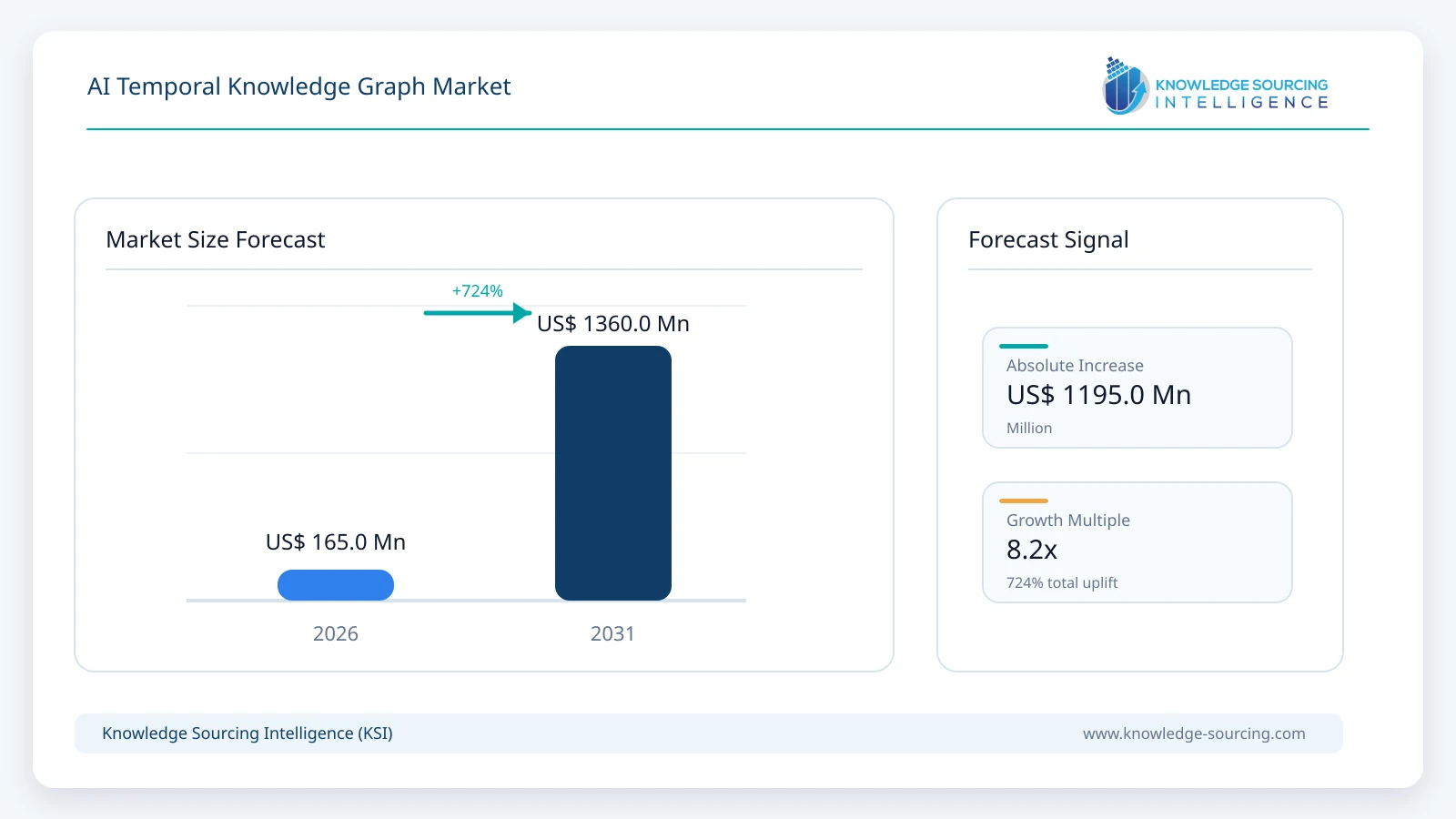
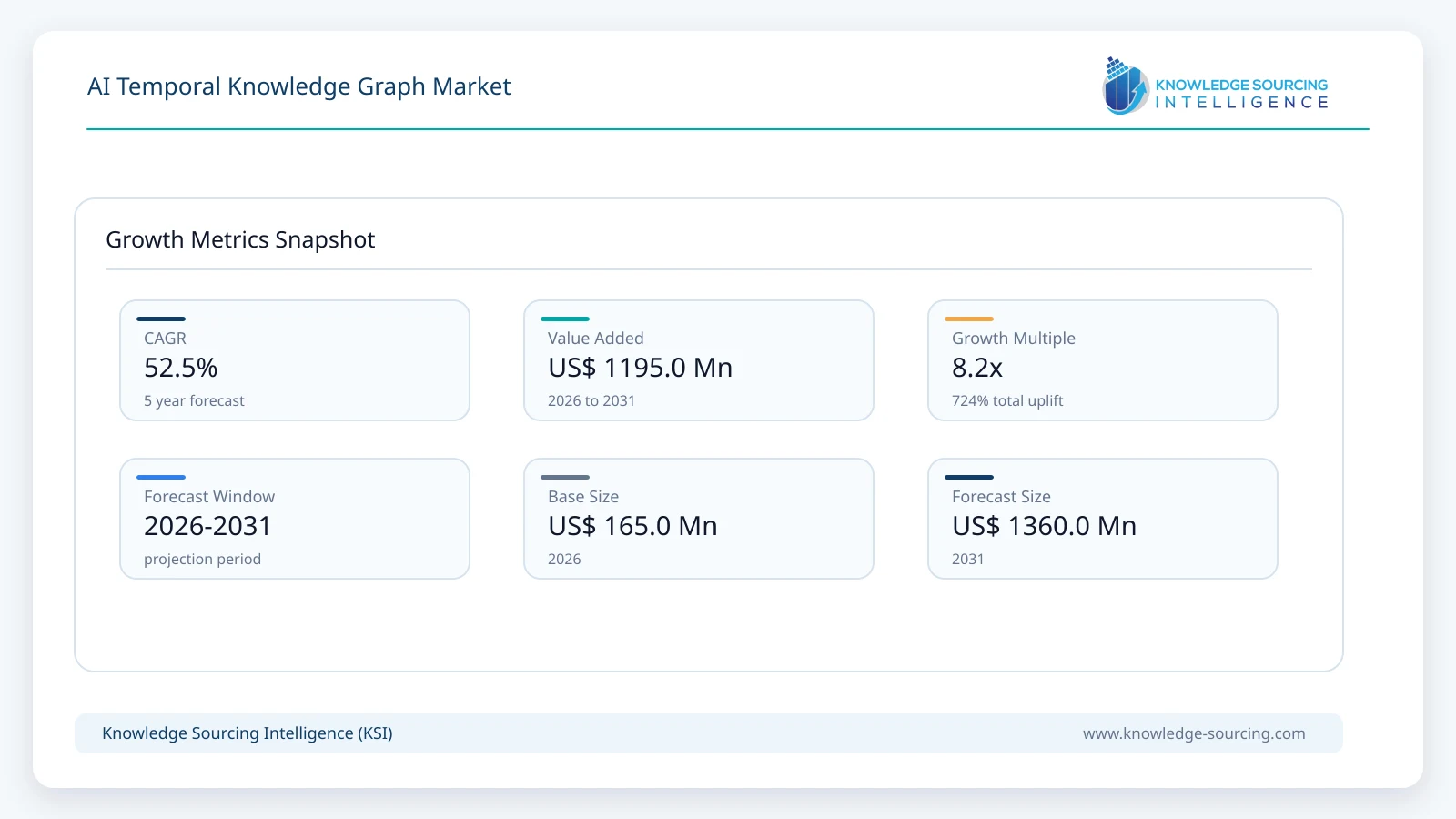
The AI Temporal Knowledge Graph Market is estimated to grow from USD 165 million in 2026 to USD 1,360 million by 2031, at a CAGR of 52.48% during the forecast period.
Highlights:
- 1Bitemporal validity and change-aware fact management account for a central share of premium temporal graph functionality.
- 2Dedicated temporal graph platform subscriptions lead the modeled commercial offering mix, while managed processing grows through consumption pricing.
- 3North America leads 2026 spending; Asia Pacific records the fastest modeled expansion as cloud and enterprise AI adoption broadens.
- 4Historical provenance and contradiction handling support differentiated value in regulated and operational settings.
- 5Provider competition emphasizes accurate chronology, source traceability, governance and incremental revenue rather than graph size alone.
The market measures attributable paid capabilities for time-aware graph modeling, continuous updates, historical queries and temporal data governance rather than total graph-database or agent-memory sales.
Temporal knowledge graphs attach dates, validity windows and source evidence to entities and relationships. A system can distinguish when an event happened from when it was recorded, preserve corrected facts and reconstruct a past graph state. These features support enterprise assistants, financial investigations, customer intelligence and workflows in which treating old relationships as current could lead to poor decisions.
The study evaluates seven independent segmentation views covering offering, temporal function, graph architecture, deployment, data source, application and end-user industry. Country-level estimates sit within five regions, with market definitions and participant coverage separated from adjacent agentic graph, semantic memory, retrieval optimization and knowledge graph reasoning markets.
AI systems using enterprise knowledge need to understand not only how two entities are related but whether the relationship applied at the time a decision was made. A supplier relationship can end, a customer account can change ownership and a policy can be replaced before an agent receives an updated record. Temporal knowledge graphs preserve these changes as related historical states rather than allowing different versions to compete in retrieval results.
Product releases during 2026 show several routes toward that capability. Zep uses Graphiti to maintain bitemporal context graphs, SurrealDB Agent Memory captures multiple dimensions of time, and Cognee provides temporal extraction and contradiction-aware handling. NOSIBLE Atlas applies historical evidence to wider commercial entity relationships, indicating demand outside personal assistants.
Commercial deployment remains closely connected to graph databases, memory APIs, GraphRAG and enterprise context platforms. Providers are competing to make temporal processing, historical relationship services and validity management accessible without replacing existing data infrastructure. Buyers will evaluate whether the additional time-aware capabilities deliver sufficient benefits in accuracy, historical consistency and operational governance.
Market Trends
Bi-Temporal Validity Becomes Part of Agent Context
AI memory platforms are moving beyond last-updated timestamps toward separate records for when a fact was valid and when a system learned it. Zep Graphiti uses validity intervals and source-linked episodes so an agent can reconstruct the known state of an account on an earlier date. SurrealDB Agent Memory extends the approach with a third time axis for the system’s belief history, reflecting growing demand for verifiable state changes.
Enterprise buyers increasingly test whether a platform can explain corrections, backdated events and conflicting reports instead of returning only the most recent text. The commercial benefit is strongest in customer records, compliance workflows and continuously changing business knowledge, where storing a previous value is insufficient unless the prior relationship can be retrieved with its original evidence.
Historical Graph Processing Moves Into Managed Infrastructure
Temporal knowledge graphs are being offered through managed context layers, graph services and composable retrieval APIs rather than only custom database schemas. Zep’s Konig architecture is designed for many separate governed temporal graphs, while Neo4j Context Engine adds an enterprise knowledge layer for agent reasoning. GreyCat offers a different approach by unifying graph and time-series structures in one database.
Managed adoption depends on more than latency. Users want reliable corrections when data arrives out of sequence, transparent provenance, tenant isolation and policy-based retention. Providers able to distinguish their premium temporal functions from generic graph traversal or vector retrieval will have a clearer monetization opportunity.
Change-Aware Retrieval Extends Into Industry Workflows
Time-aware retrieval is moving into applications that need to explain how a condition, entity or relationship evolved. NOSIBLE Atlas demonstrates point-in-time evidence across ownership, supply and policy relationships, while Cognee supports temporal extraction and non-destructive handling of superseded facts. These approaches can connect AI assistants to evolving records rather than isolated document snapshots.
Commercial implementations increasingly prioritize practical event chronology and historical consistency over large undifferentiated graph stores. Financial teams may reconstruct an account relationship before a transaction, while manufacturers may examine a supplier or component dependency during a past incident. Each use case requires careful treatment of observation time and source confidence.
AI Temporal Knowledge Graph Market Segment Analysis
By Commercial Offering
Temporal graph platform subscriptions
Paid temporal modeling entitlements combine versioned relationships with production graph access and governance. The category captures attributable premium platform capability rather than the underlying database subscription. The segment is estimated to increase from USD 65.00 million in 2026 to USD 520.00 million in 2031, as deployments extend from pilot applications toward repeatable production workloads.
Specialized subscriptions appeal to buyers that require guaranteed update throughput, history retention and permission-aware audit logs. Usage-based APIs broaden access for smaller development teams, while private installations remain relevant for regulated data.
By Temporal Function
Valid-time and bitemporal fact management
Valid-time and transaction-time tracking establishes whether a statement was true in the world and when the system learned it, enabling reliable corrections without discarding earlier evidence. The segment is estimated to increase from USD 51.15 million in 2026 to USD 394.40 million in 2031, as deployments extend from pilot applications toward repeatable production workloads.
Temporal validity controls must handle observations received after an event and statements that are later corrected. Historical retrieval and provenance modules become more valuable as customers test whether past graph states can be reconstructed consistently.
By Graph Architecture
Temporal property-graph representation
Property-graph approaches retain event dates and relationship validity as edge and node attributes, making them accessible to operational applications and existing graph developer teams. The segment is estimated to increase from USD 69.30 million in 2026 to USD 489.60 million in 2031, as deployments extend from pilot applications toward repeatable production workloads.
Property-graph deployments can extend existing enterprise relationship models with date and validity fields, while RDF and hybrid approaches offer alternatives for ontology-driven environments. Architecture selection depends on update frequency, historical-query patterns and semantic governance requirements.
By Deployment Model
Managed cloud and consumption APIs
Managed services provide ingestion, history updates and time-aware retrieval without requiring each enterprise to operate a specialized graph runtime. The segment is estimated to increase from USD 79.20 million in 2026 to USD 775.20 million in 2031, as deployments extend from pilot applications toward repeatable production workloads.
Managed temporal services reduce operational work for organizations maintaining many subject-level graphs. Hybrid and on-premises installations retain a role when historical records are subject to data-residency rules or strict separation across business units.
By Primary Data Source
Enterprise transactional and operational records
Operational records create frequent changes in customer, contract, asset and ownership states, supporting a repeatable need for current-state and point-in-time graphs. The segment is estimated to increase from USD 49.50 million in 2026 to USD 435.20 million in 2031, as deployments extend from pilot applications toward repeatable production workloads.
Transactional systems frequently provide timestamps that simplify historical reconstruction, but conversation transcripts and documents require extraction of implied event dates. Integrating these different timelines is a substantial source of technical differentiation.
By Primary Application
Change-aware agent and customer memory
Customer and agent memory systems benefit when historical facts remain auditable but expired relationships are excluded from current decisions. The segment is estimated to increase from USD 51.15 million in 2026 to USD 435.20 million in 2031, as deployments extend from pilot applications toward repeatable production workloads.
Agent memory has an immediate need to separate current preferences from superseded statements; risk teams require additional evidence about when relationships became known. The value of temporal graphs increases when users can verify both forms of historical truth.
By End-User Industry
Technology, software and cloud providers
Software companies are early adopters because agent memory, knowledge services and governed context APIs can be embedded directly into commercial products. The segment is estimated to increase from USD 57.75 million in 2026 to USD 448.80 million in 2031, as deployments extend from pilot applications toward repeatable production workloads.
Technology vendors can integrate temporal processing into cloud applications, while banks and industrial operators require more stringent auditability and continuity. The industry’s commercial mix will reflect these differences in implementation complexity and governance.
Market Drivers
Growing Need for Current and Historical AI Context
Enterprise agents encounter changing account records, policies, team structures and supplier relationships. Time-valid facts help the same agent distinguish a current instruction from an old one, reducing the risk of applying superseded information to a live decision.
Demand for Auditable Temporal Evidence
Financial investigations, compliance reviews and service disputes require proof of what was known at a particular point in time. Bi-temporal provenance can connect a relationship to the episode that established it and the date at which the system learned it.
Growth in Persistent Agent Memory and GraphRAG
Agent memory is shifting from unstructured conversation archives toward entity-linked context. Time-aware graphs can preserve earlier states while exposing only current facts to normal retrieval, creating a commercial role for temporal processing and query APIs.
Incremental Event and Operational Data Integration
Customer systems, logistics platforms and operational telemetry generate continuous updates. Incremental graph ingestion and relationship expiration reduce the cost of rebuilding full knowledge graphs after each change.
Availability of Managed Temporal Graph Services
Managed services reduce deployment effort by bundling extraction, history handling, search and governance. Zep and SurrealDB demonstrate market delivery mechanisms, while Neo4j and cloud graph providers supply adjacent infrastructure and enterprise distribution.
Market Restraints
Bundling with Graph Databases and Memory Platforms
Temporal graphs are commonly sold inside broader graph, memory or context subscriptions, making incremental price realization difficult. Customers may struggle to assess the added value of temporal processing when suppliers bundle it with other capabilities.
Inaccurate Event Times and Conflicting Sources
Natural-language sources often omit dates or describe events retrospectively. Systems can record ingestion time accurately while still misinterpreting when a fact became valid, weakening historical answers and auditability.
Data Residency, Retention and Access Constraints
Historical graphs may retain information after a business relationship has ended or a user requests deletion. Organizations must combine audit needs with privacy, access control and contractual retention requirements.
Higher Storage and Update Processing Complexity
Keeping older graph states and source episodes creates additional writes, history indexes and governance work. Buyers may reject high-cost implementations when current-state retrieval already solves their use case.
Competition from Custom Temporal Schemas and Open Source
Organizations can add timestamps and versioned edges to existing databases without licensing a separate temporal platform. Graphiti and other open-source tools increase functional availability but also exert pressure on paid differentiation.
Regional Outlook
North America
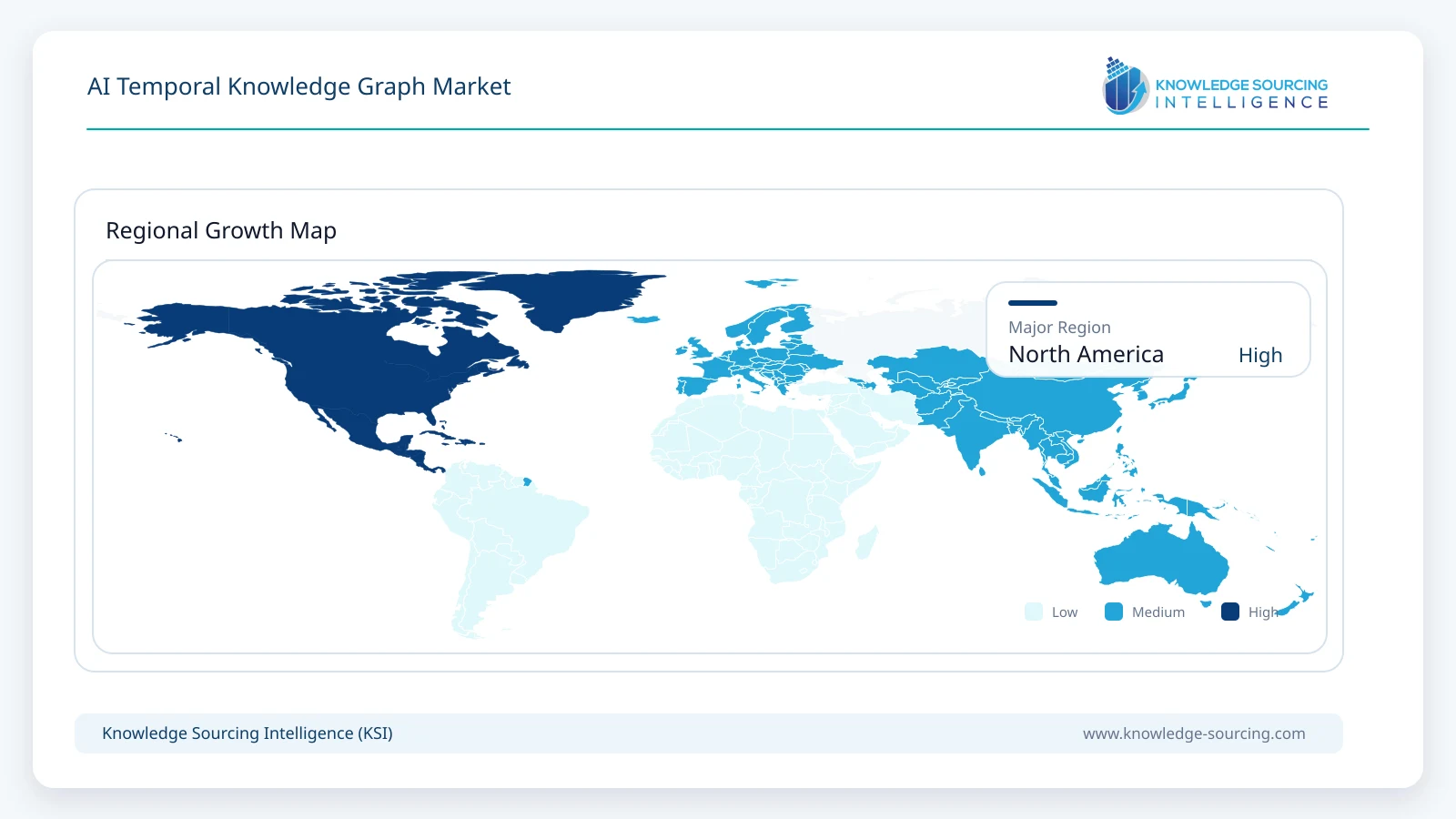
North America is the leading regional market, with revenue of USD 66.00 million in 2026 and USD 476.00 million by 2031. Enterprise graph investment, cloud development and high-stakes information workflows support demand for historical account views, auditable data relationships and production agent context. The United States accounts for most regional spending, while Canadian technology and financial-service deployments add demand for governed graph services.
Regional suppliers and enterprise buyers are increasingly concerned with time-valid evidence and permission-aware retrieval, particularly when multiple systems disagree about a business event. Zep, Neo4j and cloud graph infrastructure have significant product relevance, although their published company revenues cannot be treated as the size of this narrow temporal segment. Procurement will favor tools that demonstrate accurate backdated updates and predictable usage fees.
Asia Pacific
Asia Pacific is the fastest-growing regional market, increasing from USD 39.60 million in 2026 to USD 448.80 million in 2031. China, Japan, India and South Korea combine expanding enterprise AI development with graph-intensive manufacturing, digital services and complex supply networks. Demand for changing product, customer and operational states can support wider use of temporal graph applications over the forecast period.
Cloud-native deployment, data residency and multilingual extraction will shape adoption across Asia Pacific. Enterprises may prefer hybrid or private configurations when historical customer data and regulated records cannot move across jurisdictions. The commercial opportunity is strongest where time-aware context improves decisions enough to justify a premium over ordinary graph or vector search infrastructure.
Competitive Landscape
The competitive environment combines specialized temporal context vendors with general-purpose graph and contextual-data platforms. Zep and SurrealDB have explicit time-aware agent-memory capabilities, while Cognee, NOSIBLE and GreyCat emphasize temporal knowledge representations for different workloads. Neo4j, AWS and Arango provide wider graph distribution and adjacent capabilities that may be used to implement temporal services.
Competitive differentiation depends on bitemporal accuracy, data lineage, change-update throughput, graph-specific access controls and the economics of operating many changing graphs. Pricing ranges from credited episode ingestion to contracted graph services and dedicated enterprise deployments. Enterprise contracts may include several capabilities, increasing the importance of clear service tiers and measurable temporal benefits.
Recent Developments
October 2026: Neo4j introduced Context Engine, a shared knowledge layer that makes connected enterprise concepts available to AI agents.
October 2026: Zep released its v4 Context API with connected graph navigation and ingestion traces for agent-facing context.
October 2026: SurrealDB introduced Agent Memory with time-aware state, provenance and graph relationships in one managed application layer.
October 2026: Cognee documented its temporal-memory workflow with timestamp nodes, historical validity handling and contradiction-aware recall.
September 2026: NOSIBLE launched Atlas, a point-in-time knowledge graph connecting entity relationships to historical evidence.
August 2026: Zep detailed Konig, its governed graph data plane supporting bitemporal facts and point-in-time retrieval.
Market Outlook
AI Temporal Knowledge Graph spending is forecast to expand as enterprises connect agent-facing knowledge to evolving business state and historical records. Applications that need to answer what was true at a particular date will drive demand for valid-time processing, non-destructive corrections and source-grounded relationship history. Managed deployment can reduce the technical effort needed to implement those functions.
Product providers will compete to embed temporal reasoning and provenance into existing memory, graph and retrieval workflows. Differentiated value will come from reliable event chronology, access-controlled history and lower-cost incremental updates, rather than from graph storage capacity alone. Open-source frameworks will remain influential because they allow customers to evaluate temporal performance before accepting premium commercial contracts.
Enterprise governance requirements, unclear event dates and bundled pricing may constrain the pace of adoption. Expansion into customer intelligence, historical investigations and industrial event analysis should create opportunities for suppliers able to demonstrate the accuracy and operating benefits of time-aware knowledge services.
AI Temporal Knowledge Graph Market Scope:
| Report Metric | Details |
|---|---|
| Total Market Size in 2026 | USD 165 million |
| Total Market Size in 2031 | USD 1,360 million |
| Forecast Unit | USD Million |
| Growth Rate | 52.48% |
| Study Period | 2021 to 2031 |
| Historical Data | 2021 to 2024 |
| Base Year | 2025 |
| Forecast Period | 2026 – 2031 |
| Segmentation | Commercial Offering, Temporal Function, Graph Architecture, Deployment Model, Primary Data Source, Primary Application, End-User Industry, Geography |
| Companies |
|
| Customization Scope | 15% Free Customization included with purchase — Request Custom Breakdown → |
| Sample & Data Access | PDF Sample, Excel Databook & Analyst Briefing — Download Free Sample → |
Market Segmentation
By Commercial Offering
Temporal Graph Platform Subscriptions
Managed Temporal Processing and Query APIs
History and Governance Add-ons
Private and Vertical Temporal Deployments
By Temporal Function
Valid-Time and Bitemporal Fact Management
Incremental Event-to-Graph Updates
Historical State Querying and Time-Aware Retrieval
Provenance and Contradiction Resolution
Temporal Prediction and Event-Chain Reasoning
By Graph Architecture
Temporal Property-Graph Representation
RDF and Ontology-Driven Temporal Graph
Hybrid Graph-Vector Temporal Context
Multimodel Event, Document and Graph Architecture
By Deployment Model
Managed Cloud and Consumption APIs
Hybrid and Dedicated Private Cloud
On-Premises and Self-Managed
By Primary Data Source
Enterprise Transactional and Operational Records
Agent Conversations and Interaction Episodes
Streaming Events and Machine Telemetry
Documents, Policies and External Knowledge Feeds
By Primary Application
Change-Aware Agent and Customer Memory
Risk, Fraud and Historical Investigations
Enterprise Decision and Knowledge Assistance
Operational and Supply-Chain Event Intelligence
Scientific, Healthcare and Research Timelines
By End-User Industry
Technology, Software and Cloud Providers
Banking, Financial Services and Insurance
Healthcare, Pharma and Life Sciences
Manufacturing, Energy and Logistics
Government and Public Administration
Retail, Telecom and Other Services
By Geography
North America
United States
Canada
Mexico
South America
Brazil
Argentina
Rest of South America
Europe
Germany
United Kingdom
France
Netherlands
Italy
Spain
Rest of Europe
Middle East and Africa
United Arab Emirates
Saudi Arabia
Israel
South Africa
Rest of Middle East and Africa
Asia Pacific
China
Japan
India
South Korea
Australia
Singapore
Rest of Asia Pacific
Table of Contents
EXECUTIVE SUMMARY
1.1. Research Highlights
1.2. Market Size and Growth Outlook, 2026–2031
1.3. Strategic Market Perspective
2. MARKET SNAPSHOT
2.1. Market Overview
2.2. Market Definition
2.3. Scope of the Study
2.4. Market Segmentation
3. BUSINESS LANDSCAPE
3.1. Market Drivers
3.1.1. Growing Need for Current and Historical AI Context
3.1.2. Demand for Auditable Temporal Evidence
3.1.3. Growth in Persistent Agent Memory and GraphRAG
3.1.4. Incremental Event and Operational Data Integration
3.1.5. Availability of Managed Temporal Graph Services
3.2. Market Restraints
3.2.1. Bundling with Graph Databases and Memory Platforms
3.2.2. Inaccurate Event Times and Conflicting Sources
3.2.3. Data Residency, Retention and Access Constraints
3.2.4. Higher Storage and Update Processing Complexity
3.2.5. Competition from Custom Temporal Schemas and Open Source
3.3. Market Opportunities
3.4. Porter’s Five Forces Analysis
3.5. Industry Value Chain Analysis
3.6. Policies and Regulations
3.7. Strategic Recommendations
4. TECHNOLOGICAL OUTLOOK
4.1. Valid-Time and Transaction-Time Modeling
4.2. Streaming Entity and Relationship Updates
4.3. Historical Graph Traversal and Point-in-Time Queries
4.4. Temporal Contradiction Handling and Provenance
4.5. Governance, Retention and Temporal Reasoning
5. AI TEMPORAL KNOWLEDGE GRAPH MARKET BY COMMERCIAL OFFERING
5.1. Introduction
5.2. Temporal graph platform subscriptions
5.3. Managed temporal processing and query APIs
5.4. History and governance add-ons
5.5. Private and vertical temporal deployments
6. AI TEMPORAL KNOWLEDGE GRAPH MARKET BY TEMPORAL FUNCTION
6.1. Introduction
6.2. Valid-time and bitemporal fact management
6.3. Incremental event-to-graph updates
6.4. Historical state querying and time-aware retrieval
6.5. Provenance and contradiction resolution
6.6. Temporal prediction and event-chain reasoning
7. AI TEMPORAL KNOWLEDGE GRAPH MARKET BY GRAPH ARCHITECTURE
7.1. Introduction
7.2. Temporal property-graph representation
7.3. RDF and ontology-driven temporal graph
7.4. Hybrid graph-vector temporal context
7.5. Multimodel event, document and graph architecture
8. AI TEMPORAL KNOWLEDGE GRAPH MARKET BY DEPLOYMENT MODEL
8.1. Introduction
8.2. Managed cloud and consumption APIs
8.3. Hybrid and dedicated private cloud
8.4. On-premises and self-managed
9. AI TEMPORAL KNOWLEDGE GRAPH MARKET BY PRIMARY DATA SOURCE
9.1. Introduction
9.2. Enterprise transactional and operational records
9.3. Agent conversations and interaction episodes
9.4. Streaming events and machine telemetry
9.5. Documents, policies and external knowledge feeds
10. AI TEMPORAL KNOWLEDGE GRAPH MARKET BY PRIMARY APPLICATION
10.1. Introduction
10.2. Change-aware agent and customer memory
10.3. Risk, fraud and historical investigations
10.4. Enterprise decision and knowledge assistance
10.5. Operational and supply-chain event intelligence
10.6. Scientific, healthcare and research timelines
11. AI TEMPORAL KNOWLEDGE GRAPH MARKET BY END-USER INDUSTRY
11.1. Introduction
11.2. Technology, software and cloud providers
11.3. Banking, financial services and insurance
11.4. Healthcare, pharma and life sciences
11.5. Manufacturing, energy and logistics
11.6. Government and public administration
11.7. Retail, telecom and other services
12. AI TEMPORAL KNOWLEDGE GRAPH MARKET BY GEOGRAPHY
12.1. North America
12.1.1. United States
12.1.2. Canada
12.1.3. Mexico
12.2. South America
12.2.1. Brazil
12.2.2. Argentina
12.2.3. Rest of South America
12.3. Europe
12.3.1. Germany
12.3.2. United Kingdom
12.3.3. France
12.3.4. Netherlands
12.3.5. Italy
12.3.6. Spain
12.3.7. Rest of Europe
12.4. Middle East and Africa
12.4.1. United Arab Emirates
12.4.2. Saudi Arabia
12.4.3. Israel
12.4.4. South Africa
12.4.5. Rest of Middle East and Africa
12.5. Asia Pacific
12.5.1. China
12.5.2. Japan
12.5.3. India
12.5.4. South Korea
12.5.5. Australia
12.5.6. Singapore
12.5.7. Rest of Asia Pacific
13. COMPETITIVE ENVIRONMENT AND ANALYSIS
13.1. Major Players and Strategy Analysis
13.2. Market Share Analysis
13.3. Mergers, Acquisitions, Agreements, and Collaborations
13.4. Competitive Dashboard
14. COMPANY PROFILES
14.1. Zep AI
14.2. SurrealDB
14.3. Neo4j, Inc.
14.4. Cognee
14.5. NOSIBLE
14.6. GreyCat
14.7. Amazon Web Services, Inc.
14.8. Arango
14.9. Graphwise
14.10. TypeDB
15. APPENDIX
15.1. Currency
15.2. Assumptions
15.3. Base and Forecast Years Timeline
15.4. Key Benefits for Stakeholders
15.5. Research Methodology
15.6. Abbreviations





Frequently asked questions
What is the projected AI Temporal Knowledge Graph market size by 2031?
The AI Temporal Knowledge Graph Market is projected to reach USD 1,360 million by 2031.
What is the Compound Annual Growth Rate (CAGR) for 2026-2031?
The AI Temporal Knowledge Graph Market is forecast to grow at a 52.48% CAGR.
Which regions lead initial spending and fastest expansion?
North America leads 2026 spending; Asia Pacific shows fastest expansion.
What are core capabilities of AI Temporal Knowledge Graphs?
They attach dates, validity windows, and source evidence to entities.
What critical business problems do temporal knowledge graphs solve?
They prevent poor decisions from old relationships in financial, customer intelligence.
How is the AI Temporal Knowledge Graph market evaluated?
The AI Temporal Knowledge Graph Market evaluates seven segments including offering, deployment, and end-user industry.
Cite this report
Knowledge Sourcing Intelligence. (Oct 2026). AI Temporal Knowledge Graph Market Size, Share & Growth Forecast (2026-2031). https://www.knowledge-sourcing.com/report/ai-temporal-knowledge-graph-market