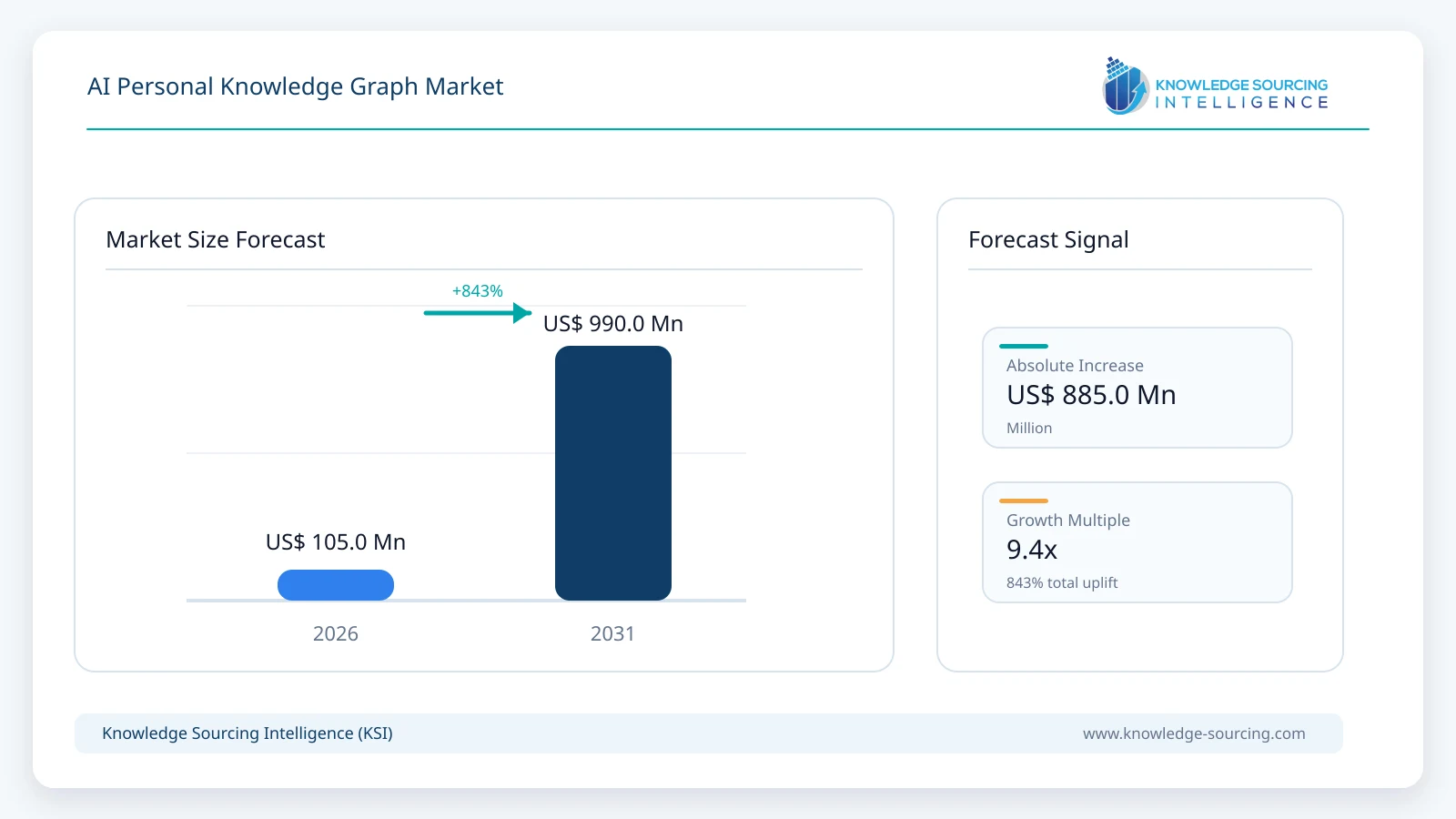
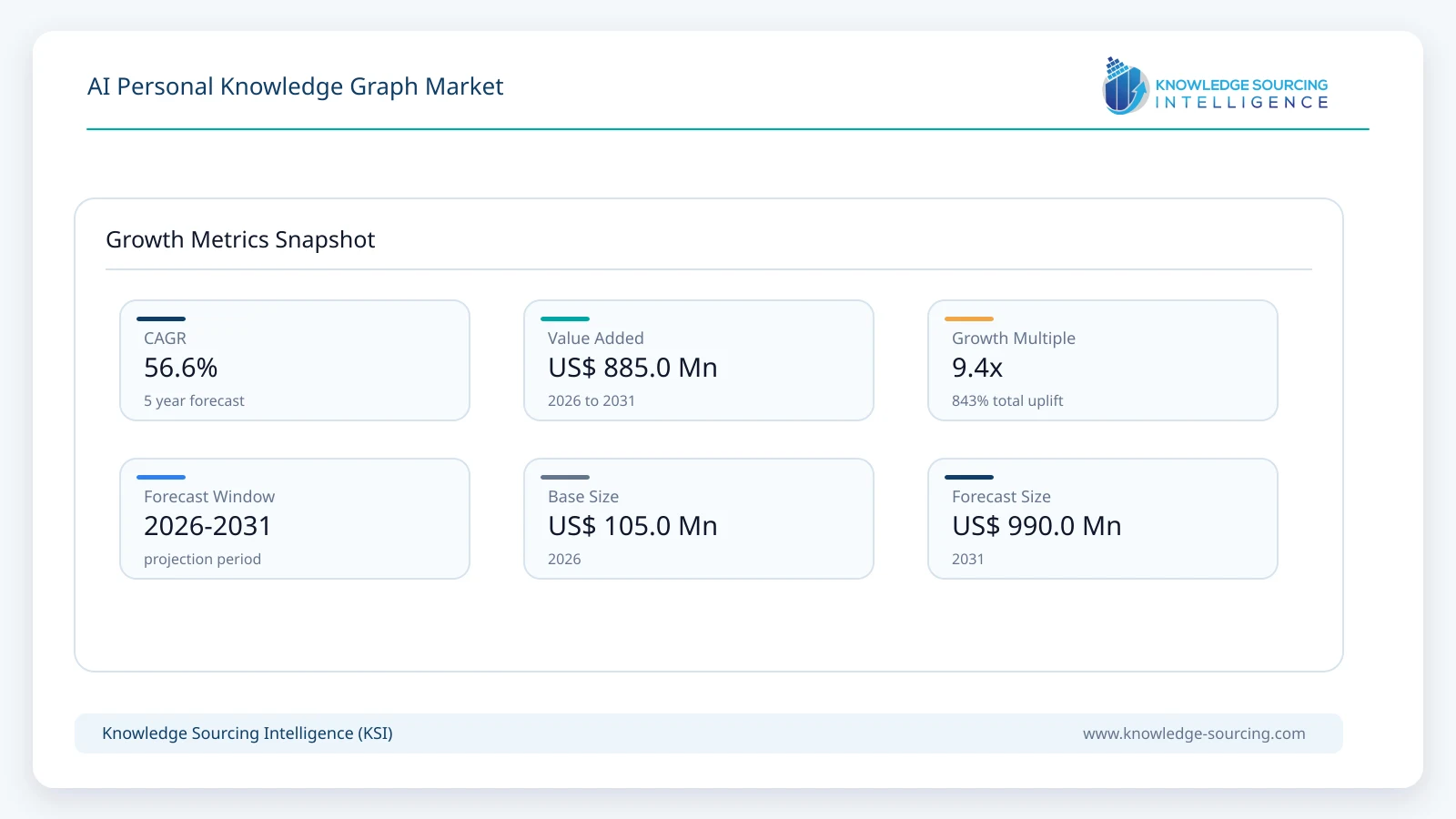
The AI Personal Knowledge Graph Market is projected to grow from USD 105 million in 2026 to USD 990 million by 2031, at a CAGR of 56.64% during the forecast period.
Highlights:
- 1Dedicated user-graph subscriptions form the largest modeled commercial stream in 2026, while managed API packs broaden application-level adoption.
- 2Entity and relationship extraction remains the leading function, with preference maintenance and cross-session graph traversal supporting recurring demand.
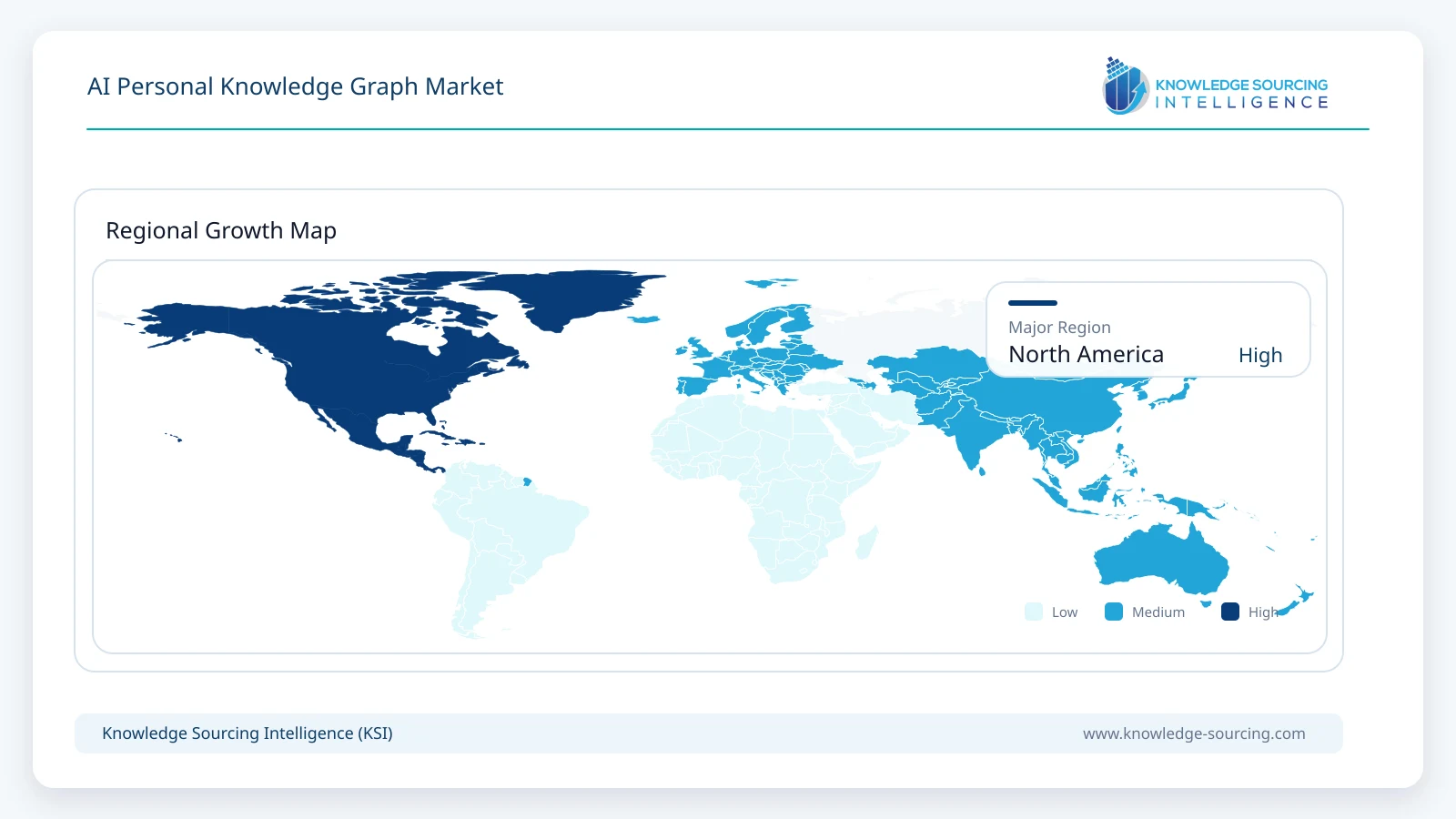
- 3North America leads in the base year; Asia Pacific records the fastest modeled expansion as AI applications scale across major markets.
- 4Graph-vector hybrids provide a practical architecture for linking personal facts with unstructured documents and conversation histories.
- 5User-controlled permissions, source traceability and correction of superseded facts increasingly shape supplier differentiation.
This market covers attributable paid software for person-scoped knowledge graphs, graph-based memory APIs, profile correction, connected personal facts and governed cross-application retrieval.
Personal knowledge graphs organize entities such as people, organizations, events, projects and preferences around a particular user identity. The study excludes unstructured chat history, basic profile settings, ordinary vector search and entire AI assistant subscription revenue.
Seven independent segmentations evaluate commercial offering, graph function, data architecture, deployment, knowledge source, application and end-user industry. Five-region and country allocations support geographic analysis, while the competitive landscape emphasizes direct suppliers with personal graph memory, relationship retrieval or identity-scoped memory infrastructure.
AI assistants that retain isolated messages often struggle to explain connections between a user’s ongoing work, collaborators and previous decisions. A personal knowledge graph provides a structured representation of those links so that retrieval can move from a known person or project to related preferences, commitments and source evidence. The improvement is commercially meaningful when the same assistant serves a user over many separate tasks and sessions.
Commercial activity in 2026 illustrates the transition from general memory stores toward linked user context. Mem0 now offers native graph memory as a paid platform feature, and Zep’s governed user graphs separate personal facts from shared account information. SurrealDB Agent Memory supports relationship records and history, while FalkorDB demonstrates graph-based memory patterns that preserve sources and isolate agent knowledge. These products create infrastructure choices for developers building personalized services.
Commercial offerings increasingly combine graph construction, semantic retrieval and governance in unified memory subscriptions. Buyers assess whether relationship navigation, profile correction and portable identity controls improve assistant results enough to justify higher service tiers. Suppliers that make these advantages easy to test can differentiate premium graph capabilities from basic memory features.
Market Trends
Personal Facts Become Connected Graph Entities
Personal AI memory is moving beyond storing isolated conversational notes toward a structured view of people, organizations, commitments, topics and past decisions. Mem0’s native graph memory identifies entities across memory entries, while Zep’s Context Graphs connect facts to the episodes from which they were extracted. These structures allow an assistant to answer relationship questions involving several conversations rather than simply matching a single passage.
The commercial value of entity-linked memory depends on how accurately the system resolves names and keeps relationships current. A user may work on several client projects with similar contacts, and an incorrect entity merge can contaminate later responses. Buyers therefore assess provenance, correction controls and relevant-fact retrieval alongside memory latency.
Cross-Application Personal Graphs Gain Identity Controls
Personal context is increasingly expected to follow a person between the AI tools used for development, writing and routine work. Zep introduced a governed memory MCP server that gives authorized clients access to the same user graph, while Membase markets one memory available to connected AI applications. This creates an opportunity for consent-aware memory services that are independent of any single model interface.
Shared access also increases the burden of authorization. Graph information must remain separated by user, project and organization, and permissions may change when a user switches roles or revokes a connection. Enterprise buyers will prefer services that attach policy checks to graph retrieval instead of assuming every connected agent can access every remembered fact.
Temporal Corrections and Profile Governance Become Core Features
Personal graphs must handle facts that cease to be true. Mem0’s October 2026 guidance describes event time, superseded memory and expiry controls; Zep attaches temporal validity to relationship records, and SurrealDB Agent Memory supports historical state. These technologies help distinguish a current work location or preference from a previous statement without erasing the history needed for a dated question.
Profile governance is becoming a differentiator because personal context is unusually sensitive. Data minimization, access logs, source-linked corrections and deletion pathways can create value for large-scale deployments. Suppliers must avoid presenting graph extraction as a substitute for a clear consent model or for application-level authorization rules.
AI Personal Knowledge Graph Market Segment Analysis
By Commercial Offering
Dedicated user-graph platform subscriptions
Dedicated user-graph subscriptions represent the largest base-year revenue stream because organizations require persistent identity, graph indexing and audit controls before they can deliver repeatable personalized services. The segment is estimated at USD 38.00 million in 2026 and is forecast to reach USD 330.00 million in 2031, supported by the expansion of production graph-memory deployments and rising numbers of recurring application users.
Managed extraction and retrieval packs expand as app developers move from prototype-level memory to greater numbers of active user graphs. Governance and private installations gain importance where personal records are linked to workplace systems.
By Knowledge Graph Function
Personal entity and relationship extraction
Entity and relationship extraction converts user episodes into linked facts that support subsequent preference recall, person-centric traversal and context assembly for AI assistants. The segment is estimated at USD 31.50 million in 2026 and is forecast to reach USD 267.30 million in 2031, supported by the expansion of production graph-memory deployments and rising numbers of recurring application users.
Preference maintenance and cross-session traversal gain share as existing graphs grow in complexity. Temporal corrections and provenance are not optional in high-trust use cases because an outdated preference can be as damaging as missing information.
By Graph Data Architecture
Graph-vector hybrid memory
Hybrid architectures combine graph traversal for relationships with semantic retrieval for unstructured messages, allowing products to support flexible queries without forcing every personal fact into a rigid ontology. The segment is estimated at USD 39.90 million in 2026 and is forecast to reach USD 356.40 million in 2031, supported by the expansion of production graph-memory deployments and rising numbers of recurring application users.
Property graphs and graph-vector combinations are likely to coexist with typed ontology approaches. Federated personal-and-shared graphs become more relevant when a task needs both a user preference and an authorized team or account record.
By Deployment Model
Managed cloud APIs
Managed APIs offer application developers a quicker route to per-user graph creation, identity-scoped retrieval and scalable lifecycle management than custom graph stacks. The segment is estimated at USD 54.60 million in 2026 and is forecast to reach USD 594.00 million in 2031, supported by the expansion of production graph-memory deployments and rising numbers of recurring application users.
Dedicated private deployments retain an important role in regulated business environments. Self-managed installations may persist for teams requiring data residency, but managed services can spread extraction and maintenance costs across larger customer bases.
By Primary Knowledge Source
AI conversation and interaction history
Conversation histories provide early training-free evidence of personal preferences, contacts and working patterns; the main revenue opportunity lies in converting that material into reliable, permissioned relationships. The segment is estimated at USD 37.80 million in 2026 and is forecast to reach USD 316.80 million in 2031, supported by the expansion of production graph-memory deployments and rising numbers of recurring application users.
Work documents and support histories become more important when personal graphs serve business professionals and customer-facing teams. Behavioral events require careful limits on inferred attributes and consent, rather than indiscriminate collection.
By Application
AI assistants and personal productivity
Personal productivity applications can use connected facts about projects, people and routines to reduce repeated setup and improve long-running assistance. The segment is estimated at USD 37.80 million in 2026 and is forecast to reach USD 326.70 million in 2031, supported by the expansion of production graph-memory deployments and rising numbers of recurring application users.
Customer relationship support and professional research assistance generate linked user, account and project knowledge. Personalized healthcare and learning use cases carry higher requirements for accuracy, appropriate permissions and transparent data use.
By End-User Industry
AI software and cloud platforms
AI platform developers are natural early customers because graph-aware personalization can be embedded into many assistant products and sold through APIs or premium memory features. The segment is estimated at USD 36.75 million in 2026 and is forecast to reach USD 316.80 million in 2031, supported by the expansion of production graph-memory deployments and rising numbers of recurring application users.
Business services and healthcare adopters require stronger governance than many consumer use cases. Consumer application providers will emphasize low-cost retrieval, while enterprise software providers will emphasize integration and auditability.
Market Drivers
Demand for User-Specific AI Continuity
AI assistants lose usefulness when every conversation begins without knowledge of a person’s projects, commitments and preferences. User-centered graphs connect facts across previous interactions so assistants can distinguish a recurring preference from a one-time request. Commercial developers can charge for this continuity when it improves repeat engagement and task completion.
Need to Connect Preferences with People and Work Context
Personalized recommendations often require relationships rather than isolated facts. A professional contact, an active project and a previous decision may belong to the same user situation but live in different applications. Graph extraction and identity resolution let assistants traverse those links without importing the entire personal archive into each model call.
Growth in Cross-Agent and Multi-Application Memory
Users increasingly interact with coding agents, workplace assistants and consumer applications that each maintain separate context. Zep’s governed user-graph MCP integration and Membase’s shared personal memory model show how a common graph can reduce repeated instruction and context transfer across tools while enforcing application-level access.
Commercialization of Managed Graph Memory APIs
Mem0 places graph entity linking inside a paid plan, while Zep supplies managed Context Graph services and SurrealDB publishes memory-service tiers. These mechanisms give developers purchase options instead of requiring every team to build extraction, identity resolution and graph retrieval infrastructure independently.
Stronger Requirements for Explainable Personalization
Users and regulated organizations need to know why a recommendation referenced a personal fact, where the information came from and whether it remains valid. Provenance-linked graph edges, date-aware corrections and user-scoped deletion make personalized assistants easier to audit and can support differentiated governance packages.
Market Restraints
Privacy, Consent and Sensitive Profile Exposure
A personal knowledge graph may join fragments from conversations, browsing, work files and support interactions into a detailed profile. Explicit consent, tenant boundaries and reliable deletion are essential and increase implementation cost.
Unreliable Entity Matching and Inferred Relationships
A mistaken identity merge can connect the wrong contact, preference or project to a user and then propagate the error through retrieval. AI-based extraction also creates unsupported edges when sources are ambiguous. Graph products need correction workflows and source traceability before buyers can trust personalization.
Overlap with Bundled Memory and Consumer AI Features
Foundation-model assistants and software suites increasingly include memories and personalized settings without separate graph fees. Buyers may not pay extra for a graph unless multi-hop retrieval, portability and governance demonstrate measurable improvement over those included functions.
Data Portability and Cross-Application Authorization
Transferring a personal graph between apps requires consistent identifiers, schemas and access policies. A workplace assistant should not inherit all information available to a private consumer app. Permission checking and revocation across graph links remain operational barriers, especially in enterprise deployments.
Uncertain Economics for High-Frequency Graph Updates
Graph building can require entity extraction, embedding, conflict detection and frequent re-ranking after user events. Small customers may avoid paid graph layers if the processing cost grows faster than measurable engagement or productivity benefits. Open-source alternatives also limit premium pricing.
Regional Outlook
North America
North America is the largest regional market, with estimated revenue of USD 45.15 million in 2026 and USD 366.30 million in 2031. The United States hosts a substantial portion of the AI software, cloud and developer-tool ecosystems that commercialize user identity, memory APIs and governed profile services. Enterprise buyers are also adopting personalized assistants for customer support, knowledge work and internal productivity, strengthening demand for controlled access to personal graph information.
Regional competition combines specialized memory-platform developers with broader cloud and graph technology suppliers. Organizations are likely to demand evidence that a graph provides better relationship recall and more accurate personalization than existing memory features included in AI assistants. Privacy controls, identity separation and integration with corporate accounts will be decisive in larger contracts.
Asia Pacific
Asia Pacific is the fastest-growing regional market in the modeled forecast, increasing from USD 24.15 million in 2026 to USD 346.50 million in 2031. China, India, Japan and South Korea combine expanding AI application development with large consumer-platform ecosystems and growing adoption of intelligent workplace tools. Demand for personalized recommendations, multilingual assistants and user-aware digital services offers a broad range of possible graph-memory applications.
The region’s adoption pattern will depend on national privacy requirements, local-language entity resolution and cloud deployment preferences. Developer-facing managed APIs can support rapid experimentation, while regulated or enterprise deployments may require private identity scopes and restrictions on sharing personal graph links. Suppliers offering accurate multilingual relationship extraction and clear usage controls could establish a commercial advantage.
Competitive Landscape
The supplier landscape combines native personal-memory vendors such as Mem0, Zep and Membase with graph database and agent-memory specialists including SurrealDB, FalkorDB, Cognee and Neo4j. Letta and Supermemory compete more broadly in persistent agent context, so only personal-graph-related functionality belongs inside this market. Graphlit’s stated service wind-down illustrates the risk of assuming every memory or context startup will remain a growing independent provider.
Pricing competition will focus on the economic difference between a user-graph capability that is included in a general memory subscription and a premium feature with demonstrable incremental value. Identity-scoped graph access, correction controls, multi-hop recall and portability may justify higher enterprise pricing. Developers will also compare the cost of managed APIs with operating open-source extraction pipelines over graph databases.
Recent Developments
October 2026: FalkorDB described identity-scoped, source-linked agent graph-memory patterns across projects built on its platform.
October 2026: Mem0 introduced practical guidance and controls for handling changing and time-limited personal memories.
October 2026: Zep released its v4 Context API, providing graph navigation and ingestion traces for agent-operated context graphs.
October 2026: SurrealDB introduced Agent Memory, combining graph relationships, source provenance and persistent agent state.
September 2026: Mem0 joined Vercel Marketplace with per-user persistent memory integration and consolidated developer billing.
June 2026: Zep introduced a memory MCP server for accessing one governed user graph across multiple agent clients.
Market Outlook
AI Personal Knowledge Graph spending is expected to increase as applications seek more coherent long-running personalization and reuse of linked knowledge across sessions. Managed services will reduce the implementation effort for smaller development teams, while organizations with privacy-sensitive data may favor dedicated graph instances or controlled hybrid deployments.
The market will move beyond simply remembering user statements toward maintaining the meaning, source and current validity of relationships among people, projects and events. Suppliers that offer dependable identity resolution, permission-aware traversal and clear update histories can support differentiated business applications without requiring a different foundation model for each end user.
Growth will remain sensitive to bundled memory features, consumer privacy expectations and the accuracy of extracted links. Stronger graph governance, reliable user corrections and clear proof of improved task outcomes should support adoption in business assistants and customer service, while commoditized storage and generic retrieval functionality will face greater pricing pressure.
AI Personal Knowledge Graph Market Scope:
| Report Metric | Details |
|---|---|
| Total Market Size in 2026 | USD 105 million |
| Total Market Size in 2031 | USD 990 million |
| Forecast Unit | USD Million |
| Growth Rate | 56.64% |
| Study Period | 2021 to 2031 |
| Historical Data | 2021 to 2024 |
| Base Year | 2025 |
| Forecast Period | 2026 – 2031 |
| Segmentation | Commercial Offering, Knowledge Graph Function, Graph Data Architecture, Deployment Model, Primary Knowledge Source, Application, End-User Industry, Geography |
| Companies |
|
| Customization Scope | 15% Free Customization included with purchase — Request Custom Breakdown → |
| Sample & Data Access | PDF Sample, Excel Databook & Analyst Briefing — Download Free Sample → |
Market Segmentation
By Commercial Offering
Dedicated User-Graph Platform Subscriptions
Managed Graph-Building and Retrieval APIs
Privacy, Identity and Preference Add-ons
Private and Cross-Agent Personal Graph Deployments
By Knowledge Graph Function
Personal Entity and Relationship Extraction
Preference and Profile Graph Maintenance
Cross-Session Relationship Retrieval
Temporal Corrections and Provenance
Consent and Identity-Scoped Graph Governance
By Graph Data Architecture
Managed Property and Relationship Graphs
Graph-Vector Hybrid Memory
Ontology and Knowledge-Schema Graphs
Federated Personal and Shared Context Graphs
By Deployment Model
Managed Cloud APIs
Dedicated Private or Hybrid Environments
Self-Managed and On-Premises
By Primary Knowledge Source
AI Conversation and Interaction History
Personal Productivity and Work Content
Customer Experience and Service Records
Personalized Commerce and Behavioral Signals
Wearables, Smart Devices and Other Linked Sources
By Application
AI Assistants and Personal Productivity
Customer-Support and Relationship Intelligence
Personalized Commerce and Recommendations
Professional Knowledge and Research Assistants
Digital Health and Learning Personalization
By End-User Industry
AI Software and Cloud Platforms
Business and Professional Services
Retail, Media and Consumer Applications
BFSI and Insurance
Healthcare and Education
Telecom, Manufacturing and Other Industries
By Geography
North America
United States
Canada
Mexico
South America
Brazil
Argentina
Rest of South America
Europe
Germany
United Kingdom
France
Netherlands
Italy
Spain
Rest of Europe
Middle East and Africa
United Arab Emirates
Saudi Arabia
Israel
South Africa
Rest of Middle East and Africa
Asia Pacific
China
Japan
India
South Korea
Australia
Singapore
Rest of Asia Pacific
Table of Contents
1. EXECUTIVE SUMMARY
1.1. Research Highlights
1.2. Market Size and Growth Outlook, 2026–2031
1.3. Strategic Market Perspective
2. MARKET SNAPSHOT
2.1. Market Overview
2.2. Market Definition
2.3. Scope of the Study
2.4. Market Segmentation
3. BUSINESS LANDSCAPE
3.1. Market Drivers
3.1.1. Demand for User-Specific AI Continuity
3.1.2. Need to Connect Preferences with People and Work Context
3.1.3. Growth in Cross-Agent and Multi-Application Memory
3.1.4. Commercialization of Managed Graph Memory APIs
3.1.5. Stronger Requirements for Explainable Personalization
3.2. Market Restraints
3.2.1. Privacy, Consent and Sensitive Profile Exposure
3.2.2. Unreliable Entity Matching and Inferred Relationships
3.2.3. Overlap with Bundled Memory and Consumer AI Features
3.2.4. Data Portability and Cross-Application Authorization
3.2.5. Uncertain Economics for High-Frequency Graph Updates
3.3. Market Opportunities
3.4. Porter’s Five Forces Analysis
3.5. Industry Value Chain Analysis
3.6. Policies and Regulations
3.7. Strategic Recommendations
4. TECHNOLOGICAL OUTLOOK
4.1. User-Scoped Entity and Relationship Extraction
4.2. Graph-Vector Hybrid Retrieval and Personal Profile Updates
4.3. Temporal Validity, Corrections and Source Provenance
4.4. Cross-Application Graph Federation and Identity
4.5. Consent, Access Policy and Personal Graph Deletion
5. AI PERSONAL KNOWLEDGE GRAPH MARKET BY COMMERCIAL OFFERING
5.1. Introduction
5.2. Dedicated user-graph platform subscriptions
5.3. Managed graph-building and retrieval APIs
5.4. Privacy, identity and preference add-ons
5.5. Private and cross-agent personal graph deployments
6. AI PERSONAL KNOWLEDGE GRAPH MARKET BY KNOWLEDGE GRAPH FUNCTION
6.1. Introduction
6.2. Personal entity and relationship extraction
6.3. Preference and profile graph maintenance
6.4. Cross-session relationship retrieval
6.5. Temporal corrections and provenance
6.6. Consent and identity-scoped graph governance
7. AI PERSONAL KNOWLEDGE GRAPH MARKET BY GRAPH DATA ARCHITECTURE
7.1. Introduction
7.2. Managed property and relationship graphs
7.3. Graph-vector hybrid memory
7.4. Ontology and knowledge-schema graphs
7.5. Federated personal and shared context graphs
8. AI PERSONAL KNOWLEDGE GRAPH MARKET BY DEPLOYMENT MODEL
8.1. Introduction
8.2. Managed cloud APIs
8.3. Dedicated private or hybrid environments
8.4. Self-managed and on-premises
9. AI PERSONAL KNOWLEDGE GRAPH MARKET BY PRIMARY KNOWLEDGE SOURCE
9.1. Introduction
9.2. AI conversation and interaction history
9.3. Personal productivity and work content
9.4. Customer experience and service records
9.5. Personalized commerce and behavioral signals
9.6. Wearables, smart devices and other linked sources
10. AI PERSONAL KNOWLEDGE GRAPH MARKET BY APPLICATION
10.1. Introduction
10.2. AI assistants and personal productivity
10.3. Customer-support and relationship intelligence
10.4. Personalized commerce and recommendations
10.5. Professional knowledge and research assistants
10.6. Digital health and learning personalization
11. AI PERSONAL KNOWLEDGE GRAPH MARKET BY END-USER INDUSTRY
11.1. Introduction
11.2. AI software and cloud platforms
11.3. Business and professional services
11.4. Retail, media and consumer applications
11.5. BFSI and insurance
11.6. Healthcare and education
11.7. Telecom, manufacturing and other industries
12. AI PERSONAL KNOWLEDGE GRAPH MARKET BY GEOGRAPHY
12.1. North America
12.1.1. United States
12.1.2. Canada
12.1.3. Mexico
12.2. South America
12.2.1. Brazil
12.2.2. Argentina
12.2.3. Rest of South America
12.3. Europe
12.3.1. Germany
12.3.2. United Kingdom
12.3.3. France
12.3.4. Netherlands
12.3.5. Italy
12.3.6. Spain
12.3.7. Rest of Europe
12.4. Middle East and Africa
12.4.1. United Arab Emirates
12.4.2. Saudi Arabia
12.4.3. Israel
12.4.4. South Africa
12.4.5. Rest of Middle East and Africa
12.5. Asia Pacific
12.5.1. China
12.5.2. Japan
12.5.3. India
12.5.4. South Korea
12.5.5. Australia
12.5.6. Singapore
12.5.7. Rest of Asia Pacific
13. COMPETITIVE ENVIRONMENT AND ANALYSIS
13.1. Major Players and Strategy Analysis
13.2. Market Share Analysis
13.3. Mergers, Acquisitions, Agreements, and Collaborations
13.4. Competitive Dashboard
14. COMPANY PROFILES
14.1. Mem0
14.2. Zep AI
14.3. SurrealDB
14.4. Cognee
14.5. FalkorDB
14.6. Membase (Unibase)
14.7. Neo4j, Inc.
14.8. Letta
14.9. Supermemory
14.10. Personal AI
15. APPENDIX
15.1. Currency
15.2. Assumptions
15.3. Base and Forecast Years Timeline
15.4. Key Benefits for Stakeholders
15.5. Research Methodology
15.6. Abbreviations





Frequently asked questions
What is the projected market size of AI personal knowledge graphs by 2031?
Market projected to reach USD 990 million by 2031.
What is the CAGR for the AI Personal Knowledge Graph market (2026-2031)?
The AI Personal Knowledge Graph Market is projected to grow at 56.64% CAGR.
Which region leads the AI Personal Knowledge Graph market initially?
North America leads; Asia Pacific records the fastest expansion.
What is the leading function driving market demand?
Entity and relationship extraction remains the leading function.
What was the largest commercial stream in 2026?
Dedicated user-graph subscriptions formed the largest commercial stream.
What types of solutions does this market cover?
Covers paid software for person-scoped knowledge graphs and memory APIs.
Cite this report
Knowledge Sourcing Intelligence. (Oct 2026). AI Personal Knowledge Graph Market Size, Share & Growth Forecast (2026-2031). https://www.knowledge-sourcing.com/report/ai-personal-knowledge-graph-market