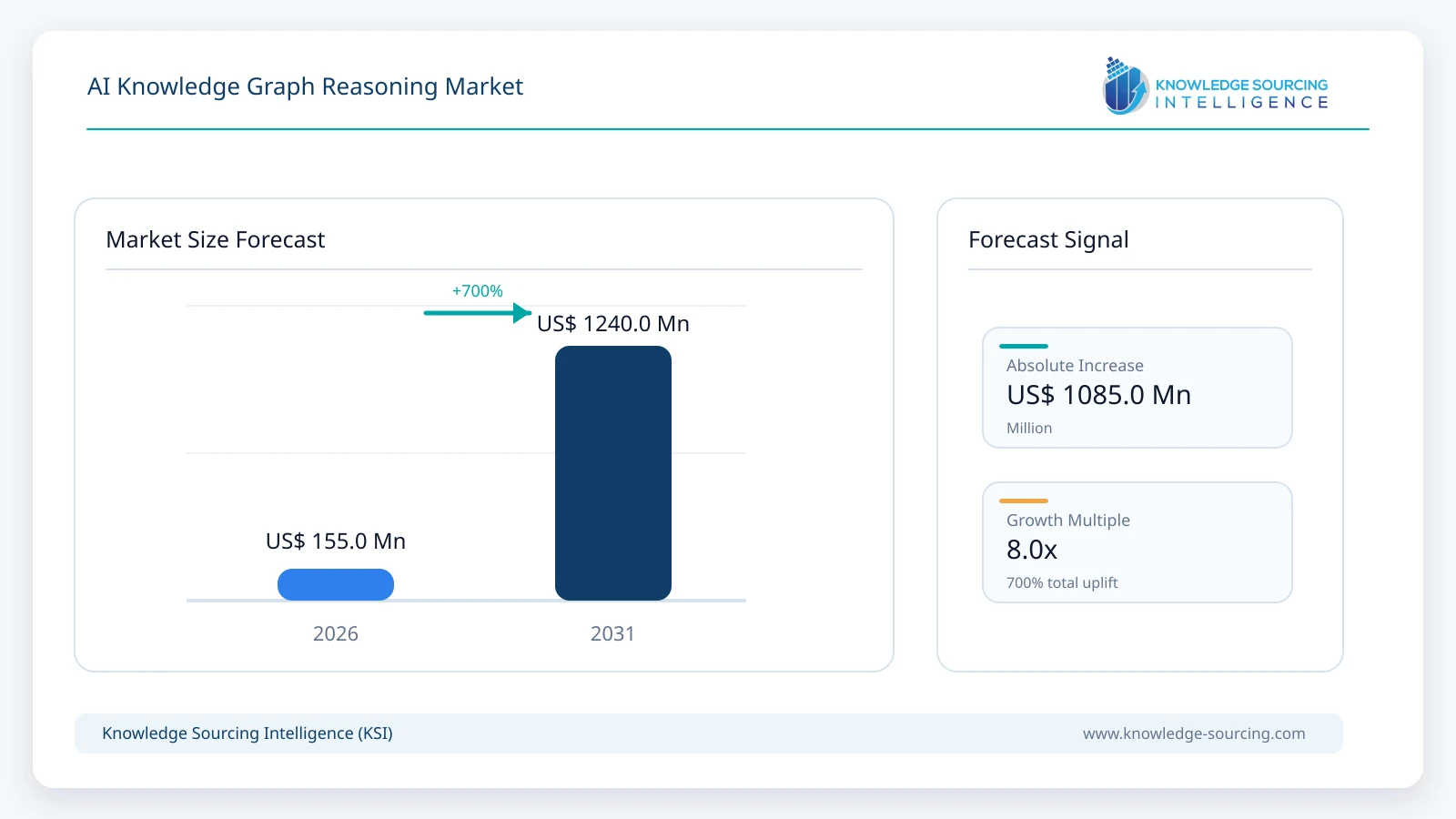
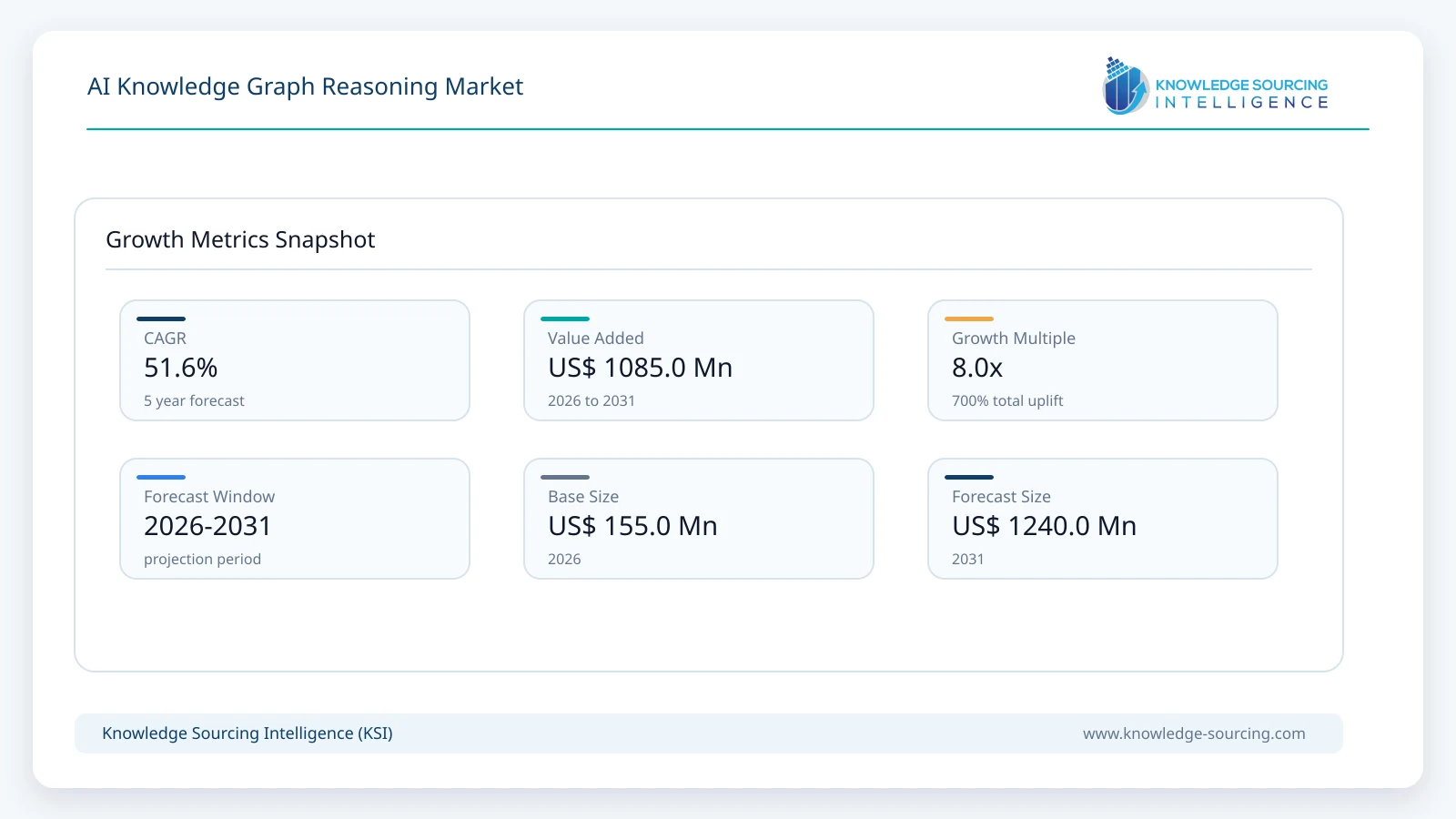
The AI Knowledge Graph Reasoning Market is estimated to grow from USD 155 million in 2026 to USD 1,240 million by 2031, at a CAGR of 51.57% during the forecast period.
Highlights:
- 1Multi-hop path inference is the largest modeled reasoning method as enterprise questions increasingly require tracing indirect entity relationships.
- 2Managed reasoning APIs gain deployment share through hosted graph agents, metered graph execution and reusable enterprise semantic services.
- 3Ontology and rule engines remain important in regulated settings where an answer must comply with business terms, policies and formal constraints.
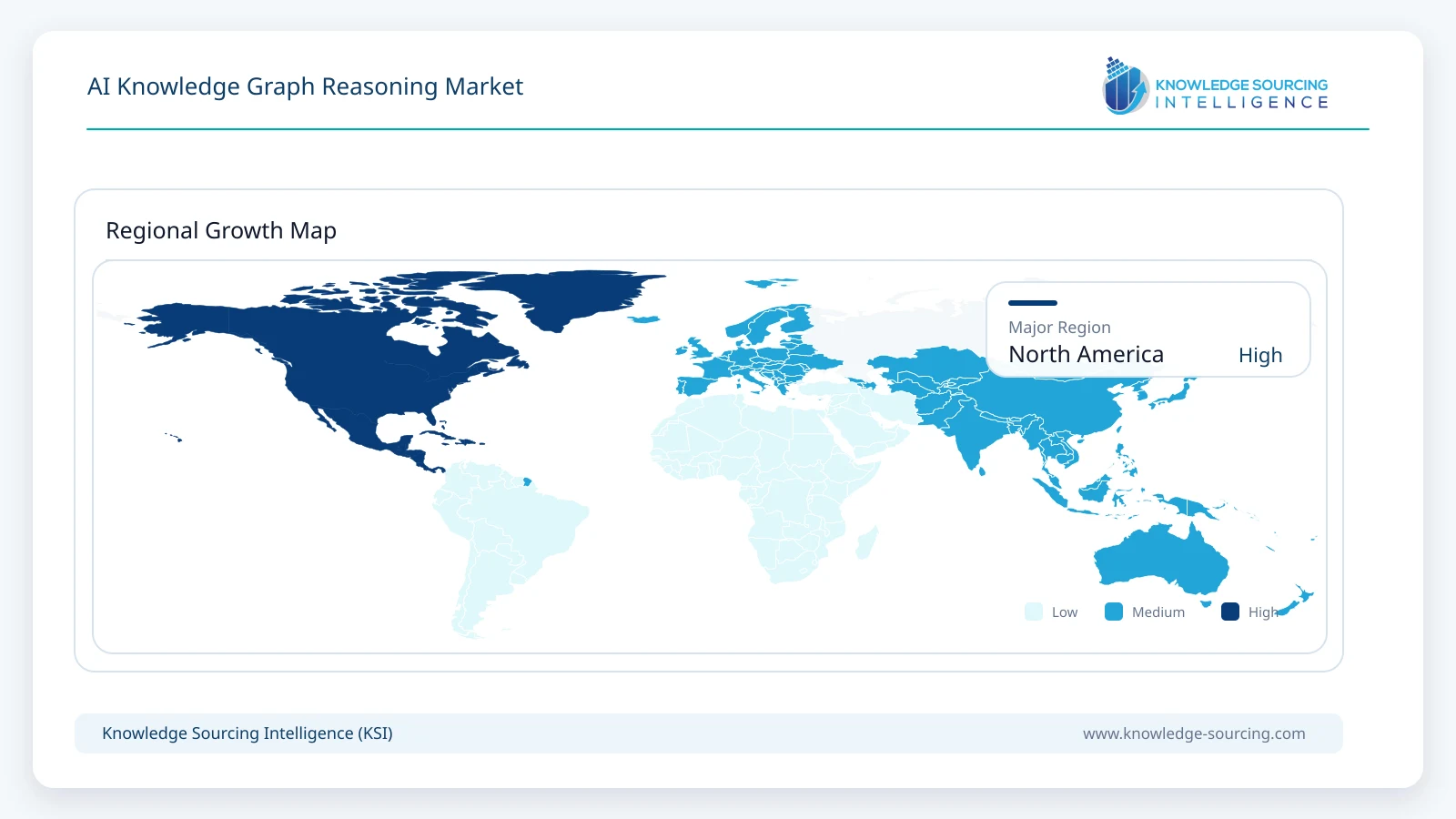
- 4North America leads initial spending, while Asia Pacific gains market share through cloud development and graph-intensive industrial applications.
- 5Supplier competition centers on auditability, inference accuracy, schema integration and avoiding double counting with general graph platforms.
It covers paid software for multi-hop relationship reasoning, knowledge graph inference, ontology-based validation and graph-grounded decision explanation, excluding the broader graph-database and graph-construction market.
Knowledge graph reasoning combines typed enterprise relationships with rule systems and model-driven query planning to reach conclusions that ordinary text retrieval cannot reliably support. Neo4j enables agents to trace graph paths, Stardog Voicebox plans multiple queries for complex questions, and Franz GraphTalker iteratively tests schema-aware SPARQL requests. Enterprise value emerges when such capabilities can support repeated financial, scientific or operational investigations with reproducible evidence.
The report evaluates seven independent segmentation dimensions covering monetization, reasoning methods, knowledge representation, deployment, workflow stages, applications and end-user industries. The regional narrative focuses on North America and Asia Pacific, while country models extend across five regions. Competitive analysis examines specialist graph suppliers, cloud infrastructure and enterprise semantic platforms serving the reasoning layer.
Knowledge graph reasoning addresses the limitations of retrieval systems that return relevant passages without establishing how entities and events are connected. A fraud investigator may need to follow beneficial ownership through several companies, while a manufacturer may need to infer which upstream asset failure threatens a downstream process. Structured relationships permit path-based explanations and rule checking that can be tested independently from the prose produced by an AI model.
Product development in 2026 demonstrates the convergence of symbolic inference and natural-language interfaces. Stardog Voicebox 1.0 introduced multi-step graph query planning, Franz AllegroGraph 9.0 introduced iterative GraphTalker reasoning, and Neo4j made Aura Agent generally available with graph-specific retrieval and reasoning tools. Graphwise developed semantic query capabilities around RDF and SPARQL, while TigerGraph advanced schema-aware GraphRAG planning. These are complementary commercial implementations rather than evidence that every graph product earns incremental reasoning revenue.
Enterprise deployment requires a clean boundary between data management and reasoning services. Graph storage, vector search, extraction and agent hosting form the supporting stack, but their total contract value belongs to other software categories. The reasoning layer earns value where customers buy verified multi-hop inference, premium rule execution, domain-specific analytical logic or dedicated hosted reasoning workloads. This distinction is essential when related markets overlap across shared provider invoices.
Market Trends
Natural-Language Questions Become Structured Graph Programs
Graph reasoning platforms increasingly convert a business question into a sequence of constrained graph queries rather than treating it as a single prompt. Stardog Voicebox 1.0 plans and executes several graph queries, while Franz GraphTalker investigates graph schema, runs candidate SPARQL requests and corrects failures. Neo4j Aura Agent likewise combines parameterized queries and dynamically generated Cypher for more complex entity-path questions.
The commercial opportunity is not merely text-to-query conversion. Buyers evaluate whether a platform preserves entity meaning, checks the intermediate path, limits unsupported assumptions and explains the final result. Repeatable query programs and validated templates are easier to govern than improvised graph exploration, creating potential for enterprise subscriptions and metered reasoning services.
Ontologies and Rules Anchor Neuro-Symbolic Decision Quality
Knowledge-graph suppliers are combining the flexibility of language models with formal semantic representations to improve inference reliability. AllegroGraph supports OWL, SHACL and rule reasoning alongside LLM interaction, while Graphwise GraphDB provides structured SPARQL templates and ontology-aware controls.
Financial services, healthcare and government buyers can apply typed relationships to explain why a constraint was satisfied or breached. These deployments require maintained taxonomies, controlled rule changes and tests for contradictory source data. Suppliers with mature semantics and governance can command value above generic graph traversal, but added maintenance and specialist skills remain barriers.
Graph Reasoning Extends Across Existing Cloud Data
Graph reasoning is becoming more closely connected to enterprise data warehouses, operational systems and managed cloud services. Neo4j moved Virtual Graph into public preview during July 2026, allowing graph access to Snowflake, Databricks and BigQuery without a mandatory full data copy. AWS Neptune also combines graph storage, analytics and GraphRAG integrations across additional regions.
Cross-system reasoning may help customers explore entity relationships that span commercial, operational and document sources, but source permissions and update timing become harder to manage.
AI Knowledge Graph Reasoning Market Segment Analysis
By Commercial Offering
Dedicated Graph Reasoning Platforms
Dedicated reasoning entitlements are the largest modeled commercial offering because they package inference logic, graph-aware agent access and monitored execution into reusable software. Revenue is estimated at USD 55.00 million in 2026 and is forecast to reach USD 420.00 million in 2031, with share moving from 35.5% to 33.9%. Vendors seek to distinguish the reasoning license from the underlying graph database or general agent subscription. Neo4j Aura Agent and Stardog Voicebox are relevant commercial reference points, although only attributable reasoning service value is counted.
Enterprise procurement will depend on how consistently the reasoning workflow supports source provenance, domain-specific constraints and repeatable decision tests.
By Reasoning Method
Multi-Hop Path and Relational Inference
Multi-hop inference traces indirect relationships and dependencies to resolve questions that require more than one lookup. Revenue is estimated at USD 52.70 million in 2026 and is forecast to reach USD 396.80 million in 2031, with share moving from 34.0% to 32.0%. Graph reasoning tools can identify a relationship path, check its direction and verify each intermediate fact before producing an explanation. Buyers in risk and industrial operations pay for reproducible logic, not simply a larger retrieval result list.
Enterprise procurement will depend on how consistently the reasoning workflow supports source provenance, domain-specific constraints and repeatable decision tests.
By Knowledge Representation
Property Graph
Property-graph reasoning remains important for operational entities, fraud networks and linked business transactions. Revenue is estimated at USD 69.75 million in 2026 and is forecast to reach USD 582.80 million in 2031, with share moving from 45.0% to 47.0%. RDF and ontology-centric systems are particularly relevant where formal classes and rule inheritance matter, while hybrid architectures combine vector relevance with graph paths and semantic constraints.
Enterprise procurement will depend on how consistently the reasoning workflow supports source provenance, domain-specific constraints and repeatable decision tests.
By Deployment Model
Managed Cloud and Metered Reasoning API
Managed APIs reduce the need to host specialized reasoning services and help teams monitor execution by workflow. Revenue is estimated at USD 71.30 million in 2026 and is forecast to reach USD 682.00 million in 2031, with share moving from 46.0% to 55.0%. Cloud providers and graph vendors increasingly expose graph-aware services within wider infrastructure, making clear usage attribution a condition of defensible market sizing.
Enterprise procurement will depend on how consistently the reasoning workflow supports source provenance, domain-specific constraints and repeatable decision tests.
By Application
Risk, Fraud and Entity Investigations
Risk and fraud investigations rely on indirect links among accounts, legal entities and transactions that graph reasoning can make explicit. Revenue is estimated at USD 35.65 million in 2026 and is forecast to reach USD 272.80 million in 2031, with share moving from 23.0% to 22.0%. Commercial use extends to ownership analysis, case linking and policy-based review, with life-sciences and industrial applications adopting different inference approaches driven by domain ontologies.
Enterprise procurement will depend on how consistently the reasoning workflow supports source provenance, domain-specific constraints and repeatable decision tests.
Market Drivers
Demand for Traceable Multi-Hop Enterprise Decisions
Enterprise investigations require reasoning across account ownership, transactions, contracts and policies where relevant facts may be several edges apart. Graph-based systems can expose intermediate relationships and evidence paths, helping analysts justify a decision rather than accepting a plausible language-model answer. Neo4j Aura Agent and Stardog Voicebox provide practical mechanisms for multi-step queries grounded in governed data.
Growth in Neuro-Symbolic and Ontology-Based AI
Regulated knowledge workflows increasingly combine language-model interpretation with symbolic classes, rules and constraints. AllegroGraph GraphTalker demonstrates the commercial integration of iterative graph queries with rules and ontologies, while Graphwise GraphDB supports semantic query templates. Buyers value the ability to test whether an inferred relationship follows defined enterprise meaning rather than relying only on text similarity.
Expansion of Managed Graph Reasoning Services
Managed graph and agent endpoints reduce integration effort for teams lacking specialist Cypher, SPARQL or inference-engine skills. Neo4j Aura Agent, AWS Neptune GraphRAG and hosted enterprise semantic platforms expose reusable graph-query functions. Attributable reasoning fees can grow as applications move from one-off analysis to repeated production queries with controlled latency and audit requirements.
Connected-Data Complexity in Financial and Industrial Operations
Financial crime networks, supplier dependencies and industrial equipment hierarchies have many-to-many relationships that cannot be explained by a single document lookup. Multi-hop graph inference helps combine linked evidence, detect indirect connections and evaluate operational consequences. Complex regulated and high-value workflows can support premium licenses for tested reasoning modules and domain-specific logic.
Improved Access Through Natural-Language Graph Interfaces
Graph users increasingly expect to ask business questions without writing custom graph queries. Stardog Voicebox and Franz GraphTalker translate language requests into structured queries and iteratively refine results. Better interfaces can expand usage from specialist graph engineers to risk teams, research analysts and operations personnel, increasing paid reasoning consumption where outputs meet quality targets.
Market Restraints
Revenue Bundling with Database and Agent Platforms
Graph reasoning is frequently delivered alongside ordinary storage, managed graph compute or agent runtimes. AWS Neptune infrastructure and broader Neo4j enterprise contracts may incorporate capabilities without a distinct reasoning invoice. Suppliers and analysts must allocate only incremental charges to avoid overstating market size and buyer willingness to pay.
Ontology Quality and Incorrect Relationship Inference
Reasoning accuracy depends on typed links, consistent entity identity and correctly maintained rules. Duplicated customers, stale ownership links or inconsistent taxonomies can produce coherent but incorrect multi-hop conclusions. Data stewardship and rule validation remain material operating costs that slow deployment in sensitive decision environments.
Latency and Cost of Recursive Graph Traversal
A complex reasoning question may call a graph database repeatedly and follow large numbers of candidate paths. These operations increase model tokens, graph CPU time and database reads, making variable cloud bills difficult to predict. Runtime limits, selective traversal and query caching must demonstrate performance gains before enterprises fund premium inference services.
Access Controls and Provenance Across Systems
Knowledge-graph reasoning can reveal sensitive relationships between customer records, investigations, protected documents and internal business rules. Cross-source virtual graphs complicate authorization and audit trails because access permissions vary across originating systems. Buyers require source lineage, least-privilege query execution and reproducible decision evidence, particularly in financial and public-sector use.
Competition from Custom and Open-Source GraphRAG
Microsoft GraphRAG, open-source frameworks and conventional Cypher or SPARQL logic allow internal teams to implement relationship-aware retrieval without paying for a proprietary reasoning module. Paid offerings must justify their price through governance, tested inference accuracy, hosted reliability and development-speed savings rather than charging simply for knowledge-graph traversal.
Regional Outlook
North America
North America holds an estimated USD 63.55 million in 2026 and is expected to reach USD 446.40 million by 2031. The United States accounts for most regional demand through established graph software suppliers, cloud infrastructure, financial-risk applications and research organizations that need explainable linked-data conclusions. Enterprise teams are moving beyond proof-of-concept GraphRAG toward repeatable inference and governed graph queries.
Regional deployment is supported by Neo4j, Stardog, Franz and cloud ecosystem partners with established enterprise relationships. Financial-services and healthcare applications often require evidence lineage and controlled rules that justify premium reasoning modules. Customers remain cautious about paying twice for database access and reasoning features, so contract attribution, benchmarked accuracy and execution-cost discipline are important for renewals and expansion.
Asia Pacific
Asia Pacific is projected to expand from USD 35.65 million in 2026 to USD 372.00 million in 2031, making it the fastest-growing major region in the internal model. China, Japan and India are expected to account for substantial opportunities through software development, industrial asset knowledge, customer platforms and increasingly complex enterprise data estates.
The region benefits from cloud availability, knowledge-graph engineering capacity and demand for relationship-aware analytics in manufacturing, financial services and telecommunications. Buyers often require multilingual entity mapping, hybrid infrastructure and strict treatment of data residency, creating opportunities for integrated semantic rule modules. Adoption is likely to remain uneven because ontology maintenance and specialist graph reasoning skills are not distributed equally across markets.
Competitive Landscape
Commercial competition involves graph platforms that bundle structured reasoning with databases, specialist semantic suppliers with mature rule systems, and cloud providers supporting graph-grounded agent workloads. Neo4j combines Aura Agent and ontology-linked context; Stardog offers multi-step Voicebox reasoning; Franz combines AllegroGraph with neuro-symbolic GraphTalker; Graphwise emphasizes GraphDB semantics and graph-aware applications. AWS, TigerGraph and ArangoDB contribute graph execution, graph-RAG or related query infrastructure used in reasoning deployments.
Competitive advantage increasingly depends on enterprise ontology interoperability, intermediate-step observability, graph query reliability and authorization controls. Suppliers with rule validation, multi-hop query planning and domain-specific reasoning support have a clearer premium proposition than providers offering ordinary graph search alone. Open-source GraphRAG and custom knowledge-graph applications nevertheless place pressure on licensing and encourage outcome-based value demonstrations.
Recent Developments
October 2026: TigerGraph released GraphRAG 2.0.4, improving schema-aware agent planning, structured query execution and query trace diagnostics.
October 2026: Neo4j announced Context Engine in private preview, bringing business ontology, governed context and graph-based reasoning into a shared agent knowledge layer.
August 2026: Stardog made Voicebox Service 1.0 generally available with multi-step question planning and a sequence of graph queries rather than single-query translation.
July 2026: Neo4j advanced Virtual Graph to public preview, supporting zero-copy relationship reasoning over Snowflake, Databricks and Google BigQuery data.
June 2026: Graphwise released GraphDB 11.4 with improved MCP SPARQL prompts and controls relevant to LLM-assisted semantic graph querying.
May 2026: Franz introduced AllegroGraph 9.0 with GraphTalker, enabling iterative, schema-aware natural-language graph queries and neuro-symbolic reasoning.
Market Outlook
AI knowledge graph reasoning is expected to become a more frequent component of regulated enterprise AI decisions as organizations demand answers supported by explicit connected evidence. Multi-hop path analysis, domain-rule enforcement and schema-aware question planning are likely to expand beyond specialist graph teams into applications used by risk analysts, scientists and operations managers.
Growth in attributable revenue will rely on managed graph reasoning APIs, dedicated inference licenses and private rule modules rather than the entire underlying knowledge-graph infrastructure. Suppliers must demonstrate incremental value through more accurate relationship reasoning, lower investigation effort, repeatable decision paths and predictable runtime billing. The overlap with Agentic Knowledge Graph, Retrieval Optimization and Semantic Memory markets will remain substantial.
North America is expected to remain the largest regional market, while Asia Pacific gains share through enterprise software and industrial applications. Products that combine maintained ontologies, authorized cross-source querying and explicit inference validation have the strongest prospects for sustainable monetization, especially where an incorrect connected-data conclusion could create meaningful commercial or regulatory exposure.
AI Knowledge Graph Reasoning Market Scope:
| Report Metric | Details |
|---|---|
| Total Market Size in 2026 | USD 155 million |
| Total Market Size in 2031 | USD 1,240 million |
| Forecast Unit | USD Million |
| Growth Rate | 51.57% |
| Study Period | 2021 to 2031 |
| Historical Data | 2021 to 2024 |
| Base Year | 2025 |
| Forecast Period | 2026 – 2031 |
| Segmentation | Commercial Offering, Reasoning Method, Knowledge Representation, Deployment Model, Reasoning Workflow Stage, Primary Application, End-User Industry, Geography |
| Companies |
|
| Customization Scope | 15% Free Customization included with purchase — Request Custom Breakdown → |
| Sample & Data Access | PDF Sample, Excel Databook & Analyst Briefing — Download Free Sample → |
Market Segmentation
By Commercial Offering
Dedicated Graph Reasoning Platform and API Entitlements
Metered Multi-Hop and Graph-Inference Execution
Ontology, Rules and Neuro-Symbolic Reasoning Add-ons
Private and Vertical Knowledge-Reasoning Deployments
By Reasoning Method
Multi-Hop Path and Relational Inference
Ontology and Deductive Rule Inference
Neuro-Symbolic Graph-and-Language Reasoning
Temporal and Event-Chain Reasoning
Probabilistic and Uncertainty-Aware Graph Reasoning
By Knowledge Representation
Property Graph with Typed Relationships
RDF, OWL and Ontology-Centric Graph
Hybrid Semantic, Vector and Graph Representation
By Deployment Model
Managed Cloud and Metered Reasoning API
Hybrid and Dedicated Private Cloud
On-Premises and Self-Managed
By Reasoning Workflow Stage
Question Decomposition and Graph-Path Planning
Evidence Traversal and Intermediate Inference
Logical Consistency and Constraint Validation
Answer Provenance and Explanation Generation
By Primary Application
Risk, Fraud and Entity Investigations
Enterprise Knowledge Question Answering
Life Sciences and Scientific Hypothesis Exploration
Supply-Chain and Industrial Dependencies
Regulatory and Policy Interpretation
Other Connected-Data Decision Support
By End-User Industry
Banking, Financial Services and Insurance
Technology and Cloud Software
Healthcare, Pharma and Life Sciences
Manufacturing, Energy and Logistics
Government and Public Sector
Retail, Telecom and Other Services
By Geography
North America
United States
Canada
Mexico
South America
Brazil
Argentina
Rest of South America
Europe
Germany
United Kingdom
France
Netherlands
Italy
Spain
Rest of Europe
Middle East and Africa
United Arab Emirates
Saudi Arabia
Israel
South Africa
Rest of Middle East and Africa
Asia Pacific
China
Japan
India
South Korea
Australia
Singapore
Rest of Asia Pacific
Table of Contents
1. EXECUTIVE SUMMARY
1.1. Research Highlights
1.2. Market Size and Growth Outlook, 2026–2031
1.3. Strategic Market Perspective
2. MARKET SNAPSHOT
2.1. Market Overview
2.2. Market Definition
2.3. Scope of the Study
2.4. Market Segmentation
3. BUSINESS LANDSCAPE
3.1. Market Drivers
3.1.1. Demand for Traceable Multi-Hop Enterprise Decisions
3.1.2. Growth in Neuro-Symbolic and Ontology-Based AI
3.1.3. Expansion of Managed Graph Reasoning Services
3.1.4. Connected-Data Complexity in Financial and Industrial Operations
3.1.5. Improved Access Through Natural-Language Graph Interfaces
3.2. Market Restraints
3.2.1. Revenue Bundling with Database and Agent Platforms
3.2.2. Ontology Quality and Incorrect Relationship Inference
3.2.3. Latency and Cost of Recursive Graph Traversal
3.2.4. Access Controls and Provenance Across Systems
3.2.5. Competition from Custom and Open-Source GraphRAG
3.3. Market Opportunities
3.4. Porter’s Five Forces Analysis
3.5. Industry Value Chain Analysis
3.6. Policies and Regulations
3.7. Strategic Recommendations
4. TECHNOLOGICAL OUTLOOK
4.1. Multi-Hop Graph Search and Path-Based Inference
4.2. Ontology and Rule-Based Logical Inference
4.3. Neuro-Symbolic Reasoning and Structured Query Generation
4.4. Temporal and Uncertainty-Aware Reasoning
4.5. Inference Quality, Governance and Runtime Controls
5. AI KNOWLEDGE GRAPH REASONING MARKET BY COMMERCIAL OFFERING
5.1. Introduction
5.2. Dedicated graph reasoning platform and API entitlements
5.3. Metered multi-hop and graph-inference execution
5.4. Ontology, rules and neuro-symbolic reasoning add-ons
5.5. Private and vertical knowledge-reasoning deployments
6. AI KNOWLEDGE GRAPH REASONING MARKET BY REASONING METHOD
6.1. Introduction
6.2. Multi-hop path and relational inference
6.3. Ontology and deductive rule inference
6.4. Neuro-symbolic graph-and-language reasoning
6.5. Temporal and event-chain reasoning
6.6. Probabilistic and uncertainty-aware graph reasoning
7. AI KNOWLEDGE GRAPH REASONING MARKET BY KNOWLEDGE REPRESENTATION
7.1. Introduction
7.2. Property graph with typed relationships
7.3. RDF, OWL and ontology-centric graph
7.4. Hybrid semantic, vector and graph representation
8. AI KNOWLEDGE GRAPH REASONING MARKET BY DEPLOYMENT MODEL
8.1. Introduction
8.2. Managed cloud and metered reasoning API
8.3. Hybrid and dedicated private cloud
8.4. On-premises and self-managed
9. AI KNOWLEDGE GRAPH REASONING MARKET BY REASONING WORKFLOW STAGE
9.1. Introduction
9.2. Question decomposition and graph-path planning
9.3. Evidence traversal and intermediate inference
9.4. Logical consistency and constraint validation
9.5. Answer provenance and explanation generation
10. AI KNOWLEDGE GRAPH REASONING MARKET BY PRIMARY APPLICATION
10.1. Introduction
10.2. Risk, fraud and entity investigations
10.3. Enterprise knowledge question answering
10.4. Life sciences and scientific hypothesis exploration
10.5. Supply-chain and industrial dependencies
10.6. Regulatory and policy interpretation
10.7. Other connected-data decision support
11. AI KNOWLEDGE GRAPH REASONING MARKET BY END-USER INDUSTRY
11.1. Introduction
11.2. Banking, financial services and insurance
11.3. Technology and cloud software
11.4. Healthcare, pharma and life sciences
11.5. Manufacturing, energy and logistics
11.6. Government and public sector
11.7. Retail, telecom and other services
12. AI KNOWLEDGE GRAPH REASONING MARKET BY GEOGRAPHY
12.1. North America
12.1.1. United States
12.1.2. Canada
12.1.3. Mexico
12.2. South America
12.2.1. Brazil
12.2.2. Argentina
12.2.3. Rest of South America
12.3. Europe
12.3.1. Germany
12.3.2. United Kingdom
12.3.3. France
12.3.4. Netherlands
12.3.5. Italy
12.3.6. Spain
12.3.7. Rest of Europe
12.4. Middle East and Africa
12.4.1. United Arab Emirates
12.4.2. Saudi Arabia
12.4.3. Israel
12.4.4. South Africa
12.4.5. Rest of Middle East and Africa
12.5. Asia Pacific
12.5.1. China
12.5.2. Japan
12.5.3. India
12.5.4. South Korea
12.5.5. Australia
12.5.6. Singapore
12.5.7. Rest of Asia Pacific
13. COMPETITIVE ENVIRONMENT AND ANALYSIS
13.1. Major Players and Strategy Analysis
13.2. Market Share Analysis
13.3. Mergers, Acquisitions, Agreements, and Collaborations
13.4. Competitive Dashboard
14. COMPANY PROFILES
14.1. Neo4j, Inc.
14.2. Stardog Union, Inc.
14.3. Franz Inc. (AllegroGraph)
14.4. Graphwise (Ontotext AD)
14.5. Amazon Web Services, Inc.
14.6. TigerGraph, Inc.
14.7. ArangoDB GmbH
14.8. Memgraph Ltd.
14.9. Zep AI
14.10. Fluree PBC
14.11. Microsoft Corporation
15. APPENDIX
15.1. Currency
15.2. Assumptions
15.3. Base and Forecast Years Timeline
15.4. Key Benefits for Stakeholders
15.5. Research Methodology
15.6. Abbreviations





Frequently asked questions
What is the projected market size for AI Knowledge Graph Reasoning by 2031?
The AI Knowledge Graph Reasoning Market is forecast to reach USD 1,240 million by 2031.
What is the Compound Annual Growth Rate (CAGR) for this market?
The AI Knowledge Graph Reasoning Market is projected to grow at a CAGR of 51.57%.
Which region currently leads spending in AI Knowledge Graph Reasoning?
North America leads initial spending; Asia Pacific gains market share.
Which reasoning method is the largest modeled in this market?
Multi-hop path inference is the largest modeled reasoning method.
What are the key segmentation dimensions covered in the report?
Monetization, reasoning, knowledge representation, deployment, applications, industries are covered.
What market areas are excluded from this report's scope?
The AI Knowledge Graph Reasoning Market excludes broader graph-database and graph-construction markets.
Cite this report
Knowledge Sourcing Intelligence. (Oct 2026). AI Knowledge Graph Reasoning Market Size, Share & Growth Forecast (2026-2031). https://www.knowledge-sourcing.com/report/ai-knowledge-graph-reasoning-market