
Artificial Intelligence or AI engineering is one of the newest and fastest-growing disciplines, which focuses on developing various types of AI-based tools, platforms, processors, and systems. Artificial intelligence engineering offers applications across a wide range of industries, majorly for the...
- Automotive- In the automotive industry, the artificial intelligence engineering solution can help in developing multiple key services, like driver assistance solutions, automation in manufacturing, and vehicle autonomy. The driver assistance system is an artificial intelligence-based tool that helps the driver by offering mild control of the vehicle, like object detection, lane assist, and multiple safety features.
- Healthcare- In the healthcare sector, artificial intelligence engineering services can help in developing new and more advanced tools and platforms for drug research, drug delivery, and patient care. With advanced tools for patient care, the disease diagnostic capability of the industry will increase significantly, creating a quicker and more accurate platform to detect several diseases.
- Manufacturing- In the global manufacturing sector, artificial intelligence services can offer the capability to integrate AI-based technologies and tools into manufacturing, ensuring an efficient and optimum manufacturing process.
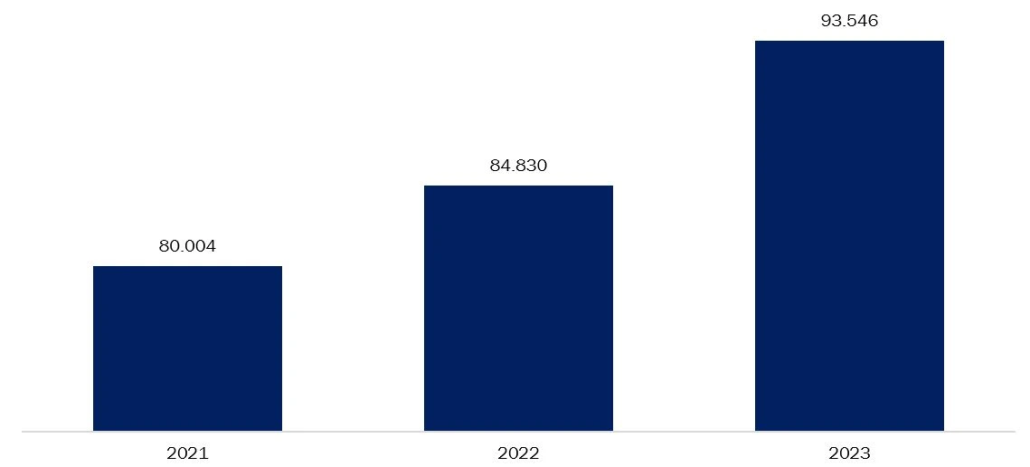 Source: International Organization of Motor Vehicle Manufacturers
2. Increasing investments in the AI sector.
The increasing global investments in AI technology are among the key factors propelling the growth of AI engineering in the global market. With increasing public or private investments in the AI technology sector, the global AI-based technology landscape is estimated to witness significant growth. Various countries across the globe introduced key policies and investment strategies to boost the AI landscape in their nation. Countries like India, China, Japan, the USA, and France are among the fastest developing nations in the technological sector, which aims to further boost the technological industries by developing the AI sector.
For instance, in July 2024, the Union Government of India, allocated over INR 551.75 crore from the union budget of the nation, for the IndiaAI mission of the nation. Through this investment, the government aims to enhance research and application of AI in the nation and seeks to strengthen the position of the nation as a leader in the AI sector. Similarly, SAP India, in its report, stated that about 77% of the start-ups in the nation invest in newer technologies like artificial intelligence, machine learning, and blockchain.
In November 2024, NHK (Japan Broadcasting Corporation) in its news stated that the Government of Japan plans to fund a sum of US$ 65 billion, for the development of AI and chipmaking in the nation. Furthermore, the Microsoft Corporation, in April 2024, announced the company's investment of about US$2.9 billion in the AI and cloud infrastructure landscape in the nation. Through this investment, the company also aims to boost the research and cybersecurity landscape of Japan. The company also announced its aim to offer training in advanced technologies like AI to about 3 million individuals in the nation. The company plans to offer training through programs focused on society and organizations' assistance. Similarly, in April 2024, Oracle, a global leader in the technological sector, also announced an investment of about US$8 billion for the development of AI and cloud computing landscape in Japan. The company aims to develop its footprint across the nation through Japan.
Key Developments
Source: International Organization of Motor Vehicle Manufacturers
2. Increasing investments in the AI sector.
The increasing global investments in AI technology are among the key factors propelling the growth of AI engineering in the global market. With increasing public or private investments in the AI technology sector, the global AI-based technology landscape is estimated to witness significant growth. Various countries across the globe introduced key policies and investment strategies to boost the AI landscape in their nation. Countries like India, China, Japan, the USA, and France are among the fastest developing nations in the technological sector, which aims to further boost the technological industries by developing the AI sector.
For instance, in July 2024, the Union Government of India, allocated over INR 551.75 crore from the union budget of the nation, for the IndiaAI mission of the nation. Through this investment, the government aims to enhance research and application of AI in the nation and seeks to strengthen the position of the nation as a leader in the AI sector. Similarly, SAP India, in its report, stated that about 77% of the start-ups in the nation invest in newer technologies like artificial intelligence, machine learning, and blockchain.
In November 2024, NHK (Japan Broadcasting Corporation) in its news stated that the Government of Japan plans to fund a sum of US$ 65 billion, for the development of AI and chipmaking in the nation. Furthermore, the Microsoft Corporation, in April 2024, announced the company's investment of about US$2.9 billion in the AI and cloud infrastructure landscape in the nation. Through this investment, the company also aims to boost the research and cybersecurity landscape of Japan. The company also announced its aim to offer training in advanced technologies like AI to about 3 million individuals in the nation. The company plans to offer training through programs focused on society and organizations' assistance. Similarly, in April 2024, Oracle, a global leader in the technological sector, also announced an investment of about US$8 billion for the development of AI and cloud computing landscape in Japan. The company aims to develop its footprint across the nation through Japan.
Key Developments
- In November 2024, L&T Technology Services Limited, a global technological leader based in India, announced the acquisition of Intelliswift, a Silicon Valley-based technological provider. Through this acquisition, L&T aims to boost product development, platform engineering, and data & AI capabilities.
Have questions?
More Blogs
Clinical Decision Support Diagnostic Systems Market: Why the U.S. Healthcare System Is Quietly Rebuilding Diagnosis Around Algorithms
The U.S. clinical decision support diagnostic systems market is rapidly evolving as hospitals adopt AI-driven tools to manage rising diagnostic complexity, workforce shortages, and operational pressures. Growth is fueled by demand for faster, accurate diagnoses, workflow efficiency, interoperability, and value-based care, while physician trust, cybersecurity, and regulatory compliance increasingly determine long-term market success.
Top U.S. Healthcare Industry Trends to Watch in 2026 for the Global Healthcare Market
The global healthcare industry in 2026 is shifting toward AI-driven efficiency, stronger cybersecurity, outpatient care expansion, and domestic pharmaceutical manufacturing. U.S. healthcare leaders are prioritizing workforce support, operational resilience, value-based care, and integrated digital systems to improve patient outcomes while controlling costs.
How AI Is Reshaping the American Healthcare Industry
The U.S. healthcare industry is rapidly integrating artificial intelligence across clinical, administrative, and pharmaceutical operations. AI is improving diagnostics, automating workflows, reducing clinician burden, accelerating drug discovery, and enhancing personalized care. With strong adoption by hospitals and tech companies, AI is transforming healthcare delivery while driving the U.S. AI healthcare market toward significant growth by 2031.