5G Base Station Equipment Market Trends & Forecast According to a research study published by Knowledge Sourcing Intelligence (KSI), the 5G base station equipment m...
5G Base Station Equipment Market Trends & Forecast
According to a research study published by Knowledge Sourcing Intelligence (KSI), the 5G base station equipment market will expand from USD 29.865 billion in 2025 to USD 52.733 billion in 2030 at a CAGR of 12.04% during the forecast period.The market is witnessing growth due to a rise in smart cities and connected devices like smart grids and IoT devices, which leads to a rise in reliable 5G networks. Additionally, the growing demand for high-speed and low-latency connectivity among consumers and organizations due to an increase in data consumption, along with an increase in shift in remote work culture, is offering an opportunity for market expansion. Moreover, the rise in urban population, along with the high internet usage, has led to growing bandwidth-intensive activities, which also promote the requirement of 5G base stations, which boost the market. Additionally, the growing technological advancement and the supportive government investment in research and development funds to advance 5G base station equipment, such as antenna systems, will also propel the market globally in the years to come.
Get In-Depth Analysis of the 5G Base Station Equipment Market
This article covers the fundamentals. Our full market report provides the granular data, competitive landscape, and strategic insights you need to navigate the global 5G base station equipment industry.- ? Detailed Market Size & Growth Forecasts
- ? Key Player Analysis & Market Share
- ? Technology and Regional Trends
5G Base Station Equipment Market Report Highlights
- The urban deployment segment is estimated to attain a greater market share by 2030 in the deployment type segment. The segment is witnessing growth driven by the rise in urban population, along with the increase in 5G infrastructure and technology in the cities. The increase in internet penetration, along with the rise in user density, also promotes the market demand in urban regions.
- The BBU (Baseband Unit) segment is the dominating segment in the global 5G base station equipment market in the architecture segment. Among the aspects that drive this rapid growth is the critical role of this architecture in the processing and managing network operations, which is usually integrated in hardwares.
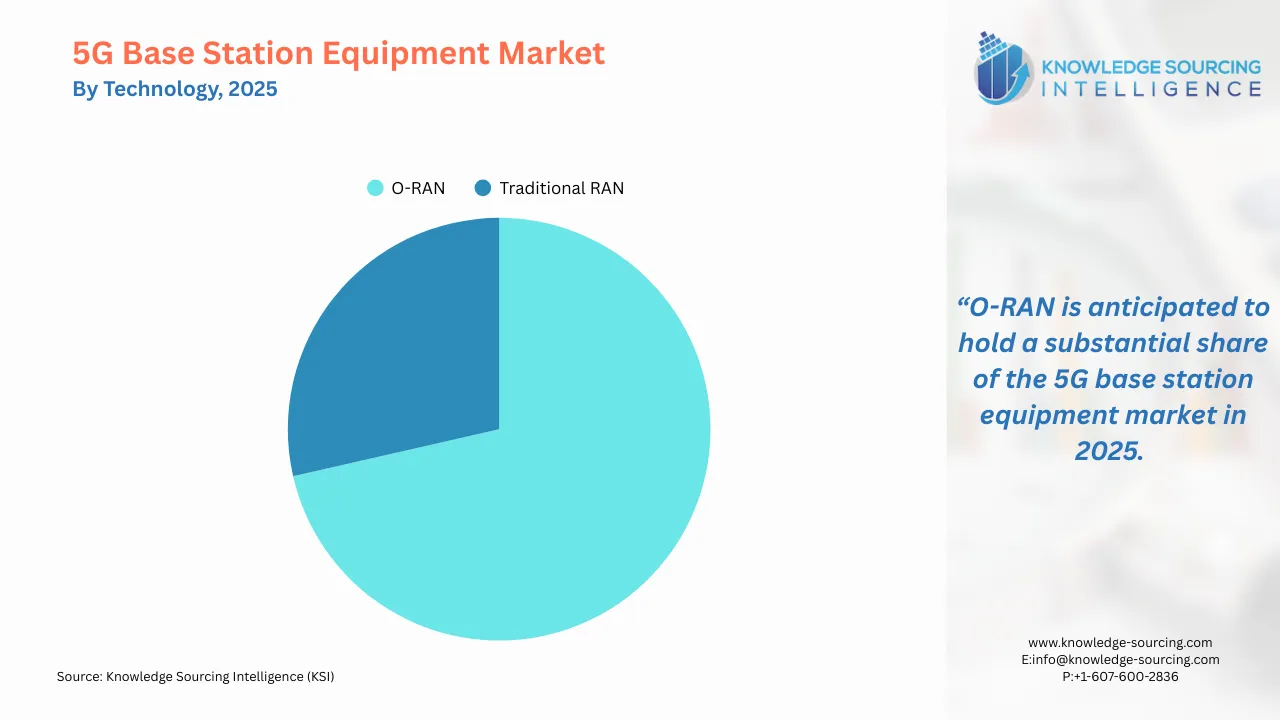
- The O-RAN technology segment is the fastest-growing segment in the technology of the 5G base station equipment market due to the increased cost savings through open interfaces, along with providing energy efficiency, compared to traditional RAN. This is also expanding in demand for AI-powered networks and virtualization globally.
- The non-standalone segment is the largest shareholder in the configuration segment of the market due to the increased ease of integration of the current network in the existing 4G LTE infrastructure, which is are cost-efficient and time-saving rollout, particularly in developing nations.
- The sub-6 GHz segment is significantly growing in the frequency band segment in the 5G base station equipment market in the architecture segment. The segment provides a wider coverage area along with resilience to climate and adoption in emerging areas for cost-effectiveness and quicker offering in smart infrastructure.
- Asia Pacific held the largest 5G base station equipment market share due to growing investment in 5G technology and infrastructure across the region, along with initiatives and policies by the government that promote fast data sharing and low latency in the network.
Explore the IoT Chip Market
The rise of smart cities and connected devices is driving demand for 5G base stations. Get our in-depth report on the IoT Chip Market to understand global trends, key applications, and growth forecasts.Report Coverage:
| Report Metric | Details |
| 5G Base Station Equipment Market Size in 2025 | US$29.865 billion |
| 5G Base Station Equipment Market Size in 2030 | US$52.733 billion |
| Growth Rate | CAGR of 12.04% |
| Drivers |
|
| Restraints |
|
| Segmentation |
|
| List of Major Companies in 5G Base Station Equipment Market |
|
5G Base Station Equipment Market Growth Drivers and Restraints
Growth Drivers:- Growing Demand for Internet Utilization: The rise in deployment of 5G network globally, especially in urban areas, aligning with the rise in mobile coverage of 5G, with internet usage rise is boosting the market demand for supporting 5G network technology and coverage across the globe.
- Rise in Demand for High-Speed, Low-Latency Connectivity: The growing 5G internet connectivity is promoting faster data speed along with ultra-low latency among consumers and businesses for diverse applications such as virtual meetings, cloud services, and video streaming.
- Power Consumption Issues: The utilization of energy by the 5G base stations is expected to be almost double that of 4G, along with environmental concerns and growing operational concerns, which can decrease its adoption.
- High Cost of Deployment and Investment: The high cost involved in building 5G infrastructure, along with site acquisition, equipment, and upgrades, which could limit the market.
5G Base Station Equipment Market Key Development
- Launch of Full-Scale Development: In February 2025, Kyocera announced the introduction of full-scale deployment of their latest base station, i.e., AI-powered 5G virtualized base stations, which use their telecommunications and expertise in virtualization with integration of NVIDIA GH200 Grace Hopper Superchip.
- 5G Base Station Export: In August 2024, Viettel High Tech announced the development and certification of its low- to high-power 5G radio base stations for application by telecom carriers. In addition to this, it rolled out from Vietnam to India under the “Made in India” initiative.
5G Base Station Equipment Market Segmentation
Knowledge Sourcing Intelligence has segmented the 5G base station equipment market based on the deployment, architecture, technology, configuration, frequency band, and region: 5G Base Station Equipment Market, By Deployment- Urban
- Rural
- AAU
- BBU
- O-RAN
- Traditional RAN
- Standalone
- Non-Standalone
- Sub-6-Ghz
- mmWave
- North America
- USA
- Canada
- Mexico
- South America
- Brazil
- Argentina
- Others
- Europe
- United Kingdom
- Germany
- France
- Italy
- Spain
- Others
- Middle East and Africa
- Saudi Arabia
- UAE
- Others
- Asia Pacific
- China
- Japan
- India
- South Korea
- Indonesia
- Taiwan
- Thailand
- Others
5G Base Station Equipment Market Key Players
- NEC
- Fujitsu
- Huawei Technologies Co., Ltd.
- Samsung
- ZTE
- Nokia
- Ericsson
- Intel
- 3M
- WiSig Networks Pvt. Ltd.
- Murata Manufacturing Co.
- Mavenir
- Cisco Systems, Inc.
Go from Insight to Action with Our Market Research
You've seen the overview. Now, get the detailed data and strategic analysis you need to stay ahead in the telecommunications market. Explore our related, in-depth reports. Each report includes comprehensive data, forecasts, and competitive analysis to empower your business decisions.Need specialized data cuts or competitive intelligence?
Our analyst team provides bespoke market sizing, supplier audits, and country-level feasibility reports tailored to your enterprise roadmap.
Speak With an Industry Analyst →Ask an Industry Analyst
Have questions regarding this briefing or market projections? Inquire with our sector lead.
Related Press Releases
View All →
ADC Manufacturing & CDMO Market is expected to reach USD 10.49 billion by 2031
Aug 7, 2026
Lifestyle-Associated Cancer Epidemiology Market is expected to reach USD 13.12 billion by 2031
Aug 5, 2026
Psycho-Oncology Digital Health Market is anticipated to surpass USD 290.01 million in 2031 at a CAGR of 8.5%
Jul 30, 2026
Intratumoral Injection Therapy Market is expected to reach USD 630.39 million by 2031
Jul 24, 2026
Palliative Care in Oncology Market is expected to reach USD 244.1 billion by 2031
Jul 22, 2026More Press Releases
Oncology Drug Resistance Testing Market is projected to reach USD 3.41 billion in 2031 at a CAGR of 6.6 %
The oncology drug resistance testing market is expanding due to rising cancer prevalence, increasing drug resistance, and growing adoption of precision oncology. Advances in NGS-based testing, companion diagnostics, and targeted therapies, alongside FDA approvals and investments in personalized medicine, are accelerating demand for effective resistance monitoring across hospitals and clinical diagnostics worldwide.
TROP-2 Targeted Therapy Market is anticipated to surpass USD 3.29 billion in 2031 at a CAGR of 8.6 %
The TROP-2 Targeted Therapy market is expanding rapidly due to increasing precision oncology adoption, rising cancer prevalence, and growing use of antibody-drug conjugates. North America leads the market, while Asia Pacific shows the fastest growth. Continuous clinical trials, regulatory approvals, and strategic collaborations are accelerating innovation and commercial adoption worldwide.
Second Primary Cancer Prevention Market is expected to reach USD 24.7 billion by 2031
The Second primary cancer prevention refers to strategies aimed at reducing the risk of developing a new, unrelated cancer in individuals with a prior cancer diagnosis. Growing cancer survivorship, advances in treatment, and increasing awareness of long-term health outcomes have heightened the importance of prevention and surveillance programs. Key approaches include routine screening, genetic risk assessment, lifestyle modification, and long-term follow-up care. Government agencies and healthcare organisations increasingly emphasise survivorship care plans and evidence-based screening protocols to detect new malignancies at earlier stages. Continued investments in early detection technologies and personalised risk assessment are expected to support advancements in second primary cancer prevention.