
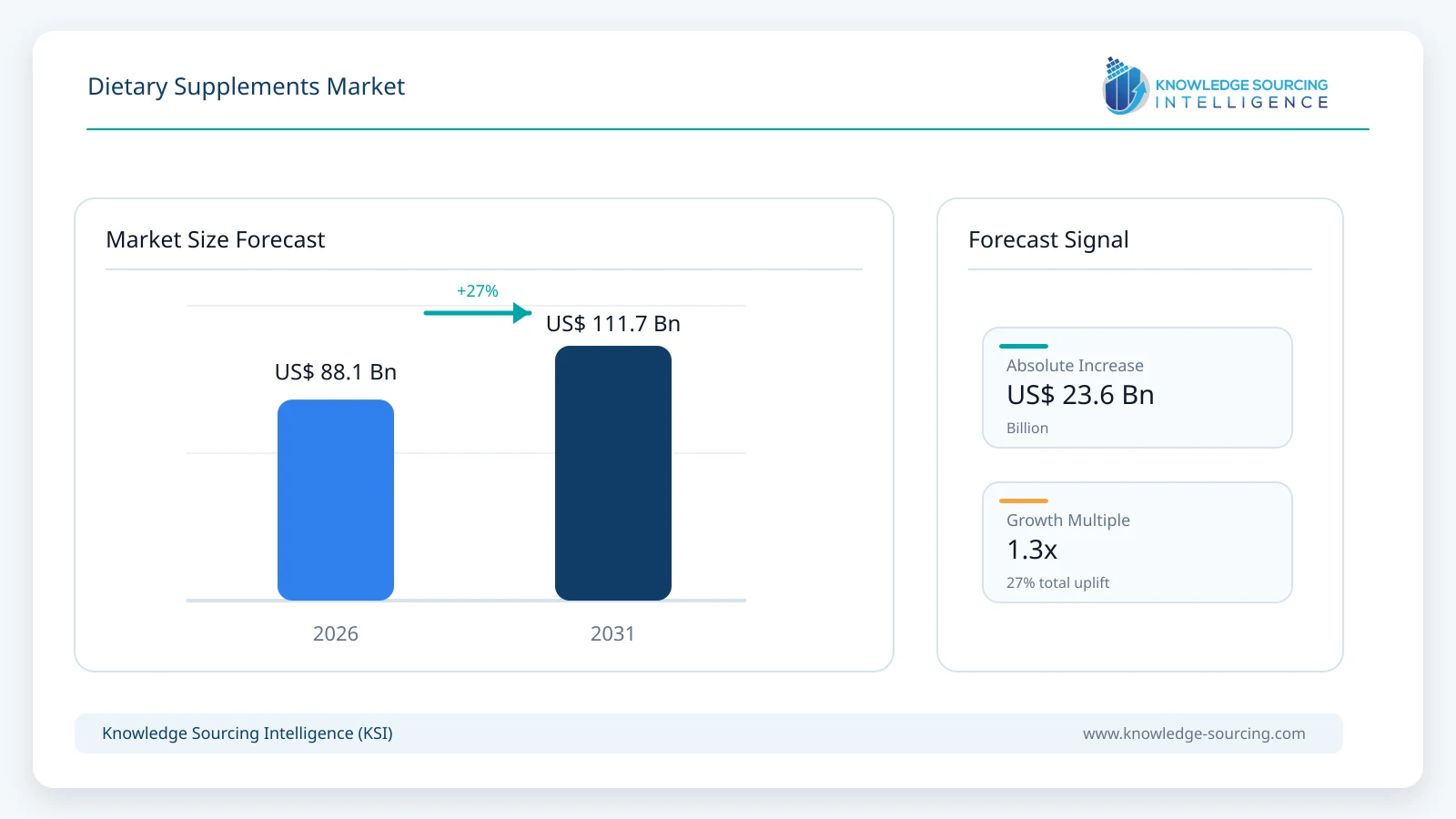
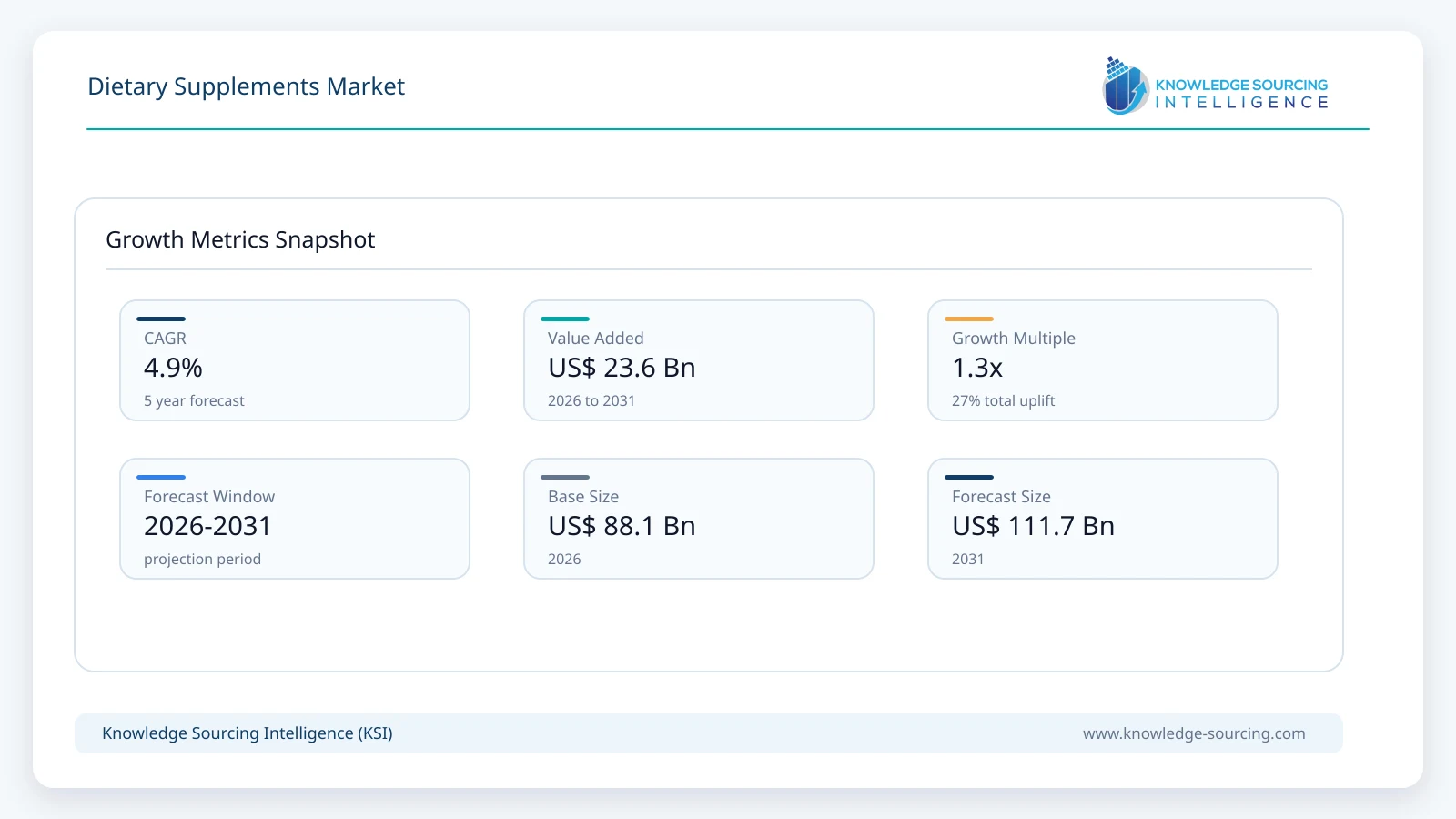
The dietary supplements market is projected to expand at a CAGR of 4.9%, reaching USD 111.7 billion in 2031 from USD 88.1 billion in 2026.
Highlights:
- 1Asia Pacific accounts for roughly 36% of global dietary supplement market value in 2026.
- 2Vitamins and multivitamins remain the largest product category, while probiotics and functional formulations grow faster.
- 3Gummies, powders and stick packs are expanding consumption beyond traditional tablets and capsules.
- 4Personalized nutrition is moving from niche diagnostics into mainstream supplement portfolios.
- 5FDA is prioritizing new dietary ingredient guidance and broader supplement-oversight modernization during 2026.
- 6Nestlé agreed in September 2026 to divest its mainstream VMS portfolio to Yellow Wood Partners.
Dietary supplements have moved from a narrow deficiency-prevention category into a broader self-care and wellness market. Multivitamins and single-nutrient vitamins remain foundational, but consumers increasingly buy supplements around specific needs such as gut health, sleep, stress, cognition, women's health, healthy ageing, beauty-from-within and exercise performance. The market therefore spans both mass retail and premium science-led products. Haleon operates Centrum, Caltrate and Emergen-C across more than 70 markets, Bayer continues to invest behind One A Day, and Pharmavite's Nature Made remains a major broadline vitamin brand in the United States. At the premium end, Thorne, Pure Encapsulations and specialist practitioner brands compete on ingredient quality, clinical positioning and personalization.
The market is also undergoing ownership changes. Nestlé agreed in September 2026 to sell its mainstream Holistic Health VMS portfolio, including Nature's Bounty, Osteo Bi-Flex, Ester-C, Nuun, Puritan's Pride and selected private-label operations, to Yellow Wood Partners for USD 1.0 billion. The transaction is expected to close in the first half of 2027, so those brands remain within Nestlé Health Science during the 2026 market year. Nestlé is retaining premium science-led brands such as Solgar and Pure Encapsulations. Separately, Church & Dwight exited the VMS category at the end of 2025 by selling vitafusion and L'il Critters to Piping Rock, making the older company list materially outdated.
Current company performance supports continued category growth without implying a uniform boom across all suppliers. Jamieson Wellness reported nearly 19% branded revenue growth in the second quarter of 2026, H&H Group reported that nutritional supplements represented more than 60% of first-half group revenue, and Herbalife returned to top-line growth while launching personalized nutrition through Bioniq. At the same time, USANA reported lower year-over-year second-quarter sales, showing that direct-selling and mature supplement channels can face competitive pressure even when the broader market expands.
Market Trends
Personalized Nutrition Is Moving Into Commercial Supplement Portfolios
Personalization is shifting from generic demographic segmentation toward data-led recommendations based on lifestyle, biomarkers, dietary intake or consumer goals. Herbalife highlighted its 2026 Bioniq launch in Europe and the United States as part of a personalized-nutrition strategy, while premium supplement companies increasingly organize products around specific health outcomes rather than one-size-fits-all multivitamins. This trend raises average selling prices and can improve subscription retention, but it also requires stronger scientific substantiation, consumer data management and clear boundaries between wellness recommendations and medical claims.
Gummies, Powders and Multi-Function Formats Are Broadening Adoption
Consumer-friendly formats are expanding the addressable market beyond people willing to take traditional tablets or capsules. Haleon has scaled Centrum Daily Kits across Asia Pacific, H&H Group continues to grow Swisse gummies, and Bayer introduced an updated One A Day Women's Multi Gummy in July 2026. Powders and drink mixes are also gaining ground in active nutrition and hydration. USANA launched a three-in-one protein, creatine and electrolyte drink mix in August 2026, illustrating how supplement formats are converging around convenience and multi-benefit positioning.
Gut Health and Microbiome Products Are Becoming a Core Growth Platform
Probiotics, digestive enzymes, prebiotics and microbiome-targeted supplements are moving closer to the mainstream vitamin aisle. Pharmavite expanded Nature Made into SuperGreens and Digestive Enzymes in March 2026, while OLLY is developing targeted probiotic products around metabolism, skin and stress. The segment benefits from broad consumer awareness but also faces formulation and evidence challenges because probiotic efficacy is strain-specific and product stability varies by dosage form and storage conditions.
Healthy Ageing and Cognitive Support Are Increasing Product Specialization
Ageing populations are expanding demand for supplements related to bone health, cognition, cardiovascular health, eye health and mobility. Kirin and Blackmores launched cognitive-support supplements containing Cognizin citicoline in Australia and New Zealand in July 2026, while H&H Group is expanding Swisse Plus around cellular nutrition and longevity-oriented positioning. Healthy-ageing products generally command higher prices than basic vitamins, making this an important value-growth area even when household penetration of standard multivitamins is already high.
Market Drivers
Preventive Wellness Supports Recurring Supplement Use
Consumers increasingly use supplements as part of routine self-care rather than only after a diagnosed deficiency. This supports recurring purchases across multivitamins, vitamin D, magnesium, probiotics, omega-3 products and condition-specific formulations. The category also benefits from a relatively low entry price compared with many other health interventions, allowing brands to reach consumers across mass retail, pharmacy, direct selling and e-commerce channels.
Ageing Populations Increase Demand for Condition-Specific Nutrition
Older consumers often have more targeted nutrient requirements and greater interest in bone, joint, cognitive, cardiovascular and digestive health. Supplement manufacturers are responding with age-specific multivitamins, calcium and vitamin D, omega-3 products, eye-health formulations and cognition-focused products. This creates a durable demand base in North America, Europe, Japan, South Korea and China, while younger consumers increasingly enter the category through stress, sleep, beauty and fitness products.
Digital Commerce Expands Access to Specialist and Premium Brands
E-commerce reduces shelf-space constraints and allows consumers to compare formulations, reviews, ingredient transparency and subscription options across a much wider assortment than physical retail. H&H Group reported strong digital growth for Swisse in China, while many specialist brands such as Thorne, NOW, Nature's Sunshine and GNC operate significant direct-to-consumer channels. Digital commerce is particularly important for premium, practitioner-led and niche products that cannot secure broad mass-retail distribution.
Market Restraints
Regulatory Scrutiny, Claim Risk and Product Quality Variability Limit Faster Growth
Dietary supplements are regulated differently from pharmaceuticals, and product quality can vary substantially across brands and channels. In the United States, FDA does not preapprove dietary supplements for safety and effectiveness before sale. The agency's 2026 Human Foods Program priorities include final guidance on new dietary ingredients and evaluation of modernized supplement oversight. Manufacturers must manage ingredient identity, labeling, adverse-event reporting and claim compliance while avoiding disease-treatment claims. Stronger oversight can improve category credibility but also raises compliance costs and increases risk for poorly documented ingredients.
Segment Analysis
By Product Category - Vitamins and Multivitamins
Vitamins and multivitamins are estimated at approximately USD 30.8 billion in 2026 and remain the largest product category. They benefit from broad consumer familiarity, mass-market distribution and routine use across life stages. Minerals, botanicals, omega fatty acids and probiotics form substantial adjacent categories, while probiotic, cognition, healthy-ageing and personalized formulations are expected to grow faster from smaller bases. The category structure increasingly blends single nutrients with multi-benefit combinations rather than relying solely on classic multivitamin tablets.
By Form - Tablets and Capsules
Tablets and capsules are estimated at approximately USD 48.5 billion in 2026 and remain the largest dosage-form segment because they provide high nutrient density, manufacturing efficiency and long shelf life. Gummies and chewables are growing faster among younger consumers and households that dislike swallowing pills, while powders are expanding in sports nutrition, greens, collagen and hydration. Liquids and stick packs remain smaller but are relevant in pediatric, elderly and on-the-go applications.
By Health Function - General Wellness and Immunity
General wellness and immunity are estimated at approximately USD 28.0 billion in 2026 and remain the largest functional segment because multivitamins, vitamin C, vitamin D, zinc and broad wellness formulas serve a very large consumer base. Digestive health, women's health, healthy ageing, cognition, sports performance and sleep or stress support are more specialized categories and generally grow faster as consumers seek products tailored to specific goals.
By Distribution Channel - Offline Retail
Offline retail is estimated at approximately USD 61.5 billion in 2026 and remains the dominant distribution channel through pharmacies, drugstores, supermarkets, mass merchants, specialty nutrition stores and direct-selling networks. Online sales continue to gain share because they support broader assortments, subscriptions and product education, particularly for specialist brands. The strongest companies increasingly operate omnichannel models rather than relying on one route to market.
By Geography - Asia Pacific
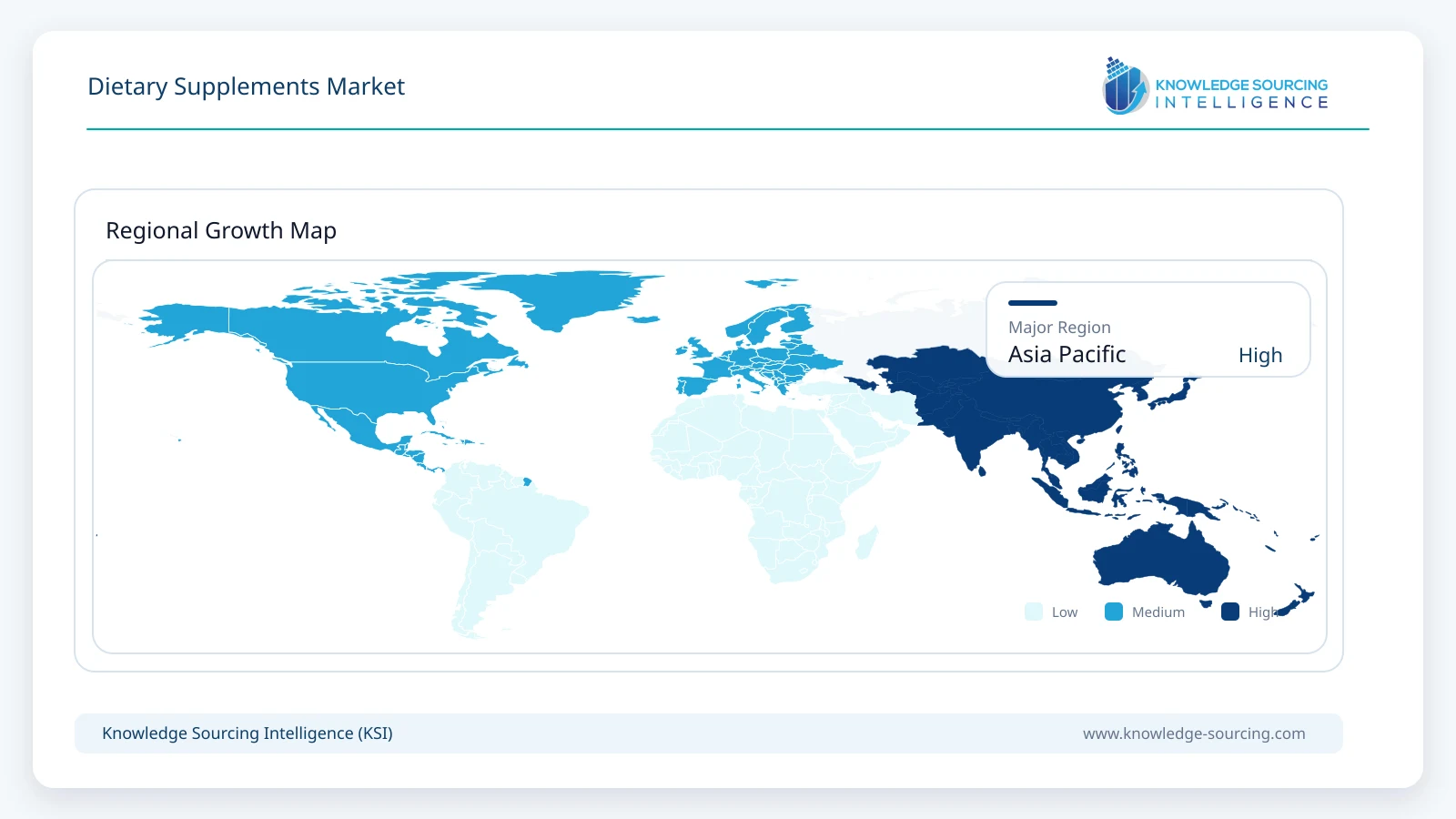
Asia Pacific is the largest regional market, supported by China, Japan, South Korea, Australia and rapidly expanding demand in India and Southeast Asia. H&H Group's Swisse business is growing strongly in China and Australia, Kirin and Blackmores are developing science-led products across Japan and Oceania, and Jamieson continues to expand in China and other international markets. North America remains a similarly important high-value region with deep penetration of vitamins, gummies, probiotics and sports supplements, while Europe has a fragmented but mature supplement market with country-specific regulatory and retail structures.
Competitive Environment
The dietary supplements market is highly fragmented despite the presence of several global brand owners. Amway remains a major direct-selling participant through Nutrilite. Haleon operates Centrum, Caltrate and Emergen-C, Bayer owns One A Day, Otsuka's Pharmavite owns Nature Made, and Nestlé Health Science retains a large VMS portfolio in 2026 while preparing to divest its mainstream brands. H&H Group, Kirin/Blackmores, Jamieson Wellness and Herbalife have strong international exposure, while NOW Health Group, Thorne, Nature's Sunshine, GNC, USANA and Piping Rock compete through specialist, direct-to-consumer, retail and private-label channels.
Recent Developments
September 2026: Nestlé agreed to sell its mainstream VMS portfolio, including Nature's Bounty and Osteo Bi-Flex, to Yellow Wood Partners for USD 1.0 billion.
August 2026: Herbalife reported fourth consecutive quarterly top-line growth and highlighted the U.S. and European launch of personalized-nutrition platform Bioniq.
August 2026: H&H Group reported 23.7% first-half revenue growth, with nutritional supplements representing 60.2% of group revenue.
August 2026: USANA launched Clear Protein + Creatine Mix, combining protein, creatine and electrolytes in one supplement format.
July 2026: Kirin and Blackmores launched Cognizin-based cognitive-support supplements in Australia and New Zealand.
July 2026: Bayer introduced an updated One A Day Women's Multi Gummy with 1,000 mcg of biotin for hair, skin and nail support.
Dietary Supplements Market Scope:
| Report Metric | Details |
|---|---|
| Total Market Size in 2026 | USD 88.1 billion |
| Total Market Size in 2031 | USD 111.7 billion |
| Forecast Unit | Billion |
| Growth Rate | 4.9% |
| Study Period | 2021 to 2031 |
| Historical Data | 2021 to 2024 |
| Base Year | 2025 |
| Forecast Period | 2026 – 2031 |
| Segmentation | Product Category, Form, Health Function, Distribution Channel, Geography |
| Companies |
|
Market Segmentation
By Product Category
Vitamins and Multivitamins
Minerals
Botanicals and Herbal Supplements
Probiotics and Digestive Supplements
Omega Fatty Acids
Amino Acids and Protein-Based Supplements
Other Specialty Supplements
By Form
Tablets and Capsules
Gummies and Chewables
Powders
Liquids and Other Forms
By Health Function
General Wellness and Immunity
Bone and Joint Health
Digestive and Gut Health
Women's Health
Healthy Ageing and Cognitive Health
Sports and Active Nutrition
Sleep, Stress and Other Functions
By Distribution Channel
Pharmacies and Drugstores
Supermarkets and Mass Merchants
Specialty Retail and Direct Selling
Online Retail
By Geography
North America
United States
Canada
Mexico
South America
Brazil
Argentina
Others
Europe
Germany
United Kingdom
France
Italy
Spain
Others
Middle East & Africa
Saudi Arabia
UAE
South Africa
Others
Asia Pacific
China
Japan
India
South Korea
Australia
Indonesia
Thailand
Others
Table of Contents
1. EXECUTIVE SUMMARY
2. MARKET SNAPSHOT
2.1. Market Overview
2.2. Market Definition
2.3. Scope of the Study
2.4. Market Segmentation
3. BUSINESS LANDSCAPE
3.1. Market Drivers
3.1.1. Preventive Wellness Supports Recurring Supplement Use
3.1.2. Ageing Populations Increase Demand for Condition-Specific Nutrition
3.1.3. Digital Commerce Expands Access to Specialist and Premium Brands
3.2. Market Restraints
3.2.1. Regulatory Scrutiny, Claim Risk and Product Quality Variability Limit Faster Growth
3.3. Market Opportunities
3.4. Porter's Five Forces Analysis
3.5. Industry Value Chain Analysis
3.6. Regulatory Environment
3.7. Strategic Recommendations
4. TECHNOLOGICAL OUTLOOK
4.1. Personalized Nutrition Platforms
4.2. Microbiome and Probiotic Formulation
4.3. Gummy and Chewable Delivery Systems
4.4. Encapsulation and Bioavailability Enhancement
4.5. Powder, Stick Pack and Multi-Function Formats
4.6. Ingredient Authentication and Quality Testing
5. GLOBAL DIETARY SUPPLEMENTS MARKET BY PRODUCT CATEGORY
5.1. Introduction
5.2. Vitamins and Multivitamins
5.3. Minerals
5.4. Botanicals and Herbal Supplements
5.5. Probiotics and Digestive Supplements
5.6. Omega Fatty Acids
5.7. Amino Acids and Protein-Based Supplements
5.8. Other Specialty Supplements
6. GLOBAL DIETARY SUPPLEMENTS MARKET BY FORM
6.1. Introduction
6.2. Tablets and Capsules
6.3. Gummies and Chewables
6.4. Powders
6.5. Liquids and Other Forms
7. GLOBAL DIETARY SUPPLEMENTS MARKET BY HEALTH FUNCTION
7.1. Introduction
7.2. General Wellness and Immunity
7.3. Bone and Joint Health
7.4. Digestive and Gut Health
7.5. Women's Health
7.6. Healthy Ageing and Cognitive Health
7.7. Sports and Active Nutrition
7.8. Sleep, Stress and Other Functions
8. GLOBAL DIETARY SUPPLEMENTS MARKET BY DISTRIBUTION CHANNEL
8.1. Introduction
8.2. Pharmacies and Drugstores
8.3. Supermarkets and Mass Merchants
8.4. Specialty Retail and Direct Selling
8.5. Online Retail
9. GLOBAL DIETARY SUPPLEMENTS MARKET BY GEOGRAPHY
9.1. Introduction
9.2. North America
9.2.1. United States
9.2.2. Canada
9.2.3. Mexico
9.3. South America
9.3.1. Brazil
9.3.2. Argentina
9.3.3. Others
9.4. Europe
9.4.1. Germany
9.4.2. United Kingdom
9.4.3. France
9.4.4. Italy
9.4.5. Spain
9.4.6. Others
9.5. Middle East & Africa
9.5.1. Saudi Arabia
9.5.2. UAE
9.5.3. South Africa
9.5.4. Others
9.6. Asia Pacific
9.6.1. China
9.6.2. Japan
9.6.3. India
9.6.4. South Korea
9.6.5. Australia
9.6.6. Indonesia
9.6.7. Thailand
9.6.8. Others
10. COMPETITIVE ENVIRONMENT AND ANALYSIS
10.1. Major Players and Strategy Analysis
10.2. Mass-Market versus Premium and Science-Led Positioning
10.3. Product Innovation and Personalized Nutrition
10.4. M&A, Portfolio Restructuring and Ownership Changes
10.5. Competitive Dashboard
11. COMPANY PROFILES
11.1. Amway Corporation
11.2. Nestlé Health Science S.A.
11.3. Haleon plc
11.4. Pharmavite LLC (Otsuka Holdings Co., Ltd.)
11.5. Herbalife Ltd.
11.6. Jamieson Wellness Inc.
11.7. H&H Group (Swisse)
11.8. Kirin Holdings Company, Limited / Blackmores Limited
11.9. Piping Rock Health Products, LLC
11.10. USANA Health Sciences, Inc.
11.11. NOW Health Group, Inc.
11.12. GNC Holdings, LLC
11.13. Nature's Sunshine Products, Inc.
11.14. Unilever plc (OLLY)
11.15. Thorne HealthTech
11.16. Bayer AG (One A Day)
12. APPENDIX
12.1. Currency
12.2. Assumptions
12.3. Base and Forecast Years Timeline
12.4. Key Benefits for Stakeholders
12.5. Research Methodology
12.6. Abbreviations
LIST OF FIGURES
LIST OF TABLES
Navigate
Trusted by the world's leading organizations











