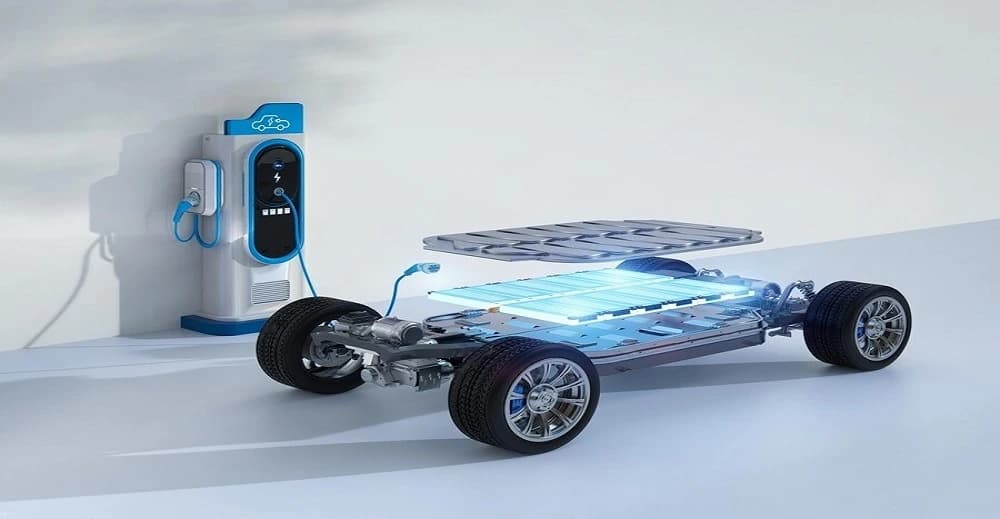
The global EV battery cooling market is expected to grow at a CAGR of 19.54% during the forecasted period, with a market valuation of US$2,314.249 million in 2024, and is expected to reach US$5,648.499 million by 2029....
The global EV battery cooling market is expected to grow at a CAGR of 19.54% during the forecasted period, with a market valuation of US$2,314.249 million in 2024, and is expected to reach US$5,648.499 million by 2029.
The increasing need for electric vehicles is contributing to the expansion of the worldwide market for EV battery thermal management systems. The production volume of these vehicles is likely to rise with the increase in demand, which in turn will assist further expansion of the global battery cooling market. New product development of a next-generation battery thermal management system will also contribute to the growth of the market coupled with increased global budgets for EV battery technology research and development. High-efficiency battery cooling system ensures not only improved battery performance and extended range but also maintains optimal condition of the battery.
One of the current trends in the global market is the development and application of liquid chilling systems. Several advantages of liquid cooling exist, which involve circulating a coolant substance through pipes or plates built alongside or around the battery cells. During the functioning of the battery, heat generated is easily removed by liquid cooling, thus maintaining the desired temperature range within the battery pack. This contributes to improved safety and increased battery life and performance. The active development of cooling plates is associated with the desire of EV manufacturers to improve battery technology and energy density, which requires advanced thermal management.
Most of the growing demand for the electric vehicles (EV) market can be attributed to the swift expansion of the electric vehicle (EV) market. Efficient electric vehicle battery cooling plates would be more important with the rising popularity of electric vehicles due to the availability of policies and the green agenda. To maintain the function of electric vehicle batteries, cooling plates are important for controlling their temperature.
Cooling systems like cooling plates and batteries that offer electric vehicle parts are gaining traction as more individuals and businesses embrace EVs instead of gasoline-powered internal combustion engine vehicles. The increase in demand in the EV sector stimulates the development of cooling and battery technologies, leading to better and superior electric vehicle battery cooling plates that are needed for larger and more powerful EVs.
The EV battery cooling market, by cooling type, is divided into three types- Air cooling, liquid cooling, and fan cooling. The rapid growth in the use of liquid cooling technology is linked to the global increase in the EV fast-charging infrastructure. For instance, in the USA, the Department of Transportation (DOT) directed in June 2023 that Direct Current Fast Chargers (DCFC) must also enable fast charging on busy corridors where these stations have already been set up. Using the DCFC devices, the batteries in electric cars can be charged up to 80 per cent for a duration ranging from 20 minutes to 1 hour. During this operation, a significant amount of heat is produced by the battery which can be dissipated by a liquid cooling system. Air cooling systems are generally easier and cheaper to deploy than liquid cooling systems. As such, these systems appeal to manufacturers who are interested in minimizing costs. This is why there is a high market for air cooling plates for electric vehicle battery cooling systems.
The EV battery cooling market, by battery type, is divided into three types: Lead acid, lithium-ion, and others. On a worldwide scale, the lithium-ion battery segment accounts most for of the total market share. The advancing technologies in batteries in terms of power density and torque which allows for fast acceleration in electric vehicles explain this growth of the segment. This raises the need for segmented growth increasing the market further. Moreover, NiMH (Nickel-metal Hydride) batteries have been employed in hybrid electric vehicles for a considerable period. It is rather an established technology that propels the growth of the segment in the market.
The EV battery cooling market, by vehicle type, is divided into three types: Battery electric vehicles, hybrid electric vehicles, and plug-in hybrid electric vehicles. To manage the lifetime, operability, and effectiveness of electric battery vehicle batteries, battery coolants are quite important. This is so because they ensure that the temperature of the battery is maintained at an optimum level, which ensures that the vehicle can operate efficiently and safely. Since the battery is the major part used for propulsion, its effectiveness invariably affects the performance and range of electric battery-powered vehicles.
In the case of hybrid cars having an electric drive and a traditional internal combustion engine, cooling systems are of utmost importance. Such vehicles often incorporate the battery pack to improve the overall efficiency of the vehicle by providing short power bursts, leading to drastic changes in temperature.
During the projected timeframe, it is anticipated that the market for EV battery cooling will experience remarkable growth within North America. The efficient use of battery coolants is a significant factor in achieving the optimum performance, safety, and durability of Electric Vehicle (EV) batteries. With the increasing demand for EVs in the market, the need for advanced cooling systems has also increased. These systems are designed to dissipate the heat generated by the active battery cells in operation, which in turn can greatly influence the battery cycle life and performance. In North America, the market is also influenced by the stringent regulations on the use of low VOC and eco-friendly products. Hence, a new battery coolant that is eco-friendly and meets the need has been developed for electric vehicles.
The research includes several key players from the EV battery cooling market, such as 3M, Boyd, Hanon Systems, MAHLE GmbH, Modine Manufacturing Company, Robert Bosch GmbH LLC, Tata AutoComp System Ltd., Valeo, Vikas Group, Sogefi SpA, Dana Incorporated, Miba AG.
View a sample of the report or purchase the complete study at https://www.knowledge-sourcing.com/report/global-ev-battery-cooling-market
The analytics report categorizes the EV battery cooling market using the following criteria:
Segmentation:
- By Cooling Type
- Air Cooling
- Liquid Cooling
- Fan Cooling
- By Battery Type
- Lead Acid
- Lithium Ion
- Others
- By Vehicle Type
- Battery Electric Vehicles
- Hybrid Electric Vehicles
- Plug-In Hybrid Electric Vehicle
- By Geography
- North America
- United States
- Canada
- Mexico
- South America
- Brazil
- Argentina
- Others
- Europe
- United Kingdom
- Germany
- France
- Italy
- Spain
- Others
- Middle East and Africa
- Saudi Arabia
- UAE
- Others
- Asia Pacific
- Japan
- China
- India
- South Korea
- Taiwan
- Thailand
- Indonesia
- Others
- North America
- EV Charging Connectors Market Report
- EV Battery Cooling Market Report
- Pressure Sensor Market Share
Have questions?
More Press Releases
How Reliance's Bombay Creamery Launch Will Shake Up the Global Ice Cream Market, Expected to Reach USD 98.3 Billion by 2031
Reliance Consumer Products Limited (RCPL) has launched Bombay Creamery, an accessible-premium dairy ice cream brand made with real dairy cream and priced from as low as Rs 10, marking its dedicated entry into India's ice cream category. The launch, supported by the nationwide network of Reliance and a brisk marketing move, puts RCPL in the competition of some established brand names like Amul, Kwality Wall's, Mother Dairy, Vadilal and global brands like Magnum, Baskin-Robbins etc. The shift is a reflection of the premiumisation and innovation trends outlined in a new report by Knowledge Sourcing Intelligence, according to which the global ice cream market is worth USD 74.9 billion by 2026, and USD 98.3 billion by 2031.
How Abbott’s Libre Duo Launch Could Impact the Continuous Glucose Monitoring (CGM) Market, Expected to Reach USD 19.4 Billion by 2031
Abbott’s Libre Duo 10 Day Continuous Dual Glucose Ketone Monitoring System represents a significant development in the continuous glucose monitoring (CGM) market by combining glucose and ketone monitoring within a single wearable device. In August 2026, the U.S. Food and Drug Administration (FDA) authorized Libre Duo for people aged 2 years and older living with diabetes, making it the first wearable device in the U.S. to continuously monitor ketone levels and the first globally to continuously monitor both glucose and ketones in one device. The system measures glucose and ketones every minute for up to 10 days and can transmit readings wirelessly to a compatible smartphone.
Voith and Jungheinrich’s Recent Automation and Electrification Developments Will Affect the Material Handling Market, Estimated to Reach USD 328.6 Billion by 2031
Material handling is advancing through electrification, automation, and digitally enabled operations. Voith’s PowerDrive Mining, Jungheinrich’s ETV 4i reach truck, and Reitar Logtech’s cooperation with Cainiao highlight developments in conveyor systems, warehouse productivity, and logistics infrastructure, supporting higher throughput, operational efficiency, integrated controls, and technology-driven material movement across industries.