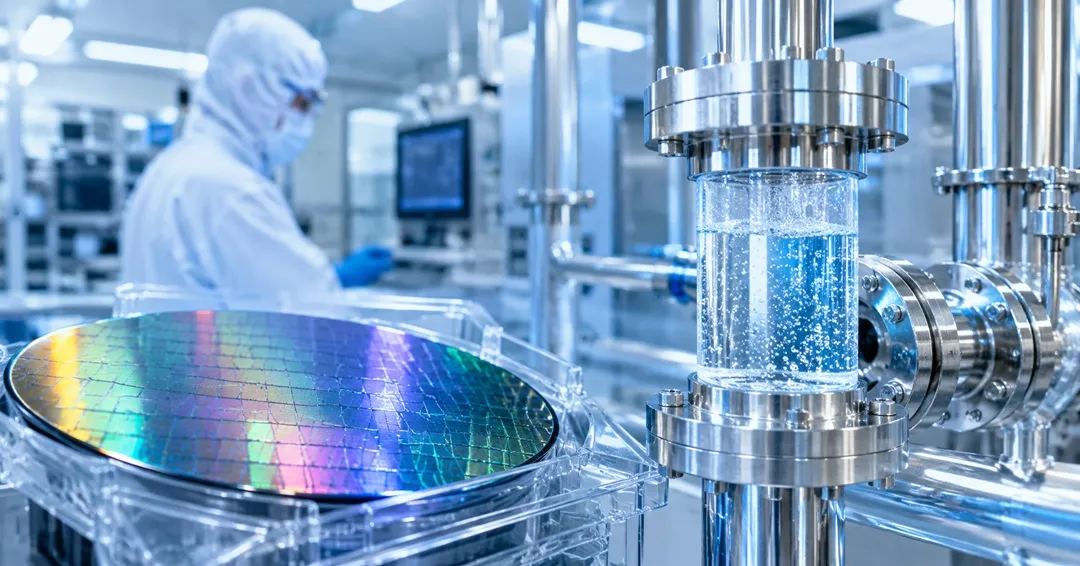
The global semiconductor ultra-pure water market is expanding as advanced chip manufacturing increases demand for reliable water purification and contamination control. Rising investments in fabrication facilities, advanced packaging, and memory production are strengthening demand for UPW systems, while water recovery, intelligent monitoring, and sustainable treatment solutions gain importance.
According to Knowledge Sourcing Intelligence, the global semiconductor ultra-pure water market is projected to grow from USD 4.80 billion in 2026 to USD 8.60 billion by 2032, registering a compound annual growth rate (CAGR) of 10.2%. Expanding semiconductor fabrication capacity, increasingly stringent contamination-control requirements, and rising investment in water recovery and reuse are driving market growth. As manufacturers expand advanced logic, memory, and artificial intelligence (AI) chip production, demand for reliable ultrapure water (UPW) production, distribution, and recovery infrastructure is expected to increase.
Semiconductor fabrication relies on exceptionally pure water for wafer cleaning, rinsing, and other critical manufacturing processes. Trace quantities of particles, dissolved ions, organic compounds, and microorganisms can compromise process performance and manufacturing yields. UPW systems integrate technologies such as reverse osmosis, electrodeionization, ultraviolet oxidation, ultrafiltration, membrane degassing, and final polishing to achieve the water quality required for sensitive semiconductor applications.
Request a free sample copy or view the report summary: Semiconductor Ultra-Pure Water Market Report
Key Growth Drivers
Expansion of Advanced Semiconductor Fabrication
Investment in advanced semiconductor fabrication facilities is creating opportunities for UPW infrastructure providers. Logic and memory manufacturing involve repeated wafer cleaning and rinsing operations, requiring dependable purification and distribution systems. Capacity expansion initiatives by TSMC, Micron, and Samsung Electronics are strengthening demand for supporting infrastructure, including UPW production, storage, distribution, continuous monitoring, and maintenance. The increasing complexity of advanced manufacturing processes is also encouraging facilities to adopt more sophisticated water-quality management systems.
Increasing Contamination-Control Requirements
Advanced semiconductor manufacturing requires strict control over particles, dissolved ions, organic compounds, and microbial impurities. Even minor variations in water quality can affect sensitive fabrication processes and potentially reduce production yields. Manufacturers are therefore prioritizing advanced filtration, final polishing, and continuous monitoring technologies to maintain consistent water purity. As semiconductor geometries become increasingly sophisticated, reliable contamination-control infrastructure is becoming an essential component of fabrication operations.
Growing Focus on Water Recovery and Reuse
Semiconductor fabrication consumes substantial volumes of water, making recovery and reclamation increasingly important for manufacturers. Integrating wastewater treatment with UPW infrastructure can reduce freshwater withdrawals, improve resource efficiency, and strengthen operational resilience. Reclaimed water must undergo appropriate treatment and qualification before being reused in sensitive manufacturing applications. This is creating opportunities for suppliers offering integrated UPW production, wastewater treatment, recovery, and water-quality management solutions.
Rising Demand for Advanced Packaging and Memory Manufacturing
Growing demand for high-bandwidth memory (HBM), advanced packaging, and high-performance computing components is encouraging investment in specialized semiconductor manufacturing capacity. These processes require controlled water quality for cleaning, rinsing, and surface preparation. Increasing production of AI-related semiconductor components is consequently supporting investment in advanced fabrication and packaging infrastructure. However, the resulting UPW demand depends on manufacturing capacity, process-specific water requirements, and facility utilization rather than semiconductor sales growth alone.
Latest Industry Developments
September 2026 – GF Piping Systems launches SYGEF Ultra: GF Piping Systems introduced a high-purity PEEK piping system for semiconductor UPW distribution, reporting approximately 80% shorter rinsing times compared with established PVDF systems.
September 2026 – Industrie De Nora secures a semiconductor water-treatment contract: The company secured an approximately €30 million contract to develop a wastewater treatment and recovery plant for a new semiconductor advanced-packaging facility in Southeast Asia.
September 2026 – TSMC advances UPW conservation: TSMC announced an initiative combining nanobubble cleaning technology and intelligent monitoring to improve water efficiency, targeting annual savings of approximately 760,000 cubic metres of ultrapure water across its 12-inch fabs in Taiwan when fully deployed.
July 2026 – Veolia reports significant microelectronics bookings: Veolia reported €343 million in microelectronics water-technology bookings since the beginning of 2026, including major UPW production and wastewater reclamation projects in Singapore and the United States.
Market Segmentation and Regional Outlook
The semiconductor ultra-pure water market is segmented by system stage, fabrication application, service model, and geography. System stages include pretreatment, reverse osmosis, electrodeionization, ultraviolet oxidation, membrane degassing, final polishing, distribution, monitoring, and recovery integration. Fabrication applications cover wafer cleaning, chemical mechanical planarization (CMP), wet etching, process equipment cleaning and rinsing, and advanced packaging. Service models include greenfield engineering, system retrofits, operations and maintenance, consumables, and analytical services.
Asia Pacific represents the largest regional market, supported by its concentration of semiconductor fabrication facilities across Taiwan, South Korea, Japan, China, and Singapore. Established manufacturing ecosystems and continued investments in advanced logic, memory, and semiconductor packaging are strengthening demand for high-purity water production and distribution infrastructure. The region's expanding semiconductor capacity also creates opportunities for suppliers providing integrated water treatment and reclamation solutions.
North America and Europe offer growth opportunities through domestic semiconductor manufacturing investments and supply-chain diversification initiatives. New fabrication projects are expected to create demand for specialized UPW infrastructure, while water availability, environmental regulations, project execution, and long-term operating economics will influence regional investment decisions.
Competitive Landscape
Key participants in the semiconductor ultra-pure water market include Veolia, Kurita Water Industries, Organo Corporation, and other specialized water treatment providers. Competition centers on purification performance, engineering expertise, system reliability, operating costs, and the ability to meet stringent semiconductor water-quality specifications.
Suppliers combining UPW production, advanced filtration, continuous monitoring, and wastewater reclamation capabilities are positioned to address the evolving requirements of semiconductor manufacturers. The growing importance of water conservation is also increasing the relevance of integrated treatment and recycling solutions. Long-term service agreements, technical support, system optimization, and the ability to support complex fabrication facilities remain important factors influencing supplier selection.
Analyst Perspective
"The expansion of advanced semiconductor manufacturing is increasing the importance of reliable ultrapure water infrastructure. As chipmakers scale advanced logic, memory, and packaging production, water treatment providers will need to deliver consistent purity while addressing freshwater consumption and wastewater management. Companies combining advanced purification, intelligent monitoring, and effective recovery solutions will be better positioned to support the semiconductor industry's evolving operational requirements."
What the Study Covers
The report provides market estimates and forecasts through 2032, an assessment of key growth drivers and restraints, segmentation by system stage, fabrication application, and service model, regional market assessments, competitive intelligence, company profiles, and relevant technological developments. It examines the factors influencing UPW infrastructure investment across semiconductor manufacturing facilities and evaluates the evolving role of water purification, distribution, monitoring, and recovery technologies.
Have questions?
More Press Releases
Modular AI Data Center Infrastructure Market to Reach USD 8.71 Billion by 2032, Driven by Rapid Deployment of Prefabricated AI Data Centers
The global modular AI data center infrastructure market is expanding as demand for high-density computing and faster AI infrastructure deployment increases. Prefabricated power modules, integrated cooling systems, and turnkey AI factory solutions are gaining traction among hyperscale operators and neocloud providers seeking scalable, energy-efficient infrastructure to support increasingly complex AI workloads.
Autonomous Vehicle Interior Market to Reach USD 26.53 Billion by 2031, Driven by AI-Powered Smart Cockpits and Human-Machine Interfaces
The global autonomous vehicle interior market is expanding as AI-powered smart cockpits, advanced human-machine interfaces, and occupant monitoring technologies transform in-vehicle experiences. Growing adoption of software-defined vehicle architectures, connected infotainment, and personalized cabin systems is creating opportunities for automotive suppliers as higher-level vehicle automation advances across global markets.
Data Center Silicon Photonics Market to Reach USD 23.1 Billion by 2032, Driven by AI Infrastructure and Co-Packaged Optics Adoption
The global data center silicon photonics market is expanding as AI infrastructure, hyperscale computing, and high-bandwidth networking increase demand for advanced optical connectivity. Innovations in co-packaged optics, photonic integrated circuits, and energy-efficient interconnects are creating growth opportunities, while manufacturing scalability, thermal management, and integration costs remain important industry considerations.