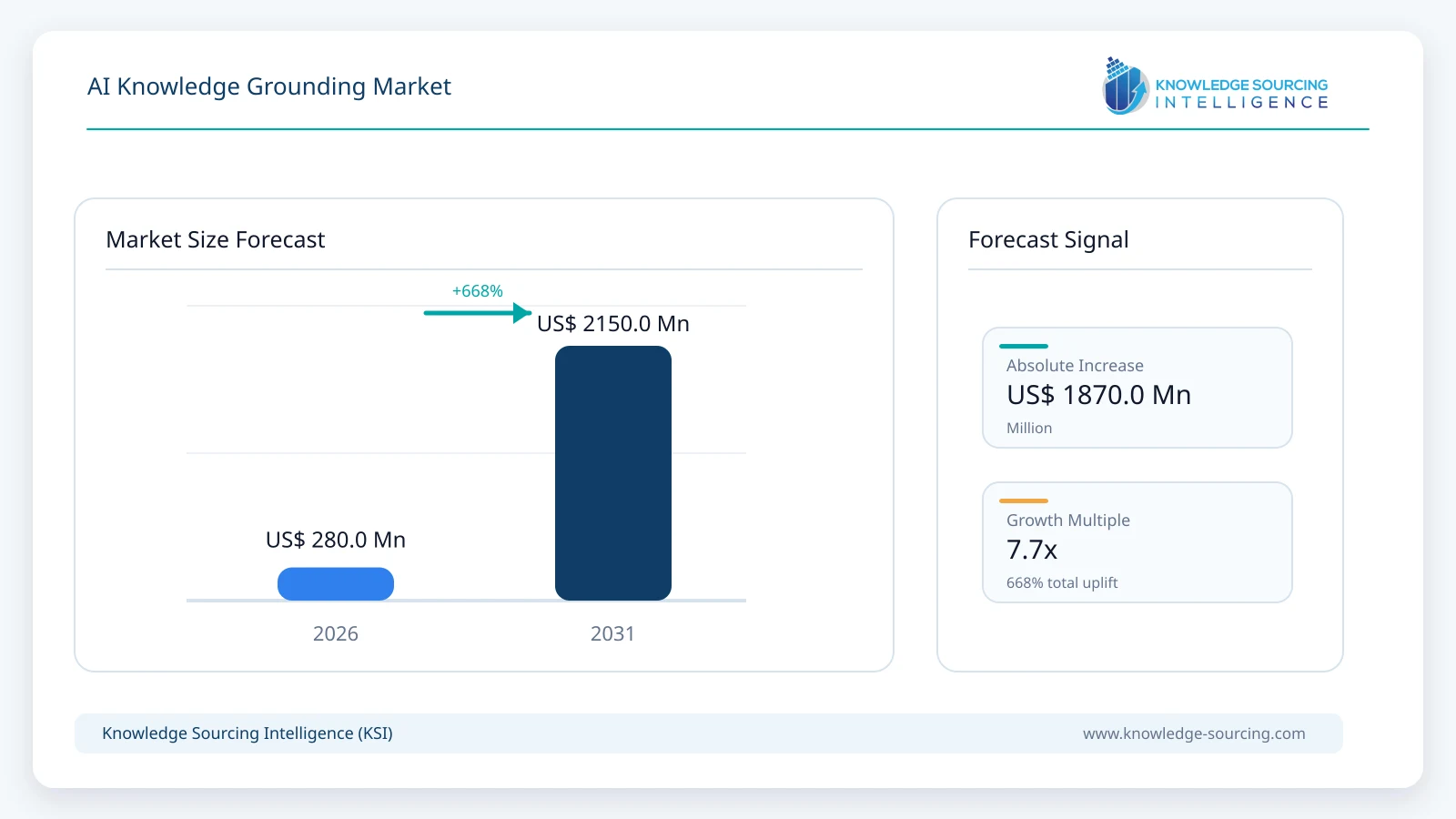
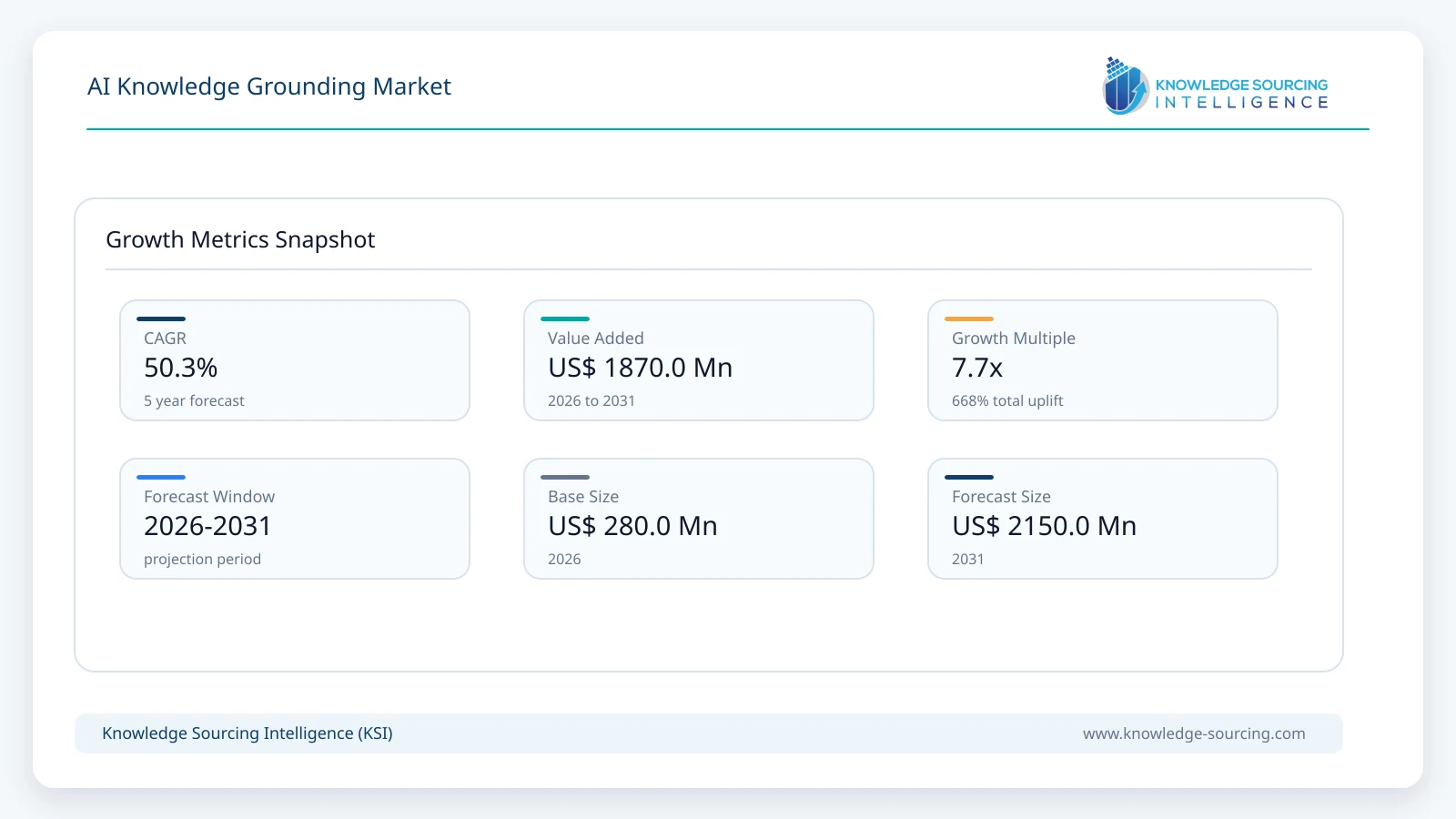
The AI Knowledge Grounding Market is set for strong momentum, surging from USD 280 million in 2026 to USD 2,150 million by 2031 an impressive compound annual growth rate (CAGR) of 50.33% during the forecast period.
Highlights:
- 1Managed grounding API usage is the largest modeled commercial stream, while citation and provenance modules provide separate enterprise monetization opportunities.
- 2Document-grounded answers lead the functional market, supported by public web, structured enterprise data and governed knowledge sources.
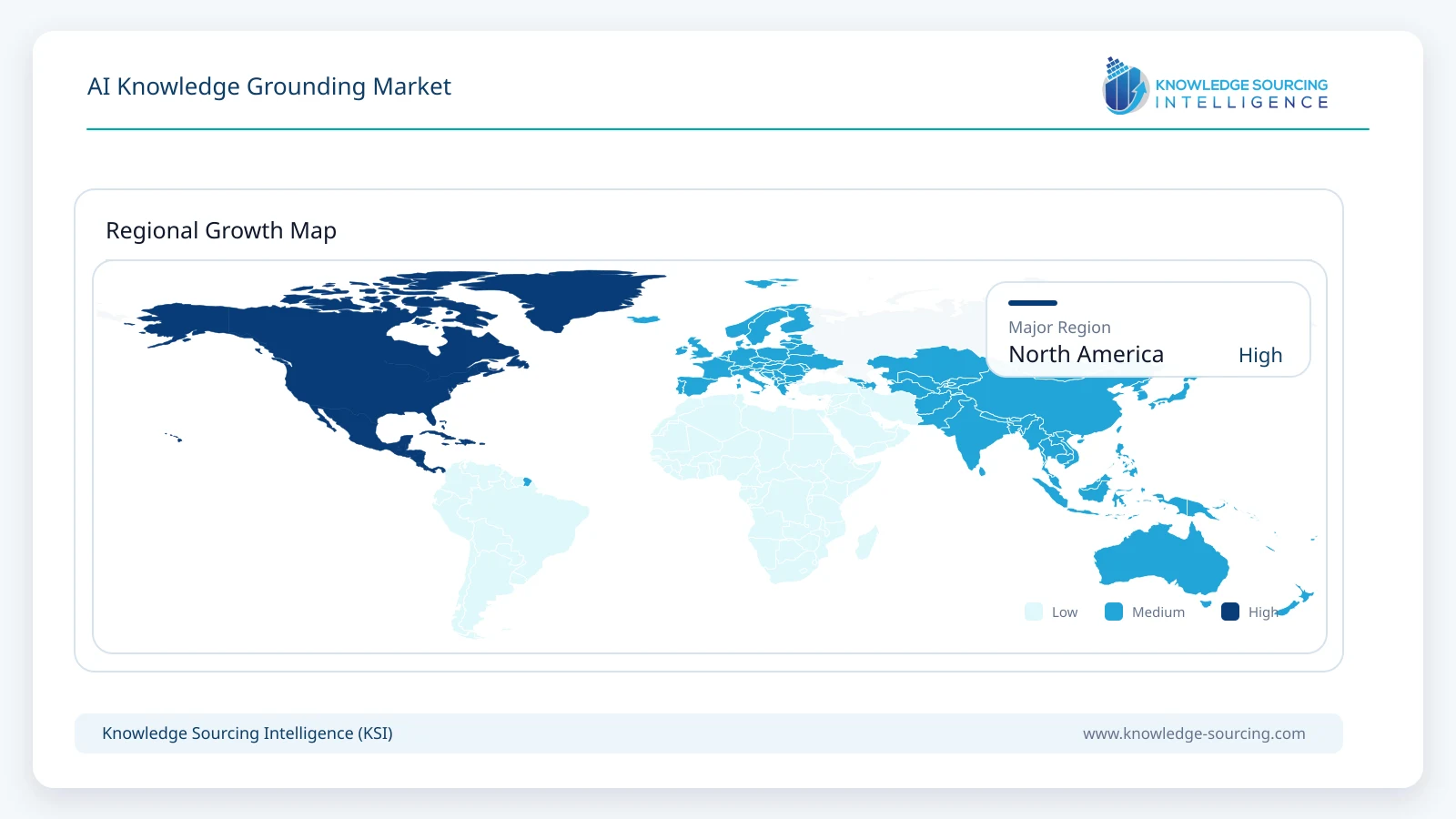
- 3North America is the largest 2026 market, while Asia Pacific is the fastest-growing region in the modeled outlook.
- 4Source provenance, access permissions and factual freshness matter increasingly as AI agents operate across multiple information systems.
- 5Banking, healthcare and enterprise research adoption support demand for governed sources, citation accuracy and current factual context.
The study covers paid grounding APIs, evidence-linked generation, citation and source-provenance modules, governed source-selection policies and dedicated domain implementations.
Knowledge grounding links generated responses with factual sources and can rely on document repositories, live web indexes, structured records and selected knowledge graphs. A grounding system may retrieve evidence, arrange it for an AI model, constrain the answer to allowed sources and return document-level or passage-level references. Grounding products differ from generic model inference, storage and independent response-testing tools through their emphasis on using trusted evidence during answer creation.
Seven independently modeled segmentations cover commercial revenue mode, grounding capability, evidence source, deployment, AI workflow, provenance control and end-user industry. The geographic model contains five regions and country allocations. The competitive environment focuses on suppliers with demonstrable evidence-grounding functionality rather than generic infrastructure firms without relevant products.
Enterprise AI applications often generate confident answers even when supporting documents are incomplete or outdated. Knowledge grounding changes the application workflow by giving the model relevant source material and preserving a link between the answer and that material.
Commercial capability has expanded across managed cloud services. Amazon Bedrock Knowledge Bases can return citations to the material used for an answer, while Bedrock Web Search connects model output to current web sources. Google Cloud exposes grounding through Search and enterprise content, and Microsoft provides source-aware enterprise agent tools.
Knowledge grounding is not identical to retrieval or fact checking. Retrieval determines which passages are relevant; grounding governs how approved evidence enters generation and how the answer is attached to its sources. Verification may subsequently test whether the answer is supported.
Market Trends
Grounded generation becomes a native model service
AI platforms are moving some grounding operations inside managed model interfaces. In August 2026, AWS added Bedrock Web Search as a built-in model tool, joining its earlier AgentCore Web Search service. Google Cloud similarly exposes several grounding paths across search, internal retrieval and enterprise sources. Native access reduces connector development but makes it important to distinguish separately billable grounding from the base inference charge.
Enterprise buyers increasingly compare provider-operated web indexes with independent retrieval pipelines. Native grounding reduces operational burden and supports citations without a separate search vendor, while third-party architectures can offer tighter domain control.
Source provenance and citation fidelity become product differentiators
Production assistants need evidence that a statement is supported by the cited document, rather than a reference appended after generation. Amazon Bedrock Knowledge Bases can return source references, while Google grounding metadata links model output to supporting search results. Enterprises benefit when citations preserve document identifiers, relevant spans and updated versions of the original source.
The strongest provenance demand is expected in workflows where reviewers must reproduce an answer. Legal research, insurance analysis, financial commentary and regulated customer support require both the answer and its evidentiary path.
Grounding connects enterprise data catalogs and structured facts
Enterprise knowledge extends beyond document paragraphs. Google Cloud described data agents grounded in its Knowledge Catalog, which gives agents business definitions and schema context when answering operational questions. This complements document grounding by letting the system use governed data definitions and structured queries instead of estimating figures from prose.
Structured grounding introduces tradeoffs between flexibility and deterministic results. Query-backed facts can be more repeatable than free-form synthesis, but they depend on semantic model definitions, permissions and the freshness of the source table.
Groundedness safeguards converge with generation-time controls
Source-backed answer generation and post-generation evidence validation are converging within platform offerings. In October 2026, AWS expanded contextual grounding checks with a Standard tier for reasoning and conversational output. Microsoft provides groundedness detection and preview correction, while NVIDIA NeMo Guardrails supports fact-checking against retrieved chunks.
The market boundary remains important because validation is not the same as grounding. A separate verification product tests the completed response, whereas the knowledge-grounding layer selects approved facts, constructs a source-bound prompt and attaches evidence to the answer.
Hybrid public and private grounding supports enterprise agents
Organizations increasingly need answers that combine current external developments with confidential organizational policy. AWS describes enterprise data and public web grounding as complementary paths, and Microsoft Foundry IQ exposes governed internal sources to agents. Hybrid systems must reconcile contradictory references without leaking private data to external tools.
This creates demand for evidence-policy modules that choose which repository may answer which question. A supplier can charge for audit trails, source precedence, consent-aware access and country-specific deployment controls.
AI Knowledge Grounding Market Segment Analysis
By Commercial Revenue Mode
Managed grounded-generation API packs
Managed grounded-generation packs are the largest exclusive commercial stream because production AI applications pay for repeat grounding calls without deploying a bespoke evidence service. The segment is estimated at USD 100.00 million in 2026 and USD 780.00 million in 2031, reflecting the expansion of production systems that require traceable, source-backed responses.
Enterprise citation modules and source-policy add-ons gain relevance as customer deployments move from experimental pilots to managed production. Dedicated installations preserve a niche for regulated operations with more complex data boundaries.
By Grounding Capability
Enterprise document-grounded answers
Grounding against internal policies, contracts and technical files has strong early demand because enterprises already hold the reference material but need models to use it consistently. The segment is estimated at USD 86.80 million in 2026 and USD 709.50 million in 2031, reflecting the expansion of production systems that require traceable, source-backed responses.
Structured-data grounding can improve decision reliability where a question requires a specific recorded fact, while citation and policy services mature alongside higher deployment volumes. Public knowledge grounding remains important for time-sensitive applications.
By Grounding Evidence Source
Enterprise documents and content repositories
Governed documents remain the leading source category, requiring reliable parsing, permissions, content refresh and stable references to support cited answers. The segment is estimated at USD 100.80 million in 2026 and USD 731.00 million in 2031, reflecting the expansion of production systems that require traceable, source-backed responses.
Public web grounding supports current events, product changes and external research. Structured enterprise sources and knowledge graphs become more important as customers integrate agents with systems of record and need precisely defined business measures.
By Deployment Model
Managed cloud grounding APIs
Managed cloud APIs lead as developers seek a relatively simple way to add citation-bearing responses and trusted source access to applications at variable usage levels. The segment is estimated at USD 120.40 million in 2026 and USD 1,010.50 million in 2031, reflecting the expansion of production systems that require traceable, source-backed responses.
Private and hybrid deployments remain commercially important for buyers with restricted data or regional requirements. Enterprise SaaS services provide a middle route when firms want governed grounding without operating their own evidence-indexing stack.
By Grounded AI Workflow
Real-time answer grounding
Real-time question answering is the principal initial workload, while multi-step agent grounding gains share as assistants make more decisions using external evidence. The segment is estimated at USD 98.00 million in 2026 and USD 666.50 million in 2031, reflecting the expansion of production systems that require traceable, source-backed responses.
Longer agent workflows increase the need to preserve why a source was selected at each decision point. Grounded summarization and data-agent applications require stricter source versioning than simple one-turn questions.
By Evidence and Provenance Control
Inline citation and source mapping
Inline citation mapping is a visible requirement for buyers who want to verify generated statements and trace each claim to supporting documents or web pages. The segment is estimated at USD 75.60 million in 2026 and USD 559.00 million in 2031, reflecting the expansion of production systems that require traceable, source-backed responses.
Policy-based filtering and claim-to-evidence alignment reduce the risk of convincing but unsupported citations. Logs and structured fact binding can create higher-value offerings in financial, healthcare and public-sector workflows.
By End-User Industry
AI software and cloud services
AI software and cloud providers are early purchasers because grounding can be embedded into many commercial assistants and offered through reusable application interfaces. The segment is estimated at USD 75.60 million in 2026 and USD 559.00 million in 2031, reflecting the expansion of production systems that require traceable, source-backed responses.
BFSI and healthcare have demanding evidence requirements, while professional services rely on source-backed research. Retail and media applications can expand usage volumes but may favor lower-cost managed packages.
Market Drivers
Enterprise demand for source-traceable answers
Enterprise assistants are moving into customer support, financial analysis and internal policy workflows where an unsupported answer can create operational cost. Grounding layers tie generated statements to permitted documents or structured records and give reviewers a route back to the evidence.
Growth of managed grounding and web-search APIs
Cloud providers increasingly expose grounded generation or live web evidence through managed APIs, reducing the work needed to integrate retrieval and citations into applications. AWS introduced native Bedrock Web Search in August 2026, while Google supports source-grounded model generation through its enterprise agent platform.
Expansion of knowledge-connected enterprise agents
Enterprise agents need factual context from systems of record, not just an isolated search result. Google Cloud described data agents grounded in enterprise catalogs in June 2026, while Microsoft Foundry IQ connects governed knowledge sources to agent workflows.
Regulated-industry evidence governance
Financial institutions, healthcare organizations and public agencies face stronger requirements to document why an AI system produced a recommendation. Permissioned evidence retrieval, approved data sources, version tracking and citation logs can support controlled deployments.
Improving source quality and citation-level evaluation
Grounded generation can still fail when retrieved passages are outdated or do not support a specific claim. Developers therefore need measurable source attribution, controlled answer generation and evaluation of citations across test sets.
Market Restraints
Bundled functionality limits incremental monetization
Several cloud platforms include basic retrieval and citations within broader knowledge-base or model services. Commercial attribution is therefore difficult, and suppliers may lower or waive dedicated fees as grounded answers become a normal platform feature.
Unreliable sources and evidence conflicts
Grounding inherits weaknesses in the underlying evidence. Duplicated policy files, stale web pages, conflicting records and low-quality document extraction can all produce misleading citations.
Latency and token-related operating costs
Grounded responses may require additional search calls, document filtering, citation formatting and claim checking before delivery. In high-volume interactive services, these stages can increase latency and per-answer costs.
Access controls and data sovereignty
Enterprise source grounding frequently crosses document repositories, databases and cloud accounts with distinct user permissions. Improperly copied passages can expose restricted information even when the final answer is accurately cited.
Citation quality does not guarantee factual correctness
A correctly formatted citation can point to a passage that is irrelevant or too weak to support the associated claim. Automated groundedness scoring also has domain, language and task limitations.
Regional Outlook
North America
North America is estimated to generate USD 127.00 million in 2026 and USD 875.00 million in 2031, representing the largest regional revenue base. The United States concentrates cloud providers, AI application vendors and buyers deploying source-backed enterprise assistants. Grounding services are especially relevant to technology, financial services, healthcare and professional research, where approved evidence must remain traceable through the answer workflow.
Regional suppliers combine native cloud grounding with enterprise-search and verification products. Buyers increasingly require access-control integration across repositories and the ability to explain why one source was preferred. Competition is therefore shifting beyond model accuracy toward permission-aware source orchestration, transparent per-call charges and reproducible citation quality.
Asia Pacific
Asia Pacific is the fastest-growing modeled region, increasing from USD 57.00 million in 2026 to USD 555.00 million in 2031. China, India, Japan and South Korea have expanding AI developer ecosystems, large digital-service populations and growing demand for multilingual enterprise information. Current-knowledge grounding and fact-backed support assistants offer adoption routes across consumer and corporate applications.
National differences in data-residency rules, languages and available cloud platforms will shape implementation. Enterprises handling sensitive records may favor country-specific repositories or hybrid evidence connectors, while application providers seek affordable managed web-grounding services. Suppliers that maintain citation accuracy across languages and protect local records can differentiate in higher-value deployments.
Competitive Landscape
The supplier landscape is led by major cloud and AI platform providers, notably AWS, Google Cloud and Microsoft, which combine knowledge retrieval with source-backed generation. NVIDIA, Cohere and Vectara support other parts of the grounding stack, while LangChain and Patronus AI offer evaluation and integration tools, while Glean, WRITER and OpenAI provide citation-backed enterprise answer workflows. These participants vary considerably in whether grounding is billed directly or offered within a broader platform.
Competition will depend on accurate citations, support for fresh and authorized data, deployment controls and predictable cost per grounded response. Cloud providers benefit from integrated model serving, while specialist companies can differentiate through independent quality measurement, domain-specific workflows and portability. Bundled retrieval and verification features will continue to make price attribution difficult for customers seeking a standalone grounding layer.
Recent Developments
October 2026: Amazon Web Services introduced the Standard tier for Bedrock Guardrails contextual grounding, extending checks to responses containing reasoning or conversational content.
October 2026: Google Cloud announced the Gemini agent at Gemini at Work, describing enterprise knowledge and governed connectors that provide context to agent responses.
August 2026: AWS made built-in Web Search generally available in Amazon Bedrock, enabling model responses grounded in current web evidence with citations.
June 2026: AWS announced general availability of AgentCore Web Search for evidence-backed agent responses through a managed search tool.
April 2026: Google Cloud described new data-agent capabilities anchored to enterprise data and governed context within its Agentic Data Cloud.
Market Outlook
AI Knowledge Grounding spending is expected to grow as enterprises require stronger evidence for AI output and more agents operate across live information sources. Managed grounded-generation services can simplify deployment for application developers, while business buyers pay more for controlled access to documents, structured facts and current external knowledge.
The market will evolve toward policy-aware grounding that preserves source identity, relevant passages and the validity of evidence through multi-step tasks. Enterprise data catalogs and governed document systems will complement web-grounding services. Suppliers offering reproducible citations, versioned sources and integration with existing permission structures are well positioned to serve regulated workloads.
Commercial expansion will remain constrained by bundled platform features, evidence quality and the cost of additional retrieval or evaluation. Buyers will increasingly compare grounding products on the percentage of claims supported by valid references and on the cost of producing a reliable answer. Clear incremental outcomes will matter more than generic claims that a model is connected to company knowledge.
AI Knowledge Grounding Market Scope:
| Report Metric | Details |
|---|---|
| Total Market Size in 2026 | USD 280 million |
| Total Market Size in 2031 | USD 2,150 million |
| Forecast Unit | USD Million |
| Growth Rate | 50.33% |
| Study Period | 2021 to 2031 |
| Historical Data | 2021 to 2024 |
| Base Year | 2025 |
| Forecast Period | 2026 – 2031 |
| Segmentation | Commercial Revenue Mode, Grounding Capability, Grounding Evidence Source, Deployment Model, Grounded AI Workflow, Evidence and Provenance Control, End-User Industry, Geography |
| Companies |
|
| Customization Scope | 15% Free Customization included with purchase — Request Custom Breakdown → |
| Sample & Data Access | PDF Sample, Excel Databook & Analyst Briefing — Download Free Sample → |
Market Segmentation
By Commercial Revenue Mode
Managed Grounded-Generation API Packs
Enterprise Citation and Provenance Modules
Evidence Governance and Source-Policy Add-ons
Dedicated Vertical Grounding Installations
By Grounding Capability
Enterprise Document-Grounded Answers
Public Web and Current-Knowledge Grounding
Structured-Data and Catalog Grounding
Citation and Claim Provenance
Source-Grounding Policy Enforcement
By Grounding Evidence Source
Enterprise Documents and Content Repositories
Public Web and Licensed Information Feeds
Structured Enterprise Databases and Catalogs
Knowledge Graphs and Metadata Sources
Multimodal and Other Sources
By Deployment Model
Managed Cloud Grounding APIs
Enterprise SaaS Grounding Layers
Dedicated Private and Hybrid Deployment
Self-Hosted and On-Premises
By Grounded AI Workflow
Real-Time Answer Grounding
Multi-Step Agent Evidence Grounding
Document Summarization and Grounded Synthesis
Enterprise Data-Agent Fact Grounding
Knowledge Assistants and Embedded Search
By Evidence and Provenance Control
Inline Citation and Source Mapping
Permission-Aware Source Selection
Claim-to-Evidence Alignment
Grounding Logs and Audit Trails
Verified Structured-Fact Binding
By End-User Industry
AI Software and Cloud Services
Banking, Financial Services and Insurance
Healthcare and Life Sciences
Professional and Business Services
Retail, Media and Consumer Applications
Government and Public Sector
Manufacturing, Telecom and Others
By Geography
North America
United States
Canada
Mexico
South America
Brazil
Argentina
Rest of South America
Europe
Germany
United Kingdom
France
Netherlands
Italy
Spain
Rest of Europe
Middle East and Africa
United Arab Emirates
Saudi Arabia
Israel
South Africa
Rest of Middle East and Africa
Asia Pacific
China
Japan
India
South Korea
Australia
Singapore
Rest of Asia Pacific
Table of Contents
1. EXECUTIVE SUMMARY
1.1. Research Highlights
1.2. Market Size and Growth Outlook, 2026–2031
1.3. Strategic Market Perspective
2. MARKET SNAPSHOT
2.1. Market Overview
2.2. Market Definition
2.3. Scope of the Study
2.4. Market Segmentation
3. BUSINESS LANDSCAPE
3.1. Market Drivers
3.1.1. Enterprise demand for source-traceable answers
3.1.2. Growth of managed grounding and web-search APIs
3.1.3. Expansion of knowledge-connected enterprise agents
3.1.4. Regulated-industry evidence governance
3.1.5. Improving source quality and citation-level evaluation
3.2. Market Restraints
3.2.1. Bundled functionality limits incremental monetization
3.2.2. Unreliable sources and evidence conflicts
3.2.3. Latency and token-related operating costs
3.2.4. Access controls and data sovereignty
3.2.5. Citation quality does not guarantee factual correctness
3.3. Market Opportunities
3.4. Porter’s Five Forces Analysis
3.5. Industry Value Chain Analysis
3.6. Policies and Regulations
3.7. Strategic Recommendations
4. TECHNOLOGICAL OUTLOOK
4.1. Document and Web Source Grounding
4.2. Citation and Passage Provenance
4.3. Structured-Data and Knowledge-Catalog Grounding
4.4. Permissions and Evidence-Policy Controls
4.5. Groundedness Evaluation and Source Freshness
5. AI KNOWLEDGE GROUNDING MARKET BY COMMERCIAL REVENUE MODE
5.1. Introduction
5.2. Managed grounded-generation API packs
5.3. Enterprise citation and provenance modules
5.4. Evidence governance and source-policy add-ons
5.5. Dedicated vertical grounding installations
6. AI KNOWLEDGE GROUNDING MARKET BY GROUNDING CAPABILITY
6.1. Introduction
6.2. Enterprise document-grounded answers
6.3. Public web and current-knowledge grounding
6.4. Structured-data and catalog grounding
6.5. Citation and claim provenance
6.6. Source-grounding policy enforcement
7. AI KNOWLEDGE GROUNDING MARKET BY GROUNDING EVIDENCE SOURCE
7.1. Introduction
7.2. Enterprise documents and content repositories
7.3. Public web and licensed information feeds
7.4. Structured enterprise databases and catalogs
7.5. Knowledge graphs and metadata sources
7.6. Multimodal and other sources
8. AI KNOWLEDGE GROUNDING MARKET BY DEPLOYMENT MODEL
8.1. Introduction
8.2. Managed cloud grounding APIs
8.3. Enterprise SaaS grounding layers
8.4. Dedicated private and hybrid deployment
8.5. Self-hosted and on-premises
9. AI KNOWLEDGE GROUNDING MARKET BY GROUNDED AI WORKFLOW
9.1. Introduction
9.2. Real-time answer grounding
9.3. Multi-step agent evidence grounding
9.4. Document summarization and grounded synthesis
9.5. Enterprise data-agent fact grounding
9.6. Knowledge assistants and embedded search
10. AI KNOWLEDGE GROUNDING MARKET BY EVIDENCE AND PROVENANCE CONTROL
10.1. Introduction
10.2. Inline citation and source mapping
10.3. Permission-aware source selection
10.4. Claim-to-evidence alignment
10.5. Grounding logs and audit trails
10.6. Verified structured-fact binding
11. AI KNOWLEDGE GROUNDING MARKET BY END-USER INDUSTRY
11.1. Introduction
11.2. AI software and cloud services
11.3. Banking, financial services and insurance
11.4. Healthcare and life sciences
11.5. Professional and business services
11.6. Retail, media and consumer applications
11.7. Government and public sector
11.8. Manufacturing, telecom and others
12. AI KNOWLEDGE GROUNDING MARKET BY GEOGRAPHY
12.1. North America
12.1.1. United States
12.1.2. Canada
12.1.3. Mexico
12.2. South America
12.2.1. Brazil
12.2.2. Argentina
12.2.3. Rest of South America
12.3. Europe
12.3.1. Germany
12.3.2. United Kingdom
12.3.3. France
12.3.4. Netherlands
12.3.5. Italy
12.3.6. Spain
12.3.7. Rest of Europe
12.4. Middle East and Africa
12.4.1. United Arab Emirates
12.4.2. Saudi Arabia
12.4.3. Israel
12.4.4. South Africa
12.4.5. Rest of Middle East and Africa
12.5. Asia Pacific
12.5.1. China
12.5.2. Japan
12.5.3. India
12.5.4. South Korea
12.5.5. Australia
12.5.6. Singapore
12.5.7. Rest of Asia Pacific
13. COMPETITIVE ENVIRONMENT AND ANALYSIS
13.1. Major Players and Strategy Analysis
13.2. Market Share Analysis
13.3. Mergers, Acquisitions, Agreements, and Collaborations
13.4. Competitive Dashboard
14. COMPANY PROFILES
14.1. Amazon Web Services
14.2. Google Cloud
14.3. Microsoft
14.4. NVIDIA
14.5. Cohere
14.6. Vectara
14.7. LangChain
14.8. Patronus AI
14.9. Glean
14.10. WRITER
14.11. OpenAI
15. APPENDIX
15.1. Currency
15.2. Assumptions
15.3. Base and Forecast Years Timeline
15.4. Key Benefits for Stakeholders
15.5. Research Methodology
15.6. Abbreviations




Frequently asked questions
What is the projected market size and growth rate for AI Knowledge Grounding?
Market projected to reach $2,150 million by 2031, with 50.33% CAGR.
Which industries are driving demand for AI Knowledge Grounding solutions?
Banking, healthcare, and enterprise research adoption support demand.
Which region currently leads the AI Knowledge Grounding market, and which is fastest-growing?
North America is largest, while Asia Pacific is the fastest-growing region.
What are the primary commercial streams for AI Knowledge Grounding?
Managed grounding API usage is the largest modeled commercial stream.
What is the core functionality of AI Knowledge Grounding?
The AI Knowledge Grounding Market links AI generated responses with trusted factual sources.
How is the AI Knowledge Grounding market segmented in the report?
Seven segmentations cover revenue, capability, sources, deployment, and industry.
Cite this report
Knowledge Sourcing Intelligence. (Oct 2026). AI Knowledge Grounding Market Size, Share & Growth Forecast (2026-2031). https://www.knowledge-sourcing.com/report/ai-knowledge-grounding-market