
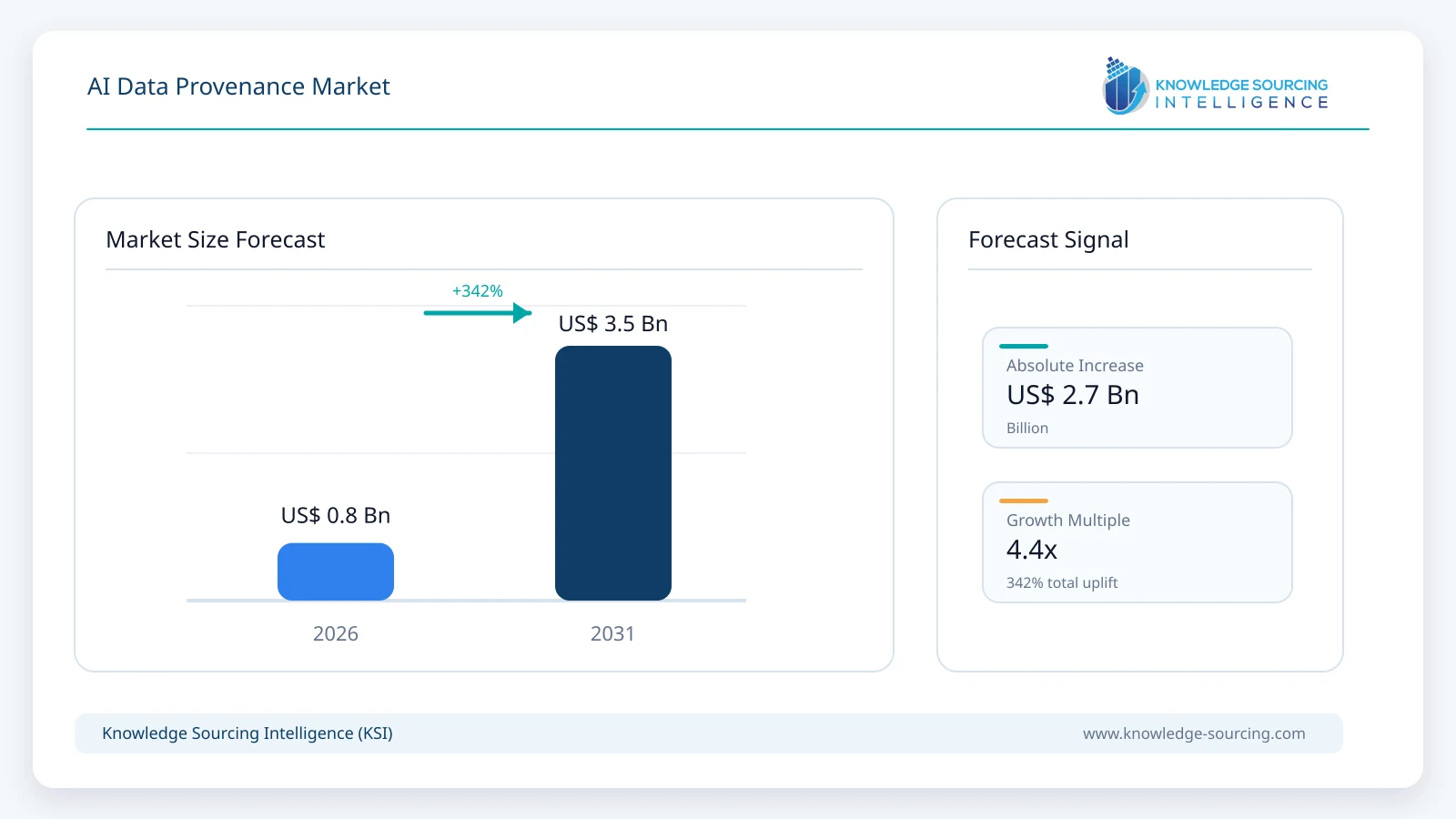
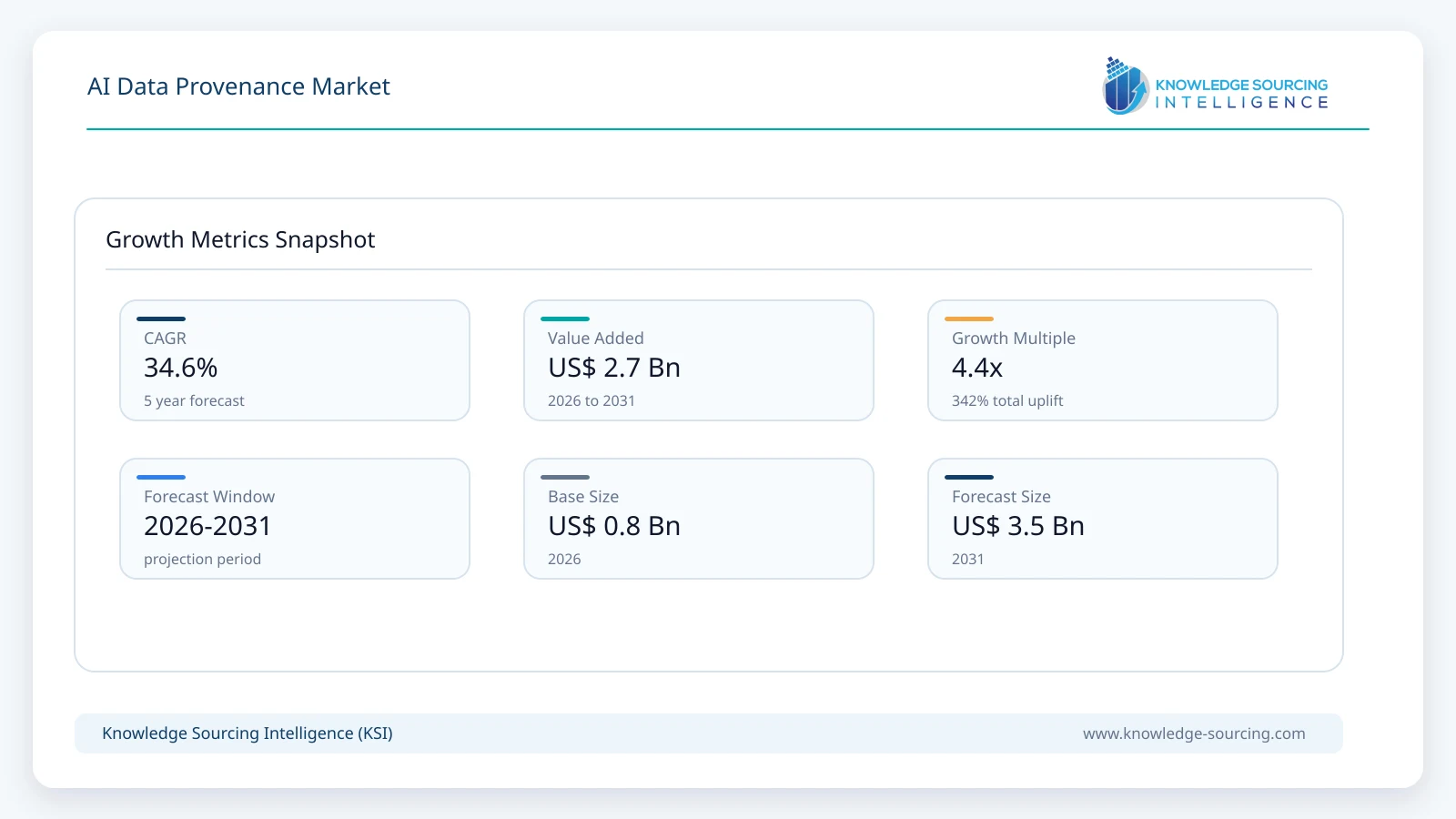
The AI Data Provenance Market is projected to grow from USD 0.78 billion in 2026 to USD 3.45 billion by 2031, at a CAGR of 34.63% during the forecast period.
Highlights:
- 1AI lineage and model-linkage platforms account for approximately 39% of market revenue in 2026, reflecting demand to connect datasets, transformations and model assets.
- 2Managed cloud services contribute around 62% of 2026 revenue as organizations favor integrated metadata capture and usage-based governance services.
- 3AI training and fine-tuning provenance represents approximately 33% of the market in 2026, supported by documentation of dataset origins and preprocessing.
- 4North America holds about 42% of global market revenue in 2026, led by large enterprise AI deployments and cloud-platform spending.
- 5Asia Pacific is expected to record the fastest regional growth to 2031 as enterprise AI deployments widen across China, India, Japan and other economies.
AI provenance records connect a data asset to its source, the transformations applied during ingestion or preparation, and the systems that eventually consume it. For model development, this may include the training dataset version, data-preparation process, feature lineage and registered model version. In retrieval-based AI applications, it can show which documents or tables supplied an answer and whether their access policies allowed the information to be used.
Databricks supports dataset-to-model lineage within Unity Catalog when training inputs are recorded through MLflow. Google Cloud Knowledge Catalog captures data lineage for supported data products and offers an API for programmatic access. The May 2026 introduction of a lineage-focused MCP interface makes it easier for AI agents to query upstream provenance and assess downstream consequences of data changes.
Enterprise metadata suppliers are expanding provenance beyond data-engineering teams. Collibra links AI governance assets to model versions and agents where platform integrations expose those relationships; Alation and Atlan connect governed definitions and lineage to AI application context. These systems are especially relevant in regulated sectors, where a model owner may have to show not only what the model produced but also where its data came from.
Market Trends
Dataset-to-Model Lineage Becomes Part of Production AI Governance
Enterprises operating several models or fine-tuned variants increasingly need a repeatable way to identify the exact data sources used for training and evaluation. Model registry entries that link to dataset versions, feature definitions and pipeline events can reduce investigation time when data quality changes or a model must be retrained.
Databricks documents registered model lineage to upstream datasets, while Amazon SageMaker maintains tracking entities for jobs, artifacts and model packages. The commercial opportunity lies in automating these records across several environments rather than keeping isolated experiment logs within each AI development team.
Provenance Is Becoming Accessible to Enterprise AI Agents
AI assistants and autonomous agents often rely on multiple enterprise systems to answer questions or make decisions. When these systems retrieve a customer record, a financial metric or an internal document, provenance metadata can help determine whether the source is current, properly governed and appropriate for the task.
Google Cloud added a data lineage remote MCP server in preview in May 2026 and introduced an agent-focused context lookup interface in June. These developments extend provenance from back-office documentation toward real-time AI application workflows, although customers still need reliable underlying metadata for the answers to be trustworthy.
Content Authenticity Adds a Distinct Provenance Use Case
Organizations publishing images, video and AI-generated media increasingly seek records showing how a digital asset was created or edited. C2PA Content Credentials provide a technical standard for attaching tamper-evident provenance assertions, while Adobe supports Content Credentials in several creative and enterprise content workflows.
Content authenticity differs from internal table lineage because it follows individual media assets and their editing histories. Its inclusion in this market is limited to paid provenance and verification capabilities; general creative software subscriptions and advertising expenditure are not attributed automatically.
Metadata Standards and Interoperability Gain Importance
Large organizations rarely run all data preparation, modeling and application activity on one platform. The gaps between cloud providers, databases, orchestration tools and model registries make metadata portability important for end-to-end investigations. OpenLineage addresses this need through standardized lineage events that can describe job inputs, outputs and execution context.
In August 2026, the OpenLineage community introduced explicit lineage facets to describe relationships with greater precision. The development supports more consistent provenance exchange, but providers must still offer useful integrations, ownership controls and audit features to support paid adoption.
AI Data Provenance Market Segment Analysis
By Offering
AI Lineage and Model-Linkage Platforms
AI lineage and model-linkage platforms lead the offering mix because enterprises need a consistent record of how data sources and transformation jobs connect to model artifacts and operational applications. The segment benefits from investments in reusable catalogs, automated lineage extraction and integrated machine learning governance.
Revenue from this offering category is projected to reach approximately USD 1.45 billion in 2031. Databricks, IBM, Google Cloud and specialist metadata vendors compete through the depth of their model integrations, cross-platform coverage and ability to produce evidence suitable for technical and governance review.
By Function
Transformation and Pipeline Lineage
Transformation and pipeline lineage is increasingly valuable as training data is cleaned, merged, labeled and reshaped across several tools before it reaches an AI model. The ability to reconstruct these changes supports quality investigations and helps data teams understand the effect of upstream corrections.
The functional segment is projected to reach approximately USD 1.00 billion in 2031. Snowflake, Microsoft Purview and OpenLineage-compatible platforms illustrate how lineage can be captured through native database features, catalog services and interoperable event records.
By Deployment
Managed Cloud Services
Managed cloud services offer automated collection of provenance metadata within data platforms and reduce the operational effort required to run specialized lineage infrastructure. Providers can monetize these capabilities through governed-asset charges, lineage processing and broader enterprise subscription packages.
The segment is forecast to reach approximately USD 2.52 billion by 2031. Google Cloud bills certain automated lineage processing through its Knowledge Catalog premium-processing model, while Microsoft Purview uses governed-asset billing for selected governance functionality.
By Application
RAG and Enterprise Agent Traceability
Retrieval-augmented generation and enterprise agents create provenance requirements extending beyond model-training records because business applications continuously consume changing documents, datasets and operational information. Technical teams need to identify which sources influenced an answer and whether the source remained permitted at the time of use.
The application is expected to generate approximately USD 1.17 billion in 2031, supported by expanding access to business knowledge through AI interfaces. Growth depends on the availability of trustworthy source-level metadata, not simply on the number of agents deployed.
Market Drivers
Production Deployment of Enterprise AI
Enterprises moving AI systems into customer operations, analytics and internal decision support must preserve a dependable connection between source records and downstream outputs. Provenance platforms give development and governance teams a common trail for investigations, model changes and approvals.
Dataset Governance and Model Documentation
Training, validation and evaluation workflows generate multiple data versions, labels and transformations that can be difficult to reconstruct after deployment. Regulatory guidance on high-risk AI data governance and model documentation strengthens the business case for source-origin records and controlled metadata.
Expansion of Multi-Cloud Data Pipelines
AI workloads increasingly use data stored across cloud platforms, warehouses, lakehouses and operational applications. As the number of transformations and handoffs grows, enterprises require lineage capabilities that cross provider boundaries rather than stopping at a single database or orchestration system.
Rising Use of Retrieval-Based AI and Agents
Enterprise agents depend on current information from document repositories, tables and workflow systems. Provenance is becoming necessary to validate the reliability and access conditions of those sources before the retrieved material influences decisions or customer-facing responses.
Greater Attention to Digital Content Authenticity
Generative image, audio and video tools are creating demand for verifiable records of asset creation and editing. C2PA-compatible credentials and enterprise verification workflows allow content owners to communicate provenance and respond to concerns about manipulated or synthetic material.
Market Restraints
Provenance Functionality Bundled into Existing Platforms
Many enterprises already receive lineage through a data warehouse, cloud catalog or governance subscription. Providers of dedicated systems must demonstrate improved coverage or controls before customers commit to a separate provenance budget, limiting monetization of functions that appear to be included elsewhere.
Incomplete Metadata Across Heterogeneous Systems
Legacy applications, unstructured files and custom data-processing code may not consistently emit source and transformation records. Missing metadata interrupts the evidence trail and can prevent buyers from obtaining the end-to-end transparency they expect from a provenance investment.
Integration and Operating Complexity
Cross-system provenance requires identity mapping, asset naming consistency, permissions and reliable ingestion of lineage events. Large customers often need specialist integration and data stewardship work before a centralized view produces operational value.
Unclear Allocation of Shared Governance Spending
AI provenance capabilities are often purchased inside larger governance or cloud agreements. This makes procurement comparisons difficult and can weaken the business case for specialist offerings when buyers cannot measure an incremental performance or compliance benefit.
Limitations of Content Credentials and Source Attestation
Provenance metadata documents information provided by participating systems but does not automatically prove that every underlying statement or content claim is correct. Metadata may be absent, deliberately stripped or incomplete, requiring complementary verification and governance processes.
Regional Outlook
North America
North America is the largest regional market for AI data provenance as the United States combines extensive cloud infrastructure, mature enterprise analytics spending and an active ecosystem of AI governance suppliers. Demand is concentrated in organizations managing sensitive operational records and large model development environments, where dataset accountability must be sustained over repeated deployment cycles.
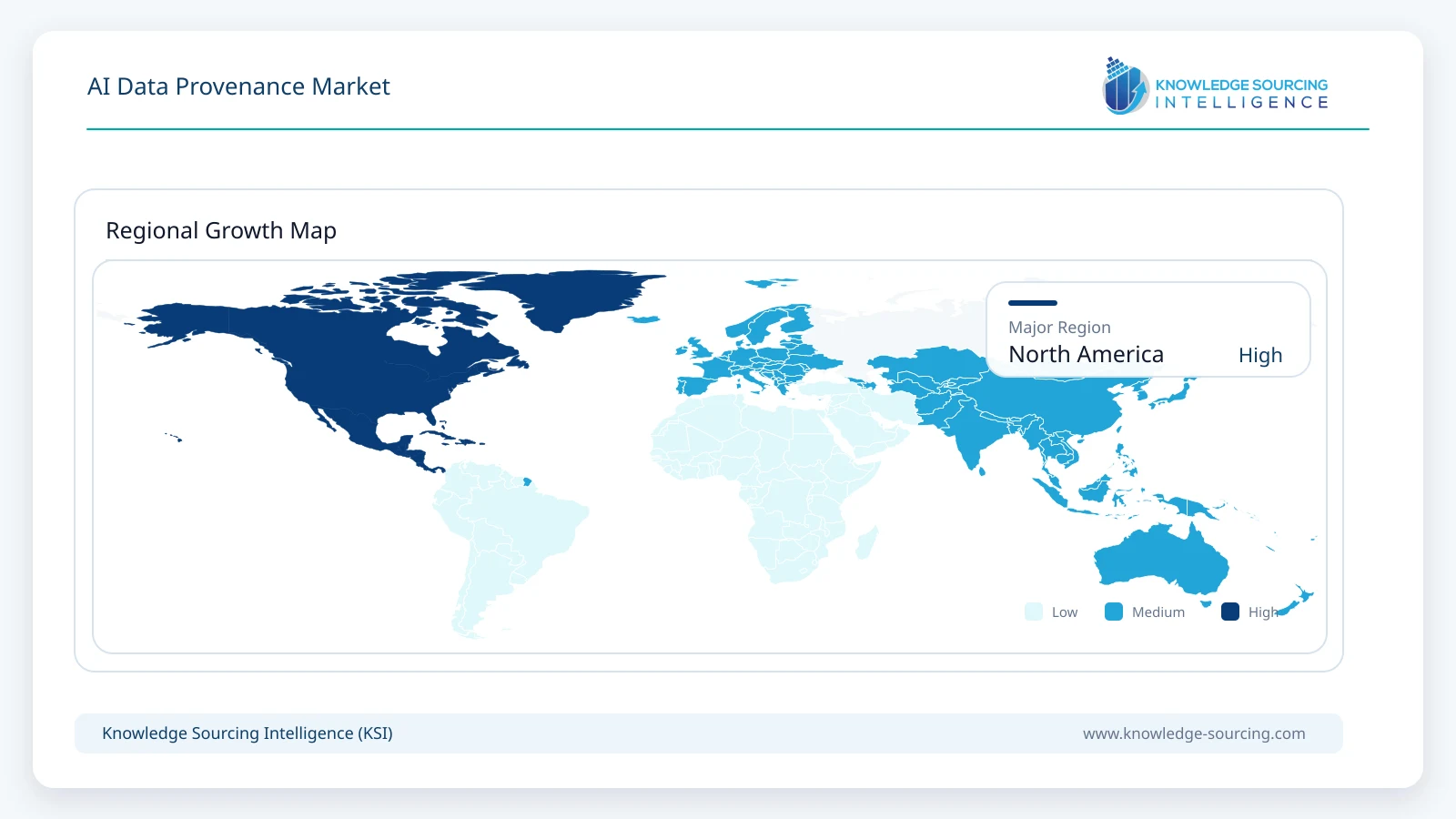
Regional market revenue is projected to reach approximately USD 1.31 billion in 2031. Databricks, Microsoft, Snowflake, Adobe and other providers support both structured-data lineage and digital content provenance, while financial services, technology and healthcare customers increase the number of AI applications requiring documented source histories.
Asia Pacific
Asia Pacific is expected to expand faster than the other major regions as China, India, Japan, South Korea, Australia and Singapore scale enterprise AI applications and connected data infrastructure. Regional demand is supported by the need to govern increasingly distributed datasets and provide consistent records across domestic and international cloud environments.
The region is projected to reach approximately USD 966 million in 2031, compared with USD 171.6 million in 2026. China and Japan maintain substantial enterprise AI and data-platform deployments, while India is expected to increase its share as software providers and large enterprises develop more governance-intensive AI applications.
Competitive Landscape
Competition combines cloud data platforms, enterprise metadata specialists and content-authenticity providers. Databricks, Google Cloud, Microsoft and Snowflake integrate provenance-related capabilities into established data-platform workflows, while Collibra, Alation, Atlan, BigID and Informatica offer cross-system governance and lineage capabilities that can serve mixed technology environments.
Commercial differentiation increasingly depends on accurate lineage extraction, model and agent coverage, source permission records, interoperable metadata standards and audit-ready evidence. Adobe participates through content-credential capabilities for digital media, while IBM connects AI and data governance through its enterprise data intelligence portfolio. Customers typically compare breadth of integration, quality of evidence and incremental operating cost rather than the presence of a lineage diagram alone.
Recent Developments
October 2026: Google Cloud announced preview self-learning context enrichment and Knowledge Studio improvements for Knowledge Catalog, expanding how stewards inspect and validate metadata used by enterprise agents.
September 2026: Alation announced six AIOS components extending governance of data, contextual definitions and AI agents across enterprise systems.
September 2026: Snowflake made stream objects visible on data-lineage graphs for Enterprise Edition customers, improving the traceability of changes through streaming pipelines.
August 2026: The OpenLineage community introduced explicit lineage facets to describe pipeline relationships more precisely and support better interoperability.
June 2026: BigID outlined data control-plane functions connecting AI usage, lineage and policy enforcement for enterprise governance.
May 2026: Google Cloud introduced a remote MCP server for data lineage in Knowledge Catalog, enabling AI applications to query provenance and downstream dependencies in preview.
Market Outlook
AI data provenance spending is expected to increase as enterprises connect more datasets to production models, retrieval services and automated agents. Software buyers are likely to prioritize cross-system evidence that can trace an AI output or model artifact to specific approved data sources and transformation histories, particularly where source data changes frequently.
Managed cloud deployments will remain important because provenance capture is often most economical when integrated with existing storage, transformation and machine learning platforms. Independent vendors will continue to compete through broader connectors, policy-aware metadata and the ability to provide one view across several competing data environments.
North America is expected to retain the largest absolute market value, while Asia Pacific records faster growth from a smaller revenue base. The balance between integrated features and separately monetized provenance products will shape supplier revenue as C2PA adoption, agent-oriented metadata access and model-to-dataset lineage capabilities develop.
AI Data Provenance Market Scope:
| Report Metric | Details |
|---|---|
| Total Market Size in 2026 | USD 0.78 billion |
| Total Market Size in 2031 | USD 3.45 billion |
| Forecast Unit | USD Billion |
| Growth Rate | 34.63% |
| Study Period | 2021 to 2031 |
| Historical Data | 2021 to 2024 |
| Base Year | 2025 |
| Forecast Period | 2026 – 2031 |
| Segmentation | Offering, Provenance Function, Deployment Model, Data Modality, Application, End User, Organization Size, Geography |
| Companies |
|
| Customization Scope | 15% Free Customization included with purchase — Request Custom Breakdown → |
| Sample & Data Access | PDF Sample, Excel Databook & Analyst Briefing — Download Free Sample → |
Market Segmentation
By Offering
AI Lineage and Model-Linkage Platforms
Provenance Metadata and Evidence Repositories
Content Authenticity and Verification Services
Implementation and Specialist Managed Services
By Provenance Function
Source and Collection Traceability
Transformation and Pipeline Lineage
Dataset-to-Model and Feature Linkage
Content Credentials and Authenticity Checks
Audit Evidence and Attestation Export
By Deployment Model
Managed Cloud Services
Self-Hosted Software
Hybrid Deployment
By Data Modality
Structured and Tabular Datasets
Text and Document Collections
Image, Video and Audio Assets
Other Multimodal and Synthetic Data
By Application
AI Training and Fine-Tuning Provenance
RAG and Enterprise Agent Traceability
Predictive ML and Feature Pipeline Lineage
AI Content Verification and Audit
By End User
Technology and Cloud Services
Banking, Financial Services and Insurance
Healthcare and Life Sciences
Retail and E-Commerce
Manufacturing and Industrial
Government and Public Services
Other Industries
By Organization Size
Large Enterprises
Medium-Sized Organizations
Small Organizations
By Geography
North America
United States
Canada
Mexico
South America
Brazil
Argentina
Rest of South America
Europe
Germany
United Kingdom
France
Italy
Spain
Netherlands
Rest of Europe
Middle East and Africa
Saudi Arabia
United Arab Emirates
South Africa
Israel
Rest of Middle East and Africa
Asia Pacific
China
Japan
India
South Korea
Australia
Singapore
Rest of Asia Pacific
Table of Contents
1. EXECUTIVE SUMMARY
1.2. Market Opportunity and Key Findings
1.3. AI Data Provenance Market Size, 2026-2031
1.4. Key Technology and Customer Trends
1.5. Regional Opportunity Summary
2. MARKET SNAPSHOT
2.1. Market Overview
2.2. Market Definition
2.3. Scope of the Study
2.4. Market Segmentation
2.5. Currency
2.6. Base and Forecast Years
3. BUSINESS LANDSCAPE
3.1. Market Drivers
3.1.1. Production Deployment of Enterprise AI
3.1.2. Dataset Governance and Model Documentation
3.1.3. Expansion of Multi-Cloud Data Pipelines
3.1.4. Rising Use of Retrieval-Based AI and Agents
3.1.5. Greater Attention to Digital Content Authenticity
3.2. Market Restraints
3.2.1. Provenance Functionality Bundled into Existing Platforms
3.2.2. Incomplete Metadata Across Heterogeneous Systems
3.2.3. Integration and Operating Complexity
3.2.4. Unclear Allocation of Shared Governance Spending
3.2.5. Limitations of Content Credentials and Source Attestation
3.3. Market Opportunities
3.4. Porter’s Five Forces Analysis
3.5. Industry Value Chain Analysis
3.6. Policies and Regulations
3.7. Strategic Recommendations
4. TECHNOLOGICAL OUTLOOK
4.1. AI Dataset Origin and Version Tracking
4.2. Transformation and Feature Lineage
4.3. Model and Agent Data Dependencies
4.4. Cryptographic Content Credentials
4.5. Open Metadata and Lineage Standards
4.6. Automated Audit Evidence and Attestation
5. AI DATA PROVENANCE MARKET BY OFFERING
5.1. Introduction
5.2. AI lineage and model-linkage platforms
5.3. Provenance metadata and evidence repositories
5.4. Content authenticity and verification services
5.5. Implementation and specialist managed services
6. AI DATA PROVENANCE MARKET BY PROVENANCE FUNCTION
6.1. Introduction
6.2. Source and collection traceability
6.3. Transformation and pipeline lineage
6.4. Dataset-to-model and feature linkage
6.5. Content credentials and authenticity checks
6.6. Audit evidence and attestation export
7. AI DATA PROVENANCE MARKET BY DEPLOYMENT MODEL
7.1. Introduction
7.2. Managed cloud services
7.3. Self-hosted software
7.4. Hybrid deployment
8. AI DATA PROVENANCE MARKET BY DATA MODALITY
8.1. Introduction
8.2. Structured and tabular datasets
8.3. Text and document collections
8.4. Image, video and audio assets
8.5. Other multimodal and synthetic data
9. AI DATA PROVENANCE MARKET BY APPLICATION
9.1. Introduction
9.2. AI training and fine-tuning provenance
9.3. RAG and enterprise agent traceability
9.4. Predictive ML and feature pipeline lineage
9.5. AI content verification and audit
10. AI DATA PROVENANCE MARKET BY END USER
10.1. Introduction
10.2. Technology and cloud services
10.3. Banking, financial services and insurance
10.4. Healthcare and life sciences
10.5. Retail and e-commerce
10.6. Manufacturing and industrial
10.7. Government and public services
10.8. Other industries
11. AI DATA PROVENANCE MARKET BY ORGANIZATION SIZE
11.1. Introduction
11.2. Large enterprises
11.3. Medium-sized organizations
11.4. Small organizations
12. AI DATA PROVENANCE MARKET BY GEOGRAPHY
12.1. North America
12.1.1. United States
12.1.2. Canada
12.1.3. Mexico
12.2. South America
12.2.1. Brazil
12.2.2. Argentina
12.2.3. Rest of South America
12.3. Europe
12.3.1. Germany
12.3.2. United Kingdom
12.3.3. France
12.3.4. Italy
12.3.5. Spain
12.3.6. Netherlands
12.3.7. Rest of Europe
12.4. Middle East and Africa
12.4.1. Saudi Arabia
12.4.2. United Arab Emirates
12.4.3. South Africa
12.4.4. Israel
12.4.5. Rest of Middle East and Africa
12.5. Asia Pacific
12.5.1. China
12.5.2. Japan
12.5.3. India
12.5.4. South Korea
12.5.5. Australia
12.5.6. Singapore
12.5.7. Rest of Asia Pacific
13. COMPETITIVE ENVIRONMENT AND ANALYSIS
13.1. Major Players and Strategy Analysis
13.2. Market Share Analysis
13.3. Mergers, Acquisitions, Agreements, and Collaborations
13.4. Competitive Dashboard
14. COMPANY PROFILES
14.1. Microsoft Corporation
14.2. Databricks, Inc.
14.3. Snowflake Inc.
14.4. Google LLC
14.5. International Business Machines Corporation
14.6. Collibra
14.7. Alation, Inc.
14.8. Atlan
14.9. BigID
14.10. Amazon Web Services, Inc.
14.11. Adobe Inc.
14.12. Informatica
15. APPENDIX
15.1. Research Methodology
15.2. Data Sources
15.3. Definitions and Abbreviations





Frequently asked questions
What is the projected AI Data Provenance market size by 2031?
The AI Data Provenance Market is projected to reach USD 3.45 billion by 2031.
What is the CAGR for the AI Data Provenance market (2026-2031)?
The AI Data Provenance Market is expected to grow at a 34.63% CAGR.
Which region holds the largest AI Data Provenance market share in 2026?
North America holds 42% of global market revenue in 2026.
Which segment contributes most to 2026 AI Data Provenance market revenue?
Managed cloud services contribute around 62% of 2026 revenue.
What is the fastest-growing region for AI Data Provenance by 2031?
Asia Pacific is expected to record the fastest regional growth.
What key trend drives the AI Data Provenance market?
Dataset-to-Model Lineage is becoming part of production AI governance.
Cite this report
Knowledge Sourcing Intelligence. (Oct 2026). AI Data Provenance Market Size, Share & Growth Forecast (2026-2031). https://www.knowledge-sourcing.com/report/ai-data-provenance-market